
GETTING MORE TALE #492: The Golden Records
In 1977, two unique records were pressed that are literally out of this world.
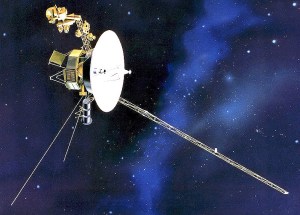 The Voyager space probes (1 and 2) were designed for exploration of our outer solar system. Never to return, the probes were built for the “Grand Planetary Tour”: a rare alignment of the outer planets that allowed the probes to use gravity to slingshot around and visit them all. The Voyager spacecraft transmitted to Earth some of the most breathtaking images ever taken. For the first time, Saturn’s rings could be seen up close, and surprised us with more layers and complexity (including the ‘F’ ring that is kinked) than anyone anticipated. Jupiter’s Great Red Spot was discovered to be a gargantuan storm, three Earths wide!
Although the probes were not really intended for long term scientific observations beyond their initial missions, their plutonium generators will continue to provide power for another decade. Clever scientists have managed to use the probes’ limited sensors to observe what goes on at the edge of the solar system. Both probes are now well on their way out of our home system, and into interstellar space. Once their generators die, they will go silent forever. They are now the furthest man-made objects from the Earth and will remain so forever, unless we find the money to invest further in deep space exploration.
Even when the Voyager probes finally go dark forever, their mission will still be ongoing. Both Voyagers were equipped with special antiquated technology that can tell alien civilizations a little bit about the troubled species that launched these probes in the first place. If an alien race ever finds our probes (the fictional Voyager 6 was found by a machine race in Star Trek I) then they will find the Golden Records.
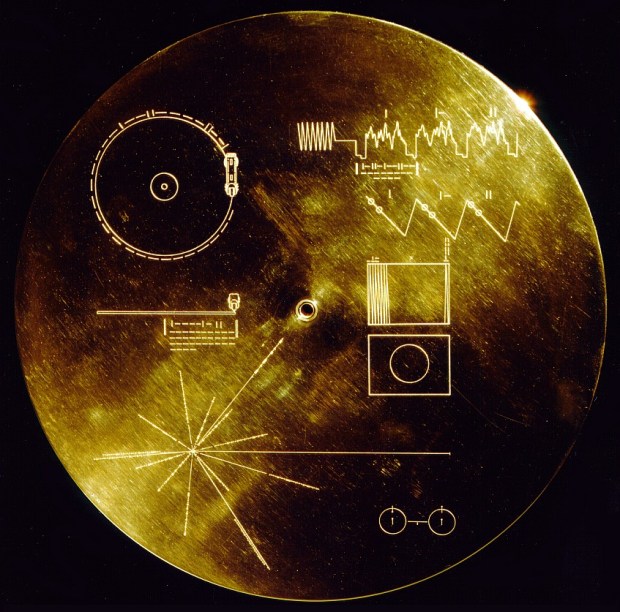
The Golden Records, surely the most priceless LPs in the universe, contain a wealth of information selected by a committee headed by the late Dr. Carl Sagan. Each record is encased in a gold sleeve. Included is a visual depiction of how to play the record, an easy task for an advanced race. Extracting sound from the grooves should be a simple process given the instructions. The needle and cartridge are already included. The records are made copper, plated in gold, one of the most corrosion resistant materials known to man.
What is included on the records? A variety of audio for one, designed to give a glimpse into human culture. First is a greeting in 55 Earth languages. Then, there are “Sounds of Earth”: birds, dogs, frogs, cars and trains, and more. Most interesting to music fans is the selection of compositions from around the world. There are 90 minutes of different pieces, including Chuck Berry’s “Johnny B. Goode” (USA), Bach’s Brandenburg Concerto (Germany), jazz and blues, and many kinds of world music. (The records are designed to be played at 16⅔ revolutions per minutes, enabling a longer play time.) In a classic example of record company stupidity, the Beatles were excluded from the golden LPs, because EMI wouldn’t let NASA use “Here Comes the Sun”. Perhaps they were afraid aliens would bootleg it without paying for it. (This serves as a fine case of EMI standing for “Every Mistake Imaginable”, as some artists refer to them.) After the music is an hour of brain wave recordings, of Carl Sagan’s wife Ann Druyan.
There are even 116 images encoded on the disc. Some of these are intended to help with calibration and interpretation. The rest are images of Earth: DNA strings, children, families, landscapes, animals, houses, cities, spacecraft and more. Tellingly, there are no images of one of human-kind’s most popular activities: warfare. Only good impressions were wanted, meaning the Voyager Records contain much false advertising. The images are encoded in the form of 512 vertical lines, in colour and black and white.
What if one wanted to listen to the rarest records in the universe? What to do then? Last year, NASA uploaded the audio contents of the records to SoundCloud. Now anyone on Earth with an internet connection and speakers can hear the greetings that we sent to the stars in 1977. Hopefully one day, someone else from another world will be able to listen as well.
Click here for the NASA SoundCloud page, and scroll down for the Voyager recordings!

 mikeladano.com
Enjoyed this very much indeed, Mike. Haven’t thought about those ‘albums’ since watching Star Trek I !
LikeLiked by 1 person
Thanks sir!
V’Ger did not understand us carbon units. Especially Kirk Unit.
LikeLiked by 2 people
I wish the Kiss Mother and Child was an unreleased song.
I clicked the.link and only found the greetings, and sounds but no music. :(
LikeLiked by 2 people
Dang…I wonder if they couldn’t include that for copyright reasons. Ah well at least you get the other interesting stuff.
As I was saying to Aaron, I was very lucky that my dad had me watching Carl Sagan’s Cosmos from a very young age.
LikeLike
I think I heard that one of the Voyagers left our solar system recently. It is now officially in interstellar space.
LikeLike
Man this is an AWESOME idea for a post! I read all about these ages ago, I’m so glad you reminded me of them.
As for them ever being found? I refer you to Calvin And Hobbes, where it’s stated “Sometimes I think the surest sign that intelligent life exists elsewhere in the universe is that none of it has tried to contact us.”
LikeLiked by 3 people
Thank you Aaron! As I said to Sean, it was his history blog that inspired me to look for stuff like this to talk bout. Plus I have been fascinated with the Voyager probes since I was a kid. My dad opened up the newspaper, probably the Globe and Mail, and showed me these huge (b&w) pictures of Saturn. Telling me all these new discoveries. I have my dad 100% to thank for my interest in these things.
LikeLike
My Dad too! He’s a scientist by training, (retired) teacher by profession. He LOVES stuff like that. I remember watching Cosmos.
Did I ever tell you I got the 4-DVD updated Cosmos for under $10 brand new? Haha. Great days.
LikeLiked by 1 person
Yes I think you texted me that. What a crazy deal! Jen bought the set for my birthday one year.
LikeLike
Fascinating story! Great article.
LikeLiked by 1 person
Thank you Sean. Your blog actually inspired me to write this! I love your historic tales.
LikeLiked by 1 person
Great post! I had completely forgotten about those records. The whole thought that something out there could ever hear those records is fascinating to me.
LikeLike
Great post, Mike. Completely forgot about man’s reaching out to alien life with the map of Earth and civilisation. If only Gaius Baltar stopped at music, huh …
LikeLiked by 1 person
Thank’s J. Yeah, good old Dr. Baltar. The character you love to hate.
Another fascinating “reach out” to space is the Arecibo message, which I’ve mentioned here before!
LikeLiked by 1 person
I hope they didn’t send The Darkness into space ;)
LikeLike
Great post! You made me think of the 1984 film “Star Man” starring Jeff Bridges and Karen Allen. It is about Voyageur 1 going off into space and an alien planet discovering it and visiting Earth. Good film.
LikeLike
I still can’t believe they never included the first Faster Pussycat LP on Voyager – dorks!
LikeLike
You may want to Taime Down your comment.
LikeLiked by 1 person
(Groans)
Carl Sagan was much more of a Roxx Gang fan apparently, so he vetoed the idea.
LikeLiked by 1 person
From what I’ve read they have a few from Sebastian Bach, although for some reason his name is shortened to just Bach.
LikeLiked by 1 person
Haha. That’ll be down to Professor Stephen Hawking – he was a massive Skid Row fan, back in the day.
LikeLiked by 1 person
“18 & Life”, if you really pay attention to the words, is actually a song refuting the theory of Relativity.
LikeLiked by 1 person
I know, I know!! You try telling most people that and they just look at you funny. I heard that Hawking wrote the lyrics (uncredited) for ‘Makin A Mess’.
LikeLiked by 1 person
Very good — few people know that. I’ll include that and the whole Skid Row/CIA incident that got them signed to Jon Bon Jovi’s label in 88, when I eventually do that review.
LikeLiked by 1 person
I believe it started when Shakespeare wrote:
‘I doth tell you man, there is something you ought to know.
Stratford-upon-Avon leadeth to Skid Row.’
LikeLiked by 1 person
I did one of those lol things then!
LikeLike
Great post.
LikeLiked by 1 person
Hey thank you!!
LikeLike