Part 10 of my series of Iron Maiden reviews! Although this book came out in 2010, I decided to talk about Paul Di’Anno during the 1987 period, when Paul released his Paul Di’Anno’s Battlezone album, Children of Madness. This was the first time I heard any of Paul’s post-Maiden music.
PAUL DI’ANNO – The Beast (2010 John Black Publishing)
Paul Di’Anno, when not in jail for assault or disability fraud, is in a state of perpetual arrested development. Scattered among the cool rock stories about touring with Kiss and rocking the stage aside Steve Harris, Di’Anno is like a little boy who will never learn his lesson. Girlfriend after girlfriend, fight after fight, arrest after arrest, Di’Anno never seems to grow up. As if an apology makes up for it, he says he is “deeply ashamed of” a drunken incident when he repeatedly pummeled a woman half his size in the face. Di’Anno states that ,”if I could turn back the clock, I would,” but he also admits that it wasn’t the first time it happened.
Paul continues to snort and drink everything that passes his way, while bedding every “bird” and smashing every bloke that gets in his way. In the meantime, there’s this story in the background about this band he was in called Iron Maiden. He talks about singing Deep Purple’s “Dealer” and “All Right Now” by Free at his audition. He describes the feeling of helping to build this band, and it sounds like being in the center of a tornado. It doesn’t take long for fame to have its effect in a negative way.
Only two albums in, Paul sheds some light on his departure. There were musical differences as he did not like the polished, more progressive direction that the band was seeking. His heart was no longer in it, and he knew it. This seems to have manifested itself in bad behaviour, and deteriorating relationships. After a final gig in Copenhagen, Paul handed in his resignation. While he has nothing bad to say about the guy who replaced him, he has special praise for Adrian Smith, “the best all around guitarist that Maiden have had.”
I just wish this book was more about the music and less about the drinking, drugs, and fighting. It doesn’t take too long to realize that Paul Di’Anno isn’t much for self-improvement. He tells his story with several winks and smiles, and lots of laughs too. At this same time this there’s dark undercurrent of violence and underachievement.
The Beast isn’t what I’d call an inspiring read, but it’s raw and real. The man has loads of stories. Whether they’re your cup of tea is really up to you!
IRON MAIDEN –Â Somewhere In Time (1986, 1996 bonus CD)
After the yearlong World Slavery Tour, to hear it told by Steve Harris, lead singer Bruce Dickinson had “lost the plot”.  Bruce on the other hand felt that the next album should be a game changer:  their Physical Graffiti.  But burned out from the road, all he brought to the table were some acoustic tunes which were all rejected. According Steve Harris, it wasn’t so much that the songs were acoustic.  It was because they weren’t very good.  This was the first time Bruce didn’t get a writing credit since The Number of the Beast!  And instead of Physical Graffiti, Bruce said that they “just made another Iron Maiden album.”
Bruce and Janick Gers acoustic, 1990
In spite of the lack of Bruce songs,  Steve, Adrian Smith and even Dave Murray came in with enough songs for an album.  They also came in with synthesizers for the first time.  All three were credited with guitar or bass synth on Somewhere In Time, a sound that threw some of us for a loop.  Also for the first time, Adrian would take sole writing credits on several Maiden songs (lyrics, music and all) which lent his more melodic bent to the resulting album.
The production, again by Martin Birch, was paradoxically both cold, and warm. Â It’s a chilly sounding album, but the synths actually bring some warmth back to it. Â Unfortunately there isn’t as much guitar grit as before, everything sounding smoothed out.
“Caught Somewhere In Time”, the excellent opener, starts right off the bat with synth; Maiden were laying their cards on the table. Â The gallop is still there and Steve still drives the Beast forward withi his bass. Â The synth doesn’t really detract from it. Â It is plenty riffy, and Bruce’s voice soars with the excellent chorus. Â This is a Maiden rocker to sing along to.
Adrian contributed the first of the two singles:  “Wasted Years”.  This classic song was my introduction to the new Maiden sound, since it came out a bit before the album was available.  Not only was the video great (black and white footage of the band rehearsing with collages of Eddies and tour photos) but the song was also great.  This is definitely hard rock Maiden, the kind of thing that made good Maiden singles, like “Flight of Icarus”.  The lyrics, also by Adrian, are clearly about the road life and I’m sure Bruce could pour his heart into the words.
Two lacklustre songs follow: Â “Sea Of Madness” and “Heaven Can Wait”. Â Neither song have ever really blown me away, but at the same time “Heaven Can Wait” turned into a tour classic for many years so what do I know? Â It was the traditional concert spot for the crowd to sing along. Â Smith contributed “Sea of Madness”, while Steve wrote “Heaven Can Wait”. Â I do like the slow part in the middle of “Sea of Madness”, with its nice solo.
That ended side one.  Side two started with “The Loneliness of the Long Distance Runner”, one of Steve’s longer songs.  It was based on a short story of the same name, and I have to admit that lyrically it’s not one of those Maiden songs that really has me waiting to sing the next line.  The choruses are pretty straightforward:  “Run, on and on.  Ru-uu-un, on and on.  The loneliness of the long distance runner.”  The synth in this song is effective although the song is arguably filler.
(Of note:  The intro portion of this song would really serve as a blueprint for many many Maiden songs to come.  You know the kind:  Steve’s rinky-dinky-rink bass, backing a mellow guitar melody, with mild synth in the background.  “Fear of the Dark”, starting 30 seconds in, is similar.  “Mother Russia”, 30 seconds in.  Most of  The X Factor.  And so on.)
The excellent “Stranger In A Strange Land” follows, the third of Adrian’s writing contributions. Â This was the second single, and a good choice it was. Â A catchy mid-tempo song, it took advantage of the textures of the new synths effectively. Â I’ve read in the past that it’s based on Stranger In A Strange Land by Heinlein, but I fail to see the connection. Â I always felt it may as well be about the 1984 film, Iceman. Â The lyrics fit.
“Stranger” was also host to another excellent Adrian guitar solo. Â It was around this time that I bought a white guitar simply because Adrian played one in the video! Â And yes, the video was an excellent summation of their stage show, with giant inflatable Eddie coming out of the stage!
Steve and Davey’s “Deja-Vu” is up next, and I have always loved this one.  It’s the only song under five minutes, and it has a furiously fast pace.  The synths take a bit of the edge off, but this one is irresistible
But alas, we are now at the end: Â The 8th and final song is yet another Steve Harris epic album closer. Â This time the topic he chose was “Alexander the Great”. Â Another historical topic for me to devour! Â I later majored in history. Â I wonder how much of that was due to my two greatest influences? Â My dad, and Iron Maiden?
“Alexander the Great” has been criticized by some as being a lesser epic.  I really don’t know.  At this point you’re into splitting hairs.  Who cares?  It’s still awesome.  Maybe you don’t like it as much as “Ancient Mariner”; maybe you prefer “Fear Of the Dark”.  It doesn’t matter:  It’s a Steve epic and that means fast parts, slow parts, different tempos and riffs.  And through it all Bruce manages to spit out the tricky lyrics:
A Phrygian king had bound a chariot yoke
And Alexander cut the ‘Gordian Knot’
And the legend said that who untied the knot
He would become the master of Asia
The choruses are awesome, and I consider this to be one of Maiden’s lesser-known triumphs.
And what about that album cover? Â Absolutely my favourite Maiden cover of all time, look for all kinds of hidden messages. Â What time is it again? Â Oh yeah…
I imagined that after Eddie’s resurrection on Live After Death, he had emerged some time in the future (around the time period of Blade Runner, it appears) and gotten himself some cybernetic enhancements. Â The cover is, in essence, an updated take on Killers. Â Emerging from his Spinner, Eddie’s traded in his hatchet for a laser. Â On the back, you can see the members of Maiden themselves witnessing Eddie’s deed. Â Notice Nicko’s goggles? Â He’d just got his pilot’s license!
The artwork for the singles were equally awesome: Â On “Wasted Years”, we see Eddie travelling back in time to 1986…chasing the T.A.R.D.I.S.? Â Its B-sides were excellent! Â As far as B-side material goes, these were two of the best. Â “Reach Out” was a rare thing: Â A song written by an outside writer, Adrian’s buddy Dave “Bucket” Colwell who would later end up in Bad Company. Â Perhaps even more astonishing was the lead vocalist: Â Adrian Smith! Â Martin Birch compared it to Bryan Adams-type rock, but fear not! Bruce shows up by chorus-time to blow you away with his wail, as he answers Adrian’s lines. Â Pure awesome in a nice sweet hard rock package.
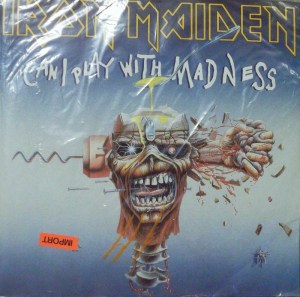
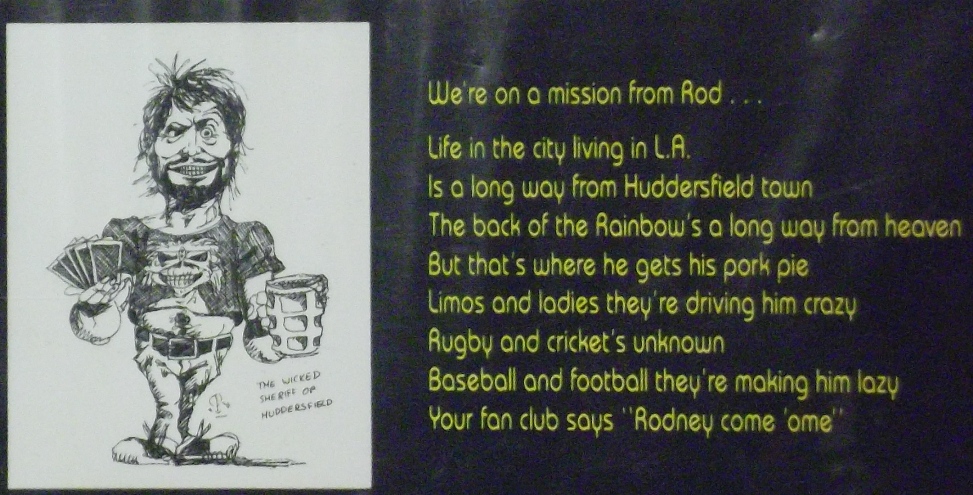
Then there was “The Sheriff of Huddersfield”, a not-very-complimentary roast of Maiden manager Rod Smallwood! Â “‘Rufus the Red’ has a crane by his bed, to wrench himself up in morn’, but if you dare to tread at the foot of his bed, you’ll wish you’d never been born!” Â Not a great song, it’s still pretty damn funny. Â Rodney, it seems, had fallen for the L.A. lifestyle and the band were not beyond giving him a hard time about it!
The “Stranger In A Strange Land” single had even cooler artwork: Â Eddie entering a space bar full of space-scum and villainy! Â Looking like a cross between Harrison Ford’s Deckard, and Clint Eastwood’s “Man With No Name”, Eddie ignores their stares. Â This might be my favourite Maiden single art of all time. Â (Of ALL time, Kanye!)
Its B-sides were two covers: Â “That Girl” (FM) and “Juanita” (Marshall Fury). Â “That Girl” is a pretty good hard rock song, very much in line with a song like “Reach Out”. Â I never liked “Juanita” much though.
Don’t worry – Maiden’s arrangement is nothing like this! Â Makes you wonder why they covered it though.
I have a real soft spot in my metal heart for Somewhere In Time. Â Although it sags a bit in the middle, and it’s toned-down Maiden, this is still one of my personal favourites. Â It came out when I first started high school, and you can’t compete with nostalgia. Â Although today many consider inferior to the albums that came before and the album that came after, I have to rate it pretty high.
IRON MAIDENÂ – Live After Death (1985, 1996 bonus CD, 1998 remastered edition)
…We shall go on to the end.  We shall fight in France, we shall fight on the seas and oceans, we shall fight with growing confidence and growing strength in the air, we shall defend our Island, whatever the cost may be. We shall fight on the beaches, we shall fight on the landing grounds, we shall fight in the fields and in the streets, we shall fight in the hills; we shall never surrender!
With that dramatic, adrenaline pumping speech from Winston Churchill, Iron Maiden hit the stage, careening across the boards ripping to shreds the opening riff to “Aces High”, guitars cranked and perfectly captured by producer Martin “Live Animal” Birch! Live After Death may be the perfect live metal album. Running over a mammoth 100 minutes (on LP anyway), it required specially skilled engineers to cut the vinyl, so long were the records!
I have played this album so many times I could review it in my sleep. I own three copies of it, each one for its own reasons (more on that later). Iron Maiden could very well have released this album and retired, and their place in metal history would have been secured. Great value for the price of a double live album, this was at the time one of the longest double live albums ever released, with not one second of precious vinyl wasted. The package was loaded with photos and text.
Inside the gatefold
Recorded in Long Beach, California (you can tell by Bruce’s incessant shouting, “Scream for me, Long Beach!”) and the Hammersmith Odeon, the crowds are absolutely nuts for Maiden. This is one of the best recorded live metal albums of all time, thanks to Birch. The crowd is loud, the band is clear, and the harmony vocals of Adrian and Steve are perfectly audible. I’m certain there’s overdubs on those backing vocals, they’re too perfect. Whatever. Do I like the album? Hell yeah.
There are some tunes here that you don’t hear live very often, such as “Die With Your Boots On” and the 14 minute epic “Rime of the Ancient Mariner” (made even better with Bruce’s intro: “This is about what not to do if a bird shits on you!”). “Powerslave” is as powerful and dramatic as the original album version, glorious solo intact. There are a handful of key Di’Anno-era tracks, such as the single “Running Free”, the growling “Wrathchild”, and the band’s early opus, “Phantom of the Opera”. Indeed, this album is worth buying for “Phantom” alone, so rarely is this played. As for “Running Free”, this may now be the definitive version of that song.
(Note: the cassette version of the album edited out the long Bruce/crowd interplay.)
Here’s the three versions I own, and why:
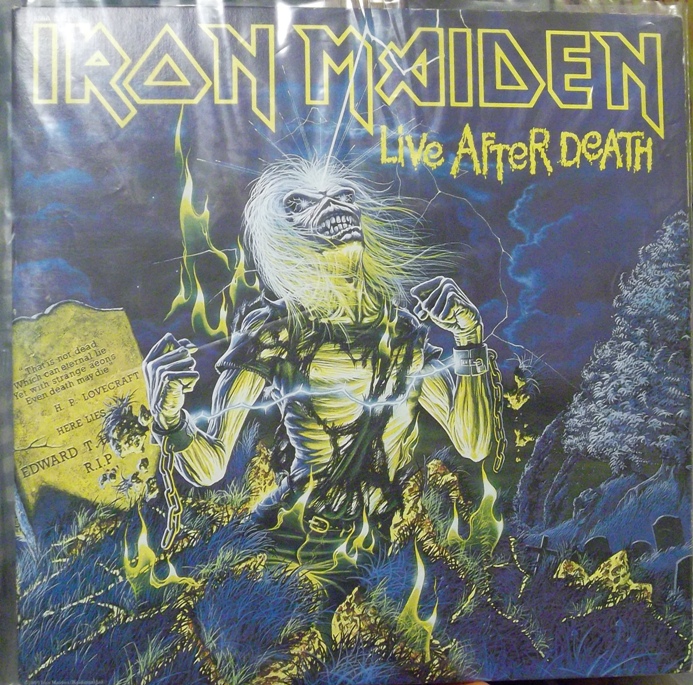
1. Vinyl. This was what I bought back in 1985 (my first Maiden LP), and I still have it. The original vinyl was a gatefold sleeve enabling you to read all the hidden messages on the tombstones.  “Letit R.I.P.” was my favourite. Inside, the album unfolds with two fully coloured photo record sleeves and a generous booklet with liner notes from Birch and a complete list of every date on the tour. Also amusing was a list of everything they went through on tour, from guitar strings to cans of beer.
2. The 1998 remastered CD edition. The original CD releases everywhere were only one single disc, and comprised only the first three sides of vinyl, ending after “Running Free”. This CD version restores side 4 on a second CD, which included “Phantom” and “22 Acacia Avenue” among others — you can’t do without these songs! It also includes a completely different set of photos from the album release, so that’s cool if you already have the vinyl. No overlap.
3. The 1995 UK CD reissue of this album, which included all three B-sides. The “Running Free” single had two exclusive songs, which were “Sanctuary” and “Murdered In The Rue Morgue”, both with Bruce singing of course. The “Run To The Hills” single included the very rare instrumental “Losfer Words” which, as far as I know, was only played a handful of times and never again.
Briefly on the cover art: You recall last time we saw Eddie was being buried. Well, he seems to have recovered. You can see the pyramid in the background. How much time has passed? Maybe we’ll find out next album….
If you don’t own Live After Death yet, then it’s time to fix that!
5/5 stars.
I’m going to pause here for a few days, as this seems a natural place to do so. Not only does Live After Death summarize the previous 6 years appropriately, but the Iron Maiden that emerged after it would be a newly modernized Beast, “Caught somewhere in time…”
I don’t wanna die, I’m a god, why can’t I live on?
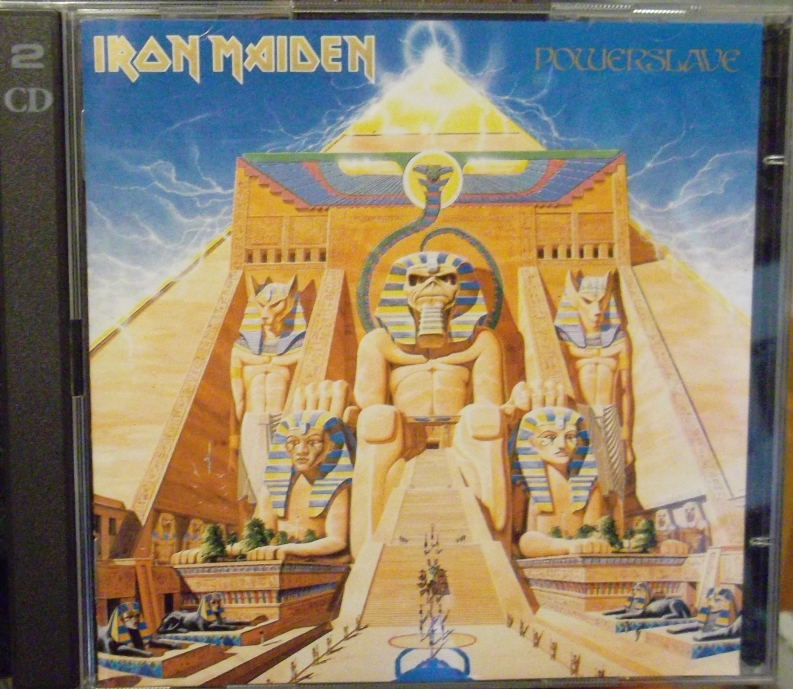
How much did I love Powerslave, especially after taking Ancient Egypt in highschool? Finally I knew what the Eye of Horus was, and what the hell the lyrics were about! When I was growing up and first getting into Maiden, Powerslave was the current album. The neighbor kid had it. We literally stared at that album cover for hours.
Derek Riggs outdid himself on the artwork this time, really outdid himself. The Egyptian theme of the artwork allowed him to weave all sorts of hidden messages into the hyroglyphs. I don’t have the LP, but I could swear that somewhere on the cover (front or back) it says “Indiana Jones was here”!
I taped the album from that neighbor, unfortunately on one of the worst sounding Scotch blanks I ever heard. It was unlistenable. Then my dad bought me the tape from the local music store, but even it sounded terrible — warbly. I found that many Capitol Records releases in the mid-80’s in Canada had awful cassette quality. From my Maidens to my Helix, they were mostly unplayable.
It was a long while before I got a listenable version of the album. Then it hit me like a ton of bricks — holy crap, this is GOOD!
“Aces High” and “2 Minutes To Midnight” are the two singles, and of course they lead the album. I only wish “Churchill’s Speech” was included as it was in the “Aces High” video! As kids we always preferred “Aces High”. It combines the manic speed of early Maiden, with the anthemic Dickinson choruses. Just great.
“Aces High” was yet another song that my dad didn’t mind me listening to out loud, since it was about one his favourite historical subjects:Â the Battle of Britain.
“2 Minutes”, a reference to the Doomsday Clock,was a Dickinson/Smith composition. At 6 minutes long, it wasn’t an obvious single.  Vocally, it’s a lot less catchy than “Aces High”. Bruce doesn’t so much sing a melody as he does spit the words out like a furious machine gun! Musically, the riff seems lifted directly from later Budgie, and early Diamond Head. See if you can spot it.
Up next is an instrumental, the first since Killers!  “Losfer Words (Big ‘Orra)” is really the only weak song on the album. As an instrumental, it’s not as exciting as something like “The Ides of March”. The riff is rather simple and it sounds like an unfinished song, like Bruce didn’t show up that day or something.  The guitar playing (well, all the playing) is of course stellar, there’s always that!
Then comes “Flash of the Blade”, a fucking awesome track, and one of my favourites. I remember trying to learn that riff as a kid, as it’s catchy but uncomplicated.  This one’s penned by Dickinson alone, and is about…of course…fencing. Like Steve Harris was on the exact same wavelength, his song, “The Duelists” is up next. Yet another song incorporating fencing, this one was my personal pick for a third single. I remember even drawing my own cover art, with Eddie dueling the Devil!  The middle section is an intricate dance of delicate guitars, you can almost picture the men parrying and feinting.
And that ended side one. Side two opened with “Back In The Village”. This would be the only other song beside “Losfer Words” that doesn’t make my road tapes. Another Smith/Dickinson song, it’s got a cool signiture Adrian riff, but up against the rest of these songs, it just doesn’t stand out to me.
But “Powerslave” does! This is another solo Bruce writing credit, and a powerful song it is! Bruce metalizes Ancient Egypt with that cool riff, and his lyrics are a labyrinth of Egyptian mythology. Very cool. The best part of the song however is the middle section. The song slows down at roughly 3 minutes, and there’s some pretty amazing soloing (sounds like Dave). Then things pick up at 3:52, and Adrian plays my favourite Iron Maiden guitar solo of all time! (Of all time, Kanye!) Damn I love that solo! I always have, even when all I had were those crappy cassettes. And as if that wasn’t enough, then there’s a harmony part with Dave and Adrian together, and then Dave’s off on another amazing solo of his own!
(For the record:Â if there was a second favourite Maiden guitar solo for me, it’s “The Wicker Man”, also performed by Adrian.)
Before you know it, we are at the end. But not quite, for the final song on Powerslave is 14 minutes long! “Rime Of The Ancient Mariner”, based of course on Coleridge, is the latest and perhaps the greatest so far of Steve’s epics. I don’t know if I want to even think about ranking his epics anymore, but “Rime” is certainly a favourite. That opening riff alone would have made a song on its own. But this is a complex song, and it twists and turns and goes through all sorts of different adventures before we’re done. As kids I remember were all blown away that this whole song was written by just one guy!
Talking about “Rime” in words is tough. Lyrically I loved it. Suddenly I understood Coleridge, and it wasn’t at all painful! But musically this is just about perfect. Bruce’s delivery is flawless, and the guitars are woven into epic and amazing solos once again. Just about every section of this song is memorable. It lags a bit in the atmospheric middle section, but this is soon replaced by a triumphant vocal with bright bass guitar melodies.
This 2 CD deluxe edition includes a bonus disc with all the B-side goodies. Didn’t you always love that cover for “Aces High”? Eddie in the Spitfire, flying on, even with a bullet in his head? The B-sides include a live version of “Number of the Beast” that used to annoy us as kids, since Bruce only sings “six!” and gets the audience to finish with “six six!”. With hindsight, who cares, it’s a great live version. It’s just funny how I have that memory so very distinctly!
“King of Twilight”, a cover from a band called Nektar, isn’t a standout though. I like that “Ahh, ahhh, ahh” section and I love the pounding drums. Otherwise it’s not a road tape classic.
“2 Minutes To Midnight” had two excellent B-sides: “Rainbow’s Gold” and “Mission From ‘Arry”. The riff that kicks off “Rainbow’s Gold” is just really catchy, as is that vocal melody. This is a cover from somebody called Beckett. Gotta give Maiden credit for trying obscure covers! Love this song.
And…”Mission From ‘Arry”. Not a song at all, here’s the story. One night, Nicko was asked to extend his drum solo while Harris (‘Arry) got his bass rig up and running. ‘Arry sent his roadie to tell Nicko, who was distracted by the roadie and fucked up his drum solo. Furious he launched into said roadie and gave him a good solid dressing down. After the show, Steve in turn told Nicko that he was out of line and to apologize. In walked Bruce Dickinson with a hidden tape recorder and a mischievous grin! The rest is history, as released on this B-side!
Now, I’m from Canada and I don’t know my British slang that well. Do you guys often use phrases like “Fuck my old boots!”?
I don’t think Powerslave was the album that Piece Of Mind was, but maybe I like it a fraction better than Beast. I dunno. It’s so hard to rank, we’re really splitting hairs here. Powerslave was a little colder sounding, a little brittle compared to the past. Steve’s bass is a little rinky, not warm and deep enough. But that’s the sound of the LP, the songs still rise above.
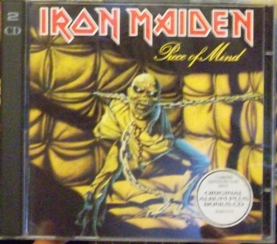
IRON MAIDEN – Piece Of Mind (1983, 1996 bonus disc)
Exit Clive Burr. Enter that hilarious crazed drum dynamo Nicko McBrain! Surely one of the most beloved characters to ever grace an Iron Maiden album, the band decided to kick off Nicko’s first album with a drum flurry. Like machine guns strafing the sky, Nicko opened “Where Eagles Dare” with a decidedly skillful salvo.
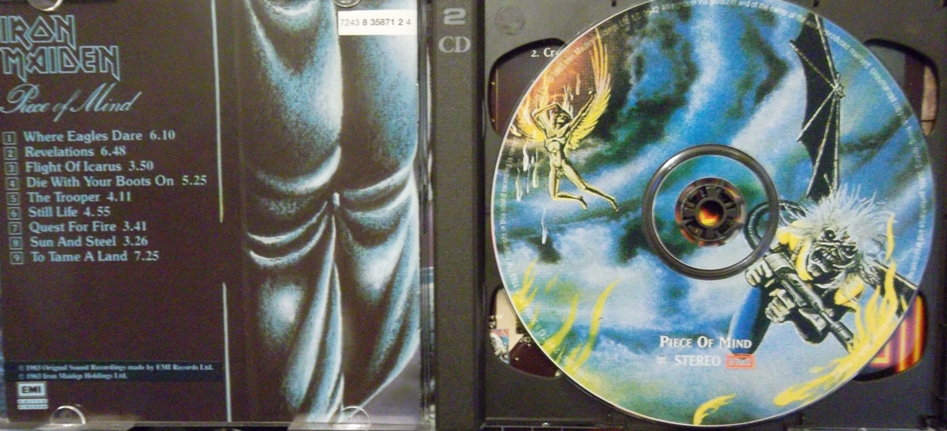
Piece Of Mind is one of Steve Harris’ favourite albums, and one of mine too. Each of its nine songs is worthy of the album; no filler. The subject matter is increasingly more interesting to me as well, as Steve punders history, literature and movies. “Where Eagles Dare” was based on the classic Clint Eastwood film of the same name, and does not disappoint. It is over six minutes of soaring vocals and solos, with the band riffing steadily behind it.
This is followed by one of Maiden’s epic slow tunes, and first ever Bruce Dickinson writing credit on a Maiden album, “Revelations”. Almost seven minutes long, “Revelations” is lyrically complex and melodically incredible. I recall one of my old highschool buddies, Andy Kandic, sang “Revelations” at a highschool audition because he wanted something that would blow the judges away. This is one of Bruce’s best vocal performances ever, but not the last of his writing contributions.
The first of Bruce’s many collaborations with Adrian Smith is next. The hit single “Flight of Icarus” is a shorter number, the type of hard rock song that Maiden occasionally pull out for use as a single. Its chorus soars like the title character, without that annoying crash at the end! This is certainly one of Maiden’s most memorable songs.
As if that wasn’t enough to exhaust you, Bruce and Adrian teamed up with Steve to pen “Die With Your Boots On”. Right from first listen, this was one of my favourite Maiden tunes. Loosely based on Nostradamus, the lyrics are great! “In thirteen the Beast is rising, The Frenchman did surmise, Through earthquakes and starvation, The warlord will arise.” But the bottom line according to Maiden is “The truth of all predictions is always in your hands!” If you’re gonna die, die with your boots on. Great song, great singalong chorus.
Side two is kicked off by one of the greatest Maiden songs of all time: “The Trooper”. This is one that has steadfastly remained in setlists, even through the Blaze Bayley years. It’s a great example of the trademark Maiden gallop. Lyrically this one is about the Charge of the Light Brigade, and the Crimean War. This is where I think Maiden deserves some credit from the educational field. Sure, a five-minute song is not going to sum up the Crimean War, but it got many, many kids into history. My father was always impressed that I had interest and knowledge in history, partly thanks to Maiden songs. He always encouraged me to listen to songs like “The Trooper”, and then follow it with some reading.
Dave Murray’s “Still Life” slows the pace, introduced by Nicko’s backwards Idi Amin impression! Then it picks up, big time. This haunting number is a story of possession, perhaps along the lyrical lines of “The Number of the Beast” and the later “Dance of Death”. I love this song. It was rarely played live, but can be found in live version on a later B-side.
“Still Life” is followed by two lesser known cuts. Slightly less impressive than the rest of the album, “Quest For Fire” and “Sun and Steel” both blow away many songs by the average metal bands out there. Both are short hard rockers, under four minutes in length, anchored by memorable choruses. “Quest For Fire” is not surprisingly based on the film of the same name, but isn’t quite as exciting as the previous stories on this album. “Sun and Steel” though is a fencing number, of course written by Bruce with Adrian. The protangonist killed his first man at 13, and goes on to live a life of battle with the blade. This would not be Bruce’s last foray into fencing with his lyrics.
Finally, another long Steve Harris epic ends this album: “To Tame A Land”. Musically and lyrically very complex, it is based on Dune by Frank Herbert. It is very, very difficult to sing along to this labyrinth of lyrics: “He is the Kwisatz Haderach, he was born of Caledon, and will take the Gom Jabbar.” Without reading the books, you’ll be lost. After reading the books however, I thoroughly enjoyed this one. Today this is one of my favourite Maiden classics. It’s certainly hard to get into instantly, but once those tricky melodies and riffs burrow their way into your head, they are there to stay!
They couldn’t get permission from Herbert to use the name “Dune” as the title of the song. Reportedly, when asked, his people responded, “Mr. Herbert does not like rock bands, especially heavy metal bands, and especially heavy metal bands like Iron Maiden!” A shame that was, as “To Tame A Land” was the gateway drug for many to discover the delights of planet Dune.
On Derek Riggs’ cover art, Eddie has been lobotomized, chained up in a padded cell. An open window and a disembodied hand tease him on the back cover. This would have made a great gatefold sleeve! I always imagined that Derek was sequentially trying to tell a story. Previously, we saw that Eddie was pulling the Devil’s strings on The Number of the Beast. But if you looked carefully, you would see that the Devil was really pulling Eddie’s. Now Eddie’s been captured and lobotomized. Further albums covers show Eddie’s burial, resurrection, cybernetic enhancement, and his offspring. I like to think that there was a hidden narrative going on with the artwork.
The bonus CD contains the two B-sides from this album’s sessions, both covers: Montrose’s “I’ve Got The Fire” and Jethro Tull’s “Cross Eyed Mary”. “I’ve Got The Fire” was previously covered by the Di’Anno-led version of Maiden, but this version’s even better. The solos and Bruce’s vocal brings the song to a whole new level, although it does lose some of Di’Anno’s punk-like reckless abandon. “Cross Eyed Mary” is not my favourite Tull song of all time, but I’m not surprised that Maiden are fans! This was probably a good choice, and Maiden do a solid job on it.
Not to overstate the obvious, but Piece of Mind is one of Maiden’s all time best. 5/5 stars
IRON MAIDENÂ – The Number Of The Beast (1982, 1996 bonus disc)
One of Maiden’s greatest album covers happened to house a great album inside. There was a segment of Maiden fans that were very much against the replacement of Paul Di’Anno, but Bruce Dickinson was undeniably the right man for Iron Maiden. Formerly known as the ridiculously monikered “Bruce Bruce” of rival band Samson, Dickinson fit in quickly and triumphantly.
From the first song, “Invaders” (a history lesson on the Norman invasion), The Number Of The Beast does not disappoint. “Invaders” is a storming opening, but not nearly the quality of the next number: “Children of the Damned”. Along the lines of the older “Remember Tomorrow”, this song proved why Bruce was the man for the job. The dramatically powerful music is only enhanced by Bruce’s wail. They nicknamed this man “Air Raid Siren” for a reason. “Children of the Damned” still sends shivers up my spine…
Another classic, “The Prisoner”, follows. Significantly, this is the first Adrian Smith co-write on the album, and in Iron Maiden. He has three co-writes on the record, and Adrian’s writing lent a melodic hard rock side to the band. His composition style is unique from the other members of the band, and identifiable. “The Prisoner” starts with that famous intro: “We want information… information… information!” The band had McGoohan’s permission to use it, and effective it is! It’s a catchy, singalong Maiden song, the kind of thing that worked great live. And Bruce really delivers on that chorus.
Charlotte the Harlot makes her return on “22 Acacia Avenue”. The lyrics boast, “You can tell her that you know me, you might even get in free.” But it’s not as simple and straightforward as that anymore, as Maiden have grown musically, so have they lyrically. Another character, perhaps a family member, turns up and asks Charlotte, “isn’t it time you stopped this mad life?” But if you’re not paying attention to that because the song rocks so hard, I understand. This one too bears the stamp of Adrian Smith who was no doubt responsible for those terrific riffs.
With the addition of Smith and Dickinson, the band had obviously grown and intensified. But the next two songs, opening side two, blew the doors off. “The Number of the Beast” and “Run To the Hills” were a double whammy: two awesome singles in a row that would help send the band off into immortality. I’m not saying that with a shred of hyperbole. If you’re reading this and don’t know these two songs, then I don’t know what’s wrong with the world!
I won’t dwell on either song. Yes, “Run To the Hills” is one that I never need to hear again, but I’m sure glad I heard it the first time. It’s the song that got me into the band. I absolutely loved the video for “The Number of the Beast”, and those chiming opening guitars. Then Bruce screams, and we’re off to the races. Great song, awesome video, funny too. This is the kind of image that people have of Maiden, that persists forever: Bruce, long red hair flowing like a precursor to Axl, that fringe of his in front, and those spiked armbands. Classic!
“Gangland”, the only unremarkable song on the album, is a co-write between Adrian and drummer Clive Burr! My understanding is that with 20/20 hindsight, Steve would have preferred to have “Total Eclipse” on the album instead. “Gangland” does have a good bridge, but is otherwise pretty stock.
Finally, “Hallowed Be Thy Name”. I remember this was misspelled “Hallowed By Thy Name” on the old cassette that my buddy Bob had, so I thought that really was the name. “Hallowed” was to be Steve’s new 7 minute epic, something he’d become known for. “Hallowed” is one of the best epics, and something that absolutely required the vocals of Bruce Dickinson to bring to complete fruition. Bruce nails that mournful slow opening, and then absolutely lets rip with some pretty intricate words. Seriously, do you ever try to sing along at album speed? I always trip up words somewhere.
“Mark my words, believe my soul lives on don’t worry now that I have gone, I’ve gone beyond to seek the truth.”
And to sing it at his volume with that much emotion? Unbelievable.
And that’s the album. The 1998 remasters tacked on “Total Eclipse” as a bonus track, and it’s here on my bonus disc. This was the B-side to “Run To the Hills”. My younger sister actually had this single and I don’t know why. (Kathryn, comment below please!) “Total Eclipse” was actually performed live, and can be found on the Eddie’s Archive box set. It’s a mid-tempo rocker with a fast breakdown in the middle, come solo time. It’s catchier than “Gangland”, and is also co-written by Clive Burr, with Dave Murray and Steve Harris!
The bonus CD this time only has two tracks. That’s all they released at the time, two singles, two B-sides. The second B-side is a stunning live version of “Remember Tomorrow” with the new guy singing. I always prefer Di’Anno, because he co-wrote the song, for his voice, and made it legendary to start with. But Bruce is no slouch. Much like Dio used to sing Ozzy’s stuff with more skill and range, so does Bruce in this case.
You’ll notice one guy is absent in the writing credits: Bruce Dickinson.  Due to lawyers and rigamarole with his old band, Samson, he wasn’t legally able to write with Maiden. Don’t worry though, he’ll make up for it on the next album!
I don’t want to give Beast a perfect 5/5 score for two reasons. One, “Gangland”. Two, better things were still to come. There has to be room for improvement. Therefore:
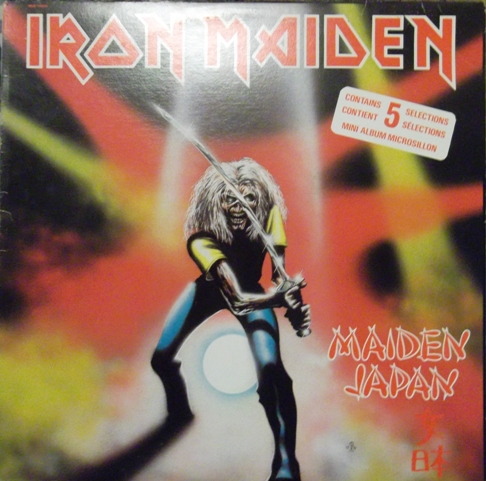
I don’t know exactly why, but some countries got four songs on this EP while others got five. Something to do with what would be considered a single vs an EP. Fortunately for me, Canada was one of the countries that got all five.
A cross section of the best songs from the first two albums, Maiden Japan (how can you not love the title?) was an almost instant love for me.  Expertly recorded by Maiden and Doug Hall, the EP breathes new life into “Running Free” and “Remember Tomorrow”, two songs from Iron Maiden. Di’Anno’s screams are absolutely awesome. By and large I often prefer these versions to the originals.
This EP was relatively easy to find here when I was growing up, so it was my first exposure to early Maiden aside from the “Women In Uniform” music video.  A lot of the time, if you hear a good live album first, that is the version that sticks with you through life.
This would prove to be Paul Di’Anno’s final release with Iron Maiden. The band were already planning his replacement. An early cover with Eddie decapitating Paul was quickly replaced with another, in light of these developments!
The original cover art
I know this was released on CD, I saw it myself.  It was with the 2 CD edition of Killers, Japanese import version. Yet another item that I wish I’d splashed out for!
Lineup:Â Paul Di’Anno, Steve Harris, Dave Murray, Adrian Smith, Clive Burr.
Changing vocalists proved to be the right move to Maiden; it launched them into a whole new world and tranformed them into a bigger, better Beast…
After the masterful introduction that was the first Iron Maiden album, the band jettisoned guitarist Dennis Stratton to get the guy that Steve wanted years before: Adrian Smith. An old buddy of Dave Murray, Adrian fit like a glove and the next album was recorded.
Written entirely by Steve Harris except for one Di’Anno co-write, Killers was also produced by Martin Birch. Birch had already helmed the biggest and best albums by Deep Purple, and was more than capable of capturing the Maiden sound in the studio, unlike former producer Will Malone.
Popular opinion is split on Killers. Some fans see it as a significant up-shift from the previous, others see it as inferior. Both aruments hold water. There is no denying that the partnership with Martin Birch created a better sounding album, one more consistent with the band’s live intensity. The addition of Smith on guitar meant that you’re hearing a more unified sound, two guitar players in great sync with each other. The songs are also harder and more intricate, with even more sections and changes.
While Killers is a good album in those respects, the songs were not as memorable this time out. There are two scorchers on this record that are among my all-time Maiden favourites: “Wrathchild” and “Killers” itself. Then you have some second tier goodies like “Murders In The Rue Morgue”, “Innocent Exile”, and “Drifter”. Beyond that, there’s little else here that would make my Maiden road tape. I don’t know why, but time after time, listen after listen, year after year, the rest stubbornly refuses to grow on me.
Killers contains one ballad (“Prodigal Son”, which is almost like Iron Zeppelin) and two instrumentals (“The Ides of March” and “Genghis Khan”). Oddly enough, one of those instrumentals, “The Ides of March” is identical to a song by rival NWOBHM band Samson, called “Thunderburst”. The song was originally an Iron Maiden idea; Samson’s drummer Thunderstick was very briefly in Iron Maiden during the late 1970’s. Samson’s singer was some guy called Bruce Bruce, known to his mum as Bruce Dickinson.
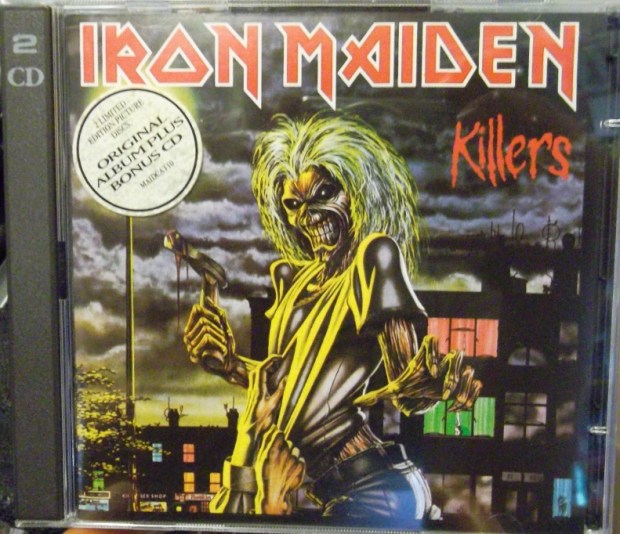
This picture disc edition of Killers came with a bonus CD containing all the associated non-album songs. “Twilight Zone”, included here, is actually an A-side of a non-album single. The US version of Killers had “Twilight Zone” on the album. Its selection as a single ahead of something like “Wrathchild” seems strange with hindsight. I never really liked the song that much, aside from Di’Anno’s screamy chorus. This one was a Dave Murray co-write as well.
Another non-album single, the infamous “Women In Uniform” is also included. This is the one that the band hated, a cover from a German band called Skyhooks. I liked it because of my early association with the cheesey music video. I wouldn’t call it a standout track, but I like it better than “Twilight Zone”. This single acually pre-dated Killers, and Dennis Stratton is still on guitar. Its two B-sides, “Invasion” and “Phantom Of The Opera (Live)” are both included. “Invasion” is an improved remake of the song from the first EP, The Soundhouse Tapes. It’s still not up to the standard of anything on album #1, but it’s still an entertaining tale of the Norsemen comin’, “raping and pillaging, robbin’ and lootin’ the land.” An early Maiden history lesson from Steve Harris.
I’ll have to say something about Derek Rigg’s artwork as well: Now we know what Eddie was up in that back alley on the last album! No good, clearly, as he’s weilding a bloody hatchet, as a man’s hands can be seen grasping his shirt. Behind Eddie, you can see a “kinky sex shop” and the Ruskin Arms, where many legendary Maiden gigs went down. Is that Charlotte in the red window?
Rating Killers is very difficult. It’s still better than most band’s best albums, yet it’s one of my least favourite. Trying to be objective here, I will rate Killers:
3.5/5 stars
Also pictured below:Â A bootleg CD from the tour called Another Live.