Box of Fire

REVIEW: Aerosmith – Live! Bootleg (1978)

LIVE BOOTLEG_0001AEROSMITH – Live! Bootleg (1978 Columbia, 2003 Sony)

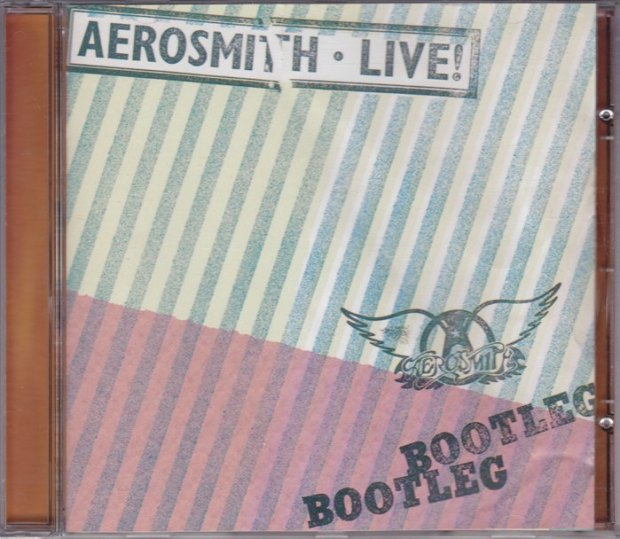
Five records in, and it’s time for a double live.  Aerosmith had gained a reputation for their fiery live shows, and bootleggers were ensuring that fans willing to pay had something live that they could buy.  The way to beat the bootleggers was for Aerosmith to put out their own official live album.  Collecting tracks from a variety of live performances and radio broadcasts, including many songs unavailable on album, Live! Bootleg is today one of the best examples of the epic double live.  The intentionally shoddy album art conceals within it a live record of nuclear critical mass.  With liner notes, photos, and even hidden tracks, Live! Bootleg hits all the bases.

“Back in the Saddle” recorded in ’77 is chosen to open the proceedings, which it does with the kind of rawness that only comes with a real live performance.  Unfortunately it’s a thin sounding version, but fear not because “Sweet Emotion” in March ’78 is full of guitar noise.  The liner notes state that there are no synthesizers on the song, just guitars “screaming in pair”.  Then “Lord of the Thighs” from the same gig keeps the momentum going smooth and dirty.  The extended jamming stretches the song out to the seven minute mark, and that is the kind of noisy spontaneity that wasn’t captured on any of Aerosmith’s studio albums.

“Toys in the Attic” was recorded in the boys’ home town of Boston, straining at the leash.  It’s a fevered live take, faster and more reckless.  Then, also from Boston is the Tyler/Whitford classic of Aerofunk tastiness, it’s the “Last Child”.  Live (in a club), it’s funkier and slinkier.  The first surprise rolled out on the album is the Beatles cover “Come Together”, from a secret gig in ’78 at the band’s headquarters the Wherehouse.  It’s very similar to the studio version they did for the Sgt. Pepper’s Lonely Hearts Club Band soundtrack, perhaps a bit slower and more menacing.

Joe Perry dusts off the talk box for an ultra-funky “Walk This Way”.  One reader said, “Joey [Kramer] sets the tone and man he’s driving the bus at break-neck speed.”  That’s it exactly!  This is Aerosmith starring in that movie about the bus that couldn’t slow down!  (I think it was called The Bus that Couldn’t Slow Down.)  As if that isn’t hot enough, a smoking “Sick as a Dog” from ’77 crashes the damn bus over the guiderail and off into the sunset!  Lots of tasty extended soloing here.

Eight songs in and only now we’re hitting the first ballad, and only ballad!  “Dream On” is a necessary outing.  Aerosmith slow it down a bit a-la “Stairway” and let it build.  Look for a surprise f-bomb in the middle of the song.  (I guess Aerosmith were not being recorded for radio broadcast that day, or if they were, Tyler just didn’t give a fuck!)

LIVE BOOTLEG_0006My favourite Aerosmith song of all time is “Chip Away the Stone”, written with Richie Supa.  This brand new song was chosen as the single fron Live! Bootleg.  The studio version was relegated to a B-side!  The live one has less piano, but has just as much boogie.  This is Aerosmith doing that old time rock and roll.  (The current version of Guns N’ Roses has been known to play “Chip Away the Stone” from time to time.)

Bringing back the funk of “Sight for Sore Eyes”, there is no time for rest, and from there it’s straight into “Mama Kin”.  Everything that the first Aerosmith album lacked in out-of-control raucousness is intact on this live version.  Without a breath they tear into “S.O.S. (Too Bad)”, ablaze with the intensity of fully-fuelled Aerosmith.

There’s an awkward transition between “S.O.S.” (recorded ’77 in Indianapolis) and “I Ain’t Got You” (1973 for a radio broadcast).  The younger band sound very different, less wartorn and ragged from the drugs.  They go straight into James Brown’s “Mother Popcorn”, complete with sax.  It’s the funkiest thing Aerosmith have ever done by a long shot.  Material like these tracks are perfect examples why Live! Bootleg is so beloved today.  They were giving you value for your money, and songs that you didn’t have, but didn’t know you didn’t have!

The next surprise is the unlisted “Draw the Line”, a live version so over the top that perhaps it even surpasses the original!  Wait until you get to Tyler’s screams if you don’t believe me.  Checkmate honey!  After a tracklist like this, ending the album with “Train Kept a Rollin'” (Detroit 1978) is one of the only options left.  Probably tired from an energetic set, Tyler gets the audience’s help on the chorus.  Joe Perry’s hanging by a thread but still able to piece together some gratuitous solos.   He throws in a bit of Sinatra’s “Strangers in the Night” for shits n’ giggles too.  Live! Bootleg ends on an overindulgent but perfectly appropriate note.

The radioactive fallout from their double live album bought Aerosmith, burning out fast from the inside, a little more time before being required to produce something new.  Even then they were breaking from the strain.  Something had to give.

Fortunately before imploding, Aerosmith managed to crank out the obligatory double live album that helped seal their place in rock history.  Check that one off the box!

5/5 stars

AEROSMITH BOX OF FIRE review series:
BOX OF FIRE THUMBDisc 1: Aerosmith (1973)
Disc 2: Get Your Wings (1974)
Disc 3: Toys in the Attic (1975)
Disc 4: Rocks (1976)
Disc 5: Draw the Line (1977)
Disc 6: Live! Bootleg (1978)

REVIEW: Aerosmith – Draw the Line (1977)

DRAW THE LINE_0001AEROSMITH – Draw The Line (1977 Columbia, 1993 Sony)

The intial batch of Aerosmith platters (particularly Get Your Wings, Toys In The Attic, and Rocks) are all but undisputably great records. Most agree that, for a couple years anyway, Aerosmith created some of the great most important rock music in America. Draw The Line, Aerosmith’s fifth, was considered at the time to be a drop in quality although it has certainly aged well and fared better in hindsight. Compared to Rocks, perhaps it stumbles behind like a drunk tumbling out of the bar, but it is still a magnificent piece of rock and roll damnation.  And you gotta love the cover art caricature, by Al Hirschfeld.

The drug problems had sunk in, a monkey it would take them another decade to shake, but you wouldn’t be able to tell by the title track. Even though they were basically only recording music in order to keep paying for drugs, they still managed to create some legendary music on the title track.  This is desert island material, one of those songs that I don’t want to live my life without. To this day nobody has written anything as perfectly manic as “Draw The Line” from start to finish. They may have been falling apart, but musically they were capable of cranking out breakneck rock and roll of the highest quality.   It was Van Halen’s frontman David Lee Roth himself who proved the mettle of “Draw the Line” in a scientific way.  When all else failed, he used it to drive a yak heard away in the Himalayas!

And I still have no idea what Steven Tyler is singing after the lead solo break.  This is what it sounds like to me:  “OOOH check mate don’t be late take another pull, that’s right, impossible, when you gotta be yourself you’re the boss of the toss so dice the price baby baby and Draw the Line…”  I’m certain that’s not entirely right, and who knows what the fuck it means, but I’m not going to go and look up the lyrics.  Do you know why?  Because Draw the Line didn’t come with lyrics. If Steven Tyler wanted me to know what the hell he’s singing there, he’d have written it down.

Much like they did with “Nobody’s Fault” from Rocks, thrash metal pioneers Testament covered “Draw the Line”, which was released on their Signs of Chaos compilation.  Once again, it’s a perfect fit for the thrashers.

It doesn’t end there with “I Wanna Know Why” being one of the catchiest of the early ‘Smith rockers.  Those Tyler piano touches and Aerosmith horns make it the most “rock and roll” of the tracks.  It’s brassy, sassy and shows no indication of the decay setting in at all.  “Critical Mass” was also great, a song that grooves along smoothly.

Although Aerosmith fared well in the past marrying funk and rock, “Get it Up” doesn’t work as well.  While the band were playing beyond what you’d expect them to be able to, their songwriting was starting to fizzle.  Joe Perry’s “Bright Light Fright” kicks the decibels, but sounds unfocused and haggard.  The saxophone solo is a highlight, but listening to “Bright Light Fright” is like watching a drunk partying in top gear.  You know the crash is inevitable, and soon.

Turning sharply back towards jaw-dropping quality, “Kings and Queens” is regal and mighty.  Listen for the banjo lying underneath.  Oh if Aerosmith could only achieve lofty heights like “Kings and Queens” today!

“The Hand that Feeds” is a crap song, but “Sight for Sore Eyes” is better.  Aerosmith seemed to be leaning on the funkier side on the latter half of Draw the Line.  They close it with a chugging blues, a cover of “Milk Cow Blues” perhaps showing that Aerosmith didn’t have enough ideas of their own, perhaps not — they have always done covers.  Regardless, “Milk Cow Blues” is well executed, sounding very live and reckless in the studio, just like it should be.

This is impaired Aerosmith, but not entirely off the rails yet!

Yet…

4/5 stars

AEROSMITH BOX OF FIRE review series:

BOX OF FIRE THUMBDisc 1: Aerosmith (1973)
Disc 2: Get Your Wings (1974)
Disc 3: Toys in the Attic (1975)
Disc 4: Rocks (1976)
Disc 5: Draw the Line (1977)

REVIEW: Aerosmith – Rocks (1976)

AEROSMITH – Rocks (1975 Columbia, 1993 Sony)

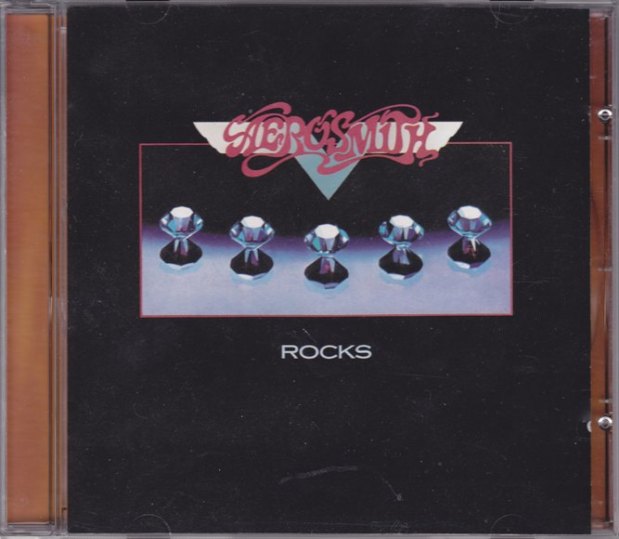
Packaged clean and sharp, Aerosmith made their intentions clear on the cover art for Rocks.  The album launched a million guitar players and a hundred careers in rock and roll.  It is also notable as being the last album before a major turning point; the point at which Aerosmith let the drugs work against them in a major way.

“Back in the Saddle” is an impressive opener.  The main riff in the song is not a guitar, but Joe Perry playing a six string bass.  Steven Tyler has mastered his own voice by this time, squealing and shrieking in conjunction with the hooks.  In some ways “Back in the Saddle” sounds like the birth of the true Aerosmith.  “Last Child” meanwhile nails the oft-overlooked funky side of Aerosmith.

“Take me back to-a south Tallahassee,
Down cross the bridge to my sweet sassafrassy,
Can’t stand up on my feet in the city,
Gotta get back to the real nitty gritty.”

With the help of an understated horn section, Aerosmith turn “Last Child” into something special.  This unexpectedly fades into the metallic aggression of “Rats in the Cellar”.  A spiritual sequel to the song “Toys in the Attic”, this one’s even meaner and faster.  Somebody said that the goal here was take what the Yardbirds were doing and turn it up.  Harmonica hooks and slide guitar goodness — I’d say they nailed it.

I need something groovy and right in the pocket after that, and “Combination” sung together by Tyler and Perry is one such groove. “Combination” is an album highlight boasting hooks and cool bass licks galore, and listen to Joey Kramer tearing it up on the drums! “Sick as a Dog” is another semi-forgotten classic. I’ve loved this melodic rocker (similar to past tracks such as “No More No More”) since day one. I can’t help but get it in my head every time I actually am sick as a dog. (Knock wood, no major illnesses yet in 2015!)

Perhaps the most important song on Rocks is the Whitford/Tyler composition “Nobody’s Fault”.  Along with “Round and Round”, Whitford has a knack for coming up with some of the heaviest Aerosmith riffs.  Testament covered it in 1988 for The New Order, taking it to an extreme that Whitford couldn’t have predicted.  The post-apocalyptic lyrics fit the concept of the Testament album.

Aerosmith’s original recording of Nobody’s Fault features some of Tyler’s most impassioned howls.  Drummer Joey Kramer considers it to be his best drumming, and I’m sure Whitford feels the same about his guitar work.  Although you can still hear that Aerosmith beat, “Nobody’s Fault” proves the band are versatile and more than just another American blues rockin’ band.

Bringing back the funk, “Get the Lead Out” isn’t particularly a standout except in terms in performance (which, with Aerosmith, is always above reproach).   “Lick and a Promise” returns us to quality, with a stock rocker about Tyler’s favourite subject.  We’re now at the end of the record, and “Home Tonight” continues Aerosmith’s knack for ending an album effectively with a slow number.  A piano ballad with plenty of guitars, “Home Tonight” adds that bit of class that Rocks needed in order to compete with an album like Toys in the Attic.

So how does Rocks compare with Toys in the Attic, anyway?

Too close to call.  Rocks is definitely a heavier record, and Toys in the Attic is closer to the dead-center of Aerosmith’s sound with the horns and strings.  Otherwise, it’s splitting hairs.

5/5 stars

AEROSMITH BOX OF FIRE review series:

BOX OF FIRE THUMBDisc 1: Aerosmith (1973)
Disc 2: Get Your Wings (1974)
Disc 3: Toys in the Attic (1975)
Disc 4: Rocks (1976)

REVIEW: Aerosmith – Toys in the Attic (1975)

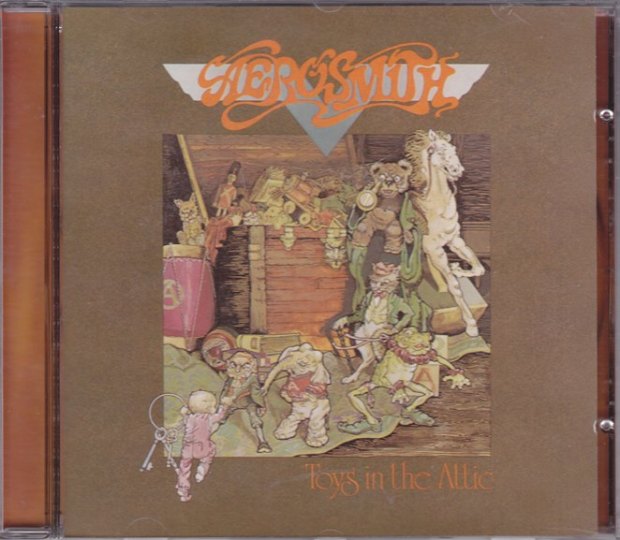
TOYS IN THE ATTIC_0001AEROSMITH – Toys in the Attic (1975 Columbia, 1993 Sony)

What’s your lucky number?  For Aerosmith, maybe it’s 3.  Third album in as many years, Toys in the Attic is considered by some to be the album: “If you’re only going to get one,” the desert island record.  Considering that Rocks was yet to come, let’s withhold judgement until we get there.  For now just be aware there is a lot of Aero-love in the world for Toys in the Attic, and you can hear why.

As if to prove that Aerosmith could keep up with some of their heavier competitors out there, “Toys in the Attic” is a blazing guitarfest careening through the speaker into your skull.  What a way to open an album: it’s a statement.  The band were honed to a razor-sharp edge by producer Jack Douglas.  Joe Perry in particular had grown to be a ferociously good blues-rock player, and “Toys in the Attic” is the evidence.

One of the great joys of listening to Aerosmith is finding the little known album gems that weren’t repeatedly re-released on hits packages.  “Uncle Salty”, a slow crawl through the blues via the neck of a bottle, is one such track.  Also underexposed is “Adam’s Apple”, which shows off Joe Perry’s greasy slide guitar sleaze.  The horn section makes an appearance here too, adding extra sauce.  Then they bring the funk on “Walk the Way”.  Run DMC recognized that funk and knew how to update it in 1986.  In 1975, Tom Hamilton’s rolling bass was the stuff that groove is made of.  This is the kind of song that proves the musical ability of these five gents from beantown beyond the shadow of a doubt.  Then the sassy horns return on “Big Ten Inch Record”, an old R&B classic from 1952.  Remarkably the band pull it off with class and sassafras.

“Sweet Emotion” is one of the band’s best known today, something that Tom Hamilton must be happy about, since it’s one of only a few Tyler/Hamilton co-writes.  It’s no surprise that Hamilton had a hand in its composition since it’s based on another one of his rolling bass lines.  But listen to the way Joey Kramer and Brad Whitford lock into him.  That groove is the foundation on which Aerosmith was built.  On top of that, Steven Tyler has always had a way with melody.  “No More No More” is one of his most irresistible singalongs.

The Sabbathy thunder of “Round and Round” was an unexpected twist.  Tracks like this and the later “Nobody’s Fault” show the metallic side of Aerosmith that usually remains shrouded.  “Round and Round”, though menacing and heavy as a brick, is the least memorable song on Toys in the Attic (only because the competition was so good).  Brad Whitford takes care of the solos on this one, a song he co-wrote (just like “Nobody’s Fault”).

“You See Me Crying” ends the album on a melancholy note but lovely note.  A piano based tune with strings and McCartney-ish melodies, it is truly the kind of classic that Aerosmith will be remembered for.  If it were not for songs like “Dream On”, “Seasons of Wither”, and “You See Me Crying”, then Aerosmith would be just another American rock and roll band playing their version of the blues that the Stones and Zeppelins of the world had already plundered.  “You See Me Crying” was proof that Aerosmith were more than that, and had their own thing going on.  (That’s Whitford playing the solos again, by the way.)

So what’s better?  Toys in the Attic, or Rocks?  Let’s find out next time.

5/5 stars

AEROSMITH BOX OF FIRE review series:

BOX OF FIRE THUMBDisc 1: Aerosmith (1973)
Disc 2: Get Your Wings (1974)
Disc 3: Toys in the Attic (1975)

REVIEW: Aerosmith – Get Your Wings (1974)

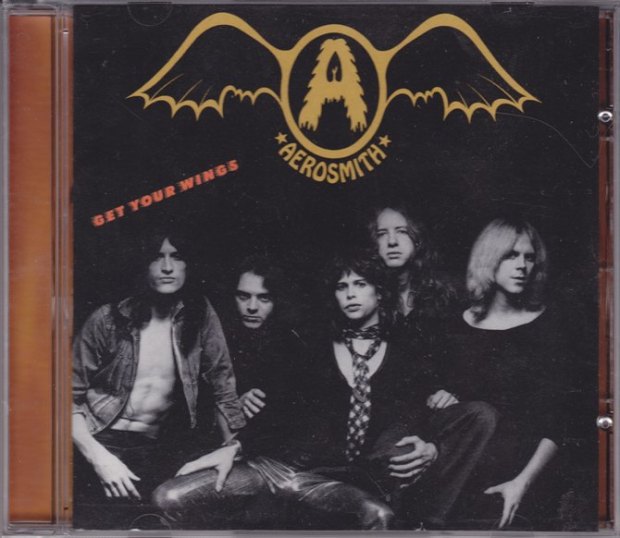
GET YOUR WINGS_0001AEROSMITH – Get Your Wings (1974 Columbia, 1993 Sony remaster)

Only the year after dropping their debut, Aerosmith cranked out another collection of solid bluesy rock tunes, but this time with better production! With Bob Ezrin overseeing the project, Aerosmith made the fateful hookup with Jack Douglas. Although the band had bigger hits under Bruce Fairbairn in the 80’s, Aerosmith made their best albums with Jack Douglas in the 70’s.

Get Your Wings really sounds like the Aerosmith we now know and love. The first album wasn’t all the way there yet. Get Your Wings sounds like my kinda Aerosmith. Surely, the opener “Same Old Song and Dance” is familiar to millions. Horn laden and funky, “Same Old Song and Dance” hits all the Aero-bases.

As a piano player, Steven Tyler usually keeps in simple and rhythmic, and “Lord of the Thighs” is the perfect example of that kind of Tyler piano part. It’s a menacing song, right in the pocket, also boasting some of Joe Perry’s more memorable solos.

One of my favourite songs, and one of the least-known is the sci-fi tale “Spaced”. This is a story about the “last man to survive”. It’s an ambitious tune for Aerosmith, and boasts a number of catchy parts. Another seldom heard track is “Woman of the World” which is also pretty cool. I like the acoustic intro and the smoking Joe Perry licks. “S.O.S. (Too Bad)” is a full-speed-ahead Aerosmith blast of adrenaline, a definite classic. These tracks boast a high level of musical depth and satisfying chops.

Aerosmith covered the legendary Yardbirds song “Train Kept a Rollin'” and managed to make it their own. When it picks up steam at the end, better hold on tight. This song may enduce whiplash. You get to cool down as it fades into the acoustic classic “Seasons of Wither”. As far as I’m concerned, “Seasons of Wither” is almost as brilliant as “Dream On”. It’s that good. It also takes advantage of the fuller production that Jack Douglas brought to the table.*

Although “Seasons of Wither” would have been a fine side closer, a coda is tacked on in the funky “Pandora’s Box”. Double and triple entendres, a rock solid rhythm section, and those soon-to-be-trademark Aerosmith horns n’ piano — what more do you need? While it does feel oddly sequenced, “Pandora’s Box” is every bit as classic as anything else on the album.

Get Your Wings showed significant growth from the band’s debut. Their trajectory had yet to peak…even better things were ahead.

4/5 stars

* I noticed in the photos in the CD booklet, this album was once available in Quad!  Oh, to have a quad version of “Seasons of Wither”!

AEROSMITH BOX OF FIRE review series:

BOX OF FIRE THUMBDisc 1: Aerosmith (1973)
Disc 2: Get Your Wings (1974)

REVIEW: Aerosmith – Aerosmith (1973)

It’s time for another series here at mikeladano.com! It’s been a while since I’ve tackled something this big, but for the last two weeks I’ve been writing and listening to a band that I hadn’t been spending a lot of time with in recent years. That band is AEROSMITH and it’s time to look at every original classic Aerosmith album on Columbia Records. The scope of the series is really simple: I’m reviewing all 13 discs in 1994’s massive Box of Fire collection — the entire box set from start to finish!

BOX OF FIRE THUMB

If you’re not into Aerosmith, I apologize, but that’s what I’ve got for the next couple weeks. To use the words of my friend Aaron, I just had to give’r.

You ready? As Steven Tyler might say, “Oooh-wha-ga-ga-ga-GOW!” Let’s go!

AEROSMITH_0001AEROSMITH – Aerosmith (1973 Columbia, 1993 Sony remaster)

Who woulda thunk that the band of young kids on this shitty album cover would become one of the biggest rock bands in history?  Nobody, that’s who!

I love this album.  I love its simplicity, its raw sound, basic production and youthful glee.  I love the built-in musical maturity that seemed to bloom fully formed.  I love the interplay of the whole band, their chemistry already intact.  Everything you love about the way that Perry and Whitford make their guitars mesh with bassist Tom Hamilton, and how Hamilton syncs in with Joey Kramer on drums — it’s already here.  Meanwhile, Steven Tyler had yet to discover all of his sass, but he was well on his way.   All Aerosmith (1973) is missing is great production, something the band would develop with Jack Douglas on the next album Get Your Wings.

It’s easy to draw comparisons between Aerosmith’s and Kiss’ first records.  Both records exhibited a more “rock n’ roll” vibe, and tame production values, with a band straining at the leash to really play like they do live.  Ultimately it took both bands a few years to capture that.

The two massive hits on Aerosmith are two of their best known and beloved:  “Dream On” and “Mama Kin”.  Think about that for a second.  One album with both “Dream On” and “Mama Kin”!  What more do you want?

You’ll also get six other great early Aero-gems.  “Walkin’ the Dog”, a Rufus Thomas cover, is one that Aerosmith still drags out in concert occasionally.  A decade later Ratt covered Aerosmith’s version, well before Guns N’ Roses made covering Aerosmith the cool thing to do, as they did with “Mama Kin”!

Hidden gem: “Movin’ Out”, based on a couple really cool Joe Perry riffs. There’s also a killer, even more raw alternate version on the Pandora’s Box set. Aerosmith recently dusted this one off again, and it sounded amazing.

I don’t think there is a weak song on the album.  There aren’t a lot that are “greatest hits”, but each one is great in its own way.  “Write Me”, “Somebody”, “Make It” and “One Way Street” are all catchy little blues rock tunes, nothing to write home about but plenty to shake your ass to.

Incidentally, with the benefit of 20/20 hindsight, Aerosmith also contains the greatest opening line of any debut album ever:  “Good evening people welcome to the show…”

Long story short: Aerosmith is a tasty blend of all the great Aerosmith ingredients that I love.  Electric rock and blues form a perfect blend, and Steven Tyler was the perfect singer to front this band.  Throw in some of his harmonica, piano and mellotron and you have a potent mix.  But keep in mind, greater things came in very short order.  Aerosmith, solid as it is, was only a precursor to true greatness.

4/5 stars