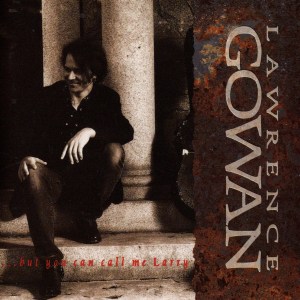
 LAWRENCE GOWAN – …but you can call me Larry (1993 Anthem/Columbia)
Lawrence Gowan was clearly making changes for his first album since 1990’s Lost Brotherhood. He was now going by his full name, Lawrence Gowan, though long-timers had a hard time not just calling him Gowan. He assembled an ace crew of musicians including Robert Fripp and Tony Levin from King Crimson, Ken Greer from Red Rider, Jann Arden, and drummer/producer Jerry Marotta, who goes back with Levin. The result is a more organic album playfully called …but you can call me Larry. The sound is pure 1993, in the best possible way.
Tinkling acoustics open “Soul’s Road”, a far cry from from the synthesizers of a decade ago. This great song soon kicks into gear on the chorus with the crackling electric guitars and the cry of a pedal steel (by Greer). It reverts back to acoustics and piano on the verses. Gowan employs just a touch of rasp in his voice for an earthy vibe. It has just the right balance between hard and soft. Great opening track, and should have been a hit.
“When There’s Time (For Love)” features Colin Linden on guitar, and stays in the acoustic zone. This slow song is loaded with melody and passion, and once again really comes to life on the excellent chorus. This is a ballad for a quiet night in, but it isn’t lifeless at all. The drums keep it moving, and the musicianship on all instruments is absolutely stunning. Such a full, rich mix. You can really feel the bass. That’s Paul Northfield’s mixing work, done at Morin Heights in Quebec, where the album was recorded.
Co-written with Jim Vallance, “Innocence” goes for a different vibe, with a tense little piano line soon giving way to a powerful chorus. Tony Levin shares bass duties with Terry Gowan, who is currently touring with his brother in Styx. This rocker still maintains a touch of acoustic guitar in the background, but this is a rock song with just a hint of nocturnal menace.
Back to ballad territory, “Your Stone Walls” has a folksy sound, beginning with minimal instrumentation and letting the acoustic guitar carry the weight. It gradually builds, adding organ and drums, but the folksy sound remains. It’s an exceptionally beautiful song, especially as it continues to grow into something more epic, with soulful backing vocals and keyboards.
Things really pick up on the moving “Dancing On My Own Ground”. Levin’s bass has a lot to do with why this one moves with such an incredible pulse. Upbeat and bright, this acoustic rocker is probably the album highlight for those who like feel-good music. There’s a violin solo to boot. Gowan’s music always includes outstanding musicians, often from the progressive rock genre. It’s no wonder he ended up in Styx with that kind of experience.
By contrast, “Cry On My Shoulder” is the opposite; a somber piano ballad. (Was the idea of having two “On My…” song titles in a row a coincidence?) This one features ample cello parts, and a stunning slide guitar part by Ken Greer.
Things go suddenly retro on “Moonchild’s Psychedelic Holiday”. Using sitar became more common in the early 9os, and of course that combined with the word “psychedelic” means we’re going back to the era of free love. There are only slight Beatles-isms incorporated, but Jim, both Hendrix and Morrison, are cited in the lyrics. It feels a little corny and contrived, but others may think it’s the best thing on the album. Enjoy some purple haze and see what you think.
The somber acoustics of “You Never Let Go” feels like we’re back on track. Yet, it’s poweful. The lyrics tell a tale of a friend, a bad seed, that Gowan can see the other side of. Even though it is mostly a quieter song, there is an undercurrent. A drive. A power. A tension. It’s all released at the halfway point when the electric guitars kick in. One of the more impressive songs on the album.
Larry goes upbeat again on “(In The) Wild Summer Night”. It never goes too hard or heavy, but this rocker has some rhythmic piano, great drums, and a bouncing chorus to keep the party going. If you can criticise …but you can call me Larry for anything, it would be that the album gets burning too rarely. There is nothing here as bouncing as “Strange Animal” obviously, but “(In The) Wild Summer Night” gets the blood flowing. The soul singing comes back for the outro, as the drums just light it up. Get out of your chair!
“Last Laugh” features Jann Arden, slide guitar, dobro, and hand percussion. This laid back acoustic song really breathes when Jann joins Lawrence on the second verse. Most songs on this album seem to have a feature or two that makes them stand out from the others. In this case it’s Jann Arden. Though it is not a loud song, it’s very powerful. “We’ll have the last laugh, now…” they sing.
Album closer “Little Face” is the one with Robert Fripp. Even so, I would have held this song for last anyway. It is meant to be a closer, with a tension that builds and builds as the song goes on. Impressive drums here, and a dark powerful vibe with exceptional guitar work by the King Crimson mastermind. A burning closer with a great chorus. “Little Face” is the cherry on top of an impressive record.
One look at the covers, front and back, and you know immediately that the design is by Hugh Syme. Hugh did a number of albums in 1993 with similar fonts and marble designs: Rush, Coverdale-Page, and Def Leppard too. In fact this CD layout is virtually identical to Retro-Active by Def Leppard. Hey, if it works…
4.5/5 stars
Thank you Aaron for this copy!


 mikeladano.com