Reviews

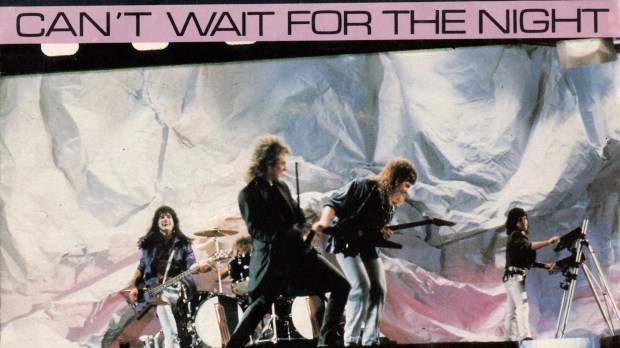
REVIEW: Brighton Rock – “Can’t Wait For the Night” (Remix) (1986 single)

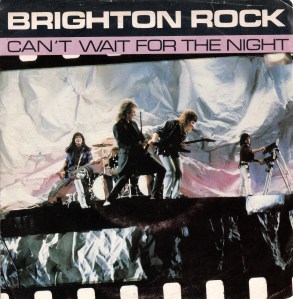
BRIGHTON ROCK – “Can’t Wait for the Night” (Remix) / “We Came To Rock” (1986 WEA single)

Niagara Falls’ Brighton Rock had a knack for rockers and ballads in equal measure.  Though “ballad” was often whispered as if it were a dirty word, Brighton Rock released a couple as singles over their career.  “Can’t Wait For the Night” was the first.  With a soft keyboard backing, the guitar melody by Greg Fraser sketches out the hook of the song.  Gerry McGhee shows a tender side to his voice, while unleashing the scream on the chorus.  His voice takes on a third texture as the chorus goes out, a grittier version.

On the 7″ vinyl format, the song was given a remix and an edit.  It was taken down from 4:25 to 3:56, and labelled as the “single mix with guitar solo”.  Presumably all that means is that the guitar solo wasn’t chopped for the edit, since the album version seems to have the same solo.  The edited music is mostly outro, and it’s hard to discern exactly what the remix adds.  Keyboards and guitars seem to be the same.  Vocal is the same.  But here it is; the “single remix with guitar solo”!

On the B-side is the rocker “We Came to Rock”, which to me was always the “first single” because of the great music video they used to play on Much.  This dramatic little number mesmerized us as kid.  It began soft and ballady, with keyboards and the sound of violins seemingly being plucked on the verses.  Then, Gerry McGhee released the beast that was his scream on the captivating chorus.  McGhee’s voice had tremendous diversity within single songs, and this is a prime example.  Finally you get to Greg Fraser’s solo, which as always was a composition unto itself.  This is the standard album version.  Simply awesome as-is!  It is one of those rare songs that is a treat to play on repeat.

This awesome little picture sleeve single isn’t hard to find nor expensive to buy.  Highly recommended.

4.5/5 stars

Tomorrow on a Grab A Stack Special Edition, new co-host Len Labelle and I go through our entire Brighton Rock collections. Don’t miss this!

REVIEW: Journey – Departure (1980, Remastered CD & 8-track) – Happy birthday Neal Schon!

JOURNEY – Departure (1980 CBS 8-track, Remastered 2010 Sony CD)
CD from the set 3 Original Album Classics

Changes were afoot in Journey, and alluded to on Departure.  Aside from the Japan-only soundtrack Dream, After Dream, this was the last stand for Gregg Rolie.  While he would also appear one more time on the Captured live album, he was not there for the new studio track included.  For all intents and purposes, Departure is his “last album”, to use an inaccurate but easy term.  For the man who once was Journey’s only lead singer, Departure only has one of Rolie’s lead vocals, and only two co-writes.  (In the discography, Departure directly followed 1979’s compilation of early material, In the Beginning, featuring early material and a large number of Rolie vocals.)

With Steve Perry leading the charge, Departure commences with the party anthem “Any Way You Want It”.  Those who don’t know it, know it.  It has been featured in the Simpsons, twice!  A rare honour, and mega-exposure, for good reason.  Perry’s impeccably arranged chorus is irresistible.  Rolie’s organ is the perfect accompaniment to keep in the realm of classic rock and roll.  Of course Schon’s solo is also tasty as heck, but this song is know for its party-hardy chorus.  For those who like to dig deeper, Ross Valory’s pulsing bassline goes underappreciated today, and Steve Smith’s smooth cymbal work is often taken for granted.

A surprising twist is taken on track two, the laid back blues pulse of “Walk Like A Lady”.  Sounds like Smith is playing with brushes, and Neal really plays it classy.  Then, a jab of organ and the players are off to indulge themselves.  “Oooh yeah!” shouts Perry, as if enjoying the jamming himself.  Soulful harmony vocals by the band really take this out on an authentic note.

Third song, third musical direction:  power balladeering!  Rolie sings a duet with Perry backing him on “Someday Soon”, a melancholy but punchy ballad.  Though it was not a single, perhaps it should have been.  There’s a cool, unique angelic vocal section near the end that nicely complements Steve Smith’s drum fills.

“People and Places” is like an exercise in creative vocal arrangements, if not showing off.  Neal Schon sings lead with Steve Perry on this complex track.  It’s more like the Dream, After Dream material than a lot of Departure.  If only the modern Journey were unafraid to create more unique music like this.  It still has room for a powerful melody and some warming cascades of guitar.  This song moves directly into “Precious Time”, which has a vibe like the still-in-the-future track “Liberty”.  Lyrically it foreshadows the “Line of Fire” on side two, and also has Rolie on harmonica.  It turns into a more typical Journey rocker by the midpoint.  Lots of tasty Schon guitars to be savoured here.

Unusually for an album of 1980, Departure had 12 tracks:  five on the first side, and seven on the second.  This is where we’d flip.

The big concert rocker “Where Were You” kicks off the back end of Departure.  This one pounds the pavement with beats, riffs and boppin’ piano.  It too could have been a single, though it did open their concerts on tour.  Then, a completely different mood drops:  “I’m Cryin'” hits like a cold wave of grief, though not without its musical thrills.  Soon it’s over and the rockin’ “Line Of Fire” brings the party back.  There’s no better way to describe it than a fast, good time rock and roll song.  “So don’t go sayin’ Steve is a liar!” warns Perry to some young lady who done him wrong.  “Bye bye bye Susie, so long girl!”  (He sure got over what was bothering him on “I’m Cryin'” pretty fast.)  Take note of Schon’s technical solo work here.

“Departure” / “Good Morning Girl” is softly progressive, with strings and light guitar, and little else.  This is over quickly, and then it’s the ballad “Stay Awile”, one of the sweetest songs Steve Perry or Journey have ever done.  Once again, listen to the bass and drums for a different perspective.  Perhaps the only thing better than Perry’s lead vocals are when he does it live.

Fortunately, Journey had the wisdom to end the album on a rocker:  “Homemade Love”.  Some of Perry’s worst words accompany some of his most acrobatic singing.  Still, at least it’s a good jam to go out on, with some fretboard burning fingerwork by Neal.

Interesting, the 8-track tape might have what would be called a bonus track here:  a reprise of “Line of Fire”.  It’s here mostly for timing reasons; there are no songs split between tracks anywhere on this album.  So, 8-track buyers got an uninterrupted listen, plus a reprise of “Line of Fire”.  Information is scarce, but it would be fun to hear the tape this way,

On remastered CD, we got some slightly more interesting bonus tracks than 8-track offered.  “Natural Thing” is a bluesy B-side, which was later released as the B-side to “Don’t Stop Believin'”.  Chronologically though, it is from this era and is as strong as any similar material on the album.  Funny how some tracks don’t make the cut when others do.  If you were told this was a standalone single, you wouldn’t have a reason to doubt it.  The CD also includes “Little Girl” from Dream, After Dream which is a difficult album to find and Rolie’s studio farewell.  It is a string-laden power ballad, very progressive, and far darker than anything on Departure.

Departure features an unusually rougher sound than other Journey albums.  The production seems unpolished despite the complexities of some tracks, with the vocals sometimes occupying a strange space that’s not quite in front of the music.  Still, a classic album is a classic album and there are so few flaws with Departure that it’s easy to dismiss them all.

5/5 stars

REVIEW: Slaughter – Stick It Live (1991 EP)

SLAUGHTER – Stick It Live (Chrysalis EP, 1991)

Slaughter were hot on the heels of their self-titled debut with a quickie live EP.  They were on the road so long, they still touring while the EP came and went on the front racks of the record stores!  The band were on fire in 1990 and 91, and Stick It Live was necessary to satisfy demand for more Slaughter.  However…

I absolutely hate listening to a live album when you can hear two or three tracks simultaneously of the lead singer.  Here, you can hear several Mark Slaughters singing together at once. Come on, Slaughter. We’re not stupid. And the thing is, from seeing them live opening for Cinderella, I know they don’t need the overdubs. The review that I wrote for my school paper at the time said, “Mark Slaughter has proved that his high-pitched wail is not studio trickery.” Well, you can’t tell that by this live EP!

Take the opening track, “Burning Bridges”. At several points you can hear several Marks singing at once. Why was this done? Did the live recordings suck?  Was it because the record company forced it?  Or because it was the fashion at the time?  I dunno. A live album (or EP) is an historical document, so too many bands feel they have to make them “perfect”. When in reality, perfect should have been as-is.  Documentary style.  My favourite live albums are often bootleg quality.

“Eye To Eye” follows “Burning Bridges”, opening with some stupid Crue-esque spoken word bit about an “ancient book of wisdom” and other unrelated nonsense. It’s a shame because “Eye To Eye” was one of their best songs. Once the song gets going, it’s fine, but you can still hear two or three Marks on the pre-chorus.  From there it’s into rote versions of the two big singles, “Fly to the Angels” and “Up All Night”.  The set ends with a high octane “Loaded Gun”, their album closer as well.  One issue to the overall listening experience is that the songs fade in and out, which may or may not be to your taste.

One fascinating note:  Mark goes out of his way to tell the audience that “Fly to the Angels” was not about suicide because “it sucks”!  Judas Priest were fighting for the musical lives in their infamous “suicide trial”, and Ozzy Osbourne was dealing with similar accusations of promoting suicide to the young and vulnerable.  An interesting artefact of 1990-91.

2/5 stars. A pretty fine live set otherwise spoiled by the dreaded studio trickery.

REVIEW: Pat Metheny – Bright Size Life (1976)

PAT METHENY – Bright Size Life (1976 ECM)

The eight tracks that make up Pat Metheny’s debut album Bright Size Life are exactly what I was looking for.  They hit the spot.

One Saturday afternoon in the summer I was enjoying instrumental jazz on the front porch.  I wanted more, and was recommended Bright Size Life by jazz enthusiast Robert Lawson.  The presence of the legendary Jaco Pastorius on fretless bass made me more intrigued.

From the very start of the title track, we’re treated to smooth, rich guitar tones and melodies.  Drift back, but not too far, because the lyrical basswork of Jaco deserves your full attention.  From harmonics to chord bending, his basswork is thick with technique.  Little waterfalls of notes splashing here and there.  Though sometimes fast and unpredictable, it always settles back into the groove of the song.  Meanwhile, Bob Moses on drums paints a picture with cymbals.

Bright Size Life is warm but sparse, featuring a basic jazz trio with Metheny playing both six and twelve string guitars.  His fingers dance a dance of tone and texture.  The melodies he plucks are challenging with unexpected notes and runs dotting the landscape.  The drums are often light and the cymbals bright.  Jaco’s bass is usually telling its own story.

You can hear the influence on instrumentalists since.  The guitar is the main focus, and it is always delivering interesting melodies to and fro, rarely repeating but always exploring.  It’s a clean, clear sound with richness and natural depth.  On some tracks, Metheny plays it slow and relaxed, on others like “Missouri Uncompromised”, it’s a race with Pastorius and Moses neck-and-neck.  Yes even so, an unexpected melody darts in here and there, keeping you on your toes.  Speed is employed effectively but not exhaustingly.

Top track:  “Midwestern Nights Dream”, a suitably noctunral beauty with smoke and atmosphere.  A Jaco bass melody dominates the second half to delicious effect.

5/5 stars

VIDEO: Unboxing Amazon, and Gift from Slam Glory & Marco D’Auria

They say if you do anything, it has to be on camera these days. In this case, I agree.  In this video you will see:

  • A generous gift from Marco D’Auria and Slam Glory received with genuine warmth.
  • Some remastered glam/”hair” metal, in preparation of an upcoming episode of Rock Daydream Nation with Peter Kerr.
  • A Japanese import of the Durling pursuasion.
  • Gratitude.

I still can’t find the words so “thank you” will have to do for now.


REVIEW: Dudes – The Original Motion Picture Soundtrack (1987)

A collaboration with Jex Russell – check out his review of the vinyl by clicking here.

DUDES – The Original Motion Picture Soundtrack (1987 MCA)

Every collector is different.  My time is a valuable commodity, so when I buy movie soundtracks made up of mixed songs, I generally only play the songs by the bands I like, and I may never hear the rest of of the album.   So it came to be, I have never played the Dudes soundtrack, despite owning it almost 30 years.  I don’t know the premise of the movie either.  All I know is the old Keel music video for “Rock ‘N’ Roll Outlaw” featured some of the movie footage, starring Jon Cryer, Flea, and Mary Catherine Stewart.  It was clearly a comedy.  Back then, they didn’t tell you what movie or album a video was from, so I never knew the movie was called Dudes until I saw the CD physically.

I bought this disc at the Record Store in 1997 mostly for Keel, W.A.S.P. and Steve Vai.  One look at the cover and I said “This is that movie with the Keel song!  I recognize those two guys!”  And so it was.

The Keel video commences with a stern warning from a police officer: “You know, maybe this wouldn’t have happened if you looked like normal folks.”  He scolds a hilariously punky-looking Jon Cryer.  We know what kind of movie this is without seeing it.  (Lee Ving of Fear is also in the film.)

“Rock ‘N’ Roll Outlaw”, produced by Kevin Beamish, is the opening track.  It’s loaded with attitude and a cool riff, backed by electric slide guitar.  “All I need is a rock and roll band, and somewhere new to play!” howls Ron Keel, a distinct singer that never achieved the level of success he was due.  There’s a dual solo, with Marc Ferrari comedically using a pistol as a slide in the music video.  “Rock ‘N’ Roll Outlaw” is one of Keel’s top tunes, and it wasn’t on their album.  The drums are recorded a little clanky, but otherwise this tune is top-notch road rock.

I have never listened to the Vandals, as far as I know, in my life until this moment.  “Urban Struggle” begins with a mock Indian war beat, and a mutation of The Good, The Bad, And The Ugly theme.  It’s a joke song with cowboy-themed lyrics in a mock accent, and then going into a punk western style, and words about mechanical bulls.  Not a song I’ll be coming back to.

“Show No Mercy” by W.A.S.P. (produced by Mike Varney) is more my speed.  A non-album track, it hearkens back to early W.A.S.P.  The lineup pictured inside was the current W.A.S.P., including Johnny Rod and Steve Riley.  The actual track is from an earlier lineup with Tony Richards and Randy Piper.  As such, it sounds exactly like the first album, and having more tunes with that sound is never a bad thing.  It is a smoker, and Chris Holmes’ familiar guitar sound is welcome in my ears.  This song easily could have been on the album, if not used as a single.

Simon Steele & The Claw don’t seem to have released much music over the years.  Shame.  “Vengeance Is Mine” is a traditional metal gallop.  The vocals are decent, usually occupying a low John Bush-like growl, but occasionally releasing into a scream.  There’s an awkward key change midway through, but the pace remains relentless throughout.

Megadeth’s jokey cover of “These Boots Are Made For Walkin'” was on their first album as “These Boots”, but this version is slightly longer.  Produced by Paul Lani, it is a different recording from the album version by Dave Mustaine and Karat Faye.   It remains as entertaining as ever.  It may as well be an original if not for the lyrics.  You’d never think it was “These Boots” if it was purely instrumental.

A complete change of pace is the pop rocker “Time Forgot You” by Legal Weapon.  Apparently they were primarily a punk band, but this is a really cool mainstream 80s rock track that could have been a big hit on radio if circumstances allowed.  Singer Kat Arthurs is a breath of fresh air after the grit of Mustaine!  This is the hidden gem of the album, with a strong bassline and catchy, well-recorded stabs of shimmering rhythm guitar.

“Jesus Came Driving Along” by Swedish band The Leather Nun is like a gothic punk rock hybrid.  The vocals are recorded low in the mix and odd sounds are rampant, but it’s pretty cool.  It has a beat you can drive to, which might be the intent.

I was never a big Jane’s Addiction fan, but “Mountain Song” is a brilliant piece of swirly-whirly rock brilliance.  A big Jane’s fan told me at the time that he never heard this particular version of “Mountain Song” before, produced by the band themselves.  He considered it a rarity.  The riff to “Mountain Song” seems like it has been ripped off so many times over the years since.  There’s a Zeppelin-esque massiveness to it, but with a tribal beat, an 80s haze, and a howling Perry Farrell.  Utter musical magnificence.

Punk band The Little Kings have a very cool song here called “The Lost Highway”.  The exaggerated warbling mannerisms of the singer recall Elvis a bit, as the band chop out a greasy rockabilly sound behind him.  It’s hard hitting and unique.  It goes breakneck for a moment, and then back into a rockabilly groove.

A short instrumental from the movie score, “Dudes Showdown” has twangy guitar, and tense synth backing.  It certainly sets a scene.  It sounds like a setup for a climax.

The final song is almost a coda.  It’s Steve Vai’s rare rendition of “Amazing Grace”, which he has since released as part of his Secret Jewel Box collection.  At the time however, it was one of those scattered one-off rarities.  Vai goes surprisingly delicate here, with heavy, dreamy guitar effects and a very experimental arrangement of the traditional music.  Steve used to say, “Sorry, I can’t help myself!” and here’s an example.  He couldn’t help doing something completely different.

And that’s the album!  Not bad actually, with only the Vandals track being the one I’d skip today.

4/5 stars


REVIEW: Grace Scheele – landings (2023 cassette, plus bonus tracks on Side B)

GRACE SCHEELE – landings (2023 EP – cassette side two – bonus tracks)

Last year we reviewed Grace Scheele’s concept tape about the moon landing called, bizarrely enough, landings!  Today we listen to the three bonus tracks that make up side two of the tape.  For your convenience, the original cassette review is included below.

Grace loves the cassette format and understands the desire to own physical music.  Therefore, she was wise to include bonus music on side two.  If you want to hear this, you have to be one of the folks who own a cassette, of which I have two.  There are three bonus tracks on the B-side.  Check out these titles:

1.  “- – – – – – – – – -”  (10:16)

2.  “pu-sil-lan-i-mous” (7:46)

3.  “cachinnate”  (3:48)

The first bonus track (I’m gonna call it “lotsa dashes”) features flute-like keys to open it.  This relaxing piece is enjoyed best with eyes closed.  The time actually flies despite its length.  This is vastly different from the music on the A-side which largely featured soundscapes and space sounds.  This is just notes: pure music, and it sounds largely improvised.  It’s like a lovely backdrop to a quiet night, drifting along to a book of your choice.  (Something science-y would be good.)

Bonus track #2 “pu-sil-lan-i-mous” is in a completely different direction from the first.  This time, the harp takes its time entering the scene over some gentle keys.  But that harp ain’t gentle at all!  With an abrasive scream, the calm is violently pierced by an instrument you do not associate with violence.  It continues to tickle the ear in unexpected ways.  A bassline underlines the music while Grace makes her harp speak, and even sound like feedback.

Percussive sounds introduce the third track “cachinnate”, and strings pluck away satisfyingly while loops ebb and flow.  This is the most “traditional” sounding harp piece on the tape, but electronics take it to another unexpected level.

This music is for those who want to be challenged every once in a while.  This is for the curious, who want to hear the lengths to which you can take a musical instrument without breaking it.  Grace Scheele’s landings is a remarkable release, perfect for open ears or ears that wish to be opened!

The original review for Side A is below.


From Grace’s bandcamp page:

“landings” centres on the real and imagined experience of the Apollo 11 mission to the moon; wielding bowed harp, electronic fx, and sampling from speeches, newsreels, mission audio, and NASA’s own interviews with those present at the historic newscast.  Ranging from the ethereally ambient to grinding, jarring industrial noise, the seven tracks across this debut EP represents an imagined journey into the darkness of space.

I’d call it a concept EP, based on that alone.  It’s a real listening experience, with elements that remind me of Pink Floyd, Star Trek, and War of the Worlds.  Some of the speeches and dialogue will be familiar, others will be novel.  There are sounds that, in my limited experience, I didn’t know you could make with a harp.  At 22 minutes,  is easy to digest in a single sitting, and the download comes with a “gapless version” that enables just that.  The layers of harp, samples, and electronic sound build, painting a sonic picture.  You can feel the tension of the launch!  I bet this sounds great with headphones.

The track “pomposity” has been getting some exposure, so if you only check out one track, try “pomposity” for a taste of what this is like.


Each tape comes in chromed silver with white printing — absolutely stunning!  They also come hand-wrapped in aluminium foil, and packed with personalized goodies.  Mine came with stickers, hand-drawn art, and even a package of Pop Rocks candy.


4.5/5 stars


Tune in this Friday on Grab A Stack of Rock for a special cassette episode with one of Grace’s teachers, Dr. Kathryn Ladano!

VIDEO: The Kiss Trivia Kollection – KISS – For The Konsummate Kiss Konnoisseur – The Might and Magic of Kiss

NOTE:  Thanks to viewer LEN LABELLE, we now know this insert came in a magazine called The Might and Magic of KISS!


Here’s a late Christmas gift that got lost under a couch!  What is it?  I dunno, but it’s called The Kiss Trivia Kollection – KISS – For The Konsummate Kiss Konnoisseur and it dates back to the Crazy Nights era of Kiss.

This trivia book has black and white photos by Mark Weiss, from several eras of Kiss. There are Q&As with all four members, memorable quotes, key dates in Kisstory, and of course, trivia. There isn’t much information about where this book originated, but we take a quick look at it in the video below.

THREE-VIEW: Eric Carr – Rockology (2000/2023 RSD reissue)

ERIC CARR – Rockology (2000 EMI/2023 Culture Factory RSD CD release)

This release provoked a bit of controversy early in 2023.  Vinyl fans and collectors were pleased that Eric Carr’s collection of unfinished tracks, Rockology, was being reissued on LP.  They were doubly elated by the retro-1970s cover art that fit in with the original 1978 Kiss solo albums.  It even came with a poster to match the original four solo albums, and the CD was printed on a disc replicating a vinyl look.  The packaging, with obi-strip and brilliant black and orange coloration, looks sharp.  They even threw on five extra bonus tracks that weren’t on the 2000 release or 2011’s Unfinished Business.

Unfortunately, much like 2011’s Unfinished Business, the bonus tracks are hardly-listenable throwaways and castoffs that were never meant for public consumption.  What’s more, like all RSD releases, the LP and CD copies were so poorly distributed that fans were soon paying ridiculous amounts of cash on the second-hand market.  Music should be accessible and affordable to everyone, but this reissue was hardly worth it for what amounts to fancy packaging and five ragged unreleased tracks.

We’ll start this review by discussing the five bonus tracks.


Part One – the five bonus tracks

First up is a “long demo” of “Tiara”, a ballad from the original Rockology.  The original track was 4:28 and this “long” version is 23 seconds longer, but it is a completely different demo version.  It is much rougher and laden with occasional noise.  The lyrics are incomplete, as Eric improvises “do-do-do” vocals over  the instrumental opening.  Bruce Kulick provides overdubbed lead guitars, but sadly it sounds like a poor quality cassette.  This is the kind of thing we got too much of on the Unfinished Business CD.

Another “alternate demo” is next, of “Can You Feel It”, a song that Eric hoped Bryan Adams would cover.  Like “Tiara”, this demo is earlier and much rougher.  Similarly incomplete lyrics over a drum machine.  The liner notes claim it’s Eric Carr playing drums, but it’s obviously a drum machine.  Shoddy liner notes.

An “accapella” version of “Eyes of Love” is just a rough multitrack vocal take with no backing music.  It’s not the exact same vocal take used on the other demo version.  It is of limited enjoyment.  It doesn’t sound like there’s a pop guard on the microphone, therefore, lots of noise.

Finally, something we’ve really never heard before:  A 1967 version of the Beatles’ “Ob-La-Di, Ob-La-Da”.  This is a very rough sounding tape with lots of noise, but due to its age, we’ll allow.  It’s a fairly faithful take of the Beatles classic, with Eric on lead vocals and drums.  It features his band The Cellarmen and is the earliest Eric Carr recording yet to be released.  A difficult listen, but at least something of value.  You’d think they could have used AI noise reduction to get rid of that crackling sound.

The last of the five bonus tracks is a 1974 original called “Stranger” by his band Creation.  Eric is on drums alone this time, with bandmates John Henderson and Sarita Squires (also the songwriters) singing lead.  It is a decent soul-rock song and one of the better sounding recordings.  Though the drums are not the main feature of the song, and buried back in the mix, you can hear Eric’s personality shine through his fills.


Part Two – the original album (review posted 2018/06/19)

The late Kiss drummer Eric Carr was frustrated towards the end.  He was writing good material, but it was always being rejected by Paul and Gene.  In the press, Eric would tow the company line and explain that everybody else had such good songs, that there was no room for his.  In his heart, he was hurt and felt shunned.

Eric Carr wasn’t just a drummer.  He could sing lead, and he could write.  Kiss’ single “All Hell’s Breaking Loose” was an Eric idea.  He co-wrote “Don’t Leave Me Lonely” with Bryan Adams.  Although his writing credits on Kiss albums were sparse, he had plenty of material in the can.  2000’s Rockology is a series of those demos, some in a near-finished state and some left incomplete.  Much of this material was intended for a cartoon Eric was working on called The Rockheads.  10 years later, Bruce Kulick finished recording some guitar parts and mixed it for release.  He also wrote liner notes explaining the origins and Eric’s intentions for each track.

Eric didn’t have a particularly commercial voice, falling somewhere south of a Gene Simmons growl.  There’s no reason why Gene couldn’t have sung “Eyes of Love” from 1989, which has more balls than a lot of Hot in the Shade.  This demo has Eric on drums and bass, and Bruce Kulick on guitar with a solo overdubbed in 1999.  It doesn’t sound like a finished Kiss song, but it could have been tightened up to become one.  Same with the ballad “Everybody’s Waiting”.  It sounds custom written for Paul Stanley.  But it was 1989, and nothing was going to displace “Forever” from the album, nor should it have.

Many of the demos have no words.  “Heavy Metal Baby” features Eric scatting out a loose melody.  This heavy and chunky riff would have been perfect for the later Revenge album, had Eric lived.  In a strange twist, several of the best songs are instrumentals.  The hidden gem on this CD is the unfinished “Just Can’t Wait”.  It could have given Journey and Bon Jovi a run for their money.   Eric, Bruce and Adam Mitchell wrote it for Crazy Nights, and you can almost hear a killer chorus just waiting to leap out at you.  This potential hit could have been the best song on Crazy Nights, had it been finished.

“Mad Dog” has nothing to do with the Anvil song of the same name.  The chorus is there but the verses are a work in progress.  This hard rocker from 1987 was probably too heavy for what Kiss were doing, though it would have added some much needed groove.  “You Make Me Crazy” is in a similar state of completion and boasts a tap-tastic solo by Bruce.  Apparently this demo was originally called “Van Halen” and you can hear why.  Two versions of a song called “Nightmare” exist, including a really rough one without drums.  This incomplete song could have really been something special.  It has a dramatic feel and different moods, and was probably too sophisticated for Kiss, though any number of 80s rock bands would have been lucky to have such good material.

The last batch of tracks show off the Rockheads material.  Whether Eric’s cartoon idea ever would have happened or not, the advent of bobble-heads and Pops would have made marketing easy.   The songs are virtually complete though the drums are programmed.  “Too Cool For School” is a little cartoony, which is the point, right?  For keyboard ballads, “Tiara” showed promise.  It’s not the equal of “Reason to Live” but it demonstrates a side to Eric unheard before.  Next, Bruce says that they always wanted Bryan Adams to cover “Can You Feel It”.  It would have fit Adams like a nice jean jacket.  Not that Adams really needed the help, it would have been awesome on Waking Up the Neighbors.  The set closes with “Nasty Boys”, nothing exceptional.  It sounds like a song called “Nasty Boys” would sound…or anything by 80s Kiss really.


Part Three – the packaging and remastering

The selling point for the majority of fans for this reissue was the packaging.  The original cover featured Eric in 1989 or 1990, obviously without makeup.  The new version is designed to look like an Eraldo Caragati portrait matching the first four Kiss solo albums.  It does, after a fashion.  It doesn’t have the depth or realism of a Caragati, but it matches.  The aura colour is orange.  Inside, there is a poster that similar recalls the original four from 1978.

The liner notes from the original CD release are missing.  This is unfortunate.  As such you don’t get the stories or context or knowledge from Bruce Kulick about the background of these songs.  Instead you get a CD that looks like a record.  This is pressed in black plastic, and has actual ridges on the face side that look like record grooves.  The play of the CD is inhibited in no way by this.

The remastering is much louder.  It does sound like somebody messed with the tapes.  “Eyes of Love” sounds like it has more echo on the drums compared to the original.  Is this due to more echo being applied, or more being audible due to the raised volume?  Possibly just a listener-induced effect, but it does sound different.


If you want but don’t have Rockology yet, seek out the reissue.  If you’re dying to make a display of the five lookalike solo albums, get the reissue.  If you don’t feel like listening to rough demos with tape crackle bonus tracks, run away like a fox.


Original score: 3/5 stars

Reissue value:  1/5 stars

Original mikeladano.com review:  2014/04/24

MOVIE REVIEW: Mystique – Standing On the Firing Line (2022)

Note:  This review is of the new 96 minute cut of Mystique – Standing On the Firing Line. 

A collaboration with Jex!  For Jex Russell’s review, click here!

MYSTIQUE: STANDING ON THE FIRING LINE (2022, 2023 edition)

Directed by Marco D’Auria

“EPIC METAL” – Martin Popoff

They had the raw talent to make it.  They just needed a break.  They didn’t get it, but what they achieved instead was a legendary status with a handful of priceless releases left behind.  They were Mystique, a progressive heavy metal band from Hamilton Ontario.

Standing On the Firing Line is a 2022 documentary film by Marco D’Auria, finally shedding light on the history and music of this lesser-known band.  They always deserved more attention, and hopefully the film brings them that.  From the first shots of the band, the music of “No Return” assaults the senses with chopping riffs and unholy screams.  Why didn’t they make it?

The main driving force of Mystique from their beginnings to their demise were opera-trained singer Ray D’Auria (originally from Naples Italy), and perfectionist drummer John Davies, who had spent time in a few hard rock bands before Mystique.  Many other talented members joined and enhanced them along the way, but it was Ray and John who were there ’til the end.  The two met up when John auditioned for Ray’s band, Orion.  A friendship was formed, but the band wasn’t paying them the money they were owed.  They split as a pair and didn’t waste time starting their own thing.  15 year old Dave Dragos was a shredder – rated 2nd best in Canada at the time – and was first on board.  He introduced them to bassist Mark Arbour (a mixture of Geddy Lee and Chris Squire), and a solid band was formed.  A 1984 basement tape of “Black Rider” shows the nameless band had the goods.  It was Ray who blurted out “Mystique”, which felt right.

They found a rehearsal space, and added keyboardist Victor Barreiro.  The band practiced hard, and pushed each other to improve as musicians.  Davies tended to handle the business side, but they were attracting attention to themselves.  They found a manager (Ted Smirnios), money was borrowed, and songs were improved upon, until they were finally in shape to record.  Primitive but technically inventive tracks were recorded on 1/2″ tape, on a 16-track desk.  Not the best for sound quality, but good enough to get the songs down.  They went as far as to butcher a classic Leslie speaker to get a driving keyboard sound.

A stoned viewing of the animated Lord of the Rings movie captured John Davies, and inspired the song “Black Rider”.  The band had a sort of gothic bent in the mid-80s, but Ray D’Auria’s voice was appropriate for this progressive style of metal.  Journalist Martin Popoff remarks that the keyboards brought them into that progressive world.  Melodic guitar/keyboard solos took time to work out.  They were unafraid to play ballads, which Martin compares to a vintage Judas Priest dirge.  Mystique were a serious band!  The Black Rider EP impressed their peers for the playing if not the sound.  Popoff heard a strong Maiden influence, but compares more to Armored Saint and Odin with elements of power metal.  1000 copies were sold, an impressive amount.  Their manager got it as far away as Greece, and even accidentally set himself on fire as part of their stage show!

The band were doing well but dreams were not exceeded, and eventually members left for greener pastures, leaving Ray and John to rebuild.  Bizarrely, they met a talented French guitarist named Eric Nicolas in Jackson Square, and went to France to record their next demo:  1987’s I Am the King.  They struggled with the language barrier, and were recording digitally for the first time.  Ray blew everyone away with the “God note” that he held in “I Am the King”.  They were offered a record contract with Elektra in France, which didn’t pan out.  They brought the tapes home to Canada for release.

They added a new bassist, Les Wheeler, and evolved from metal to “hair”.  “The explosion in the costume factory look,” as described by Popoff, of their new extreme look that didn’t match their music.  “It looked good, from a distance,” jokes Ray.  Teenage girls loved their posters though!  Unfortunately having a guitar playing living in France was a barrier.  Wheeler broke his wrist in an accident.  A new lineup formed.  They felt forced to go more commercial, which resulted in the 1988 Poison-esque single “Rock and Roll Party Tonight”.  It was vastly different from “Black Rider”, but they went straight from that to recording a proper album, funded by EMI.  They taped 11 to 12 songs…but the album was never released and is partly lost today.  The masters tapes were sold and erased.  There were some good songs on that tape.  Ray, however, looks back at their change of direction as a mistake.  More shuffles in band members caused long breaks in activity, and the writing was on the wall.  Ray no longer identified with the music, and was the one to leave.  By 1989, their music was out of date anyway.

Manager Ted Smirnios is given a tremendous amount of credit for making Mystique happen.  It’s a touching part of the film.  The band members went their separate and sometimes surprising ways, but the story never really ends so long as people keep discovering the music.  Their releases are now valuable collectables today, worth a small fortune on the second-hand market.

Rare live clips and candid photos really bring an intimate look at Mystique.  You feel like you get to know the personalities.  This new edit of the film cut a substantial amount of footage, mostly interview footage with people who were there at the time.  The movie gains better pacing from this, as it just flies by in no time.  A new ending to the film brings us to the present day, and the movie’s theatrical premiere in front of a cheering audience.  The original cut might be considered for more hard-core viewers who want that “feels like being there” experience, but the current 96 minute edit is better for the enjoyment of Mystique.  It’s a much tighter and more direct story.  There is still plenty of unreleased music and vintage images.

Stay tuned for the mid-credit scene!

4.5/5 stars