The Meat Challenge: Listen to an album we’ve never heard before, and write about it while listening for the first time on headphones. I was given Drama by Yes.
YES – Drama (1980 Atlantic)
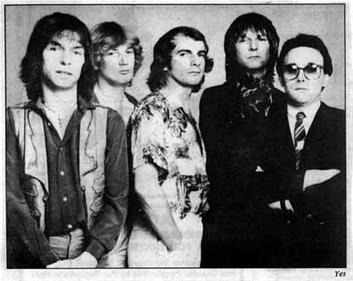
Because context is always important, a quick glance at Wikipedia tells us that Drama the first Yes album “to feature Trevor Horn as lead vocalist, as well as keyboardist Geoff Downes. This followed the departures of Jon Anderson and Rick Wakeman after numerous attempts to record a new album…Drama was recorded hurriedly, because a tour had already been booked before the change in personnel.”
Heavy-footed “Machine Messiah” begins like a metal epic, with a dense, galvanizing guitar riff, and then goes through multiple lighter sections of acoustics and keyboards. Regal and bouncy, “Machine Messiah” is uplifting despite (and because of) its complexity. Clouds form about halfway through the song, darkening the landscape, but that guitar returns for second round. Tricky bits are three-dimensional, snakelike and winding, but satisfying. An enticing start!
After a 10 minute opener, you’re fairly warmed up for anything, but “White Car” is surprising nonetheless for its lushness and brevity. It sounds like there should be more, but then Chris Squire brings the bass of “Does it Really Happen”, reminding me that he’s truly one of the all time greatest four-stringers in history. His fingers gallop. What a crisp, tight bass sound. Hard to describe this track — it moves, and it’s full, but not immediate. Builds nicely up with organ, vocal layers and guitar chords though. I dig the bass licks right after the false ending. Chris Squire was the man!
Drama‘s second side starts with “Into the Lens”, and another bass pulse by Chris Squire. Bouncing from section to section, it’s hard to pin this song down to one style. It’s easy to say it’s great though. It’s a big song, always interesting and going someplace. From the camera lens, we “Run Through the Light”, opening with gentle acoustic picking and elegant singing. Then the electric guitar and keyboards lay down the hooks. This is my favourite song so far. Trevor Horn’s vocals are enticingly catchy with a Police-like chorus, but then there’s a squirrely and cool Steve Howe guitar solo.
We end the set on “Tempus Fugit”, the only track I was previously familiar with. Like a space race with time, this song goes into hyperspace with engines powered by Chris Squire. In a flurry, the album is over. Drama.
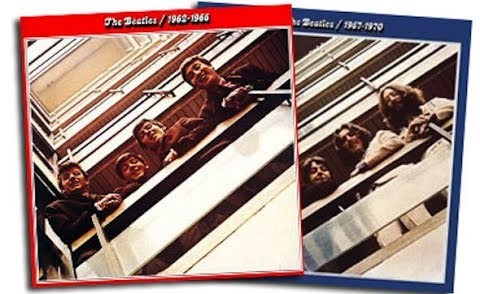
It was the second of April, 1973. EMI released two Beatles compilations simultaneously, the “greatest hits” to end all greatest hits. They were double albums, split up by era. Hence the titles 1962-1966, and 1967-1970. Nobody refers to them as such. Due to their packaging, fans simply call them the Red and the Blue albums.
This story is not about those albums.
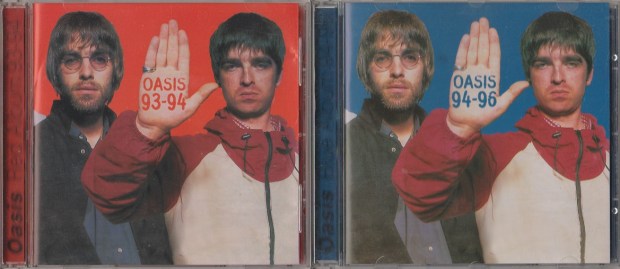
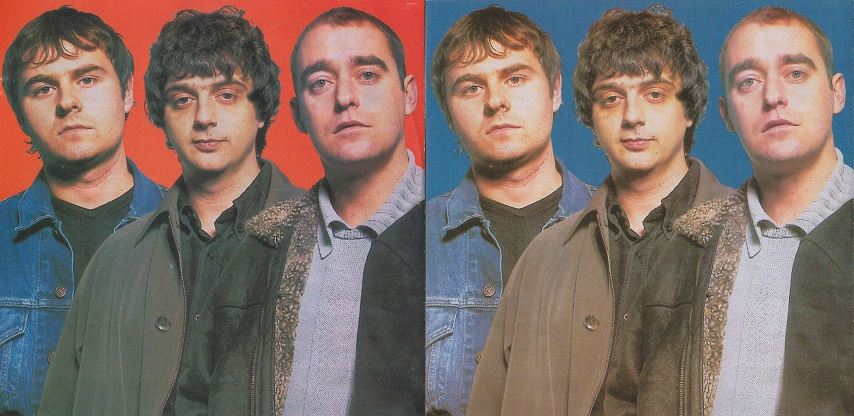
Of course, some cheeky bootlegger used a similar gimmick when compiling up all of Oasis’ B-sides and non-album tracks back in the late 1990s. The earliest rarities were lumped together on The Red Album 93-94. Everything beyond was on The Blue Album 94-96. The CDs had matching artwork and back covers that boasted “A complete and global anthology of non-album tracks”. And for the period, that seems to be generally true!
When I first got into Oasis, they already had plenty of singles and B-sides out there. Collecting them all was an intimidating prospect. Oasis singles were always chock loaded with quality unreleased songs. Unlike most artists, Oasis’ Noel Gallagher insisted that their B-sides were as good as album tracks. And they were — often better. My Record Store cohort T-Rev had a complete collection of singles, but was still missing a few other rare songs. While at a record show, we found the Oasis Red and Blue CDs. At $30 a pop they were still cheaper than trying to collect all the Oasis singles, with the added bonus of the songs T-Rev was missing! They were recorded for him immediately of course.
T-Rev preferred the Creation Records singles, which were the UK printings. My bootlegs were interesting to him, but not something he would spend money on. When I moved into his apartment for a few months in ’98, he could listen to my bootlegs whenever he wanted to anyway. He knew I was fussy about the handling of my music, and he was as well, so we could easily trust each other with our collections. It was a very easy situation because we both had total respect for each other’s music.
The two songs he didn’t have (yet) were only available in two official capacities. “Sad Song” was exclusive to the vinyl and Japanese versions of Definitely Maybe. Similarly, “Bonehead’s Bank Holiday” was exclusive to the same formats of (What’s the Story) Morning Glory. Neither of us had heard these songs before. What a joy to find that they were as extraordinary as the rest of Oasis’ B-sides.
Several other rarities couldn’t have been found just by collecting the regular Oasis CD singles. A demo of “Cigarettes and Alcohol” came from somewhere else, likely a compilation. The second version of “Fade Away” on the Blue Album with Noel singing was from a Warchild charity CD. A demo of “Some Might Say”, and the Beatles cover “You’ve Got to Hide Your Love Away” (lead vocals by Noel) were only on Japanese CD singles. These songs have since been reissued on official Oasis releases, but at the time, the value they added to these bootlegs was immense.
Still, a bootleg is never as good as an original. Sound is a problem on a couple tracks. “Up in the Sky”, “Sad Song” and “Whatever” have volume issues. There are also cute track-listing errors. “Round Are Way” is amusingly “corrected” to “Round Our Way”.
Oasis have done a commendable job of deluxe edition album reissues. Their first three albums have all been given triple disc deluxe CD upgrades. That renders the Red and the Blue bootlegs largely obsolete. There is only one song on the Blue Album that can’t be found on one of the deluxe Oasis reissues, and that is “Fade Away”, the Warchild version. It can, however, be found on the B-side to Oasis’ 1998 single “Don’t Go Away”.
There is some truly remarkable music on these CDs that make their occasional listening a recurring pleasure. Even some of the primitive early material like “Alive” and “I Will Believe” have true spark. By the time you get to the more polished side of Oasis, like “Whatever”, you’ve already been treated to a number of early Oasis classics. Live and alternate versions of “Columbia”, “Bring it On Down”, “Up in the Sky”, and “Supersonic” represent the best of Oasis’ early material. There is also the love-it-or-hate-it extended live workout of “I Am the Walrus”, all 8:20 of it.
The Blue Album is a consistently brilliant listen. So many incredible single-quality originals: “Acquiesce”, “Round Are Way”, “Step Out”, and “The Masterplan”. Any of these could have stormed the charts as an A-side. “Bonehead’s Bank Holiday” is decent too, though it sounds a bit of drunken fun. There are also the terrific covers of “Cum on Feel the Noize” and “You’ve Got to Hide Your Love Away”.
At the time, circa 1997, it was easy to justify paying a combined $60 for these two albums. T-Rev’s friend Paul “Geeza” thought they were pretty neat. Geeza was from England, and he visited Canada in the summers. T-Rev befriended him via the store. When he was back in Canada, he came over to the apartment and looked over our awesome CD collections. He was all over my Red and Blue albums. I made sure Geeza knew how I liked to take care of my stuff. He was respectful but teasing.
I had to go out. When I got back, Geeza and T-Rev were gone, but a note was left behind.
It was from Geeza. He teased that he took my Oasis CDs!
We lived in such a small place, they weren’t hard to find. I think the Red Album was under my pillow. The other CD took longer. It was just in good fun. I was probably pissed off for a minute or five, but who cares now? I get the joke now. Living with me must have been a little like living with Sheldon Cooper.
If a guy like Geeza, who was an absolutely madman for Oasis, was interested in the Red and Blue albums, maybe you should keep an eye open for them too. Don’t pay $30 each, but consider adding these eye-catchers to your collection.
OASIS – The Red Album 93-94 OASIS – The Blue Album 94-96
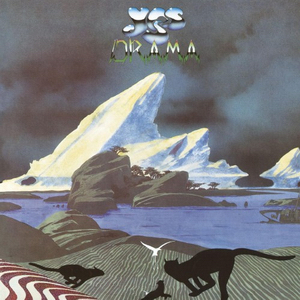 YES – Drama (1980 Atlantic)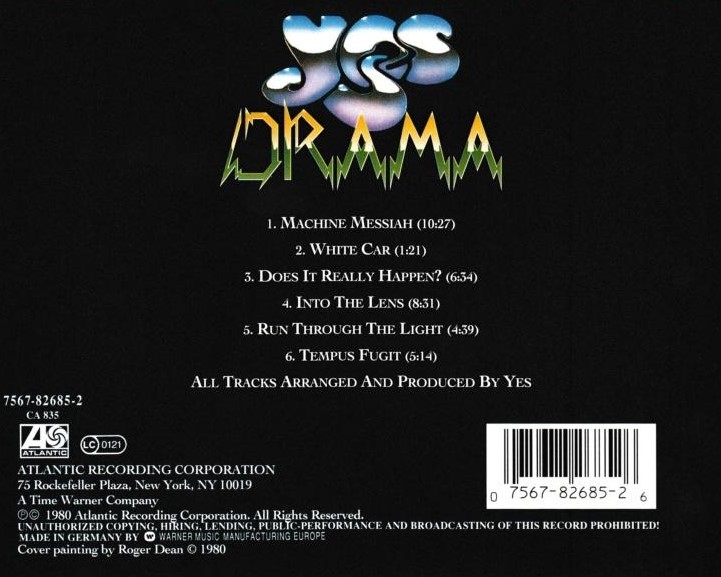



 mikeladano.com