
GETTING MORE TALE #492: The Golden Records
In 1977, two unique records were pressed that are literally out of this world.
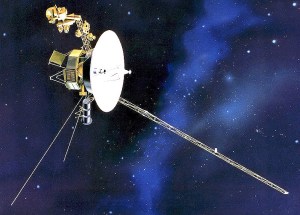 The Voyager space probes (1 and 2) were designed for exploration of our outer solar system. Never to return, the probes were built for the “Grand Planetary Tour”: a rare alignment of the outer planets that allowed the probes to use gravity to slingshot around and visit them all. The Voyager spacecraft transmitted to Earth some of the most breathtaking images ever taken. For the first time, Saturn’s rings could be seen up close, and surprised us with more layers and complexity (including the ‘F’ ring that is kinked) than anyone anticipated. Jupiter’s Great Red Spot was discovered to be a gargantuan storm, three Earths wide!
Although the probes were not really intended for long term scientific observations beyond their initial missions, their plutonium generators will continue to provide power for another decade. Clever scientists have managed to use the probes’ limited sensors to observe what goes on at the edge of the solar system. Both probes are now well on their way out of our home system, and into interstellar space. Once their generators die, they will go silent forever. They are now the furthest man-made objects from the Earth and will remain so forever, unless we find the money to invest further in deep space exploration.
Even when the Voyager probes finally go dark forever, their mission will still be ongoing. Both Voyagers were equipped with special antiquated technology that can tell alien civilizations a little bit about the troubled species that launched these probes in the first place. If an alien race ever finds our probes (the fictional Voyager 6 was found by a machine race in Star Trek I) then they will find the Golden Records.
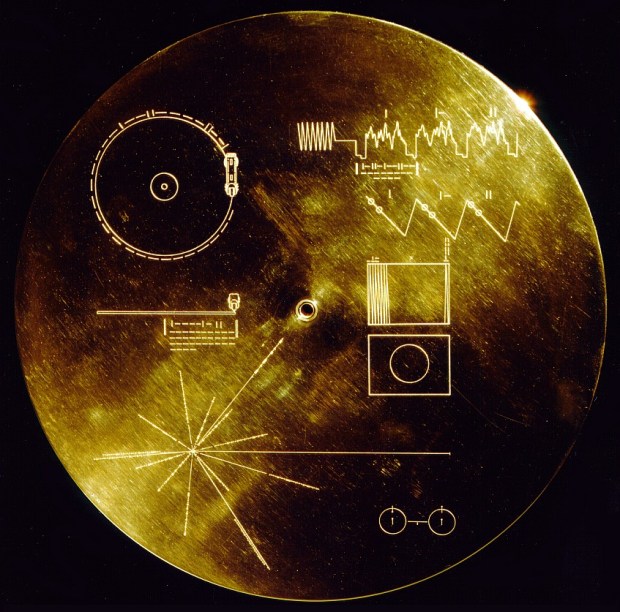
The Golden Records, surely the most priceless LPs in the universe, contain a wealth of information selected by a committee headed by the late Dr. Carl Sagan. Each record is encased in a gold sleeve. Included is a visual depiction of how to play the record, an easy task for an advanced race. Extracting sound from the grooves should be a simple process given the instructions. The needle and cartridge are already included. The records are made copper, plated in gold, one of the most corrosion resistant materials known to man.
What is included on the records? A variety of audio for one, designed to give a glimpse into human culture. First is a greeting in 55 Earth languages. Then, there are “Sounds of Earth”: birds, dogs, frogs, cars and trains, and more. Most interesting to music fans is the selection of compositions from around the world. There are 90 minutes of different pieces, including Chuck Berry’s “Johnny B. Goode” (USA), Bach’s Brandenburg Concerto (Germany), jazz and blues, and many kinds of world music. (The records are designed to be played at 16⅔ revolutions per minutes, enabling a longer play time.) In a classic example of record company stupidity, the Beatles were excluded from the golden LPs, because EMI wouldn’t let NASA use “Here Comes the Sun”. Perhaps they were afraid aliens would bootleg it without paying for it. (This serves as a fine case of EMI standing for “Every Mistake Imaginable”, as some artists refer to them.) After the music is an hour of brain wave recordings, of Carl Sagan’s wife Ann Druyan.
There are even 116 images encoded on the disc. Some of these are intended to help with calibration and interpretation. The rest are images of Earth: DNA strings, children, families, landscapes, animals, houses, cities, spacecraft and more. Tellingly, there are no images of one of human-kind’s most popular activities: warfare. Only good impressions were wanted, meaning the Voyager Records contain much false advertising. The images are encoded in the form of 512 vertical lines, in colour and black and white.
What if one wanted to listen to the rarest records in the universe? What to do then? Last year, NASA uploaded the audio contents of the records to SoundCloud. Now anyone on Earth with an internet connection and speakers can hear the greetings that we sent to the stars in 1977. Hopefully one day, someone else from another world will be able to listen as well.
Click here for the NASA SoundCloud page, and scroll down for the Voyager recordings!


 mikeladano.com