heavy metal

REVIEW: Deep Purple – Live at Montreux 1996 (2006)

The Deep Purple Project continues, from Blackmore to Morse!
Scan_20160128DEEP PURPLE – Live at Montreux 1996 (2006 Eagle)

One of the lovely things about collecting Deep Purple is how much the setlists change over the years.  “Fireball” was rarely played with Blackmore in the band, but with Morse, it opened much of the Purpendicular tour.  It did in Montreux in ’96.  Ian Gillan sounds ragged, but Ian Paice on the double bass drums kicks as much ass as he did in 1971.  This version lacks some of the fire (pardon the pun) of past renditions, mostly because Gillan sounds like he’s struggling a bit.  Roger Glover takes a slightly extended fuzz bass solo, always a treat, but it is Jon Lord on the keys who sets the place alight.  As it often does, “Fireball” ends with a brief snip of “Into the Fire” from In Rock.  Apropos, no?

“Vavoom: Ted the Mechanic” is one of Purple’s greatest triumphs of the Steve Morse era.  Typically for Ian Gillan, it’s about a character he met in a bar.  Followers of the choppy riffing that Steve Morse is known for will dig it, as the rest of us wonder just how the hell he does it.  “Ted the Mechanic” is just fun, so get up and dance.  You won’t have the chance to dance on “Pictures of Home”, one of the heaviest tracks from Machine Head.  Ian can’t hit the screams, but the band is on point.  Listen to Ian Paice swing!  Morse has no trouble welding one of his trademark solos onto this classic.  Another golden oldie, the single “Black Night” is reliable.  Morse and Paice are securely in the drivers seat, but there is no way a modern rendition of “Black Night” will have the adrenaline of the Made in Japan B-side version.  Just sayin’ — and that’s not a knock on Deep Purple today.  Just an observation.  Morse actually takes a very nice jazzy guitar solo that’s a little more laid back.

“Woman From Tokyo” continues the hit parade.  It’s never been Deep Purple’s most remarkable song, but you’d probably miss it if it were not in the setlist.  Gillan’s voice is shredded, probably from givin’ ‘er all night the day before!  I don’t necessarily mean on stage.  A Deep Purple collector will appreciate a live CD with the singer a little more rough than usual, but certainly a first time buyer wouldn’t.  The hit parade comes to a momentary halt, with some deep cuts.  “No One Came” is a treat.  It’s almost spoken word, so it doesn’t matter that Ian was having voice issues.  In fact they enhance the song.  It’s hard to find a live version of “No One Came” without the horn section they sometimes used.  This is the way I remember hearing it when I saw them in Toronto.  Raw, heavy, bouncy, slightly funky and fucking cool!  “When a Blind Man Cries”, the blues B-side of “Never Before”, is the next rare track.  They started playing this one when Morse joined the band, and what is remarkable is how the song is transformed by his hands.  He does not play like Ritchie Blackmore, yet both guys did amazing versions of this song.  Morse plays it spacey, with volume swells and heavenly tones.  The solo is unique to this version, and it’s one of a kind.  This extended take features a long Jon Lord keyboard intro.

Before they got back to playing the greatest hits, Purple performed the newbie “Hey Cisco”.  According to another live set I have (The 12 CD Soundboard Series which you will be reading about soon), it’s a song about Clayton Moore, who played the Lone Ranger.  An elderly Moore was legally barred from doing public appearances as the Lone Ranger, which Ian Gillan was quite upset about, but he couldn’t find the right words to go with “Lone Ranger”!  He changed the character to the Cisco Kid, but the story is the same.  “Can’t open no more supermarkets.”

“Speed King” is always a blast.  Jon and Steve have a beautiful play-off together.  Predictably the set ends with “Smoke on the Water”.   I’m quite fond of Steve Morse versions of this song.   Since it’s a tune they’ve played 3 billion times, it’s loose and free.   Later on, Steve started teasing out classic rock riffs such as “Whole Lotta Love” and “Crosstown Traffic” before “Smoke”, but not on this CD.  Interestingly, Gillan flubs the words!  “When it all was over, h-h-how could I refuse?  Swiss time was runnin’ out, see if we would lose the blues.”

The CD is slightly edited.   Played that night, but not on the disc, was “Cascades: I’m Not Your Lover Now”.  I’m sure between-song banter has also been edited.  Ian is known for his humorous song intros, and there aren’t many here.  Instead of the unedited show, they tossed on two bonus tracks from a 2000 Montreux show.  These are the incredible “Sometimes I Feel Like Screaming”, and the rarely played “Fools” from Fireball.  These are both long bombers, a combined 16+ minutes of bonus music.  Ian was in smoother voice in 2000, and this live version of “Screaming” has to be one of the best.  Then: “Fools”, one of the most impressive Deep Purple deep cuts.  Long, progressive and heavy, “Fools” represents Deep Purple at their very best.  Both Ians are in prime shape, with Paice winning the MVP award for his menacingly perfect rhythms.

3.5/5 stars

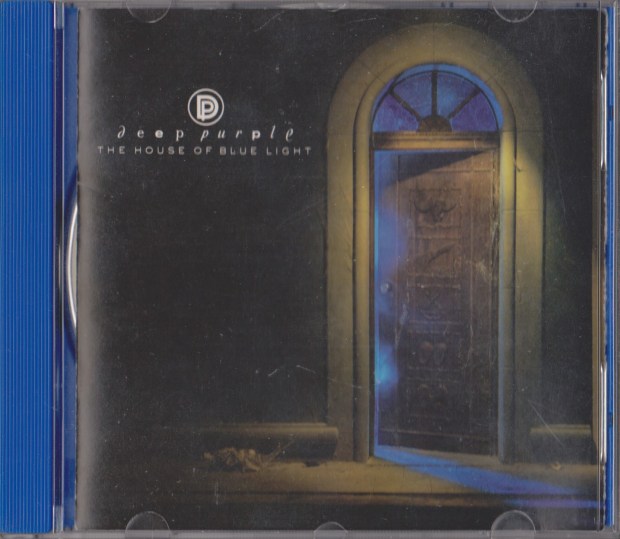
REVIEW: Deep Purple – The House of Blue Light (1987)

The Deep Purple Project continues!  Join me for the next week (plus?) and see more rock majesty than you can shake a purple stick at!

Scan_20160129 (4)DEEP PURPLE – The House of Blue Light (1987 Polygram)

The Deep Purple reunion was the success beyond what anybody hoped for.  The band had revitalized after many acrimonious years apart.  They were fresh and rejuvenated, and the resultant album Perfect Strangers was the proof.   If the live recordings are anything to go by, then the tour was also dynamite.   Obviously the next thing to do would have to be a second reunion album.

According to Ian Gillan’s autobiography Child in Time, things went south very fast.  He found Ritchie Blackmore increasingly difficult to work with, refusing even to record guitar for one song.  Gillan admits he was no treat either, so it was the band that suffered.  Ian compared Deep Purple to a beautiful meal, a plate full of gourmet perfection — that’s Roger Glover, Ian Paice and Jon Lord.  Ian and Ritchie were the fork and knife on either side.

The House of Blue Light (title taken from Little Richard via Purple’s own “Speed King”) was not a fun album for anyone to make.  Some hold it in high esteem today, such as renowned writer Martin Popoff, who rated it 10/10 in Riff Kills Man (as he did Perfect Strangers).  While I believe Perfect Strangers is easily a 10, I don’t find The House of Blue Light to be its equal.  The band may agree; none of its songs have been performed live since this tour.  That also just could be residual hard feelings.

There is no mistaking the organ of Jon Lord on “Bad Attitude”.  What an opening statement this is.  Just as strong as the best songs on Strangers, “Bad Attitude” rules.  It’s all about the spaces between, but Ritchie ensures there is a catchy trademark Deep Purple riff involved.  His solos are exotic delight.  Even in 1987, Purple weren’t afraid to load their single down with solos!  Jon Lord’s synths are perhaps more prominent than they were in ’84.  This is not a bad thing, because Jon Lord makes synth sound good.  Synth and electronics take center stage on “The Unwritten Law”, powerful both because of and in spite of it.  The pulse and beats give it a dramatic chase-like feel.  Its drum outro is very reminiscent of “Chasing Shadows” from album #3 in 1969!  It’s also the only Ian Paice co-write.  In the 80’s, instead of splitting the writing credits five ways as they always had, Purple changed to awarding individual credits (and royalties).  This led to petty squabbles and infighting.

“Call of the Wild” was a single and (pretty terrible) music video, and didn’t really make much of an impact.  Too bad.  It’s one of Purple’s more pop songs, but that’s just fine by me.  Purple have occasionally forayed into commercial songwriting, but have always done so with class.  This one sounds like a Rainbow song circa the Joe Lynn Turner years.  “Mad Dog” blows away all three of the previous songs.  With a killer, choppy Blackmore riff right up front, it sounds vintage.  Gillan gets to play some bluesy harmonica on “Black & White”, a good mid-paced groove but not an outstanding one.  Something like this needs a timeless Blackmore solo to drive it home, but the fire fails to light.

There’s a natural split between side one and side two, which still comes across on CD.  “Hard Lovin’ Woman” (supposedly a sequel to “Hard Lovin’ Man” from In Rock) is one of the few songs that was played live, probably because of its energy.  It has the pace of an old-school Purple rocker, but not the timelessness.  It’s largely forgettable and really only notable because it’s on the live album Nobody’s Perfect.  Back to regal sounding Deep Purple, “The Spanish Archer” could really have been something had they bothered to play it in concert.  It has a drama to it that is one of Purple’s strengths, but a lot of its strength is sapped by 80’s production values.  Glover’s bass doesn’t have enough meat to it, and there is a hint of electronic effects on the drums.

Onto “Strangeways”, the only long song (7:35).  Its vibe is very much in tune with “Hungry Daze” from the previous album.  The lyrics are unusually topical for Gillan and Glover.  “Have you seen the headlines?  Princess engaged.  Three million out of work, but that’s on the second page.”  Its length is taken up by some of Ritchie’s most subtle playing, but if you listen carefully, you can hear Ian Gillan on the congas.  Just like old times.  “Mitzi Dupri” is the one that Blackmore refused to record.  The guitar you hear on the album track is taken from the original demo.  Once Ian came up with the lyrics, Blackmore proclaimed he did not like it and would not participate in recording it for the record.  I think he found the words a bit dirty.  Closing the record is “Dead or Alive”, speedy Purple in the classic fashion.  If only the production of this album were a bit tougher, that song would be mercilessly heavy.

The House of Blue Light is not the equal of its predecessor.  Given some better production and perhaps one or two different songs, it could have been.  Someone in Purple (I think it was Glover) said that every other Purple album was “difficult”.  Perhaps there’s a smidgen to truth to that, because The House of Blue Light does not sound like the same confident band that recorded Perfect Strangers.

3.5/5 stars

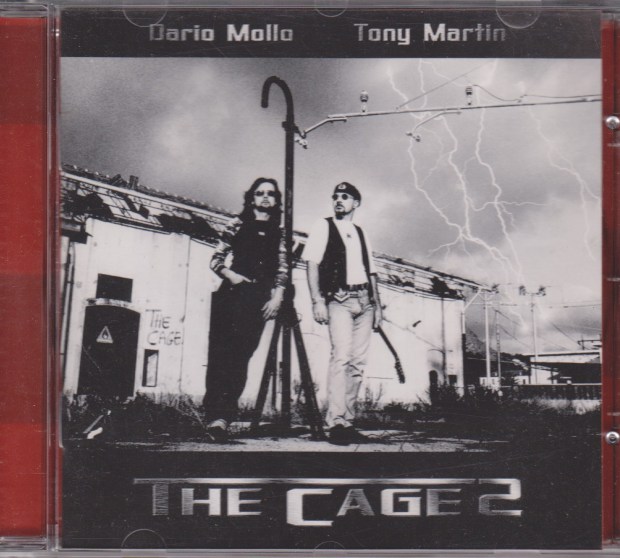
REVIEW: Mollo / Martin – The Cage 2 (2002)

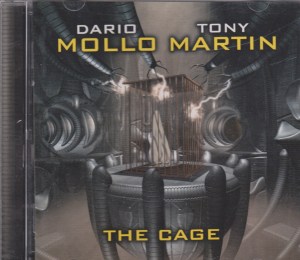
Scan_20160208DARIO MOLLO / TONY MARTINThe Cage 2 (2002 Frontiers)

Three years out from their debut album The Cage, Tony Martin and Dario Mollo re-teamed up for a sequel, creatively titled The Cage 2!  On their second effort, Mollo and Martin broke out of a cage of sorts and made heavy metal music with a little more identity.  Keyboardist Don Airey did not return for this album, but in his stead is the legendary Tony Franklin on bass.

Heavy modern nu-metal touches highlight “Terra Toria”, a detuned beast with a bit of grunting on the choruses.  Thankfully the verses are piled high with Tony’s melodies, the same kind that he used to contribute to his Black Sabbath albums.  Mollo meanwhile lays down the shred with a Neal Schon vibe and plenty of power chords.  The heavy stuff takes a bit of a back seat on “Overload” which could have worked well as a Dio power ballad.  Underrated as a vocalist, Tony Martin has no issues delivering the hooks and high notes.  One thing I have loved about Tony Martin is that he also plays violin, and sometimes throws that into his songs, as he did on his solo album Scream.  “Overload” has a fast flying violin solo, and it’s a killer.

Distorted lead vocals on “Life Love and Everything” lend it a modern touch on the verses, but the layered vocals of the chorus make it clear that this is not nu-metal.  The guitar riff is a tricky shuffle, but with a groove.  It’s soul metal with the emphasis on the metal rather than the soul!  “Balance of Power” is just speed metal, along the lines of some of the things Sabbath had done on Tyr such as “The Lawmaker” and “Heaven in Black”.  If you miss that era of Sabbath, or the kind of fast metal that Dio was apt to do, then check out “Balance of Power”.  If you’re in  tune with 80’s Sabbath, check out “Amore Silenzioso”.  It is the closest thing to Black Sabbath’s “The Seventh Star” that I have heard, though not quite on that level.  A short keyboard based instrumental (“II”) closes that, and goes into “Wind of Change”, not the Scorpions song, but a ballad nonetheless.  If the songs on Cage 2 have a common weakness, it is that many are on the long side.  “Wind of Change” is too much ballad, though it does house an absolutely stunning guitar solo.

“Theater of Dreams” carries over with the 80’s Sabbath sound, and more intricate and cool guitars.  The slow groove combined with the might of Martin and the metal of Mollo make it a winner in these books.   Then they take a drive down Van Halen alley, with “What a Strange Thing Love Is”, not a bad tune at all, but definitely in the summer song style of Sammy Hagar.  It’s pop metal with soulful backing vocals, and it’s cool.

Scan_20160208 (2)

The only serious mis-step is an ill-advised cover of “Dazed and Confused”.  It’s nearly impossible to do this song without sounding like a jackass.  As great as Martin sings most of it, he ruins it by adding in his own adlibs that just remind you, oh yeah,  it’s a cover of a better version by Led Zeppelin. Thankfully Mollo makes the guitar solo the centerpiece and it does the job without copying Jimmy Page.  Without this cover clogging up the works, the CD is actually more enjoyable.

Moving into the last lap, “Guardian Angel” pounds the ground with double bass and heavy riffing.  It has Iron Maiden elements but kicks ass all around.  Still they saved the best track for last, which is “Poison Roses”.  This melancholy closer is the most memorable in a batch of pretty strong heavy metal songs.

You have to give Tony Martin credit.  He’s a great singer, a good songwriter, but no matter what kind of albums he makes, he remains in the shadows.  Too bad.  Fans would do well to seek his his collaborations with Dario Mollo.  They compete in quality with the albums Tony made in his better known band.

3.5/5 stars

REVIEW: Mollo / Martin – The Cage (1999)

Part one of a two-parter!

Scan_20160109DARIO MOLLO / TONY MARTIN – The Cage (1999 Dreamcatcher)

When Ozzy Osbourne returned to Black Sabbath in 1997, that was undeniably a very exciting moment in heavy metal, and rock in general.  By ’98, original drummer Bill Ward even returned to the band, completing the original lineup.  We were rewarded for our patience with two new Black Sabbath songs called “Psycho Man” and “Selling My Soul” by the original lineup, but otherwise it was the beginning of a long drought.  Though Sabbath toured and played festivals, it was the sparsity of new material that pissed off a few fans, this one included.

Thankfully during this Sabbath ice age, some former members kept the flame alive with new heavy metal music.  Former vocalist Tony Martin, who was ousted for Ozzy’s return, recorded three albums with Italian guitarist Dario Mollo.  1999’s The Cage, featuring Don Airey (Deep Purple) on keyboards, is their first collaboration.  This helped scratch the Sabbath itch during the drought.

A jagged Dio-ish guitar riff commences “Cry Myself to Death”.  The doomy edge is present.  Martin sounds as if in peak voice.  The thirst is quenched.  It’s easy to imagine a song like this could have been on a followup to 1995’s Forbidden.  Dario Mollo is nothing like Iommi, being capable of heavy modern shreddery at maximum velocity.  This is proven on “Time to Kill”.  This time the vibe is like “Lawmaker” from 1990’s Tyr album.  The pace is breakneck, but Don Airey is more than capable of keeping up on the keys.  This is a stunning metal track mixing the spirit of old with the talent of new.  It verges on regal Priest-isms by the solo break, blazing on to the end in a frenzy.

Don Airey plagiarizes his own keyboard part from Judas Priest’s “A Touch of Evil”, for an instrumental intro called “The Cage”.  This serves as the start for a moody Dokken-esque ballad called “If You Believe”.  Don Dokken only wishes he could still write a song this good, a quality dark ballad, perhaps akin to Sabbath’s “Feels Good to Me”.  Then “Relax” also operates on a dark Dokken / Whitesnake vibe.  Mollo’s shredding on this would would make Eddie Van Halen nod in approval.  And speaking of Whitesnake and Cov the Gov, guess what they cover later on in the album?  “Stormbringer”!  Don makes the keyboards a bit too spacey on that one, but it is an otherwise pretty authentic cover, and the guitar solo is virtually note for note.

Scan_20160109 (3)

“Smoke and Mirrors” is pretty lame.  “Some girls, they look really pretty but they tell you lies,” sings Martin.  Well maybe, but some singers sing real good but struggle on the lyrics.  The weakest track so far, “Smoke and Mirrors” has a sleezy rock vibe, like a latter-day Europe track.  Mollo’s playing is the highlight but the song is pretty skippable.  “Infinity” is more Sabbathy, reminding me of “Headless Cross”.  Onto “Dead Man Dancing”, I think of Gary Cherone and Extreme.  The song boasts a soaring Martin chorus and plenty string mangling by Mollo.  Then it’s onto “This Kind of Love”, a dead ringer for Van Hagar.

The album closes on “Soul Searching”, (kind of similar to Sabbath’s “Nightwing”) which is something I wish Dario and Martin had done more of during the writing of this album.  It would be nice to hear more of the sounds of their own personalities rather than songs that remind us of other bands.  That’s rock and roll; the great struggle.  It is not easy to carve out your identity among the thousands of bands who already have.  The Cage is loaded with great music, and the playing is above reproach.  What it lacks is originality.  Even in the guitar playing, I would say that Dario Mollo owes John Sykes a debt of gratitude, though he is certainly no slouch.  I just crave more originality in the tunes.  Yes, part of the appeal of following ex-Sabbath members like Tony Martin into a solo career is to hear a bit more of that sound you loved.  There are just too many moments on The Cage that sound like songs you already know.

3.25/5 stars

TV REVIEW: American Dad (featuring James Hetfield of Metallica) – “The Life Aquatic with Steve Smith”

AMERICAN DAD! – “The Life Aquatic with Steve Smith” (Episode 2, season 12)

American Dad is back!  The 12th (or 13th) season (depending on how you count) commenced last week.  While last week’s instalment was ho-hum, this week’s was a brilliant return to form, thanks in no small part to the mighty metal music of Metallica.

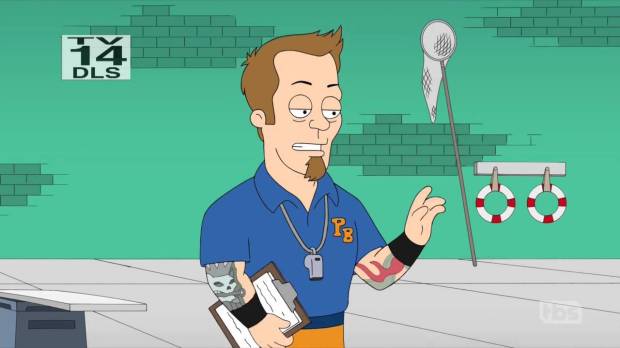
It is spring time.  14 year old Steve Smith has vowed that this year, he will finally get to touch his first real boobs.  His latest scheme is simple.  Varsity athletes seem to touch boobs all the time.  Therefore, Steve needs a varsity jacket.  The water polo team is looking for members, and hardly anyone has signed up.  At tryouts, we meet the coach:  “I’m the new coach, James Hetfield.  I know what you’re thinking.  ‘Woah! The James Hetfield from Metallica?’  The answer is no way.  Even though I look and sound like him, and have all his guitars.  The point is, if I had to deal with the kind of pressure that guy is under, I’d probably crack and end up as a high school water polo coach.  So it’s a good thing that I’m just this very different James Hetfield.”

Unfortunately Steve cannot swim and is cut from the team.  Only when he colludes with the family goldfish Klaus (an East German ski jumper whose brain was transferred into the body of a fish) does he have a chance.   They realize that Steve can become the greatest water polo player in the world, with a little extra help from Klaus.  Klaus operates Steve’s legs by using his short n’ curlies as puppet strings, and Steve is unstoppable!  With his legs being controlled by Klaus, Steve can concentrate on the ball.  Cue:  “Master of Puppets”.  Steve is back on the team!  In fact, he’s the star.

The next musical number is the more recent “All Nightmare Long” (one of the best tunes from Death Magnetic), accompanying a montage scene.  Steve and Klaus’ plan seems to be working, as Steve attracts the attention of Amy (Ashley Tisdale), the school sports editor.  She wants to know what makes Steve so skilled at water polo, and the pressure is on.  James Hetfield orders the team to take the rival highschool “off to neva-neva-land-ah!”

The side plot involves Stan Smith and Roger the alien buying a sailboat at a CIA auction.  Roger’s antics are always hilarious, but the side plot can’t help but remain in the shadow of the main Metallica feature.  Still, Roger’s voice is always hilarious to me, and I crack up when I get to hear Roger calling people “assholes”.  I am easily amused.  The show does benefit from the ability to use mild swearing now.  Roger and Stan realize that owning a boat is kind of useless since they have nowhere to go and no idea how to sail.  They must get rid of it…somehow!

If American Dad can maintain this level of quality, it is bound to be a great season.  It’s also good to know that American Dad is maintaining its strong musical connections, even though showrunner Mike Barker left in 2013.  Barker was responsible for many of the show’s best such moments, such as the My Morning Jacket episode.  Although last season was a little bumpy, this episode might be the best one since Barker left.

5/5 stars

DVD REVIEW: Black Sabbath – Never Say Die (live 1978)


BLACK SABBATH – Never Say Die (Live in 1978, 2003 Sanctuary DVD)

Recorded in 1978 at the Hammersmith, the DVD Never Say Die was recorded for TV, and not badly either.  The video part, anyway!  Great live angles and decent editing lead to a very watchable concert, albeit chopped down for length.  The audio leaves something to be desired.

The muffled riff of “Symptom of the Universe” commences the set, Iommi sounding as if powered through a crappy battery powered transistor amp, such is the horrible sound captured.  A blazed Ozzy growls through it, and Bearded Bill is in the back wearing braids and looking like a complete dirt bag.  As for Geezer?  He’s mixed too low to have any significant impact.  Tony Iommi stands guard at center stage, while Ozzy claps along next to him.

The close-up shots are nice and vivid, Ozzy waving the peace sign during the start of “War Pigs”.  He then commands the crowd to put their hands together, and they soon oblige singing along with him.  There is something about a live version of this song with the full original lineup including Bill Ward.  Bill was always a jazzy drummer, and that’s the vibe he loaned Black Sabbath.  It’s especially necessary on tracks like “War Pigs” which require a certain swing on the traps.  With Bill here still in vintage mode, the song has all the right heft and movement.

It’s hard to tell that this was a group of guys who couldn’t bear each other anymore.  While they mostly keep to themselves on the large stage (as they always have), Ozzy acts as Tony’s cheering section during the guitar solos, and you can even see a hint of a smile in Tony’s eyes.  Then Ozzy claps and screeches his way through the monolithic “Snow Blind”.

IMG_20160123_163908

The only track from the new album, Never Say Die, is the title track.  Its upbeat attitude and fast tempo allude to where Ozzy was going to go as a solo artist.  For Sabbath, it’s one of their most unappreciated tracks.  This live version is pretty sloppy but very rock and roll (including an old-tymey rock and roll riff that wasn’t in the original).  Then, Ozzy introduces the all-time classic, “Black Sabbath”, with an interesting statement.  “Thanks for the last 10 years, and we hope we’re around for another 10 years, and another 10 years.”  It’s interesting because at this point, Ozzy had already left the band once, been replaced by Dave Walker (Savoy Brown) for one TV performance (“Junior’s Eyes”), and then returned to the band to do the Never Say Die album, refusing to sing anything they wrote for Walker.  Not exactly the kind of environment to encourage longevity!  Of course the amazing thing is that three of these guys are still together, winding up the band that they formed.

It’s worth noting that nobody can (or will) capture the vibe of “Black Sabbath” like the original four.

Detouring to Technical Ecstasy, Sabbath pour into the underrated prowl, “Dirty Women”.  After this, uncredited, is a brief Bill Ward drum solo.  That melds into “Rock and Roll Doctor”, another obscurity.  Ward’s cowbell and Tony’s rock and roll riff give it a retro vibe.  Bill plays it busy compared to the album version; that’s fine by me.  Tony takes a guitar solo before the scary oldie-goldie, “Electric Funeral”.   Always a treat to hear this rarely played Paranoid classic, but unfortunately this one is noticeably edited down.

Closing out the disc, “Children of the Grave” is an obvious highlight.  Once again there is no drummer on Earth who can play it properly, except for Bill Ward.   Some come close, but none capture the reckless engine that drives it.  For the encore, Ozzy asks the audience “What do you wanna hear?” to which they are supposed to respond “Paranoid!”  I don’t know if they do; the audio here is really not good.  They trot out “Paranoid”, the flaw of which is that it always sounds by rote.  Ozzy couldn’t sound less interested in singing it again for the millionth time.

You have to consider the sound quality on a DVD like this and if you’re the kind of person who will care or even be able to tell the difference.  I don’t care.  This is a great though imperfect glimpse at a rare period in Black Sabbath’s history.  A short while later Ozzy would be solo, and Sabbath would go to Heaven and Hell with Ronnie James Dio.

3.5/5 stars
 

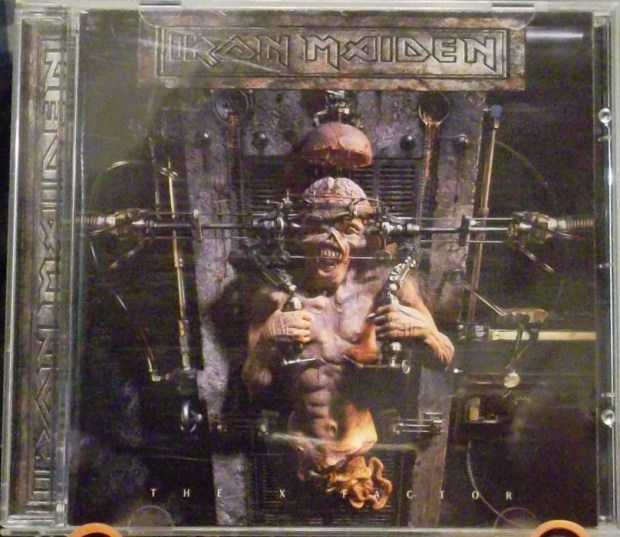
#463: The X Factor Failure


GETTING MORE TALE #463: The X Factor Failure

When Bruce Dickinson left Iron Maiden in 1993, the metal world was rocked yet again by another major defection.  First Vince Neil, then Rob Halford, and now Bruce!  It seemed the old guard of 80’s metal had suddenly fallen from the top of the world, to critical condition on life support.

Some fans gave up.  The loyal waited eagerly for news.  First were the rumours that Paul Di’Anno would come back (quickly shot down by Steve Harris).  Then Michael Kiske from Helloween had his name dropped in a few speculative magazine articles.  Finally in 1994, the identity of the new singer was released:  Blaze Bayley, ex-Wolfsbane.  In North America, the majority  muttered, “Who?”  The fans who still cared, anyway.  Those who did not cut their hair and moved on to Soundgarden and Alice in Chains.

Another long quiet year went by before new Maiden music hit the shelves.  When it did, in the form of the album The X Factor, it was clear that Iron Maiden had changed.  They were now a quieter, darker animal, with a singer to suit that sound.  The departure was not well received.  Fans were not impressed by the long, repetitive songs, nor the lower-voiced singer.  The album failed to make a significant dent in the charts, although it sold well initially in Quebec,  the last stalwart of metal in Canada.  One fan who did accept and embrace the changes was yours truly, Mr. LeBrain, but not without taking flak for it.

When the CD was released, I was already working at the Record Store, so I bought it immediately.  We didn’t stock enough copies to get it in early, or even offer a good price on it.  In other words, we ordered just three copies of the new Iron Maiden CD, with one of those being reserved for me!   That’s how far Maiden had fallen.  It took two or three good listens to adjust to the new softer Maiden, but certain songs jumped out fairly quickly, such as “The Sign of the Cross” and “Lord of the Flies”.  I enjoyed the darkly introspective lyrics on new songs such as “The Aftermath” and “Look for the Truth”.

The girl I was dating at the time was not into rock music; not in the least.  The last CD I bought for her was Much Dance ’95, featuring such hits as “What is Love” by Haddaway, “Saturday Night” by Whigfield, and of course, “Macarena”.  I even took a bullet and listened to it with her, the whole thing.  In turn, she tried to give my Joe Satriani a shot, but she wasn’t particularly interested.   I knew there was no chance she’d be into Iron Maiden, but since I was excited that they had new music out, I was talking about it a lot.  I tried to tell her how much I was enjoying the new lyrics on the album.

That’s when she said the words I will never, ever forget:

“Why are you even listening to new Iron Maiden?  You know they will never be popular again.”


Aye carumba!

Popular?  What true Maiden fan ever bought an album because it was popular?

I was deeply disappointed in her words, and even a little hurt.  I was trying to convey to her that the words and music were impacting me; I was feeling something and wanted to express that.  It is always good when music provokes thoughts and feelings.  I would have loved for the album to be successful, but that wasn’t the point.  I never listened to Maiden to be cool.

She dumped me shortly after I bought the new Lisa Loeb album for her.  Damn you, Lisa Loeb.  Then, she started banging an ex-girlfriend of mine, and her new boyfriend…at the same time.

Let me repeat that for you just in case you missed it.

Then, she started banging an ex-girlfriend of mine, and her new boyfriend, at the same time.  Both of them.

Henceforth, I dove headfirst into that Maiden album to drown my misery, and it became one of several discs that were my soundtrack to that miserable winter for me: Maiden, Ozzy’s Ozzmosis, and Oasis’ (What’s the Story) Morning Glory.  If there is a reason I have a soft spot for The X Factor by Iron Maiden, you can blame that girl who said they’d never be popular again.

While all is forgiven today, I have not forgotten that remark (obviously), and the amazing thing is that she was 100% wrong.  Maiden are more popular today than they ever have been.   Their T-shirts have become fashion statements.  Kids who weren’t even born when Bruce left the band are buying tickets to see them live in 2016!  But much more important than that, they have achieved a level of artistic integrity and consistency that most bands should be envious of.

Maiden, never popular again?  File that under failed predictions from the 90’s, right next to the Y2k scare!  Up the Irons!

SAM_1037

REVIEW: Deep Purple – Copenhagen 1972 (2013)

Scan_20160103DEEP PURPLE – Copenhagen 1972 (2013 Edel)

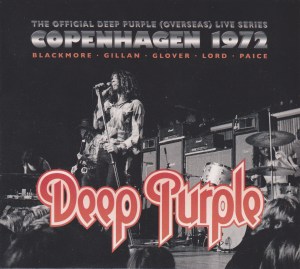
How many live albums are there from the Machine Head tour in ’72?  I lost count, and I don’t really care.  I’ll buy ’em all!  Copenhagen 1972 represents Purple at their best, in their prime, playing their best songs.  The difference is (there always is a difference) is that this is a particularly pummelling Purple potluck.  As awesome as they were in ’72, it’s rare to hear them play as ferociously as you will here!  This set was previously released by Sonic Zoom as Live in Denmark ’72 in 2002, but technology is constantly improving and it has been given a subtle sonic upgrade.  With restored master tapes, the 2013 release is the definitive one, not to mention it has four bonus tracks over the previous Live in Denmark ’72.  These Sonic Zoom discs seem to be re-released periodically, but these versions from the Deep Purple (Overseas) Live Series are in all cases the ones to own.

“We got the telly here tonight, so we got to be good.”  That explains how this show was recorded so well.  The clown prince Ian Gillan is a dry unorthodox frontman when it comes to banter, and that’s why we love him so.  “Highway Star” herein is one of the best versions of the song you will ever find.  The non-album single “Strange Kind of Woman” follows, extended with Blackmore and Gillan’s interplay.  Behind them, a constant presence, is the growl of Jon Lord’s Hammond.  What a beast!  Lord always tended to improvise on his intro to “Child In Time”, lending it different flavours every time it was played.  The Copenhagen ’72 version has its own personality.  There is a delightful quieter middle section where Jon gets to have some jazzy fun.  Drummer Ian Paice gets his moment on “The Mule”, one of Purple’s most progressive rock moments from 1971’s Fireball.  Paice, being outstanding through the whole concert, dominates this one into submission.  It is remarkable how well recorded these drums are.  Glover’s bass too, which has a shining spot in the mix.  “Lazy” smokes just as hot, but it is “Space Truckin'” that has the honour of being stretched out for over 20 minutes.  With the many live versions of “Space Truckin'” out there, I wonder how many sheer hours of this song that I own?  This one is unique in its own right.

Scan_20160103 (4)

The show continues on CD 2, with “a little bit of fun” called “Fireball”.  With an extended intro I haven’t heard anywhere else before, this version of “Fireball” kills it.  It’s immediately followed by “Lucille” which was a periodic Deep Purple encore back then.  Simply incendiary, over the top, and blazing fast.  The last song of the show is the old single “Black Night”:  that’s right, no “Smoke on the Water”!  I guess they just didn’t play it that night.  Machine Head wouldn’t be out for another three weeks.

CD 2 has four bonus tracks on top of this.  The aforementioned “Smoke” along with more versions of “Strange Kind of Woman” and “Space Truckin'” are included, from New York in ’73.  This version of “Strange Kind of Woman” is unusually funky; more like the Deep Purple Mk III that would emerge in 1974.  “Smoke” is still fresh, but “Space Truckin'” surprises by being only half the length of the version on CD 1.  It’s interesting to hear how the songs evolve from year to year.

The final bonus track is a brief 1971 interview done in Australia.  There is not much here; it’s just an add-on.  It’s fun to hear them talking about the forthcoming new album, Machine Head.

4/5 stars

REVIEW: Triumph – Edge of Excess (1992)

Bought in Taranna at Kops for $2.50!


Scan_20160102TRIUMPH – Edge of Excess (1992 Virgin)

When Triumph split in ’87, Rik Emmett went off in a pop direction leaving his two bandmates with no singer/guitar player, and without their most recognizable member.  As bassist Mike Levine said in M.E.A.T Magazine, “We couldn’t just be Duo-umph”.  Since Triumph always had two lead singers in Rik Emmett and drummer Gil Moore, this time Gil simply stepped up and sang everything.  Then they needed a guitar player.  Gil and Mike Levine wrote and recorded most of Edge of Excess with Mladen Zarron in Toronto, before hiring ex-Frozen Ghost (current Bon Jovi) shredder Phil X.  Five years after the split, the new Triumph emerged with a heavier and darker album, Edge of Excess.

Triumph boldly opened the album with a whole minute of nothing but bluesy guitar noise.  If there was a stronger way to say “We don’t need Rik,” I don’t know what that would be.  This guitar noise serves as an intro to the first Triumph song without Emmett, “Child of the City”, a harder edged Triumph song with the same kind of hooks.  It’s hard to determine who is playing lead guitar, Mladen or Phil X, but rest assured that whoever it is has laid waste to the land.  Rik Emmett wasn’t just a shredder, but a talented player who composed his solos with class and ability.  Mladen and Phil have done the same, but without emulating Rik.  (Phil’s going to have his work cut out for him in Bon Jovi, though.)

The rip-roaring “Troublemaker”, easily the fastest and heaviest Triumph track to date, was featured on the soundtrack to Hellraiser III, and it’s easy to see why.  It’s as close to speed metal as Triumph have been, and I shouldn’t need to tell you that again the solos shred.  Who’s playing?  Fucked if I know, there are three guys credited on the song.  The song is actually very close to high-octane Whitesnake and it would be easy to imagine Coverdale’s crew doing it.

Lest you think that ballads were a thing of Triumph’s past, “It’s Over” has a country & western feel. Unfortunately of the two singers, Moore had the less commercial voice.  This is where Gil’s voice reveals its limitations.  On backing vocals, some big names are on hand such as Fred Coury of Cinderella and Steve DeMarchi of Sheriff, to help beef up the big chorus.  It’s not enough to make a memorable song.  They cook up some groove on the title track, tapping the vein of Van Hagar.  But without Rik Emmett, Triumph lost part of what made their unique sound.  On Edge of Excess it’s too easy to compare them to contemporaries.  “Turn My Back on Love” is better, occupying a dirty mid-tempo groove, and with Phil X handling all the guitars himself.  The big chorus is the closest thing to old Triumph on the album.

That’s the side; the second one opens with “Ridin’ High Again”, a sleezy rocker that sounds like Don Dokken emigrating to Canada.  Phil X really can shred though, and anyone who’s curious what he can do should check it out.  I don’t think Phil will be able to play to his strengths in his new band, so give this a listen and hear the guy blaze like Vai meets Van Halen.  “Black Sheep” starts as a total surprise; a blues right in the middle of the album.  No drums, just claps.  Sadly instead of sticking with this, it transforms into a stock hard rocker.  “Boy’s Nite Out” has a grammatically incorrect title:  The lyrics are clear that it is not a boy’s night out, but “the boys”, plural.  It should therefore be called “Boys’ Nite Out”.  Here I am bitching about the grammar and not the word “Nite”…anyway, back to the song.  Standard rocker.  Plenty of great shreds, but this album is far too burdened by generic rockers.  Rik Emmett used to bring a variety of influences to the table, and their albums with him may have had their weaknesses, but they were more diverse than Edge of Excess.  Without enough identity, Triumph forged a batch of largely forgettable bluesy hard rock songs.  Lots of crunch, not enough stick-to-your-brain hooks.

Fortunately the classy power ballad “Somewhere Tonight” helps wind things up properly.  Identity is still a problem, but at least this is a break in the rut the album had been in.  Right back into the rut for “Love in a Minute”, the last in a batch of heavily generic rock songs that sound like about a dozen bands…none of them Triumph.

Like any fan, I was pleased that Triumph kept going despite such a huge setback as losing your main guy.  Unfortunately the album they produced in ’92 was not up to par, and I guess that’s why it took me 23 years to finally buy it!  A couple good songs early in the album, but not much more.

2.5/5 stars

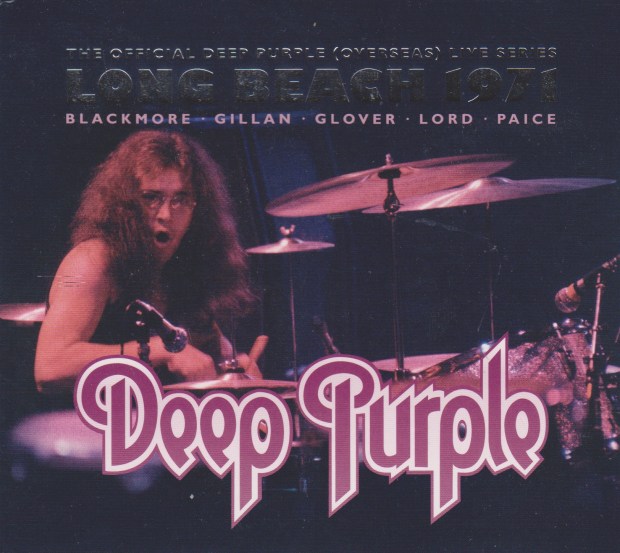
REVIEW: Deep Purple – Long Beach 1971 (2015)

DEEP PURPLE – Long Beach 1971 (2015 Edel)

This CD is over 70 minutes long.  It has four tracks.  The shortest one is 11:05.  The longest is 27:18.  We just needed to be upfront with you, about what you are about to read, in case you felt like turning back now.  This would be the time to do so.

Still with us?  Great!

This live album was recorded during a period in Deep Purple where their setlist was in a state of flux.  Their first heavy rock album and first serious bonafide smash hit, Deep Purple In Rock, was still dominating the set.  The mid-term single, “Strange King of Woman”, had been included on the new album Fireball in the US, but it’s the only new song here.  Even though the show was well recorded for radio, this set has never been released before officially.

A energetically ragged “Speed King” opens affairs.  “A Speed King is somebody who moves very quickly from one place to another, and always gets there first,” says Ian Gillan during the long middle solo section.  When it’s Blackmore’s turn to play, he’s smooth with just enough rough edges.  Everybody shines; live in 1971, Deep Purple were a well-oiled machine running on the fuel of pure creativity.  Ian and the others liked to have a drink now and then, but they were never a drug band until other members joined and brought their troubles with them.  When a band as talented and unfettered and uninhibited by chemicals hit the stage, this is what can happen.  “Speed King” is a mind-breakingly enjoyable version, both in spite of and because of its length!
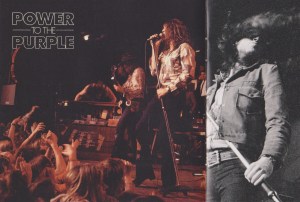
The new single goes down a storm, and Blackmore’s solo is inspired.  Then “Child in Time”, the old standby since late ’69, begins delicately with Ian in prime voice.  Deep Purple at full power doing “Child in Time” complete with screams?  Jazzy shuffle right in the middle?  Always nice to have.  The last half-hour of the set is dedicated to “Mandrake Root”, an unremarkable song from the first LP that operated in concert as the forum for their “big” jam, the one that descends into madness and chaos by the end.  Brilliant stuff, but a bit much for those who just wanna rock.

If four songs loaded with solos are not your cup of java, that’s fine.  There are plenty more Deep Purple live albums to be had.  In the 80’s, the soloing was de-emphasized in favour of playing more songs.  Those albums, featuring the exact same lineup, may be more your speed if this doesn’t sound like your kinda deal.

3.5/5 stars