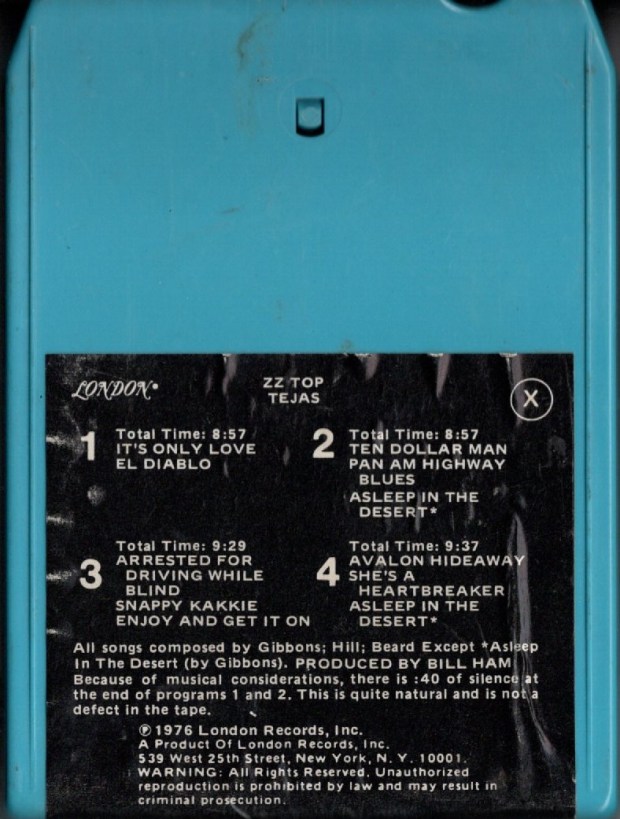
 ZZ Top – Tejas (1976 Warner)
Billy Gibbons described the sixth ZZ Top album Tejas as “transitional”. Modern technology was creeping its way into the recording studio, but ZZ Top were still as bluesy and greasy as ever. Their palette was becoming more colourful, if anything. Not just the browns of desert landscape and beer bottles, but a broadening spectrum of shades.
Opening with fan favourite slow groove “It’s Only Love”, we are off to a stunning start. The high twang of the guitars contrast with the low thump of Dusty Hill’s bass, but it is the chorus most of us remember best. Frank Beard’s drums clank along creatively, and the band are cooking. Vocals are shared between Billy and Dusty. Three quarters in, the song shifts into something a little more tense, with a brilliant harmonica solo.
Things sound a little more familiar on the bouncing “Arrested For Driving While Blind”, a solid blue boogie. Listen to Frank shuffle while Billy effortless rips out one of his patented smokers. The grooves turn gently relentless on “El Diablo”, a nocturnal desert tale, with adventurous chord changes and rolling guitar work. Once again Dusty Hill creates a backdrop of low thunder. This ain’t blues, but a sci-fi hybrid. Likewise, “Snappy Kakkie” is not at all standard, nor is it a bizarre Frank Zappa workout. Yet it has certain adventurous and challenging elements that lend it a foot in many worlds. At the end of the day, that hook of “Say hey Snappy Kakkie!” keeps you coming back. The pace picks up on “Enjoy and Get It On”. This track is a serious deep cut; a nice little greasy blues blitz at the end of side one.
“Ten Dollar Man”, with Dusty on vocals, is a ripper. As Frank Beard deftly taps out the beats, Dusty and Billy get down to the business of cooking. A menacing track with plenty of head-bopping potential. Then you better solder your head on straight, for “Pan Am Highway Blues” rips! ZZ Top are never content to just play the blues. They have to throw a few tricks in the bag, and they do, but this song is focused more on the highway and the gas pedal. Billy takes advantage of the studio tech to overlay a few nice slide guitar lines.
Dusty takes the mic on “Avalon Hideaway” which features some tasty, pounding Frank Beard fills. The lead solo by Billy might be the best part, but the slightly funky vibe really makes it a mover. Beard is a busy drummer without sounding busy. “She’s a Heartbreaker” is a classic pop/country/rock/Top tune. The croonin’ melody of the chorus is a classic that will go down as one of ZZ’s best in their vast catalogue. “She’s a heartbreaker, she’s a love taker, but she can break a heart and take all the love she needs…” There’s a hint of violin just to nail that hoedown vibe. As far as Top tunes go, this one’s a masterpiece of musical fusion.
Tejas closes on a brilliant instrumental, “Asleep In the Desert”, which allows Billy to play both electric and acoustic, slow and easy, as the sun sets over the oasis and the sounds of the night begin to emerge…
Many ZZ Top albums can be considered among their best in the catalogue. In 1976, there was concern that ZZ Top was going too far country. Obviously in hindsight, that wasn’t the case, and we can appreciate Tejas for what it was. Because none of its songs were included on 1977’s Best Of ZZ Top, Tejas abounds in great deep cuts. It’s not the kind of album you buy and get all the hits you remember. It’s something far better. It’s an album you buy and learn a bunch of brilliant songs you might not have heard before. It’s a must.
4.5/5 stars


The 8-track release shuffles the track order, but no songs are split between tracks, which is always nice. “El Diablo” coming in second changes the vibe of the listen a bit.


 mikeladano.com