The KISS RE-REVIEW SERIES Part 14:

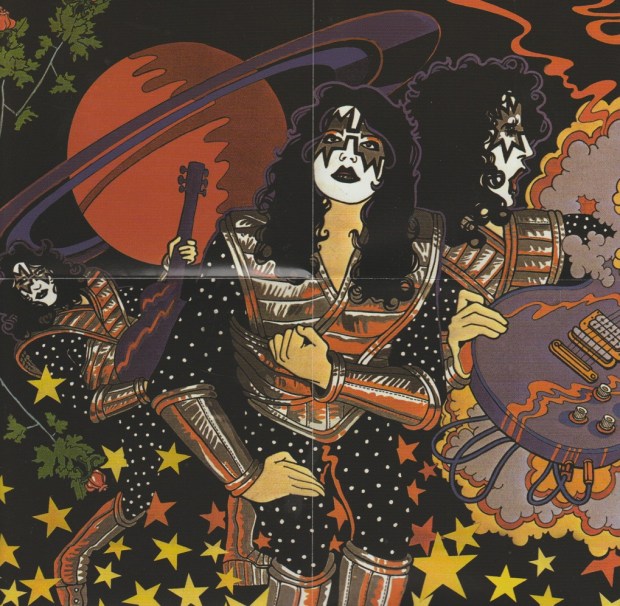
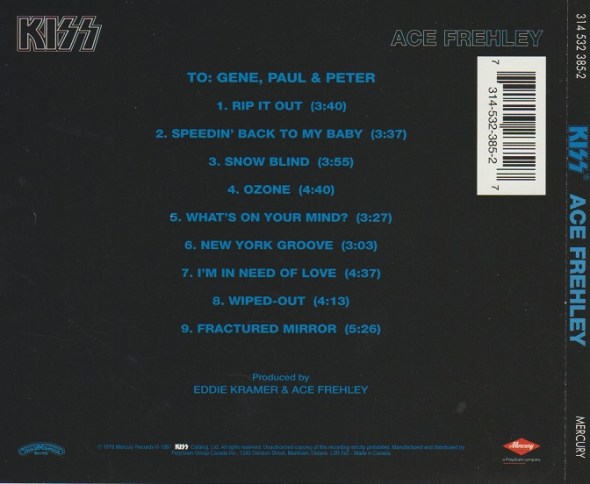
 – Ace Frehley (1978 Casablanca solo album, 1997 Mercury remaster)
Of the four members of Kiss, Ace Frehley felt he had the most to prove on his solo album. He’d only had two lead vocals with Kiss, and usually only contributed a couple songs to each album. Could he write and sing an entire solo album? Some in the Kiss camp had their doubts.
Ace regrouped with his favourite Kiss producer, Eddie Kramer, and crucially got a newcomer named Anton Fig to play drums. Anton, from South Africa, has a long and fruitful career but a huge chunk of it was with Ace, and it started right here. Ace Frehley played almost everything else himself. Will Lee (Anton’s future bandmate on the Late Night with David Letterman show) played bass on three tracks. Ace also wrote the majority of the songs by himself, proving he wasn’t reliant on Gene and Paul.
“Rip It Out” is one of the great Ace album openers. He used it to open his Frehley’s Comet shows in the 1980s, and on album, it really sets the right scene. Ace was singing great, but more importantly, he had a chance to really let his guitars shine. Listen to the main riff — you can clearly hear an acoustic guitar mixed in with the electrics. In Kiss, Ace’s job was to solo and complement the rhythm guitars. Now Ace could play with multi-layered guitars and effects. “Rip It Out” really sounds like a statement of intent. Listen very carefully to the number of guitar parts happening in the mix, from slides and squeals to solos.
Ace has a knack for a pop melody, and “Speeding Back to My Baby” has that side to it. It’s pop rock complete with female backing vocals, but with serious crunch. Frehley is the master of guitar crunch, so even when we call a song “pop”, it really rocks. Check out Frehley’s partly backwards stoppy-starty guitar solo too.
The heavy side of Ace is explored on “Snow Blind”, a mean rocker with a nasty riff. The solo section is to die for. “Ozone” too is heavy, and possibly better known as a cover by the Foo Fighters. There weren’t any questions about the subject matter: “I’m the kind of guy who likes feelin’ high,” sings Ace in the opening line. Gene would not have approved, but note the combined use of electrics and acoustics once again.
Ace ended the first side with another triumphant pop rocker: “What’s On Your Mind”. It is tracks like this that helped Ace’s solo album become a clear fan favourite. The guitar riff has punch, but when doubled with acoustics, it rings like a bell. From brilliant guitar licks to the unforgettable melody, Ace nailed it with “What’s On Your Mind”. It also bookends the first side very well with “Rip It Out”.

The big hit, still getting radio play today, was the Russ Ballard cover “New York Groove”. Ballard originally gave his demo to the band Hello, but it was Ace that made it an important song. Ace took the words (written by an Englishman!) and adapted his persona to them. His lovable rough and tumble New York personality fit the song to a “T”. It’s a bit cheesy, but Ace can take cheesy and make it cool. The stompy beat was created using studio experimentation, Eddie Kramer the mad genius who would record anything and everything to get just the right sound.
A pair of rock tracks, “I’m In Need of Love” and “Wiped Out”, fill the middle of side two. Ace’s echoey guitar slides on “I’m In Need of Love” deliver the prime hooks. It’s an excellent example of what Ace can do with an electric guitar. Meanwhile, “Wiped Out” is like a sequel to the surf rock classic “Wipe Out”, and not Ace’s last foray into surf rock either. His intricate picking here would cause a lesser player’s fingers to fall off. Check out that wacka-ja-wacka stuff too, funky and cool.
Ace saved the most impressive track for the last, and the first in his so-called Fractured Quadrilogy: “Fractured Mirror”. This instrumental features shimmering six and twelve strings working in tandem. Ace and producer Eddie Kramer went to great lengths to get the guitar sounds on this song. One technique included playing the figure on a doubleneck guitar, but only using the pickups on the open-tuned second neck. The pickups to the neck that Ace was actually playing on were turned off. Once overdubbed, this gave the guitars a bell-like chime, and fans spent years trying to figure out just how Ace did it. Now you know.
This album was a turning point for Ace. It gave him confidence. It ushered in a slew of Ace Frehley lead vocals in Kiss. And eventually, it set him up for his departure, as nothing he did in Kiss was as artistically freeing as his first solo album.
Today’s rating:
5/5 stars
To be continued…
Original mikeladano.com review: 2012/07/19



You must be logged in to post a comment.