Reviews

REVIEW: Talas – Sink Your Teeth Into That (1982)

A two-part review of the 1989 compilation CD, Billy Sheehan – The Talas Years.
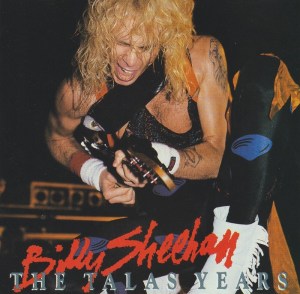
scan_20161210BILLY SHEEHAN – The Talas Years (Part One of Two)  (1989 Relativity)
TALAS – Sink Your Teeth Into That (1982 Relativity)

Fans of David Lee Roth are probably already aware of Talas via their incredible bassist Billy Sheehan, an innovative genius of the four-string rumble.  His first recordings were with Talas (1979-1983), a Buffalo power trio.  With Roth, he re-recorded the Talas track “Shy Boy” on Eat ‘Em And Smile.  The Talas original can be found on their second LP Sink Your Teeth Into That, or the compilation The Talas Years.

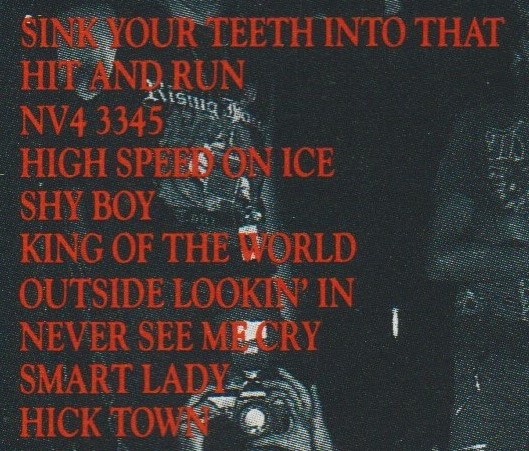
The focus is immediately and obvious on the bass.  Billy plays it simultaneously as a lead instrument, and the rhythmic foundation.  “Sink Your Teeth Into That”, the title track boasts not only insane playing, but sounds that had never been heard before from a bass guitar.  And the song’s pretty good too.  It’s raw 80s hard rock, no more no less, except for that bass.  “Hit and Run” is just as strong.  Talas were not just a bass showcase, but a band that could actually write good songs.  These are unpolished and rough songs, with the band (Dave Constantino on guitar and Paul Varga on drums) alternating lead vocals.

The centerpiece of the album is the bass solo “NVH 3345”.  Write that down and turn it upside down:  it spells “SHEEHAN”.  It has been said before that as Eddie Van Halen’s “Eruption” was a game changer on guitar,  “NVH 3345” is the “Eruption” of the bass guitar.  It is hard to imagine more sheer technique stuffed into 2:21.  For anyone who is a serious collector of hard rock heroes, “NVH 3345” must find a way into your collection.
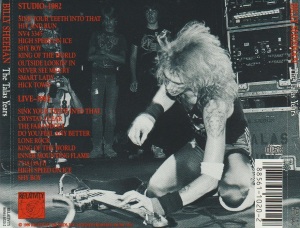
scan_20161210-3

“High Speed On Ice” returns to a hard rocking momentum, like “Highway Star” via Buffalo New York.  Then “Shy Boy” which needed David Lee Roth and Steve Vai to finally perfect it.  Think of this version as a prototype.  It is hard to believe that David Lee Roth did not write the line “Gotta keep things movin’ ’til my personality starts it groovin'”, but Roth made it sound like he meant it.

“King of the World” and “Outside Lookin’ In” occupy the mid-tempo range, and that would be Billy singing those high screams.  Both good songs with the memorable hooks to go with the bass hijinks.  Shadows fall on “Never See Me Cry”, a darker side of Talas but still with the hooks intact.  Second to last song “Smart Lady” is the only loser.  There isn’t room for songs that just don’t cut it.  “Hick Town” ends the album on a better note, with bass pyrotechnics and thrills to go.

Sink your teeth into Talas, and come back tomorrow for a look at Live Speed on Ice.

4/5 stars
scan_20161210-4


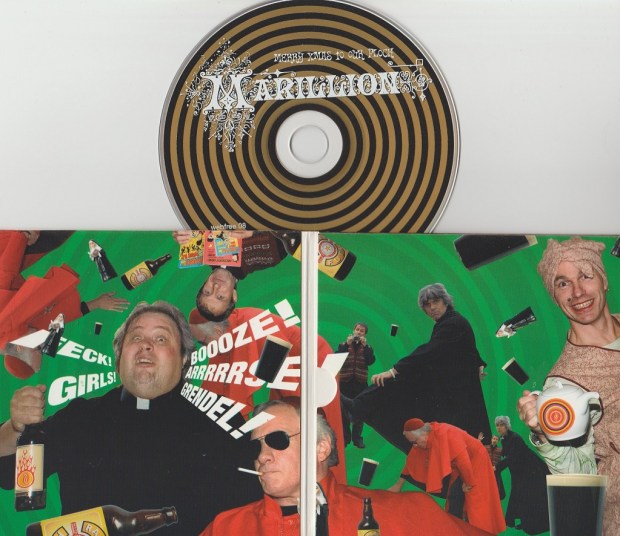
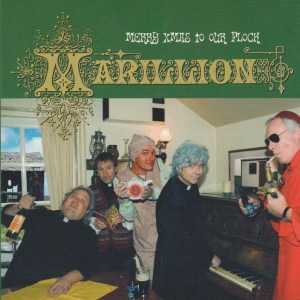
REVIEW: Marillion – Merry Xmas to Our Flock – Christmas 2005

scan_20161204MARILLION Merry Xmas to Our FlockChristmas 2005 (2005 Racket Records WebUK membership CD)

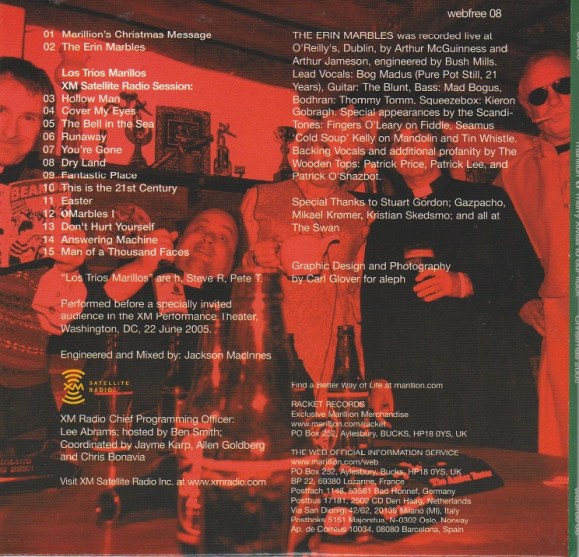
Every year, like the most reliable loyalty program in the world, Marillion reward their fanclub members with a special Christmas release.  Each one has exclusive music on it, some more Christmas-y than others.  The main exclusive on the 2005 Christmas release is a live set by “Los Trios Marillos”:  a stripped down trio version of the band.  Los Trios does acoustic versions, usually for radio sessions, and consists of singer Steve Hogarth, guitarist Steve Rothery, and bassist Pete Trewavas.  These 13 tracks were recorded in Washington DC for XM radio, featuring a wonderful cross-section of Hogarth-era favourites.

That’s not all, of course!  Marillion deliver their traditional Christmas message at the start of the CD, campy and tipsy.  Bonus points if you’re from North America but can still translate everything the band says.  It takes them a few takes to finally get it to their, err, satisfaction.  “We hope you have a really good Christmas, don’t get too drunk, and we’ll see you next year.”  Then, “That’s not written down at all!”  Usually these albums include a brand new studio Christmas track too, and this time it’s the celtic “Erin Marbles”.  It’s a hyperactive Irish jig with mandolin, tin whistle, squeezebox, fiddles and bodhran.  Calling this a Christmas track is a bit of a stretch, as it is basically the song “Marbles” from the same-titled album done up for fun, mixed with a medley of Christmas tunes.  There is no question it’s fun for the fans, but nobody except fans will “get it”, so it’s not really useful for mom’s Christmas mix CD this year.

The Los Trios set commences with the downer “Hollow Man” which is an abrupt change of moods.  The was recorded live with an audience, but they are so quiet during “Hollow Man” you could hear a pin drop, which makes the song that much more haunting.  It is performed solo by Hogarth only accompanied by piano.  “It’s a little early in the morning to be singing,” says Steve.  Fortunately things become upbeat if only for a little while on “Cover My Eyes”, a song that is brilliant acoustically.  If you have heard Marillion’s piano treatment of this single, then you will recognize this arrangement.  It might have been too early to sing that morning, but Steve manages just fine, including the high “pain and heaven” section that challenges every mere mortal.  Rothers and Pete join Hogarth at this point for the B-side “The Bell in the Sea”, which Steve mis-introduces having lost his place in the set list!  It’s live radio, folks.  This is the jazzy bass-oriented acoustic version that the band had been performing since at least 1998, very different from the nautical epic original.  They then return to the song that H was beginning to introduce, “Runaway” from Brave.  It was the song that kickstarted the whole concept of the album.  It is a dark and emotional band and fan favourite, but stripped down to a trio format, it is even more delicate.

The first of four songs from the most-recent Marbles is the dancey hit “You’re Gone”.  Acoustically  it is a different animal, but just as beautiful.  The focus isn’t on the beats but on the melody.  Another song that is completely altered is “Dry Land” from Holidays in Eden.  It is slowed down with a gentle electronic pulse as it rolls softly.  “Fantastic Place” from Marbles flows naturally from there, and Rothery’s solo is absolutely supernatural.  The set really moves at this point, with minimal talking.  “This is the 21st Century” from Anoraknophobia burns quietly but strongly.  On album it percolates with unusual electronic effects, but live it simmers with the hot tone of Steve’s guitar.

“Easter” is a bright light in the set.  This version starts very quiet, slow and understated.  It’s an inventive take, and it slowly builds to the resemble the original, though it ends early.  “Marbles 1” and “Don’t Hurt Yourself” are the last of the new songs presented, and the audience get right into it.  “Don’t Hurt Yourself” has to be one of the best songs Marillion has ever written, and the clapping crowd energizes it.  “Don’t Hurt Yourself” was one of many highlights on Marbles, but here it is head and shoulders the winning track.  A wonderful performance of an exceptional track.

Old favourites end the radio session:  “Answering Machine” (from Radiat10n) and “Man of a Thousand Faces” (from This Strange Engine).  “Answering Machine” should be very familiar, as this acoustic mandolin and guitar arrangement has been recorded many times before.  The handclapping crowd returns to finish “Man of a Thousand Faces” with class.  This song has always been acoustic, so this does not tread far from its roots, though it is shortened for the trio format.

You can’t buy this CD anymore and the chances of stumbling upon one in the shops are nil, however you can still download it by joining the official Marillion webUK fan club.  It is well worth it.  You get three thick, glossy full colour magazines, this year’s Christmas CD, and access to download all the old ones and much more.  Worth thinking about, or adding to this year’s Christmas list.

4/5 stars

scan_20161204-2


REVIEW: W.A.S.P. – First Blood…Last Cuts (1993)

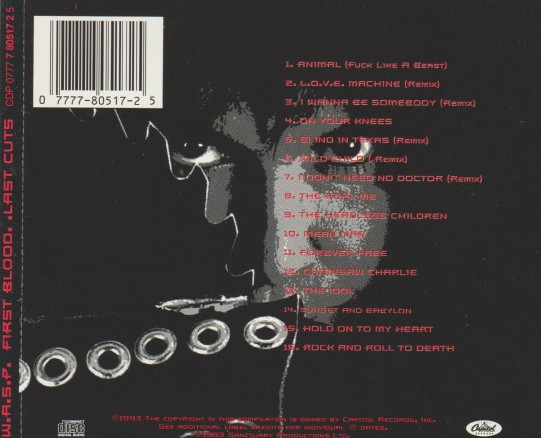
scan_20161125W.A.S.P. – First Blood…Last Cuts (1993 Capitol)

When grunge took over the airwaves in 1991-1992, a lot of older guard bands found themselves without a record contract.  W.A.S.P.’s 1992 concept album The Crimson Idol failed to generate enough interest for Capitol Records to continue investing in the band.  A greatest hits contractual obligation album was a typical move for bands in this situation, and that is how First Blood…Last Cuts came to be.  With that in mind, the 16 track album is great bang for the buck.  Rarities and new songs add value, and the photo-loaded booklet is tons of fun.

A rarity right off the bat, “Animal” was a non-album single and W.A.S.P.’s first.  It’s better known as “Fuck Like a Beast”, and that might explain why it wasn’t on the W.A.S.P. album.  A good but not exceptional track, it does boast a nice metal chug, but it’s otherwise just there for shock value.  It is primitive metal akin to the first LP, with Blackie in full screech.  You either like W.A.S.P. or you don’t.

“L.O.V.E. Machine” from the first LP is remixed with the first verse re-recorded, for some reason.  Presumably Blackie must have been dissatisfied with the original.  There are several remixes on this CD, including singles “I Wanna Be Somebody”, “I Don’t Need No Doctor” (a metalized Ray Charles cover via Humble Pie), “Blind In Texas” and “Wild Child”.  The remixes generally have a sharper drum sound, particular the tracks originally from the muddy first album.  The remixing leads to an uneven listen.  Rather than sounding fresh, the remixes feel off-kilter and slightly unfamiliar, especially when butted up against non-remixed tracks.  The muddy “On Your Knees” follows the remixed “I Wanna Be Somebody”.  The transition between the two songs, both originally from the same album, could be better.

Thankfully the strong songs outnumber the middling by a hefty margin.  “Headless Children” and “The Real Me” (a Who cover from Quadrophenia) remain two highlights of the W.A.S.P. canon.  The chugging heavy epic “Chainsaw Charlie” has never been topped by Blackie.

The final incentives are the two new songs, although one (“Rock and Roll to Death”) was recycled on 1995’s Still Not Black Enough.  “Sunset and Babylon” is special as it features Lita Ford on guest lead guitar.  The nimble-fingered Ford adds some character to the tune, a pretty standard rock n’ roller from Blackie and cohorts.

At 75 minutes, First Blood…Last Cuts is a long running album providing great value.   Perhaps it runs a song or two too long, but nit picking aside it is a solidly hot listen through.  The drunken cowboy blasts of “Blind in Texas” are as fondly remembered as the gentle strumming on ballads like “Hold On to My Heart”.  Indeed, as the album runs on to its second half, ballads begin to outshine the rockers.  “Forever Free” remains one of W.A.S.P.’s brightest stars, as likeable as it was in 1989.  “The Idol” is a darkly beautiful ballad demonstrating that Blackie Lawless is indeed deeper than just his assless chaps.  Although the album dialogue should have been chopped for this greatest hits CD, it just breaks up the flow.

Most people do not need all the W.A.S.P. albums.  In fact, scientific studies have shown that one or two W.A.S.P.’s is all the average homo sapiens will ever need.  First Blood…Last Cuts would be solidly recommended CD for your first or only W.A.S.P. purchase.

4/5 stars

scan_20161125-2

REVIEW: Al Atkins – Victim of Changes (1998)

scan_20161117AL ATKINS – Victim of Changes (1998 Pulse)

Al Atkins was the original lead singer in Judas Priest, before “Bob” Halford was invited to join. You’ll find a number of Atkins credits on the first two Priest albums, even though he was out of the band by that time. In fact, Atkins formed a band called Judas Priest in 1969. The band were named by bassist Bruno Stapenhill. They split in 1970, and Atkins went looking for a new band. He found them in Ken “KK” Downing and Ian “Skull” Hill, who were looking for a singer. With Atkins and drummer John Ellis, they eventually settled on the name Judas Priest, same as Atkins’ prior band. And yes, that means that Ian Hill is actually the only remaining original member of Judas Priest.

Atkins wrote and co-wrote much of Priest’s earliest material. Before he left, he wrote a song called “Whiskey Woman”. Rob Halford used that song and merged it with one of his called “Red Light Lady”. The result was “Victim of Changes”, the first and perhaps greatest of Judas Priest’s epics. Two other songs he wrote in Priest were “Mind Conception” and “Holy is the Man” which were demoed but never released.

Atkins worked a 9-5 job after Priest, but got back into music again in short order. His fourth solo album, Victim of Changes, was essentially a tribute to his Judas Priest years. It is a collection of new recordings of (mostly) a lot of numbers that Priest played live during the Atkins era.  As a gimmick, he had Priest’s drummer from the 1980s, Dave Holland, on this album.

Atkins and Halford couldn’t sound less alike.  Rob is known for his high-pitched operatics.  Atkins has a gutsier, grittier sound, somewhat like a Paul Di’anno meeting Blaze Bayley.  There is no question that Rob is the right singer for Judas Priest, so it is really only a matter of curiosity to hear these tunes with Atkins singing.  The tunes are at least good.

The unreleased “Mind Conception” commences the disc, re-recorded and very modern sounding especially in the guitars.  It is difficult to know exactly what the original “Mind Conception” sounded like, but it’s very safe to say it would not have sounded like this.  In the liner notes, Atkins states the original demos were recorded stoned and with a sore throat.  “Holy is the Man” has a slower groove to it, and would work very nicely as a modern Priest track.  As the only representation of these unreleased tracks available, die-hard Priest collectors will want to hear them.  Another track of interest is the cover of Quatermass’ “Black Sheep of the Family” which Priest played live at their earliest gigs (along with Hendrix’s “Spanish Castle Magic”).  Rainbow’s recording is still the one to beat.

scan_20161117-2

The familiar Priest tracks are actually anything but.  They are probably arranged more like the way Priest used to play them in the early days.  “Never Satisfied” is extended with a tough bluesy acoustic intro.  The heavy parts have a Zeppelin-y beat, due to Holland’s straightforward style.  Same with “Winter”.  Then there is “Caviar and Meths” which is a whopping 7:12 long.  According to Atkins, this song was their big finale live, but never recorded in full in the studio.  This version is the full-length arrangement that they used to close with live.  And it’s brilliant.  Finally there is “Victim of Changes” itself, and Atkins has some help from a backup singer for the high parts that Rob does.

There are a couple tracks that could be considered filler, since they have nothing to do with Judas Priest.  These are the instrumentals “The Melt Down” and “Metanoia”, written by guitarist Paul May.  They are excellent tracks, however, and should not be ignored.  (“Metanoia” serves as a postscript to “Winter” on the CD.) They are European sounding heavy metal tracks, loaded with guitar drama and ferocity.

Check out Victim of Changes for a glance at what Priest might have sounded like with Al Atkins singing lead.  One can hope for those unreleased demos to surface, but one can also wish for the moon.

3/5 stars

REVIEW: Ted Nugent – Double Live Gonzo! (1978)

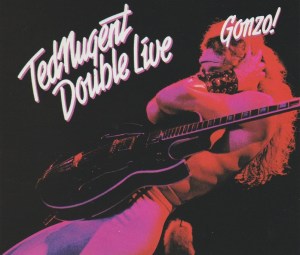
scan_20161129-2TED NUGENT – Double Live Gonzo! (1978 CBS)

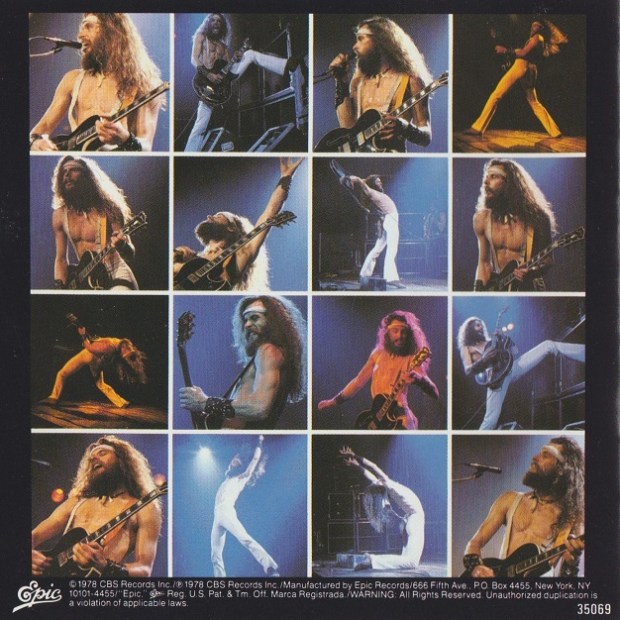
Ted Nugent has expressed his displeasure with Double Live Gonzo! I wish I still had the 1990 magazine interview where he trashed the record, because I have to strongly disagree. To these ears, Double Live Gonzo! is another one of those incredible 1970s cornerstone live albums that every self respecting rocker should listen to at least once. It’s the album that spawned the name “Nashville Pussy”, and houses the definitive live take of “Great White Buffalo”.

Double Live Gonzo! was recorded at multiple shows. The shout-outs to Nashville and San Antonio (“suck my bone-i-o!”) make that obvious, but it’s not a detriment to the LP. With Derek St. Holmes on guitar and vocals, Ted and the gang bring the rock and roll noise to the best party in town. All you have to do is hit play and hold on tight.  It’s an intimidating track list at first: three songs run over 10 minutes, with the majority over 5:00. There is Terrible Ted on the front cover, covering his ears as if in pain from the powerful feedback contained inside.

Ted’s hits are present (“Catch Scratch Fever”, “Stranglehold”, “Yank Me Crank Me”) but are overshadowed by more epic rock orgasms. “Great White Buffalo” and its incredibly dexterous riff is the main attraction.  Though this song was originally recorded by Nugent’s Amboy Dukes, the live version is the most important.  Love Ted or hate him, no serious rockers should have to live without “Great White Buffalo” in their collections.   It’s all about that riff, which is hard to duplicate but impossible to forget.

The Indian and the buffalo,
They existed hand in hand,
The Indian needed food,
He needed skins for a roof,
But he only took what they needed, baby,
Millions of buffalo were the proof.

But then came the white man,
With his thick and empty head,
He couldn’t see past the billfold,
He wanted all the buffalo dead,
Everything was so sad.

The Amboy Dukes’ “Hibernation” grandstands with some equally impressive musical chops (as do all the songs).  Almost as good as “Hibernation” itself is its live intro.  Ted introduces his guitar to the crowd:  “This guitar right here is guaranteed to blow the balls off a charging rhino at sixty paces,” he claims.  “You see this guitar definitely refuses to play sweet shit, you know, it just refuses.”  However “Hibernation” is pretty sweet, as far as rock n’ roll goes.

If you are looking for some “Wang Dang Sweet Poontang”, then Terrible Ted has your prescription:  it’s “Just What the Doctor Ordered”.  The Nuge has done a few live albums over the years, but none as beloved as Double Live Gonzo!  For its minor faults (it could sound beefier with less crowd noise), Double Live Gonzo! serves the needs of the masses looking for some full bluntal Nugentity. His gut-busting guitar playing can’t be touched and with Derek St. Holmes in the house, you also don’t have to listen to Ted singing lead on every track.

Double Live Gonzo! isn’t just for guitar players, but guitarists will absolutely dig Ted’s incredible licks and control of feedback. Few guitarists can command the instrument like Ted does. Players will find much to examine, while the average listener can just look forward to a double serving of 1970s live rock. No lyrical messages, just brutal sonic massages.

4.5/5 stars

scan_20161129-3

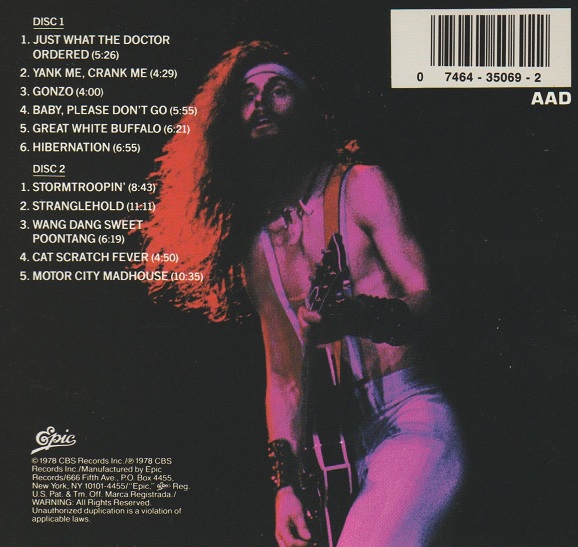
The back cover has a mis-print.  “Hibernation” is 16:55 long, not 6:55.

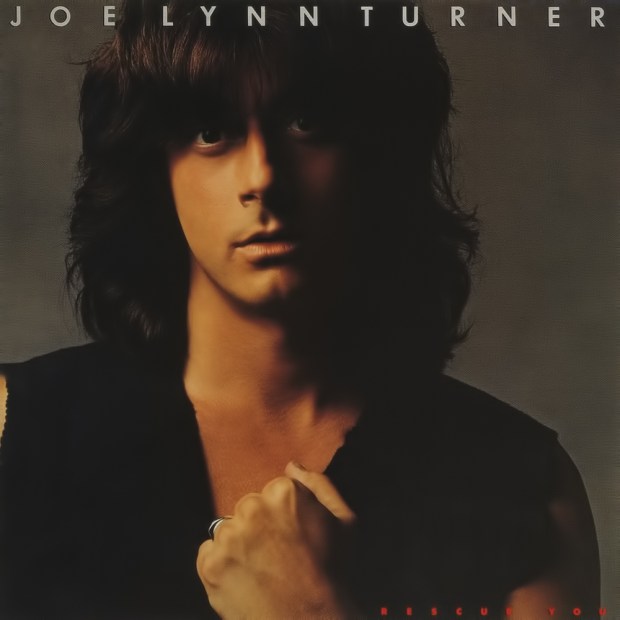
REVIEW: Joe Lynn Turner – Rescue You (1985)

jlt-ryJOE LYNN TURNER – Rescue You (1985 Elektra)

Post-Rainbow, Joe Lynn Turner embarked upon a solo career.  With the last Rainbow drummer Chuck Burgi on hand, Joe debuted his solo self with Rescue You in 1985 on Elektra.  Roy Thomas Baker, best known for his work with Queen, worked on the production.  All songs were written by Joe and guitarist Alan Greenwood.  The direction was heavy on keyboards, and sampled drum sounds.  The only thing in common with Rainbow is the voice.

That voice cannot be mistaken.  Nobody can sing soul-driven broken hearted AOR rock like Joe Lynn Turner.  Opening track “Losing You” fits this description like a glove.  The samples and keyboards are occasionally distracting, but the melodies are strong.  Joe has always been a fine writer.  Perhaps Journey should have knocked on Joe’s door for some help when they were struggling to come up with Raised On Radio.  The second song, “Young Hearts” is pure pop rock like Steve Perry did on Street Talk in 1984.

“Endlessly” was the single/video, a keyboard rock ballad, and a decent one at that, but it is overwhelmed by the title track. “Rescue You” is once again very keyboard heavy, but rocks better than anything else on the album. It has a European flavour, sounding a bit like some of the material Glenn Hughes was doing in the 1980s. Back to the Americas, “Feel the Fire” is a bit limp, but sounds like something that could have been played on radio.

The LP continued on side two with “Get Tough” which isn’t that at all. The toughest thing about it is Burgi’s excellent drumming at the start. The bassline sounds like “Livin’ on a Prayer” but before that song was ever conceived. One gets the feeling that many of these songs could have been hits if only recorded by someone more famous. “Eyes of Love” is a decent moody mid-tempo song, and Joe sounds awesome on it. “On the Run” is a bit more upbeat, boasting a strong chorus that’s as good as anything on Slippery When Wet.  Moving into Purple territory, “Soul Searcher” could have fit in well on their Slaves and Masters LP.  One almost aches to hear what Blackmore and Lord would have added to it.  Going into the closer, “The Race is On” really has the life sucked from it with the keys and samples.  You can distinctly hear a heavy blazing rocker desperately trying to get out.  The recorded song sounds half-arsed, with those unnecessary keys taking up valuable sonic ground.

Not a bad solo debut from Joe, but certainly inferior to the Rainbow that came before and the Purple that came after.

3/5 stars

scan_20161104

Songs written by Greenwood/Turner except noted

“Losing You” – 4:25
“Young Hearts” – 3:52
“Prelude” (Newman, Turner) – 0:56
“Endlessly” – 3:40
“Rescue You” – 4:31
“Feel the Fire” – 3:28

“Get Tough” (Delia, Turner) – 4:33
“Eyes of Love” (Turner) – 3:49
“On the Run” – 3:53
“Soul Searcher” (Greenwood, Newman, Turner) – 4:08
“The Race Is On” – 3:23

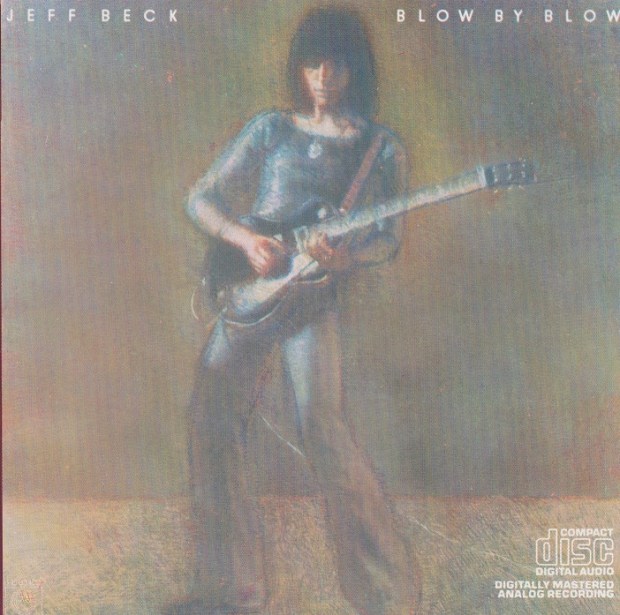
REVIEW: Jeff Beck – Blow By Blow (1975)

Purchased at BMV in Toronto, $4.99

scan_20161111-2JEFF BECK – Blow By Blow (1975 Sony)

Jeff Beck’s first solo album, Blow By Blow, was co-produced by George Martin.  The talents of both need no elaboration.  A guitar god and “the” producer’s producer were bound to make something special together.  With an ace quartet (Max Middleton on keyboards, Phil Chen on bass and drummer Richard Bailey), there were no weak links.

Blow By Blow spans many musical genres, all augmented with Jeff’s sharp and slippery fingerwork.  Funk, jazz, blues, Carribean and progressive rock all collide in the grooves.  The songs are instrumental hybrids of styles, but Jeff keeps it consistent.  His guitar speaks.  There really isn’t a better way to describe what he does with tone, technique and technology.  There is even an uncredited Stevie Wonder cameo on “Thelonius”.  If you can’t get enough funky clavinet, you’ll love Blow By Blow.

This albums is tops in almost every conceivable measure.  The drum rhythms and bass grooves are hard hitting and relentless.  Musicianship like this is rare and valuable.  Without Jeff Beck there could be no Steve Vai — this, I firmly believe.

Play Blow By Blow, and then play it again.  Thanks to George Martin’s fine musical sensibilities, it reveals new nuances each time.  A complete triumph.

5/5 stars

scan_20161111-3

This has been a 200 word review in the tradition of the #200wordchallenge.

REVIEW: The Sword – Age of Winters (2006)

Purchased at BMV in Toronto 2016 for $6.99.

scan_20161126THE SWORD – Age of Winters (2006 Kemado Records)

The scene:  Earth, post-Rapture.  A seedy bar somewhere in America, haunted by the few remaining survivors.  In walks a cloaked figure, here to recruit the only man who can help him defeat the Antichrist:  former CIA agent Stan Smith.  On the jukebox in the futuristic post-apocalyptic watering hole:  “Barael’s Blade” by The Sword.  (American Dad season 5 episode 9 – “Rapture’s Delight”)

Sounds bizarre, right?  Seth MacFarlane’s American Dad has always used modern rock music in interesting ways, and this wasn’t the only use of music by The Sword on that show.  “Iron Swan” appeared in an episode called “Minstrel Krampus” (also featuring soul crooner Charles Bradley).  Interestingly, not only are both these appearances in rather twisted Christmas episodes, but both songs were drawn from The Sword’s debut long-player, Age of Winters.

The doomy riffs of opening track “Celestial Crown” immediately recall early Black Sabbath circa 1970-72, but drawn out, slowed down, grinding heavy like a glacier carving its path through a mountain.  J.D. Cronise’s howling vocals break the ice on “Barael’s Blade”, but the assault continues right on to “Freya”.  This track, the ogre stomping “Freya”, wields multiple guitar riffs as heavy as the thunder of an avalanche.  The Norse goddess of fertility is also the goddess of war and death.  “Freya” brings the sonic conflict to your speakers.

When the “Winter’s Wolves” arrive, your senses are already overloaded by the riff-heavy metal.  “Wolves” centers on a heavy drum section, like Bill Ward on ephedrine.  Almost as if part of the same song, “The Horned Goddess” reverberates like a coda to “Winter’s Wolves”, different yet solidly in the same icy field.  “The Horned Goddess” soon transforms into a stampede of mammoths making their last stand.  Hypnotizing lead vocals welcome you into this hazy landscape of sound.

Acoustic instrumentation brings “Iron Swan” a different aura, like the Beatles via The Sword.  Then it immediately launches in a thrash metal “War Pigs”, as if all the speedy chops the band had in storage were being used up right now at this very moment.  Epic only touches on what “Iron Swan” is, as there is so much riffery that it becomes overwhelming.  Scientific studies* have shown that the human memory can only retain so many riffs at one time, and so “Iron Swan” becomes like a wave of them hitting your senses one after the other.

Painting of an Aurochs from Wikipedia

Painting of an Aurochs (Wikipedia)

The Aurochs, a part of European megafauna until their extinction in the early 1600s, were the direct ancestor of the modern domestic bovine whose products millions of people consume every day.  It is the Aurochs you see in cave paintings today.  The Sword have given us a seven-minute-plus “Lament for the Aurochs”, and we do not forget the impact that mankind has had on the ancient land we inhabit.  Although back-breeding has produced Auroch-like “Heck cattle”, we shall never feel the ground shake with a herd of Aurochs again.

“And none may see again the shimmering of Avalon,
Or know the fates of all the races man has cursed,
Long gone are the ages of the alchemists,
Now there are none who know the secrets of the earth.

“Lament the passing of the Aurochs,
And the slaying of the ancient wyrm,
Would you dare meet the gaze of the basilisk,
Or face the flames as the phoenix burns?”

The Aurochs give way to an epic instrumental “March of the Lor”, another exercise in maximizing potential riffage.  When “Ebethron” arrives to end the album with a hammering blow, it is a mercy killing.  Age of Winters is almost non-stop, all-in, nothing but riffs and pounding through its entire length.  That in mind, it only takes a short while to recover, and hit play one more time….

I look forward to exploring more of The Sword’s discography.

4.5/5 stars

Look for a review of album #2, Gods of the Earth, soon.

*Not really.


ROGUE ONE: A Star Wars Story trailer “Trust”

It is a period of civil war. Rebel spaceships, striking from a hidden base, have won their first victory against the evil Galactic Empire.

Rogue One will be out in 19 days.  Get ready.

REVIEW: Don Dokken – Up From the Ashes (1990)

scan_20161027DON DOKKEN – Up From the Ashes (1990 Geffen)

“The best revenge is to live well.” — Don Dokken’s liner notes.  Passive aggressive much?

Dokken imploded in 1989 not with a bang but a whimper.  Rather than remembering the live album they finished with (Beast From the East), people recall the animosity and bitter attacks in the rock press.  George Lynch and Mick Brown began Lynch Mob, while Jeff Pilson formed War & Peace. Don Dokken meanwhile was cooking up a hot new band.  The only issue was the name.  The ex-members, who owned a stake in the Dokken name, refused to let Don use it.  They also shot down the names “Dokken II” and “DKN”.  (Reportedly Dokken was told if he wanted to just use the vowels “OE” for his new band, that would be fine with the others!)  Don was understandably upset that he couldn’t use his own last name for his name, so he opted to bill himself as Don Dokken the solo artist.

His solo band was a killer.  Fresh out of Europe with a smash hit album under his belt, John Norum joined on guitar.  Billy White from the thrash metal band Watchtower was the second guitar player, giving Dokken a double guitar lineup (or three if you count Don himself).  King Diamond’s Mikkey Dee was aboard on drums, several years away from joining Motorhead (and now Scorpions).  Rounding out the band was veteran Accept bassist Peter Baltes, who played with Dokken in their earliest days.

With all this burning anger coupled with tremendous instrumental firepower, one might expect Don to come back rockin’ harder than ever.  His solo album Up From the Ashes was a down-ratchet from Dokken, slightly, with an emphasis on melodic rock.  It did however continue the core Dokken sound, with some biting and very Lynch-like guitar riffs.

Entering with the kind of jagged riffs that made Dokken famous, “Crash ‘N Burn” sounds almost exactly like Don’s old band.  Hard rock, smooth vocals, and six-string acrobatics.  There is no familiar Jeff Pilson backing vocal, but Peter Baltes and John Norum get the job done.  The incredibly impressive guitar histrionics are clearly not George Lynch, but fans will love what John and Billy White cooked up.  A strong follow-up called “1000 Miles Away” sits in a comfortable mid-tempo rock zone.  It’s not a ballad, it’s not a rocker, but it’s somewhere in between.  Hit material.  The album’s single was a track called “Mirror Mirror”, with a stuttery Van Halen riff.  The lyrics are very telling:

“Mirror mirror, on the wall,
Seven years, I survived them all,
Mirror mirror, tell me more,
If that was love, then love is war.”

Dokken had a roughly seven-year long life as a recording band, so think what you will.

A lot of Up From the Ashes fits into a nice little hard rock box, a little smoother around than edges than classic Dokken, but strong as ever.  “When Some Nights” has a similar vibe to “1000 Miles Away”, and there are many others.  No real weak songs abide within.  There are only a few that are head and shoulders standouts.  Among these is “Living a Lie”, a sharp Norum co-write with a Europe-like sound.  Also up there, “Give It Up” is a brief blast of rock.  “Stay” leans in a slightly more pop direction, successfully so.

Drony ballads are less impressive.  “When Love Finds a Fool” is fortunately the only one, which does at least boast some impressive musical contributions from all the players.  The momentum is killed by starting side two with this slow Scorpions-wannabe.  Another issue is a slightly damp production, which makes the drums sound woefully underpowered.  This is a shame since Mikkey Dee is such a drum demon.

With Up From the Ashes, Don re-established himself.  Nobody could accuse him of leaning on George Lynch.  With the benefit of 20/20 hindsight, this band really should have been called Dokken.

3.5/5 stars