
The Deep Purple Project continues! Here is one big solid chunk of rock majesty.

DEEP PURPLE – The Soundboard Series – Australasian Tour 2001 (2001 Thames 12 CD box set)
One day in spring of 2002, I wandered into Encore Records in Kitchener. I spied this lovely box o’ rock up front in their glass case, where they stored similarly awesome boxes of rock.
“What’s that?!” I asked, and was promptly handed 12 CDs of live Purple. A quick glance, and “I’ll take it.” Only a short while before, I bought yet another 12 CD live Deep Purple box set. When I first noticed this box under the glass, I was hoping it was just a reissue of the same thing; something I already had that I could safely pass on. It only took one close look to realize that this was a whole other animal completely. Rather than a collection of bootlegs from the 80’s and up, like the one I had, this box chronicled Deep Purple’s 2001 tour of Australia, Hong Kong and Japan. What special concerts those must have been. Read on and you’ll discover why.
Each concert presented in this box is complete, and mixed from the 8-track soundboard DAT tapes. No audience recordings in this bad boy, which is a good thing, since Purple were touring with numerous extra musicians and accoutrements that require sonic clarity. Of the six concerts included, four are largely the same. A lot of Ian Gillan’s song intros are the same from night to night, and the setlists are by and large the same. Of course where Deep Purple are concerned, that means very little. Their solos are never the same, and each performance is its own experience. Steve Morse has never really repeated himself night after night, nor did Jon Lord.
There are some cool surprises in the sets. One of the best tracks, and one of the most rarely played, is “Mary Long” from Who Do We Think We Are. This rhythmic monster goes down smashingly well, and it’s a wonder that Purple never tried it any earlier. There are some true buried gems on those early Purple albums, especially Fireball and Who Do We Think We Are, that were never given a fair shake in their day. Deep Purple today are able to have more fun with their setlists than they were in the 70’s. Another such track is “No One Came”, one of the strangest songs in the catalogue. It benefits greatly from a three piece horn section (the Side Door Johnny’s). There are versions with horns on some other live albums as well, such as Live at the Olympia ’96, so while horns are not unheard of in Deep Purple, they are rare. “No One Came” and “Fools” (both from Fireball) are quite a treat any time you get to hear them live, which you didn’t get to do in the 70’s. They also play the classic B-side “When a Blind Man Cries”, a blues that deserves the spotlight.
Of course Deep Purple always play new material, but what’s really surprising is that they only played one song from their last studio album (1998’s Abandon), and only one time, during the first four concerts! At the first show, in Melbourne, they played “’69”. Then it was dropped and the set slightly shuffled. “Smoke on the Water” was moved from the middle to the second half of the set. Speaking of “Smoke”, fans familiar with the Steve Morse version of Deep Purple are aware that he really likes to have fun with the intro. He teases out several classic rock riffs, all instantly recognizable, as he tries to remember which riff is the one he’s supposed to be playing (or so it seems). AC/DC’s “Back in Black” is the one that really stands out, and it’s remarkable how well it works with Deep Purple. There are lots more, including “Whole Lotta Love”, “Heartbreaker” and “Stairway to Heaven”, that one normally does not associate with Deep Purple! Other favourite riffs include “Sweet Home Alabama”, “Little Wing”, and even a Van Halen inspired version of “You Really Got Me”, but the one that surprised me the most was “To Be With You”, by Mr. Big. Don’t forget, Mr. Big are absolutely huge in Japan, so when they played that little bit in Tokyo, I’m sure everybody knew it.
Also of note, Jimmy Barnes came out for “Highway Star” and “Smoke on the Water” for a couple Australian shows. Sharp-minded readers will remember that Barnes was one of many singers who auditioned for Deep Purple in the late 80’s before they hired on Joe Lynn Turner. He seems to have a blast screaming his way through “Highway Star”! Must be like a dream come true. Gillan’s in great voice too, by the way!

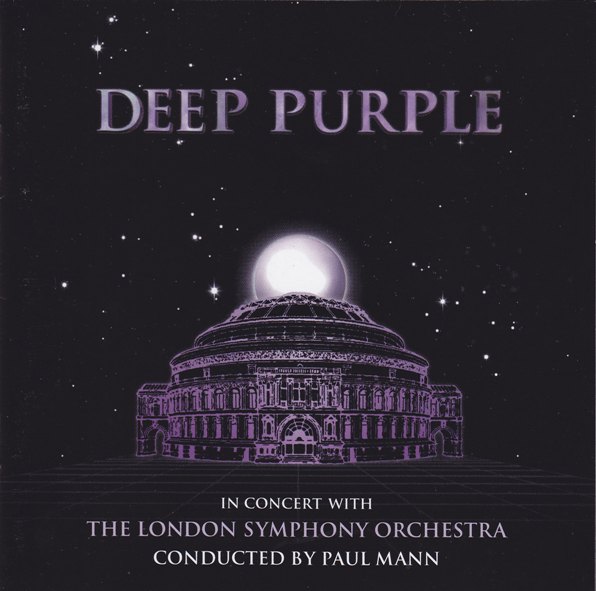
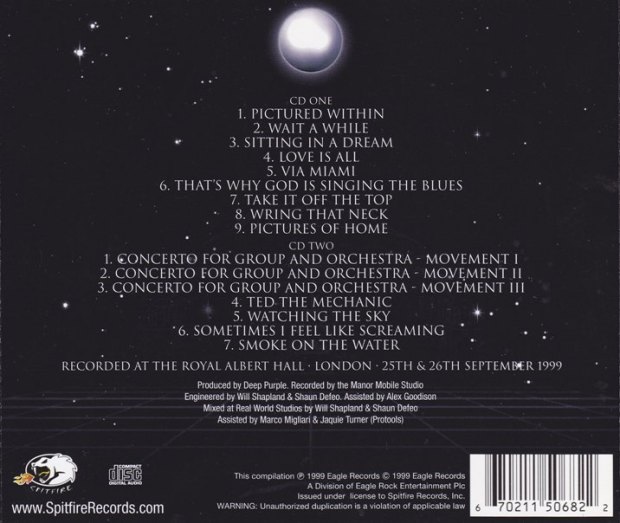
For more thrills with special guests, we must go to the last two shows, in Japan. Australia surely had a treat with the Side Door Johnny’s and Jimmy Barnes, but what Japan got was even better. Fresh off their well-received Live at the Royal Albert Hall album from 2000, conductor Paul Mann joined Purple for two nights in Tokyo. That meant a full performance of the legendary and almost never performed Concerto for Group and Orchestra, all three movements. Mann and the New Japan Select Orchestra joined Purple on a number of their songs as well, including “Watching the Sky” from Abandon, but it was only played on the first night. All that said, there was no greater thrill than the presence of Ronnie James Dio. As he did on the Albert Hall album, Ronnie sang lead on two songs from the Purple solo catalogue. He performs Roger Glover’s “Sitting in a Dream” and the delightfully bouncy hippy anthem “Love is All”. Ian Gillan, meanwhile takes the lead on Jon Lord’s “Pictured Within”. Dio also returns for “Smoke on the Water”, trading with Gillan, but what’s really special is that Purple actually performed two Dio songs at these shows. Though Dio and Purple are two very different bands, Purple adapt and do great versions of “Fever Dreams” and “Rainbow in the Dark”. The drum and keyboard parts are the most different, but nobody’s complaining! It’s great that they did “Fever Dreams” from Dio’s Magica, a great album that deserved the recognition. “Fever Dreams” is one of Dio’s best tunes from the latter period.
“Wring that Neck” and “Pictures of Home” were brought out of mothballs for the Tokyo concerts. “Wring that Neck” is a jazzy version with the horns coming in strong, just like it was on the Albert Hall CD. Undoubtedly though, the centerpiece is the Concerto itself. Even though it put Purple on the map in 1969, it wasn’t particularly well liked by the members of the band (Jon Lord aside, obviously, since it was his creation.) With Steve Morse in the band instead of Ritchie Blackmore, feelings softened and ideas like resurrecting the Concerto were possible. The music however was lost. It took Dutch composer Marco de Goeij years to re-create it, but once Lord helped him finish, it could be performed once again. It’s incredible to think that they were able to take it to Japan and play it for those lucky fans, both nights. You can absolutely tell the difference from the London version. It’s fortunate that it was recorded so well (not perfect but damn well good enough!), and released for you to be able to own forever.
There is no point in breaking this down for a disc-by-disc rating. If the box set could be faulted for anything, it is that there is so much repeat between the first four concerts. For me, box sets tend to work best in the car. I put this on a flash drive and took about three weeks to listen to the whole thing in sequence. In that environment, I don’t bore of the songs. Instead I enjoyed the slight differences. “Oh, this is a little different than the way they introduced it, when I heard it a couple days ago.” Obviously, only a true Deep Purple lover needs to own this. But every Deep Purple lover should own it.
Discs 1 & 2 – Melbourne, March 9 2001
Discs 3 & 4 – Wollongong, March 13 2001
Discs 5 & 6 – Newcastle, March 14 2001
Discs 7 & 8 – Hong Kong, March 20 2001
Discs 9 & 10 – Tokyo, March 24 2001
Discs 11 & 12 – Tokyo, March 25 2001
4/5 stars






 mikeladano.com