THE HONEYDRIPPERS – Volume One (1984 Atlantic, 2007 Rhino reissue)
In 1981, Robert Plant felt like playing some old fashioned rock and roll again. He assembled a group of friends including Jimmy Page, Jeff Beck, Nile Rodgers, Dave Weckl and Paul Shaffer. With a handful of covers ready to go, The Honeydrippers Volume One EP went top ten in the US and Canada. I have now officially bought this EP four times: First time on cassette, then vinyl, then CD, and now finally this remastered CD with one bonus track. One bonus track is all they could be bothered to beef this up by. A grand total of 22 minutes, up from 18.
Originally released in 1984, in a lot of ways this was as close to a Page/Plant reunion as we were likely to get in the 80’s, although this is very different from Led Zeppelin. These are classic golden oldies, rock and roll and R&B hits: the sound like guys like Plant and Page grew up with. So get up, get down and dance!
“I Get A Thrill” is an excellent track with which to open the EP. It’s a great song with wonderful backing vocal harmonies. A nice fast one to dance to. Everybody should know “Sea of Love”, the lush, elegant slow-dancer. Today it is better known than the Phil Phillips original. The music video might be most notable for the speedo-wearing Frank Zappa lookalike on the xylophone. Ray Charles is last for side one: “I Got A Woman”. It’s breakneck fast, and might be too much for those on the dance floor cutting a rug! Don’t go and break a leg….
Does humour belong in music?
Plant croons his way through “Young Boy Blues”, a Phil Spector oldie done justice by Robert’s rich voice. It’s as lush and brilliant as “Sea of Love” and easily as good as the better-known single. Back to cutting a rug though, you’d better get up for “Rockin’ At Midnight”, another hit single for the Honeydrippers. Jeff Beck nails the perfect guitar solo in the midst of a boppin’ horn section. Rock perfection!
The one measly bonus track is a live version of “Rockin’ At Midnight”. It’s shorter than the studio version of the song by two minutes. It’s hard to fathom how Rhino only had one bonus track to include. Plant performed live with the Honeydrippers numerous times. To think they only ever recorded one track live is pretty hard to believe.
This remaster (released in 2007 as part of the Plant remasters) sounds great, and despite the short running time, is worth your cash as long as you’ve never bought it on CD before. It’s fun, it’s warm, it’s a great listening experience and every one of these tracks is a bonafide classic. It’s kind of odd hearing Plant’s distinctive squeal on some of these songs, but it actually works.
4/5 stars, but only because they could have included more bonus material.
2001: A Space Odyssey – Original motion picture soundtrack (originally 1968, 1996 Rhino remaster)
Stanley Kubrick changed the sci-fi playing field with 2001: A Space Odyssey. When he and Arthur C. Clarke sat down to write the “proverbial good science fiction movie”, they strove for a depth and realism that had yet to be attempted. No sounds in space. No thruster sounds, no pinging space radar. Music (or even lack thereof) would be required to tell the audio story. Kubrick initially contacted Spartacus composer Alex North. The plan changed, however. Stanley had been editing the film to a temporary score of classical music. Nothing North could come up with satisfied the fussy director as much as the classical pieces, so that is what was used on the final film.
The film was fiercely different, free of cliches and intensely determined not to dumb things down. The same could be said of the soundtrack, reissued on CD by Rhino with four supplementary bonus tracks. This fine release enables the listener to delve deeper and unlock even more of the secrets of the universe. Ligeti’s dissonant “Atmospheres” delivers an uneasy feeling; after all we humans know nothing of what is really out there. The conflicting (and conspiring) tones of “Atmospheres” is supplanted by the main title, “Also Sprach Zarathustra”. The music implies great revelation, standing on the cusp of universal breakthrough.
Unease returns with the bee-like swarms of “Requiem” also by Ligeti. Voices sing, each one in their own world, but joining together to join a coherent piece. In the film, this unsettling music appears when we encounter the enigmatic Monolith. The Monolith is a tool of our growth as a race and a stark warning that there are things beyond that our science is not equipped to explain. Arthur C. Clarke’s “third law” states “Any sufficiently advanced technology is indistinguishable from magic,” and that describes one aspect of the Monolith in 2001. (The other two laws: 1. “When a distinguished but elderly scientist states that something is possible, he is almost certainly right. When he states that something is impossible, he is very probably wrong.” 2. “The only way of discovering the limits of the possible is to venture a little way past them into the impossible.”)
After the chaos of “Requiem” and “Atmospheres”, Strauss’ “Blue Danube” offers a warm respite. The brilliance of the “Blue Danube” in the film is how Kubrick managed to capture the dance-like coordinated movements of objects in space. A shuttle docks with a spinning space station; spinning of course to create artificial gravity that humans need to survive long-term in space. This complex docking maneuver requires no dialogue, just Strauss. But space is a cold deadly place, hostile to almost all known life. Ligeti returns, as he must, with “Lux Aeterna”. This music was used to back Dr. Floyd’s trip across the lunar surface to meet the Monolith. It is mildly disconcerting, as is what Floyd’s team finds.
Khachaturian’s “Gayane Ballet Suite” is a somber piece, depicting the boredom and routine of interplanetary space flight. Astronauts David Bowman and Frank Poole seem disconnected from their humanity; the music has more feelings than they do. The coldness of space is easy to feel from inside their stark white starship, and Khachaturian painting the tone.
Mankind meets its future on “Jupiter and Beyond”, a combination of three Ligeti pieces. Once again, we must face the Monolith and what it means. Dr. David Bowman experienced great terror as he plunged inside it, and this is the music that accompanied his long trip into the beyond. The film at this point became its most experimental: impressionist images and obscure dissonant music put many viewers off balance as they struggled to comprehend just what the hell was going on. It is over only when Zarathustra speaks again, and humanity has taken its next giant leap.
These are challenging pieces of music, but not difficult to enjoy. They have all become intertwined with the film forever. Even The Simpsons used “The Blue Danube” for a space docking scene (Homer and a potato chip) in an homage to 2001. Whatever the original composers intentions were, in the 20th and 21st centuries, the pieces used in this movie are now associated with it forever. You simply cannot hear these Ligeti pieces without seeing Bowman’s journey in your mind. You cannot hear “Thus Spake Zarathustra” without feeling the awe of 2001‘s revelations.
The Rhino edition adds some bonus material. Ligeti’s “Adventures” was altered for the film to add an impression of laughter. Ligeti himself was not amused. The original complete “Adventures” is on this CD. From the archives is a different recording of “Thus Spake Zarathustra”. The version used in the film and on the CD was conducted by Von Karajan, but the original LP had a version by Ernest Bour. The latter version has been added to the Rhino CD release. “Lux Aeterna” was longer on the original LP than the film, and the long version is also restored to CD. Perhaps most valuable of all is a track of Douglas Rain’s dialogue as HAL 9000.
The excellent liner notes state that this CD release is the definitive one. It contains all the music from the original soundtrack LP, and all the music from the film. It’s a one-stop shop to get your musical mind blown.
My sister used to have a tradition. Because I’ve always been a collector, she would have an easy time buying gifts for me as a young rock fan. When I was 17 years old, I only had a few albums by certain artists. She’d sneak into my room and go over my collection. She saw that I only owned a few of Alice Cooper’s: Trash, Prince of Darkness, Billion Dollar Babies, and Greatest Hits. For Easter of 1990, she got me Alice’s Welcome to My Nightmare. Not knowing what to except from the Coop, it was pretty much instant love.
I played that cassette a lot and grew to know its track sequence, which was completely different from CD. Later on I purchased the original CD release, but what Welcome To My Nightmare needed (and the rest of the Cooper catalogue needs) is a proper remaster with bonus tracks. Rhino took care of that in 2002.
Now the album itself sounds so much better than the original CD. This sounds more like vinyl, the way it should, rich and deep. The liner notes, unfortunately, are somewhat crappy. They basically just explain to the youth of today why Alice Cooper is cooler than the bands they like. There’s not much about the genesis of the album, which is disappointing. This is, after all, the very first solo album by Vincent Furnier aka Alice Cooper. By 1975, the Alice Cooper band (Furnier, Michael Bruce, Dennis Dunaway, Neil Smith, and the late Glen Buxton) was no more. Never again would they share a stage or a recording studio, at least the original five. The four survivors did finally re-team for a couple songs on 2011’s sequel, Welcome 2 My Nightmare.
Welcome To My Nightmare was a revelation to me when I received it, and it is still mind-blowing today. I think that is due to the production talents of Bob Ezrin. The man who later produced Destroyer and The Wall really came into his own on this album. His production is, for lack of any better words, jaw dropping. You can totally tell it’s him, if you know his style well enough: that creepy horror movie piano, all the orchestrations, sound effects, the kids singing. Those are trademarks. My favourite moment for the kids was in the song “Department of Youth”. Cooper and the kids sing in the fade-out:
Together – “We’re the Department of Youth, ahh ahh, we got the power!”
Alice – “Who got the power?”
Kids – “We do!”
Alice – “And who gave it to you?”
Kids – “Donny Osmond!”
Alice – “WHAT?”
Loosely, this is a concept album about the kind of nightmares Alice would have. The result was a collection of remarkably timeless and classic songs: “Only Women Bleed”, “Black Widow”, and “Escape” for example. “Escape” is the most straightforward rocker on the album, and a joy it is. The rest is often more complex, arrangement-wise and lyrically.
The title track is a fun rollercoaster ride with epic horns. Same with “Devil’s Food” and “The Black Widow” which work together as a creepy classic featuring Vincent Price. I would not want to live my life without these songs. Alice is nothing if not diverse, and then “Some Folks” sounds showtune-y. “Only Women Bleed” is the famous ballad, often misunderstood, but respected enough to be covered by artists such as Lita Ford, Tina Turner, and Etta James.
“Department Of Youth” and “Cold Ethel” are more rock and roll, and why not? What better genre to sing about rebellion and necrophilia? It’s worth pointing out the guitar charms of Steve Hunter and the late Dick Wagner. These two incredible players, under the guidance of Ezrin, lent Welcome To My Nightmare the rock edge that it needed, lest it be swallowed up by the dramatic tendencies.
Of course, Welcome To My Nightmare features the first-ever appearance of the character of Steven. “Years Ago” has Alice singing in this incredibly creepy little-kid voice, as Steven. Then the song “Steven” kicks in, and it’s even creepier, but very epic in scale. Alice is at his most effective here. Steven would pop up many times, such as on the next album Alice Cooper Goes To Hell, 1991’s Hey Stoopid, 1994’s Last Temptation, and the more recent Along Came A Spider. Whether it’s supposed to be the same guy, or just a character who shares the same name, I do not know.
The bonus tracks are alternate versions of “Devil’s Food” (much extended), “Cold Ethyl”, and “The Awakening” with alternate lyrics and more Vincent Price! Not available on the Life and Crimes of Alice Cooper box set! These three tracks alone, to the Cooper collector, necessitate a re-buy. The improved sound probably would have hooked them in anyway.
I could never say, “If you only buy one Alice Cooper album, buy this one.” The reason I can’t is that almost every album by the original Alice Cooper band was monumental, particularly School’s Out and Billion Dollar Babies. However, if you buy two or three Coops, please make one of them Welcome To My Nightmare, remastered!
5/5 stars
* There is also a DVD Audio of this album mixed in 5.1 by Bob Ezrin himself!
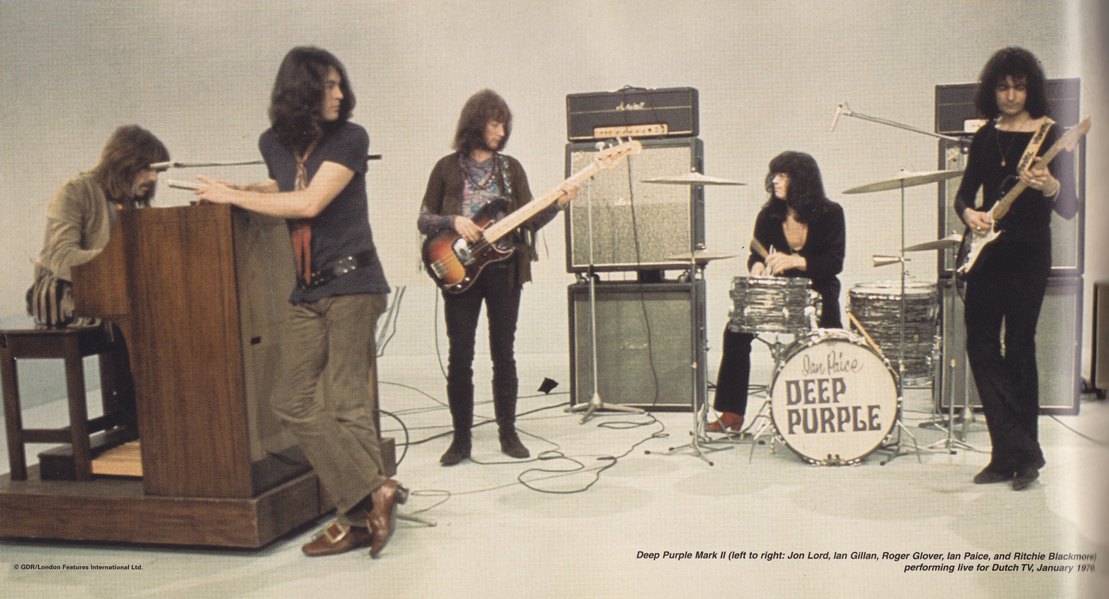
DEEP PURPLE – Shades 1968-1998 (Rhino 1999 box set)
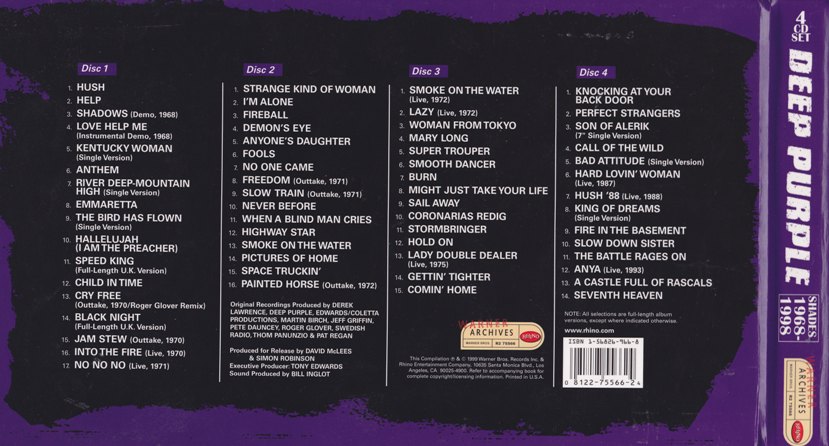
I was really excited about this 1999 box set when it came out, but what it came down to was this: I paid “x” amount of dollars for just two songs that I didn’t have on other recent Deep Purple CDs. One song, “Slow Down Sister” by Deep Purple Mk 5 was only available here. It’s since been reissued on the Slaves and Masters deluxe edition. The other is a very rare and very great 1971 live version of “No No No” from a compilation called Ritchie Blackmore/Rock Profile Vol. 1. So there’s your bait.
Unfortunately, the booklet and discography is loaded with errors. This was disappointing. The packaging is nice, with that sheet metal looking embossed cover. It opens kind of awkwardly though, making it hard to handle. And man, there are so many Deep Purple box sets out there now! I have Listen, Learn, Read On which is six CDs dedicated entirely to just 1968-1976. Obviously you can’t squeeze Deep Purple’s career onto just four discs. This set covers 1968-1998, which is a huge chunk. It’s almost the entire Jon Lord tenure. It skimps in some places and confounds me in others. Usually, Rhino do such a great job, but I felt this one didn’t live up to their other products.
Disc one covers 1968 to 1971 (Shades Of to Fireball). The tracks listed here as demos or rarities are from the Deep Purple remastered CDs, all except for the aforementioned “No No No” which really is awesome. If you have the great Singles A’s & B’s and the Deep Purple remasters, you have all this stuff. Except maybe the edit version of “”River Deep, Mountain High”, I’m not certain about that one. You get a good smattering of favourites on here, like “Kentucky Woman”, “Speed King”, “Child In Time” and so on, but it’s not really sequenced all that well. The slow-ish Deep Purple Mk I material fits awkwardly with the Mk II. Other songs of note include non-album singles and B-sides such as “Hallelujah” (first recording with Ian Gillan) and “The Bird Has Flown”. The version of “Speed King” included is the full UK cut, with the crazy noise intro.
Disc two is 1971 to 1972: more Fireball, and Machine Head. All these tracks can be found on Deep Purple remasters. There are some excellent tracks here, such as the rare “Painted Horse” and “Freedom”. “Painted Horse”, a personal favourite, has been available for decades on an album called Power House. I guess Blackmore didn’t like them at the time, so they languished until the band broke up before the record label released them. “I’m Alone” was rare for a long time, and “Slow Train” was completely undiscovered until the Fireball remaster. I like that “Anyone’s Daughter” is on here, a very underrated song. Of course you will hear all the big hits on this disc: The studio versions of “Smoke on the Water”, “Fireball”, Highway Star” and “Space Truckin'”. This will be many people’s favourite disc.
The third CD continues with Mk II. It starts off with the Made In Japan live version of “Smoke” which is fine, but now you’ve heard it twice. Soon, it’s “Woman From To-kay-yo”, “Mary Long”, and the scathing “Smooth Dancer”. Then Gillan and Glover are out, and in comes Coverdale and Hughes One rarity on this disc is the instrumental “Coronarias Redig”, which dates from the Burn period. It also includes some of Mk III’s most impressive work, including two of the best tunes from Come Taste The Band. Conspicuous by their absence is the epic “You Keep On Moving”, and Blackmore-era fave “Gypsy”. You will, however get “Burn”, and “Stormbringer” from Stormbringer itself.
The fourth CD is the one that ticks me off the most. This covers the reunion era, from 1984 to the then-most recent album Abandon in 1998. The hits are here, “Perfect Strangers” and “Knocking’ On Your Back Door”, as well as some singles from the Joe Lynn Turner era. What ticks me off here is the song selection. “Fire In The Basement”? What? That song kind of sucks, why not “The Cut Runs Deep”? Only one song from The Battle Rages On is included, only one from the excellent Purpendicular, and only one from the recent Abandon? And not even the best songs? That makes no sense.
To short-change the later era of Deep Purple only serves to short-change the listener. The band were revitalized and rejuventated by Steve Morse, and made some really good, well received music. I saw them live with Morse in 1996.
From The House of Blue Light era, a single edit of “Bad Attitude” is included, which is probably rare. What you won’t get is the full, 10 minute + version of the instrumental “Son Of Aleric”. This is one of the best lesser known tunes from the reunion era. Instead, you get the truncated 7″ single version. That makes the 10 minute version frustratingly hard to get. It was originally released on a 12″ single, which you may be able to find. You might have better luck finding it on the European version of Knocking at Your Back Door: The Best of Deep Purple in the 80’s. It was included there, replacing “Child In Time” from the US version. I managed to get it thanks to my mom & dad who bought it for me at an HMV store in Edinburgh (along with Restless Heart by Whitesnake).
Mick Wall’s liner notes offer the Morse years a mere mention, and end on a nostalgia note of “bring back Blackmore.” Come on. Let’s focus on the present of a band that shows no signs of slowing down, shall we? But this box set short changes the present, and by picking it up you won’t hear such awesome later songs as “Sometimes I Feel Like Screaming” or “Fingers to the Bone”.
I know many reviews of this set are glowing, and each reviewer has their own reasons for doing so. I can’t. This band is too important, too vital, and dammit, still alive! This box set simply doesn’t do them justice. I was ticked off when I bought it and realized I owned almost all the “rare and unreleased” material. Collectors won’t find much here worth the coin spent, and rock fans who just want a great box set of Deep Purple won’t get to hear enough Morse.
Fact: When I was a kid, I used to think that Jay Jay French might in fact be blind; I never saw him without his dark shades!
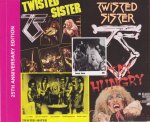
25 years of Stay Hungry? Actually 29 years at press time! I don’t want to believe it. Anyway, this reissue was a pretty big deal because Stay Hungry was out of print on CD. For whatever reason (legal, contractual?) when Twisted issued their series of remasters with bonus tracks back in 1997, Stay Hungry was not one of them. Then in 2004, the reunited band recorded an album called Still Hungry, which was all of Stay Hungry re-recorded “the way they originally wanted it to sound” (cough). As a fan, I only enjoyed it for the new and unreleased bonus tracks. I was underwhelmed by the re-recording. It’s impossible to duplicate a specific recording, especially when the singer can no longer hit the high notes in “The Price”. And it just didn’t sound good.
That was then, this is now, and Stay Hungry has finally been remastered and beefed up with a bonus disc of unreleased material and one brand new song! (None of these unreleased songs were even heard on Still Hungry, but a couple were remade by Dee on a solo album.) The album itself remains one of Sister’s best, although my preference is to You Can’t Stop Rock N’ Roll. The bonus disc sheds light on what else the band was writing at the time.
The remastering and liner notes are excellent. The album sounds like it should, the way a pristine vinyl copy would sound back then. Still Hungry was mastered way too loud; this is much better. The liner notes reveal friction between the band and producer Tom Werman. Werman rejected a lot of what the band had written, which makes up disc two. However, he was also a big supporter of their heavier songs such as “Burn In Hell” and “Horror-Teria: The Beginning”, while disliking “We’re Not Gonna Take It”. Dee Snider, in fact, wanted to save “Horror-Teria” for a rock opera he was composing, but Tom Werman wisely insisted it go on this album.
The special thing about the original Stay Hungry album was that there was not one bad song on it. From all three smash hit singles (“I Wanna Rock” and “The Price”), to album cuts like “Don’t Let Me Down” and “S.M.F.”, every song here is a classic. And only one ballad!
Twisted Sister appeared in the 1985 comedy, Pee Wee’s Big Adventure
Highlights include the opener “Stay Hungry”, which smokes the speakers immediately. “Burn In Hell” (seen performed by Twisted Sister in the 1985 film Pee Wee’s Big Adventure) turns up the scare factor with some unholy Snider vocals. Snider’s epic “Horror Terria” is split into two parts. “Captain Howdy” (later to become Snider’s character the film Strangeland) is a warning to stay away from the title character. It’s ominous, Snider obviously hamming it up as Captain Howdy. As a kid I never fully appreciated exactly what the song is depicting, unfortunately this kind of thing is now in the news on a weekly basis. Part two is “Street Justice”, an angry song that inspired scenes in the film.
The man was caught, and brought before a judge, who had just returned from a three-drink lunch. His lawyer screamed, “You must set him free!” And off he went, on a technicality.
Side two commenced with two of the big singles, “I Wanna Rock” and “The Price”, but equally good was “Don’t Let Me Down”. This would have been another single as far as I’m concerned. “The Beast” is evil and Sabbathy, but the album ends with the TNT blast of “S.M.F.” At this point you are blown back into your seats.
The sound quality on the bonus disc varies from track to track, as is bound to happen with demos this old. Don’t let that spoil your enjoyment. These are some of the heavier songs that Twisted were writing, that Werman simply did not feel were strong enough. Perhaps with some fleshing out and proper studio time, tracks like “Death From Above” or “We’re Coming On” could have stood proud on the album as well. Clearly these demos are unfinished, most are very brief and unadorned. Some are a bit too similar to stronger songs that did make the album. Listening to the whole disc makes you wish that they had been fleshed out and released on B-sides or albums, as some are pretty good.
The highlight of this disc is the brand new Twisted Sister song, “30”. Finally, somebody has written an anthem for older rockers! It’s about time! And it’s a great tune, as well! “30 came and went a long long time ago,” sings Dee, with absolutely no shame, and rightfully so!
If you’re a new fan, or an old fan who has heard Stay Hungry a million times, this is a compulsory purchase. It renders the original release obselete. Still Hungry pales to this reissue. Well done, if only all reissues were put together with this much care and effort.
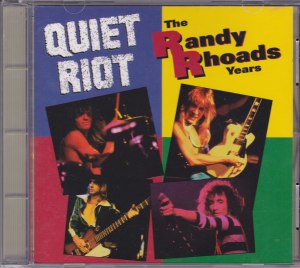
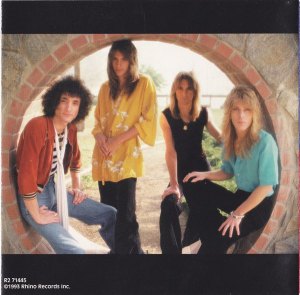
Growing up in the 1980’s, Quiet Riot was the first “metal” band I liked. Back then, we were aware that Quiet Riot had two albums prior to Metal Health. These albums seemed unobtainable forever at best, mythical at worst! The first two, Quiet Riot and Quiet Riot II, were released in Japan only. Later on, I did manage to get both albums, so I have a unique perspective on this CD: The Randy RhoadsYears, by Quiet Riot.
See, here’s a nutshell version of the story: QR lead howler and co-founder Kevin DuBrow had wanted to re-release the Randy material for years. Randy himself was never happy with those albums, nor his guitar sound on those albums. In light of this, the late guitarist’s mother Delores was very guarded of Randy’s legacy. She knew that Randy felt the albums consisted of sub-par songs with horrible production. DuBrow eventually won her blessing to re-release some of the old Quiet Riot material, but on one condition only: Get the quality of the songs up to snuff so it doesn’t tarnish Randy’s legacy.
So that’s what he did, using all the means available, and the result is a highly modified collection of Quiet Riot songs with Randy Rhoads.
I can tell people out there who haven’t heard the first two albums that they do sound awful. That’s not a myth. Randy’s guitar is but a shadow of what it would become, and the songs are mostly pretty bad, especially on the first album. The second is much better (particularly in the songwriting category) but it is still hampered by poor production. So what could DuBrow do to get permission to do a re-release?
He started by picking out six of the better songs from the first two records: “Mama’s Little Angels”, “It’s Not So Funny”, and “Look in Any Window” from Quiet Riot, and “Trouble”, “Killer Girls”, and “Afterglow (Of Your Love)” from Quiet Riot II. All of these songs were heavily remixed, with completely re-recorded vocals, from scratch. DuBrow felt, probably correctly, that his original singing voice on those albums was too “boy-ish”.
DuBrow re-sampled all the drums, and re-recorded all of Randy’s guitar tracks through a Marshall stack. Randy had confided with Kevin that he was happiest with the way his guitar sounded live with Ozzy, so Kevin recorded the original, sterile guitar tracks through Carlos Cavazo’s amps. They used the Randy Rhoads Tribute CD as a guide.
On one guitar solo, Kevin knew that Randy wished he had used a wah-wah, but couldn’t afford the pedal at the time. Kevin played the wah-wah pedal himself, using Randy’s guitar tracks, a unique form of collaboration between two friends.
With the Small Faces cover, “Afterglow”, Kevin came up with a cool idea. “Unplugged” albums were on trend, so Kevin stripped all the drums and electric instruments off the track, leaving just Randy’s bare acoustic guitar. It is like stripping a layer of paint off old beautiful old wood: the bare guitar track reveals previously unheard warmth. Kevin re-sang the vocal, kept the electric guitar solo intact, and used a triangle sample to cover up places where the original drums had leaked into Randy’s mike. This painstaking work created from the ground up an incredible alternate version that Randy would hopefully have been very proud of.
None of these people are Frankie Banali.
One of Quiet Riot II‘s best songs is “Trouble”. Kevin felt that it plodded too much, so he slightly sped it up which also raised its pitch. He then re-sang it, and the result is a much better song. Suddenly “Trouble” is a rich sounding hit-worthy rock track.
“Killer Girls” had some minor tampering, a blast of guitar where previously there was nothing. It is “Last Call For Rock ‘n’ Roll” that is most changed. Previously titled “Mama’s Little Angels” on Quiet Riot, Kevin re-wrote what he thought was a juvenile lyric. (It was about trashing the house playing a game of “indoor baseball”.) Bobby Rondinelli, who was working with Kevin on a Quiet Riot album called Terrified at the time, helped him re-write the tune. Unfortunately, regardless of all this work, the song is still just a stock sounding track, nothing special, aside from Randy’s always classy if underplayed guitar work.
The rest of the album consists of unreleased songs. One of the most exciting is a live take of “Laughing Gas” which Quiet Riot never cut in the studio. It comprised an evolving, extended Randy Rhoads guitar solo. Within it, you can hear the kernels of ideas that later became Ozzy Osbourne classics such as “Dee” and “Crazy Train”. Even this “live” track is tampered with: Kevin re-recorded his lead vocals (even the “Ladies and gentlemen, Mr. Randy Rhoads!” part) and actually spliced two different guitar solos together into one. You can hear the splice point between the two quite clearly. Of course this makes the solo no less jaw-dropping.
“Picking Up the Pieces” and “Breaking Up is a Heartbreak” are two of a kind. Kevin says these come from their “pop” period after the second album, just before Randy was off to work with Ozzy. They were getting more desperate for hits, and wrote these two melodic, radio-ready tunes. Both are excellent. Much like “Trouble”, these two songs are world-class. Kevin re-recorded the vocals and so on just as he did with the other tracks. At this time, bassist Kelly Garni had left the band and Randy played bass himself.
Lastly, “Force of Habit” is the only bare, untampered song. In the liner notes, Kevin says they lost the original master tapes, so he was unable to remix or re-record any of it. I think it’s an excellent heavy song on its own. In fact, Ozzy Osbourne must have thought so as well, since parts of this song later became “Suicide Solution”!
This work, and “Laughing Gas” in particular were enough to convince the Rhoads family to go forward with this album. If Kevin hadn’t done this, undoubtedly we would never have seen this release. On the other hand, this isn’t the way Randy recorded it, and Randy obviously had no input to how the tracks were mixed. This has polarized fans, some of whom thought Kevin was the great Satan, others just enjoying the album for what it is.
I enjoy the album for what it is. I like it a lot, actually. I do have misgivings about the tampering, but since I own the first two albums, that feeling has subsided. I can back up the claims that the first two albums are pretty poor.
Kevin had planned on a second volume, including such treasures as Quiet Riot’s metallic cover of “The Mighty Quinn”. He had also mentioned a home video, including the extended “Laughing Gas” guitar solo. Sadly DuBrow, will never get to complete these Rhoads reissues.
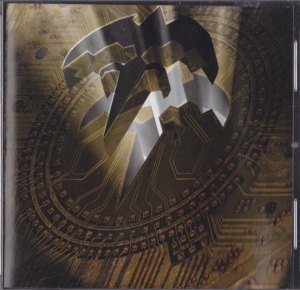
Disclaimer: I am in a very small minority of fans who love the Q2k album. Most don’t. Many consider it a continuation of the “grungy” sounds of Hear In The Now Frontier, but weaker. That’s not my point of view, so be forewarned. Read on.
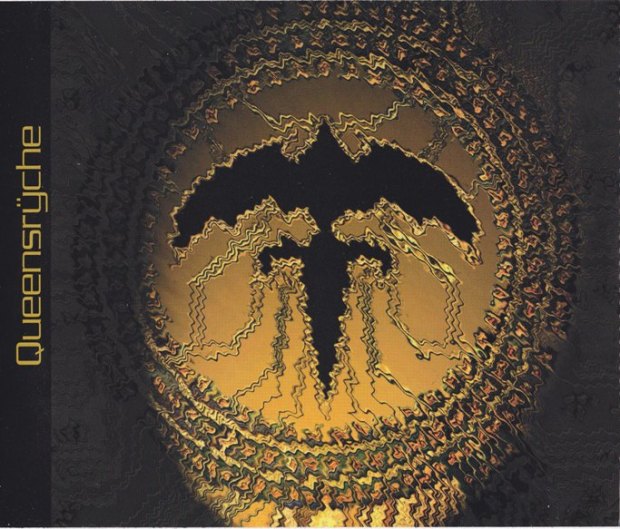
Chris DeGarmo’s departure after Hear In The Now Frontier shattered the group, but they decided to soldier on with old friend Kelly Gray (ex-Geoff Tate’s old band Myth, producer of Dokken, Candlebox, Bob Rivers etc.). Gray was a strong writer, but had a completely different style from the melodic DeGarmo. Gray’s sound is more based in heavy riffing, groove, and lots of wah-wah solos. It’s a different Queensryche and change was exactly what this band needed after the terrible Hear In The Now.
Sure, the album title sucks. I wonder if they regret it now? I’m sure they must. Thankfully, the music inside doesn’t suck. Heavy, grooving, riffy, powerful, well recorded…I love this album. The only flaw, and the only reason this doesn’t get five stars from me, is that there is a certain sameness to the songs. Almost all have a similar groove. Yet all are catchy and enjoyable. Truly this is Queenryche at their most “rock” and rock it does!
This remastered edition, like all previous Queensryche remasters, contains liner notes by Geoff Tate and bonus tracks. The liner notes reveal the strife that the band had experienced at the time, largely due to the change in guitar players. Clearly this was not a happy time for the band but the music is only stronger for it. The bonus tracks are cool, my favourite of them being the ballad “Until There Was You”. I was always quite pleased to finally get the live version of “Sacred Ground”, originally only on the Japanese version.
Fave songs:
“Falling Down” – tribal thumping opens this groovy riff rocker
“Sacred Ground” – a droney riff that somehow works within the Queensryche context
“Liquid Sky” – a little more old-school on the riff, but with that same groove
“Breakdown” – sounds a bit too much like “Falling Down”, but is no less powerful
“Burning Man” – the faster side of Queensryche, furious drumming from Rockenfield, simply awesome
“Wot Kinda Man” – the first of the dumb Tate titles conceals a wah-wah infested rocker
“The Right Side Of My Mind” – the most proggy and the most old-school ‘Ryche
Bad lyrical moment: “Like electrical shock-waves in the sky.” Yikes!
Dull song: “When The Rain Comes”. It’s not a terrible song, just a bit too slow without building into anything memorable.
I mentioned the bonus tracks. “Howl” is the first song, very similar to the heavier rocking songs on Q2k. You can see why it was left off initially, as the album is already loaded with songs like this. “Howl” is just slightly inferior in terms of melody and heaviness. “Until There Was You” is a much better song, and I think it should have been on the album. Indeed, the band chose this song for their anthology, Sign of the Times. It’s a ballad with a great chorus, memorable and strong.
“Sacred Ground”, as mentioned, was the live Japanese bonus track. This is not the same version as the one on Live Evolution, this is an earlier recording. Collectors will be happy that they don’t have to hunt down a Japanese copy. Lastly there’s a single edit of “Breakdown”, chopping a minute out of the song. I wasn’t too fussed to have this one, because I already own all three promo singles from this album, from my record store days. I was given free copies of “Breakdown”, “Falling Down”, and “The Right Side of My Mind”. (There was no edit version of “Falling Down”, but the edit version of “Right Side” is missing from this expanded edition. I was actually given two sets of these, but I sold the other set.)
I’m quite fond of Q2k, and I can honestly say that I haven’t liked any of the albums since then quite as much, not even Mindcrime II which should have been a slam-dunk winner. I do hope that the new Queensryche (with La Torre) will return them to the rocking glory years.
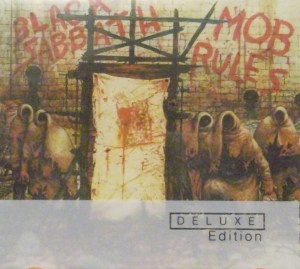
The entire Dio-era catalogue of Sabbath has now been reissued so many bloody times! First there was the original CD issues, then the Castle remasters in 1996, then the Dio years boxed set (The Rules of Hell), and now these deluxe editions. I’m feeling lightly pillaged. But buying these is optional…unless you’re a die-hard like me. If you’re not, stick to the Dio box. If you are a die-hard, plunge forward.
The big reason to buy this set is the Live at Hammersmith Odeon bonus disc. Folks, when Rhino announced this live album in 2007, I jumped on it immediately. The CD sold out immediately, only 5000 copies were ever made. Limited and numbered (I got #3723), even if it sucked it was bound to be worth a fortune in the future right? Well not necessarily. Now it’s been included as a bonus disc. (It’s also seen a vinyl reissue.) So, for me this sucks — my Rhino issue is no longer as desirable to collectors. For you, it’s awesome. Now you can have this blistering live album, way better than Live Evil!
All the other expected perks are here, including bonus tracks: the soundtrack version of the title track, and a B-side (“Die Young”, live) from a 12″ single. It also has extensive liner notes that cover the recording, the tour, and the Hammersmith disc. Throw in some photos and a great remastering job, and you have (hopefully!) the last copy of Mob Rules that you will ever need to buy.
Mob Rules itself is very much a brother record to Heaven and Hell. You have that big dramatic epic (“The Sign of the Southern Cross”), the speedy opener (“Turn Up The Night”) and everything else in between (“Voodoo”). It’s not quite up to the lofty standards of H&H, although it does follow the blueprint quite closely. I find the closer (“Over & Over”) to be the weak link in an otherwise pretty damn strong chain.
I think the title track, “The Mob Rules”, is probably one of the greatest heavy metal songs ever written. Furiously paced, with Dio’s pipes in fine form, it an energized trip. “The Sign of the Southern Cross” is, as far as I’m concerned, pretty much an equal track to “Heaven and Hell”. Its riff is simply earth-shattering. Once again, Dio’s pipes are unequaled.
Even something like “Country Girl”, a lesser known track, blows me away. Iommi pulls another memorably powerful riff out of his bag of tricks, while Ronnie wails away…about what, I’m not sure. But it sure is fun to sing along. “Slipping Away” is another personal favourite due to Geezer’s fluidic bass solos. “Falling Off the Edge of the World” smokes, another fast Iommi riff that bores its way into the brain. You’ll be exhausted by the end of it. Really, the only mis-step is the album closer, “Over and Over”, which I find a bit too dull and slow for an album as great as Mob Rules.
Pick it up to help complete your Sabbath collection, and to hear the awesome Live At Hammersmith Odeon.
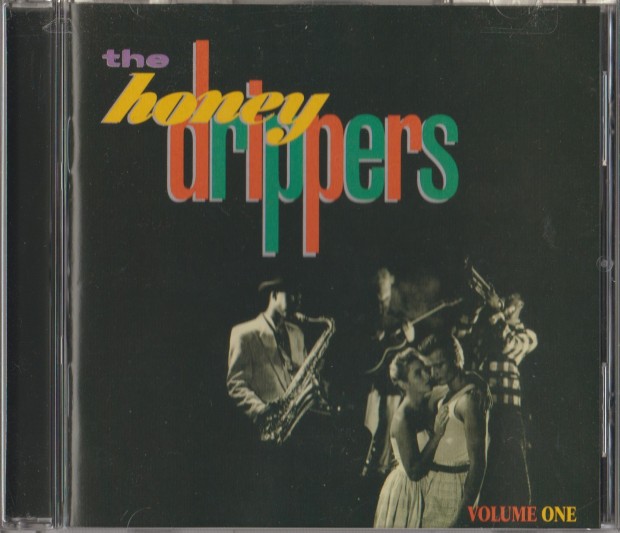
 THE HONEYDRIPPERS – Volume One (1984 Atlantic, 2007 Rhino reissue)


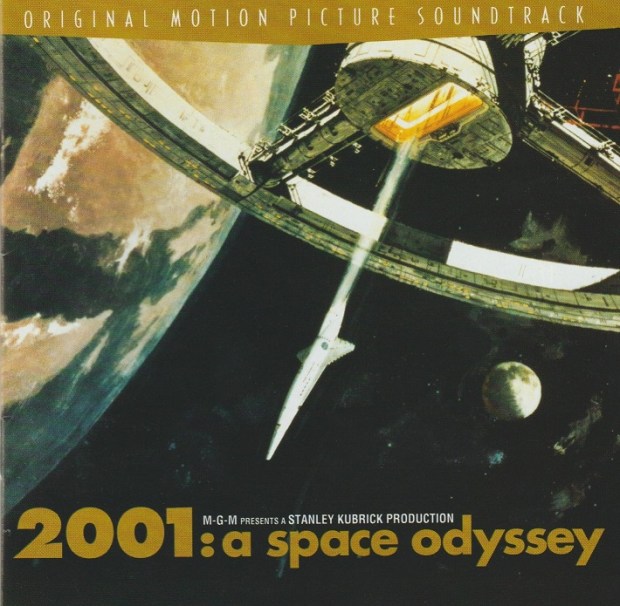

 2001: A Space Odyssey – Original motion picture soundtrack (originally 1968, 1996 Rhino remaster)
 After the chaos of “Requiem” and “Atmospheres”, Strauss’ “Blue Danube” offers a warm respite. The brilliance of the “Blue Danube” in the film is how Kubrick managed to capture the dance-like coordinated movements of objects in space. A shuttle docks with a spinning space station; spinning of course to create artificial gravity that humans need to survive long-term in space. This complex docking maneuver requires no dialogue, just Strauss. But space is a cold deadly place, hostile to almost all known life. Ligeti returns, as he must, with “Lux Aeterna”. This music was used to back Dr. Floyd’s trip across the lunar surface to meet the Monolith. It is mildly disconcerting, as is what Floyd’s team finds.


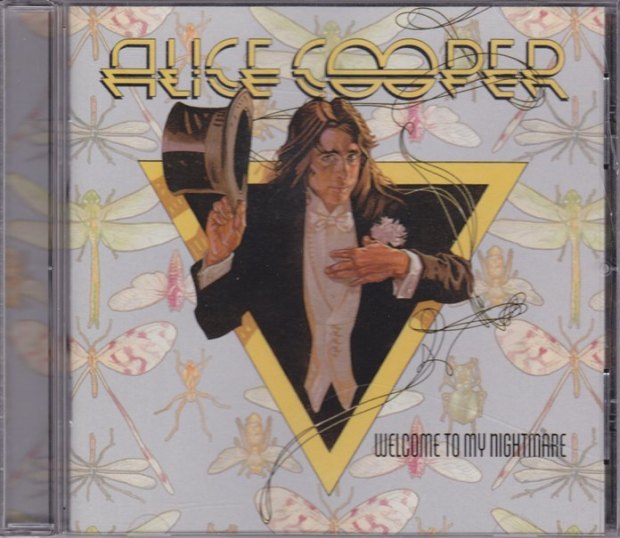
 ALICE COOPER – Welcome To My Nightmare (1975)













 mikeladano.com