RECORD STORE TALES #1194: You got exactly two words of that right.
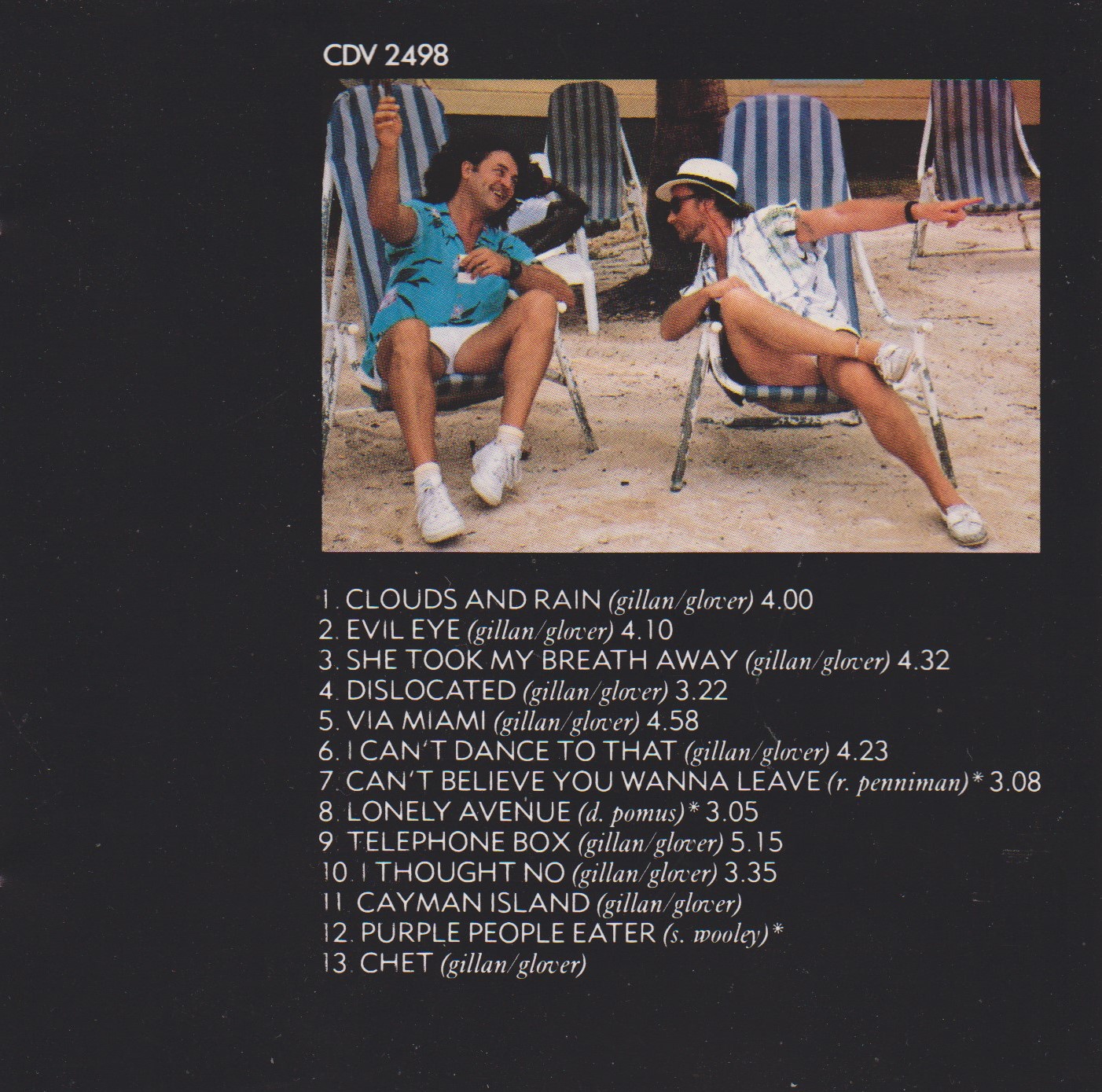
I have a soft spot for Ian Gillan and Roger Glover’s Accidentally on Purpose. The Deep Purple Pair had a writing partnership dating all the way back to the 1960s and a band called Episode Six. Before Ian was fired from Deep Purple in 1988, he and Roger emerged from the sessions for The House of Blue Light with an excess of stifled creativity. These lighter, more summery tuned formed the basis for their only duo album. I found it on cassette in the mid-90s, right when I was seriously collecting Deep Purple for the first time.
It’s not rock. There are some songs that do rock a bit, but it’s more like fun pop with roots in rock and prog. There’s saxophone, and loads of programming. Very 1980s. It took a couple listens to adjust to this distinctly non-Purple album, but once certain songs like the floaty “Clouds and Rain” and the funky “Evil Eye” started to hit, they stuck. Programming aside, you’ll hear some cool instrumentation and musicianship on this album. Eventually, I grew to like it. As soon as I found out the CD reissue had three bonus tracks that were not on the cassette, I upgraded, as I often do.
The bonus tracks included a song that would have worked on a corny 80s Beach Boys album, called “Cayman Island”. It also had a sax-heavy cover of “Purple People Eater” which is the definition of guilty pleasure.
Shortly after I bought the CD, a used copy came into stock at the Beat Goes On. It always happened that way. If you bought something new, you’d see a used copy a matter of weeks later. It was eerily inevitable. Of course, when that used copy came in, I threw it into the rotation for store play one afternoon.
A guy walked up to the counter, intrigued by the music.
“What’s this that we’re listening to right now?” he asked.
I was thrilled to have someone ask!
“This is a side project by Ian Gillan and Roger Glover from Deep Purple,” I answered with inner glee, but also some trepidation as I’d personally prefer to keep listening to it!
He responded, “Roger Waters from Pink Floyd?“
What…? No! No! You got just two words of that right: “Roger” and “from”!
He sulked away upon learning it was not Floydian music. No sale that day!
“Recently, a young journalist asked me how many songs I had written in my life. I replied that the last time my assistant counted, twenty years ago, it was over 500. I felt quite accomplished until she pointed out Dolly Parton’s 5,000 songs, calling me a lazy sod.” – Ian Gillan
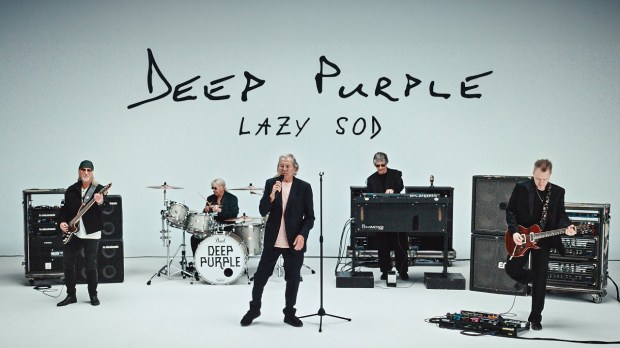
DEEP PURPLE – “Lazy Sod” (2024 Ear Music)
Since Deep Purple’s =1 album was my #1 album of 2024, it should be no surprise that I love the single “Lazy Sod”. It exemplifies what Simon McBride brings to Deep Purple on this new album. His smooth playing is loaded with feel and perhaps he adds just a tad more hooky riffiness into the band. “Lazy Sod” is a fantastic track, a shorty at 3:40, even loaded with solos by Simon and Don Airey. No fat, just like those old Deep Purple Machine Head firecrackers from the early 70s.
Back when we reviewed the =1 box set, we speculated why a live version of “Highway Star” with Simon McBride wasn’t included. Same with “Lazy”. Here they are. “Highway Star” (Milan, October 17 2022) is pretty damn energetic and features the Simon stuff that we were waiting for. His sound might be likened as somewhere between Steve Morse and Ritchie Blackmore, but what he brings to the table fits perfectly, without copying either.
“Lazy” (Sofia, May 23 2022) is the lengthy one, at 8:33. Don Airey opens it with some meandering organ soloing, before playing some more familiar notes. Then it’s Simon’s turn, sending out a delightfully original solo for “Lazy”. He throws it back to Don like a game of ball, and Don slays it some more. “Fun” doesn’t begin to sum it up. There are old Deep Purple versions of “Lazy” where it does not sound like they are having fun. This does, for Don and Simon in particular. The rest of the band have to be able to feed off that. Ian Gillan doesn’t enter the picture for over five minutes. He turns in a performance more like a lounge singer, but with some screams towards the end.
Another great single from the Purples. Thanks for keeping the format alive. It’s limited to 2000 copies but hopefully that’s enough for the collectors who want it.
Here we have a simple and straightforward one hour bonus DVD. No bonus features other than subtitles, so let’s dive in and watch Deep Purple hit the road! This documentary, unlike past ones, is not about the making of the =1 album. This is about Deep Purple on tour, and is more like a fly on the wall look at the band in their environment. We seem them relax, practice, drink and work.
We begin with Steve Morse, and his sad necessity to step down from Deep Purple after 28 years in the band. Roger Glover explains that Steve came in at a time (1995) when Deep Purple needed to reinvent themselves, which is what they did. Then, we transition to Deep Purple live on stage with Simon McBride, and “No Need to Shout” from the bonus live 10″ records included in this box set. Don Airey calls it a “fresh start”, and Ian Paice contemplates on how a new member creates new energy in the Purples. Roger praises Simon’s “cool” personality. The important thing, with any new Deep Purple member, is to musically just be themselves. Don jokes that Simon “brought the average age of the band down to 74.”
Time to hit the road. Ian Gillan talks about the routine, and the tour begins (to the tune of “Hush”). Hotels, breakfasts, limousines…and security tips from Gillan! It takes about three hours to set up the stage and start checking the PA. Drums are tuned and cymbals are attached to the kit. The guitar tech talks about the adjustment from Steve Morse to Simon McBride, and a different brand of guitars. We also get a good look at Don Airey’s keyboard rig. In a cute touch, Don keeps a bobblehead of his old boss, Ozzy Osbourne, on his keys. Finally the band turns up and sound checks. Don Airey tells Ian Paice a funny story about Gary Moore messing with his keys. The band have a quiet, very English sense of humour, but they are often seen laughing and kidding around.
During soundcheck, we get to hear Purple working on a new song: “Old-Fangled Thing”, which ended up on =1. Airey says he really enjoys soundchecks because it gives them a chance to play things like bossa novas, and entertain the crew. We move on to the 02 arena with Blue Oyster Cult opening, and other gigs with Jefferson Starship, who Purple seem to get along with famously.
There is a hilarious bit in Don Airey’s keyboard solo. He takes a wooden shim, and sticks it in the keys to hold them down. As a single note plays. A waiter with a glass and bottle emerges. Don pours himself a glass of wine as he takes a brief break. It’s all so very quaint and gentlemanly funny. Don’s son is actually the band’s stage manager, and it has allowed him to see more of his dad than he ever would at home.
The documentary then jumps to another day, and the 10 minute wait before showtime. Backstage, Roger Glover takes a crack at Ritchie Blackmore’s violent aversion to cameras. Ian Paice jokes about the palpable tension in the air, as the band continue to joke around and laugh, whiling away the last minutes before stage time. Paicey picks up a pair of bananas, plays a drum roll, complains the bananas are not properly balanced, and tosses them aside. That’s the wildest party moment in the Deep Purple dressing room.
Finally the waiting is over. The whole day revolves around the 90 minutes on stage, remarks Gillan. The band take the stage while Holst’s “Mars: Bringer of War” assaults the crowd in preparation. “Highway Star” (which, incidentally, is not included on the live records in the box) rolls out the thunder, and Simon McBride brings his own style to it. The documentary runs through a few live clips to give you a taste of the set, including the beautiful ballad “Nothing At All”.
When Deep Purple hits Berlin, Ian Paice has the idea to play a bit of “Let the Good Times Roll”. A young horn section is brought in, and it sounds great to everyone. We are treated to a clip of a soundcheck of “Hush” with the horns.
Show over, it’s off to the hotel, get a tea, and into bed with a book for Ian Gillan. Paicey prefers a glass of wine after a show, “because I’m allowed”.
Though it’s never overtly stated, one can’t help but notice the contrast in this documentary to the war stories of old. We remember the tales of on-stage and backstage blowups, food trays thrown about…but not any more. Now Deep Purple is five older gents who love playing together and don’t seem to mind each other’s company too much. That’s nice to see. And it’s still entertaining enough for an hour.
As a bonus DVD in a box set, this one’s easily a 5/5.
The box also came with art prints, a lanyard, guitar picks, a nice T-shirt and more, all seen in this unboxing video below.
DEEP PURPLE – =1 Live Album – 10″ Vinyl (2024 Edel)
When you buy a Deep Purple super deluxe, you get a new live album on three 10″ records every time. These records are each 45 RPM. This wonderful Deep Purple tradition carries on with this important release, the first live album with Simon McBride to be released. Let’s have a listen to all six sides.
Record 1 was recorded in Milan 2022, the same gig that yielded the B-sides for the “Pictures of You” single (“When A Blind Man Cries” and “Uncommon Man”), though they are not included here. This record opens with Machine Head‘s “Pictures of Home”, and Ian Paice beginning the proceedings with his usual drum intro. Don Airey’s organ dominates the mix, but Simon can be heard doing justice to the original arrangement. His tasty solo is his own unique composition, combining bluesy playing with shred in a way unheard before in Deep Purple. Blackmore fans who found Steve Morse to be just too different may prefer Simon McBride.
From 2020’s Whoosh! album comes “No Need to Shout”, one of the more straightforward tracks. It has a solid “Stormbringer”-like groove, but consider that Deep Purple remain unafraid to play new songs on tour every time. Simon and Don sneak in these quick licks that add season to the sauce. The chemistry with McBride is immediately undeniable.
A set highlight is the powerful ballad “Nothing At All”, probably the best song from Whoosh! Originally this song had a trademark Steve Morse guitar lick, but Simon acquits himself very well in this tricky part. It’s not identical, but the right notes are played, if in a very slightly different style. This beautiful song is harder live, with Ian Paice really smoking those drums, and Don Airey hitting his keys with more vigor.
The first record closes with another Machine Head classic, the undeniable “Lazy”, which we have so many live versions of. I have at least 34 live versions of “Lazy”, with more residing on live albums I have yet to rip to my PC. This version is the first available with Simon, and the word to use is “refreshing”. After 52 years, it is nice to have a version with another lead soloist, bringing his own powerful, melodic twist. Ian Gillan’s vocal is a little laid-back, but this version is a delight! When Ian starts playing the harmonica, it changes into something more akin to a country jam.
Record 2 was recorded in Sofia, Bulgaria in 2022. “Strange Kind of Woman” keeps us in classic territory. Somehow I get the feeling that Airey’s organ isn’t growly enough. Of course Gillan struggles with the high notes, but that’s old news and nobody should really care anymore. Simon’s solo is, once again, a fresh twist. Then they dig back even further with “Hush” from Shades of Deep Purple. Nothing different here, just the same classic groove and a killer organ solo, followed by a playful tradeoff between Simon and Don.
Side two only has newer material, beginning with “7 and 7 Is” (by Love) from the covers album Turning To Crime. Including “Hush”, that’s two covers in a row. It is cool that they were playing Turning To Crime material live, but this is skippable for most people (except Ian Paice fans who will dig the busy drum parts). More enjoyable is “Throw My Bones” from Whoosh! Don’s synth on this track is especially fun, and Simon makes it a bit heavier in the guitars. “Time For Bedlam” from InFinite closes this side. Ian Gillan struggles with the difficult vocals, which makes it harder to enjoy, though the guitar melodies are just sublime. This is a very technical track. Roger Glover holds everything together on bass while the feature players stretch out.
We are back to Milan on the third disc. Record 3 opens with the biggest surprise: “Anya” from 1993’s The Cattle Grazes Battle Rages On. It is no secret that making the album was an unpleasant experience for the band, especially Ian Gillan, but it is really cool to see them reaching back to the early 90s. This is the first version available with Don or Simon. Just as “Anya” is the only representation of the 1990s (a decade with four Deep Purple studio albums), “Perfect Strangers” is the only track from the 80s, as it often is. This is a solid workmanlike version.
The final side closes, of course, with “Smoke on the Water” and “Black Night”, leaving us without a version of “Highway Star” with Simon. This is a real shame; we hope one will come on future inevitable live albums. Ian Paice sounds great on these, and Simon’s solo on “Black Night” is bonkers, the same way that Blackers used to be bonkers.
This is a great little late-period live album. With a band and a back catalogue this extensive, it is natural that they can’t always fit in songs from Purpendicular, Now What, or In Rock. Newer material is more valuable in a live release such as this. Still…would have been nice to get “Highway Star”.
“It all adds up to one…” Would that have made a better title? Deep Purple don’t always come out with the greatest album titles or covers, but they have produced consistently good music during the Morse era, and now beyond. In their first lineup change since Don Airey joined the band in 2003, Steve Morse has stepped down for important personal reasons, and new kid Simon McBride has picked up the plectrum.
When Mr. McBride was born in Belfast in 1979, Deep Purple weren’t even a band anymore. They were in the middle of an eight-year hiatus. The last Deep Purple compilation released was 1979’s Mk II Purple Singles when he was an infant. Deepest Purple wasn’t even out yet. Rainbow was about to release Down to Earth with Graham Bonnet. Gillan were working on the second album as a band, Mr. Universe. Into that world sprang Simon McBride. He would grow to become a solo artist who would work with Purple members Don Airey and Ian Gillan, before being asked to join temporarily and then permanently.
Retaining Bob Ezrin the producer’s chair, Deep Purple wound up with something familiar, yet slightly different. There is less double tracking on Ian’s voice, which gives it a fresher sound. The songs are slightly harder edged, and there are more of them. =1 is the first first Deep Purple without bonus tracks since InFinite, and like Whoosh, feels conceptual on some tracks. According to the band, the world is “growing ever more complex, everything eventually simplifies down to a single, unified essence. Everything equals one.” I don’t know about that, but that’s what =1 means to them.
At 13 songs, the album could be trimmed down to a tidy ten. Let’s break them down.
Simon gets to show off some new sounds at the start of “Show me”, a relentless groove, unlike anything from the Morse era. Ian’s speak-sing storytelling vocal is familiar and fun, a perfect way to adapt to singing in your 70s. The groove is different from past works. Wonderful solo work from Don and Simon here, with Don on synth. The back and forth is very tasteful. It’s more playing for the song, and less trying to outplay each other like Jon Lord and Ritchie Blackmore in the 1970s.
Track two continues that hard grooves. “A Bit on the Side” boasts a great chugging guitar part, very different for Deep Purple of any era. The chugging is almost Slash-like, circa “Locomotive”. The chug-riff is the main feature, but once again Simon’s solo is stratospheric with loads of technique. Don’s is equally cool, with a spacey vibe.
“Sharp Shooter” is one song on which Ian doesn’t sing the name in the chorus. Instead there is a memorable refrain of “Shot in the dark”. The vocals are pushing the upper limit a bit, and the song has a vibe very much like the Morse era of Deep Purple. Nice soulful female backing vocals here, which is rare in Deep Purple. Once again, Don is focusing on the synth for solos. Not a highlight, but a decent tune with a modern Purple groove.
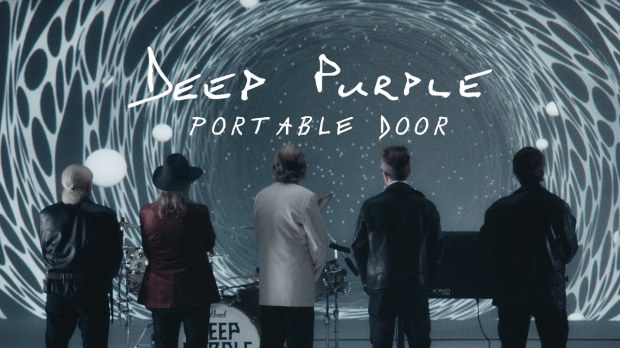
The first video/single was “Portable Door”. Ian Gillan weaves his traditional “English as a second language” lyrical whimsy. Some favourite lines:
When it came to me one day in Jerksville Man, I was right on the edge And that jacket’s too small for a man of your size And those socks are too big for your head
I love that. Socks are too big for your head? Why not. The lyrics seem to be about tedious conversations that go in one ear and out the other.
I was trapped in a dire situation Between reason and someone-in-law
“Between reason and someone-in-law” is just brilliance. Only Ian Gillan could write that. Meanwhile, Simon hits you with a cool chord that swooshes through. “Portable Door” has a stamp like the last few albums, but the one Simon chord really sets it apart. One chord: huge impact.
“Old-Fangled Thing” has a nice lyrical reference back to “Living Wreck” from In Rock, but is not the most memorable of songs. Is “old-fangled” another Gillan-ism? This song is a little tricky, like much of the Morse era was. In the end, it’s possible that this song could have been axed, but its speed is impressive.
There are two “ballads” (or slow blues) on this album. The dramatic one is “If I Were You”. There is a memorable chorus and a mournful guitar melody that might recall things like “When A Blind Man Cries”. Either way, Purple have done some impressive ballads and slow songs during the Morse era, and now the Simon era too. His solo is a little Bonamassa at times. Also take note: there’s an orchestra on this track!
The second single “Pictures of You” is immensely memorable. A fantastic song, with a focus on vocal melody. Purple play it simpler here and the dividends pay off. There’s a bit of multi-tracked vocals on the chorus, which is essentially what this song is about: the chorus! Until we get to the outro that is, which is more Marillion than Purple.
On the single for “Pictures of You”, the song went right into “Portable Door” without a break. The effect was an exciting transition. It’s less exciting on album, leading into “I’m Saying Nothin'”. This has that herky-jerky feel of the Morse era, but is otherwise not particularly memorable. Another one that could have been cut.
What’s the story with “Lazy Sod”? Ian Gillan was asked how many songs he’d written in his life. He estimated about 500. He was then informed that Dolly Parton wrote over 5000…”you lazy sod”. Can’t argue with that, so Ian turned it into a lyric. “That’s alright because I’m a lazy sod, and I’m hot.” It’s the third single and the most “rock” of them. Very old-school Deep Purple. Could have been on Who Do We Think We Are!
“Now You’re Talkin'” is the second song with an abbreviated “in'” title instead of “ing”. (David Coverdale, were you in the room?) Very similar to “Bananas” from 21 years ago. Almost a re-write of that prior song, but with a really fun screamed part in one of the verses. Really great riff, and always a pleasure to hear Ian do a scream, whether he sounds like a 70+ year old or not! Wait til you get to the solos!
Back in the Rapture of the Deep era, Ian told us that “Money Talks” to him. Now, he has “No Money to Burn”! There is an organ-based riff, which is a nice change of pace for this album, but the song is otherwise unremarkable. The third of three songs we could cut to get down to ten.
Deep Purple are not overkilling it on ballads. “I’ll Catch You” (maybe a slow blues) is a lovely ballad, soft and bluesy like a smokey club. It is placed perfectly near the end as an ear-cleanse, before we get into one of the best Deep Purple closers in years with the very English title, “Bleeding Obvious”.
If “Bleeding Obvious” isn’t the best closer since “Bludsucker” on Abandon, then let’s hear your picks! It could also be the most progressive tune? Could that opening figure work for Dream Theater or Marillion? Or even Rush? This is an absolutely brilliant tune, mostly down to that tricky riff and melody.
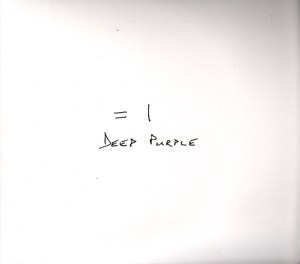
And so that’s it with =1; no bonus tracks this time. There is a deluxe box set with the first official release of a concert with Simon McBride, which we’ll get into on a separate review. Aside from the length, the only real complaint here is the minimalist artwork. The inner sleeve art is far more engaging.
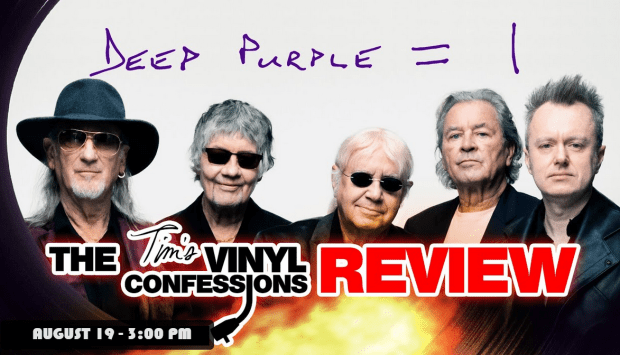
Deep Purple albums take time to absorb, especially in the current “Ezrin era”. The records are not lazy with simple songs (puns intended)! Tim and I attempted to break down the new album =1, track by track. We tended to agree on a lot of the songs.
What’s with the artwork? Is Simon a new Blackmore? What the heck is Ian Gillan singing about? Find out in this excellent episode of Tim’s Vinyl Confessions, out today.
My written review of the album will follow tomorrow morning, with the deluxe edition live discs getting the written review treatment in the coming weeks.
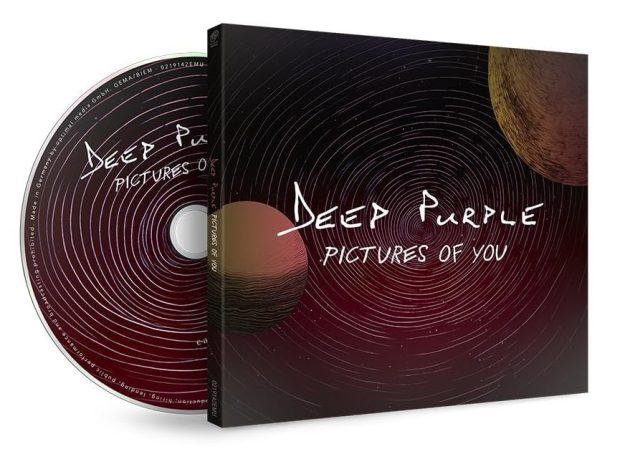
Deep Purple’s first new album with Simon McBride on guitar will be out July 19. Called =1 (“equals one”), the music seems to heading into a riffy direction. The band have just released a new CD single, something of a tradition for them during the Bob Ezrin era in this late part of their career. This single includes two tracks from the album, including the recently released “Portable Door”, and two live tracks with Simon recorded in 2022. Let’s have a listen and hear what the Purples have in store.
Track one, “Pictures of You” has a pretty cool and weighty riff. Backed by Don Airey’s organ, it’s one of Purple’s catchiest riffs in recent years. The chorus follows the riff melody. “These pictures of you are too good to be true,” sings Ian Gillan. Ian’s voice is pushed to its current limits, which is often the thing you hear people moaning about the most, but it’s really no issue. Simon comes in with a wicked catchy solo, before the whole song detours into a dainty Don Airey piano part with Simon doing volume swells overtop. Though only 3:50 long, “Pictures of You” packs a lot into a short time.
Without a gap, the band breaks into something completely different, ominous and heavy: “Portable Door”. Ian Paice is the backbone, always smooth, always identifiable, infallible. With Ian Paice on drums, Deep Purple will always sound like Deep Purple. Don Airey’s organ really dominates the solo section, as it should, and Simon’s guitar work is sublime. As for the tune itself? Top notch.
The live tracks were recorded October 17 2022 in Milan, Italy. These tracks will not be on the deluxe box set version of =1, and are exclusive to the single. First up is the classic blues “When A Blind Man Cries”, and we get to hear Simon do what Simon does. Perhaps more interesting though, the arrangement includes a new lounge-y into with piano. “Blind Man” feels slower than usual, but Ian Gillan is in fine voice. Simon takes center stage on the guitar solo, and it’s so phenomenal that you can hear the audience break into applause at its conclusion. It’s slow and passionate until he lets rip. Having Don Airey follow is almost anti-climax. Welcome to Deep Purple, Simon McBride!
The more recent “Uncommon Man” closes the disc, with a beautiful guitar solo backed by heavenly keyboards. As one of Purple’s more regal songs, it sounds great on stage. Roger Glover gets a little bit of the spotlight just before Simon’s solo, but this is a pretty faithful version. Most importantly, it is good to see that Deep Purple do not drop songs from the latter part of their career out of the setlist. (There are three other live versions of this song with Steve Morse available on other releases: Celebrating Jon Lord the Rock Legend, To the Rising Sun in Tokyo, and the Now What?! Live Tapes Vol. 2)
With only 5000 copies worldwide, this is sure to be a collector’s item.
Deep Purple’s first new album with Simon McBride on guitar will be out July 19. Called =1 (“equals one”), it is largely a mystery what the album will sound like. Many predicted a return to “hard rock” after the last three more progressive albums. The first single “Portable Door” is not all that different from the Steve Morse era. Don Airey’s organ really dominates the solo section, as it should be. Simon’s guitar work is sublime but not showcased as some had hoped. He has this one cool lick in the riff that is really electrifying, but we want more Simon!
Ian Gillan? Reliable as ever, his voice has worn in like suede. He can still sing the hooks. Haters call him “over and done” – fans don’t care. Ian Paice is the backbone, always smooth, always identifiable, infallible. With Ian Paice on drums, Deep Purple will always sound like Deep Purple. His work here is busier than the we’ve become used to…which is just fine!
How does “Portable Door” stack up against recent Purple singles? It doesn’t have that instant “wham!” of “Vincent Price”, and it doesn’t have the hooks of “Johnny’s Band”. It’s a strong, workmanlike latter day Deep Purple single that will grow with increasing listens.
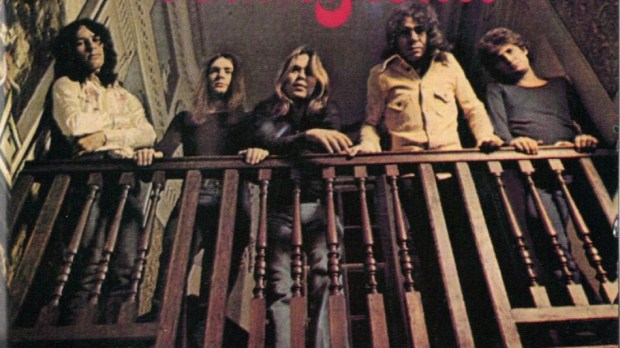
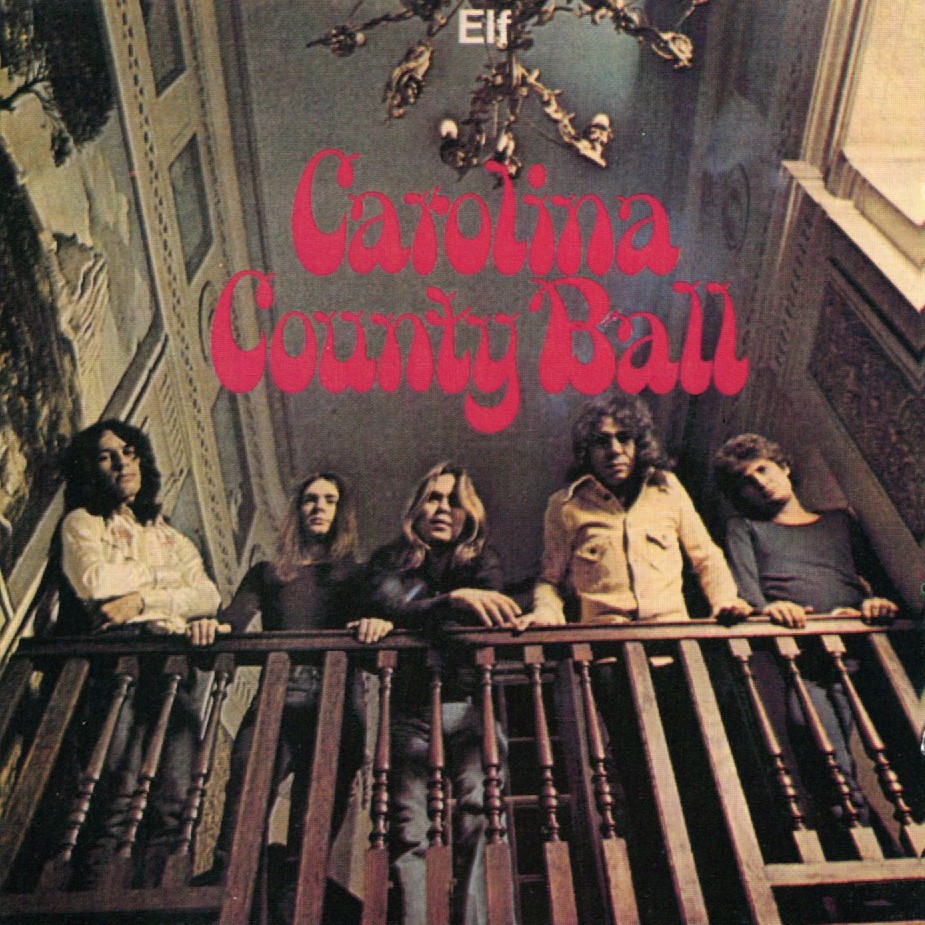
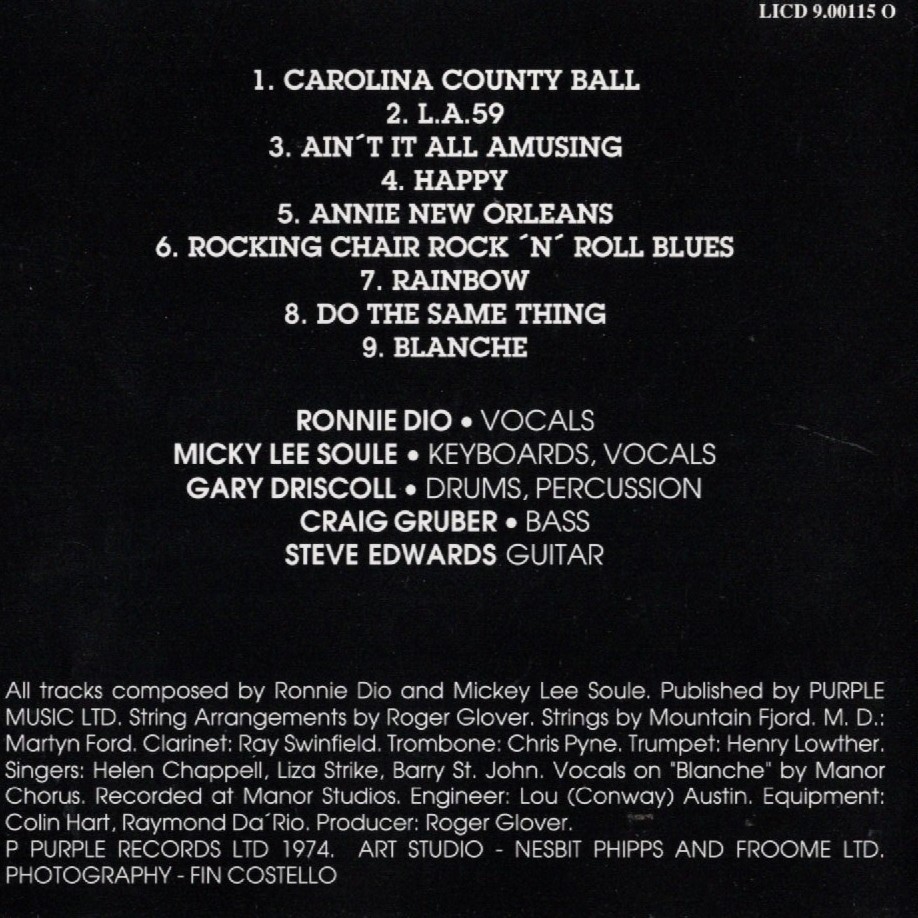
Before the Rainbow there was Elf. It was basically the same band – Ronnie James Dio on lead vocals, Mickey Lee Soule on keys, Gary Driscoll on drums, and Craig Gruber on bass. The one and only difference was Steve Edwards on guitar, who would have no place when Richie Blackmore came knocking a year later. Their second album, Carolina County Ball, was produced by Deep Purple’s Roger Glover. It’s fair to say that Dio hadn’t found his niche yet. With Mickey Lee Soule, Ronnie co-wrote every song, but was seeking a bouncier Guess Who direction at this point in time.
It sounds like Mardi Gras on the opening title track, with clarinets, trombones and trumpets accompanying the band on this “boogie-woogie Friday night”. Soule shines, ticking the keys with delicate intent. Heavy metal, this is not not! Not even close. There’s a guitar solo but it’s a secondary feature. Only at the end does the song pick up the pace. It’s actually a great tune, but anyone expecting dungeons and dragons had better head back to their gamesmaster for a new dice roll. Expect boogie.
“L.A. 59” opens like an old bar room, with a piano taking up all the space. The opening figure sounds like it’s emulating a train, which is probably a good guess. “Get me back to L.A., 59!” sings Ronnie, sounding a bit more like the mighty mite he would become. “Hello, hello sunshine!” Upbeat, with the guitar taking up more of the song this time. A great upbeat tune to start your day.
A little bit of a funky swing emerges on “Ain’t It All Amusing”, demonstrating the talents of the rhythm section in particular. Driscoll was no slouch and Gruber had no issue filling the bottom end with interesting vibes. This fun song really is about rhythm with a pinch of funk. It sounds a lot like Deep Purple Mk I, especially with the long percussion break that ends it.
“Happy”, which is ironically anything but, is a bit filler-ish. It’s Elf playing in a smokey nightclub and it’s all a bit repetitive. “Annie New Orleans” picks it up, with another Elf piano boogie-woogie. Whitesnake have also done songs of this nature in their early days. Then the awkwardly titled “Rocking Chair Rock ‘N’ Roll Blues”, which is a ballad more or less. It boasts a nice guitar solo and a laid back sound, but it’s going to have some reaching for the skip button. They shouldn’t, because three minutes in, a new riff arrives and transforms the song into another rockin’ boogie-woogie. Listen for some of Driscoll’s fun cowbell work on the back end too.
The one title that grabs everyone’s eye is “Rainbow”. Don’t get too excited. It doesn’t sound anything like Blackmore’s Rainbow; more like a a third rate tribute to The Band. The boogie-woogie is starting to wear a little thin, and same-samey now. “Do the Same Thing” is more like it. It sounds like a prototype to Rainbow’s “If You Don’t Like Rock ‘N’ Roll”. This allows the players to shine a bit more.
The album goes out on a cringey ballad called “Blanche”, with Dio singing about “Rainy days, rainy days” in a voice quite unlike the power he would later master. This is little more than a silly album outro; nothing to be taken seriously.
Every album and every band will have its defenders, but Elf was the least of Dio’s four main bands over the decades (counting Black Sabbath and Heaven and Hell as one band). Carolina County Ball lacks focus, and Glover doesn’t provide any punch in the stale production. The album rests on the songs and performances alone. Fortunately the band could play, though they seemed uncertain about who they wanted to be.
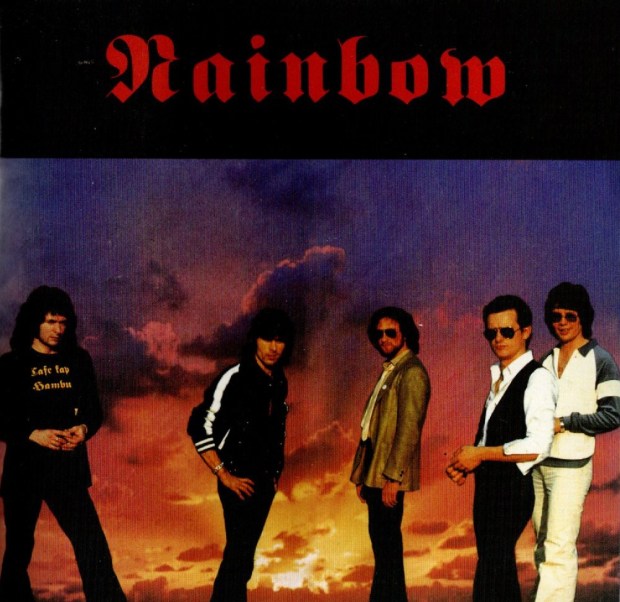
RAINBOW –Down To Earth Tour 1979 (2015 Purple Pyramid box set)
On the surface, this is quite a deluxe box set. It’s larger than than a typical CD case by an inch on either side, and it’s almost an inch deep. It has a beautiful hologram-style finish, shining and shimmery. There are three discs inside, one from each of three shows on the 1979 Rainbow tour: Denver, Long Island, and Chicago. Each CD comes in its own full colour sleeve, and there are other goodies packed inside, such as the obligatory booklet. It’s a loaded booklet, with loads of photos and text.
You might look at the track listing on the back and ask why there are only seven tracks per show (five for Chicago). Rainbow were only an opening act (for Blue Oyster Cult) on this tour, a source of frustration for the band. Also, the track listing is deceiving because “Lost In Hollywood” is a long bomber, over 20 minutes long on each disc, and contains lengthy solos and detours.
There are issues. First and foremost: the audio. It’s not great. None of the discs are particularly outstanding. They’re all different sounding; just a different variety of bad! People who buy bootlegs won’t mind so much, but when you look at a set this deluxe on the store shelves, you might be expecting more sonically. A lot more. That’s just the nature of these kinds of releases. They’re fine to play, but some people will dismiss them.
The other issue with the music would be that the tracks are repeated from show to show. The variety comes from the playing, not the setlist.
Speaking of playing, even though the band were tired of the opening slot, they don’t show it. The lineup was one of Rainbow’s best: Graham Bonnet on lead vocals, Don Airey on keyboards, Deep Purple alumnus Roger Glover on bass, the legendary Cozy Powell on drums, and of course the man in black Ritchie Blackmore on guitar. Everyone knows what to expect from a Blackmore guitar solo, but a Don Airey keyboard solo is less familiar territory. It’s part Doctor Who and part rock and roll. And Cozy, of course, slams. You only wish he were better recorded.
Rainbow were playing loads of new material on this tour, with only a handful of Dio-era classics. “Eyes of the World” is an interesting choice for opener, not an obvious selection. It causes the show to open with an electronic pulse, all atmospheric and sci-fi. It’s a change from the usual hit-em-hard kind of opener. Of course, the song does rock, but the intro is over a minute long. A second new song, the slower blues “Love’s No Friend” follows, another interesting choice. It’s rife with brilliant guitar work from Blackmore, and Airey compliments him perfectly. Continuing with new material, “Since You Been Gone” was the familiar single written by Russ Ballard, which closes with a load of solos from Blackmore and Airey, and the “Over the Rainbow” segment as well. “All Night Long” (which opened the Down to Earth album) works well to regain focus after all that meandering. I like how Graham changes the lyrics. He clearly sings “I need a girl who can give me head, all night long,” instead of “keep her head”! Unsubtle. The fifth and last of the new songs is the aforementioned scorcher “Lost In Hollywood”, bloated to 22 to 26 minutes from show to show. This is the track for the musicians in the audience, and for everyone else to take a pee. Fortunately for those who love great drum solos, Cozy has a spotlight moment. Unfortunately, not everyone loves drum solos.
The set closes with two Dio classics: “Man on the Silver Mountain” (long solo opening, and a bit of “Lazy”), and “Long Live Rock and Roll”. It’s hard for any singer to do Dio and here they sound like a Graham songs. I prefer Graham’s version of “Silver Mountain” to Joe Lynn Turner’s. Really, these are pretty good interpretations, as long as you can forget the mighty elf’s versions for a few moments. Graham had no issue with the range or power, just that he’s a completely different vocalist from Ronnie James Dio.
The Chicago set is missing “Since You’ve Been Gone” and “Silver Mountain”, which were not played that night.
The liner notes are excellent, except when printed in black ink over a blue background, rendering them extremely hard to read. It’s 28 pages with rare photos and ads. The set also includes a heavy metal bottle opener that you’ll never use, a Richie Blackmore guitar pick that you’ll never use, and a Rainbow button & patch that you won’t put on any jacket that you own.
This set is for diehards only; those that need as many Rainbow shows from as many lineups as they can get. For everyone else, it’s pure overkill.















 mikeladano.com