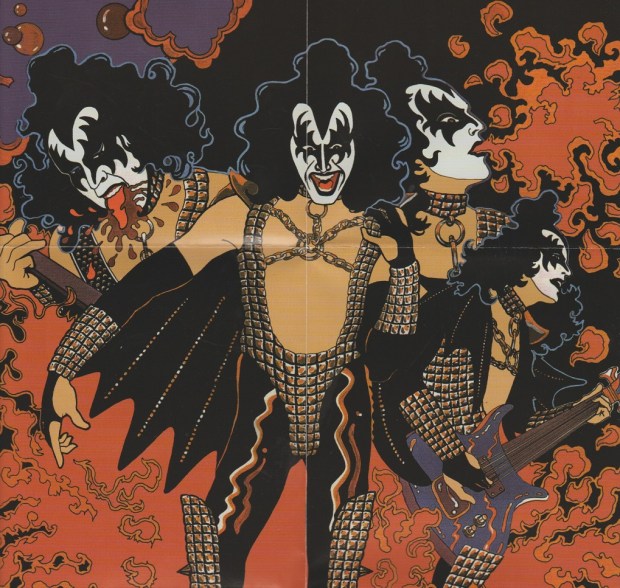
The KISS RE-REVIEW SERIES Part 15:
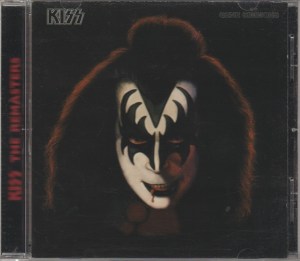
 – Gene Simmons (1978 Casablanca solo album, 1997 Mercury remaster)
Given Gene’s demon persona, certainly some fans would have expected his solo album to be the heaviest and darkest. Imagine their shock upon finally hearing the finished disc! Musical flights of fancy and whimsical songs dominate Gene’s record, as the demon was determined to do something very different. His album has the most guest stars, the most diverse songs, and the most split of personalities.
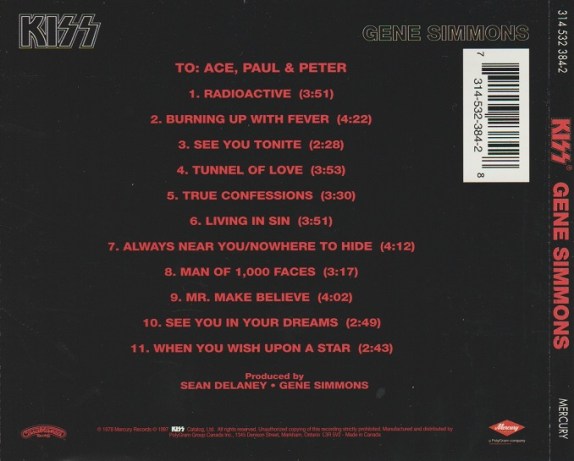
Even the “evil” sounding choirs that open the album are more whimsical than demonic. This soon gives way to a guitar riff, and the first song “Radioactive”. The audio compression gives it a disco-like beat, but “Radioactive” is a rock and roll track. It is one of the songs featuring guests Joe Perry and Bob Seger, not to mention a slew of backing vocalists. It’s also the one track that Kiss played live on tour in 1979.
The demon sounds like he’s prowling for ladies on “Burning Up With Fever”. If you’re wondering about that funky bass line, it was played by Neil Jason. In a surprise move, Gene didn’t play bass on his solo album, only guitar. This lends the whole LP a funkier-than-expected sound. This plus the ample backing vocals almost makes Gene Simmons sound like an R&B/rock hybrid from time to time. “Burning Up With Fever” is a bad tune for a sexed-up demon, but not one of his finest either.
Some of Gene’s solo songs were oldies that predated Kiss. Others were of more recent vintage. The folksy ballad “See You Tonite” sounds like one of the older tunes. It’s a good one; good enough that Kiss recorded it live in 1995 for their MTV Unplugged appearance. In a strange twist, some of the best tunes on Gene’s solo platter are the ballads. Jeff “Skunk” Baxter played on this one and “Burning Up With Fever” as the cavalcade of guest stars continues. Even Katey Sagal (Married With Children) sings on the LP.
“Tunnel of Love” and “True Confessions” are two of Gene’s non-descript exploits, fairly ordinary songs given a huge boost by the larger than life production (by Gene and Sean Delaney). The backing vocals are immaculately arranged. “Tunnel” features Joe Perry and Donna Summer. Helen Reddy sings on “True Confessions”. Unfortunately these two songs are more notable by who appears on them rather than how good they are.
Gene was dating Cher at that time, so it’s not really a surprise that Cher appears on “Living in Sin” (as the groupie on the phone). This side two opener has a bit of that rock and roll spirit missing on other songs, though very corny. The ballads on side two are better. “Always Near You/Nowhere to Hide” has some of Gene’s best singing, showing off that high falsetto. Gene couldn’t get the Beatles to appear on his album, so he did the next best thing and had Mitch Weissman and Joe Pecorino from Beatlemania sing on “Always Near You/Nowhere to Hide”. This melancholy song is one of Gene’s most ambitious.
“Man of 1000 Faces” is big and bombastic, orchestrated for maximum impact. It has more in common with Destroyer than anything else Kiss has done, but even more overblown and bombastic. It also suits Gene’s persona perfectly. “I can put on any face, you won’t know me but it’s no disgrace. The king of night, he understands!” Then “Mr. Make Believe” is laid back and acoustic, and also another fantastic song. Gene’s ability with ballads should not be understated. “Mr. Make Believe” is the most Beatles-esque of Gene’s solo tracks.
“See You In Your Dreams” is a remake of the Kiss song from Rock and Roll Over. Apparently Gene thought it could have been recorded better, but the more basic Kiss version is much more appealing. Rick Neilson from Cheap Trick plays guitar on it, but Michael Des Barres’ backing vocals are obtrusive and irritating.
And that leaves only the final track. Some stop playing the album before track 11, others consider it an indispensable part of Gene’s solo statement. But there it is: “When You Wish Upon a Star”, the song whose lyrics meant so much to Gene that he recorded it for the last track of his album. It was not intended as a joke, but many see it as such.
Gene’s solo album can’t be dismissed as garbage, not with the great tunes it has (especially the ballads). However it’s so scattershot and just plain strange that it’s hard to really just enjoy. It’s interesting to study and dissect. Not so much fun to play in the car.
2.5/5 stars
To be continued…
Original mikeladano.com review: 2012/07/20



You must be logged in to post a comment.