writing

#435: How to Write a Music Review

GETTING MORE TALE #435: How to Write a Music Review

So you want to throw your voice into the din, and write album reviews?  Good for you!  Allow me to offer some suggestions to help yours stand out.

First and foremost:  Know your subject.  That doesn’t mean you have to do a whole bunch of research.  It means you should listen to the music and pay attention to the parts you want to talk about.  Don’t say, “This song is really catchy” before you realize you can’t remember how it goes the next day.  Listen and let it speak.  It’s always tempting to blast a new release and say, “It’s awesome!” or “It sucks!”  Just browse Amazon for hundreds of reviews like that.  Don’t say something is “awesome” or “sucks” unless you are sure that’s how you feel about it, and can back it up in your review.

Research isn’t necessary, but you do have to make sure your review is factually correct.  If you don’t, the trolls will come out.  For example don’t say “Steve Perry is singing better than ever on the latest Journey album,” because that’s not him!  Make sure you get those things straight – who plays on the album, who wrote the songs.  All this can be easily determined via Wikipedia which is usually accurate enough for a review.  It takes a few extra minutes, but helps ensure you won’t sound like an idiot.  When all this information is out there and available for free, there’s no excuse for inaccuracy.

Another great tip:   Be passionate.   It’s music after all.  How does it make you feel?  Put that feeling (positive or negative) into your review.  If readers can pick up on your passion, it’ll help keep them engaged.  You don’t want a dry, boring review that people skip to the end to read the rating.

One reviewers’ strategy that I recommend:  Read other reviews.  Lots and lots of them.  See what you like, and do not like, about other writers’ styles.  What can you do better?  Use this to inform your own style.  Perhaps, like me, you like a review that is thorough.  On the other hand perhaps you prefer to cut to the chase.  Either technique is valid and perhaps you will choose to mix the two.  To me, the most rewarding part of reading other reviews is picking up on words and phrases that I might not have used otherwise.  There are only so many ways that I have in my verbal arsenal to describe “awesome” riffs, “killer” lead vocals, “pounding” drums, “bone-shaking” bass, or “scorching” lead guitars.  Add more words and phrases to your bag by paying attention to other writers.  And by all means, don’t be afraid to use a thesaurus!  I use them all the time, to remind myself of words I like but just can’t think of when I need them!

Once you’ve written a few reviews, I think it’s important to shake it up.  Keep your readers interested by changing up your style a bit.  Don’t do every single review as track-by-track.  Don’t use the same format every time.  Don’t allow yourself to get bored with your own writing.  If you’re bored, will your readers follow suit?

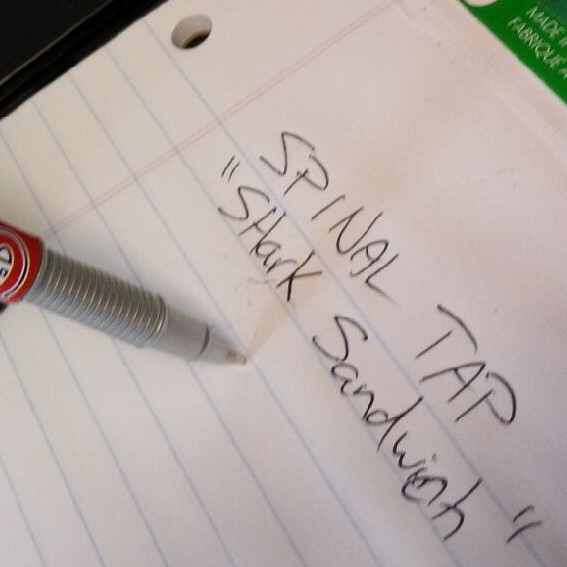
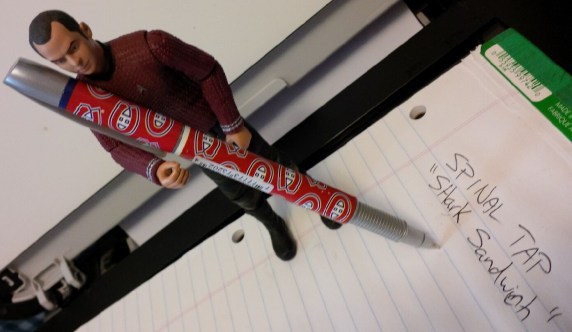
What about length?  Length does not matter.  If you have a lot to say, then say it.  Writing reviews online is completely different from doing it for print publications.  There are no word limits, and there are no censors.  Short is fine too.  Some of the best reviews I’ve ever read were just one sentence.  “Shit Sandwich” – everybody remembers that two-word review from This is Spinal Tap.    Of course the review “Shit Sandwich”, classic as it is, does violate an earlier rule:  “Don’t just say an album sucks.”  Sometimes you can get away with it, if you’re an established reviewer, because readers can refer back to your past more detailed work and see what you had to say about the band before.  This is a thin line – the fine line between clever and stupid….

How about photos and videos?  They are helpful to augment a review.  The help break it up visually and add more information.  But even though a picture can speak 1000 words, make sure your words are up to par.  The words must come first.  Everything else is just icing.  (Don’t use too much icing, either!)

Ultimately, the best advice is the simplest:  Enjoy what you do.  Write music reviews simply because that’s what you want to do.   If you spend all day talking about and thinking about music anyway, chances are you’ve already written a bunch of great reviews in your head.  Now you just need to get them out on paper.

Get out there and do it – there’s nobody to stop you!
IMG_20150914_172206

#383: The Moment of Inspiration

RECORD STORE TALES MkII: Getting More Tale
#383: The Moment of Inspiration

I’m not comfortable using the word “writer” or “artist” when describing myself.  Where I’m concerned, I find it pretentious for myself to wear the guise of an “artist”.  But I do write, and what I have posted here does amount to my art.  Within the context of music reviews, I use this platform to be creative and express myself.  I’ve told my stories via Record Store Tales.  Even though I don’t like calling myself a “writer” per se, I do spend a lot of time writing and trying to come up with fresh ideas.  Writer’s block does exist.  Many days go by when I can’t be arsed to write anything down.

When the inspiration to create strikes, it’s usually in an inconvenient setting.  The car, where much of my music listening is done, has proven to be a great location for ideas.  Sometimes it’s a mall, or a grocery store.  Other times it’s in the middle of the night in bed!  The key is being able to take quick notes and write down your ideas before they are gone.  This takes determination but is well worth it, to tap those fleeting good ideas that we all get.

I’ve had one advantage that I’ve been happy to exploit: a huge backlog of unpublished reviews and stories.  When creativity fails to strike, I was always able to dip into the pile and polish work up for posting.  In a similar vein, my buddy Craig once told me, “Don’t be afraid to re-post a good idea that’s worth the exposure.”  So sometimes I will even revamp something you’ve read before in a new way, and hopefully you haven’t noticed.

Once the creative juices start flowing, keeping the faucet turned on is the next challenge.  My advice is to try to avoid second guessing yourself.  Keep your work accessible, but write for you.  Readers will offer their feedback.  Some will be good advice, some will not be.  I’ll give you two examples.

  • A friend of mine found the length of some of my earlier articles to be too much. I found that, even if I had a lot to say about a matter, it was better to break it down into smaller parts.  That way I can actually milk a story for longer, by posting multiple chapters instead of trying to squeeze it all into one.  I also reduce the risk of losing the reader’s attention over a long ass story.
  • A former co-worker at the Record Store made a point to send a lengthy email about my site.  He was upset about the things I was saying and how I said them. He didn’t approve of the “great pains” that I took to poke fun at one or two people that he knows.  This feedback had me questioning my direction, and considering whether I should have lightened things up or even written anything at all.  After some serious soul searching I concluded that there were no “great pains” taken; that the stories were fun for me and others, and would continue to be.  I poke fun and criticize myself more than anyone else in my stories.  I am my own worst critic, as are many of us.  I decided that I should not change my style to please a small but vocal minority of readers.

Keep writing.  Keep searching for inspiration.  It can be found in the unlikeliest of places, all you have to do is open your eyes and keep a pen nearby.  Don’t be afraid to voice your opinion.  Take the time to compose your thoughts.  Don’t rush into posting something.  Be sure you’re satisfied before you hit that button.

Any time anybody verbalizes their opinions about anything and puts it out there on the internet, they take the chance that someone will take issue with what was said.  That goes for people like me who write about music, and it can go for anyone.  I’ve certainly read plenty of nasty reader comments over seemingly inoffensive subjects all over this World Wide Web of ours.  People can be nasty.  Many of them would rather take a shot at you and try to take you down a notch than live and let live.  But you can’t let that scare you off.  WordPress allows you to screen your comments if that’s something you think you need to do, but don’t be afraid of what others might say.

Let me sum up this writing advice in point form below.

  • When inspiration strikes no matter where, write it down! (Just park your car first.)
  • Listen to advice…
  • …but write for yourself.
  • Any good idea is worth re-using.
  • Don’t worry about how your art will be received. Fear kills creativity.

Enjoy the creative juices!  Preferably with a great song in the background!

IMG_20150322_150006