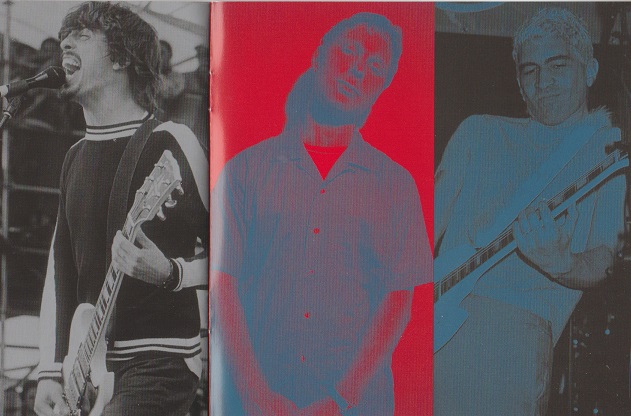
REVIEW: Foo Fighters – The Colour and the Shape (remastered)

FOO FIGHTERS – The Colour and the Shape (Originally 1997, 2007 Sony Legacy edition)

Sometimes, an album is just perfect.  Nothing needs to be added or taken away.  It is simply right the first time.

The Foo Fighters got it right the first time when they released The Colour and the Shape in 1997  At 47 minutes, it was already a bit longer than the average album, but what a towering 47 minutes they are!  There is a reason that The Colour and the Shape is consistently the album that all others are compared to.  It’s that one magical, flawless album that can never be equalled no matter what Dave Grohl & Co. come up with next.

The Colour and the Shape was a product of its time and all the things Grohl was going through.  The drummer (William Goldsmith) was fired mid-way and Dave re-recorded all the drums himself, bar two ballads.  Maybe that’s one reason that the album is so special.  When Dave plays the drums, the energy level goes through the roof and comes out the speakers.  That’s what happens on “Monkey Wrench”, “My Hero”, “Everlong”, “New Way Home” and “Hey, Johnny Park!”, five of the most exciting tracks.  The energy simply cannot contained.  The Law of Conservation of Energy dictates that it all comes out of your body as you rock to this album!

Of one were to give a negative critique to any of this album, it might be Grohl’s screaming on “My Poor Brain” and “Enough Space” among others.  It is true:  Grohl chips the paint with his voice from time to time.  This works though, as an appropriate contrast to the soft melodies of “Walking After You” and “February Stars”.  The album is well rounded.  It joyfully careens from those heavy blasts, to quiet acoustic bits of pop glory.

The Colour and the Shape has the songs, it has the riffs, and mindblowing drums.  It has the vibe, and it reeks of passion.  Whatever Grohl was going through at this time, it ended up in the music.  The production by Gil Norton is a bright contrast to the lo-fi of the debut album Foo Fighters.  It simply cannot be improved upon.  Even the lyrics go full circle.  Listen to “Doll” and “New Way Home” and see if you catch it.

When Sony Legacy added seven bonus tracks, it beefed the album up to well over an hour.  If you listen to the CD as a whole, it completely changes the listening experience, and not in a good way.  It’s Coke vs. New Coke.  Adding essentially a third side of B-sides doesn’t make it better.  It would be advised to collect the original Foo Fighters singles from which these tracks were taken.  And if you do, you’ll get more songs that weren’t included on the Sony Legacy, such as live and acoustic versions.  Of the bonus tracks, the Gary Numan cover “Down in the Park” is particularly exceptional.  The new liner notes by bassist Nate Mendel are quite cool.

The Colour and the Shape is one of the best albums of 1997, if not the very best of that year.  It’s tough to beat and adding bonus tracks didn’t do the trick.  Therefore, The Colour and the Shape gets two ratings:

Original 1997 CD:  5/5 stars

Sony Legacy 2007 CD:  4/5 stars


#604: Heavy Vinyl is a Tactile Experience

GETTING MORE TALE #604: Heavy Vinyl is a Tactile Experience

Now that vinyl is back in a big way, you may have noticed more and more heavy vinyl in your local record store.  180 gram vinyl records are very popular, particularly for reissues.  You’ll notice the front cover stickers touting the weight, but what does this all mean?

As it turns out, not very much.  Heavier weight vinyl is a preference, but not one that particularly pays off in improved sound quality.

Typical records are pressed on 120 grams on vinyl.  It starts as vinyl pellets, which are melted and expertly pressed between two plates.  A record is plenty thick enough to accommodate grooves pressed into both sides.  Thickness is not the issue.  Sound quality more depends on other factors.  Virgin plastic, not recycled, is preferred by connoisseurs.  The quality of the presses, the experience of the engineers, and of course the mastering of the music for vinyl are all critical.  Thickness, not so much.  The groove in a record depends more on surface area in order to get a good sound, and that comes from width.  Sound issues arise when a side of a record is so long, that the grooves need to be squeezed onto that 12″ diameter.  Then you lose clarity and distinction.  A thick record might cut down on vibration from the turntable, but a good platter will do the same job.

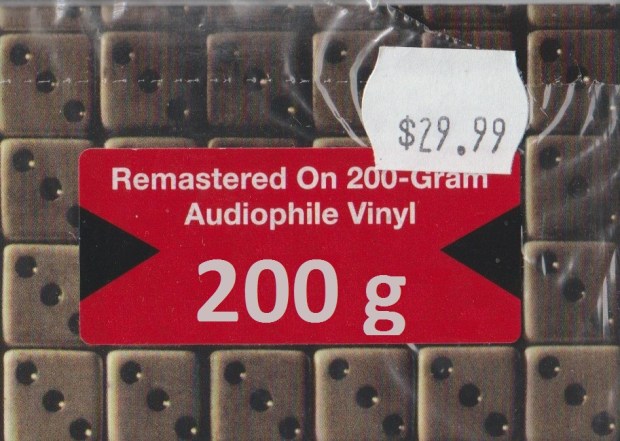
200 gram vinyl.  Notice the thick edge.

Heavy vinyl feels amazing in the hand. Like buying a heavy-duty vehicle, you feel the weight and sturdiness and associate it with quality.  Generally, you would be correct.  When a label presses a release on 180 gram vinyl, it’s often the case that this is some special reissue.  Perhaps it’s been specially re-mastered for vinyl, or manufactured in limited quantities.  Sometimes these come in special gatefold packaging.  If the remastering is done well and not overdriven like a lot of modern releases, chances are you’ll be getting a good sounding record.

120, 180, 200 grams…how heavy can these things get?  Is there an upper limit?  I asked Gerald McGhee, vice-president of Precision Pressing in Burlington Ontario.  He also sings in Canadian band Brighton Rock.

“You can go higher.   200 is in vogue right now.  140 is standard,  and 180 is getting more traction, but very little difference in sound quality,” says McGhee.

In theory you could take vinyl to absurd limits, but what would be the point?  Maybe if you’re Blink 182, you could do a special 182 gram release.  (Make sure I get my cut for the idea if you do.)  If you as a consumer buy heavy vinyl, you’re doing it mostly because you enjoy it for reasons other than sound.  Perhaps you buy them because you are used to getting a good mastering job with such releases.  Perhaps, like me, you also enjoy the satisfying feeling of handling such a record.  Perhaps you just like to collect variations.  But if you are not one of those, you may just want to save the extra few bucks and buy a cheaper version.


#603: Canada Wants to Tax Your Staff Discount

GETTING MORE TALE #603:
Canada Wants to Tax Your Staff Discount

Record store employees! Have you heard? Now the Canada Revenue Agency wants a piece of your staff discount.

According to CTV, “when an employee receives a discount on merchandise because of their employment, the value of the discount is generally included in the employee’s income.”  They will calculate the tax by using the “equal to the fair market value of the merchandise purchased, less the amount paid by the employee.”   That is unless the discount is “available to the public or a segment of the public, at some point during the year.”  Those car deals where you “pay what the employees pay” wouldn’t count as a taxed staff discount, which is good for people who work at dealerships.  CD stores generally don’t have a “staff discount sale”.

Let’s say, just like when I was working in the Record Store, an $11.99 CD gets sold to you at the discount price of $7.99. The government now wants to tax you on the $4 discount that was the only perk of a crappy retail job.

I used to buy several CDs a week.  Let’s say for the sake of conservative estimates that I bought three CDs a week with my discount.  Let’s take the same $4 discount used in the example above, with Ontario’s 13% sales tax.  That’s $0.52 of tax now added.  $0.52 per CD on three CDs a week, multiplied by 52 weeks:  That’s $81.12 a year of brand new taxes, enough to buy several albums instead.

Conservatives are accusing Prime Minister Justin Trudeau of exploiting Canadians who can least afford it. Lisa Raitt, Conservative Deputy Leader, said the government is “picking the pockets of minimum wage earners.” Finance critic Pierre Poilevre says the tax will “target those who can least afford to pay more”. Other commentators have noted that staff discounts will need to be rigorously tracked for taxation.

It is true. At the Record Store, a manager would simply ring in the staff sale with discount. Now, copies of receipts will have to be kept, filed and forwarded to Payroll, with the original price and discount.  This will cost businesses time, but they will have no choice but to comply with whatever law takes shape.  All paperwork would have to be kept in case of audit.

If this goes through on January 1, it will stink to high heaven.

Staff discounts on a CD, or a pair of shoes, or a meal are part of the perks of working a thankless job. It’s something people can look forward to. Celebrate passing your three month probationary period with a discounted purchase.

Who is going to pay this tax, the employee or the employer? It will hurt both regardless. Employees may have to stop taking advantage of discounts and just buy less from their places of work.  Some people only buy non-essential luxury items from work (like CDs), but what about those who get a staff discount on necessities?  That’s a part of their shrinking budget.

Canadians are tired of being nickel and dimed to death with taxes. It’s hard enough making ends meet, and this tax goes after something previously held sacred. It’s not good for Canadians and we certainly hope it does not come to pass.

UPDATE:  Feds are now denying this story and say there’s no such tax coming.   Hmmm.


STAR WARS: The Last Jedi – Trailer #2

So much here to absorb and analyze. It’s clear that the danger this time is that Rey is headed down a dark path. Will be the beacon of hope for the galaxy be extinguished forever?

Find out December 15 2017.

BOOK REVIEW: KISS Still On Fire – Dave Thomas & Anders Holm (1988)

The KISS RE-REVIEW SERIES Part 37: bonus book review

 Still On Fire – Dave Thomas & Anders Holm (1988 Melody Line)

In the 1980s, there were generally no Kiss books on the market.  If you found one, you bought it.  The only widely known Kiss book back then was 1978’s paperback Kiss by Robert Duncan.  I was lucky to find Kiss Still On Fire in Stratford Ontario on December 27, 1990 in a great little store called The Book Vault.  Still On Fire is very very unofficial, but it was unequalled in its time:  130 magazine sized pages, mostly in full colour, loaded with pictures, facts and a few errors.

Peppered with old interviews and article snippets, Still On Fire takes a balanced look at the band and isn’t afraid to get critical when it’s warranted.  It also attempts to take a crack at who played what on some of those tracks where it wasn’t quite clear.  For example, Ace Frehley is pictured on the front cover of Killers, but didn’t play on any of the new songs.  Still On Fire quotes a Paul Stanley interview.  Was it Bob Kulick playing lead on these tracks?  “Bob did come out, yes, but he didn’t play.  When I couldn’t handle things — and I don’t consider myself the ultimate lead player — another friend of ours came in and gave us a little help.”  The book states this friend was Robbin Crosby of Ratt, a claim that is not backed up in other sources.  Did Crosby play on Killers?  Who knows, but according to this book, he did.  Other books such as Julian Gill’s Kiss Album Focus claim Bob Kulick did play some on Killers.  In other words, if you read something interesting in this book that contradicts what you’ve read elsewhere, take it with a grain of salt.

There’s a bit of content here about what Gene was doing in the 1980s outside of Kiss:  producing bands such as Black & Blue and EZO.  Gene was responsible for EZO’s fantastic single “Flashback Heart Attack”, co-written by James Christian of Simmons Record act House of Lords.  Gene was also working on movies but was having trouble finding the time.  Apparently Sergio Leone really wanted Gene Simmons for Once Upon a Time in America in the role of Max, ultimately played by James Woods.  Can you imagine?

Besides the ample photos, the most impressive feature of Still On Fire is the discography.  Though incomplete, Still On Fire attempts to document myriad Kiss bootleg recordings, including cover art.  There are also interesting promo and foreign releases, such as the Special Kiss Tour Album and Kiss – The Singles.  Side projects and solo albums are included, from major (Frehley’s Comet) to obscure (Bruce Kulick’s band The Good Rats).  A variety of singles, picture discs and videos are on display, fully illustrated.  All of this was completely new to me then.  Not to mention the titles of unreleased songs!  What the heck were “Don’t Run” and “The Unknown Force”?  (The Elder demos.)  This is also where you’ll find the most typos and spelling errors.  (I really want to hear this song called “Pick It Up”.)

Still On Fire isn’t definitive nor is it definitely 100% accurate, but it should still prove to be a valuable resource for your Kiss library.

3.5/5 stars


#602: Nepotism

GETTING MORE TALE #602: Nepotism

Small businesses without oversight can sometimes suffer from nepotism. At the Record Store, the senior supervisor who I refer to as “the Bully” seemed to favour her friends over the rest of us.  I say this with complete certainty.  This was not only my observation, but that of others who were questioning what they were seeing at work.  I still have emails from old co-workers about it.

The personal goal for every store manager was to eventually get out from behind the counter. Nobody wants to be there forever.  It wears you down.  We had all been told that hard work would get us out. But it only happened for the select chosen few. One of the first was the Bully’s fiancé. He was promoted to an office job running our website. No one questioned that he was good and qualified. He certainly was. But would he have gotten that promotion if he was me?

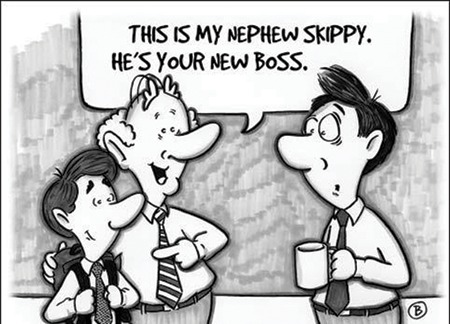
Other store managers that were close personal friends with the Bully got off easy when it came to inspections. She would come in to my store and point out every fingerprint or coffee stain that hadn’t been cleaned up yet, throwing down words like “disgusting” and “gross” to make me feel extra bad. Meanwhile, when I was visiting the store in Cambridge managed by one of her close friends, I found a pile of crumbled drywall bits on a window sill that had obviously been there a long time.  It looked like a drywall anthill.  Others also noticed that the Cambridge location was not held to the high cleanliness standards as the rest of us. We would talk and wonder how they got away with this stuff, when we’d been raked over the coals for less. The Bully would even spend every Friday afternoon working with her friend in Cambridge. It was like clockwork. Every Friday afternoon, she was gone from her desk and working in Cambridge with her friend. Cambridge was “really busy” on Fridays and they needed the extra help, it was claimed. It became a joke around the store. “It’s Friday, she must be in Cambridge working with her friend again.” The owner didn’t question this activity, if he was even aware of it. It seemed strange to the rest of us that this one powerful regional manager would have to work every single Friday in the store where her friend worked.  What are the odds?

The bright side to this was actually that the Bully would be out of my hair on Fridays. Normally she worked at her desk, right in the back office of my store. She couldn’t harass me so much from Cambridge. I didn’t mind that every Friday was spent with her friend. It worked out well for me, but it smelled fishy.

Nepotism reared its ugly head again in 2003. All the store managers showed up for another late night staff meeting. This time, a bombshell was dropped that didn’t sit right with a couple of us. Yet another closer personal friend of the Bully was getting a promotion. A new position was created for her.

“She’s a helper,” said the store owner. “She is not your boss! She’s not in charge of you. She’s just here to help. If you need someone to cover shifts, she’ll be there. She will be in charge of store displays. If you need help with signage, she can do that.”

The accountant Jonathan told me the next day that he advised against this change. “In retail, you never create a new position that doesn’t make money,” he told me. Others were confused. “How did she get that job and not you?” a few people asked me. I’d been there almost a decade and was stuck behind the counter every day. In fact, in my time at the Record Store, the only people who got away from the counter permanently were friends with the Bully. Nepotism at its finest.

One day the Helper was in St. Catharines working on a display of CD wallets. She made the display, tore it down, started over. She spent an entire shift working on that display and signage. Money well spent?

Something strange happened in the months afterwards. Even though we were all assured “she’s not your boss”, the Helper quickly became another boss. Before too long we were answering to her, as if she was a surrogate of the Bully. Some used to refer to her as the Bully’s “Handmaiden”. It stank to high heaven. We’d all been lied to, right to our faces.  And not one of us said anything about it.

It was very clear that the Bully and the Helper didn’t give a shit about me.  Jonathan caught them having a laugh at my expense.  They thought it was hilarious that I was going to have to work all summer without any full-time backup employees.  One day the Helper was in my store, doing a store inspection. I think she purposely did it before I got in that day. I had been hearing that they liked to stack the deck against certain managers that they didn’t favour. One manager had “garbage was piled to the ceiling” written on an official store inspection document. If that had been written on mine, I wouldn’t have signed off on it. Garbage “piled to the ceiling”? Horse shit! That wasn’t even physically possible. Pictures or it didn’t happen!

I came in for my shift, not knowing a surprise inspection had been done. I started as I often did, by cleaning glass surfaces and counters. The place was spic and span. Then the Helper came out to talk to me about the store inspection. “Fingerprints on glass and counters” was a complaint she wrote down.

“I cleaned that as soon as I got here,” I said. “Have a look yourself. Nothing’s dirty.”

She responded, “It was when I wrote it down.”

“Yeah but as soon as I got here, I cleaned it, without even knowing you’d inspected the store. It’s a non-issue,” I protested.

“Well, it’s too late, I already wrote it down” she said. And so it went on my official report. That seemed very unfair. If they inspected stores before I even got there for the day, of course they would find issues. There was only one person on duty before I got in for the day. If he was busy with customers, he would not be able to do a really solid cleaning. When I got in, there were now two people on duty.  One is free to clean.  They knew this.

It was patently obvious that the one who was “not our boss” was in fact another boss we had to answer to. She even got me to run and do bank deposits, which was her responsibility, not mine. But I did it because I wanted to be “helpful” and maybe one day prove that I deserved a promotion too.  What was I supposed to do, say “no”?  If I had, she’d be on the phone with Bully next.  If I refused, they would have made sure I paid for it.

Lessons learned from this: When you do something once to be “helpful” or as a “favour”, by the second time it becomes expected. The harder lesson to learn was that I was never going to get anywhere. I wasn’t a member of the inner circle. I never was going to be. I had dug my own grave. I didn’t want to hang out at bars with her crew like some of the inner circle did. I’ve always been the kind of person who looks forward to coming home after work, and enjoy a movie or a couple albums. Even going out to a bar once a week is too much for me. It’s not something I enjoy. Whether Bully took this as a snub, or whether it just meant I wasn’t going to work my way into the inner circle, I do not know. All I know is that some were lucky enough to escape the wrath, and enjoy an easier work life. Others were not and quit in frustration, and in some cases, tears. It was pure favouritism and the owner was oblivious. He was too busy out wheeling and dealing, opening new stores and making contacts.

I still have friends who work there.  Bully is long gone from that place now; I hope that means the nepotism is too.

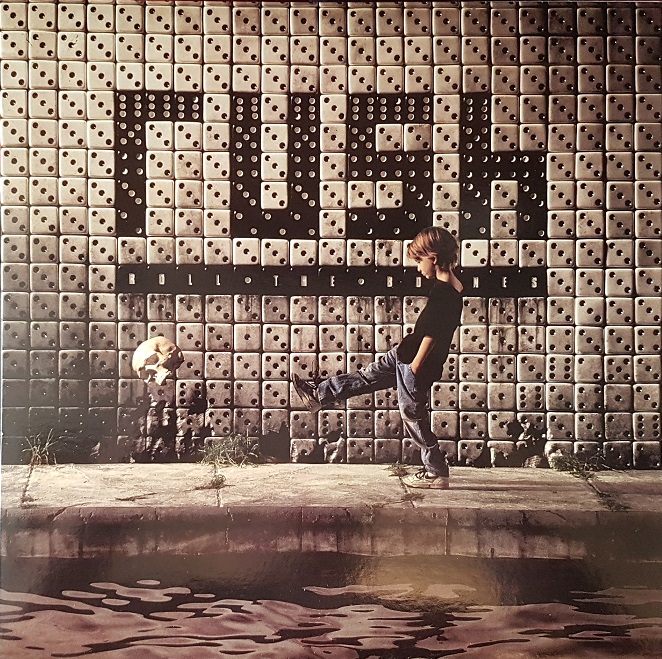
REVIEW: Rush – Roll the Bones (1991, remastered 200 gram vinyl)

RUSH – Roll the Bones (1991 Anthem, 2015 remaster on 200 gram vinyl)

There was a period in the 1980s when, in some circles, Rush had lost the plot.  Writers such as Martin Popoff have been very critical of this era, with its keyboards and shorter songs.  In 1989, Rush began to turn the ship around with Presto.  It and 1991’s Roll the Bones really ushered in the next phase of Rush, combining new and old.  Fans (and Alex Lifeson) were happy that keyboards were toned down, at least in comparison to Hold Your Fire (1986).

The theme of the album is “take a chance”.  Roll the Bones starts with a punch called “Dreamline”.  Geddy Lee’s pulse pushes this into overdrive.  The chorus goes into hyperspace.  It’s hard to think of too many other Rush songs that are so concisely hot.  “Dreamline” has it all:  hooks, licks, force and grace.

Neil Peart is king on “Bravado”*, a sudden change of direction.  His drumming, always hard, is unusually sharp.  Yet it’s a slow song that might be termed a “ballad”.  Whatever — it’s Rush.  It’s incredible.  It’s powerful in an understated, triumphant fashion.  If you know somebody who says they hate Rush, play this.

The title track and first single is a Rush classic, but that rap section sounds dated today.  That was always the danger of such an experiment, but fortunately the song is too strong for it to matter much.  That’s Geddy rapping incidentally, with his voice lowered and effects added.

Side one also has “Face Up”; fast but not particularly memorable.  But it also has “Where’s My Thing?”, a smashing instrumental featuring Geddy and Alex’s flying fingers.  It’s subtitled “Part IV, ‘Gangster of Boats’ Trilogy” as a joke on past pretentiously prog-rock titles they’ve employed.  Rush have always had a sense of humour, and also fun.  “Where’s My Thing” is a fun instrumental, kept short and ever so slightly funky.

The second side of Roll the Bones isn’t as consistent as the first.  “Ghost of a Chance” and “You Bet Your Life” are immediate standouts.  An appropriate spectre-like keyboard part enhances “Ghost of a Chance” and justifies the use of the instrument.  The other three songs (“The Big Wheel, “Neurotica” and “Heresy”) are fine for Rush deep cuts, but may or may not appeal to your specific tastes.

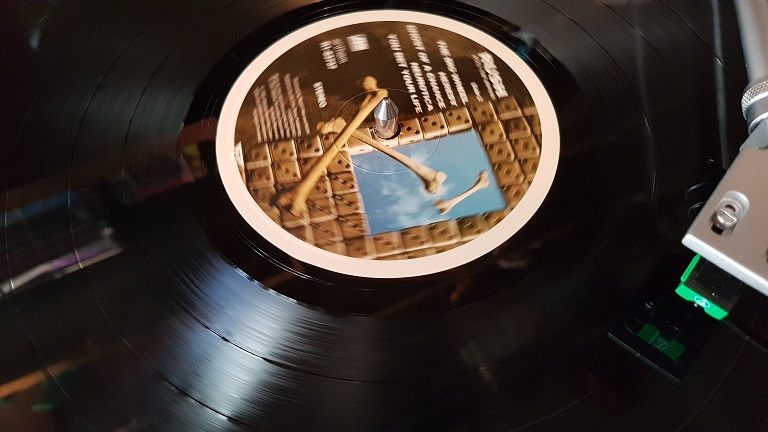
This 200 gram vinyl remaster is exquisite!  Keyboard parts previously unnoticed are now audible, as if brand new.  The drums have the punch missing on the old CD, and the bass hits the guts.  Great dynamics and depth.  If you are in the market for remastered Rush, these 200 gram vinyl reissues are pricey but a nice treat.

3.5/5 stars

*At 3:50 of the song, Peart performs a drum roll that I can only describe as pure ecstasy.  Chills up the spine.

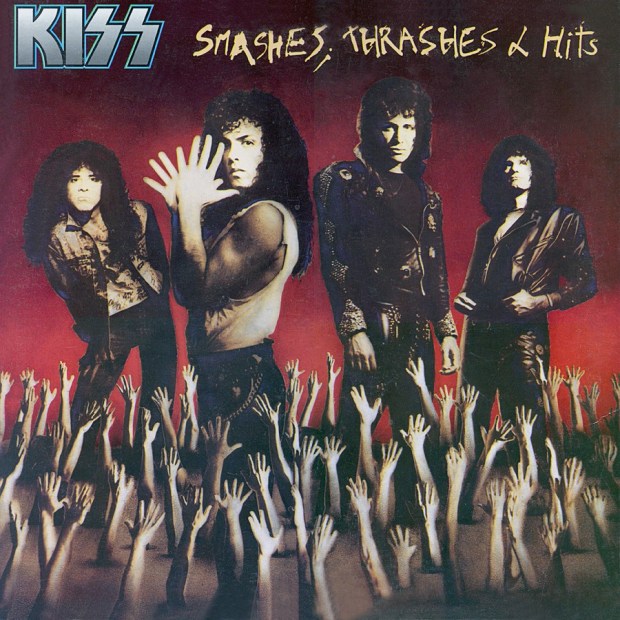
RE-REVIEW: KISS – Smashes, Thrashes & Hits (1988)

The KISS RE-REVIEW SERIES Part 36: 

 – Smashes, Thrashes & Hits (1988 Mercury)

Though hard to believe, in 1988 Kiss needed the money.  According to CK Lendt in his book KISS and Sell, they were in trouble financially.  Some bad investments and too many expenses, plus the underperformance of Crazy Nights, had the band in a bind.  The traditional easy solution is to throw together a “greatest hits” set.

Gene announced this album to Canadian audiences on a trip to the Great White North promoting his record label, Simmons Records.  House of Lords were the band he primed to be big, and their debut album is held in high esteem by rock connoisseurs worldwide.  It seemed to fans that Simmons was transitioning from Hollywood to businessman.  Surely, it was hard to believe him when he claimed Kiss was still his priority.

Greatest hits albums need something new to sell them.  This was left to Paul Stanley, who produced two new songs co-written with Desmond Child (and Diane Warren on one).   It seems unlikely that Gene cared much at this point.  In the music video for one of the new songs, “(You Make Me) Rock Hard”, he can be clearly seen miming the wrong words.

Speaking of music videos, “Let’s Put the X in Sex” was something new for the band (and it wasn’t the lawsuit from the people who owned the building in the video).  Suddenly, Kiss were a three-piece backing band with a guitar-less frontman.  At least in the videos for Crazy Nights, Paul Stanley wore and danced with a guitar.  In “Let’s Put the X in Sex”, he is front and center, without instrument:  the frontman.  Gene’s just the bass player in these videos, looking completely lost.  Paul was doing all the work behind the scenes, therefore he was going to take the spotlight.  And why not?

Getting two new Kiss songs on a greatest hits was good in theory.  Even back then, we sensed they were more the “Paul Stanley Project” than Kiss.  For Kiss, they are too light and glossy.  “Let’s Put the X in Sex” has horns (or is it synth?) making it sound vaguely like an Aerosmith outtake from Permanent Vacation.  At least Steven Tyler injects a little cleverness into his innuendo.  Both Bruce Kulick and Eric Carr rise to the occasion with worthy work, but the tune is a dud.

Likewise with “(You Make Me) Rock Hard”, which passed for a rocker at the time.  Neither of the new tracks are as good as the four on Kiss Killers.  Paul must have just been out of gas.  He states these songs were the best he could do at the time without his partner in crime.  “Rock Hard” is just Kiss by numbers.

First two tracks aside, Smashes, Thrashes & Hits contains 13 of the greatest.  Most are remixed (ill-advisedly) to bring all the tracks to a standard sonic backdrop.  The remixes are from a variety of names in a number of studios:  Dave Wittman, David Thoener, Jay Messina for example.  Some played it a little more loose with the tracks, others didn’t meddle much.  “Love Gun” is an example of a remix that changes things up, but still works.  Ace’s solo is given more emphasis by mixing out the vocals.  It’s a cool alternate arrangement.  Excess echo is added on the drums…you can’t win ’em all.  Many of the remixes suffer from drum related issues.

Smashes, Thrashes & Hits takes a scattershot approach to running order.  It’s very telling that no tracks from Crazy Nights were included, except in the UK where “Crazy Crazy Nights” and “Reason to Live” were hits.  No tracks with an Ace Frehley writing credit were included, and only one from Peter Criss.  That’s another gripe that fans have with this album.

“Beth” is included, a throwback to one of Kiss’ biggest hits, which they tended to shun since Peter’s 1980 departure from Kiss.  It’s considered a slap in the face to Peter that Eric Carr was called in to re-record the lead vocal.  The backing track is identical.  Carr never felt comfortable in this role, but had never been featured on an album lead vocal before.  It was a hell of a dilemma for the drummer.  He’d been in the band for six years and six albums, and never got a lead vocal.  He did the best he could.  The re-recorded “Beth” didn’t replace the original, and it remains an oddity in the Kiss canon.

One afternoon in the summer of 1990, Bob and I were hanging out with these two girls at his trailer that we were going out with.  We were listening to songs, but Bob and I didn’t seem to get much say in what songs.  One of the girls said, “I have some Kiss!” and put on Beth.  As soon as she did, I had a feeling it wouldn’t be the original.  Simultaneously, Bob and I both said, “Oh no, it’s Eric!”  The girls had no idea what we were talking about or why it was a big deal.

Smashes, Thrashes & Hits was the first compilation to reconcile the makeup and non-makeup eras of Kiss.  The majority are from the makeup years, as it should be, with only three from non-makeup albums.  You could argue for this song and that song, but the running order is jarring.  “Heaven’s On Fire” into “Dr. Love” is not even as bizarre as “Beth” into “Tears are Falling”.  The less familiar remixes don’t help the situation.  Incidentally, the only songs untouched by remixers’ hands are “Lick It Up”, “Heaven’s On Fire”, “Tears are Falling” and “I Was Made For Lovin’ You”.

There was no tour for Smashes, Thrashes and Hits.  Gene had his label stuff, including a new Canadian band called Gypsy Rose to think about.  (Remember “Poisoned By Love” on Simmons Records?)  Paul Stanley didn’t want to sit idle, and so did a 1989 solo tour.  Kiss family member Bob Kulick returned to his side on guitar.  Kiss keyboardist Gary Corbett was there with bassist Dennis St. James and ex-Black Sabbath drummer Eric Singer.  The setlist featured a number of old Kiss classics that hadn’t been played live in 10 years, such as “I Want You”.  Eric Carr was unhappy about the solo tour, worrying about what it meant.  Like most Kiss fans, he wondered if it was the beginning of the end.  He also worried that Paul didn’t ask him to be his solo drummer.  Paul said it was because two Kiss members wouldn’t be right for a solo tour.  Ominously, Eric Carr said about Singer:  “That’s the guy who’s going to replace me.”

Fans were confused and some were unhappy.  Like they had once before, Kiss were drifting further and further into pop music.  This time, it was without Ace Frehley to keep them anchored.  Paul Stanley now seemed to be a Bon Jovi-like dancing frontman.  These new songs were not easy to stomach, and the Eric Carr vocal felt all wrong.  Had Kiss lost all credibility?  Smashes, Thrashes and Hits wasn’t winning any back.

Today’s rating:

2/5 stars

Original mikeladano.com review:  2012/08/06