REVIEW: Dio – Strange Highways (1994)

Scan_20151011DIO – Strange Highways (1994 Reprise)

Black Sabbath had a very acrimonious split with Ronnie James Dio in 1993. Β Sabbath were asked to open for Ozzy Osbourne at his “farewell” concerts in Costa Mesa. Β At the end there was to be an original Sabbath mini-reunion. Β Ronnie James Dio outright refused to perform and left the band immediately afterwards. Β Sabbath were forced to get Rob Halford, not so far away in Pheonix, to fill in (the first of two times he would have to do so in Black Sabbath, the second time due to an Ozzy illness). Β Halford did so admirably under the circumstances. Β After the show, drummer Vinnie Appice joined Ronnie in a new version of Dio.

The new Dio lineup was a four-piece for the first time since album #1. Β On bass, Jeff Pilson (ex-Dokken), also helping out with keyboards and backing vocals. Β Pilson was always capable of singing the high parts in Dokken songs, and with Dio he adds a little bit of melodic accentΒ by harmonizing with Ronnie. Β On guitar, controversially so, was Tracy G (Griljalva) from the band WWIII, which had also included Appice at one point. Β Dio described his mood as “pissed off” during this period and it certainly came out in the heaviest Dio album yet.

The thing with Tracy G was that he had an abrasive, atonal drony guitar sound, although certainly fitting to the new angry Dio sound. Β It was very different from the slick neo-classical bent that guys such as Vivian Campbell added to their solos. Β It was a brutally heavy and edgy change that should have earned Ronnie some credit rather than criticism. Β “Jesus, Mary & the Holy Ghost” opens the album on a speed metal approach, showing off the new guitar player. Β Tracy G was like the mad man’s scientist heavy metal guitar player crossed with Steve Stevens from Billy Idol’s band. Β If you want to check out what Tracy G did within Dio, just crank up “Jesus, Mary & the Holy Ghost”.

Admittedly, a whole album of Tracy G’s razor blade guitars can make one weary, but fortunately Dio albums are usually varied in song tempo and style. Β “Firehead”, the second track is a slow metal groove that suits Dio well. Β Arguably, the Dio lineup with Pilson on bass is more adept at this Sabbathy path than any other. Β Pilson has always been one for the low end, and his bass has an elastic thud that is similar, but different from ex-Dio bassist Jimmy Bain. Β Slower and heavier still is the title track “Strange Highways”. Β Ronnie has always stated that he liked to hear the space between the instruments, and that’s “Strange Highways”. Β This really was a great lineup for the band.

“Hollywood Black” is based on a lyric that Ronnie wrote for the sessions of Black Sabbath’s Dehumanizer album. Β Maybe it’s even the same melody; the original has never been leaked. Β This is a strong mid-tempo slog; the most mainstream Dio song yet in this collection. Β Side closer “Evilution” (love that title) is even better; nastier and snippy.

I have a funny story about this song. Β I bought the cassette while out on a road trip with my buddy Peter, who was always a much bigger OzzyΒ fan than Dio. Β We put the tape in the car deck. Β TheΒ wordsΒ at the end of the songΒ baffledΒ us both, but it was a case of mis-heard lyrics! On Peter’s overdriven, bass-heavy car system, we heard the closing words as:

“Hello, good night, it’s me,
I’m open again,
Come back, come in, goodbye,
Wear clothes!”

The actual final line is “We’re closed.” If you play the song and pay attention…you can hear it too, can’t you? “WEAR CLOTHES!” Misheard lyrics…or hidden message?

As if there was any question from the first side of the album that Ronnie was in a bad mood lately, then “Pain” should settle. Β “Take the water and wash your face with pain!” Β Or, “Take the hammer and pound yourself with pain!” Β My favourite, “Bury my bones on the moon, if they ever should find me it would be too soon.” Β It was hard to find Ronnie’s usual positivity in some of these words. Β  But listen to that one floor tom hit at 2:00 in! Β Holy drums, Batman! Β I love that one hit, it’s my favourite part of the song, which is actually pretty good.

“One Foot in the Grave” is a lot more upbeat than you’d expect by the title and it too is pretty decent. Β Notice these songs are not “great” — they are just shy of whatever quality makes a song great. Β Then “Give Her the Gun” is the Dio power ballad, but thematically it too stark and real for some tastes. Β Child abuse, gun rights? Β In a Dio song? Β All power to the man for speaking his mind, but even the most ardent supporter must concede that this is an unusually blunt song for him.

Onto “Blood From a Stone”, back to metaphors once again, and back to blazing hot Tracy G shreddery. Β Back to insuppressible Pilson bass. Β There are some 80’s-isms in some of the guitar licks, but blink and you’ll miss ’em. Β Then, rock out to “Here’s to You”, which sounds like a blazing hot celebration of the rock, or the “masters of the universe”, or something. Β But according to Ronnie, “The wheel goes ’round, so here’s to you!” Β Sounds like by this point in the record, Ronnie has worked out whatever bitterness he had left seething in his system. Β Finally “Bring Down the Rain” ends the album on a very Dio note, with all the majesty and power he can inject into a closing song. Β It’s just heavier than before. Β “Put out the flame”, sings Ronnie, his leathery lungs never more impassioned nor powered.

Perhaps Dio still had much anger left in him after all, since the next album was the aptly-titled Angry Machines. Β But that’s another review.

Strange Highways in a good album bordering on great — but not quite.

3.5/5 stars

#445: An Orgasm For the Brain

GETTING MORE TALE #445: An Orgasm For the Brain

The Boss at the Record Store used to have a little office in the back of one of our stores. Β The walls seemed paper-thin. Β You could figure out what he was doing back there from the sounds, especially when he had a cold. Β His sneezes were epic. Β  They were monolithic in scale, and sounded like they were a tremendous relief each time.

“AHHHHHHHHH-HOOOOOOOOOOOOOOOOOOOOOOOOO! Β Woo!” Β Something like that.

One afternoon, he was having a particularly active bout of the sneezes, and the frequency and strength of them combined were impossible to ignore. Β One of my customers noticed and chuckled.

“Sounds like that guy is having a good time back there,” said the man.

I know the feeling a good, refreshing sneeze too. Β “Yeah,” I replied. Β “He’s had a cold all week but he’s really good at sneezing.”

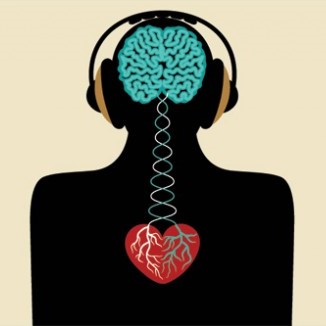
“No, seriously,” the man persisted. Β “A sneeze is like an orgasm for your brain. Β That guy back there is basically having a whole bunch of brain orgasms right now.”

I didn’t know how to respond to that, so I answered, “Wow. Β I did not know that!”

“You learn something every day!” said the man, who went on to do his music shopping.

Is there any truth to this? Β Or is this just one of those wild tales that customers used to tell me?

The folks over at livescience have the answer. Β “This myth isn’t worth the price of a tissue,” they say, but also add, “Connections do exist, however.”

For one, a sneeze may release endorphins. However, “Although supporting literature remains sparse, cases have been reported of men and women who sneeze when sexually aroused. Doctors suspect that the phenomenon might arise from a case of crossed wires in the autonomic nervous system, which regulates a number of automatic functions in the body, including β€œwaking up” the genitals during arousal. The nose, like the genitals, contains erectile tissue.”

I was not aware of that. As my old customer said, you learn something new every day!

REVIEW: Glueleg – Heroic Doses (1994)


GLUELEG – Heroic Doses
(1994 Page Publications)

Any band that can handle an instrument as beastly as the Chapman Stick is worth listening to at least once. Glueleg, from Toronto Ontario, were once such band. They boasted not only the Stick but also a horn section with sax and trumpet. If that wasn’t enough to garner them some local praise, a few people turned their heads when they hooked up with James Stewart (cousin of The Cult’s Jamie Stewart) to produce their first CD, Heroic Doses. Prior Glueleg releases were cassettes…CD was the big time.

The title track was the first single/video, and entered rotation on MuchMusic and several rave reviews. Guitar player Ruben Huizenga sings this immediately infectious track. The hypnotic vocals, the punchy horns, the Stick, that low-as-fuck rib-busting riff…this track is perfect in every way. “Heroic Doses” nails it completely and there is no wonder that it garnered some serious attention. The end result of this was a record deal with EMI, but nobody can accuse Glueleg of being commercial on “Heroic Doses” even so.

“Pollo” (“Chicken”) is rapped and sung by Stick player Carlos Alonzo. He has an interesting voice, able to do a rap in a Beastie-like style but with his own spin. He can also sing quite well. He also sings “Mister Pink”, another manic groove. The horns deliver consistent punctuation, and that Stick just thumps. “Lilies” has a droney riff/groove combo that stoner rock bands today love to utilize. “Spiderman” is an original, an instrumental, but it certainly recalls the classic cartoon theme. Glueleg songs don’t tend to adhere to convention song structures. They have more in common with Mr. Bungle than the Chili Peppers, but much more accessible. Their songs have the complexity and chops of Bungle, but are direct. There are also grunge elements, a-la Alice in Chains.

The sonics of this album are really quite good even today. The Stick has a snap to it, and the horns have depth. Having two singers enabled them to play different styles of songs even within the confines of what Glueleg were doing. “Dust” is a dirge, for example. Then the next track “Pampa De Chooch” is completely different, at times almost sounding like Kyuss with horns. “Park Alien” might be Zappa-esque progressive jazz. “I Saw You Joja” is then something else again. Perhaps there’s a lack of focus, or maybe it’s just that Glueleg were so bursting full of ideas, but some songs come off as scattershot.

Biggest surprise of the album: the closing track “Red”, the King Crimson instrumental. What a drum tour de force performance this is, by Christian Simpson. Simpson is no slouch; he later went on to play with Saga for several years, as well as David Usher and Edwin.

I like all of it. Heroic Doses is one of those discs that are indicative of their times, and has nostalgia value, but also plenty of musical chops to keep you busy. If the songs had been tightened up a bit more I think you’d have a serious classic here. Unfortunately there are some songs that are just not quite there.

3.25/5 stars

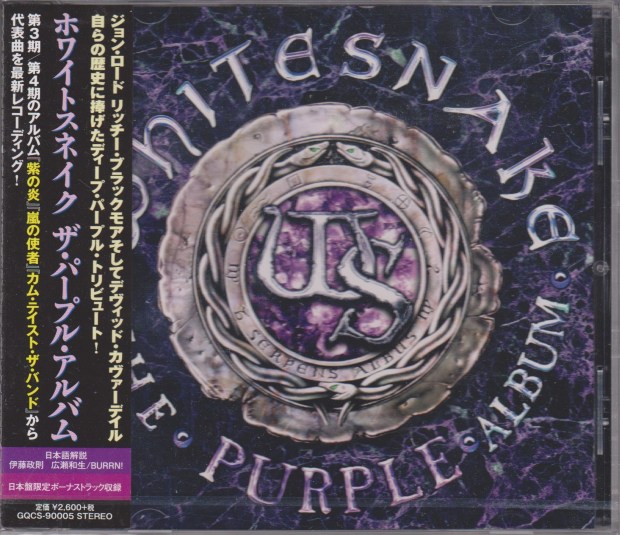
REVIEW: Whitesnake – The Purple Album (2015 Japanese & deluxe editions)

WHITESNAKEΒ – The Purple Album (2015 Frontiers, Β Japanese & deluxe editions)

One old school buddy of mine, Rob Vuckovich, was a huge David Coverdale fan back in the 1980’s, but mostly a Deep Purple fan. He took great pride in telling me that he went to see Whitesnake on the 1987 tour. He held aloft a sign that said “PLAY PURPLE”. David reportedly acknowledged his sign by saying, “We’re not doing any of that!” What changed?

Jon Lord’s dying wish to his friend David Coverdale was to somehow reform Deep Purple MkIII. “Life’s too short and too precious to hold any animosities,” learned David after Lord’s passing. He reached out to Candace Night, wife of Ritchie Blackmore, and eventually spoke to the Man in Black about a Lord-less reunion. Blackmore was intrigued and David started working on updated arrangements for the tunes. He didn’t want toΒ singΒ them in the same way that he did in his 20’s. The situation with Ritchie didn’t work out, but David did not want the work he had gone to on the new arrangements to go to waste. He approached his band and asked them what they thought about a Deep Purple covers album. The response was instant. Joel Hoekstra (guitar) in particular was pumped.

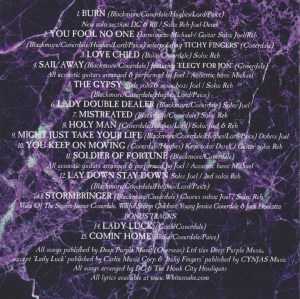
The result is The Purple Album. Sourced from Coverdale’s three albums with Deep Purple (Burn, Stormbringer, and Comes Taste the Band), 15 songs were selected. It’s hard to argue with the selection, either. There are chances taken. “Holy Man” is a damn hard song to sing, and it was originally performed by Glenn Hughes, not David. And four, count ’em, four songs (on the deluxe) from Come Taste the Band, perhaps the most underrated album in the Purple canon.

Scan_20151007 (6)

The sound is “Snaked up” as David says, which means modern guitars and technical shredding. To his credit, David really let his band play instead of copying Deep Purple. Joel Hoekstra is a hell of a guitarist, able to shred. He has brought some soul back to Whitesnake that I felt was missing from their two studio albums with Doug Aldrich. Other songs are stripped down, such as the now-acoustic “Sail Away”. This song is dedicated to Jon Lord and it’s certainly among the best songs on The Purple Album. It’s very “live” in the studio.

Is it necessary? Hell no, but David’s entitled to do what he wants. Nobody else is keeping these songs alive except for Glenn Hughes now and then. Jon Lord would be delighted with the quality of it, but he would surely be saddened that Deep Purple MkIII has never reunited. Since that was indeed the case, David and Whitesnake worked very hard on plenty of new parts and licks for their own arrangements. Reb Beach sings many of the Glenn Hughes lead vocal parts (quite well), and finally Whitesnake feels like a real band again. It’s odd that it happened on a Deep Purple cover album, but the band sound like a real band, on album for the first time in ages. Hopefully the injection of passionate young blood in Hoekstra and new bassist Michael Devin will result in new music some day.

The deluxe edition of The Purple Album comes with two bonus tracks and a loaded DVD. “Lady Luck” and “Comin’ Home” from Come Taste the Band are actually two of the best selections. It’s rare that bonus tracks are album highlights, but just because these songs are not as world-renowned as “Burn” does not mean they are not as good. They’re awesome. “Comin’ Home” is very different from the original, having a new and very Whitesnake (circa Slide It In) riff installed.

Japan usually get exclusive bonus tracks and this time it’s a different mix of “Soldier of Fortune”. The reason for the alternate mix (according to the documentary DVD, which we’ll get to) is that David was somewhat torn on which version heΒ liked best. The original concept was a straight acoustic version, with just David’s voice and an acoustic guitar — one guitar, like in Deep Purple. That version didn’t make the album. In a last minute decision, David chose to record bass and other embellishments, and that is what you hear on the standard album. The lucky fans in Japan (or those who wish to shell out for an import!) get the original concept as a bonus track. Delightful.

The bonus DVD is a nice treat, for the 30-minute “Behind the Scenes” feature. It’s great to see the band get so much face time, talking about their love of Deep Purple. Things like this aid in your appreciation of the final album. Observations: Reb Beach does a hilarious Coverdale impression. Tommy Aldridge is still an unstoppable beast of a drummer, even today. Indeed, the new Whitesnake lineup comes across as an inspired band. It is a brand new era for Whitesnake, according to David. He is happier with their sound than he has been in years.

Then there’s the fluff, the Whitesnake EPK (electronic press kit) which is just a condensed version of the main feature. Added to this are four music videos. It’s almost amusing that Whitesnake made music videos today, but again the band get a lot of face time and that’s cool. In the music videos,Β it really seems like Whitesnake are a bandΒ regardless of the lineup changes. The videos are glossy, a little cheesy, but a nice little add-on.

The original rating for this album was going to be 3/5 stars. Cover albums just can’t be judged by the same yardstick as an album of original material. Having seen and heard how much passion and work Whitesnake put into The Purple Album, I’ve grown to appreciate it more. Therefore:

3.5/5 stars

#444: β€œCan I Listen to This?”

GETTING MORE TALEΒ #444: β€œCan I Listen to This?”

In the early 1990’s, the CD store in which I worked was just an ordinary music store that sold new product in a mall.Β  Later on, we did the switch to used discs which was the smartest move the owner could have done.Β  He was able to control his own cost of goods sold.

Switching to 99% used stock attracted customers to the better prices.Β  Before too long, the used selection was better too, because we would see many deleted and rare titles that you couldn’t buy new anymore.Β  Ebay didn’t exist yet. Β It was hard to find those titles on CD. Β Another benefit to the switch was the ability for customers to sample music before they bought it.Β  It was harder before.

In the earliest days, if a customer wanted to hear something, we had to crack open the disc and play it on the store player.Β  We didn’t even have a re-sealing device.Β  The way around this was to carefully (carefully!) cut the cellophane off the CD case, along the spine of the disc.Β  Carefully (carefully!) slide the disc out of the cellophane.Β  When done, you can carefully (carefully!) slide the disc back into the cellophane, and β€œseal” it up with a piece of strategically placed Scotch tape.Β  This did the trick well enough for us.Β  We made due.

The annoying thing wasn’t the fact that we had to crack open a disc for people to listen to.Β  The real irritant was that we didn’t have anything for them to listen to it on, except the store CD player.Β  If a customer came up and said, β€œCan I listen to this?” it meant stopping whatever you were playing, and putting in their disc.

This happened one Saturday afternoon, sometime in the spring of ’95.Β  Radiohead had just released The Bends, and we only carried three copies to start.Β  A guy came in curious what it was like.Β  The Bends may be critically acclaimed by fans worldwide, but that spring afternoon in 1995, it did absolutely nothing for me*.Β  Skipping from one track to the next, then back, at the customer’s command, I hated what I heard.Β  To my ears it sounded too mellow and I was ready for a nap. Β It was definitely not what I wanted to hear while I was trying to work. Β To date I still don’t ownΒ The Bends.Β  This guy stood there listening for half an hour before decliningΒ to buy it.Β  It was annoying for both myself, and the other customers, to have to listen to this disc skipping from track to track at the guy’s hand signals or nods.

But we didn’t have anything else, and we were customer service oriented, so what are you to do? Β You listen to (rather, skip back and forth through) The Bends.

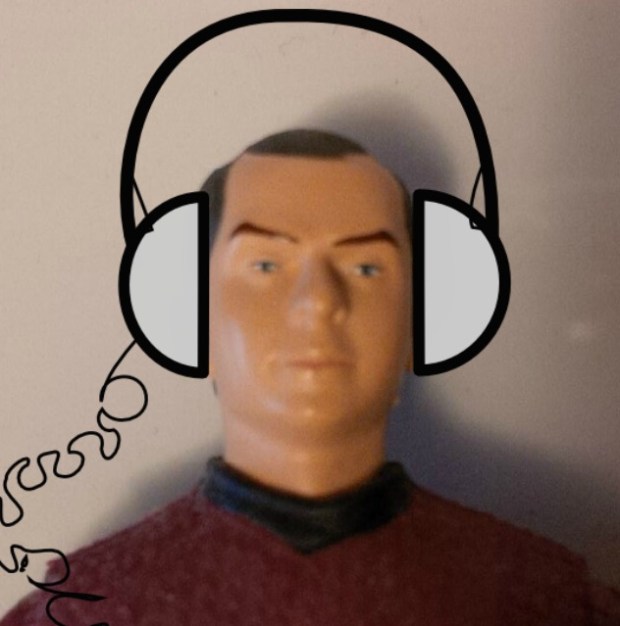
A year later I was managing a bigger store, with the 99% used format.Β  We had a store player, plusΒ several other units hooked up to headphones.Β  With an entire store of used stuff to listen to, and a pair of headphones to do it with, it was a vast improvement over the old way.Β  Once again the owner had a great idea. Β Even though there is no question they were a huge popularΒ feature for our stores, the β€œlistening stations” as we called them were still ripe for abuse.Β  Customers would make you run around retrieving 20 (or 30 or 40) discs to listen to, only to buy none.Β  They’d complain about the sound quality.Β  The headphones were constantly busting due to overuse and abuse.

β€œThese headphones suck.Β  I can’t hear the nuances in the music.”  That was a real complaint.Β  Since there wasn’t much I could do about it, I explained that the listening stations were there just so you could hear a song and decide if you liked it or not.Β  Not much thought was given to hearing the nuances.Β  But this guy insisted he couldn’t tell if he liked a song without the β€œnuances”, so no sale was made.

Other folks would want to listen to an entire CD – the whole thing! – to make sure it didn’t skip before they bought it.Β  Even though we offered a guarantee.

Even though we had gone through the effort and expense of providing these listening stations, there are some people you can never please.Β  More than one fellow (yes, it was only guys) asked to listen to something, only to complain, β€œNo, I don’t want to hear it on those headphones.Β  I want to hear it on the big speakers!”  Yeah, but nobody else in the store wants to.

Music fans:Β  Although you can now listen to almost anything you want in the comfort of your own home, please, if you want to use the listening stations at a CD store, don’t be a douche!


*I do have Kid A in my collection. Β I love Kid A. Β 

REVIEW: Bon Jovi – New Jersey (Super Deluxe, part 2)

Concluding an in-depth review of the Bon Jovi New JerseyΒ Super Deluxe edition. Previous reading:

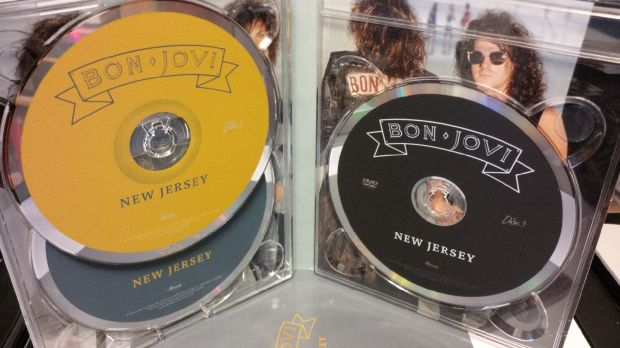
BON JOVIΒ – New Jersey (2014 Universal Super Deluxe edition, part 2)

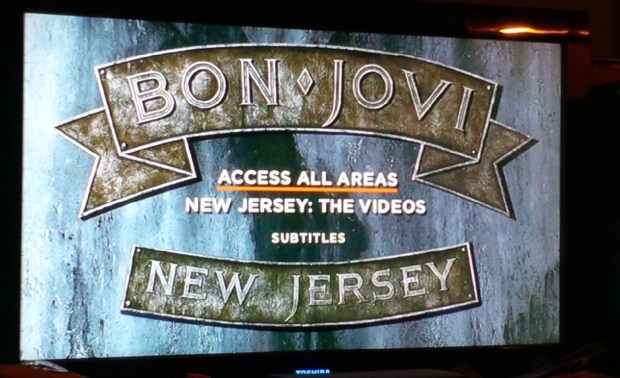
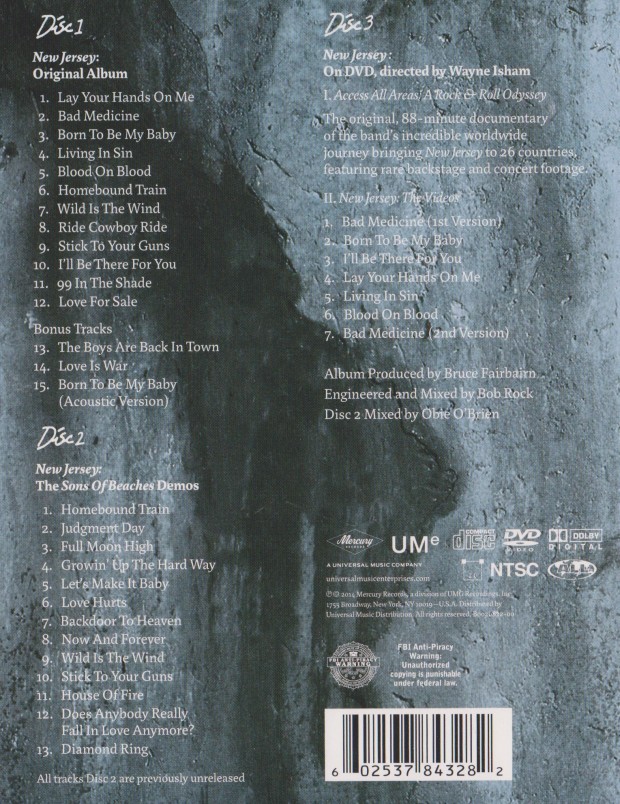
Of all the Bon Jovi albums, New Jersey certainly deserved the Super Deluxe treatment. Β New Jersey‘s promotional cycle included two VHS releases, both present on this DVD:Β The old Wayne Isham tour documentary Access All Area, and New Jersey: The Videos. Β Isham was responsible for virtually every cool larger-than-life video Bon Jovi made. Β In 1988, trendy grainy black and white footage was all the rage, and so Access All Areas, where we will begin, has an over-abundance of it.

In a piece of incidental pre-show rehearsal footage, Richie Sambora sings “Purple Rain”, proving who the talent in the band always was. Β It is nice though to see everybody in the band hanging out, having a good time, and seeming like genuine friends. Β As for the audience, it’s amusing to see the giant hair from the perspective of today.

The sound of “Bang” by Russian metal band Gorky Park indicates we’re off to the Soviet Union. Β Bon Jovi were pioneering in being one of the only hard rock bands to play behind the Iron Curtain (they were officially sanctioned by the government), and this part of the show is certainly the most interesting. Β Bon Jovi even have a ten-man blues jam with the Russian band, building bridges at the end of the Cold War. Β The blues is universal. Β This visit leads to the massive Moscow Music Peace Festival, which I had on tape from MTV, and wore completely out. Β (Not shown: the backstage moment when Tommy Lee rips the shirt off Bon Jovi manager Doc McGhee’s back, for allegedly upstaging Motley Crue by using fireworks in Bon Jovi’s show, against prior agreement. Β It’s a long he-said she-said story involving McGhee who was managing both Motley and Bon Jovi at the time. Β Motley felt McGhee had prioritized Bon Jovi, and fired him immediatelyΒ after.)

The boys have a blast in the warmth of Rio de Janeiro, quite a contrast with snowy Moscow. Β  In Tokyo they are chased by a swarm of screaming girls. Β Through it all, even though they’ve been on the road forever and can’t wait to get home, they maintain themselves with a lot of joking around. Β Fortunately Isham captured this endearing footage. Β The live rehearsal stuffΒ is also excellent, up close and in the faces of the band.

In a very cool moment backstage at Wembley, Bon Jovi, Cinderella and the Scorpions work on covers together for a big jam. Β “Travelling Band”…holy shit, is that Elton John on piano? Β Sure looks like it. Β Rick Allen, Brian May, Lita Ford! Β “I am the happiest kid on Earth!” shouts an excited David Bryan. Β Another gig features Bon Jovi with the late comedian Sam Kinison on “Wild Thing”. Β At Tower Records, they are threatened with arrest by the riot squad if they perform, so naturally Jon and Richie break out the acoustics and do “Ride Cowboy Ride”. Β In swoop the fuzz, who had nothing to worry about. Β Alec John Such’s birthday is celebrated in West Berlin, where they visit the wall. Β (In a shivery moment, Jon is eyeballed by an East German soldier on the other side.) Β Their cover of “The Boys Are Back in Town” is performed, and Jon takes a chip out of the wall.

Jimmy Page is present at a three hour charity gig at Hammersmith, and they jam on “Train Kept a Rolling”. Β (Best moment: when Jon sings a Steven Tyler “wha-ga-ga-ga” in it near the end, just like Tyler did in Aerosmith’s version.) Β It’s clear that even then Jon was the boss — he alone makes the setlist, and says if something goes wrong he’ll call the shots. Β He comments he has “never been so nervous.” Β Bad Company’s “Shooting Star” is a duet with Richie Sambora, who had been playing it long before Bon Jovi formed. Β It’s a stunning version and it’s hard to imagine Bon Jovi ever doing anything this big again, both in terms of success and quality.

Australia! Β “Bon Jovi: We go everywhere, but we live nowhere!” says Sambora. Β “Love For Sale” is played at HMV for swarms of long-hairs both male and female (but mostly female). Β Sam Cooke’s “Having a Party” is another incredible cover selection, and you have to give Jon credit for that. Β The final show is a big multi-gig stand in Guadalajara, Mexico that almost never happened due to “politics” (money) and a riot! Β The first gig is postponed to the next day forcing Bon Jovi to play a double-header starting at 11 am! Β “We should go on stage in riot gear,” jokes (?) Jon. Β (They don’t.)

Access All Areas was a good rock doc for the time. Β It feels whitewashed and scrubbed clean of blemishes, but that was music in general in the late 80’s. Β The real pleasure is getting to see the other band members hanging out. Β Alec John Such seems a funny, talented guy with a great voice. Β David Bryan is clearly a lot more gifted than he gets to show off in the band.

The music videos (only mixed in stereo, unfortunately) are all you remember them to be: more mixtures of black & white, and colour footage, golly! Β Both versions of “Bad Medicine” are included. Β (More Sam Kinison!) Β There are funny interludes with the band in between the songs, joking around back stage. Β (Special guest: Skip Rope Skid Row’s Dave “Snake” Sabo.) Β “Me, if I wasn’t a musician, I’d be a drummer!” says Jon. Of the music videos, “I’ll Be There For You” and “Lay Your Hands On Me” are the coolest, just no-nonsense stage performance clips. Β “Blood on Blood”, which I’d never seen before, is a live version.

The DVD portion of this box set is a nice supplement, but you won’t be in a hurry to sit down and watch again. Β The black & white/colour back and forth is very tiring. Β Fortunately Bon Jovi seem(ed) like a nice bunch of guys from the neighborhood that have loads of talent, and fun to watch in any setting.

DVD: 3/5 stars
Bonus tracks: 4.5/5 stars
Album: 4.5/5 stars

Overall rating: Β 4/5 stars

Thanks for joining us for this massive review! Back to something else tomorrow.

REVIEW: Bon Jovi – New Jersey (Super Deluxe, part 1)

BON JOVIΒ – New Jersey (2014 Universal Super Deluxe edition, part 1)

BACKLOG! I received this box set over 10 months ago. Β We at LeBrain HQ are so busy with so much rock and roll that it has taken that long to finally give this entire box set a proper examination. Β Fortunately, we (the “royal” we) have already reviewed New Jersey itself, in March of 2014 before this box set was released. Β There is no need to repeat what was said in that review. Β It is still an accomplished album worthy of its 4.5/5 star rating. Β New Jersey was and easily remains a very high water mark. Β For this review we will look at all the bonus tracks and the entire DVD in detail. Β All three parts combined will probably give you theΒ most completeΒ look at the New Jersey Super Deluxe edition out there.

There are loads of bonus tracks to discuss, some of which were available before. Β Bon Jovi must have known this release was always in the cards. Β Look at the track list for their box set, 100,000,000 Bon Jovi Fans Can’t Be Wrong. Β Not one of these demos is on that massive five disc box set. Β Many of theseΒ tracks had been leaked a long time ago on bootleg CDs such as Keep the Faith/New JerseyΒ Outtakes, but never issued by the band. Β It’s naturalΒ to be cynical and say, “Well they must have been saving them for another box set like this one.”

“The Boys Are Back in Town” is an A-OK Thin Lizzy cover. Β When Lizzy wrote this song, Phil Lynott almost had the blueprint for the future of Bon Jovi plotted out. Β Bon Jovi, a back who love singing songs about the boys being back in town, were the perfect band to cover it and make it their own song. Β Cynics may laugh, but Richie Sambora and Tico Torres are quality players able to inject class into the cover. Β Keyboardist David Bryan uses the “organ” setting on his keys to offer appropriate backing for the boys. Β It’s hard to have a winner with a Lizzy cover and not sound like a bunch of jackasses. Β This one was recorded by Bruce Fairbairn for the 1989 anti-drug compilation Stairway to Heaven/Highway to Hell.

“Love is War” was good enough to be a single in its own right, but it was only the B-side to “Living in Sin”. Β Perhaps the reason it was chosen for B-side status was that the verses and chorus don’t quite jibe. Β The song has great, dark verses and a big old Slippery-like chorus. Β It doesn’t quite sound like a New Jersey song, butΒ it’s hard to track down today.

A very rare bonus track is an acoustic version of “Born to Be My Baby”, only available on a Japanese “Living in Sin” CD single. Β Fans love when Jon and Richie just sit down together with a couple acoustics and do a live-in-the-studio rendition of a hit. Β It’s an uber-rarity that LeBrain HQ did not even know existed before this box set was issued. Β As usual, Richie’s soulful singing reaches deep into your guts. Β His classical-influenced guitar solo is a masterpiece.

Famously, Bon Jovi once considered the awful title Sons of Beaches for their 1988 album. Β Disc two is called the Sons of Beaches Demos and there are plenty more great tracks here that are familiar to bootleg collectors. Β The opening demo version of “Homebound Train” is even bluesier and greasier than the great album take. Β Anyone who doubts the instrumental ferocity of Bon Jovi can check this out and see what the original lineup was capable of.

IMG_20151004_090939

“Judgement Day” opens with traditional “nah-nah-nah” Bon Jovi vocals, giving it a sound-alike quality to other more familiar Bon Jovi songs. Β It is good enough that it could have been on an album (or single B-side). Β Then “Full Moon High” (also known as “River of Love” on bootlegs) is familiar.Β  I recognize the music from somewhere else: itΒ became the Keep the Faith B-side “Save a Prayer”! Β The riff is intact, and what “Full Moon High” amounts to is an alternate 80’s version of it. Β It is just as great as “Save a Prayer”, and it is difficult to pick a preferred version. Β “Full Moon High” is an achievement, and Richie’s guitar playing isΒ nutso. Β “Growing Up the Hard Way” is back to the “nah-nah-nah’s”, and it sounds as if this is an early version of “Love is War”, but with a very different chorus.

With a slinky, dusky song behind him, Jon urges someone “Let’s Make it Baby”. Β This tune would have been good enough for Keep the Faith, but did not surface until a double disc version of These Days was issued in the mid-90’s. Β This is a noticeably different mixΒ from that release — more raw. Β Then “Love Hurts” goes into upbeat territory with a decent set of melodies to sing along to. Β It is a bit similar to “Love is War” once again, but that’s why these songs were never officially released before. Β I’ve had this song in my collection for 20 years, but not with this level of audio quality. Β Likewise “Backdoor to Heaven”, a ballad that fans have loved for a long time (just not officially). Β Again, this song was probably deemed too similar to others such as “I’ll Be There For You”. Β Same with “Now and Forever”, another ballad of high quality, but also similarity.

A harder-edged “Wild is the Wind” demo is otherwise very similar to the album arrangement, with some different bits on keyboards and acoustic guitars. Β Singling out Tico Torres as drummer extraordinaire, I love his hard hitting style. Β Same with the excellent “Stick To Your Guns”; it’s more or less already complete at the demo stage. Β The rawness is a beautiful thing…you can hear Richie talking at one point.

The one track of all of these which LeBrain HQ was most excited about is “House of Fire”, a song that Jon donated to Alice Cooper for his Trash LP. Β Cooper’s version was “unremarkable” [LeBrainΒ Trash review], but Bon Jovi did it right. Β If Alice didn’t release his own single for it, I wonder if Jon would have? Β One word: Β infectious.

Fans in the know have always loved “Does Anybody Really Fall in Love Anymore”, another ballad that might be deemed too similar. Β Another issue is that the chorus really reaches for the high notes, and Jon misses most of them on this demo. Β Somebody probably realized it would be a difficult song to bring to the concert stage. Β The bootleg version of this is more complete, with backing vocals filling it out. Β This demo, perhaps earlier than the one that was bootlegged ages ago, lacks all backing vocals and sounds like it may be live in rehearsal. Β “Keep going,” says Jon to someone, indicating this is likely the case.

IMG_20151004_091117“Diamond Ring” became such a fan favourite after the band played it live that this New Jersey demo was tried out again for Keep the Faith, and finally made an album in 1995 for These Days. Β Each arrangement of the ballad was different from the last. Β This one is the earliest, featuring bluesy electric guitars and organ. Β Its final incarnation was much quieter.

Very conspicuous by itsΒ absence: Β “Rosie”. Β This was written by Richie and Jon about someoneΒ they knew growing up (as many of their songs are). Β Desmond Child and Diane Warren helped them finish it, and it was recorded by Sambora for his first solo album Stranger in This Town. Β Since that album featured Tico Torres and David Bryan on drums and keys, you can almost consider that a Bon Jovi song. Β But why is it not here, with the demo sessions that it belongs with? Β It’s cynical but not unlikely to think it’s due to Jon and Richie’s feud. Β Shame. Β There are other Sons of Beaches demos missing that are out there on bootlegs, such as “Love is War” so don’t fool yourself, this is not a complete set of ’em.

Come back tomorrow and we’ll look at the final disc in this set, the DVD.

To be concluded…

Scan_20151004

#443: Touched by the Music

TOUCHED BY THE MUSIC

GETTING MORE TALEΒ #443: Touched by the Music

I recently attended a memorial service for a friend of my wife’s, who was a local musician.Β  His chosen genre was considered β€œdark synthpop”, something I don’t have a lot of in my collection.Β  In the 80’s, he released a few records with his brother – actual vinyl records!Β  I first met him through the Record Store, as he was a customer.Β  I didn’t know the man very well.Β  I knew him to see him and say hello, but it was my wife who really befriended him.Β  They had become close, playing cards weekly with other mutual friends.Β  She had come to really love his understated but sharp wit.

A few months ago, when she was told that he had passed away peacefully, she was absolutely gutted.Β  Neither of us can really understand how a kind gentle soul can be taken too soon, but it happens every day in this world.

The memorial service was very emotional, and for me, I felt like I was getting to know him for the first time.Β  His family made it a musical service.Β  His younger brother, who described him as a genius, sang a modified version of Eddie Money’s β€œBaby Hold On” for him, one of his favourites.Β  We also heard a lot of his own compositions.Β  Even though synthpop isn’t a genre that struck a chord with me before, I found myself entranced by his music.Β  It was remarkable in ambient depth, melodic composition, and feeling.Β  His best friend spoke at the service, and described him as a science fiction and horror movie buff, as well as a music nerd extraordinaire.Β  In his music, I could hear that.Β  I picked out influences from Dr. Who, Friday the 13th, and other cinematic sources.Β  In short I loved what I heard.

But there was more to it than just enjoying his music. Β At the service, his family said that he expressed himself mostly through music rather than words, and I could hear that.Β  I felt like I was getting to know him a little bit better through his melodies, rhythms and arrangements.Β  It is arduous, trying to explain just how I felt like I was really recognizing him for the first time.Β  All I know is, I could hear him there.Β  It was as if he was in the room, but unable to speak beyond the notes he had recorded.Β  The music was enough and I think everyone in that room felt it.

He was gifted; a musical genius in fact.

I wish I had that gift, of being able to musically represent myself and my feelings the way he could.Β  I’m glad that, for a moment, my soul was touched by his through music.

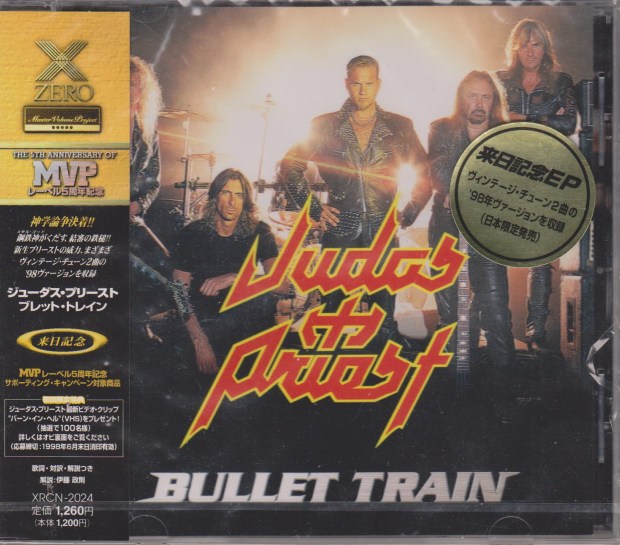
REVIEW: Judas Priest – “Bullet Train” (1998 single)

Scan_20151003JUDAS PRIEST – “Bullet Train” (1998 Zero, from Japan)

I know not why it took Priest until 1998 to release a single from 1997’s Jugulator. Β In hindsight, the choice of “Bullet Train” as a single seems a calculated move. Β Nu-metal was all the rage with the disaffected youth of the late 90’s. Β The new singer (Ripper Owens) was capable of doing any kind of vocal, so why the hell not, I guess?

Whatever kind of metal it is, it seems Priest can play it. Β With Scott Travis nailing the double bass like a metronome, “Bullet Train”Β is an example of razor-sharp precision. Β Travis is always a pleasure to listen to just blasting away. Β It’s just a shame they didn’t choose a better song for a single. Β “Bullet Train” is only about the fourth-best song on Jugulator, an album so atrocious that it’s more accurate to say that “Bullet Train” is only the seventh-worst.

Of course, nobody would order this all the way from Japan unless there were B-sides worth having, and there are. Β Much like Iron Maiden did with Bruce Dickinson, Priest decided to re-record some old Priest classics with the new singer. Β They picked two incredible songs; timeless metal favouritesΒ updated for the period. Β From British Steel, it’s “Rapid Fire”! Β Neither Owens nor Travis played on the original, so the song is naturally more fierce and aggressive. Β Both of them kill it. Β Some may object to Ripper’s insertion of addition lyrics:

“Rapid fire, between the eyes,
Rapid fire, terrifies,
Rapid fire, before you die
Rapid fire.”

Doesn’t bother me.

“Green Manalishi” is updated in an interesting way. Β Unexpectedly it is slowed down. Β Live, they always tended to play it just a hairΒ faster than the mid-tempo original. Β On this studio re-take, they’ve gone the opposite direction, closerΒ to the original 1970 Fleetwood Mac tempo. Β This is just a one-off, they did not perform it live in this slow guise. Β Live, it was faster than ever. Β Given that this is ultimately just an alternate slant on an obscure single, it lives on as an interesting side road. Β The tempo naturally extends the song, giving you even more Priestly goodness! Β The star of the show is the singer. Β Ripper takes one final scream at the end there that seals the deal: Β he was definitely good enough for Judas Priest.

Not a bad little single here. Β The two B-sides were later re-released on a limited edition digipack version of their next album, Demolition.

3.5/5 stars

REVIEW: Judas Priest – Jugulator (1997)

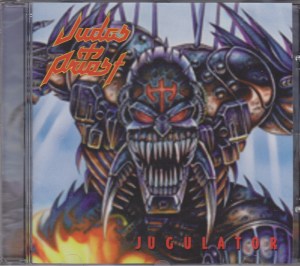
Scan_20151003JUDAS PRIESTΒ – Jugulator (1997 BMG)

One of the most anticipated, but frustratingly bad albums that I have ever looked forward to was Judas Priest’s big return on Jugulator. Β Seven whole years had passed. Β Rob Halford split, taking drummer Scott Travis with him, and had an entire career with the modern metal band Fight, before they split in ’96. Β Travis returned to Priest, who had found their new singer in Tim “Ripper” Owens, a young man with incredible pipes. Β Owens came from a Priest tribute band, and this was considered an interesting enough story to warrant an entire movie loosely based on him (Rock Star).

The resultant album, the heavy-as-fuck Jugulator, was a disappointment from the first note. Β Opening with over a minute of looped samples (of clanking metal) and drony guitars, the album takes way too long to really start. Β Only at 1:45 into the title track does Ripper finally let out a scream (a blood-curdling one at that). Β The riffs finally take over, turning the song into “Painkiller, Part II” for all intents and purposes. Β That’s fine — “Painkiller” is a high water mark of intensity and speed. Β But when I put “Jugulator” on a mix CD, I edit out the first 1:45 because it’s just a waste of space.

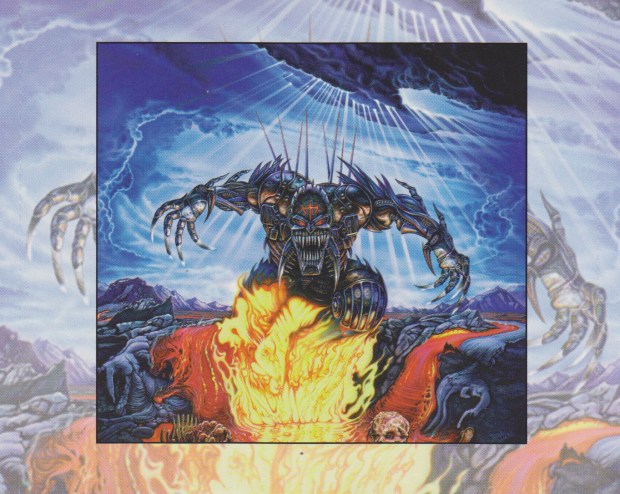
The fact that “Jugulator” sounds uncomfortable like “Painkiller”Β shouldn’t come a surprise. Β Just look at the cover art. Β Mark Wilkinson created a Painkiller Jr. for the album cover, including a modernized Priest “tuning fork” logo in his forehead. Β Musically (and intro aside), “Jugulator” is one fine metal assault, even if it is just a second cousin to “Painkiller”. Β Lyrically, “Jugulator” is among the worst crimes Priest have foisted upon us. Β With Rob Halford gone, Glenn Tipton was left to write the lyrics. Β  The words he eventually producedΒ are such a pale imitation of past Priest that I cringe to hear them.

“Exterminator, you are dead.
Mu-til-ate.
Sharpened razor, takes your head.
Jugulator.”

I do like the word Glenn invented in one line, “Predit-hater”. Β I like one word in the whole song!

“Blood Stained” is fierce, and was even better live (such on ’98 Live Meltdown). Β  It’s obvious from the cranked bass, detuned instruments, noisy guitar anti-solos, and driving groove that Priest were trying to emulate nu-metal. Β Quite a few fans were turned off by the modern twists in songs like “Blood Stained”, including grunted vocals. Β There is enough of the core Priest sound, including screams, riffs and standard solos that “Blood Stained” is really more of an amalgam of old and nu-metal. Β Ripper is certainly a capable singer, and should shoulder none of the blame if you don’t like it. Β Blame Glenn and K.K., not the vocalist.

It’s not until the third song, the creatively titled “Dead Meat”, that I lose interest. Β Until now, the songs had been good enough. Β “Dead Meat” is not. Β The violent, bloody lyrics are starting to wear thin. Β There are always individual moments of brilliance, such as the solos,Β drum patterns, and high-pitched wails. Β This is not enough to carry a song. Β One of the more nu-metal tracks is “Death Row”, which is even worse, especially when it comes to the prose. Β “Oh no, I won’t go! Β You’ll never get me down to death row.” Β Priest have shed no light whatsoever on the issue of capital punishment, only written a boring cartoon song about the subject. Β Even worse, there is dialogue in the intro to the song that is so poor that I’m embarrassed for them. Β Sticking to a theme that alreadyΒ wore out its welcome, “Decapitate” is about the guillotine! Β “Your head, you will lose it. Β Severed, when executed”. Β That’s the opening line! Β The atonal nu-metal guitars have also worn thin.

If this were an LP, that would be the side closer. Β The second half of the CD is heralded in by “Burn in Hell”; a little bit better song than the previous three in a row. Β It seems a little more effort went into the melody this time, although “Burn in Hell” is just as heavy as everything else. Β It builds and has some dynamics to it, which you cannot say for most of Jugulator. Β It’s too long at 6:41. Β Unfortunately much of this album is just too long.

“Brain Dead” is yet another stunningly creative song title. Β This slow chug has no character, it’s just a senseless march into oblivion. Β I feel “Brain Dead”, listening to it drone on and on. Β Thematically it’s just Judas Priest stealing “One” by Metallica and calling it something else. Β For my money, Jugulator can end right here (only seven songs in), because I’ve checked out. Β My brain is turning to mush; that’s how it feels. Β Then “Abductors” should have been a winner for me, a UFO buff. Β The opportunity for a cool song is blown on yet another nu-metal sludge-fest with shite for lyrics: Β “They come at night and they infiltrate you, they paralyse and they mentally rape you.” Β The only redeeming quality is the likeable Ripper Owens. Β He rolls his R’s like Halford used to, and you have to give the guy credit for doing the best he could with the material he was given to sing.

The single was “Bullet Train”, which I have on Japanese import (of course). Β This isn’t a bad tune. Β ItΒ drivesΒ like a perpetual motion dynamo. Β It’s more nu than old metal, which may be why it was chosen as a single, compared to a better song like “Blood Stained”. Β Finally, the lyrics are about something other than death or maiming. Β It’s still not sunshine and puppy dogs, as the words seem to about someone suffering fromΒ Siderodromophobia, or fear of trains, while riding on a train! Β Fun! Β Let’s be clear: this is an improvement.

The final song offers a little redemption. Β “Cathedral Spires” (over nine minutes!) is in the mold of old Priest classics such as “Beyond the Realm of Death”. Β A slow, mellow opening with dramatic lead vocals invites you in, and it’s a due respite from all the nu-metal bombardment. Β Ripper really sinks his teeth into the singing, and I think it was quite clear that he loved his job. Β The classy intro eventually degenerates into another sound-alike chug, but once again redemption is ahead. Β The chorus is great: pure traditional Priest drama with the nu-metal grunts in moderation.

I’ve listened to Jugulator many, many times over the years. Β I desperately want the next listen to be the one where I finally “get it”. Β That has yet to happen, and it almost certainly never will. Β Thankfully Judas Priest realized they needed to diversify their sound next time around. Β 2001’s Demolition was a marked improvement.

2/5 stars
In tomorrow’s review, we’ll take a look at the B-sides on the Japanese CD single for “Bullet Train”.