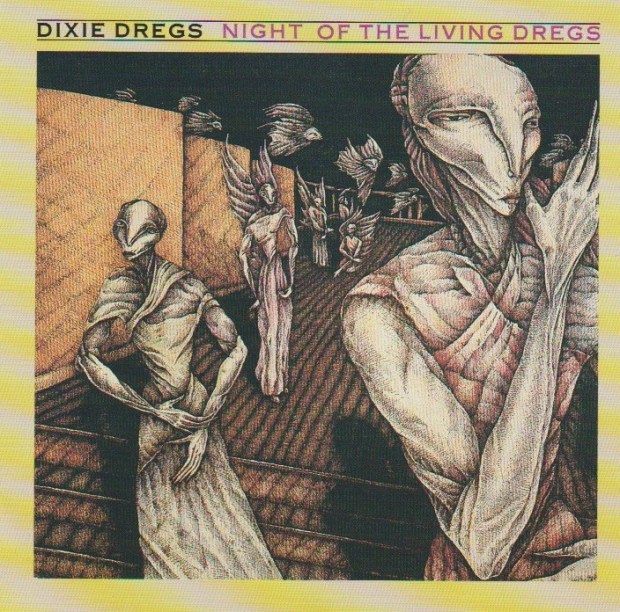
Dedicated to my dear friend Uncle Meat. This CD was purchased off Joe “Big Nose” at the Waterloo branch of the Record Store at which I used to work.
 DIXIE DREGS – Night of the Living Dregs (1979 Polydor)
If they could bottle genius, distill it down to its essence, sell it and serve it at a party…then the Dixie Dregs are the music that should be played at that party.
The Dregs are undefinable. Just when you think you have them nailed down to a progressive jazz-rock hybrid, they go classical on you, or full-bluegrass mode. Their instrumental chops are incomparable, while still managing to deliver such basic song pleasures such as “melody”, “hooks” and “grooves”. These melodies are usually delivered at the hands of Steve Morse (guitar) or Allen Sloan (violin). Listeners familiar with with the guitar stylings of Morse will have an idea of the kind of songs and arrangements he writes: challenging, but rewarding.
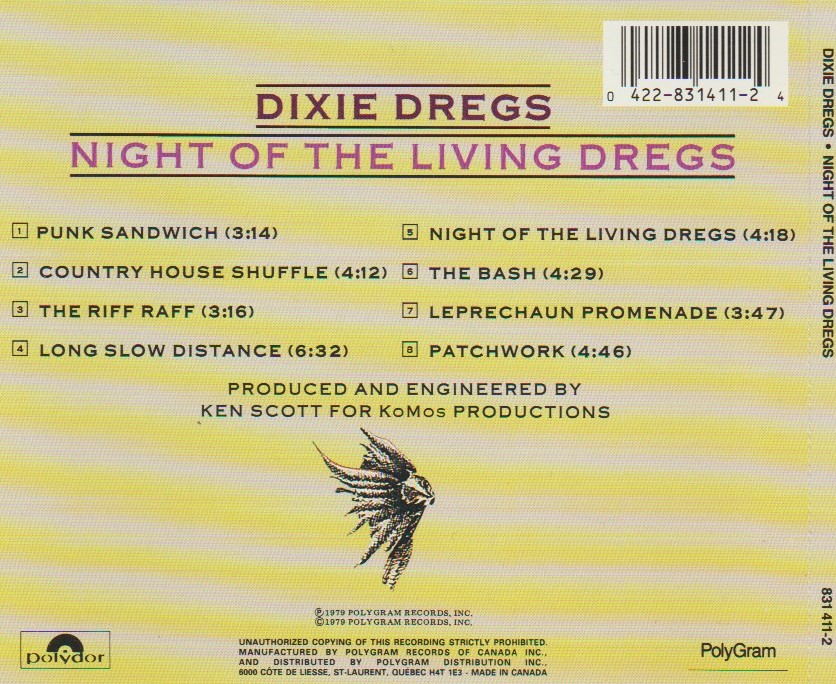
Night of the Living Dregs is half studio, half live. The first side, from the cleverly-titled “Punk Sandwich” to the ballad “Long Slow Distance” are carefully crafted studio recordings, each different from the last. While each track is unique and showcases different sides of the band, it is “Long Slow Distance” that really shines. This soft work captures so much of what Morse does well. There are jazzy licks embedded within melodies, and so many different textures of guitar.
The live side is recorded nice and clean without a lot of crowd noise. “Night of the Living Dregs” is an upbeat little number, featuring some absolutely jaw-dropping melodic bass playing from Andy West. This is also where drummer extraordinaire Rod Morgenstein comes up to the plate. His playing is so multifaceted and you can hear it on this track. The most fun can be found on “The Bash”, a full-on bluegrass ho-down, chicken-pickin’ full steam ahead. Any jaws left on the floor are hopefully picked up so they don’t miss “Leprechaun Promenade”. There are celtic flavours thanks to the violin, and the song is comparable to Jethro Tull. Then suddenly it turns into Frankenstein’s monster with some eerie keyboards (Mark Parrish). This is complex stuff, not for the timid!
The whole experience ends on “Patchwork”, which works as a description of the album at large. It is a patchwork of style and feels, which create the whole. The Dixie Dregs are a challenging listen, but ultimately rewarding. There is plenty of joy in the grooves. The band does not play anything simple or easy. Everything is a little bit of smarty-pants music, but for the listening, this is a delight.
4/5 stars


You must be logged in to post a comment.