classic rock

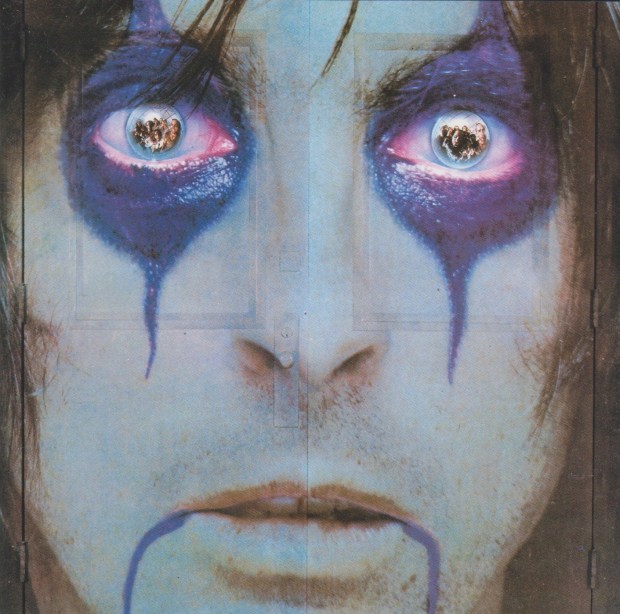
REVIEW: Alice Cooper – From the Inside (1978)

ALICE COOPER – From the Inside (1978 Warner)

In 1978, Alice Cooper’s health had hit a low point.  His excessive drinking was causing bleeding ulcers.  Alcohol always seemed to help before, but now it was time for Alice himself to get help.  He found himself in one of the strangest places he’d ever been in his life:  a sanitarium.

Alice got sober, for a short while anyway, and hooked up with some new players.  He wrote the lyrics for his next album with Bernie Taupin (Elton John) and got David Foster to produce him for the first and only time.  The inspiration for his next concept album was the sanitarium.  The people he encountered there inspired the characters on his album:  Millie, Billie, Nurse Rozetta, Jackknife Johnny, and more.  He amalgamated their stories and and personalities into the characters on the record, and with Bernie Taupin wrote some of his most interesting lyrics.  The horror themes of the past have been replaced by the real life madness of being locked in that place.

Musically, From the Inside is a hard pill to swallow.  Like a dose of Thorazine, it’s a sedated and subdued form of rock and roll, mixing Disco production and David Foster’s soft rock tendencies.  The sound of the album is clean and clear, but it is a dated a product of its time, the compression being the dead giveaway.  From the Inside is far more interesting lyrically than it is musically.  Bob Ezrin used to add strings, orchestras and choirs to the Alice Cooper mix, but David Foster’s version of the same is much more saccharine; much more easy listening without the weirdness.  Few of these songs are still in the live set.  Last time I saw Alice in 2006, he played “Wish I Were Born in Beverly Hills” with his daughter Calico playing a Paris Hilton type character on stage.  The Disco-stompin’ title track, and one of the only hard rockers (“Serious”) have also been performed in recent years.  For the most part, From the Inside is too much of a departure for these songs to having any staying power in Alice’s incendiary live show.

The title track is Alice’s story, and there are subtle references to Alice’s drinking club the Hollywood Vampires.  “Proposed a toast, to Jimi’s ghost.”  There also seems to be just a touch of bitterness about his situation:

Y’all got your kicks from what you saw up there,
Eight bucks even buys a folding chair,
I was downing Seagram’s on another flight,
And I worked that stage all night long.
You were screaming for the villain up there,
And I was much obliged,
The old road sure screwed me good this time,
It’s hard to see where the vicious circle ends.

It’s actually a fun Disco-rock tune, but now it’s time to meet Alice’s friends from the sanitarium.   The aforementioned “Wish I Were Born in Beverly Hills” boasts a catchy chorus (“I wish I could drink as much as she spills!”) and some nice Dick Wagner guitar harmonies.  For haunting music, “The Quiet Room” fits the bill.  It’s clear that the sanitarium was a serious place, and Alice and Bernie paint it clearly.  “They’ve got this place, where they been keepin’ me, where I can’t hurt myself, I can’t get my wrists to bleed.”  The character in this song questions why he wants to kill himself, but laments that he can’t even try in this place, “my Twilight Zone”.  He has spent so long there, alone with his thoughts and memories that “the quiet room knows more about me than my wife.”  It’s a strangely affecting tune.  Alice’s character driven lead vocal is the highlight; musically it’s pretty safe stuff.

The funniest track has to be “Nurse Rozetta”.  The lead character, clearly a priest, seems to really have a thing for Nurse Rozetta.  “I’m suddenly twice my size, my pants are all wet inside.”  Or my favourite line, “She popped the buckle off my Bible belt.”  The perverted priest fantasizes about the nurse on a string-laden but unremarkable tune, once again overshadowed by the words.  Alice and Marcella Detroit duet on “Millie and Billie”, a standard ballad, about a killer “criminally insane” couple to close Side One.

The only really killer hard rock track on the album is “Serious”, commencing the second side.  Foster’s production adds carefully arranged backing vocals, which matches the sound of the album, but dates the music to the time it was recorded.  Ezrin had a way of pulling off similar tricks and making them sound weighty.  Foster turns it around and produces a celebratory, gleeful sound.  I prefer the Ezrin approach, but one time the David Foster style works was the single “How You Gonna See Me Now”.  Something about this schlocky ballad works. The character in the song is writing a letter home to his wife, accompanied by this cheesey 70’s AM radio ballad. That’s the perfect way to do it.

“For Veronica’s Sake” and “Jackknife Johnny” are both good but unremarkable, although it seems Alice and crew really tried! They get an “A” for effort, but this brand of late 70’s adult contemporary rock has not aged well. The playing is the highlight, organ and guitar both. What the album was really missing up to this point is a suitably psychotic Alice Cooper song, but the final track “Inmates (We’re All Crazy)” scratches that itch. With all the pomp and circumstance necessary, this song delivers the dose of drama and strangeness that you need on an Alice Cooper album. It’s a disturbing lyric, too. “It’s not like we did something wrong. We just burned down the church, while the choir within sang religious songs.” Another inmate derailed a train. Then, the child-like sing-song chorus of “We’re all crazy, we’re all crazy, we’re all crazy…(Lizzy Borden took an axe and gave her mother forty whacks)…” Such a contrast, the child-like innocence and the horrendous deeds, but this is nothing new for Alice. The picture is now complete, and the album is over.

The cover art really pops on LP. Alice’s face is painted on hospital doors, which fold out to reveal the characters inside. Too bad all I have here at LeBrain HQ is a little CD booklet.

Alice, Bernie Tauper, David Foster, Dick Wagner, and the rest of them made an accomplished album with From the Inside. It’s a left-of-center artwork that isn’t immediately appealing, but does have the knack of drawing you back for another listen. I recommend doing just that.

3/5 stars

DVD REVIEW: Taylor Swift & Def Leppard – CMT Crossroads (2009)

TAYLOR SWIFT & DEF LEPPARD – CMT Crossroads (2009 Walmart exclusive DVD)


“There’s always a first day when you discover a band, be it the Beatles or Taylor Swift, when you hear the name for the first time and then you go and check it out. So we just Googled her, iTuned her, listened to it all and said, ‘Wow’!” — Joe Elliott

“I like to write songs about what’s going on in my life.” — Taylor Swift, stating the obvious

IMG_20160116_192039

Before the Swifties come and tear us apart for what you’re about to read, let’s be perfectly clear. Taylor Swift is very talented and has a genuine love for Def Leppard’s music. She is also an incredibly bright individual, and she has written more hits than Def Leppard in a fraction of the time. Both of them started in their teens, and are guilty of using outside writers. In the included interview footage, she and Def Lep seem like a mutual admiration society. We have nothing against Taylor Swift here, though her brand of pop music is never heard around LeBrain HQ…save this Walmart exclusive DVD release.

How did they hook up? Taylor was on tour with “Tim and Faith” (McGraw and Hill) who’s tour manager was Rick Allen’s brother. She expressed interest in doing an episode of CMT Crossroads with them, and then the phone rang.

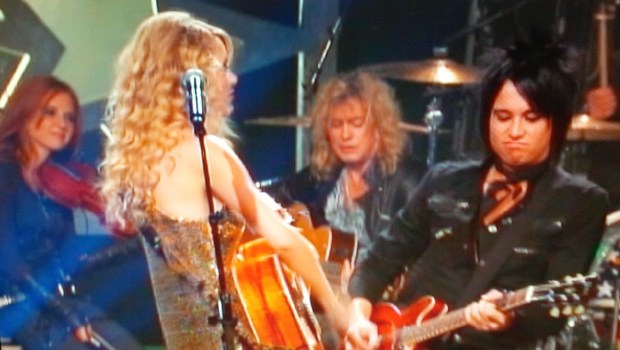
Leppard and the Swift’s band share the stage, dual drummers, umpteen guitar players, and fiddle…but on a heavier track like “Photograph” you can’t really hear her group. Taylor gets the first line (she says she felt like a kid in a candy store to do so); then she and Joe swap. It’s clear that she doesn’t have the power nor the control that Joe Elliot has. Her voice is whispy by comparison. It’s also weird to see a girl in a gold mini-dress and cowboy boots fronting Def Leppard, but talk about dreams come true! I’m sure Def Leppard didn’t mind the national exposure either.

“Picture to Burn” is the kind of candy-coated pop country that irritates so many fans of the old fashioned stuff. Taylor is more at home on her own songs, but Joe has never sounded more awkward. Taylor’s band dominates on this song, with only a few Phil Collen guitar squeals to remind you he’s there. Tellingly, Joe Elliot says of her music, “You take the banjos and fiddles off, and you’ve got pop.” The next Taylor number, “Love Story” is one I’ve heard on pop radio many times, but it’s hard to suffer through. It brings back bad memories of Leppard’s pop disaster, X.

Taylor butchers my favourite Def Leppard ballad, “Hysteria”. The song successfully absorbs the twang, but again, Swift just lacks the vocal power to blast it the way Joe can. Her own ballad “Teardrops on my Guitar” is so laid back that most of the Leppard guys are sitting down for it. The bands mesh well and the song is pretty good, although she has a guitar player who kind of looks like a goth country emo Russell Brand. She’s at home on Leppard’s “When Love and Hate Collide”. Once again the meshing of the two bands works well here. There’s a full string section, plus backing vocalists crowding the already overloaded stage, but that’s what the song calls for and it’s genuinely great version of the well-worn hit. “Should’ve Said No” is a Swift song I don’t know, but it’s one of those pop tracks that just feels like it was written by a computer. It transforms directly into the show closer “Pour Some Sugar on Me”, but…damn. Taylor’s out of breath. She is audibly gasping (a big no-no) between lines and unable to deliver the goods. With the fiddle and extra accouterments added, this one’s a write-off.

IMG_20160116_194451

There are three bonus tracks that weren’t broadcast as part of the show: One Swift, two Leppard. Taylor says she wrote “Our Song” in ninth grade (“three years ago, actually”). That’s exactly what it sounds like, ninth grade pop, but obviously there is a need in the world for that kind of kid-friendly music. Leppard fans won’t find any appeal here. They will however appreciate “Love”, the only new Leppard song in the set. Interestingly it starts with only Taylor and two of her guitarists on stage, then Leppard emerge from the shadows. As a duet, it’s enjoyable, and it’s overall probably the heaviest thing all night. The much-overplayed “Two Steps Behind” is the final bonus track. The fun thing here is trying to count the number of people playing guitar on stage. (Eight plus fiddle and Rick Savage on acoustic five-string.)

Phil Collen gets bonus points for wearing a jacket on stage, dressing up a bit for the television, but he sticks to tradition by having no shirt on underneath.

2.5/5 stars

REVIEW: Rainbow – Live in Munich 1977 (vinyl)

Thanks for joining me this week for my Deep Purple Project. I admit that this review is a bit of a cop-out. I got dreadfully sick with the flu a week ago and was not able to finish any more Purple reviews for this week. I pulled an old one out of the hopper instead. This is close to Purple,  — the Man in Black himself, and Blackmore’s Rainbow. This review is for music writer Victim of the Fury!

RAINBOW – Live in Munich 1977 (2013 Eagle Rock 180 gram 2 LP set)

Something about listening to classic rock with that rich, warm sound of pristine vinyl played on nice big speakers for the first time…is there anything better?  Dropping the needle on side A, let us begin the ritual of properly listening to a double live album.

This 180 gram was a birthday gift from my sis, knowing my love of all things Ronnie James Dio. Not to be confused with the double CD Live in Germany 1976, this freshly mastered concert was recorded in 1977 for German television.  Dio was one hell of a powerhouse, especially in 1977.  Live in Munich contains what must stand as one of the best Dio performances caught on tape.  This was caught just before the album release for Long Live Rock ‘n’  Roll.  “Kill the King” was a storming opening and the live recording is all but flawless.  If Rainbow could be faulted for anything at this point in their brief life, perhaps they played too many long jams on stage.  “Mistreated”, the Deep Purple concert favourite, is the first of these.  As usual for the Man in Black, Ritchie Blackmore himself, the song is almost 12 minutes in length when stretched out live.

Lets not get into comparing Ronnie James Dio to David Coverdale. There’s no point to that.  As with Black Sabbath, you either like Ronnie’s interpretation or you don’t.  Regardless is it drummer Cozy Powell who detours most noticeable from the Deep Purple original, doing a busier blast than Ian Paice did.  As for Blackmore, his solo spans the entire spectrum delightfully.  He fluffs it for a moment, only to immediately take control and keep going.  This is a brilliant version of a song we have heard many times.  Ritchie then takes center stage for a delicate workout to “Greensleeves”, before blasting into the Rainbow barnstormer.  Once again, this is probably the best live version on tape.

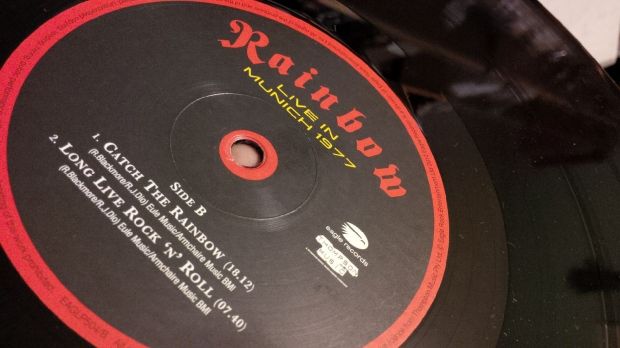
IMG_20151108_111910Flipping the record to side B, we are treated to Ritchie seemingly tuning his guitar…melodically…working his way into a lengthy “Catch the Rainbow” including classical interludes.  There’s more than a little “Little Wing” within “Catch the Rainbow”, which Ritchie plays into.  Bassist Bob Daisley sings the angelic backing vocals, proving why he has been such an integral member to so many bands over the years.  In fact this would have to be one of the strongest Rainbow lineups, period.  Keyboardist David Stone rounded out the quintet, and he is kept busy on “Catch the Rainbow”.  The brand new song “Long Live Rock ‘N’ Roll” is next, and a few people in the crowd indicate they may already know the song!  It is presented more Deep Purple in style (hints of “Black Night”), perhaps a bit more laid back with nice flashes of organ here and there.

The second LP has to shuffle the track order out of necessity.  “Still I’m Sad” is 25 minutes, so it must occupy all of side C, even though it was played after “Man on the Silver Mountain” in concert.  There is something about a side of vinyl that contains one monolithic slab of music in only one track.  It feels like a challenge, a solo-laden endurance challenge.  Once it starts rolling, it becomes one of the most intense versions of the song yet recorded by Rainbow.  Then it goes all over the place as pretty much every member has moments to shine.  It’s way too much and it’s way over the top and taxing even to the staunching rock fans.  It was 1977 and this is the way it went down!

Settling in for the final slab o’rock, side D is also daunting with two tracks of 15 minutes apiece. Purple’s “Lazy” is teased out, as part of “Man on the Silver Mountain”. Lots of soloing and noodling abound, and the big weakness with this period of Rainbow is that they thought we needed this much of it. The segue into “Starstruck” is way more fun. More solos and a frantic “Do You Close Your Eyes” ends the concert. Stone’s keyboard solo is cheesy fun, but overall this is another great over the top performance from Rainbow. You can hear a guitar destroyed at the end of it all.

Double lives are best experienced on vinyl, and pristine 180 gram records fit the bill perfectly. If you’re going to go double live for Rainbow, do it with Live in Munich.

4/5 stars

A
1. “Kill the King”
2. “Mistreated”
3. “Sixteenth Century Greensleeves”

B
1. “Catch the Rainbow”
2. “Long Live Rock ‘n’ Roll”

C
1. “Still I’m Sad”

D
1. “Man on the Silver Mountain”
2. “Do You Close Your Eyes”

REVIEW: Deep Purple – Made in Europe (1976)

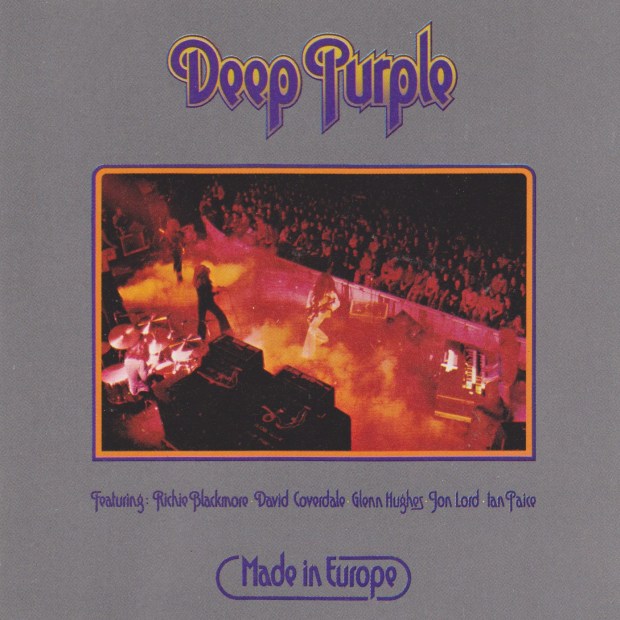
Scan_20160114DEEP PURPLE – Made in Europe (1976 EMI)

In 1976, Deep Purple ended with a thud.

With no desire to carry on, the band split in 1976 after the ill-received addition of Tommy Bolin on lead guitar.  David Coverdale was eager to start a solo career where he could sing, and not “scream his balls off”.  Everybody else was just plain tired of it all.  Dutifully, the record company trotted out live albums and compilations, to keep the cash flowing.  Made in Europe, intended as a followup to Made in Japan, came first.  It was followed by Power House, When We Rock We Rock, Deepest Purple, Last Concert in Japan, Live in London, and many more.  The goal was not to provide fans with good quality unreleased music for them to enjoy.  The purpose was to make more money.

Made in Europe has since been superseded by better releases.  MkIII: The Final Concerts expanded and remixed this material, sourced from their last shows with Ritchie Blackmore.  He had already made the decision to quit, unbeknownst to his bandmates.  More recently, the Official Deep Purple (Overseas) Live Series released full shows of two concerts, Graz and Paris.  It is always preferable to have the full show, rather than a song here or there sloppy edited and mixed into a live album.  Don’t you agree?

With only five songs, Made in Europe was hardly representative of Purple’s set at the time, but it seems a single LP was all that EMI were willing to invest in.  Producer Martin Birch was unable to get the same heavy, crisp sound that he got on Made in Japan.  This one is heavy, but that crisp sound is muffled under a blanket.

“Burn” is an apt opener, and both David and Glenn Hughes were in fine form that night.  Blackmore, Paice and Lord always are.  Yet Deep Purple sound almost…bored?  Playing by rote?  Blackmore’s guitar is also too buried in the mix.  The first of two jams is up next: “Mistreated (Interpolating ‘Rock Me Baby’)”.  While no one questions that this is one of the greatest songs in the Deep Purple MkIII catalogue, the live jam has always dragged.  Ritchie’s playing is still a delight, but they could have trimmed two or three minutes from the song.   That’s followed by a frantic “Lady Double Dealer”, never one of Purple’s finest.  Birch applies an irritating echo to the chorus, but that’s all for the first side.

The second side is dominated by 16 minutes of “You Fool No One”, the second jam.  Jon Lord takes center stage for the organ solo intro, but if you dig cowbell, this song is for you!  Could Ian Paice be the #1 cowbell player on the planet?  “You Fool No One” testifies to that.  He is absolutely the MVP on this track (for his drumming, too)!  Finally, the full gale force of “Stormbringer” brings the proceedings to an end, easily the best track on the disc.

What, no “Smoke on the Water”?  No “Highway Star”?  It appears EMI wanted to avoid song overlap with Made in Japan, so you get MkIII material and only MkIII material!  That the drawback to a set such as this which is really only about half of a proper Deep Purple concert.

3/5 stars
Scan_20160114 (2)

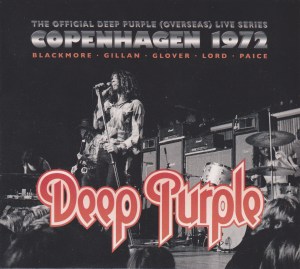
REVIEW: Deep Purple – Copenhagen 1972 (2013)

Scan_20160103DEEP PURPLE – Copenhagen 1972 (2013 Edel)

How many live albums are there from the Machine Head tour in ’72?  I lost count, and I don’t really care.  I’ll buy ’em all!  Copenhagen 1972 represents Purple at their best, in their prime, playing their best songs.  The difference is (there always is a difference) is that this is a particularly pummelling Purple potluck.  As awesome as they were in ’72, it’s rare to hear them play as ferociously as you will here!  This set was previously released by Sonic Zoom as Live in Denmark ’72 in 2002, but technology is constantly improving and it has been given a subtle sonic upgrade.  With restored master tapes, the 2013 release is the definitive one, not to mention it has four bonus tracks over the previous Live in Denmark ’72.  These Sonic Zoom discs seem to be re-released periodically, but these versions from the Deep Purple (Overseas) Live Series are in all cases the ones to own.

“We got the telly here tonight, so we got to be good.”  That explains how this show was recorded so well.  The clown prince Ian Gillan is a dry unorthodox frontman when it comes to banter, and that’s why we love him so.  “Highway Star” herein is one of the best versions of the song you will ever find.  The non-album single “Strange Kind of Woman” follows, extended with Blackmore and Gillan’s interplay.  Behind them, a constant presence, is the growl of Jon Lord’s Hammond.  What a beast!  Lord always tended to improvise on his intro to “Child In Time”, lending it different flavours every time it was played.  The Copenhagen ’72 version has its own personality.  There is a delightful quieter middle section where Jon gets to have some jazzy fun.  Drummer Ian Paice gets his moment on “The Mule”, one of Purple’s most progressive rock moments from 1971’s Fireball.  Paice, being outstanding through the whole concert, dominates this one into submission.  It is remarkable how well recorded these drums are.  Glover’s bass too, which has a shining spot in the mix.  “Lazy” smokes just as hot, but it is “Space Truckin'” that has the honour of being stretched out for over 20 minutes.  With the many live versions of “Space Truckin'” out there, I wonder how many sheer hours of this song that I own?  This one is unique in its own right.

Scan_20160103 (4)

The show continues on CD 2, with “a little bit of fun” called “Fireball”.  With an extended intro I haven’t heard anywhere else before, this version of “Fireball” kills it.  It’s immediately followed by “Lucille” which was a periodic Deep Purple encore back then.  Simply incendiary, over the top, and blazing fast.  The last song of the show is the old single “Black Night”:  that’s right, no “Smoke on the Water”!  I guess they just didn’t play it that night.  Machine Head wouldn’t be out for another three weeks.

CD 2 has four bonus tracks on top of this.  The aforementioned “Smoke” along with more versions of “Strange Kind of Woman” and “Space Truckin'” are included, from New York in ’73.  This version of “Strange Kind of Woman” is unusually funky; more like the Deep Purple Mk III that would emerge in 1974.  “Smoke” is still fresh, but “Space Truckin'” surprises by being only half the length of the version on CD 1.  It’s interesting to hear how the songs evolve from year to year.

The final bonus track is a brief 1971 interview done in Australia.  There is not much here; it’s just an add-on.  It’s fun to hear them talking about the forthcoming new album, Machine Head.

4/5 stars

#462: The Deep Purple Project

Scan_20160112

GETTING MORE TALE #462: The Deep Purple Project

If loyal readers know one thing about LeBrain, it is that he owns a lot of CDs.

A LOT.

I haven’t done a count in ages and I’m giving up on keeping track of these things.  I estimate over 3000 CDs are in inventory currently.  Add to that a few hundred tapes, LPs, DVDs and other miscellaneous musical formats.

For Christmas this year, I received a number of Deep Purple releases.  Some of these releases would presumably replace older Deep Purple discs in my collection.  For example, I expected the 5 CD box set Hard Road 1968-1969 to replace the first three Purple albums in my collection, and I could retire those discs permanently.  This was not the case.  I began checking, track by track, and it turns out the individual CD versions have tracks that are not on the Hard Road box set.  “Hush” live from US TV is one such track.  There are also BBC Top Gear sessions on the remastered CDs that are not on Hard Road, but I believe all of these are duplicated on yet another Deep Purple CD, BBC Sessions 1968-1970.  On top of all that, there is another CD called The Early Years that covers the same ground, but it too has one exclusive track on it.  That is an alternate take of “Kentucky Woman” that I don’t have elsewhere.  This is crazy!  How can anyone keep track of it all?

I’ve been ripping all the CDs in my collection to the computer in bits and pieces for a couple years.  It didn’t have much rhyme or reason.  If I wanted to listen to something, I ripped it at that time.  If it was a new arrival, I’d rip it to PC on first listen.  This Deep Purple situation got me to go over my entire Purple collection, looking for duplicates and redundant releases.  (I didn’t find any.)   This in turn prompted me to get the rest of my Purple albums ripped and digitized for good.  This has turned out to be a monumental task.

My Deep Purple folder had 74 sub-folders in it, each one an album or a disc from one.  That’s a lot of Purple.  So how many did I have still to rip?

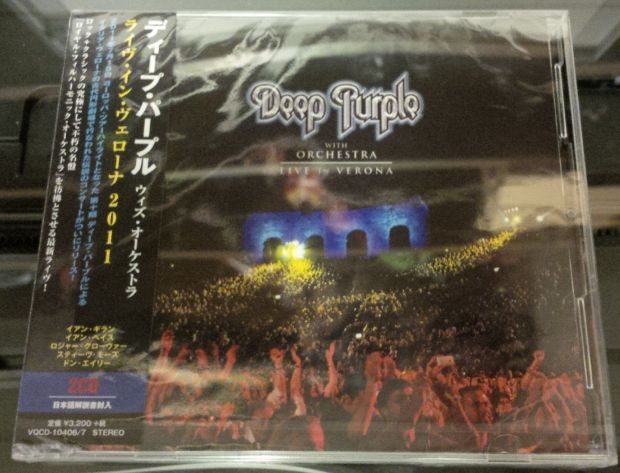
At first count, it was 64 more discs.  That includes 12 discs from a box set called The Soundboard Series (the second of two 12 disc live Purple box sets I have!).  It includes all the multi-disc sets I got for Christmas.  With the exception of the Hard Road box set, these are all live discs, and all official releases!  Then, I had to adjust my count.  I found two more box sets tucked away (as box sets sometimes are, due to their odd shapes):  On Tour MCMXCIII (4 discs), and Live Encounters (2 CDs, plus 2 DVDs too).  Last week, a double live from Japan arrived at LeBrain HQ, called Live in Verona.  Up that count to 72 more discs.  So far, I’ve ripped 25 of them.

This isn’t even all the Deep Purple I have left un-ripped.  I have some things that I don’t particularly need to listen to.  The 3 CD Live in Japan was a great package for its time.  It contained a remixed and expanded version of Made in Japan.  While I always want a unique official remix in my collection, just to have it, I don’t need to listen to it since it has been usurped by the remixed (again) 4 CD deluxe Made in Japan.  Who cares about a remix they did in ’93?  Obviously I only care enough to keep it (for “completion”), not to play it.  There are more like that, such as an earlier mix of California Jam that has since been replaced by a better, more complete version.

Now that you have a glimpse at what Obsessive Compulsive Disorder looks like up close, I’m sure you have one specific question.

“How many versions of ‘Smoke on the Water’ are there?”  Well, it appears that I have 63 versions on CD.  63. Different. Versions. Of.  “Smoke on the Water”.  By Deep Purple.  None of these are covers by other bands.

This, folks, is a shat-ton of Deep Purple!  Won’t you join me each day this week for some live Purple action?

IMG_20160114_171447_edit


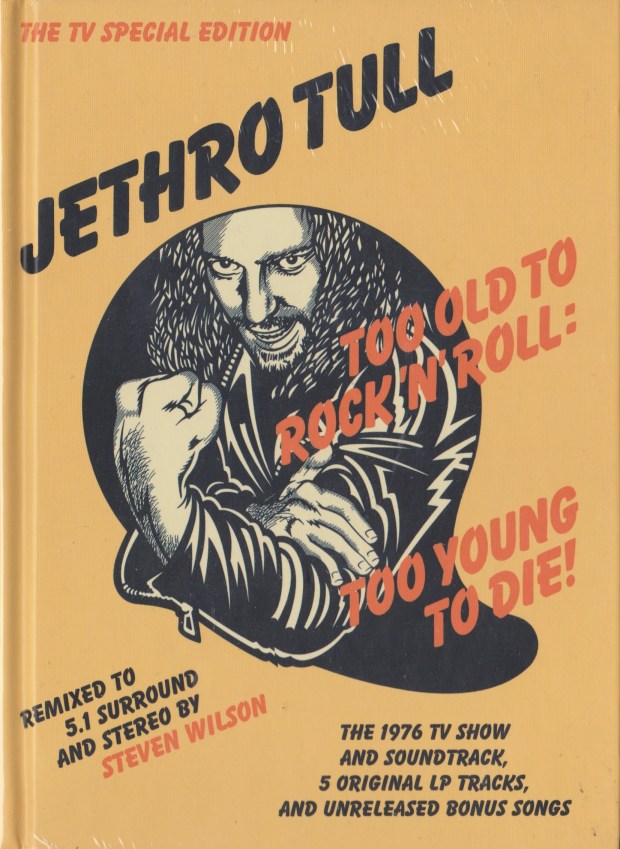
REVIEW: Jethro Tull – Too Old to Rock ‘n’ Roll: Too Young to Die! (TV special edition – 2CD/2DVD set)

JETHRO TULL – Too Old to Rock ‘n’ Roll: Too Young to Die! (1976, 2015 Chrysalis TV Special edition 2CD/2DVD)

I foresee a future time, when every man woman and child will be able to buy deluxe multi-disc box sets of just about every album ever made.  While old geezers with greying beards will sit back in a rocking chair (a hovering one, no doubt) listening to multi-track backing tapes for every single Poison CD, our children will be able to do the same with a comprehensive book-box version of the NSync debut album.  It’s going to happen eventually, so we may as well get good albums like Tull’s Too Old to Rock ‘n’ Roll: Too Young to Die! in box set form while the concept still has validity.

Of course this isn’t the first Jethro Tull album to get this kind of treatment.  A super deluxe Aqualung was a fairly recent release, and I received Benefit myself for Christmas last year.  The bold four-colour album cover for Too Old to Rock ‘n’ Roll makes for a splendid book-form box with plastic CD trays inside.  An absolutely massive (80 page) full colour booklet awaits you inside.  Rare photos are the norm of course, but a features such as “From Carmen to Tullman” about the late John Glascock are valuable reads.  Detailed liner notes will help you make sense of the track listing, and the multiple versions of each song included.  Almost all of this material is rare, previously unreleased, or newly mixed material by studio wizard Steve Wilson.

IMG_20151227_162750

Scan_20151229First of all, I was not aware that all of Too Old to Rock ‘n’ Roll was re-recorded for a UK television special, included here on DVD.  Anderson had a theatrical presentation in mind, so playing live wasn’t of interest to him.  But, apparently due to British law, the LP Too Old to Rock ‘n’ Roll could not be used for backing music on a “live” TV special.  Anderson’s vision seemed to involve the band miming to the album while pulling amusing faces and occasionally acting out the lyrics.  In order to mime and do it legally, brand new recordings of every song had to be made!  In fact the band painstakingly took great care in recreating the album, although there are also obvious differences.  For the DVD and CD, these tracks been newly mixed and are available for the first time.  CD 1 contains the standard stereo mix of the re-recorded album.  DVD 1 has the special in both stereo and 5.1 surround.

The original album was also meant to be remixed top to bottom in 5.1 by Wilson.   This was not possible, because the original multi-track tapes survived for only five songs, almost the whole second side:  “From a Dead Beat to an Old Greaser”, “Bad Eyed and Loveless”, “Big Dipper”, “Too Old to Rock ‘n’ Roll”, and “The Chequered Flag”.  Tull’s semi-acoustic nature lends itself well to a good 5.1 mix.  The audio field is filled out, but not to excess.  It’s a good balance and the tracks included in 5.1 shine with fresh light.  Do not be surprised to hear parts you didn’t hear before.

The bonus associated tracks are a light collection of rare Tull.  The two bonus tracks from the prior 2002 remaster, “One Brown Mouse” and “A Small Cigar” are included here unaltered on CD 2, or on lossless 96/24 stereo PCM on DVD 2.  The unreleased tracks are excellent.  “Salamander’s Rag Time” sounds like the Jethro Tull collaborating with the Beatles via “A Day in the Life”.  Meanwhile, “Commercial Traveller” is a lushly arranged and recorded ode to the road with full strings and Martin Barre guitar blazes.  “Strip Cartoon” also has quaint Beatles-isms though it is really just a bright Tull acoustic jaunt.  An incredible instrumental take of “Salamander” is pure delight, hearing it ring in live perfection.  There is also a bare acoustic version of “A Small Cigar”, and earlier versions of “Quiz Kid” and the title track.  As always, these are available on both the CDs and DVDs.  Four of these (“Salamander’s Rag Time”, “Commercial Traveller”, “Strip Cartoon” and the acoustic “Small Cigar”) can be heard in 5.1, again mixed by Wilson.  Expect the same level of lushness and quality as the album tracks, although with the acoustic arrangements, it’s more about the spaces between.

One of the great advantages of the DVD format is the ability to re-release classic Quadrophonic mixes for modern audio systems.  Like many rock bands (and especially progressive rock bands) of the early 1970’s, Jethro Tull released Too Old to Rock ‘n’ Roll in Quad.  That long unavailable version is right here in 4.0, on DVD 2.  It’s certainly an interesting animal.  Where Steven Wilson’s 5.1 mixes envelope the listener in clouds of Tull music, the Quad mixes things hard into individual channels.  It’s an interesting experience.  The vocals are mostly on the right, the flute behind, and the other instruments tucked into their corners.  If you want to hear it as if the music is coming from four separate corners of the room, then this Quad mix is that exactly.  There is something to be said for this, because you can clearly hear each instrument isolated, and easy to study.  You can easily lose yourself in a particular part of the mix, which is the benefit and weakness of the format.  Regardless, the classic 1976 Quad mix has parts you won’t hear elsewhere, and it’s available again, and that is a good thing.

With all this talk of extras and remixes and surround sound, the original album is almost overlooked!  Fear not.  A bit like an afterthought, the original, stereo, classic Too Old to Rock ‘n’ Roll: Too Young to Die! is here, as the final 11 songs on CD 2.  Even the Benefit super deluxe box set didn’t include the original album on CD.  If you prefer lossless stereo, it’s there on DVD, too.

What of the original album, then?  Well, I reviewed that in 2012, and you can read all about it here.   A brief summary:


SAM_1882Like many Tull albums from the mid-70’s, there’s plenty of acoustics to go around accompanied by lovely flute passages and complex drum patterns.  There’s also some horns and orchestration courtesy of David Palmer (not yet a full member of the band).  Personal highlights:

  • “Salamander”, a folksy number with intricate acoustics.
  • The harmonica riffing of “Taxi Grab”, reminiscent of an earlier bluesier Jethro Tull.  The guitar soloing (both electric and acoustic) is also divine.
  • “Big Dipper”, a playful yet complex number with plenty of flute and a fun chorus.
  • The masterpiece title track (obviously), lush with ochestration.
  • “Pied Piper”, one of the most obviously catchy songs on the whole album, albeit still complex with multiple parts and section.
  • The final track of the album, a slow but dramatic grandiose number called “The Chequered Flag (Dead or Alive)”.


Too old to rock ‘n’ roll?  Never.  Buy this for the grandpa on your lists.

4/5 stars
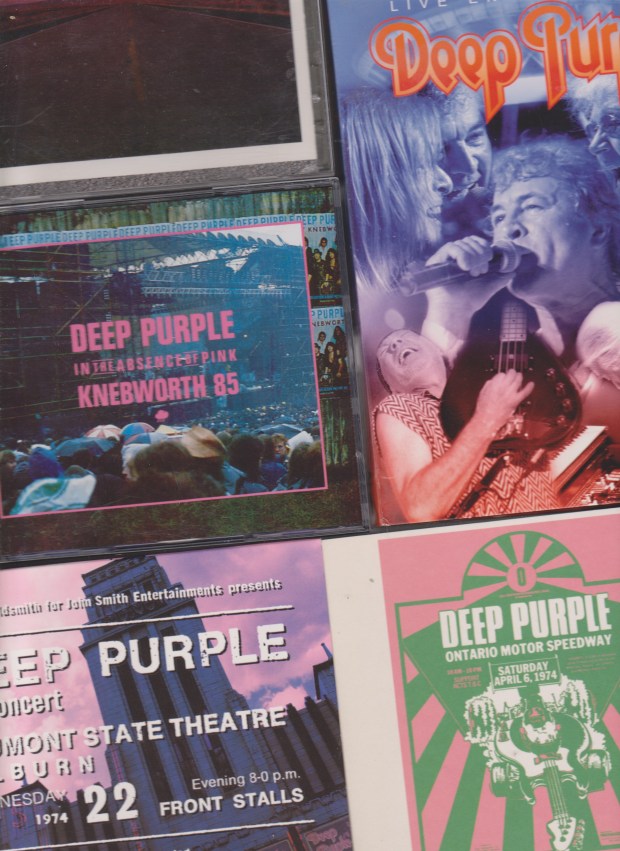
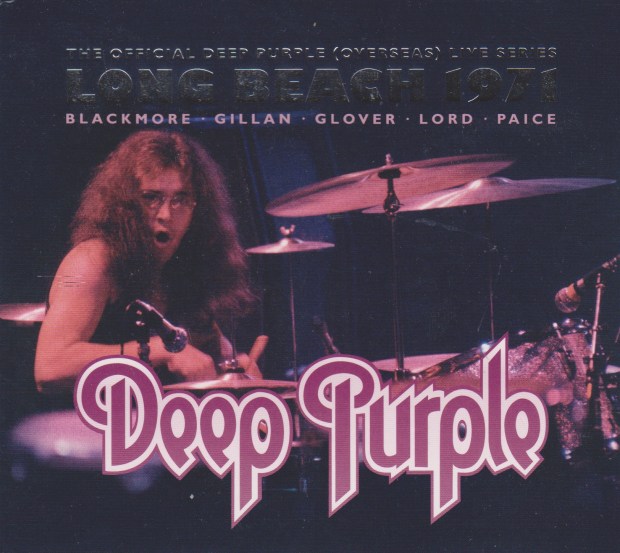
REVIEW: Deep Purple – Long Beach 1971 (2015)

DEEP PURPLE – Long Beach 1971 (2015 Edel)

This CD is over 70 minutes long.  It has four tracks.  The shortest one is 11:05.  The longest is 27:18.  We just needed to be upfront with you, about what you are about to read, in case you felt like turning back now.  This would be the time to do so.

Still with us?  Great!

This live album was recorded during a period in Deep Purple where their setlist was in a state of flux.  Their first heavy rock album and first serious bonafide smash hit, Deep Purple In Rock, was still dominating the set.  The mid-term single, “Strange King of Woman”, had been included on the new album Fireball in the US, but it’s the only new song here.  Even though the show was well recorded for radio, this set has never been released before officially.

A energetically ragged “Speed King” opens affairs.  “A Speed King is somebody who moves very quickly from one place to another, and always gets there first,” says Ian Gillan during the long middle solo section.  When it’s Blackmore’s turn to play, he’s smooth with just enough rough edges.  Everybody shines; live in 1971, Deep Purple were a well-oiled machine running on the fuel of pure creativity.  Ian and the others liked to have a drink now and then, but they were never a drug band until other members joined and brought their troubles with them.  When a band as talented and unfettered and uninhibited by chemicals hit the stage, this is what can happen.  “Speed King” is a mind-breakingly enjoyable version, both in spite of and because of its length!

The new single goes down a storm, and Blackmore’s solo is inspired.  Then “Child in Time”, the old standby since late ’69, begins delicately with Ian in prime voice.  Deep Purple at full power doing “Child in Time” complete with screams?  Jazzy shuffle right in the middle?  Always nice to have.  The last half-hour of the set is dedicated to “Mandrake Root”, an unremarkable song from the first LP that operated in concert as the forum for their “big” jam, the one that descends into madness and chaos by the end.  Brilliant stuff, but a bit much for those who just wanna rock.

If four songs loaded with solos are not your cup of java, that’s fine.  There are plenty more Deep Purple live albums to be had.  In the 80’s, the soloing was de-emphasized in favour of playing more songs.  Those albums, featuring the exact same lineup, may be more your speed if this doesn’t sound like your kinda deal.

3.5/5 stars
REVIEW: Poison – Look What the Cat Dragged In (remaster)

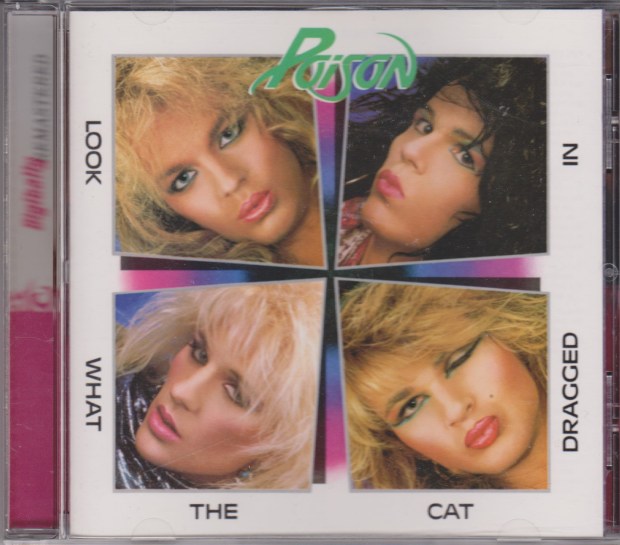
POISON – Look What the Cat Dragged In (1986, 2006 Capitol remaster)

I remember seeing this album in the racks of our local Zellers store.  I didn’t know the band.  I thought CC Deville was pretty cute.

Taking the gender-bending makeup of the mid-80’s to its logical end point, Poison stormed out of Hollywood and onto the charts.  They did this with a handful of great singles, including “Talk Dirty to Me”, “Cry Tough”, and “I Won’t Forget You”.  Also huge, but barely tolerable as a song, was the singalong “I Want Action”.

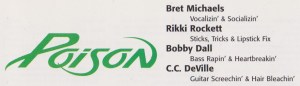
Bass "rapin'?" Good god!

Bass “rapin’?” Good god!

Armed with just $23,000, Poison recorded Look What the Cat Dragged In with producer Ric Browde (Ted Nugent, W.A.S.P.) in less than two weeks.  What they emerged with was a fun, raunchy and terrible sounding album with some big hits and plenty of filler.

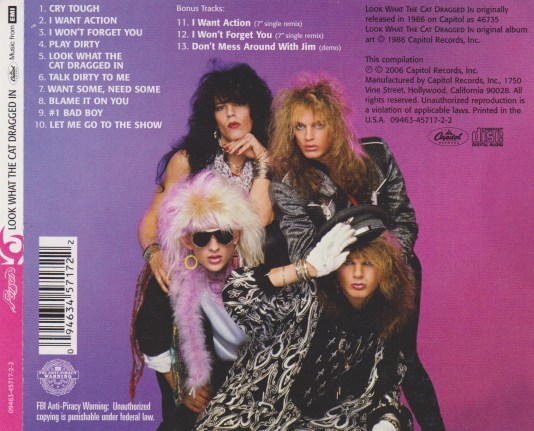
“Cry Tough” was a tight little opener, a hot and bright rocker about going out and givin’ er.  “You gotta cry tough, out on the streets, to make your dreams happen!” sings Bret Michaels in full-on cheerleader mode.  Unfortunately the sonics of the album leave much to be desired.  The guitar, drum and vocal sounds are demo quality at best, but that’s what you get for $23,000 and Ric Browde.

The other singles were all huge.  “Talk Dirty to Me” is now minor staple, and “I Want Action” (annoying as it is) is another.  The ballad “I Won’t Forget You” is an album highlight, well before Bret & co. had mastered the art of writing hit ballads.  Low key, basic and electric, “I Won’t Forget You” is very different from “Every Rose” and some of the later broken-hearted Poison love songs. Paul Stanley has a cameo in the road-ready music video, which didn’t hurt.

That leaves a hell of a lot of room for filler, and Look What the Cat Dragged In has plenty.  Of the album tracks, the decent ones include the saucy glam-slam rawking title track, and another song called “Want Some, Need Some”.  Both tunes could have used some last-minute tightening up, but neither are as bad as the dreck on the tail end of the album:  “#1 Bad Boy”, “Blame it on You” and the horrid “Mama Let Me Go to the Show” all suck absolutely.  “Play Dirty” on side one is also pretty awful.

Even with the quality issues in sound and songwriting, Look What the Cat Dragged In sold over 3,000,000 copies.  20 years later, it was given a fresh remastering and three bonus tracks.  The remastering could not fix the audio issues, but the bonus tracks are pretty good.  Single remixes of “I Want Action” and “I Won’t Forget You” are marginally better than the original album tracks.  Somebody realized that they were sonically deficient, and the remixes help a teeny tiny bit.  Then Jim Croce’s “You Don’t Mess Around With Jim” is added to the end, a song that got more exposure on the covers album Poison’d!  The bonus tracks go a long way towards making the album a little more listenable from start to end.

2/5
stars
Scan_20151117 (4)

REVIEW: KISS – Greatest Live Hits (2015)

NEW RELEASE

Scan_20151212 (2)KISS – Greatest Live Hits (2015 Concert Live limited edition)

“What’s this?”, you ask with scorn.  “Just another Kiss hits/live thing, is it?”

Yes and no.

Concert Live is a great company that records and releases “instant live” albums from major artists like Kiss and Alice Cooper among many.  You can buy them immediately after the concert, or online as I have.  Kiss have a lot of Concert Live releases.  I have three, all from the Sonic Boom tour:  Montreal, Saskatoon, and Atlanta.  They are live, not overdubbed, raw and real.  And expensive!  So when Concert Live announced they were releasing a Greatest Live Hits CD from these concerts, I clicked the “add to cart” button immediately.  The original order claimed there were only 200 copies available, but you can now get it from Concert Live as a part of a multi-album box set.

This 2 disc collection has all the classic hits (nothing more recent than ’83) from a variety shows from different nations.  There are three tracks of Kiss from the Download Festival, in 2008.  Paul’s voice is surprisingly strong, and the reason why is because they are from seven years ago.  There is no booklet with details, so only the location of the recordings is obvious from the packaging.  It is true that Eric Singer covers for Paul when his voice cracks or he cannot hit the note anymore.  Concert Live seemed to focus on the best versions they could find of these particular tracks, so you get a high ratio of good-to-bad Paul performances.

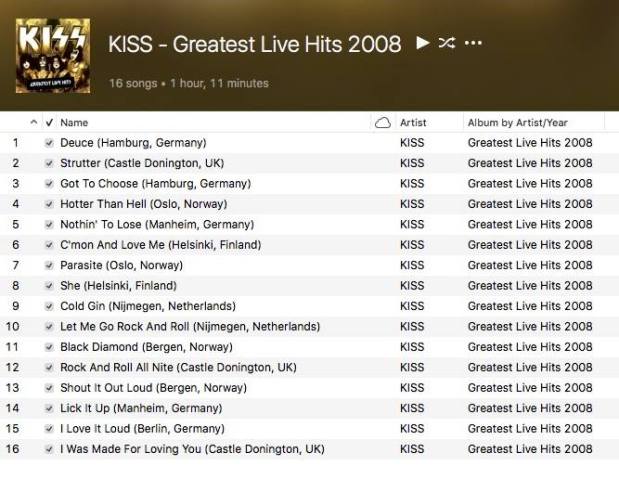
Below are the recording details, courtesy of rock journalist Mitch Lafon.  He suggests re-ordering the tunes to create an actual Kiss setlist.

702906_10153597285184193_861533072_n

At this stage, with so many Kiss live packages on the market, there’s no point in discussing specifics.  The recordings sound as you have come to expect from Concert Live.  Warts and all, but with sonic care and clarity, these are true live albums.  When Gene has to suddenly sing in a lower key in “Rock and Roll all Night”, that’s in there.  This is the kind of thing that drives casual music fans up the wall.  I actually know people who can’t stand live music because of such realities.  I find it hard to understand because that is a real moment captured in time, and it’s just a moment.  The song does not derail and Gene soon returns to the original key.

Random observations:

1. When “Strutter” begins, the first second sounds uncannily like “Hide Your Heart” and it always takes me by surprise!

2. It’s nice to get “Rock and Roll all Night” out of the way early, but “I Love It Loud” as a closer?  That’s a weird way to end an album: on a sluggish, way overplayed note!

3. On “Let Me Go Rock and Roll”, Eric Singer tries to do his version of Peter Criss’s shtick, talking to the crowd in the cool-cat voice.  Unfortunately I find this to sound contrived and awkward for the new Cat Man, Eric.

4. Tommy Thayer haters can suck it.  He’s playing the style Paul and Gene want him to play, and he does his job perfectly.  This is the Kiss sound they have gone for, a classic Frehley guitar sound, and Tommy Thayer’s the man for that job so long as the Ace Man isn’t.

I was pleasantly surprised by the overall quality of this disc.  A few more concert details would have been nice, and some of the edits between tracks aren’t so great, but this is a worthwhile buy for any fan of the present day Kiss!


3.5/5 stars