classic rock

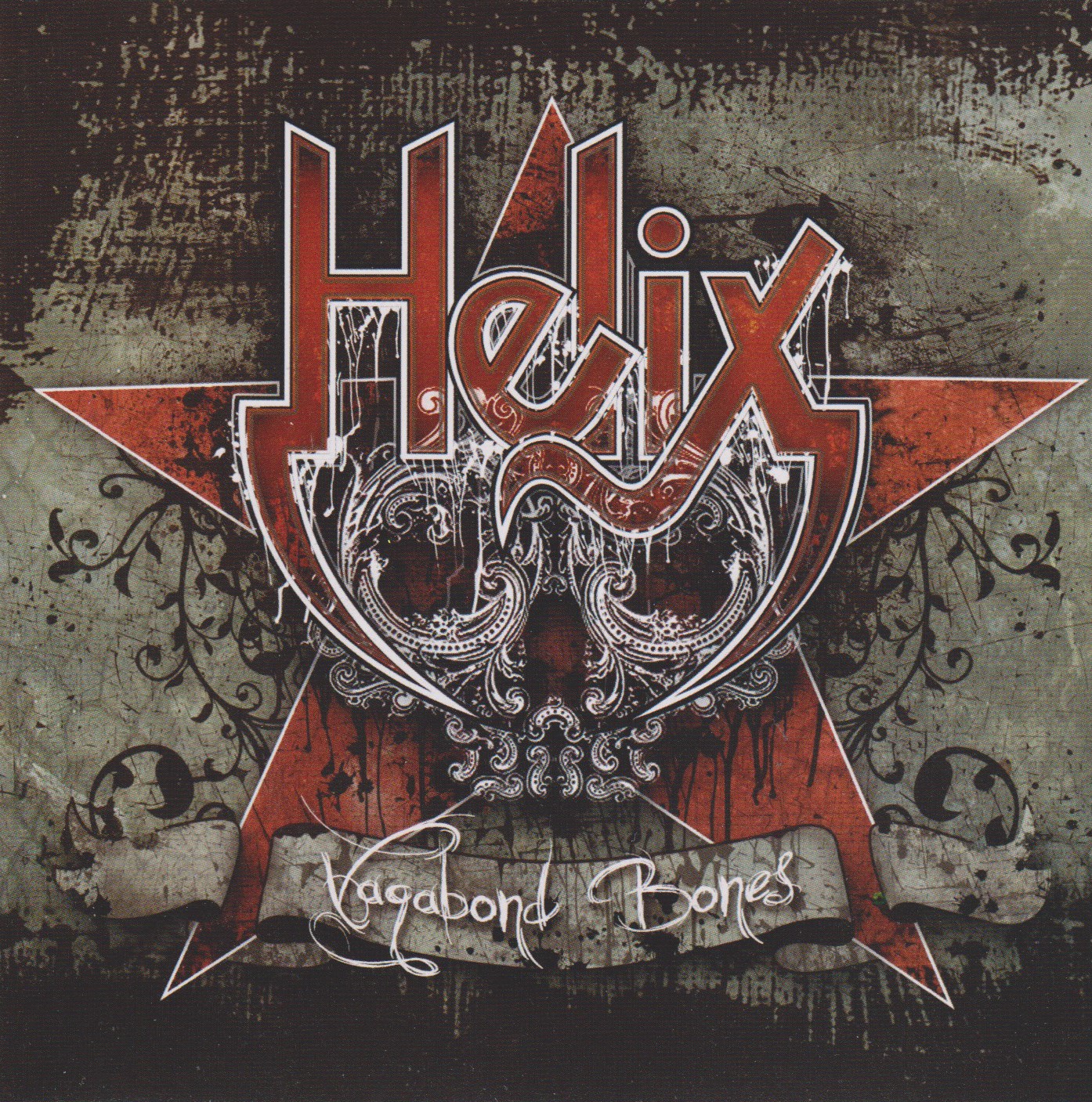
REVIEW: Helix – Vagabond Bones (2009)

STRAT

Welcome back to Canadian Rawk Week!

Scan_20160210HELIX – Vagabond Bones (2009 Universal)

2009 was an exciting time to be a Helix fan.  15-odd years of rotating lineups kept the band alive and in the clubs, but it was hard to grow attached to any band members when they only stayed for a couple years and were off elsewhere.  Helix main man Brian Vollmer had always maintained strong ties with former members, and guys like Brent Doerner often showed up on albums, or in the audience at local Helix shows.  It was still a surprise when Doerner, drummer Greg “Fritz” Hinz, and bassist Daryl Gray all returned to the Helix lineup.  This completed the classic 80’s version of the band, or at least the surviving members thereof.  Paul Hackman was killed in 1993 in a tragic auto accident.  Replacing him in the lineup was Kaleb “Duckman” Duck, who had previously worked with Brent.

Vollmer was working on a new album (originally called It’s Rock Science, NOT Rocket Science!), writing with his partners Sean Kelly and Moe Berg (The Pursuit of Happiness).   The final product entitled Vagabond Bones has a variety of different players on it.  Former Helix members Brent “Ned” Niemi and Rob MacEachern play drums, and guitar maestro Kelly (also briefly a Helix member) contributed to guitar and bass.  Also on the CD is Steve Georgakopoulos who played on a few past Helix albums.  You’d think it would be a case of “too many cooks” in the kitchen.  That’s not the case; Vollmer and Co. brewed a potent mixture of songs, with all the attitude and quality that you have come to expect from this band.

Immediately you’re hit over the head by the slick production work by Vollmer, Kelly and Aaron Murray. “The Animal Inside (Won’t Be Denied)” has the stamps of both Helix and Sean Kelly all over it, from the absurdly catchy chorus to the shredding solos. Vollmer sings powerfully, but his voice has so much depth character from years of training and road work.  Very few singers from the 70’s still sound the same, but Brian Vollmer is damn close!  “Go Hard or Go Home” has another powerful chorus, plus great catchy riff, and fun lyrics.  “Go hard, or go home, take your little whiny candy ass and go.”  Considering all that Helix has been through, Vollmer surely knows only the strong survive.  “No short cuts, no sweet deals,” he sings and he knows it!  The title track “Vagabond Bones” makes it three great songs in a row. It’s an instantly likeable good time hard rock boogie.

Helix really developed a knack for melody as they grew. One of the most pop moments is “Monday Morning Meltdown”, a song that Brian compared to Cheap Trick in terms of style.  You can hear it in the choruses, but it’s just a great pop rock song with another great Sean Kelly riff holding down the fort.  Very different for Helix, and very good.

Onto a fast vintage Van Halen style shuffle, “When The Bitter’s Got The Better Of You” is the fifth straight up great song in a row.  It too is very different for Helix.  It continues a theme of “down on your luck” songs, but always with a message to keep on givin’ ‘er.  That holds true on “Hung Over But Still Hanging In”, a sleeze rock duet with Russ Dwarf of Killer Dwarfs.  If you need a hard rocking party song, then this is what you want. It has the groove, the fun, and the lyrics so just hoist them wobbly-pops and rock on!

My personal favourite song has always been “Best Mistake I Never Made”. It has a classic 70’s rock aura, an acoustic guitar, and if I had to compare it to something else it would be Helix’s excellent 1992 single “That Day Is Gonna Come”.  That’s a trip down memory lane that I don’t mind taking.  “Make ‘Em Dance” is a fast stomper with a beat that strikes me as almost Disco.  It just rages though, I wouldn’t try dancing to it until you want to break your neck!

Ending the album on a funky rock vibe is “Jack it Up”. This is a really interesting song, because I used to hate it. You may have to let it grow on you because, like much of this album, it’s forging new territory for Helix. It’s still great party rock, but just a little laid back.

With sharp production, Vagabond Bones was certainly the best sounding Helix album, and the best overall in many a year. And that’s saying something, because 2007’s The Power Of Rock And Roll was very, very strong.  Hearing this album for the first time, I just smiled.  I had to.  Helix were back and pretty much better than ever.

5/5 stars

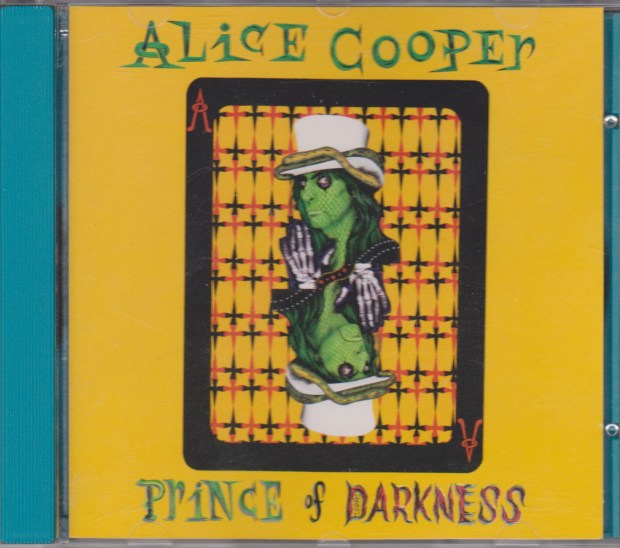
REVIEW: Alice Cooper – Prince of Darkness (1989)

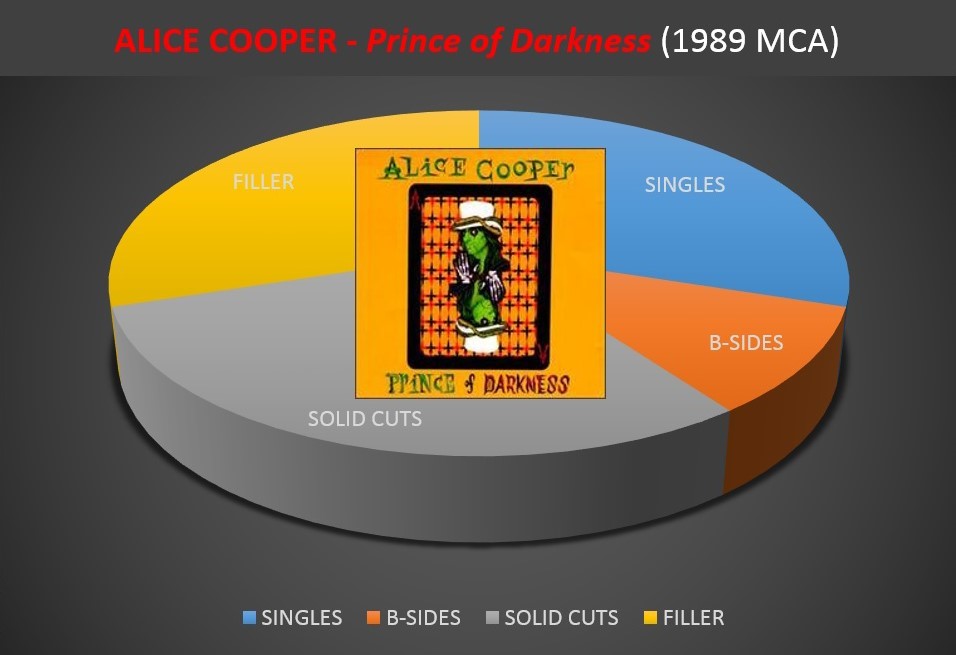
ALICE COOPER – Prince of Darkness (1989 MCA)

Even though Alice hadn’t produced anything as timeless as “School’s Out” during his 1980’s comeback, his profile rose greatly.  Clean, sober and focused, Alice Cooper was very active in the last part of the decade.  The same year as his final MCA album Raise Your Fist and Yell, he had memorable appearance at Wrestlemania III.  In the corner of “good guy” Jake the Snake Roberts, Cooper had the honour of draping Roberts’ snake named Damien all over the Honky Tonk Man.  After that, even my dad knew who Alice Cooper was.

Cooper only had a two record deal with MCA:  Constrictor was the first in ’86; also the first album in the comeback period.  Having re-established himself with MCA, Alice then signed with Epic and had a genuine smash success with 1989’s Trash.  With a dream team of writers and collaborators (including hitsmiths Desmond Child, Jon Bon Jovi, Richie Sambora, Steven Tyler, Joe Perry and many more), Alice scored a platinum album.

While Trash was still charting and producing singles, MCA put out a competing record:  Prince of Darkness, a 10 track compilation of Cooper’s material for that label.  Normally these kinds of releases are throw-aways, but Prince of Darkness is not and this review will tell you all about it.

It is not unfair to state that Constrictor and Raise Your First were mixed affairs.  You had to wade through a significant amount of filler to reach a disproportionate amount of modern classics.  Prince of Darkness does a great service by collecting some of the best material together on one CD.  It is well sequenced and even includes one rare track, an exclusive on compact disc.

A grand opening is the dark and metallic “Prince of Darkness”, a theme song from a movie of the same name.  This ominous and menacing track is one of the more memorable from this era, a heavy monument.  It works amazingly well as an opening track, and “Roses on White Lace” follows by going faster and heavier.  It was surprising to hear Alice creep this close to thrash metal, but what a track!  A distorted vocal adds to the creep factor, making this one of the better samples of Cooper’s music during his “splatter horror” period.  The 1986 single “Teenage Frankenstein” would be a must-own for any fan, and there it is in the #3 position.  The big single from this era was “He’s Back (The Man Behind the Mask)”, a synthpop classic quite unlike the prior metal material.  Right here is an easy and simple way to get this classic track, without having to buy Constrictor.  Same with “Teenage Frankenstein”.

A nice little track here is a 1976 live recording of “Billion Dollar Babies”!  This was a B-side from the “He’s Back (The Man Behind the Mask)” single, but Prince of Darkness is the only CD with it.  The track itself sounds heavily remixed (remixing is credited to Garth Richardson) but it is indeed a B-side that is easy to acquire by getting this disc.  Ignore the annoying, screaming overdubbed crowd and just dig the vintage performance of one of Alice Cooper’s most timeless numbers.

There are a few filler tracks on side two.  “Lock Me Up” was fun, but not particularly memorable.  Feel free to skip “Simple Disobedience” and “Thrill My Gorilla”, and go straight to “Life and Death of the Party”.  Alice steps back into the shadows for a chilling horror number, mid-tempo and overcast.  We are over and out with “Freedom”, another great single and dangerously close to thrash metal again.  Prince of Darkness serves as the most effective way to get this one.

That’s why I recommend Prince of Darkness to any fan who wants to get a slice of Alice in the late 80’s — but just a slice.  The whole cake is for diehards.

4/5 stars
COOPER

REVIEW: Alice Cooper – Raise Your Fist and Yell (1987)

Scan_20160303ALICE COOPER – Raise Your Fist and Yell (1987 MCA)

And lo!  The beast named Alice reincarnated with a slab of wax, and they called it Constrictor.  Slithering into the spotlight again was a triumph of will:  Alice battled his demons (including the bottle), found some new young band members and started fresh on a new label.    Though the music was merely OK, at least the man himself was doing just fine.  As fans, I believe we genuinely wish our rock star heroes to be healthy and happy, so even if the music wasn’t the greatest, we could be glad that Alice was back.

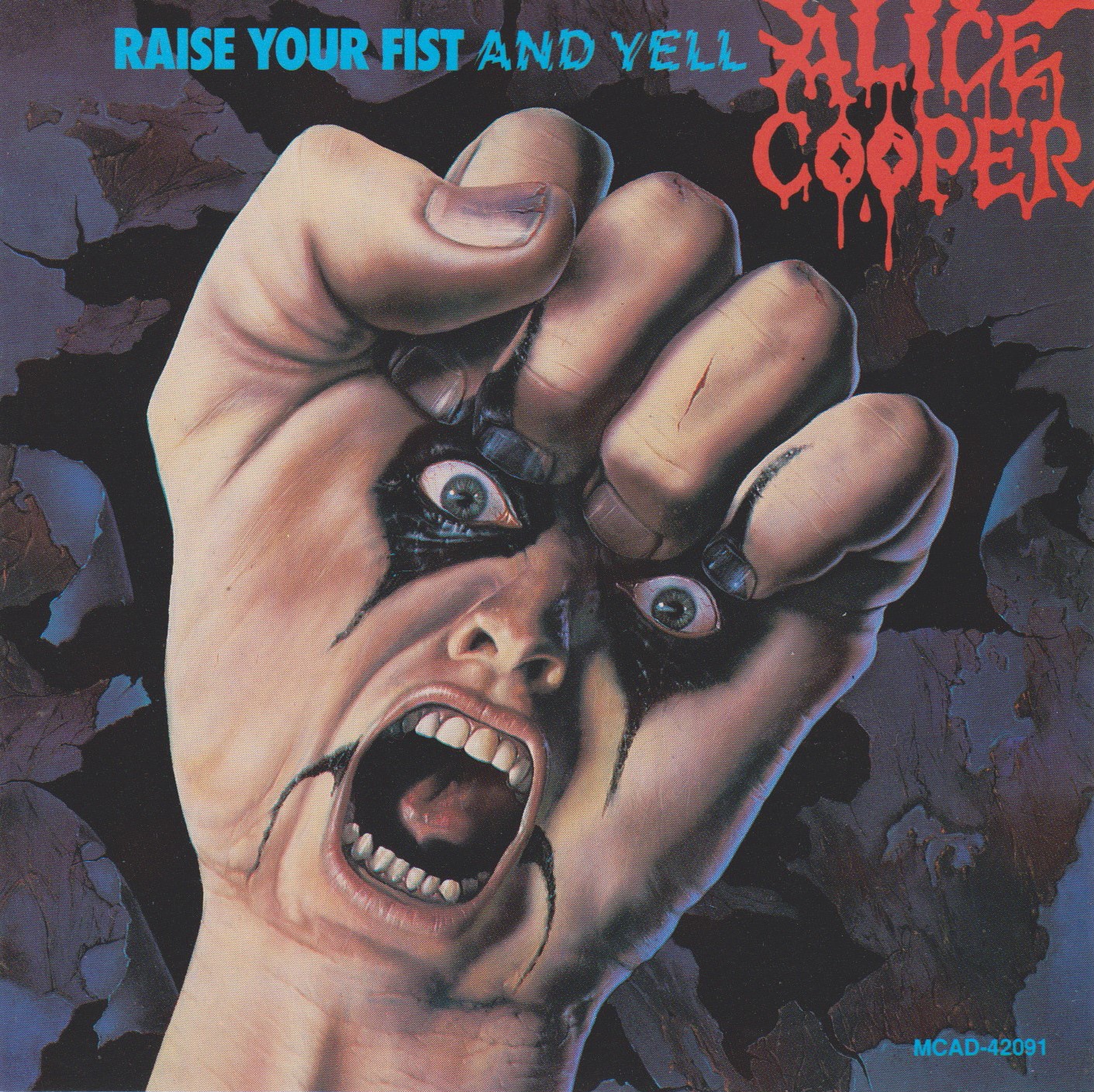
In the 70’s and early 80’s, Alice Cooper maintained a breakneck release schedule.  This slowed down a bit in the second phase of Cooper’s career, but he still managed to follow Constrictor a mere 12 months later with Raise Your Fist and Yell.  I probably don’t need to tell you this, but look at the cover:  certainly one of the worst to ever envelope a major label release.  The guilty party is a fella named Jim Warren who must hate this cover as much as I do, because just look at it.

It continued with the same shock-rock horror-splatter-movie theme, but turned up louder.  Indeed, the lead single “Freedom” was the fastest most thrash-like track that Alice had yet performed.  Censorship was a big target in Alice’s sights.  “Freedom” was his ode to the PMRC:  “You want to rule us with an iron hand, you change the lyrics and become big brother.  This ain’t Russia!  You ain’t my dad or mother.”  Lemme tell you, when “Freedom” came out, the PMRC seemed a genuine threat.  Dee Snider and Frank Zappa were testifying in front of the senate and stores were refusing to stock records.  “Freedom” was an anthem we could all get behind.  I don’t think anybody expected him to go so heavy!

The video was interesting. Kane Roberts looks like he’s not sure if he’s at a bodybuilding competition or a music video shoot. There were some new guys in the band; that’s not Kip Winger on bass. On drums is Ken Mary, later of House of Lords. Most interesting is the guy dressed as a priest. You can see him up close during the lyric “Back off preacher I don’t care if it’s Sunday.” They looked like the biggest bunch of misfits assembled. Perhaps this is what Alice was going for?

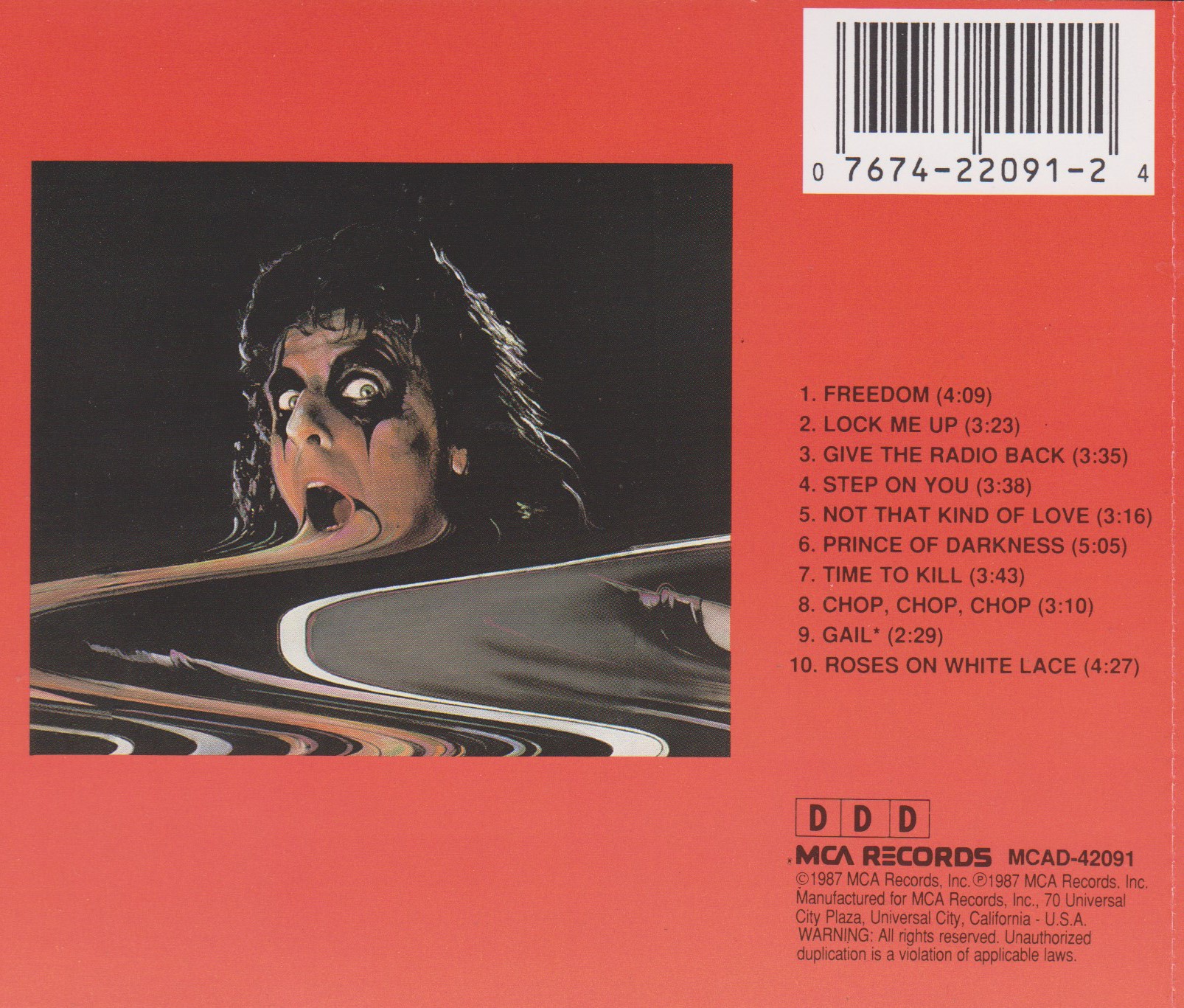
During this period, Alice was writing a few goofy rock songs.  “Lock Me Up” is silly, but fun.  It has a beat and you can headbang to it.  “Take the Radio Back” sounds like a predecessor to “Hey Stoopid”, but not quite.  “Give the radio back to the maniac!” sings Alice.  Is he begging for airplay?  It’s OK, but “Step on You” isn’t really.  There are moments here and there, but these are mediocre songs.  “Step on You” has an interesting atonal instrumental section but it doesn’t fit the song at all.  “Not That Kind of Love” continues the heavy rock, but without hooks.

Back to quality, “Prince of Darkness” is a heavy metal horror movie theme, from the film of the same name in which Alice had a cameo.  Menacing and intense, this tune scores high marks on both the Cooper Scale of Rock Thrills and Chills, and the Cooper Scale of Heavy.  Kane Roberts’ lead solo is pure pointless 80’s excess, but the song is what counts and it’s a good’un.  The acoustic outro is perfection.

“Time to Kill” keeps things above the bar.  “Chop, Chop, Chop” does not.  I know — you’re surprised, right?  A song called “Chop, Chop, Chop” isn’t a diamond of the highest carat weight?  Nor is it a turd, but certainly well below the watermark.  It does serve as a lead-in to “Gail”, a high quality also-ran that recalls Alice in the year 1975.  It is the only Kip Winger co-write on the album, and he’s responsible for its eerie keyboard vibe.  Finally it’s “Roses on White Lace”, another borderline thrash metal track that absolutely rips every head in the room off.  This track, firmly in the splatter film world, is an excellent example of Alice at his heaviest.  For its entire duration, it’s breakneck speed.  Bold song to end an album with.

Post album, Kip Winger and keyboardist Paul Taylor bailed, and formed another band you might have heard of.  Michael Wagener produced this record, and while heavy, the album is definitely lacking sonically in comparison to its contemporaries.  All told there are four songs worth buying the album for:  “Freedom”, “Prince of Darkness”, “Roses on White Lace”, and Gail.  Three of those four songs can be found on the MCA compilation Prince of Darkness.  So…your move.

2.5/5 stars

Scan_20160303 (3)


#469: Stump LeBrain (Getting More Retro!)


GETTING MORE TALE (Retro) #469: Stump LeBrain Week, by Aaron!

“Getting More Retro” is a sub-series of my music stories Getting More Tale.  I posted this back in March in 2012, when nobody was reading except Aaron and my old boss from the Record Store.  Before that, Aaron posted it on the KeepsMeAlive (Feb. 19).  And now, for the third time, here’s Stump LeBrain Week!

I had become such a dominating force on the 4 O’Clock 4-Play, my favourite music contest on 107.5 Dave Rocks, that listeners were now writing in 4-Play quizzes specifically to stump me!  For a while there it seemed everybody wanted to be the one to put an end to LeBrain’s reign!

Craig had me in the studio for the contest, live on the Craig Fee show, during what he dubbed “Stump LeBrain Week”.  Each day that week, I came in at 4 o’clock in order to play the contest on the air.  Craig selected five 4-Plays, one for each day.  If I answered correctly, I won the prize (I Mother Earth tickets).  If I was stumped, the person who wrote the 4-Play question would win the prize.

At the end of the week, I sent Aaron audio CDs of all my appearances minus commercials.  He was kind enough to document it in the written word for history.  Since very few saw this when I re-posted it at the launch of this site, I’m re-posting it once again for you!  Re-use and recycle, baby!

Big thanks to Aaron for listening to all five shows and writing it down, and of course thanks to Craig for giving me the opportunity!  Here we go.  Ready?


Four-Play #1 (submitted by Chris Cottingham)

01 Motley Crue – Shout At The Devil

01 Mike’s Guess: ‘tracks that were not singles’ (no)

02 Rolling Stones – Brown Sugar

02 Mike’s Guess: ‘bands that have toured with guns ‘n roses’ (no)

03 Bruce Springsteen – Cover Me

03 Mike’s Guess: ‘special lp packaging’ (no)

04 Loverboy – Working For The Weekend *

04 Mike’s Guess: ‘album covers featuring pants’ (yes!)

* at this point, before Mike’s last guess, it was exposed that the Motley Crue song was supposed to have been Live Wire, which changed everything, and he got it from there.

Comment: He still got it, even with a wrong song played. Improbable? Never! The man is a machine.

Score: Mike is 1/1.


Four-Play #2 (submitted by The Crook in Elmira)

01 Motorhead – Ace Of Spades (live)

01 Mike’s Guess: ‘artists who’ve done duets with Ozzy Osbourne’ (yes!)

02 Alice Cooper – School’s Out

03 Dio – Holy Diver

04 Lita Ford – Kiss Me Deadly

Comment: He nailed this one before the first song was even over. Jeez.

Score: Mike is 2/2.

Four-Play #3 (submitted by Kathryn Ladano, Mike’s sister)

01 Rush – Subdivisions

01 Mike’s Guess: ‘album covers with dogs on them’ (no)

02 Neil Young – Rockin’ In The Free World

02 Mike’s Guess: ‘all Canadian artists’ (no)

03 Guess Who – Runnin’ Back To Saskatoon

03 Mike’s Guess: ‘songs about Canadian cities’ (no)

04 Loverboy – Turn Me Loose

04 Mike’s Guess: ‘all artists who sang on Tears Are Not Enough’ (yes!)

Comment:

Broadcasted live from Chicopee ski resort. This was not the Four Play that Kathryn had wanted played, so her confidence at being able to stump her brother was pretty low, at the outset. It shocked me that Mike had never heard the Guess Who song before. I thought everybody knew that song.

Score: Mike is 3/3.

Four-Play #4 (submitted by Greg Laughtenschlager)

01 Megadeth – Hangar 18

01 Mike’s Guess: ‘science fiction, aliens, conspiracy theme’ (no)

02 Quiet Riot – Mama We’re All Crazy Now

02 Mike’s Guess: ‘books (1984, Roswell)’ (no)

02 Mike’s Extra Guess: ‘stripey pants’ (no)

03 Iron Maiden – The Trooper

03 Mike’s Guess: ‘bands that opened for Sabbath’ (no)

04 Dio – Rainbow In The Dark

04 Mike’s Guess: ‘all four albums covers were paintings with mascots’ (yes!)

Comment: Definitely a HEAVY set, which I thoroughly enjoyed. And Mike nails it. So cool.

Score: Mike is 4/4.

Four-Play #5 (submitted by Nick Byerjean sp?)

01 KISS – Beth

01 Mike’s Guess: ‘songs that originated as b-sides’ (no)

01 Mike’s Extra Guess: ‘no members of the band played on the track’ (no)

01 Mike’s Extra Guess: ‘crappy songs from great albums’ (no)

02 Guns ‘N Roses – Used To Love Her

02 Mike’s Guess: ‘single monikered album titles’ (no)

02 Mike’s Extra Guess: ‘songs with unusual percussion’ (no)

02 Mike’s Extra Guess: ‘songs people think is about one thing, but it’s about something else” (no)

02 Mike’s Extra Guess: ‘acoustic ballads’ (no)

03 Aerosmith – Angel

03 Mike’s Guess: ‘bands led by duos’ (no)

03 Mike’s Extra Guess: ‘bands who shortened their name from something longer (no)

03 Mike’s Extra Guess ‘all are bands from America’ (no)

04 Slash with Andrew Stockdale – By The Sword

04 Mike’s Guess: ‘songs released in even numbered years’ (no)

04 Mike’s Extra Guess: ‘all albums released in leap years’ (no)

04 Mike’s Extra Guess: ‘songs released in Canadian-hosted Olympic years’ (yes!)

Comment: OK, that was RIDICULOUS. Hearing him work through that last one was incredible. Even with all the extra guesses, that answer was from so far out of left field. Wow.

REVIEW: Alice Cooper – Constrictor (1986)

EPIC REVIEW TIME.

Scan_20160207 (2)ALICE COOPER – Constrictor (1986 MCA)

Alice Cooper’s bizarre DaDa album was the end of an era.  It marked the last album Alice recorded for his Warner Brothers contract, now complete.  It was also the end of his experimental period that ran from 1980’s Flush the Fashion through to DaDa.  It was the the last album Alice would make that he couldn’t remember making.

Alice mostly disappeared for the next three years.  His activities were so low key that most people didn’t even notice them.  He was hospitalized for cirrhosis of the liver caused by his blackout drinking.  He got sober, for good.  He also dealt with a divorce.  Musically there was very little going on.  In 1984, Alice starred in a very low budget horror movie called Monster Dog.  He recorded two songs for the soundtrack:  “Identity Crisises” and “See Me in the Mirror”.  These two tracks are very much the conclusion to Alice’s early 80’s art-rock persona.  “Identity Crisises” has a lo-fi, garage-y Iggy Pop sound.  “See Me in the Mirror” is in the synthpop direction of DaDa:  creepy, atmospheric and mostly electronic.  These two songs were finally released for purchase on the legendary Life and Crimes of Alice Cooper boxed set in 1999.

Alice next emerged with one of the bands he inspired:  Twisted Sister.  Along with Brian Setzer, Clarence Clemens and Billy Joey, Cooper accompanied Twisted Sister on their single “Be Chrool to Your Scuel”. A very clever zombie-filled big budget horror-inspired music video was made for the song, which Alice co-starred in, as did Bobcat Golthwait (who was also in Sister’s “Leader of the Pack” clip).  It should have been a big deal, with Alice getting equal screen time with Dee Snider.  Unfortunately hardly anyone saw the video. MTV barely touched it. As a result it did nothing to aid Alice in terms of a comeback.  It was good to note that Alice looked healthier than he had in years.

Alice regrouped and re-invented himself in a new persona. Taking inspiration from his Welcome to My Nightmare period, Alice went into “slasher film” mode. He recruited a massive muscle-bound heavy metal guitarist and songwriter, Kane Roberts, to be his co-pilot for this adventure. Also along for the ride was a hot new bassist and singer named Kip Winger, whose large mane hid the fact that the man was a classically trained musician. With producer Beau Hill, they made an album in tune with what was happening in 1986, and that meant heavy metal. Alice had always been a diverse, experimental artist, but this time the mission was pretty simple and the lines were clear.

Another horror film served to launch the next official Alice Cooper music: Friday the 13th Part VI: Jason Lives. Alice appeared in a brief cameo, but more importantly contributed two new songs to the movie soundtrack. They were the anthem “Hard Rock Summer”, and “He’s Back (The Man Behind the Mask)”, which served as the movie’s theme song. “Hard Rock Summer” was a bit of a throwaway, and was not used on the next Alice album. You can really hear the backing vocals of Kip Winger and Kane Roberts on it, but a classic it is not. “He’s Back”, and its very cool music video became synonymous with this new period of Alice Cooper’s life.

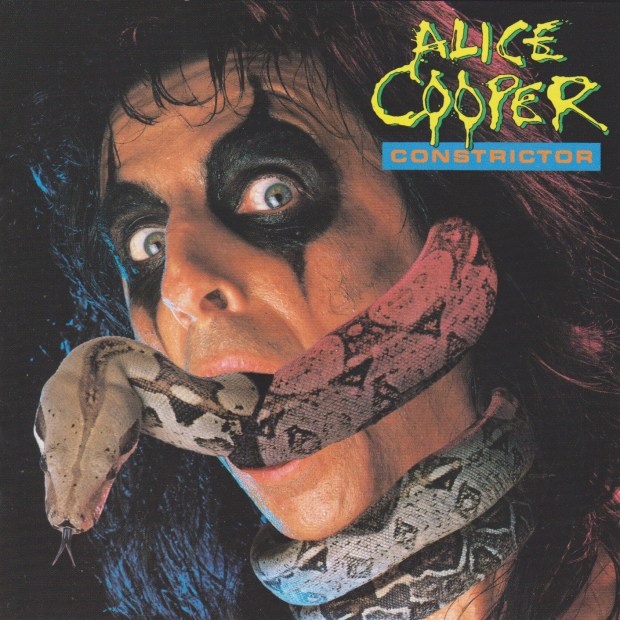
The new album, Constrictor, was finally released in September of ’86. With a snake in his mouth on the cover (not really; you can see it’s cheaply cut and pasted) it was pretty clear that Cooper was going for the scares. Opening track “Teenage Frankenstein” continues the horror theme, but combines it with Alice’s teen anthem style from the early 1970’s. “Teenage Frankenstein” is essentially an “I’m 18” for 1986. It’s not as memorable, inventive, or as good, but it gets the job done. It’s an Alice Cooper heavy metal anthem for pounding your fist to in concert. In lieu of a proper music video, a clip from his live show The Nightmare Returns was used, featuring Alice building a living robot monster on stage, which then turns against him!  Alice was still one of the best live acts in the world.

It’s funny that DaDa is remembered as Alice’s “drum machine” album when it’s clear on “Give it Up” that a lot of the beats are programs and samples.  “Give it Up” is a radio friendly hard rocker, nondescript but at its core not that different from the music Alice made in the 70’s.  It’s even has some rock and roll piano.   It’s just dressed up for the 80’s.   There’s not much going on with “Thrill My Gorilla”, just a forgettable song with the shrill production that was so popular in the 80’s.  Much better is the somewhat epic “Life and Death of the Party”.  Slower, creepier and much more effective, “Life and Death of the Party” is the kind of song I like to point to as proof there was some mighty good material during this period.  Unfortunately “Simple Disobedience” isn’t among that material.  Like “Thrill My Gorilla”, there is little here to attract listeners today.  The electronics and samples really are a drag.  It is like there is a layer of distraction over the song that you have to penetrate through.

Flipping the record over (or pretending to since I own this on CD), “The World Needs Guts” isn’t a bad start to the second side.  It could have been much heavier.  It verges on the speedy power metal tendencies of bands like Accept, but the production keeps it from going all the way.  As such it kind of sounds like a thin Judas Priest Turbo outtake with the synths stripped off.  “Trick Bag” may sound familiar.   It actually started life as “He’s Back (The Man Behind the Mask)”.  There’s a demo version of “He’s Back” on the aforementioned Alice Cooper box set musically identical to “Trick Bag”.  “He’s Back” was re-written, but the original music ended up as “Trick Bag”.  It’s a decent album track but like much of Constrictor not particularly classic.  “Crawlin'” is pretty close.  With all the melody and hooks of an old 70’s Alice Cooper track circa Goes to Hell, “Crawlin'” is pretty good stuff.

“The Great American Success Story” is fantastic for two reasons.  One is that it was originally written for the Rodney Dangerfield classic Back to School.   Second, it’s like an updated “School’s Out” for the 80’s.  Instead of celebrating the end of school, this time we are celebrating going to school.  “He’s gonna take that plunge, gonna jump back in there.”  Which, if you’ve seen the movie, you know is also a reference to Dangerfield’s character joining the diving team.  “He thinks about the teacher in his literary class,” and I don’t blame him; it was Sally Kellerman!  “Always been a brat, don’t get no respect” is another obvious reference to Dangerfield.  But it’s a good song! It really should have been a single, and it probably would have been if it were in the movie.

Closing the album, we go full circle back to Friday the 13th and “He’s Back”.  There’s little question that “He’s Back” is the best song on Constrictor.  It actually bears more similarity to the synth-pop of DaDa than it does to the rest of the album.   It’s brilliant because they stripped the song down to a very basic frame, which is a creepy digital pulse.  There’s a little guitar but it’s mostly just horror pop of the finest quality.  Ch-ch-ch-ha-ha-ha…don’t turn out the lights.

Part of the problem with Constrictor is that Alice had a faceless, fairly bland group backing him.  Kane Roberts can play guitar, and Kip Winger can play the bass, but did they have their own identities?  No.  Dennis Dunaway played bass on those early Alice Cooper albums like no other bassist in the world.  Michael Bruce, Steve Hunter, Dick Wagner, and the other great players Alice worked with all had their own sound.  There is none of that on Constrictor.

I want to give Alice and company an A for effort: for finally getting sober, for finally getting back there on tour, and also for going heavy this time.  Unfortunately Constrictor was a comeback album that needed a bit more comeback in it.  The good news is that Alice did eventually get back to full quality, but Constrictor is only about half an album.  Therefore:

2.5/5 stars

Scan_20160207 (3)

REVIEW: Deep Purple – The Gemini Suite – Live (1970/93)

The Deep Purple Project goes on with a flashback to 1970.

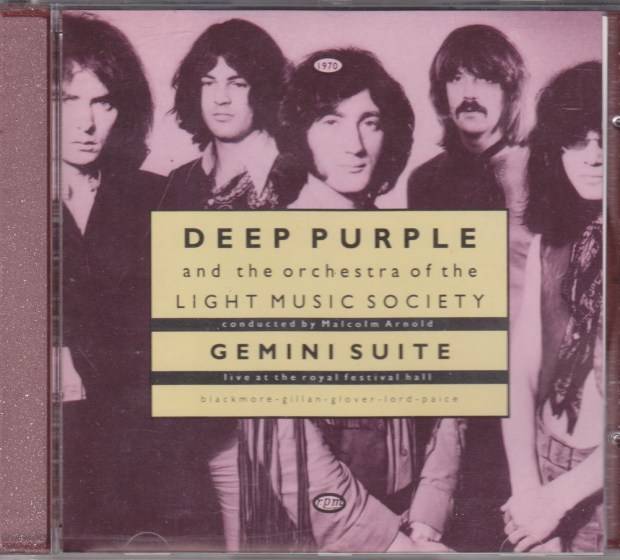
Scan_20160212DEEP PURPLE and the orchestra of the LIGHT MUSIC SOCIETY – The Gemini Suite – Live (recorded in 1970, released 1993 EMI)
Conducted by Malcolm Arnold

Jon Lord’s Concerto for Group and Orchestra put Deep Purple on the map.  An original concerto in three movements written specifically for an orchestra and a rock group together had never been accomplished before.  Headlines and offers to bring the Concerto over to America helped cement Deep Purple’s name in the public consciousness.  The only problem was, public perception was that this was a band who always played with orchestras.  They were not:  Deep Purple wanted to be a heavy rock band.  They did not want to be cornered into playing with orchestras for their career.  There may also have been some internal friction because Lord was being singled out as the band’s leader in the press.  Ritchie Blackmore and Ian Gillan were united in their insistence that the orchestral work cease.  Worse, some in the band suggested that Lord was using the Concerto as a potential launch pad to other projects.  These were accusations of petty youthful jealousy of course, but it led to Lord announcing his intention to leave Deep Purple.

Scan_20160212 (3)Management arranged a sit-down and peace was kept.  They collectively agreed that the way forward was with rock music, not classical hybrids.  There was just one catch, which was that Jon Lord had already been contracted to write a second classical/rock piece for Deep Purple to perform.  This project had to go forward, it was too late to do otherwise, but the band insisted that it was publicized as little as possible.  The new piece was played live by the band, but a Deep Purple album release of the final product, the Gemini Suite, would not happen until 1993!  Instead, Jon Lord recorded and released a studio version of it with other guests and musicians.

Perhaps to assuage some bruised egos, Lord decided to compose his next work around the five members of Deep Purple.  Each movement had time for a member of Deep Purple to shine on his own.  The first goes to Ritchie Blackmore.  The year was 1970, and Deep Purple were working on the Fireball LP.  The quiet moment in Blackmore’s movement is tonally similar to Ritchie’s solo in Purple’s “Fools”.   According to the liner notes, this is one of the last occasions that Ritchie played a Gibson on stage.  Jon Lord goes next with an organ piece (though on the back cover it’s incorrectly listed as the vocal movement).  There are some very cool atonal parts here.  You have to admire the man for his ambition and vision, but as technically brilliant as this is, it doesn’t have the level of impact of the Concerto nor is it as well recorded.  The are fewer memorable themes and instrumental moments, and the end result is that these two movements take some patience to absorb.

It was noted that Ian Gillan had not written the lyrics to his movement until the night of the show.  The lyrics are not really important; what counts is that you’ve never heard Ian Gillan sing like this before.  With an exaggerated falsetto, and an unusual psychedelic melody, Ian really knocked it out of the park.  Halfway through, this gives way to standard Gillan howling.   It’s hard to make out all the words, but this is Ian Gillan in peak voice, totally in control and at the top of his game, backed by a friggin’ orchestra.  What more do you want?  This vocal movement is the highlight of the entire Gemini Suite.  Roger Glover goes next with his bass spotlight.  It’s about as interesting as you imagine a bass spotlight to be, but the orchestra plays it busy in the background.  There’s some great oboe on this movement, which ends on a sudden, awkward note.

Ian Paice goes last.  With military precision, Paice marches forward, leading the orchestra and percussion section.  They answer his drums in interesting ways, making this movement another solid highlight.  The crowd clearly loved it.  Then, there is a long finale (10 minutes) with everybody playing together.  It attempts to tie together the previous movements, but without memorable themes, this is difficult.  The Suite lacks cohesion overall.  There are some absolutely mindblowing moments of musical precision and dexterity, as well as rock thrills (most of them concentrated in the finale).  It is probably well enough that they did not release an LP of this at the time, for it would most definitely have lived in the shadow of its superior predecessor.

3/5 stars

Look at that backstage photo.  Looks like nobody wanted to be there that night, particularly Ian Gillan.

REVIEW: Deep Purple – The Soundboard Series – Australasian Tour 2001 (12 CD box set)

The Deep Purple Project continues!  Here is one big solid chunk of rock majesty.

Scan_20160209

DEEP PURPLE – The Soundboard Series – Australasian Tour 2001 (2001 Thames 12 CD box set)

One day in spring of 2002, I wandered into Encore Records in Kitchener.  I spied this lovely box o’ rock up front in their glass case, where they stored similarly awesome boxes of rock.

“What’s that?!” I asked, and was promptly handed 12 CDs of live Purple.  A quick glance, and “I’ll take it.”  Only a short while before, I bought yet another 12 CD live Deep Purple box set.  When I first noticed this box under the glass, I was hoping it was just a reissue of the same thing; something I already had that I could safely pass on.   It only took one close look to realize that this was a whole other animal completely.  Rather than a collection of bootlegs from the 80’s and up, like the one I had, this box chronicled Deep Purple’s 2001 tour of Australia, Hong Kong and Japan.  What special concerts those must have been.  Read on and you’ll discover why.

Each concert presented in this box is complete, and mixed from the 8-track soundboard DAT tapes.  No audience recordings in this bad boy, which is a good thing, since Purple were touring with numerous extra musicians and accoutrements that require sonic clarity.  Of the six concerts included, four are largely the same.  A lot of Ian Gillan’s song intros are the same from night to night, and the setlists are by and large the same.  Of course where Deep Purple are concerned, that means very little.  Their solos are never the same, and each performance is its own experience.  Steve Morse has never really repeated himself night after night, nor did Jon Lord.

There are some cool surprises in the sets.  One of the best tracks, and one of the most rarely played, is “Mary Long” from Who Do We Think We Are.  This rhythmic monster goes down smashingly well, and it’s a wonder that Purple never tried it any earlier.  There are some true buried gems on those early Purple albums, especially Fireball and Who Do We Think We Are, that were never given a fair shake in their day.  Deep Purple today are able to have more fun with their setlists than they were in the 70’s.  Another such track is “No One Came”, one of the strangest songs in the catalogue.  It benefits greatly from a three piece horn section (the Side Door Johnny’s).  There are versions with horns on some other live albums as well, such as Live at the Olympia ’96, so while horns are not unheard of in Deep Purple, they are rare.  “No One Came” and “Fools” (both from Fireball) are quite a treat any time you get to hear them live, which you didn’t get to do in the 70’s.  They also play the classic B-side “When a Blind Man Cries”, a blues that deserves the spotlight.

Of course Deep Purple always play new material, but what’s really surprising is that they only played one song from their last studio album (1998’s Abandon), and only one time, during the first four concerts!  At the first show, in Melbourne, they played “’69”.  Then it was dropped and the set slightly shuffled.  “Smoke on the Water” was moved from the middle to the second half of the set.  Speaking of “Smoke”, fans familiar with the Steve Morse version of Deep Purple are aware that he really likes to have fun with the intro.  He teases out several classic rock riffs, all instantly recognizable, as he tries to remember which riff is the one he’s supposed to be playing (or so it seems).  AC/DC’s “Back in Black” is the one that really stands out, and it’s remarkable how well it works with Deep Purple.  There are lots more, including “Whole Lotta Love”, “Heartbreaker” and “Stairway to Heaven”, that one normally does not associate with Deep Purple!    Other favourite riffs include “Sweet Home Alabama”, “Little Wing”, and even a Van Halen inspired version of “You Really Got Me”, but the one that surprised me the most was “To Be With You”, by Mr. Big.  Don’t forget, Mr. Big are absolutely huge in Japan, so when they played that little bit in Tokyo, I’m sure everybody knew it.

Also of note, Jimmy Barnes came out for “Highway Star” and “Smoke on the Water” for a couple Australian shows.  Sharp-minded readers will remember that Barnes was one of many singers who auditioned for Deep Purple in the late 80’s before they hired on Joe Lynn Turner.  He seems to have a blast screaming his way through “Highway Star”!  Must be like a dream come true.  Gillan’s in great voice too, by the way!

Scan_20160209 (2)

For more thrills with special guests, we must go to the last two shows, in Japan.  Australia surely had a treat with the Side Door Johnny’s and Jimmy Barnes, but what Japan got was even better.  Fresh off their well-received Live at the Royal Albert Hall album from 2000, conductor Paul Mann joined Purple for two nights in Tokyo.  That meant a full performance of the legendary and almost never performed Concerto for Group and Orchestra, all three movements.  Mann and the New Japan Select Orchestra joined Purple on a number of their songs as well, including “Watching the Sky” from Abandon, but it was only played on the first night.  All that said, there was no greater thrill than the presence of Ronnie James Dio.  As he did on the Albert Hall album, Ronnie sang lead on two songs from the Purple solo catalogue.  He performs Roger Glover’s “Sitting in a Dream” and the delightfully bouncy hippy anthem “Love is All”.  Ian Gillan, meanwhile takes the lead on Jon Lord’s “Pictured Within”.   Dio also returns for “Smoke on the Water”, trading with Gillan, but what’s really special is that Purple actually performed two Dio songs at these shows.  Though Dio and Purple are two very different bands, Purple adapt and do great versions of “Fever Dreams” and “Rainbow in the Dark”.  The drum and keyboard parts are the most different, but nobody’s complaining!  It’s great that they did “Fever Dreams” from Dio’s Magica, a great album that deserved the recognition.  “Fever Dreams” is one of Dio’s best tunes from the latter period.

“Wring that Neck” and “Pictures of Home” were brought out of mothballs for the Tokyo concerts.  “Wring that Neck” is a jazzy version with the horns coming in strong, just like it was on the Albert Hall CD.  Undoubtedly though, the centerpiece is the Concerto itself.  Even though it put Purple on the map in 1969, it wasn’t particularly well liked by the members of the band (Jon Lord aside, obviously, since it was his creation.)  With Steve Morse in the band instead of Ritchie Blackmore, feelings softened and ideas like resurrecting the Concerto were possible.  The music however was lost.  It took Dutch composer Marco de Goeij years to re-create it, but once Lord helped him finish, it could be performed once again.  It’s incredible to think that they were able to take it to Japan and play it for those lucky fans, both nights.  You can absolutely tell the difference from the London version.  It’s fortunate that it was recorded so well (not perfect but damn well good enough!), and released for you to be able to own forever.

There is no point in breaking this down for a disc-by-disc rating.  If the box set could be faulted for anything, it is that there is so much repeat between the first four concerts.  For me, box sets tend to work best in the car.  I put this on a flash drive and took about three weeks to listen to the whole thing in sequence.  In that environment, I don’t bore of the songs.  Instead I enjoyed the slight differences.  “Oh, this is a little different than the way they introduced it, when I heard it a couple days ago.”  Obviously, only a true Deep Purple lover needs to own this.  But every Deep Purple lover should own it.

Discs 1 & 2 – Melbourne, March 9 2001

Discs 3 & 4 – Wollongong, March 13 2001

Discs 5 & 6 – Newcastle, March 14 2001

Discs 7 & 8 – Hong Kong, March 20 2001

Discs 9 & 10 – Tokyo, March 24 2001

Discs 11 & 12 – Tokyo, March 25 2001

4/5 stars

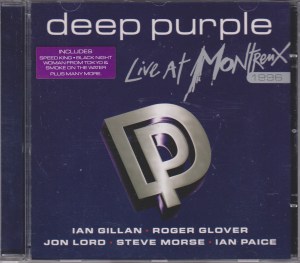
REVIEW: Deep Purple – Live at Montreux 1996 (2006)

The Deep Purple Project continues, from Blackmore to Morse!

Scan_20160128DEEP PURPLE – Live at Montreux 1996 (2006 Eagle)

One of the lovely things about collecting Deep Purple is how much the setlists change over the years.  “Fireball” was rarely played with Blackmore in the band, but with Morse, it opened much of the Purpendicular tour.  It did in Montreux in ’96.  Ian Gillan sounds ragged, but Ian Paice on the double bass drums kicks as much ass as he did in 1971.  This version lacks some of the fire (pardon the pun) of past renditions, mostly because Gillan sounds like he’s struggling a bit.  Roger Glover takes a slightly extended fuzz bass solo, always a treat, but it is Jon Lord on the keys who sets the place alight.  As it often does, “Fireball” ends with a brief snip of “Into the Fire” from In Rock.  Apropos, no?

“Vavoom: Ted the Mechanic” is one of Purple’s greatest triumphs of the Steve Morse era.  Typically for Ian Gillan, it’s about a character he met in a bar.  Followers of the choppy riffing that Steve Morse is known for will dig it, as the rest of us wonder just how the hell he does it.  “Ted the Mechanic” is just fun, so get up and dance.  You won’t have the chance to dance on “Pictures of Home”, one of the heaviest tracks from Machine Head.  Ian can’t hit the screams, but the band is on point.  Listen to Ian Paice swing!  Morse has no trouble welding one of his trademark solos onto this classic.  Another golden oldie, the single “Black Night” is reliable.  Morse and Paice are securely in the drivers seat, but there is no way a modern rendition of “Black Night” will have the adrenaline of the Made in Japan B-side version.  Just sayin’ — and that’s not a knock on Deep Purple today.  Just an observation.  Morse actually takes a very nice jazzy guitar solo that’s a little more laid back.

“Woman From Tokyo” continues the hit parade.  It’s never been Deep Purple’s most remarkable song, but you’d probably miss it if it were not in the setlist.  Gillan’s voice is shredded, probably from givin’ ‘er all night the day before!  I don’t necessarily mean on stage.  A Deep Purple collector will appreciate a live CD with the singer a little more rough than usual, but certainly a first time buyer wouldn’t.  The hit parade comes to a momentary halt, with some deep cuts.  “No One Came” is a treat.  It’s almost spoken word, so it doesn’t matter that Ian was having voice issues.  In fact they enhance the song.  It’s hard to find a live version of “No One Came” without the horn section they sometimes used.  This is the way I remember hearing it when I saw them in Toronto.  Raw, heavy, bouncy, slightly funky and fucking cool!  “When a Blind Man Cries”, the blues B-side of “Never Before”, is the next rare track.  They started playing this one when Morse joined the band, and what is remarkable is how the song is transformed by his hands.  He does not play like Ritchie Blackmore, yet both guys did amazing versions of this song.  Morse plays it spacey, with volume swells and heavenly tones.  The solo is unique to this version, and it’s one of a kind.  This extended take features a long Jon Lord keyboard intro.

Before they got back to playing the greatest hits, Purple performed the newbie “Hey Cisco”.  According to another live set I have (The 12 CD Soundboard Series which you will be reading about soon), it’s a song about Clayton Moore, who played the Lone Ranger.  An elderly Moore was legally barred from doing public appearances as the Lone Ranger, which Ian Gillan was quite upset about, but he couldn’t find the right words to go with “Lone Ranger”!  He changed the character to the Cisco Kid, but the story is the same.  “Can’t open no more supermarkets.”

“Speed King” is always a blast.  Jon and Steve have a beautiful play-off together.  Predictably the set ends with “Smoke on the Water”.   I’m quite fond of Steve Morse versions of this song.   Since it’s a tune they’ve played 3 billion times, it’s loose and free.   Later on, Steve started teasing out classic rock riffs such as “Whole Lotta Love” and “Crosstown Traffic” before “Smoke”, but not on this CD.  Interestingly, Gillan flubs the words!  “When it all was over, h-h-how could I refuse?  Swiss time was runnin’ out, see if we would lose the blues.”

The CD is slightly edited.   Played that night, but not on the disc, was “Cascades: I’m Not Your Lover Now”.  I’m sure between-song banter has also been edited.  Ian is known for his humorous song intros, and there aren’t many here.  Instead of the unedited show, they tossed on two bonus tracks from a 2000 Montreux show.  These are the incredible “Sometimes I Feel Like Screaming”, and the rarely played “Fools” from Fireball.  These are both long bombers, a combined 16+ minutes of bonus music.  Ian was in smoother voice in 2000, and this live version of “Screaming” has to be one of the best.  Then: “Fools”, one of the most impressive Deep Purple deep cuts.  Long, progressive and heavy, “Fools” represents Deep Purple at their very best.  Both Ians are in prime shape, with Paice winning the MVP award for his menacingly perfect rhythms.

3.5/5 stars

REVIEW: Deep Purple – The House of Blue Light (1987)

The Deep Purple Project continues!  Join me for the next week (plus?) and see more rock majesty than you can shake a purple stick at!

Scan_20160129 (4)DEEP PURPLE – The House of Blue Light (1987 Polygram)

The Deep Purple reunion was the success beyond what anybody hoped for.  The band had revitalized after many acrimonious years apart.  They were fresh and rejuvenated, and the resultant album Perfect Strangers was the proof.   If the live recordings are anything to go by, then the tour was also dynamite.   Obviously the next thing to do would have to be a second reunion album.

According to Ian Gillan’s autobiography Child in Time, things went south very fast.  He found Ritchie Blackmore increasingly difficult to work with, refusing even to record guitar for one song.  Gillan admits he was no treat either, so it was the band that suffered.  Ian compared Deep Purple to a beautiful meal, a plate full of gourmet perfection — that’s Roger Glover, Ian Paice and Jon Lord.  Ian and Ritchie were the fork and knife on either side.

The House of Blue Light (title taken from Little Richard via Purple’s own “Speed King”) was not a fun album for anyone to make.  Some hold it in high esteem today, such as renowned writer Martin Popoff, who rated it 10/10 in Riff Kills Man (as he did Perfect Strangers).  While I believe Perfect Strangers is easily a 10, I don’t find The House of Blue Light to be its equal.  The band may agree; none of its songs have been performed live since this tour.  That also just could be residual hard feelings.

There is no mistaking the organ of Jon Lord on “Bad Attitude”.  What an opening statement this is.  Just as strong as the best songs on Strangers, “Bad Attitude” rules.  It’s all about the spaces between, but Ritchie ensures there is a catchy trademark Deep Purple riff involved.  His solos are exotic delight.  Even in 1987, Purple weren’t afraid to load their single down with solos!  Jon Lord’s synths are perhaps more prominent than they were in ’84.  This is not a bad thing, because Jon Lord makes synth sound good.  Synth and electronics take center stage on “The Unwritten Law”, powerful both because of and in spite of it.  The pulse and beats give it a dramatic chase-like feel.  Its drum outro is very reminiscent of “Chasing Shadows” from album #3 in 1969!  It’s also the only Ian Paice co-write.  In the 80’s, instead of splitting the writing credits five ways as they always had, Purple changed to awarding individual credits (and royalties).  This led to petty squabbles and infighting.

“Call of the Wild” was a single and (pretty terrible) music video, and didn’t really make much of an impact.  Too bad.  It’s one of Purple’s more pop songs, but that’s just fine by me.  Purple have occasionally forayed into commercial songwriting, but have always done so with class.  This one sounds like a Rainbow song circa the Joe Lynn Turner years.  “Mad Dog” blows away all three of the previous songs.  With a killer, choppy Blackmore riff right up front, it sounds vintage.  Gillan gets to play some bluesy harmonica on “Black & White”, a good mid-paced groove but not an outstanding one.  Something like this needs a timeless Blackmore solo to drive it home, but the fire fails to light.

There’s a natural split between side one and side two, which still comes across on CD.  “Hard Lovin’ Woman” (supposedly a sequel to “Hard Lovin’ Man” from In Rock) is one of the few songs that was played live, probably because of its energy.  It has the pace of an old-school Purple rocker, but not the timelessness.  It’s largely forgettable and really only notable because it’s on the live album Nobody’s Perfect.  Back to regal sounding Deep Purple, “The Spanish Archer” could really have been something had they bothered to play it in concert.  It has a drama to it that is one of Purple’s strengths, but a lot of its strength is sapped by 80’s production values.  Glover’s bass doesn’t have enough meat to it, and there is a hint of electronic effects on the drums.

Onto “Strangeways”, the only long song (7:35).  Its vibe is very much in tune with “Hungry Daze” from the previous album.  The lyrics are unusually topical for Gillan and Glover.  “Have you seen the headlines?  Princess engaged.  Three million out of work, but that’s on the second page.”  Its length is taken up by some of Ritchie’s most subtle playing, but if you listen carefully, you can hear Ian Gillan on the congas.  Just like old times.  “Mitzi Dupri” is the one that Blackmore refused to record.  The guitar you hear on the album track is taken from the original demo.  Once Ian came up with the lyrics, Blackmore proclaimed he did not like it and would not participate in recording it for the record.  I think he found the words a bit dirty.  Closing the record is “Dead or Alive”, speedy Purple in the classic fashion.  If only the production of this album were a bit tougher, that song would be mercilessly heavy.

The House of Blue Light is not the equal of its predecessor.  Given some better production and perhaps one or two different songs, it could have been.  Someone in Purple (I think it was Glover) said that every other Purple album was “difficult”.  Perhaps there’s a smidgen to truth to that, because The House of Blue Light does not sound like the same confident band that recorded Perfect Strangers.

3.5/5 stars
REVIEW: Alice Cooper – DaDa (1983)

ALICE COOPER – DaDa (1983 Warner)

DaDa is one of the most fascinating albums in the Alice Cooper catalogue.  So interesting in fact that this is the second time I’ve tackled a review of it.  The first, posted on Amazon years ago shortly after buying the album, was not flattering.  The entire thing is below:


This is what happens when you drink too much and can’t remember years of your life anymore.

This is what happens when your producer is nursing his own drug problems.

This is what happened to Alice Cooper in the early 80’s. Guitars, drums and bass have been jettisoned in favour of samples, keyboards, and programs. Songs? Non-existant. This album is worthless, filled with dreck that Cooper wouldn’t have even considered a decade earlier, or later. I defy anyone to explain the concept of the story to me. No songs ever played live, no tour.

One novelty track: “I Love America”, which is actually hilarious. It is also available on the Cooper boxed set. Pick that up, not this.

0/5 stars. The absolute nadir of the man’s storied career.


That’s what I said then, and I have to own it now.  I could delete it and pretend I never said it, but that would be dishonest.

Rich at Kamertunesblog did a fantastic Alice Cooper series a few years back.  When he got to DaDa, I said that “I still have not really penetrated [it]. I don’t know if I so much as appreciate it, rather than like it.”  When Rich said he found that surprising, I realized I must be missing something with DaDa.  So how does DaDa sit now, after a few years to let it absorb?

It’s different.  It’s creepy.  It’s funny.  It’s worth the time spent with it.

The story of DaDa itself is almost as interesting as the story of how one man can go from hating it to loving it.

Alice re-teamed with Bob Ezrin on this album, for the first time in years.  Dick Wagner came back for guitar, bass and songwriting duties.  Wagner claimed in his autobiography that Alice wasn’t that enthused about making this album, and confessed that contracts stipulated he had to.  Backing up Wagner’s claim is the fact that this was Alice’s last album for Warner, followed by a three year hiatus to finally get clean and sober for good.  There was no tour, in fact no band.

In lieu of a drummer, all beats are programmed.  This lends a stark early 80’s synthpop sound to DaDa.  It works exceptionally well on the title track, an Ezrin instrumental creation.  The echoey electronics sound as if from a frightening science fiction horror movie from the period.  Punctuating this is the mechanical repeating sample of a child saying “da da”…and heavenly new age keyboard melodies.  Talk about chills!  If that doesn’t get you, perhaps the spoken word conversation between a therapist and a patient will give you the shivers.  “I have a daughter too,” says the elderly patient.  “You don’t have a daughter,” responds the doctor.  “Yeah, I have a daughter,” insists the sick man.  “Sir, you have a son,” insists the doctor as the conversation gets creepier.  Alice Cooper is not even on this piece.  Perhaps that is one reason it failed to make an impression on me all those years ago.

Alice emerges on “Enough’s Enough”, changing to the perspective of the son.  “I just want to tell you, you’re a lousy dad, to hell with you!”  Dark but strangely upbeat, “Enough’s Enough” has some of those Bob Ezrin touches that you love, such as the perfectly arranged backing vocals.  The Dick Wagner guitars are the only real touch of rock and roll; the song otherwise lives in a punky new wave land.  The best song is much creepier:  “Former Lee Warmer”.  Alice alludes to the character of “Former Lee” on the previous song: “Why’d you hide your brother?”  “Former Lee Warmer” reveals that the body of the brother was locked in a chest in the attic.  “All the mops and brooms keep him company, misconceived of the family.”  Musically and thematically, this is just as good as Welcome to My Nightmare!  This is all done in Alice’s brilliant speak-sing style.

The concept becomes harder to follow on “No Man’s Land”, a good rock and roll song only weakened by the clanky electronic percussion.  Wagner is outstanding.  Similarly disconnected is “Dyslexia”, which sounds like Devo snuck into the studio.  Harmless fun; I wonder how many songs have been written about dyslexia in popular music?  It’s not clear who is on bass (probably Prakash John rather than Wagner), but the bass pulse is brilliantly subtle and perfect.  “Scarlet and Sheba” is an album highlight, electronically exotic and heavy too.  It’s perfectly dressed a with killer chorus and kinky lyrics, topped with a brilliant Ezrin arrangement.

“I Love America” is admittedly a novelty track, but I still like it today.  Taking on the persona of a redneck, Alice lampoons every cliche about his homeland.  “I love Velveeta slapped on Wonder Bread!  I love a Commie…if’un he’s good ‘n dead!”  The reason it works is because it’s Alice Cooper.  I don’t think anyone else could have pulled it off.  Ezrin provides suitably pompous backing music, turning it into a rock national anthem.  (My favourite lyric is the last one:  “I love my bar, and I love my truck.  I’d do most anything to make a buck!  I love a waitress who loves to ffff…flirt.  They’re the best kind!”)

Going into “Fresh Blood” you’ll notice the synth horns, not really a substitute for the real thing.  It’s actually a pretty good funky rock tune.  Alice sings melodically with layered vocals, and once again the bass sounds awesome if you pay attention to it.  The final track is another drama-laden burner called “Pass the Gun Around”.  The character (referred to as “Sonny”; perhaps the son from earlier in the album) wakes up in a hotel room after another blackout night.  It’s not a pretty scene but it ends the album on a suitably serious and musically complex note.  It’s actually one of the better Cooper tracks from any era, thanks in no small part to Bob Ezrin and Dick Wagner.

Interesting trivia:  Probably because Ezrin recorded the album in his native land (Canada), Lisa DalBello is credited on backing vocals.  Queensryche would later cover one of her singles, “Gonna Get Close to You”.  She was also a part of Alex Lifeson’s Victor project.

Today’s rating:  4/5 stars, but only after a long journey.  And the concept still seems to derail halfway through the album.