classic rock

REVIEW: King’s X – Kings of the Absurd (split bootleg with Faith No More)

quiz

Complete studio albums (and more!), part 3


KING’S X – Kings of the Absurd (split 1990 Metal Crash live bootleg with Faith No More)

Live bootlegs vary in quality, but usually have one thing in common: they are almost always interesting.  Kings of the Absurd, a split live bootleg from Italy, raises a curious question.

Why put Faith No More and King’s X together on one CD?

No reason.

The King’s X set is from London at the Astoria; Faith No More’s from a festival set in Italy many months later.   It’s an odd pairing, with no common musical denominator.  If anything, both bands share critical acclaim, but that’s about it.  Why are they together on one CD?

No reason!


Absolutely no reason.

The Faith No More portion of this CD will be reviewed at a later time, probably as part of a Faith No More review series.  For now we’ll just examine the four songs presented by King’s X, which, believe me, are enough to melt your face off without the help of Mike Patton and co.  I found this CD in the racks of the used CD store in which I started working, in early 1995.  Loving both bands, and stickered at just $11.99, this was an easy winner once you figured in my staff discount.  I was just lucky to have snagged it before Thomas, also a massive Faith No More and King’s X fan.

“What is This?” is the only song lifted from their debut album Out of the Silent Planet.  The original set was 10 songs, and this was the second, but it works as an opener as well.  The heavy groove and the slick backing vocals of Ty Tabor and Jerry Gaskill are intact.  Doug is more impassioned live than on album, which is the way it is with any good soul singer.  Doug’s take on “What is This?” is very different from the album; he just lets the vocal come out as it does.  Even on this crappy sounding CD, you can hear that the bass is hella-heavy, and that Jerry Gaskill is one of the most underrated drummers you will ever lay ears on.

Doug addresses the crowd between songs.  “We’re going to try to do almost everything that we know tonight for you,” he teases, with no idea that these words would end up on a live bootleg with only four songs!  Next (and the next song played that night) is “Out of the Silent Planet” from their then-current Gretchen Goes to Nebraska album.  The complexity of the backing vocals doesn’t seem to present them a problem.  It’s clear that this is one hell of a trio, as if you were in any doubt.  The CD doesn’t have “Sometimes”, the next song played, but instead goes to “Summerland”, also from Gretchen.  The poor sound hampers the song slightly, since it’s lighter and doesn’t slam as hard as the others.  Doug is again outstanding, not only one of the greatest singers in rock but also a top notch bassist.  “Fall On Me” (Gretchen) ends this short set.  It was a great song on album, but live it’s just as amazing.  Doug’s lungs sound as if diesel-powered.

The fact that King’s X only got tacked onto the end of a Faith No More bootleg CD is sadly not unexpected.  They got boned by the music business, so why not by bootleggers too?  The whole set is out there, and it sounds like an amazing show.  Just check out this article and the comments section, over at our friends Every Record Tells a Story.  A few readers were there that night.

You gotta give King’s X a 5/5 stars for a set this hot, but Metal Crash get 0/5 stars for the CD

KING’S X review series:

Part 1 – Out of the Silent Planet

Part 2 – Gretchen Goes to Nebraska

REVIEW: King’s X – Gretchen Goes to Nebraska (1989)

quiz

Complete studio albums, part 2


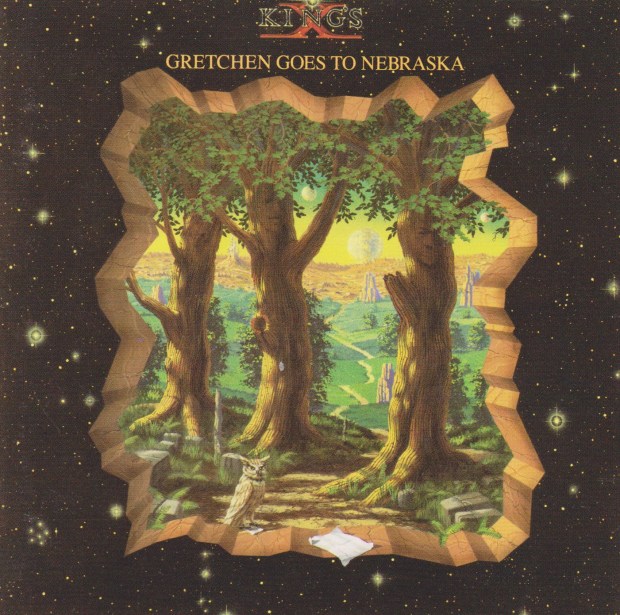
Scan_20151018KING’S X – Gretchen Goes to Nebraska (1989 Atlantic)

Only a year — one measly year! — after debuting with one of the most dearly beloved first albums in memory, King’s X summoned the muse for a second time.  They went back into the studio with Sam Taylor to repeat the magic.  Repeat it they did, with their original blend of influences and talents, but without backing off one inch in compromise. They did make a couple corny but cool music videos, although the rarity of their airplay must have frustrated everyone involved.

“Over My Head” surely made the band look and sound cool. Their souls-meets-metal-meets whatever they want vibe is concisely summed up in under five minutes. “Grandma used to sing, grandma used to sing, every night when she was prayin'” says Doug, opening up old wounds that he would still be singing about for years. But it’s not dark; instead, the music is as uplifting as a church choir. But only if the church band featured Jimi Hendrix and the Isley Brothers.

Production is improved on Gretchen, and diversity has expanded once again. “Out of the Silent Planet” (the title track for the last album!) opens with sitar, but before too long a very Rush-like riff is enveloped by the lush psychedelic harmony vocals that Doug, Ty and Jerry create so naturally. Clearly the band did not take summer holidays that year because the growth is audible. Layers of guitars, sitars and unknown sounds create a swirl of purple haze. And listen to Doug’s chiming bass on the outro. What’s that you hear? Yeah, it sounds like the bass outro to “Jeremy” to me, too. Jeff Ament of Pearl Jam once said that “King’s X invented grunge”. I don’t think that’s true although it probably indicates that some smart guys in Seattle had good taste in music. I think Doug Pinnick invented the way that he and Ament play bass. If you hear Pearl Jam occasionally in King’s X, I think that’s the part that was tapped by Jeff Ament via Doug Pinnick.

Gretchen may be challenging like Silent Planet was, but King’s X try to make it easy for you to climb aboard the train. The light melodic picking in “Summerland” sound enticing so just come on in. Doug’s soulful wailing brings the clouds but Ty’s harmonies blow ’em back away. “Summerland” is a rock triumph, possessing drama with melody and integrity in a flawless mix. Back to church again on “Everybody Knows a Little Bit of Something” — but only briefly as we are now on funky ground. Accelerated for action, “Everybody Knows a Little Bit of Something” is a pulse-pounder not to be missed. King’s X can do no wrong, especially when combining disparate elements in new ways. Another side of King’s X is the acoustic one often visited by Ty Tabor, and that’s “The Difference”. The setting feels like a chilly fall day but King’s X paint pictures that allow you to see your own images. That’s the beauty of the music.

“I’ll Never be the Same” is more familiar King’s X territory. Never keeping it simple, never making it inaccessible must have been the motto. Their pool of influences seems to come out slightly different each time. Church organ (by Sam Taylor) makes its debut on “Mission”, an appropriate place for it, but that’s a bluff. “Mission” is actually a metallic assault on televangelists. “What is the mission of the preacher man?” asks Doug in an impassioned wail. “Some are true, Some do lie,” he warns. “Fall on Me” will then take your head off with some of the rockingest King’s X on the album. If a record label was looking for an accessible single, here it is. I guess this band really was just too smart for radio, like with the cosmic “Pleiades”.

Far off in the field I see a castle,
Today the people gather at the pole,
He tried to tell us all the world was spherical,
They burned his body but not his soul.

Keep in mind this is a band that is often lumped in with Christian rock!  But what about the riff?  Imagine the love child of Ritchie Blackmore and Jimmy Page.  They had a baby and named it “Pleiades”.

Pinnick brings the soul back on “Don’t Believe It (Easier Said than Done)”.  “This is not the end of the road,” he sings and he’s right — even though it is track 10, it’s not the end.  King’s X beefed up Gretchen with 12 tracks, a rare bounty in 1989.  But this was not a normal band.  These was an inspired trio with thoughts and feelings to get off their collective chests.  “Send a Message” keeps the pace upbeat but not straight; there have to be some twists and turns.  Ty then takes the final track with “The Burning Down” and a mellow ballad.  Floyd meets Rush meets King’s X, and it’s over.

The first two King’s X albums boasted rich and impressive album art.  Gretchen is the best of the pair.  Now that’s an album cover; the LP at least anyway.  On CD it’s much harder to appreciate.  No matter since it’s the music that counts.  It’s rare for a band to grow from an incredible album like Silent Planet to something even bigger like Gretchen.  That’s exactly what King’s X did, even though they did it in obscurity.

5/5 stars

REVIEW: King’s X – Out of the Silent Planet (1988)

QUIZ

SERIES DEBUT

Join us for a serious look at every King’s X studio album!…and more.

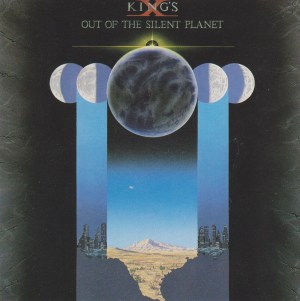
Scan_20151018KING’X – Out of the Silent Planet (1988 Atlantic)

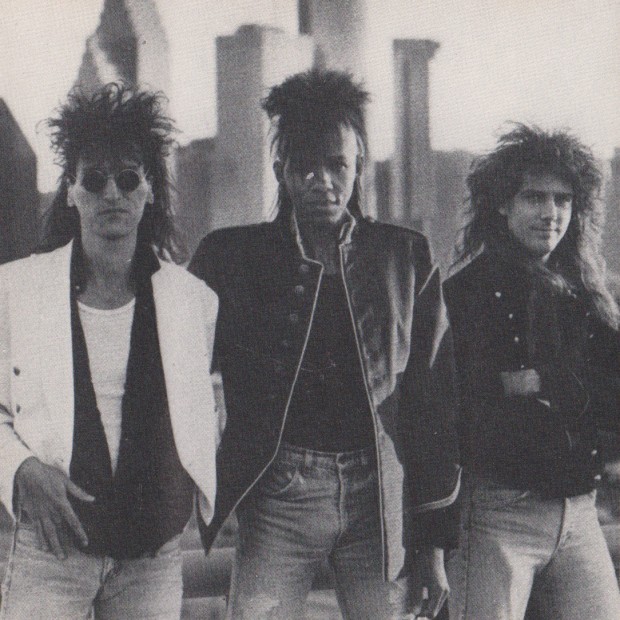
The Texas Trio, the soul-bringers of progressive rock…call ’em what you want (I just did, I made those two titles up), King’s X are too important for you to ignore any longer.  If you have been aboard the King’s X train already, then you know what I am about to tell you.  If not, then realize that this band has been tragically ignored for aeons.  Since 1983 in fact, as Sneak Preview, a glammy rock band who released one record before changing direction and name to King’s X.  Even though Sneak Preview were certainly not hinting that there was more beneath the surface than just some good sounding rock and roll, it was obvious that they had the ability to write and to play.  They made a few music videos, and “Linda” depicts them delivering hooks more typical of Bon Jovi or Van Hagar.

Supposedly, the band were not happy with the way the Sneak Preview album turned out. Of 1000 copies made, half were reportedly destroyed on purpose. Today copies sell for over $200.

Newly christened as King’s X, the band and producer/manager Sam Taylor went into the studio for Megaforce, a division of Atlantic, the label that launched Led Zeppelin. They emerged with one of the most startling and important debut albums of the 1980’s, Out of the Silent Planet.  Starkly original and different, King’s X took the critics by storm.  If only the record buying masses followed their lead.

According to esteemed scholar and Sausagefester Scottie Geffros, “From Out of the Silent Planet right up to Tape Head (1998), there is so much good stuff that the world in general should be embarrassed that ‘music fans’ never caught on to the greatness that is King’s X.” Adds fellow ‘Fester Johnny Cheddar, “I remember the first time listening to Out of the Silent Planet with Dr. Dave…we had been on a music buying mission, and he found an elusive vinyl copy; going cheap if I recall. It was a hard album to come by in those days. I was amazed to hear such a heavy riffy metal sound, but without the sinister vibe that goes with it.”

Starting with a dramatic space rock intro, “In the New Age” soon introduces the core King’s X sound:  The soul, the dual vocal talents of Doug Pinnick and Ty Tabor, and their unique cross of influences.  Ty and Doug have voices on opposite sides of the rock spectrum.  Ty sings high and clean with a hint of Lennon, and Doug goes deep to the howling limits of his soul.  Their trio format, with Jerry Gaskill (another talented singer in his own right) on the drums still allowed them to create expansive rock.  They were not writing anything simple or pandering anymore; “In the New Age” boasts daring changes and a progressive bent that major labels weren’t usually hawking.
The central song might be the ballad “Goldilox”.  On this track, the band have married a knack for a good pop song without compromising their integrity.  “Golidlox” is a spring-like, bright song of hope.  Doug Pinnick has a voice to be envied by anyone, with power and the ability to evoke the classic soul singers of an era gone by.  The other two back him to form a lush curtain of slightly psychedelic harmonies.

“Power of Love” has a pop rock chorus, but punched up by the hard hitting band.  Vocally, this is a soul anthem.  Musically, it’s anthemic rock and roll, good for head-banging or banana-dancing.  It’s up to you — and that’s the “Power of Love”!   Although hard rock songs not unlike this were getting played on the radio, King’s X were probably too smart for radio.  “Power of Love” melds seamlessly into “Wonder”, a song about divisions between us.  “There’s a wall between us, a partition of sorts.”  Yup, too smart for radio.  Chunky like good peanut butter, and still fresh today, “Wonder” is indeed still a wonder.  “This is church, this is state, rock and roll, Amazing Grace.”  Then, “Should I go to the front, should I go to the back?  Should I just pray or should I attack?”  Considering it’s Doug singing (Doug is black), I wonder if some folks of limited intelligence might have found those lyrics just a little scary?  This is some powerful shit.

Doug sounds wracked with pain on “Sometimes”, again tormented by the world he sees around him.  As King’s X progressed, so too would Doug’s subject matter and way of approaching it.  In 1988 he was deeply religious. “I stand here waiting for new Jerusalem, I know it’s greater than the world outside.”  The pain subsides on “King”, which is an incredible high water mark of songwriting…and it’s on a debut album.  Consider that for just a moment.  Again Doug is using Biblical imagery in his words, but King’s X did not seem to preach.  Even if some were starting to suspect that the titular “King” was Jesus Christ himself, hey look an awesome guitar solo!

The rumblin’ bass of Pinnick shakes your teeth on “What is This?”  Heavy and melancholy until the chorus kicks in, “What is This?” nails it again.  “Far, Far Away” ceases the slamming temporarily, for some 60’s textures and dreamy Van Halen-esque chops.  “Shot of Love” has a slight but noticeable jangle to its marching riffage.  Out of the Silent Planet boasted numerous styles of rock on one album but also usually within a single song too.  “Shot of Love” recalls gospel, marches, Queen, Judas Priest and Supertramp.  Finally, “Visions” is heavy on riffage, combined with heavenly choirs of vocals.  Sabbathy riff changes, Motorhead tempos, Eddie Van-shred, and Beach Boys harmonies.  Put that in your pipe and smoke it.

1988 came and went, with King’s X winding up on many critics’ top 10 lists.  As luck or perhaps just taste would have it, that did not translate into sales.  But in 1988 that didn’t mean the end.  That just meant you go back into the studio and make another album.  A better album.

5/5 stars

Scan_20151018 (3)

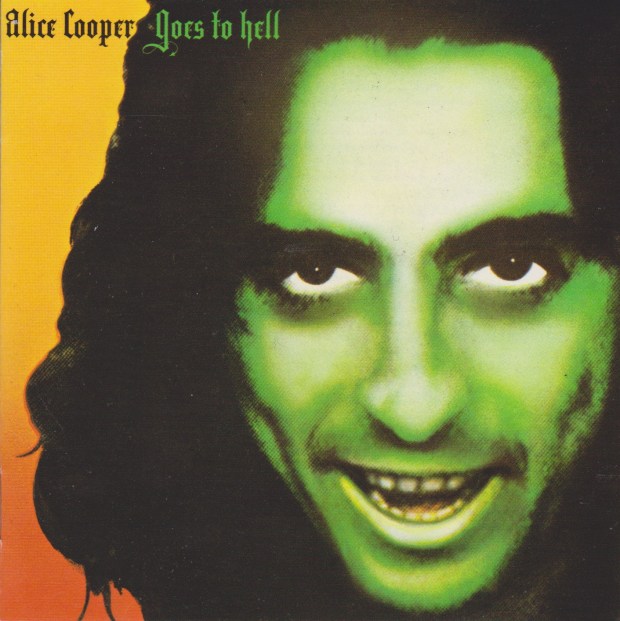
REVIEW: Alice Cooper Goes to Hell (1976)

Happy Halloween, folks!  And what better way to celebrate this day than with the king of horror rock, Alice Cooper?

ALICE COOPER – Alice Cooper Goes to Hell (1976 Warner)

Last time, he welcomed you to his nightmare.  Now, journey with Alice as he takes you straight to hell!  Subtitled (in the inner booklet) as “A Bedtime Story”, Alice Cooper Goes to Hell is another concept album, to follow a concept album.  Steven is back.  It’s a pretty mad concept, and one that ties into not only Nightmare, but also Nightmare 2, decades later.  Steven will fall asleep, and follow Alice down a dark endless staircase, “the pit where he doesn’t want to go, but has to.”

Written and produced by Alice, Bob Ezrin, and Dick Wagner, Goes to Hell features a backing band with a name you might recognize: The Hollywood Vampires.  It’s not the same band, obviously (Johnny Depp was 12 years old), but it does demonstrate just how long Alice has been using that name for a band.  Among the many musicians herein, you will recognize many:  Steven Hunter, Dick Wagner, Tony Levin, and Allan Schwartzberg are probably in your record collection many times (credited or otherwise).

Goes to Hell doesn’t have the fire, or the reputation, of Welcome to My Nightmare.  It is the beginning of a long slide that did not fully right itself until after Alice had kicked the booze for good.  It is, however, an under-appreciated album with fun and nuance in the dark shadows.  The title track is one song that still graces the live stage.  Here, Alice seems to be paying for his crimes committed.  “For criminal acts and violence on the stage, For being a brat refusing to act your age, For all of the decent citizens you’ve enraged, You can go to hell!”  You’ll never have so much fun on the road to H-E-double-hockeysticks, this side of an AC/DC album.  Quintessential Alice, this is, and indispensable too.  Anyone who has ever liked the biting humour and celebrated riffs of Alice Cooper will love “Go to Hell”.  Bob Ezrin adds the usual accompaniment to the mix:  horns, keys, and gang vocals condemning Alice to hell!

A full three years before Kiss, Alice Cooper went disco.  If you like disco rock metal music, then “You Gotta Dance” to this one.  This is a track that some Alice fans would probably love to bury, but it has its moments.  Steve Hunter plays a wicked funky guitar solo.  There is always instrumental integrity.  “I’m the Coolest” slows the pace to a jazzy drawl.  At this point I imagine the character of Alice is meeting various people down in hell, perhaps the man in charge himself.  “Didn’t We Meet” suggests this.  “To look at you, deja vu, chills me to the core.”  Then, “They say you’re the king of this whole damn thing.”  These three tunes are all quite a departure from hard rock, but Alice has always been so diverse.  The hit ballad “I Never Cry” (#5 in Canada) is very pretty, unusually so for Alice.  It is, according him, an “alcoholic confession”, and not the only moment on the album that touches on his drinking.

The first side of the album has some great tracks, but only the first (“Go to Hell”) really rocks.  Side two is similarly diverse and dark.  “Give the Kid a Break” is a campy musical number, with Alice pleading his case before the judge.  “I don’t know why I’m down here, I don’t deserve to roast or bake.”  Predictably, things don’t go well, since the next song is called “Guilty”!  “Guilty” is the hardest rocker on the album, and one of the only songs to be played live occasionally through the decades.   Not that all the other songs on the album suck; Alice just sounds right when he’s rocking like he always has.  And the lyrics rule:

Just tried to have fun, raised hell and then some,
I’m a dirt-talkin’, beer drinkin’, woman chasin’ minister’s son,
Slap on the make-up and blast out the music,
Wake up the neighbors with a roar,
Like a teenage heavy metal elephant gun.

If you call that guilty, then that’s what I am.
I’m guilty, I’m guilty!

This is right up the alley of a tune like “Escape” from the last album.  It’s a shot in the arm and just when you need it.

With “Wake Me Gently”, we are back in ballad land, and it is unfortunately the longest song on the album.  It sounds like an Ezrin creation, but in comparison to his other works, it is among his lesser creations.  The string section is the highlight.  Then he turns up the funk again for “Wish You Were Here”, with the help of Wagner on funky gee-tar.  “Havin’ a hell of a time my dear, wish you were here.”  Sounds like Alice has more than enough of hell by now.  Steve Hunter plays the blazing Lizzy leads at the end of the song.

In a surprising-but-not turn, Alice pulls “I’m Always Chasing Rainbows” out of the hat, an old Vaudeville song (1917) once performed by Judy Garland in 1941.  It actually works within the concept of the album, and predictably, Alice perfectly camps it up.  It blends splendidly into “Going Home”, with Steven finally escaping his nightmare.  Was it a nightmare?  “I wonder what happened to Alice,” he ponders.  This is pompous, overdone Ezrin, just the way you like it.  Orchestration and thunderous percussion lend themselves well to this dramatic close.

It’s pretty clear that the reason Alice Cooper Goes to Hell is not as fondly remembered as Welcome to My Nightmare is the sudden change in direction to balladeer.  There are only three rocking songs on an album of eleven tracks, and Alice was always primarily a rock artist, albeit an experimental one.  You still found his records in the “rock” section of your friendly neighbourhood record store.  Three rockers aside, the rest is a diverse assortment of music, well put together and played.  Clearly, that has to be the key.  But there is more to it than that.  Nightmare seemed a more celebratory affair.  It felt lively; it felt alive.  Goes to Hell sounds less so.  Alice’s lungs seemed weakened, just a smidge, from how they used to bellow.

Alice Cooper Goes to Hell is worthy of praise, not derision.  Just remember — it’s not a rock album.  At best it’s rock opera.  Proposed analogy:  Goes to Hell is Alice’s Music From the Elder.  They even have the same producer!

3.5/5 stars

Happy Halloween kiddies!

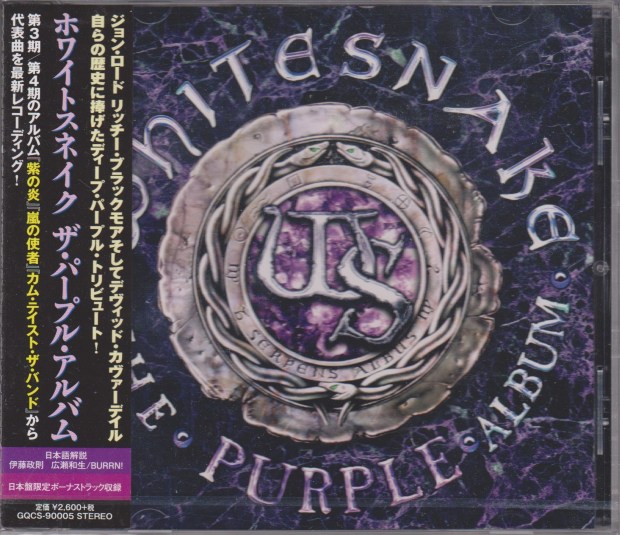
REVIEW: Whitesnake – The Purple Album (2015 Japanese & deluxe editions)

WHITESNAKE – The Purple Album (2015 Frontiers,  Japanese & deluxe editions)

One old school buddy of mine, Rob Vuckovich, was a huge David Coverdale fan back in the 1980’s, but mostly a Deep Purple fan. He took great pride in telling me that he went to see Whitesnake on the 1987 tour. He held aloft a sign that said “PLAY PURPLE”. David reportedly acknowledged his sign by saying, “We’re not doing any of that!” What changed?

Jon Lord’s dying wish to his friend David Coverdale was to somehow reform Deep Purple MkIII. “Life’s too short and too precious to hold any animosities,” learned David after Lord’s passing. He reached out to Candace Night, wife of Ritchie Blackmore, and eventually spoke to the Man in Black about a Lord-less reunion. Blackmore was intrigued and David started working on updated arrangements for the tunes. He didn’t want to sing them in the same way that he did in his 20’s. The situation with Ritchie didn’t work out, but David did not want the work he had gone to on the new arrangements to go to waste. He approached his band and asked them what they thought about a Deep Purple covers album. The response was instant. Joel Hoekstra (guitar) in particular was pumped.

The result is The Purple Album. Sourced from Coverdale’s three albums with Deep Purple (Burn, Stormbringer, and Comes Taste the Band), 15 songs were selected. It’s hard to argue with the selection, either. There are chances taken. “Holy Man” is a damn hard song to sing, and it was originally performed by Glenn Hughes, not David. And four, count ’em, four songs (on the deluxe) from Come Taste the Band, perhaps the most underrated album in the Purple canon.

Scan_20151007 (6)

The sound is “Snaked up” as David says, which means modern guitars and technical shredding. To his credit, David really let his band play instead of copying Deep Purple. Joel Hoekstra is a hell of a guitarist, able to shred. He has brought some soul back to Whitesnake that I felt was missing from their two studio albums with Doug Aldrich. Other songs are stripped down, such as the now-acoustic “Sail Away”. This song is dedicated to Jon Lord and it’s certainly among the best songs on The Purple Album. It’s very “live” in the studio.

Is it necessary? Hell no, but David’s entitled to do what he wants. Nobody else is keeping these songs alive except for Glenn Hughes now and then. Jon Lord would be delighted with the quality of it, but he would surely be saddened that Deep Purple MkIII has never reunited. Since that was indeed the case, David and Whitesnake worked very hard on plenty of new parts and licks for their own arrangements. Reb Beach sings many of the Glenn Hughes lead vocal parts (quite well), and finally Whitesnake feels like a real band again. It’s odd that it happened on a Deep Purple cover album, but the band sound like a real band, on album for the first time in ages. Hopefully the injection of passionate young blood in Hoekstra and new bassist Michael Devin will result in new music some day.

The deluxe edition of The Purple Album comes with two bonus tracks and a loaded DVD. “Lady Luck” and “Comin’ Home” from Come Taste the Band are actually two of the best selections. It’s rare that bonus tracks are album highlights, but just because these songs are not as world-renowned as “Burn” does not mean they are not as good. They’re awesome. “Comin’ Home” is very different from the original, having a new and very Whitesnake (circa Slide It In) riff installed.

Japan usually get exclusive bonus tracks and this time it’s a different mix of “Soldier of Fortune”. The reason for the alternate mix (according to the documentary DVD, which we’ll get to) is that David was somewhat torn on which version he liked best. The original concept was a straight acoustic version, with just David’s voice and an acoustic guitar — one guitar, like in Deep Purple. That version didn’t make the album. In a last minute decision, David chose to record bass and other embellishments, and that is what you hear on the standard album. The lucky fans in Japan (or those who wish to shell out for an import!) get the original concept as a bonus track. Delightful.

The bonus DVD is a nice treat, for the 30-minute “Behind the Scenes” feature. It’s great to see the band get so much face time, talking about their love of Deep Purple. Things like this aid in your appreciation of the final album. Observations: Reb Beach does a hilarious Coverdale impression. Tommy Aldridge is still an unstoppable beast of a drummer, even today. Indeed, the new Whitesnake lineup comes across as an inspired band. It is a brand new era for Whitesnake, according to David. He is happier with their sound than he has been in years.

Then there’s the fluff, the Whitesnake EPK (electronic press kit) which is just a condensed version of the main feature. Added to this are four music videos. It’s almost amusing that Whitesnake made music videos today, but again the band get a lot of face time and that’s cool. In the music videos, it really seems like Whitesnake are a band regardless of the lineup changes. The videos are glossy, a little cheesy, but a nice little add-on.

The original rating for this album was going to be 3/5 stars. Cover albums just can’t be judged by the same yardstick as an album of original material. Having seen and heard how much passion and work Whitesnake put into The Purple Album, I’ve grown to appreciate it more. Therefore:

3.5/5 stars

REVIEW: Bon Jovi – New Jersey (Super Deluxe, part 2)

Concluding an in-depth review of the Bon Jovi New Jersey Super Deluxe edition. Previous reading:

BON JOVI – New Jersey (2014 Universal Super Deluxe edition, part 2)

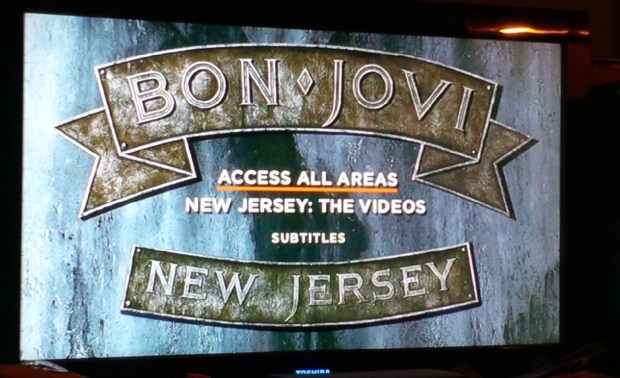
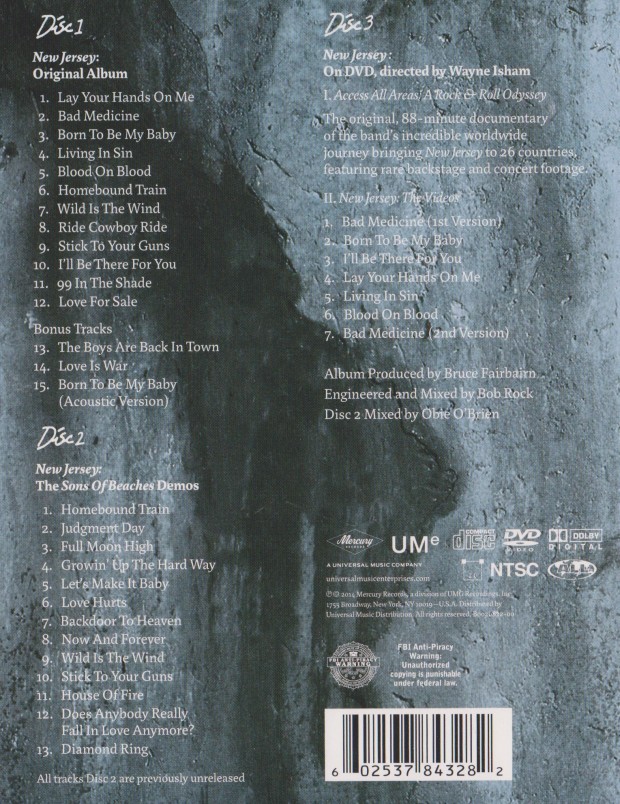
Of all the Bon Jovi albums, New Jersey certainly deserved the Super Deluxe treatment.  New Jersey‘s promotional cycle included two VHS releases, both present on this DVD: The old Wayne Isham tour documentary Access All Area, and New Jersey: The Videos.  Isham was responsible for virtually every cool larger-than-life video Bon Jovi made.  In 1988, trendy grainy black and white footage was all the rage, and so Access All Areas, where we will begin, has an over-abundance of it.

In a piece of incidental pre-show rehearsal footage, Richie Sambora sings “Purple Rain”, proving who the talent in the band always was.  It is nice though to see everybody in the band hanging out, having a good time, and seeming like genuine friends.  As for the audience, it’s amusing to see the giant hair from the perspective of today.

The sound of “Bang” by Russian metal band Gorky Park indicates we’re off to the Soviet Union.  Bon Jovi were pioneering in being one of the only hard rock bands to play behind the Iron Curtain (they were officially sanctioned by the government), and this part of the show is certainly the most interesting.  Bon Jovi even have a ten-man blues jam with the Russian band, building bridges at the end of the Cold War.  The blues is universal.  This visit leads to the massive Moscow Music Peace Festival, which I had on tape from MTV, and wore completely out.  (Not shown: the backstage moment when Tommy Lee rips the shirt off Bon Jovi manager Doc McGhee’s back, for allegedly upstaging Motley Crue by using fireworks in Bon Jovi’s show, against prior agreement.  It’s a long he-said she-said story involving McGhee who was managing both Motley and Bon Jovi at the time.  Motley felt McGhee had prioritized Bon Jovi, and fired him immediately after.)

The boys have a blast in the warmth of Rio de Janeiro, quite a contrast with snowy Moscow.   In Tokyo they are chased by a swarm of screaming girls.  Through it all, even though they’ve been on the road forever and can’t wait to get home, they maintain themselves with a lot of joking around.  Fortunately Isham captured this endearing footage.  The live rehearsal stuff is also excellent, up close and in the faces of the band.

In a very cool moment backstage at Wembley, Bon Jovi, Cinderella and the Scorpions work on covers together for a big jam.  “Travelling Band”…holy shit, is that Elton John on piano?  Sure looks like it.  Rick Allen, Brian May, Lita Ford!  “I am the happiest kid on Earth!” shouts an excited David Bryan.  Another gig features Bon Jovi with the late comedian Sam Kinison on “Wild Thing”.  At Tower Records, they are threatened with arrest by the riot squad if they perform, so naturally Jon and Richie break out the acoustics and do “Ride Cowboy Ride”.  In swoop the fuzz, who had nothing to worry about.  Alec John Such’s birthday is celebrated in West Berlin, where they visit the wall.  (In a shivery moment, Jon is eyeballed by an East German soldier on the other side.)  Their cover of “The Boys Are Back in Town” is performed, and Jon takes a chip out of the wall.

Jimmy Page is present at a three hour charity gig at Hammersmith, and they jam on “Train Kept a Rolling”.  (Best moment: when Jon sings a Steven Tyler “wha-ga-ga-ga” in it near the end, just like Tyler did in Aerosmith’s version.)  It’s clear that even then Jon was the boss — he alone makes the setlist, and says if something goes wrong he’ll call the shots.  He comments he has “never been so nervous.”  Bad Company’s “Shooting Star” is a duet with Richie Sambora, who had been playing it long before Bon Jovi formed.  It’s a stunning version and it’s hard to imagine Bon Jovi ever doing anything this big again, both in terms of success and quality.

Australia!  “Bon Jovi: We go everywhere, but we live nowhere!” says Sambora.  “Love For Sale” is played at HMV for swarms of long-hairs both male and female (but mostly female).  Sam Cooke’s “Having a Party” is another incredible cover selection, and you have to give Jon credit for that.  The final show is a big multi-gig stand in Guadalajara, Mexico that almost never happened due to “politics” (money) and a riot!  The first gig is postponed to the next day forcing Bon Jovi to play a double-header starting at 11 am!  “We should go on stage in riot gear,” jokes (?) Jon.  (They don’t.)

Access All Areas was a good rock doc for the time.  It feels whitewashed and scrubbed clean of blemishes, but that was music in general in the late 80’s.  The real pleasure is getting to see the other band members hanging out.  Alec John Such seems a funny, talented guy with a great voice.  David Bryan is clearly a lot more gifted than he gets to show off in the band.

The music videos (only mixed in stereo, unfortunately) are all you remember them to be: more mixtures of black & white, and colour footage, golly!  Both versions of “Bad Medicine” are included.  (More Sam Kinison!)  There are funny interludes with the band in between the songs, joking around back stage.  (Special guest: Skip Rope Skid Row’s Dave “Snake” Sabo.)  “Me, if I wasn’t a musician, I’d be a drummer!” says Jon. Of the music videos, “I’ll Be There For You” and “Lay Your Hands On Me” are the coolest, just no-nonsense stage performance clips.  “Blood on Blood”, which I’d never seen before, is a live version.

The DVD portion of this box set is a nice supplement, but you won’t be in a hurry to sit down and watch again.  The black & white/colour back and forth is very tiring.  Fortunately Bon Jovi seem(ed) like a nice bunch of guys from the neighborhood that have loads of talent, and fun to watch in any setting.

DVD: 3/5 stars
Bonus tracks: 4.5/5 stars
Album: 4.5/5 stars

Overall rating:  4/5 stars

Thanks for joining us for this massive review! Back to something else tomorrow.

REVIEW: Bon Jovi – New Jersey (Super Deluxe, part 1)

BON JOVI – New Jersey (2014 Universal Super Deluxe edition, part 1)

BACKLOG! I received this box set over 10 months ago.  We at LeBrain HQ are so busy with so much rock and roll that it has taken that long to finally give this entire box set a proper examination.  Fortunately, we (the “royal” we) have already reviewed New Jersey itself, in March of 2014 before this box set was released.  There is no need to repeat what was said in that review.  It is still an accomplished album worthy of its 4.5/5 star rating.  New Jersey was and easily remains a very high water mark.  For this review we will look at all the bonus tracks and the entire DVD in detail.  All three parts combined will probably give you the most complete look at the New Jersey Super Deluxe edition out there.

There are loads of bonus tracks to discuss, some of which were available before.  Bon Jovi must have known this release was always in the cards.  Look at the track list for their box set, 100,000,000 Bon Jovi Fans Can’t Be Wrong.  Not one of these demos is on that massive five disc box set.  Many of these tracks had been leaked a long time ago on bootleg CDs such as Keep the Faith/New Jersey Outtakes, but never issued by the band.  It’s natural to be cynical and say, “Well they must have been saving them for another box set like this one.”

“The Boys Are Back in Town” is an A-OK Thin Lizzy cover.  When Lizzy wrote this song, Phil Lynott almost had the blueprint for the future of Bon Jovi plotted out.  Bon Jovi, a back who love singing songs about the boys being back in town, were the perfect band to cover it and make it their own song.  Cynics may laugh, but Richie Sambora and Tico Torres are quality players able to inject class into the cover.  Keyboardist David Bryan uses the “organ” setting on his keys to offer appropriate backing for the boys.  It’s hard to have a winner with a Lizzy cover and not sound like a bunch of jackasses.  This one was recorded by Bruce Fairbairn for the 1989 anti-drug compilation Stairway to Heaven/Highway to Hell.

“Love is War” was good enough to be a single in its own right, but it was only the B-side to “Living in Sin”.  Perhaps the reason it was chosen for B-side status was that the verses and chorus don’t quite jibe.  The song has great, dark verses and a big old Slippery-like chorus.  It doesn’t quite sound like a New Jersey song, but it’s hard to track down today.

A very rare bonus track is an acoustic version of “Born to Be My Baby”, only available on a Japanese “Living in Sin” CD single.  Fans love when Jon and Richie just sit down together with a couple acoustics and do a live-in-the-studio rendition of a hit.  It’s an uber-rarity that LeBrain HQ did not even know existed before this box set was issued.  As usual, Richie’s soulful singing reaches deep into your guts.  His classical-influenced guitar solo is a masterpiece.

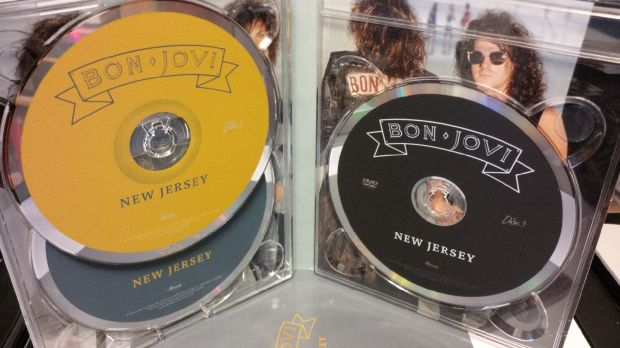
Famously, Bon Jovi once considered the awful title Sons of Beaches for their 1988 album.  Disc two is called the Sons of Beaches Demos and there are plenty more great tracks here that are familiar to bootleg collectors.  The opening demo version of “Homebound Train” is even bluesier and greasier than the great album take.  Anyone who doubts the instrumental ferocity of Bon Jovi can check this out and see what the original lineup was capable of.

IMG_20151004_090939

“Judgement Day” opens with traditional “nah-nah-nah” Bon Jovi vocals, giving it a sound-alike quality to other more familiar Bon Jovi songs.  It is good enough that it could have been on an album (or single B-side).  Then “Full Moon High” (also known as “River of Love” on bootlegs) is familiar.  I recognize the music from somewhere else: it became the Keep the Faith B-side “Save a Prayer”!  The riff is intact, and what “Full Moon High” amounts to is an alternate 80’s version of it.  It is just as great as “Save a Prayer”, and it is difficult to pick a preferred version.  “Full Moon High” is an achievement, and Richie’s guitar playing is nutso.  “Growing Up the Hard Way” is back to the “nah-nah-nah’s”, and it sounds as if this is an early version of “Love is War”, but with a very different chorus.

With a slinky, dusky song behind him, Jon urges someone “Let’s Make it Baby”.  This tune would have been good enough for Keep the Faith, but did not surface until a double disc version of These Days was issued in the mid-90’s.  This is a noticeably different mix from that release — more raw.  Then “Love Hurts” goes into upbeat territory with a decent set of melodies to sing along to.  It is a bit similar to “Love is War” once again, but that’s why these songs were never officially released before.  I’ve had this song in my collection for 20 years, but not with this level of audio quality.  Likewise “Backdoor to Heaven”, a ballad that fans have loved for a long time (just not officially).  Again, this song was probably deemed too similar to others such as “I’ll Be There For You”.  Same with “Now and Forever”, another ballad of high quality, but also similarity.

A harder-edged “Wild is the Wind” demo is otherwise very similar to the album arrangement, with some different bits on keyboards and acoustic guitars.  Singling out Tico Torres as drummer extraordinaire, I love his hard hitting style.  Same with the excellent “Stick To Your Guns”; it’s more or less already complete at the demo stage.  The rawness is a beautiful thing…you can hear Richie talking at one point.

The one track of all of these which LeBrain HQ was most excited about is “House of Fire”, a song that Jon donated to Alice Cooper for his Trash LP.  Cooper’s version was “unremarkable” [LeBrain Trash review], but Bon Jovi did it right.  If Alice didn’t release his own single for it, I wonder if Jon would have?  One word:  infectious.

Fans in the know have always loved “Does Anybody Really Fall in Love Anymore”, another ballad that might be deemed too similar.  Another issue is that the chorus really reaches for the high notes, and Jon misses most of them on this demo.  Somebody probably realized it would be a difficult song to bring to the concert stage.  The bootleg version of this is more complete, with backing vocals filling it out.  This demo, perhaps earlier than the one that was bootlegged ages ago, lacks all backing vocals and sounds like it may be live in rehearsal.  “Keep going,” says Jon to someone, indicating this is likely the case.

IMG_20151004_091117“Diamond Ring” became such a fan favourite after the band played it live that this New Jersey demo was tried out again for Keep the Faith, and finally made an album in 1995 for These Days.  Each arrangement of the ballad was different from the last.  This one is the earliest, featuring bluesy electric guitars and organ.  Its final incarnation was much quieter.

Very conspicuous by its absence:  “Rosie”.  This was written by Richie and Jon about someone they knew growing up (as many of their songs are).  Desmond Child and Diane Warren helped them finish it, and it was recorded by Sambora for his first solo album Stranger in This Town.  Since that album featured Tico Torres and David Bryan on drums and keys, you can almost consider that a Bon Jovi song.  But why is it not here, with the demo sessions that it belongs with?  It’s cynical but not unlikely to think it’s due to Jon and Richie’s feud.  Shame.  There are other Sons of Beaches demos missing that are out there on bootlegs, such as “Love is War” so don’t fool yourself, this is not a complete set of ’em.

Come back tomorrow and we’ll look at the final disc in this set, the DVD.

To be concluded…

Scan_20151004

REVIEW: Judas Priest – Sad Wings of Destiny (1976)

Welcome to PRIEST WEEKEND! It’s a long Thanksgiving weekend in Canada, and…

Well, here’s the truth of it. I had three Judas Priest reviews lined up and needed a spot to schedule them. A three day weekend worked. That’s how much thought went into the scheduling of this Thanksgiving theme.

Enjoy PRIEST WEEKEND starting with their immortal second album…

Scan_20150930JUDAS PRIEST – Sad Wings of Destiny (1976 Gull)

It’s quite a shame that Judas Priest haven’t regained the rights to their first and second albums.  Too many fly-by-night labels have done shoddy or half-arsed reissues of the albums and Sad Wings is no exception.  This one, on Snapper, isn’t too objectionable.  It’s funny to see “digitally mastered” on the front sticker, as if this is some kind of selling feature.  All CDs are digitally mastered!  Remember that old AAD, ADD, DDD logo that used to appear on CDs?  The A and D refers to analog or digital processes: recording, mixing, and mastering.  Every CD is at least AAD.  The “informative liner notes” (by somebody called “Krusher”) is just a blubbering general history essay on the band.

Fortunately, no matter how it’s packaged, the music is exceptional.

“Victim of Changes” defines “epic”, and probably remains Judas Priest’s definitive word on the epic song.  This is actually a mashup of two earlier songs called “Red Light Lady”, written by Rob Halford, and “Whiskey Woman” by original singer and founder, Al Atkins.  That’s how it came to be that Halford shares a writing credit with his predecessor, an unusual circumstance indeed!   The finished song “Victim of Changes” has everything: the concrete heavy riffs, the drama, the melody and the unearthly screams!  It takes its time, but it simply lays waste to the landscape.  By the time Rob nails his final scream, you may find yourself hard of hearing.  As if that wasn’t enough, “The Ripper” (a shorty) contains even more screams-per-minute than “Victim”.  Priest seemed to take a turn away from blues, towards metal on Sad Wings of Destiny.  The first two songs are as sharp and devastating as anything else in the Priest canon.

Although they are often separated on compilations and whatnot, “Dreamer Deceiver” and “Deceiver” are more or less one song.  One sounds incomplete without the other.  “Dreamer Deceiver” is an airy, acoustic number about some sort of ethereal being.  It is as entrancing as its title character:

“We followed the Dreamer through the purple hazy clouds,
He could control our sense of time.
We thought were lost but, no matter how we tried,
Everyone was in peace of mind.”

Rob’s vocal performance on this one ranges from the deep and dramatic, to the wails that Priest fans crave.  It is the blueprint for similar early Iron Maiden tracks such as “Remember Tomorrow”.  Even the guitar solo is a well-composed piece of music, but this is just the beginning.  Morphing into “Deceiver”, the acoustic plucking has changed to an electric chug.  This time the guitar solo blazes rather than cries.  “Deceiver” burns out quick, ending the first side.

Scan_20150930 (3)

Side two begins, as it obviously should, with a piano instrumental!  Glenn Tipton wrote and performed “Prelude” which is really just another track meant for you to let your guard down…before being ploughed over by the evil “Tyrant”!  He is the destructor, and every man shall fall!  The way Rob screams it, you believe it.  This is straight up the alley of prior tunes, like “Ripper” and “Deceiver”:  fast, lean, and heavy as balls!

“Genocide” is a change of pace, a leaning towards the mid-tempo ground that Priest would find great success with later.  There is a Priest stamp to it: a simple 4/4 beat, a couple of cool riffs, verses, chorus and solo…but I like the slow middle section best.  “Sin after sin…I have endured, but the wounds I bear, are the wounds of love.”  Sin After Sin was used as the next Priest album title.  Then, another surprise.  “Epitaph” is a piano ballad with Rob singing with a Queen-like backdrop of vocals.  Only piano and vocals, that is it.  Once again this is a Glenn Tipton song, and even though Priest let on that they had quiet tendencies, this is still a bit of a shocker.  “Pretty” is an appropriate word.  It is a tour de force for Rob, who performed some very intricate singing.

Chugging off to into the horizon, “Island of Domination” is the final track on a purely excellent heavy metal album.  Multi-layered Halford screams usher in the final assault.  Rocking both heavily and intelligently, the mighty Priest finished the album with a blitzkrieg, taking no prisoners.  From gallop to groove, “Island of Domination” has a bit of everything Priest did well.

What an album.  Do you like heavy metal music?  Then you need Sad Wings.  Period.  Exclamation point!

5/5 stars

REVIEW: Gillan & Glover – Accidentally on Purpose (1988)

IAN GILLAN & ROGER GLOVER – Accidentally on Purpose (1988 Virgin)

Shit LeBrain’s Customers Said

I was playing this album in-store one afternoon in the 90’s.  A customer walked up to me and asked what I was playing.

“This is a side project by Ian Gillan and Roger Glover from Deep Purple,” I answered

He responded, “Roger Waters from Pink Floyd?

What…?  No!  No!  You got just two words of that right: “Roger” and “from”!

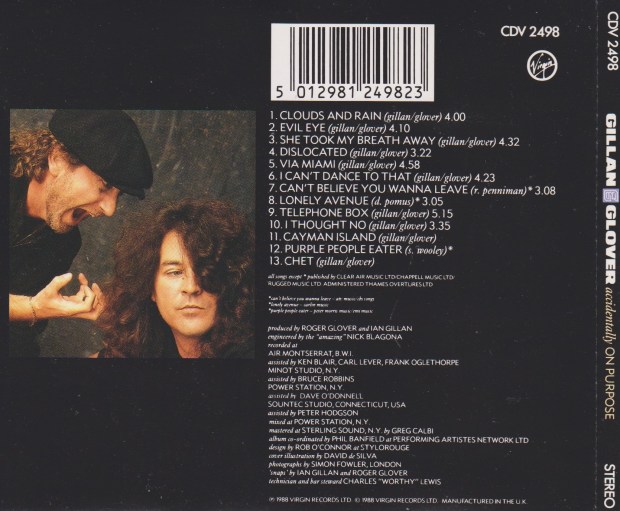
Deep Purple’s The House of Blue Light was an incredibly difficult album to make, especially for Ian Gillan.  A working vacation was in order, so he and Glover took off for the Caribbean.  They settled in to Sir George Martin’s recording studio AIR Montserrat, to record whatever they felt like.  The result was the light and tropical Accidentally on Purpose, an album that Gillan says has become the favourite record for a number of his friends.  He is very proud of it, especially since it came on the heels of a terrible creative experience in Deep Purple.  It would not have been born if not for the gloomy Purple process.  Many guests contributed to the jovial sessions, such as Dr. John, George Young, and Andy Newmark.

Jump in your TARDIS, and travel back in time to 1987.  Your destination:  a tropical island with plenty of rum, beaches and a recording studio.  Can you picture it?  Can you hear the sounds of the late 80’s in your mind?  Then you can imagine what Accidentally on Purpose sounds like.

There are no “Clouds and Rain” in the images in my mind, only boats and surf and sand.  Glover plays bass and keyboards, Newmark is on drums, while George Young contributes a light sax solo.  This is not for most Deep Purple fans, most assuredly.  This is for those who want to open their minds and have a trip into the clouds and sunshine.  This is about as light as light rock gets, but there is a quality to it above the pop morass.

Hard hitting electronic drum beats back “Evil Eye”, a much edgier track.  Still, don’t expect guitars, solos or Ian Gillan to scream his ass off.  If you enjoy the kind of pop rock that Robert Plant was doing in the 80’s, you’re in the right ballpark for this.  It’s blatantly commercial compared to Deep Purple, but at the same time it’s not because there are musical challenges to be found here.

“She Took My Breath Away” is a sweet love song, similar musically to the brightness of “Clouds and Rain”, but relying too much on electronics.  Then they get goofy on “Dislocated” which sounds like Ian Gillan having a blast.  (I recognize one of the keyboard voices on this song from our old Yamaha back in the day!)  Glover’s enjoying himself too; he plays some brilliant bass parts, very different from Deep Purple.  “Via Miami” ended the first side with an old time rock and roll party!   It’s the first significant guitar rocker, and it sounds like something the Honeydrippers could have gotten away with.  (In fact Plant would sound brilliant singing this.)  Bring on the sax!

There is plenty more guitar on “I Can’t Dance to That”, which unfortunately is not a good song.  It is not different enough from Deep Purple rawk, but not good enough for Deep Purple.  The old blues classic “I Can’t Believe You Wanna Leave” is incredible, giving Ian a chance to sing something different, and he does it with lung power!  Dr. John on the keys lends it that funky N’awleans drawl.  If you were to make a mix tape of Ian Gillan’s finest vocal performance, then this song should be on it.  The skippable “Lonely Avenue” only has synth to back it; largely forgettable.  Synth-rocking to “Telephone Box” is more fun; it’s probably the best rocker on the album.  Cool female backing vocals make Gillan sound even more suave.  He breaks out his trusted congas on it, and truthfully you could imagine the Deep Purple of today performing a song like this now.

The last tune on the record was “I Thought No”, rocking bluesily along to the end.  If you want a drunken, laidback jam session with scads of harmonica to go, then “I Thought No” will deliver the right thrills.  Just open a bottle and dive in…but the CD offers three more bonus tracks!   The cool rockin’ blues of “I Thought No” is contrasted by the most nauseating track, “Cayman Island”.  Ian’s done some kind of Jamaican twist to his accent.  Pure synth, with all those keyboard presets I remember from the 80’s, that’s “Cayman Island”!  And I love every second of it, as terrible as it is.  No matter how much you hate “Cayman Island”, you have to be a real hard hearted bastard if you don’t like “Purple People Eater”.  That’s exactly the song you think it is, and who better to do it than the guys from Purple?  You want a golden oldie performed by the guy who loves the golden oldies the most?  I sure do so fuck off if you don’t!  It’s brilliant, and you just gotta dance.  The last song is a synth throwaway called “Chet”, which references a boat called the Carrie Lee; Gillan also name-dropped the vessel in Cayman Island.

Accidentally on Purpose probably kept Ian and Roger sane at the time.  That has to be why it sounds so gleeful.  They needed this.  Does a Deep Purple fan “need” this?  No.  But they’d find some good times here regardless.

3/5 stars

Scan_20151005 (3)

REVIEW: Aerosmith – Jaded (2001 EP)

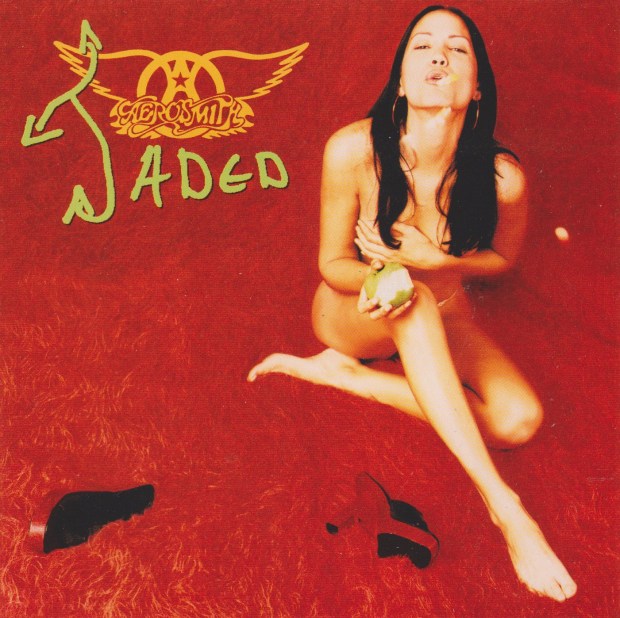
Scan_20150922AEROSMITH – Jaded (2001 Sony EP)

It’s not unfair to suggest that I might be a little J-J-Jaded when it comes to 2000-era Aerosmith. People ask me when I think the decline hit. I answer, the abomination that is “I Don’t Want to Miss a Thing”.  Nine Lives was a good album.  It might not be an Aerosmith classic, but it was good, no two-ways about it.  By the time Aerosmith hit 2001 with Just Push Play, the co-writers and love ballads had taken over completely.

That said, the first single from Just Push Play, “Jaded”, was a pretty good song.  Joe Perry didn’t write that guitar hook, but it’s more the drum part that I am drawn to.  Joey Kramer was capable of turning crap into class (not that “Jaded” is crap), he is so talented.  “Jaded” boasts both catchy verses and choruses, and is firmly ensconced in acoustic-electric-pop land.  I think it’s a great track actually, but in the context of its album, it was one of very few.  You can handle something like this as a commercial track on a single.  On an album where each song is more sold-out than the last, “Jaded” was a very minor victory.

But wait, there’s more!  There is an acoustic and a “guitars mix” of “Jaded” as well.  The stripped down acoustic version is pretty cool although it lacks punch.  If you want to hear the song taken back to the basics without embellishment, here it is, and it’s still a good song.  It just misses the soft/loud contrast of the album version.  The guitar mix is the opposite.  It’s the album track with the electric guitar parts turned up in lieu of the strings.  So with the three tracks, you kind of get it in the full spectrum, from the light to the heavy.  (Incidentally, there’s also a radio remix of “Jaded” out there, on a 2 CD version of Just Push Play from Japan that I don’t have.)

“Angel Eye” is a non-album track from the Charlie’s Angels soundtrack, saving you from buying that CD for one song.  Thankfully it’s a heavy song, but without any serious hooks.  The guitar riff is devastating, but once again, Joe didn’t write it.  When it comes to this aeon of Aerosmith, perhaps we should just be grateful for a heavy song, period?

The final track is a bit of a throw-away at a mere 1:00.  “Under My Skin” sounds like an album outro, or a piece of incidental music recorded for a soundtrack.  I guess it’s a teaser for the full-length song that appeared on the album?  Too bad because “Under My Skin” is one of the most irritating songs on Just Push Play.  I don’t recognize this bit from the song, but I also don’t really want to investigate any further.

2/5 stars

Scan_20150922 (2)