concept album

REVIEW: Alice Cooper Goes to Hell (1976)

Happy Halloween, folks!  And what better way to celebrate this day than with the king of horror rock, Alice Cooper?

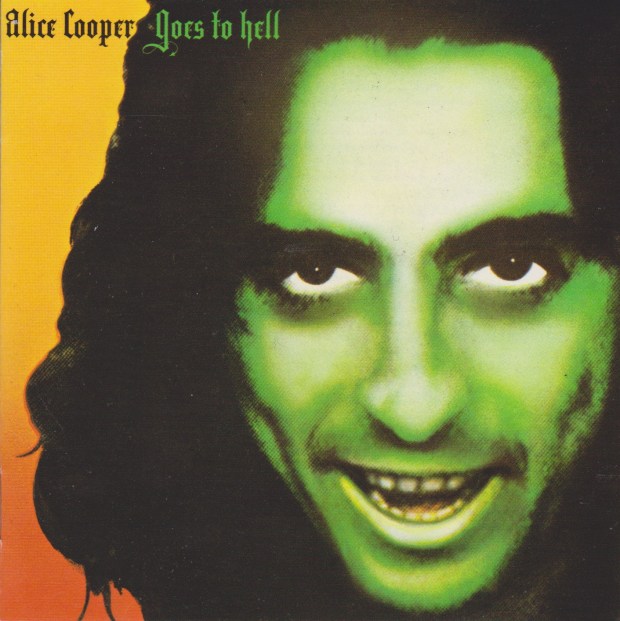
ALICE COOPER – Alice Cooper Goes to Hell (1976 Warner)

Last time, he welcomed you to his nightmare.  Now, journey with Alice as he takes you straight to hell!  Subtitled (in the inner booklet) as “A Bedtime Story”, Alice Cooper Goes to Hell is another concept album, to follow a concept album.  Steven is back.  It’s a pretty mad concept, and one that ties into not only Nightmare, but also Nightmare 2, decades later.  Steven will fall asleep, and follow Alice down a dark endless staircase, “the pit where he doesn’t want to go, but has to.”

Written and produced by Alice, Bob Ezrin, and Dick Wagner, Goes to Hell features a backing band with a name you might recognize: The Hollywood Vampires.  It’s not the same band, obviously (Johnny Depp was 12 years old), but it does demonstrate just how long Alice has been using that name for a band.  Among the many musicians herein, you will recognize many:  Steven Hunter, Dick Wagner, Tony Levin, and Allan Schwartzberg are probably in your record collection many times (credited or otherwise).

Goes to Hell doesn’t have the fire, or the reputation, of Welcome to My Nightmare.  It is the beginning of a long slide that did not fully right itself until after Alice had kicked the booze for good.  It is, however, an under-appreciated album with fun and nuance in the dark shadows.  The title track is one song that still graces the live stage.  Here, Alice seems to be paying for his crimes committed.  “For criminal acts and violence on the stage, For being a brat refusing to act your age, For all of the decent citizens you’ve enraged, You can go to hell!”  You’ll never have so much fun on the road to H-E-double-hockeysticks, this side of an AC/DC album.  Quintessential Alice, this is, and indispensable too.  Anyone who has ever liked the biting humour and celebrated riffs of Alice Cooper will love “Go to Hell”.  Bob Ezrin adds the usual accompaniment to the mix:  horns, keys, and gang vocals condemning Alice to hell!

A full three years before Kiss, Alice Cooper went disco.  If you like disco rock metal music, then “You Gotta Dance” to this one.  This is a track that some Alice fans would probably love to bury, but it has its moments.  Steve Hunter plays a wicked funky guitar solo.  There is always instrumental integrity.  “I’m the Coolest” slows the pace to a jazzy drawl.  At this point I imagine the character of Alice is meeting various people down in hell, perhaps the man in charge himself.  “Didn’t We Meet” suggests this.  “To look at you, deja vu, chills me to the core.”  Then, “They say you’re the king of this whole damn thing.”  These three tunes are all quite a departure from hard rock, but Alice has always been so diverse.  The hit ballad “I Never Cry” (#5 in Canada) is very pretty, unusually so for Alice.  It is, according him, an “alcoholic confession”, and not the only moment on the album that touches on his drinking.

The first side of the album has some great tracks, but only the first (“Go to Hell”) really rocks.  Side two is similarly diverse and dark.  “Give the Kid a Break” is a campy musical number, with Alice pleading his case before the judge.  “I don’t know why I’m down here, I don’t deserve to roast or bake.”  Predictably, things don’t go well, since the next song is called “Guilty”!  “Guilty” is the hardest rocker on the album, and one of the only songs to be played live occasionally through the decades.   Not that all the other songs on the album suck; Alice just sounds right when he’s rocking like he always has.  And the lyrics rule:

Just tried to have fun, raised hell and then some,
I’m a dirt-talkin’, beer drinkin’, woman chasin’ minister’s son,
Slap on the make-up and blast out the music,
Wake up the neighbors with a roar,
Like a teenage heavy metal elephant gun.

If you call that guilty, then that’s what I am.
I’m guilty, I’m guilty!

This is right up the alley of a tune like “Escape” from the last album.  It’s a shot in the arm and just when you need it.

With “Wake Me Gently”, we are back in ballad land, and it is unfortunately the longest song on the album.  It sounds like an Ezrin creation, but in comparison to his other works, it is among his lesser creations.  The string section is the highlight.  Then he turns up the funk again for “Wish You Were Here”, with the help of Wagner on funky gee-tar.  “Havin’ a hell of a time my dear, wish you were here.”  Sounds like Alice has more than enough of hell by now.  Steve Hunter plays the blazing Lizzy leads at the end of the song.

In a surprising-but-not turn, Alice pulls “I’m Always Chasing Rainbows” out of the hat, an old Vaudeville song (1917) once performed by Judy Garland in 1941.  It actually works within the concept of the album, and predictably, Alice perfectly camps it up.  It blends splendidly into “Going Home”, with Steven finally escaping his nightmare.  Was it a nightmare?  “I wonder what happened to Alice,” he ponders.  This is pompous, overdone Ezrin, just the way you like it.  Orchestration and thunderous percussion lend themselves well to this dramatic close.

It’s pretty clear that the reason Alice Cooper Goes to Hell is not as fondly remembered as Welcome to My Nightmare is the sudden change in direction to balladeer.  There are only three rocking songs on an album of eleven tracks, and Alice was always primarily a rock artist, albeit an experimental one.  You still found his records in the “rock” section of your friendly neighbourhood record store.  Three rockers aside, the rest is a diverse assortment of music, well put together and played.  Clearly, that has to be the key.  But there is more to it than that.  Nightmare seemed a more celebratory affair.  It felt lively; it felt alive.  Goes to Hell sounds less so.  Alice’s lungs seemed weakened, just a smidge, from how they used to bellow.

Alice Cooper Goes to Hell is worthy of praise, not derision.  Just remember — it’s not a rock album.  At best it’s rock opera.  Proposed analogy:  Goes to Hell is Alice’s Music From the Elder.  They even have the same producer!

3.5/5 stars

Happy Halloween kiddies!

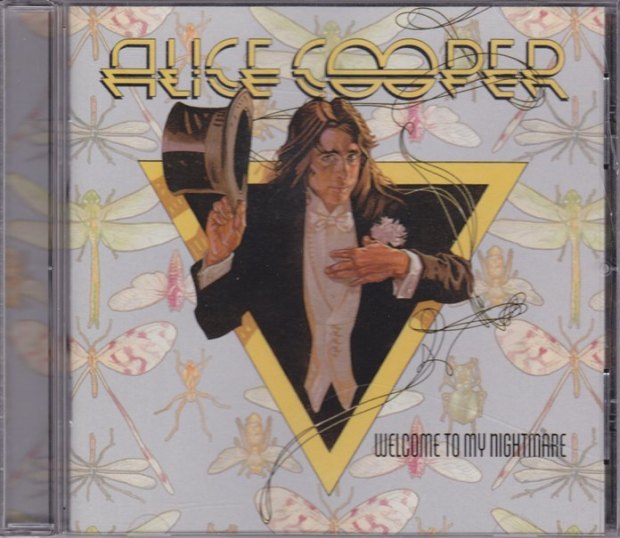
REVIEW: Alice Cooper – Welcome To My Nightmare (1975)

WELC0ME TO_0001ALICE COOPER – Welcome To My Nightmare (1975)

My sister used to have a tradition.  Because I’ve always been a collector, she would have an easy time buying gifts for me as a young rock fan.  When I was 17 years old,  I only had a few albums by certain artists.  She’d sneak into my room and go over my collection.  She saw that I only owned a few of Alice Cooper’s:  Trash, Prince of Darkness, Billion Dollar Babies, and Greatest Hits.  For Easter of 1990, she got me Alice’s Welcome to My Nightmare.  Not knowing what to except from the Coop, it was pretty much instant love.

I played that cassette a lot and grew to know its track sequence, which was completely different from CD.  Later on I purchased the original CD release, but what Welcome To My Nightmare needed (and the rest of the Cooper catalogue needs) is a proper remaster with bonus tracks.  Rhino took care of that in 2002.
Now the album itself sounds so much better than the original CD. This sounds more like vinyl, the way it should, rich and deep. The liner notes, unfortunately, are somewhat crappy. They basically just explain to the youth of today why Alice Cooper is cooler than the bands they like. There’s not much about the genesis of the album, which is disappointing. This is, after all, the very first solo album by Vincent Furnier aka Alice Cooper. By 1975, the Alice Cooper band (Furnier, Michael Bruce, Dennis Dunaway, Neil Smith, and the late Glen Buxton) was no more. Never again would they share a stage or a recording studio, at least the original five.  The four survivors did finally re-team for a couple songs on 2011’s sequel, Welcome 2 My Nightmare.

Welcome To My Nightmare was a revelation to me when I received it, and it is still mind-blowing today. I think that is due to the production talents of Bob Ezrin. The man who later produced Destroyer and The Wall really came into his own on this album. His production is, for lack of any better words, jaw dropping. You can totally tell it’s him, if you know his style well enough: that creepy horror movie piano, all the orchestrations, sound effects, the kids singing. Those are trademarks. My favourite moment for the kids was in the song “Department of Youth”. Cooper and the kids sing in the fade-out:

Together – “We’re the Department of Youth, ahh ahh, we got the power!”
Alice – Who got the power?”
Kids – “We do!”
Alice – “And who gave it to you?”
Kids – “Donny Osmond!”
Alice – “WHAT?”

Loosely, this is a concept album about the kind of nightmares Alice would have.  The result was a collection of remarkably timeless and classic songs:  “Only Women Bleed”, “Black Widow”, and “Escape” for example. “Escape” is the most straightforward rocker on the album, and a joy it is. The rest is often more complex, arrangement-wise and lyrically.

The title track is a fun rollercoaster ride with epic horns.  Same with “Devil’s Food” and “The Black Widow” which work together as a creepy classic featuring Vincent Price.  I would not want to live my life without these songs.  Alice is nothing if not diverse, and then “Some Folks” sounds showtune-y.  “Only Women Bleed” is the famous ballad, often misunderstood, but respected enough to be covered by artists such as Lita Ford, Tina Turner, and Etta James.

“Department Of Youth” and “Cold Ethel” are more rock and roll, and why not?  What better genre to sing about rebellion and necrophilia?  It’s worth pointing out the guitar charms of Steve Hunter and the late Dick Wagner.  These two incredible players, under the guidance of Ezrin, lent Welcome To My Nightmare the rock edge that it needed, lest it be swallowed up by the dramatic tendencies.

Of course, Welcome To My Nightmare features the first-ever appearance of the character of Steven. “Years Ago” has Alice singing in this incredibly creepy little-kid voice, as Steven. Then the song “Steven” kicks in, and it’s even creepier, but very epic in scale. Alice is at his most effective here.  Steven would pop up many times, such as on the next album Alice Cooper Goes To Hell, 1991’s Hey Stoopid, 1994’s Last Temptation, and the more recent Along Came A Spider.  Whether it’s supposed to be the same guy, or just a character who shares the same name, I do not know.

The bonus tracks are alternate versions of “Devil’s Food” (much extended), “Cold Ethyl”, and “The Awakening” with alternate lyrics and more Vincent Price! Not available on the Life and Crimes of Alice Cooper box set! These three tracks alone, to the Cooper collector, necessitate a re-buy.  The improved sound probably would have hooked them in anyway.

I could never say, “If you only buy one Alice Cooper album, buy this one.” The reason I can’t is that almost every album by the original Alice Cooper band was monumental, particularly School’s Out and Billion Dollar Babies. However, if you buy two or three Coops, please make one of them Welcome To My Nightmare, remastered!

5/5 stars

* There is also a DVD Audio of this album mixed in 5.1 by Bob Ezrin himself!

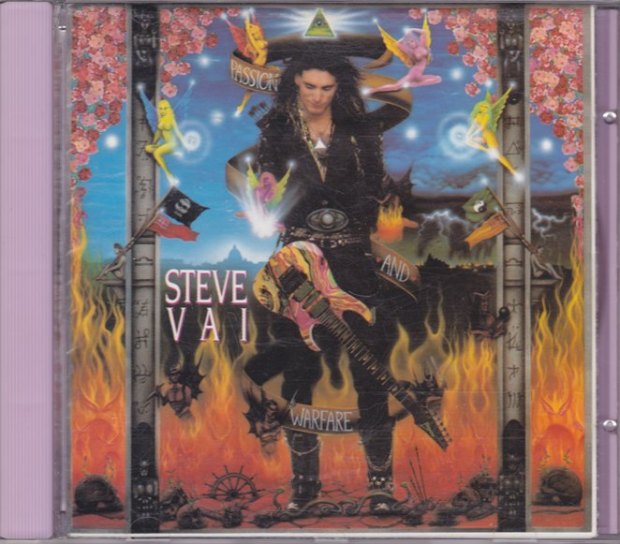
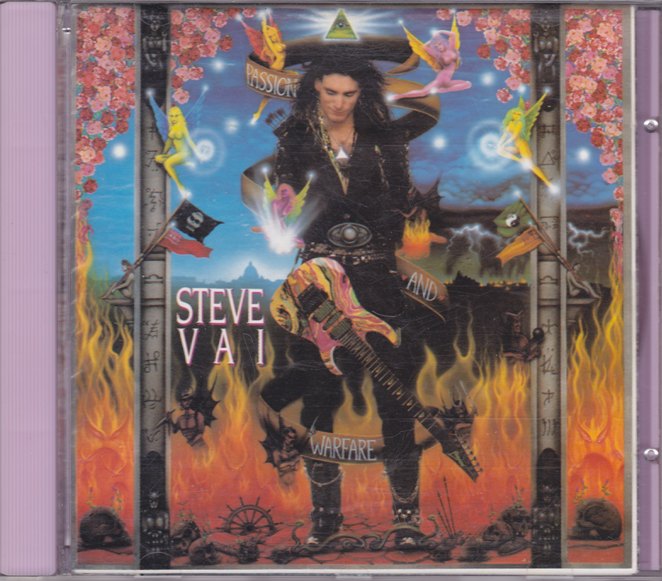
REVIEW: Steve Vai – Passion and Warfare (1990)

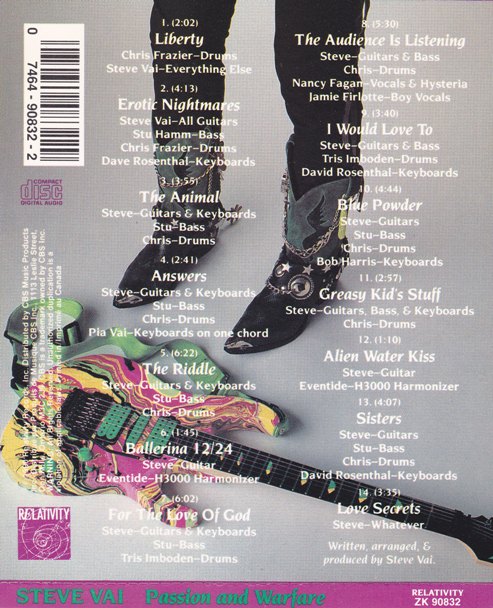
PASSION AND WARFARE_0001STEVE VAI – Passion and Warfare (1990 Relativity)

Passion and Warfare was released in 1990.  I didn’t expect it to chart, but it did!  It was an exciting time for instrumental guitar records.  Joe Satriani had recently become a household name with albums such as Surfing With the Alien and Flying in a Blue Dream, but Flying had vocals on some songs.  Now his student Steve Vai was on the charts with his own solo album.

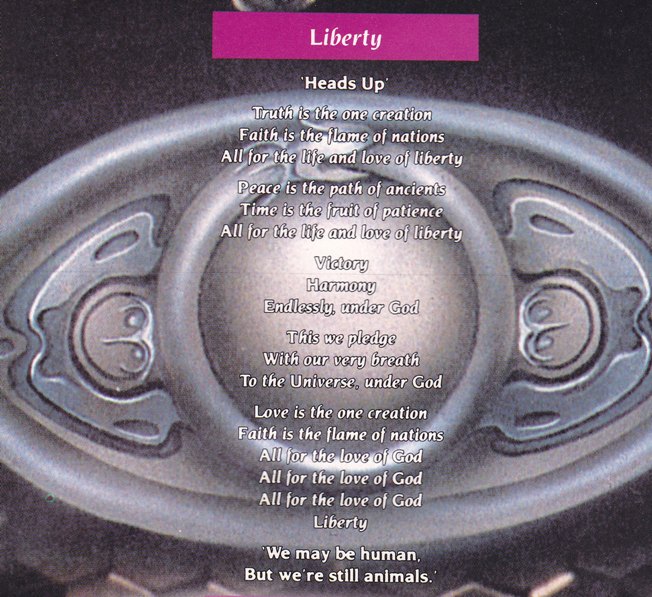
Different from Flex-able, which was basically just released demos, Passion and Warfare was a fully realized piece of art.  Some consider it to be Steve’s “real” debut album.  Some of the music dated back almost a decade.  “Liberty”, said Steve, was a melody he heard in a lucid dream and tried to recall.  Of the dream, Steve remembered saluting a flag he didn’t recognize, with an anthem playing.  “Liberty” opens the CD, which is actually a lyricless concept album.  Steve Vai is nothing if not ambitious.  There is some dialogue on and between songs (some performed by Steve’s then-Whitesnake bandmate David Coverdale), and the liner notes trace out some of the dreams that inspired the music.

Lyrics for a song that has no lyrics!

Lyrics for a song that has no lyrics!

“Erotic Nightmares” is self-explanatory.  Steve composed a chunky rock track with so much guitar that I doubt he even knows how many tracks of shredding is on it anymore.  Guitars build layer after layer, playing melodies that don’t seem possible to perform with fingers.  It’s not mindless shredding for the sake of shredding.  The “concept album” aspect means that the songs have movement and go to different places, trying to convey these ideas to the listener.  Steve used an Eventide harmonizer to give his guitar flute and keyboard-like tones.  Those bizarre sounds compounded with Steve’s impossible fretwork means this is one hell of an ambitious song and album.

Steve was using his new Ibanez 7-string guitar exclusively now.  I believe he stated in an interview that there is hardly any 6-string on Passion and Warfare at all.  It’s that 7th string that enables Steve to dig low on the groovy “The Animal”.   With the expert rhythm section of Stu Hamm (bass) and Chris Frazier (drums), there is no way this would suck.  Steve remembers to throw enough melodic hooks down to keep it listenable for laypeople.  “Answers” is less accessible, a cute dance of strange munchkin-like melodies.  There is a melody here, however, that recurs through the length of the album.  It’s an old melody, and part of it appeared on Flex-able and an Alcatrazz album as well.  Clearly these ideas had been gestating a long time before they were fully realized on tape.

After a brief dialogue snippet (a tape of a preacher that Steve recorded off the radio many years prior) comes the track “The Riddle”.  That’s right — the answer came before the riddle.  I love stuff like that.  It sounds like there are backwards guitars on this song, but who knows!  I’m sure Steve can make his guitar sound backwards.  “The Riddle” is a long epic that goes to exotic territories, and many textures.  “Ballerina 12/24” is a short transitional piece that shows off the Evontide harmonizer – the notes are moved up a few octaves making it sound unlike a guitar at all.  Then a deep breath and it’s onto the serious album epic — “For the Love of God”.  Considered by some as one of the greatest guitar songs of all time, you can hear what all the hype is about.  The melody that it is based on becomes increasingly more complex and expressive as the song progresses.  That’s not a sitar on the song either, just Steve wrenching sounds of the guitar that it was not intended to make!

You can’t close a side better than with “For the Love of God”.  The second half of the album commenced with the jokey “The Audience is Listening”.  While this is a smoking track, the dialogue (performed by Steve’s actual grade school teacher) doesn’t stand up to repeated listens.  It’s amusing but it has a short shelf life.  The school room theme had some comparing it to “Hot For Teacher” by Van Halen, but there’s no similarity beyond that.  It was an obvious choice to release as a single/video, with Thomas McRocklin playing young Stevie.

“I Would Love To” was the most accessible track on the album, and it too was chosen as a single/video. This is as mainstream as Passion and Warfare gets! An uptempo rock track like this is an easy point of entry for the uninitiated. That’s not to say anything is sacrificed for the sake of simplicity. Steve’s guitar is as dropping as ever. I’m not sure where it fits into the concept of the album. The liner notes tell us that the next song, “Blue Powder”, depicts a scene “high above the trees. Everything was more vivid than I thought was ever possible. I saw things from all sides. Then I realized I wasn’t perceiving things through human eyes.” Deep stuff, but musically it starts as a slow blues. Through the fingers of Steve Vai of course, so that means different from any slow electric blues you’ve heard before. And then it goes to outer space, anyway. It’s incredible how well Steve can play the blues, as well as the space-age stuff, and make it sound authentic. “Blue Powder” also boasts a freaky-funky bass solo from Stu Hamm.


I love that they make fun of New Kids on the Block in this video

“Greasy Kid’s Stuff” serves as an upbeat track with the smoking-guitar quotient at max.  “Alien Water Kiss” is another brief demonstration of how a harmonizer could make the guitar sounds like a not-guitar.  “Alien Water Kiss” actually sounds like what it’s supposed to sound like — assuming aliens have lips.  You get the feeling that a lot of Steve’s lucid dreams were wet dreams!   “They must have sensed that my actions and thoughts were harmless, being that they induced a union between us.”  Yikes!

Sometimes Steve Vai doesn’t get too weird and just writes beautiful music.  “For the Love of God” is one such song, and so is “Sisters”.  This soft ballad showcases a side of Steve Vai that some don’t know.  His technique is flawless, but so is his feel.  It doesn’t hurt to have Hamm and Frazier playing with him, who are also able to wrench feeling from their instruments.  The final song, “Love Secrets” is just Steve, at his most bizarre.  It’s a dramatic close to a confusing concept album, that leaves you with the feeling that you just heard something really significant.  You don’t know what that is, but it has a weight to it — and that’s what draws you back.

I’ve been listening to and enjoying Passion and Warfare for 25 years now.  Although Steve’s guitar tone sounds a little thin by comparison to today’s standards, I am just as enthralled as I was in 1990.  Passion and Warfare remains a genius album, and to this day it is still my favourite.

5/5 stars

PASSION AND WARFARE_0003

REVIEW: Jon Bon Jovi – Blaze of Glory (1990)

JBJ BOG_0001

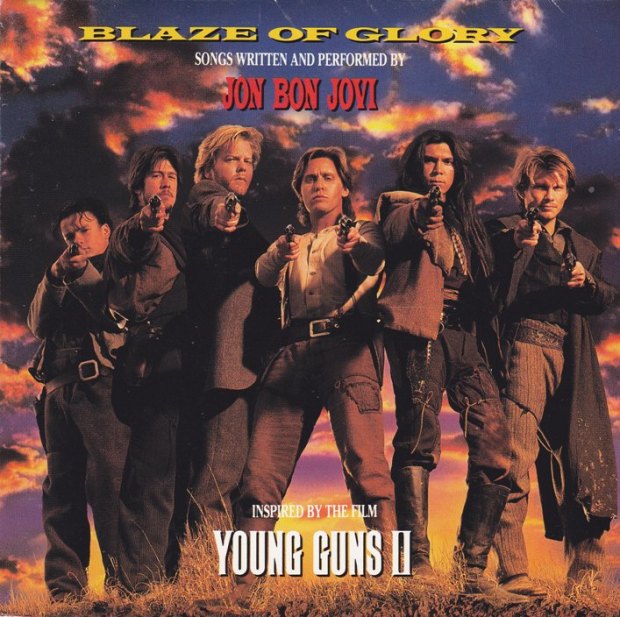
JON BON JOVI – Blaze of Glory: Inspired by the film Young Guns II (1990 Mercury)

Billy the Kid was a fascinating character.  Perhaps he was the embodiment of the Old West itself: a charismatic outlaw, who reportedly had a hair trigger temper but also a heart of gold.  Unfortunately, the film Young Guns II seems more about a person called Brushy Bill, rather than William H. McCarty, also known as William H. Bonney, but best known as Billy the Kid.  Having killed his first man at 18, the Kid earned his nickname with his boyish looks.  He looked nothing at all like his screen counterpart Emilio Estevez, but it’s because of Emilio that Jon Bon Jovi recorded the soundtrack to Young Guns II.

A popular theory from the 1990’s was that Billy the Kid was not killed by Sheriff Patrick Frank Garrett in 1881.   In 1948, a character called Brushy Bill Roberts emerged claiming to be the Kid, alive and well.  There was enough facial resemblance, and also sworn statements from five people who knew the Kid. Roberts never proved that he was actually William McCarty, and today historians have dismissed his claims due to the number of facts that do not match (such as dates of birth).   Young Guns II, the film, operated on the popular theory that Billy survived, and that he faked his death with the help of Pat Garrett.

In fact Garrett did shoot the Kid and lived a life of shame afterwards, as the details of the shooting of the popular Kid didn’t paint him in a positive light.  Oddly enough, Garrett himself was shot and killed in 1908 by a rancher named Jesse Wayne Brazel, in New Mexico.  The interesting coincidence about this is Brazel was uncle to a Mac Brazel, also a rancher in New Mexico, near the town of Roswell.  It was on his ranch that something strange (almost certainly an actual UFO) crashed and was covered up.  It is an amusing intersection of two of the great folk tales in American history.

So along came this movie.  Emilio Estevez asked Jon Bon Jovi if they could use “Wanted: Dead or Alive” in the film.  Jon declined and said, “The lyrics don’t make sense.  That song is about touring, let me write you something more appropriate to the old west and Billy the Kid.”  This turned into an entire album.  Essentially Blaze of Glory is not a soundtrack album (since none of Jon’s songs are in the movie until the end credits) but a concept album based on the film.

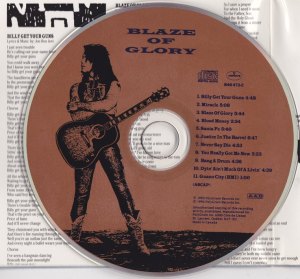
The album begins with a snippet of dialogue:  “Yoo-hoo!” says Emilio/Billy.  “I’ll make ya famous.”  A gunshot and the song “Billy Get Your Guns” begins.  That’s Kenny Aranoff on drums in case you were wondering.  “Billy Get Your Guns” isn’t a hard rock song like Bon Jovi was doing at the time.  But it’s still rock and roll, featuring some great slide guitar riffing by Waddy Wachtel.  Jon’s voice is young, strong and loud.  It’s a sound I miss.  I think it’s impossible to dislike the excellent “Billy Get Your Guns”, especially when topped by a Jeff Beck guitar solo, who plays on pretty much the whole album.  (The album also features two Journey bassists:  Randy Jackson and Bob Glaub.)

Jeff even appeared in the music video for “Miracle”, the hit ballad from the album.  The lovely accordion and spare arrangement gives it quite a different feel from old Bon Jovi ballads. Once again I am reminded that Jon once possessed quite a powerful voice.  It’s also worth noting that Jon wrote every song himself.

“William H. Bonney, you are not a god.” – Keifer Sutherland as Doc Scurlock

“Why don’t you pull the trigger and find out.”  – Emilio Estevez as Billy the Kid

I still love “Blaze of Glory”.  It’s timeless, more so than a lot of Bon Jovi’s hits from the time — “Bad Medicine” and so forth.  I remember seeing Aldo Nova on TV playing the riff on an acoustic guitar, and it is perfect in its classic simplicity.  Aldo is one of Jon’s oldest friends and he plays on the whole album as well.  This dynamite hit song has become so loved that Bon Jovi play it live and included it on their greatest hits compilations, even though only Jon was part of it.  Jeff Beck’s smoking solo is as much part of the song as Jon is.  I cannot understate how great this song is. From quiet acoustic strumming to bombastic aplomb, the song is a great achievement.

“Blood Money” is a short ballad, with spare acoustics, tambourine and accordion.  Jon sings as Billy the Kid, directly to Pat Garrett.  Historically we don’t know if Garrett and McCarty were friends as they are portrayed in the film, but likely they were not.  Regardless, even though the lyrics are implausible historically, it is still a powerful little song.

This leads into “Santa Fe”, which is from the perspective of Doc Scurlock.   You want epic?  Look no further.  An album highlight, “Santa Fe” boasts strings, powerful Aranoff beats, and Jon’s most vivid lead vocal.  If it had been on a Bon Jovi album, I think it would be regarded as highly as a song like “Dry County” which it resembles slightly.

JBJ BOG_0003

Side two opened with Lou Diamond Phillips (Chavez y Chavez in the film) singing a native chant.  The song “Justice in the Barrel” refers of course to the barrel of a gun, and Jeff Beck’s playing in the opening reminds us why he is one of rock’s most legendary gunslingers.  The song however is more laid back, a slow rock groove.  “Never Say Die” is the most straightforward rocker on the album, and it features Robbin Crosby of Ratt on electric guitar.  This song most closely resembles Bon Jovi, the band, even lyrically.  It is followed by a song that sounds nothing at all like them, and also my favourite:  “You Really Got Me Now”.  From first listen, way back in 1990, to today, this is a song that always puts a smile on my face.  Imagine Jon Bon and Little Richard building a time machine, travelling back to 1881, and jamming in a saloon.  That’s “You Really Got Me Now”.  Richard plays piano and sings the second verse, and I love it.  It’s a shame this little tune is only 2 1/2 minutes long, but I guess it was a bit of a novelty.

“Bang a Drum” is a pleasant soft soul rock anthem, but the Hammond organ and Jeff Beck help maintain its integrity.  The soul comes from the backing vocals of Julia and Maxine Waters.  This is the climax; the denoument is “Dyin’ Ain’t Much of a Livin'”.  The delicate piano is provided by one Elton John (before he would become Sir).  Elton also joins Jon on backing vocals.  “All this fame don’t bring ya freedom,” sings Jon, a line that may apply to a rock star life as well as an outlaw.  The powerful song is a natural ending to a story such as this.

There’s a brief coda, an orchestral piece from the movie by composer Alan Silvestri called “Guano City”.  I always wondered why this piece (as good as it is, sounding like some of John Williams’ more exciting segments) was on the album.  Nevertheless, there it is, and the album is done.

Jon was very emphatic in stating that Blaze of Glory was not his true solo album.  It was 10 songs written specifically for a movie, to fit that movie.  His solo album would come seven years later with Destination Anywhere, but first it was time to get Bon Jovi, the band, back on track.  This began with a 1991 live performance of “Blaze of Glory” at the Academy Awards, by the full Bon Jovi band, augmented by additional guitarists Waddy Wachtel and Danny Kortchmar.

If you consider solo albums and soundtracks as part of the overall catalog, Blaze of Glory still clocks in as one of my absolute favourites.

5/5 stars

REVIEW: Alice Cooper – The Last Temptation (1994 CD, comic books)

Warning:  image heavy review!

LAST TEMPTATION_0001ALICE COOPER – The Last Temptation (1994)

When this album first came out, the local music geeks and I spent a lot of time discussing it. The foremost argument was, “What influence did grunge have on The Last Temptation?” While this is by no means a grunge album, I think there is a subtle grunge influence, and The Last Temptation is all the better for it.

The Last Temptation was heavier…more serious…more raw in production. These are all trends that grunge helped usher in. Alice had taken a bit of a slip, quality-wise, in the late 80’s and early 90’s. The Last Temptation was the album he needed to release in 1994.  While it was not a commercial success, it excited the long time fans.  It was the kind of thing we’d really missed from Alice, since the 1970’s.

The most obvious grunge influence is that Chris Cornell of Soundgarden wrote two songs and co-sings one. “Stolen Prayer”, the best song on the album, is Cornell’s, and his pipes have never sounded so good. Grunge forced a lot of hard rockers to drop the glossy production sheen of the 80’s, get serious a little bit on the lyrics, and write harder songs. This is evident in the world of Alice. This album spends a lot of time on the temptation of drugs, and while many rock fans might cringe at the idea of Alice delivering a “message” to us, this really is nothing new for our favourite masked rock star. He’s been serious before, on some of his finest moments in fact, but he always makes his messages fun to listen to and sing along with. West Side Story has always been a huge influence on Alice as fans know, and The Last Temptation is another album that shows this Broadway influence. “Bad Place Alone”, for example, has a chorus that sounds influenced by musicals.

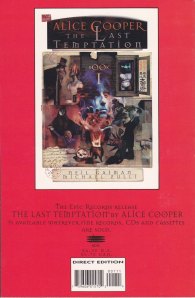
LAST TEMPTATION_0007Alice is nothing if not ambitious. The Last Temptation was Alice’s first “true” concept album since DaDa in 1983. In fact there was a even three-part Neil Gaiman comic book available at the time to help flesh out the story. One edition of the CD came with issue #1.  Here you can find images from all three issues.

Marvel went all out on these comics.  The covers are hard stock, and the artwork inside by Michael Zulli is detailed and, at times, horrifying.  The colour palette evokes autumn (the story is set in October).  Even Alice himself appears as the Showman character, but the protagonist is (of course) Steven.  These comics were later reissued in a trade paperback, but all are affordable today, running at about $4 each.  The most desireable edition is probably the rare one that came backed with the CD:  issue #1, with a white border.

Musically, Alice is at the very top of his game here. Gone is the gloss. In fact, the opening track “Sideshow” sounds so much like the 70’s that you could swear it’s from the original Welcome To My Nightmare record. Awesome horn sections, great riff, killer lyrics; you’ll be singing this one for days after hearing it. “Nothing’s Free” rips off “Billion Dollar Babies” somewhat with the opening drum hook, but you won’t be complaining when you hear it. Most likely you’ll be pumping your fists to it. The first single “Lost In America” is a fast, tight rock song with insanely catchy lyrics, very different from a lot of stuff Alice had done in the 80’s.

The rest of the album is strong, with “It’s Me” being the sole ballad. “Stolen Prayer” is an absolute diamond.  Chris Cornell sings on the choruses with that classic, incredible 90’s Soundgarden voice.  Although the song is largely acoustic and mellow, the best word I can use for it is “epic”.  It’s a classic, and I believe that to be the reason that Alice used it to close his comprehensive box set, The Life and Crimes of Alice Cooper.  (Cornell also wrote the track “Unholy War”, solely — even the lyrics, which Alice used without modification.)

Overall the direction of the album is dark and catchy, with great playing from the entire cast and Alice spitting out the words as only he can. The fact that most of these songs were played live on tour is a testament to the strength of the material and Alice’s confidence that he had made yet another classic album.

The Last Temptation is a record that is sadly unknown to many casual rock fans. However, anybody who loved Welcome To My Nightmare would be well advised to pick this up. They might find that Alice has built a musical time machine, an album that sounds timeless despite its 1994 release date. It may not be a grunge album, but I think we owe a thanks to the grunge movement for helping Alice make the strongest record he’d done since 1975.

What happens to Steven? You’ll just have to listen and find out.

5/5 stars


REVIEW: Queensryche – Promised Land (Japanese import)

QUEENSRYCHE – Promised Land (1994 EMI, Japanese import)

I’m sure the pressure was on to top Empire, so what did Queensryche do? They retreated to an isolated but luxurious cabin on an island, and wrote & recorded an introspective atmospheric masterpiece of a record.  Far from record companies and hangers-on, the band focused on the art. By their own admission, the isolation (plus smoking pot and drinking wine) were catalysts for this great album.

I spoke to bassist Eddie Jackson about 13 years ago regarding this album, and I told him I thought it had a lot in common with Rage For Order. He didn’t see it at first, but both albums feature loads of sound effects and atmospherics. Neither album is a true concept album, but both have recurring themes and ideas that run the course of the CD. Promised Land is a deeply personal CD, mostly slower-paced, and one that must be listened to with headphones on.

Drummer Scott Rockenfield came up with the opening piece, “9:28 a.m.”, which is a collage of tones and sounds, ending with some shattering chimes and a baby’s birth. This melds into the first song, “I Am I”, not a typical Queensryche rocker by any stretch but certainly one of the most brilliant things they’ve ever composed. Tate’s lyrics begin the introspective theme of the album, backed by odd percussion instruments, voices, sitar, cello (by guitarist Chris DeGarmo) and droning power chords. There is so much going on beneath the surface of this song; that is why I say that headphones are required.

A skipping CD sound leads straight into the next song, the heavy and dark “Damaged”. “Damaged” is about psychological damage, the effect that bad relationships and experiences have on the self. At various times, Tate’s voice doubles and triples and quadruples, seemingly indicating multiple personalities, or perhaps voices in head. At one point it sounds like his voice has short circuited. Eddie Jackson told me that effect was a total accident in the studio that they couldn’t duplicate.

DeGarmo’s “Out Of Mind” follows, an acoustic piece regarding mental illness. It is a nice quiet composition with spare drumming and a beautiful DeGarmo guitar solo. This break in the pace continues with the next acoustic song, “Bridge”. DeGarmo’s shattered relationship with his father is the theme here. He has hinted before at issues with his father, (“Are you my father? The one that was promised?” from “Screaming In Digital”) but here we get more of the story. His father wishes to mend bridges, but DeGarmo tells him, “You never built it, dad.” A sad tale, and an odd choice for a single, but a single it was.

Side one ended with the powerful epic title track which is nearly 9 minutes long. Anchored by Eddie Jackson’s rumbling bass and Geoff Tate’s atmospheric sax, this is a mindblowing song. The lyrics deal with the fact that as youths, we are told that the world is our oyster, and a promised land is waiting for us. But it doesn’t pan out that way for everybody. There are many voices and sound effects in the background of this song, and Tate’s vocal is wracked with feeling. You can hear that this is taking place in a bar (“Drinks for all my friends!) Again, use headphones!

RYCHE FULLYou hear a person leaving the bar, walking across a gravel lot. This melds into industrial city sounds. Soon the next track has begun, “Disconnected” (writted as “Dis con nec ted” in the lyric sheet). Tate’s vocal is spoken, to great effect. When he speaks in a staggered manner (“I must…release…my…rage…”) it is so understated; yet another mindblowing moment. Again, this song is anchored by Eddie Jackson’s deep bass lines, underscoring.  Due to the odd staggered vocal, this song will not be for everybody. On the surface, it sort of resembles “Della Brown” from Empire. This song seems to be about feeling disconnected from the world around us, despite the technology that supposedly brings us together.

“Lady Jane” follows, revisting the mental illness theme. This is a dramatic piano-based song; the piano is played by Chris DeGarmo. The next track is the most straightforward song on the album, “My Global Mind”. A rocker with few frills, this is perhaps the most Empire-sounding of all the tracks. The plaintive “One More Time” comes next, with some amazing melodies and a fairly standard song structure.

All this leads into one epic final song, “Someone Else?” which is simply piano and voice. The lyrics, as with all of Promised Land, are incredible and Tate’s vocal is among the best he’s ever sung. Looking back, the person he is seems to have been someone else all along. This look back ends the album, which of course started with the birth sequence. Very nice bookends.

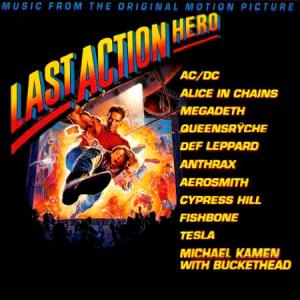
LASTThe Japanese got bonus tracks (of course), one of which is “Real World” from the Last Action Hero soundtrack. Strings are the main feature here, by the late Michael Kamen. The arrangement is a little too saccharine for me, but that’s Kamen for you. Then we also have the “full band” version of “Someone Else?” which adds an entire verse, but loses the piano arrangement that made the song special in the first place.

The remastered edition of Promised Land (which I don’t have and don’t need) has two additional live tracks, which were “Damaged” and “Real World” recorded in ’94. There were, of course, lots more live tracks available on singles at the time, but for those you will have to track down the actual singles. Some of them, such as “Dirty Lil’ Secret” which was issued with the Empire remaster, for whatever reason.  And of course there was the ultimate rarity, an acoustic song called “Two Mile High” which was recorded specifically for the Queensryche’s Promised Land video game.  This too is not included on the remastered CD, leaving the song frustratingly unavailable today.

On a final note, when I saw ‘Ryche live in Toronto on the final date of the Promised Land tour, they played the entire album live (albeit not in order), a good 10-15 years before doing so was in vogue. That’s how strong this album is, and that’s how good this band is.

Headphones are a must. Multiple listens are a must. Queensryche have never been deeper or more trippy. A masterpiece.

5/5 stars

PROMISED LAND_0003

Gallery of CD singles below!

REVIEW: Judas Priest – Nostradamus (deluxe edition)

NOSTRADAMUS_0001JUDAS PRIEST – Nostradamus (2008 Sony deluxe edition)

I was really worried about this album. I started reading some of the early bad reviews and was a little shocked as to how much some people hated Nostradamus. Even more worrisome were the mixed reviews, often coming from long-time Priest fans. Many liked it, but they were far from blown away.

I’m strongly in the “like” category with this CD. I get completely why some fans don’t like it. Most of the terrible bad reviews I read came from dyed-in-the-wool metal fans, and yeah, you’re not going to love it if all you eat, breathe, and sleep is metal. I’m not meaning to be condescending here. People who don’t love just metal, but also progressive rock, classical, and even opera, are more likely to love Nostradamus.

The production is OK (self produced this one is), but the drums are oddly buried in the mix. Maybe Scott Travis isn’t even the right drummer to be playing these kind of grooves (plods?), I don’t know. He sure does wail on “Persecution” though, among others. Still, it’s like a weird 80’s drum sound from a Leatherwolf album or something.

KK Downing and Glenn Tipton — awesome as ever.  At least KK went out of Priest on a high note.  He got to stretch his wings out a bit on this, as did Glenn.  There is everything a guitar lover could want on Nostradamus. Lots of natural guitar tones, distortion, crazy riffs and spastic solos, even a bloody flamenco! Mental solos – unbelievable.

Halford — awesome. On some songs he’s really reaching back to his love of opera, no doubt of that. Buddy sings in Italian on one song! Kind of jarring, but it suits the whole epic nature of the music. Yes, there are screams. He’s learned to make the screams more effective by using them sparingly, more strategically. At the same time a lot of fans want to hear him scream at the top of his lungs again, like he did on Painkiller, and I can understand that. Fact is, maybe the guy can’t do it like that anymore. Is that his fault? Of course not. His singing is very much like it was on Angel Of Retribution. Mature’s a good word. I miss the screaming too, but if he can’t do it like he used to, it can’t be helped. It is what it is.

Regarding bassist Ian Hill, I can’t hear the bass guitar, most of the time. I guess that’s kind of expected in Priest, right?  They’re not really known for bass.  Don Airey of Deep Purple played keyboards, and he’s great. As always. Lots of dramatic piano, circa vintage Sad Wings era Priest.  Very different from what he does currently in Deep Purple.

There are also real strings, so don’t fret. Lots of guitar synths as well, but not on a “Turbo Lover” sort of scale. I didn’t find the synth too intrusive for the most part. In a lot of cases the string and synths combined make it sound like a massive Michael Kamen score. You’ll know what I mean when you hear it.  It’s very big and bombastic and some don’t find that kind of string arrangement to their tastes.  Some find it very one-dimensional.  Personally I think it had to be this way on Nostradamus, since the strings need to be heard among the guitars.

This “Deluxe Edition” comes in a nice hardcover book. It’s roughly DVD sized. Very nice package even if you have to slide the CD out of a cardboard sleeve (again!). Worth the extra cash to you? Well, that’s up to you. I’m not sure it’s worth it to me or not, but I bought it, so there you go.

I wonder if Nostradamus will go down as the most controverial Priest album ever?  Even more so than Turbo, Point Of Entry, or Jugulator?  Certainly some of the initial reaction on the usual sites was pretty harsh.  Priest have always been a diverse metal band, and if you love Priest’s entire history including all the nooks and crannies, you’ll love Nostradamus. If you only like British Steel, you are probably going to hate Nostradamus!

4/5 stars

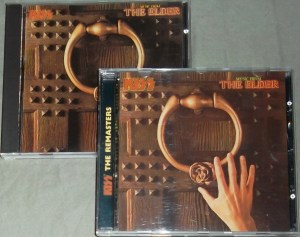
REVIEW: KISS – Music From The Elder (1981, 1997 remaster)

Part 17 of my series of Kiss reviews, leading up to the release of Monster!

SAM_2256

KISS – Music From The Elder (1981, 1997 remaster)

Exit Peter Criss.  Enter Eric Carr.

Music From The Elder has grown on me a lot since I first heard it back in 1986. It will grow on you if you let it. Its reputation is that this is the worst album Kiss have ever made, but I disagree. It’s very flawed, but it does grow on you and it does have many redeeming values.

Here’s a brief version of the story behind The Elder: Kiss intended to make a rock album, after the way-too-pop Unmasked.   The material they were coming up with (including “Nowhere To Run”, released on the next album Kiss Killers) was deemed to be too much like what Kiss had done before.  Producer Bob Ezrin (Destroyer) was brought back into the picture, and he encouraged them to do a concept album (he had  recently finished The Wall). Gene dug up a short story he wrote about a group of god-like beings called The Elder, who seek a hero in every time to fight evil. This hero, The Boy, is the protagonist of the story.  Got that?

If you have the original LP, cassette, or CD editions of Music From The Elder, the songs are in the wrong order.  Y’see, the record label (Casablanca) wasn’t too confident in Kiss’ new music, so they decided to change the track order so that the album started with a rocker (“The Oath”).  This makes the story completely jumbled and unintelligible.  The 1997 remaster with the restored track order also has some Gregorian chanting at the end of “fanfare”, that was previously cut.

I won’t get into the story except that there’s a boy (“Just A Boy”) who is recruited by The Elder (“Under The Rose”) to fight the evil (“Mr. Blackwell”). There’s an escape (“Escape From The Island”) and some self-affirmation (“I”) and that’s about it.  All the epic battles were to happen in Music From The Elder 2: War of the Gods. Ahh, but that’s another story.

Here’s a song breakdown.

“fanfare”: An orchestral bit by Ezrin based on Paul’s “Just A Boy” melody.

“Just A Boy”: Fantastic Paul ballad featuring his falsetto. Acoustic and powerful with epic verses and choruses. Great guitar solo too.

“Odyssey”: Paul sings this orchestral song as well. When I was a kid, I loved any rock songs with orchestras.

“Only You”: Gene’s first song, and the first tune that resembles a rocker. Starts off slow, then goes into a groove. Not a bad song, although not a standout.  At the end it goes straight into Paul’s “Just A Boy” melody again, which recurs on the album.  This has been covered by Doro, on a Gene Simmons produced solo album.

“Under The Rose”: Eric Carr’s very first songwriting contribution to Kiss.  Gene sings this slow song, which has a very gothic chorus sung by what sounds like a men’s choir. Very odd, but I quite like it.

“Dark Light”: Formerly “Don’t Run”, this is Ace’s first song and only vocal on the album. It’s not as great as any of Ace’s songs on previous albums. Still, it sounds like basic stripped-down Kiss, and it’s Ace, and it is one of the few songs on the album that has noticeable Ace guitar.

“A World Without Heroes”: Formerly, “With Every Little Bit Of My Heart”. Paul’s excellent demo apparently impressed Gene, who rewrote the lyrics with Lou Reed. One of Kiss’ softest songs, it has since been covered by Cher.

“The Oath”: Finally, a real rocker of a song that showed off Eric Carr’s drumming for real. Possibly the best song on the album, “The Oath” was just epic. Kiss could play it live today if they chose. The riff is the main focus of this song. Paul sings in falsetto again on the chorus.

“Mr. Blackwell”: A Gene song, probably my least favourite.

“Escape From The Island”: A Frehley instrumental, and a firecracker of a song. Ace makes some interesting sounds on his Les Paul and the song just rocks along at a furious pace. Eric Carr had a hand in composing this one as well.  This song didn’t make the Japanese release for some reason.

“I”: “I don’t need to get wasted, it only holds me down”. Obviously this is Gene’s baby, it is his philosophy on life. It is also a great song and a great single. A fast rocker, Carr doesn’t actually play drums on it. Allan Schwartzberg (of Gene’s solo album) does. I didn’t know that at the time. Ends with a spoken word coda.

Music From The Elder was thus named because it was supposed to be the first part of a series, perhaps a series of soundtracks to a movie. Thus, Music From something.  It was so poorly received that all plans were cancelled, and the band never toured for it. The shame of it is, when they played on “Fridays” with Ace Frehley, these songs sounded great. Frehley complained that Ezrin cut out half of his guitar work, and live there were ample extra solos. It makes you wish for what could have been.

Frehley left the band, sick of being sidelined by Gene and Paul and The Elder was his last straw. The fans hated it because, frankly, it doesn’t sound like Kiss. I don’t know what it sounds like. It doesn’t sound like progressive rock because it’s a little too clumsy, a little too blocky. It is Kiss after all, not Genesis. They get an “A” for effort, and the truth is the songs are pretty good. Production could have been better and there could have been more guitar. It is what it is.

3.5/5 stars.

Incidentally there are some great demos and outtakes from this album that are worth checking out, and one track was later used by Ace Frehley on his first solo album as “Breakout”. The very same track was used by Kiss on Revenge as “Carr Jam 1981”.  I have a CD (seen in the gallery below) called Demos 1981-1983.  It features intrumental Elder outtakes such as:  “Heaven”, “The Council of the Elder”, and “The Unknown Force”.