documentaries

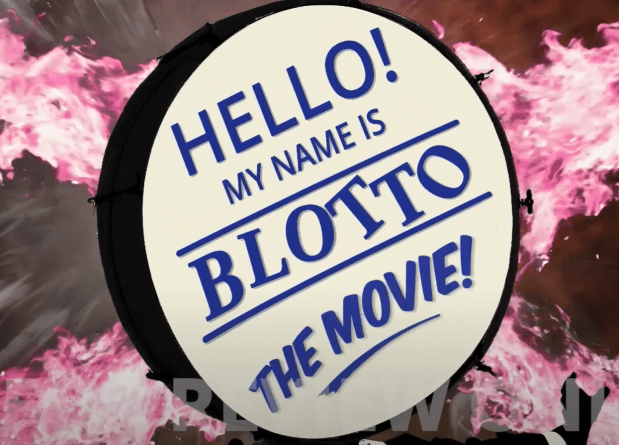
REVIEW: Hello! My Name Is Blotto – The Movie!

HELLO!  MY NAME IS BLOTTO – THE MOVIE! (2025 – 1 hour 44 minutes)

Directed by Rob Lichter

I am a firm believer in documenting music history.  There are many groups throughout rock history that have had hits, fans, and stories to tell, but with scarce documentation.  One such band was Blotto – until now.

In 2025, director Rob Lichter (also known as Bert Blotto) finally released the long-gestating Blotto documentary film, Hello! My Name Is Blotto – The Movie!  This film has been a labour of love, and that love comes across in every frame.  Meticulous attention to detail, comprehensive live and TV clips, and extensive interview footage with all the band members make up the bulk of this loving look at Albany’s greatest…comedy rock band?  Rock comedy ensemble?  What are Blotto anyway?  This is a question that comes up during the movie several times.  Why didn’t the record labels get what Blotto were selling?

“We were not musical enough to be a musical band, and not funny enough to be a comedy act!” sums up guitarist and singer Broadway Blotto.  “We wanted fame with a living wage.”

“We weren’t rich and famous; we were solvent and well known,” responds guitarist and singer Bowtie Blotto.

Starting out in the early 1970s as the Star Spangled Washboard Band, three of the founding members of Blotto first began playing comedic bluegrass music.  They used costumes and aliases:  “Broadway Harris” for example (no relation to Bill & Emily).   The roots of Blotto were forming, though in a genre far removed from rock.  You’ll see early TV appearances, featuring Bowtie’s much bigger hair, and some music that was later rocked up into Blotto songs, such as “High School Honey”.  The Star Spangled Washboard Band earned great reviews and plenty of laughs.  Their knack for quick comedy was evident, as the chemistry between Sarge, Broadway and Bowtie blossomed.  It’s possible that I saw the Star Spangled Washboard Band on television back when I was a child, as they appeared on programs like the Mike Douglas Show, which was a TV staple in our house.

From the bass-playing hotspot of Ballston Spa, New York, came Cheese Blotto, a gifted musician who had a knack for groove.  The Washboard Band never launched into super-stardom though, as misfortune derailed a big New York City gig.  The band broke up in 1978, but of course, they couldn’t stay apart forever.  Working as a bartender, Cheese was eager to be on stage instead of serving drinks, so he called his old buddies for a jam.  They didn’t even have a name, but washboard was out and rock was in.

The band acquired singer Blanche Blotto, who started as a fan (a “Blottette”), and became a key member, singing lead on “Stop (In The Name of Love)”.  Finally, they found drummer Lee Harvey Blotto, who fit in like a glove from day one.  “You’ll know the songs better than they do,” he was assured.

Blotto wisely decided to record some demos.  “I Wanna Be A Lifeguard” became a hit, earning radio play in New York City, and crucial airtime on the fledgling MTV.  “Lifeguard” was in fact the 36th song ever played on MTV, on day one.  Did you know the video was filmed on a freezing cold April day?

Shortly after “Lifeguard”, Blotto secured a recording with legendary producer Bob Clearmountain, which yielded two songs in one overnight session.  Unsurprisingly, they sounded great.  Sadly, it never led to a major label deal as they hoped.  “I think Atlantic Records is going in a different direction than Blotto,” went one heartbreaking rejection.

The film is divided into six sections, each one covering an era of the band.   It is augmented by interviews with the people who were there at the time, including MTV VJ Martha Quinn to talk about “Lifeguard” burning up TV screens nationwide.  Buck Dharma, who shared their sense of humour, appears to discuss the hit “Metal Head”.  We even get to see outtakes from the innovative music video.   This movie is packed full of facts, fans, and perspectives from Albany New York, where they became local heroes.  Sadly, the talented Cheese Blotto passed away in 1999, and only TV footage remains of him.  Though we lost Sarge in 2019, plenty of interviews with him remain.  Past members Chevrolet, Hammerhead and Clyde Blotto also appear, fleshing out the documentation of the different lineup changes.

“Chevrolet Blotto, our newest Blotto, was auditioned mainly on the strength of his last name,” jokes Broadway in a vintage interview clip.

There are clips of unreleased songs such as “I Love You Calvin Klein”.  There are so many stories; hilarious stories.  Detailed stories about the creation of the songs and the album covers.  There are tragic stories of loss, and bizarre tales of Blotto haters.  Who could hate Blotto?

This is the only unanswered question that the film leaves open.  Who could hate Blotto?  Though the labels had no idea what to do with them, the fans kept coming back through theme nights, Blottoweens, reunion gigs and new members.  The band never really packed it in.  They moved on; got other work.  Lee Harvey even did double duty as a lawyer and a lifeguard.  But they never really stopped being Blotto.  As Blanche says, it’s always a part of them.

Though I laughed throughout the film, there are tears to be shed as well.  Both Cheese and Sarge went too soon, and it is clear that they are missed.  Each member of the band brought something to the table.  Sarge was not just a singer, but also an artist.  Cheese’s disco grooves were magically delicious, and his decision to go bald brought a new visual dimension to the band.  Their quick wits are on sharp display in the vintage footage.

I have always felt like the world needed more Blotto.  Their small treasure chest of tunes is easy to devour in a sitting or two.  Now, we finally have more Blotto, and a serious addition to the catalogue it is.  Hello! My Name is Blotto – The Movie! is a constantly entertaining deep dive on a band that we needed more of.  A band that the world needs to hear.  Anyone who likes music would enjoy this film, and maybe become a new fan, just a few decades late.

5/5 stars


#1178: Kitchener Blotto

RECORD STORE TALES #1178: Kitchener Blotto

There’s an old saying; I think it goes back to Aristotle.  It goes, “Never meet your heroes.”

I think we can prove that wrong, right here.

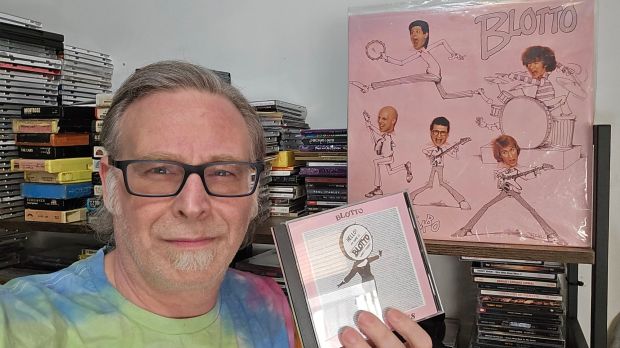
Quick recap:  I first heard Blotto’s song “Metal Head” as a young kid.  Not sure what to make of these guys, I filed it away as “interesting” but never had the opportunity to hear more through my younger life.  I even worked at a used CD store from 1994-2006.  You know how many used CDs by Blotto came in during that 12 year span?  Zero!  Not a one!  I started to wonder if they were a real band.  Fortunately, along came the internet, confirming that my memory wasn’t playing tricks on me.  Some of the core Blotto members first assembled in the early 1970s, as the Star Spangled Washboard Band.  They had albums and singles.  Yet, up here in Kitchener Ontario Canada, nobody I knew had the record, heard the record, or knew where to buy the record.  It was frustrating as hell, but I never forget the name “Blotto” nor the song “Metal Head”.  The music video was indelible.  The singer had charisma!  The band looked unique.  One guy was bald (a rarity in 80s rock bands) and one guy had glasses and wore a tie!?  What was with that?  In the 80s, we had Revenge of the Nerds and I couldn’t help but wonder what this band was about, because visually, that was what I was seeing!  A nerd with a guitar?  It made no sense to 13 year old me.

But I never forget.

Fast forward to 2018.  My pal Aaron and I had this summer ritual of hitting Toronto to go record shopping.  This trip almost never happened because Jen’s mom was dying of cancer and we only had so many weekends together left.  However, she ordered me:  “Mike, go with your friend.”  And so, first thing in the morning, we embarked.  The first store we hit was BMV and there it was:  Combo Akimbo by Blotto, featuring the song “Metal Head”.  Flip the record over.  There was the bald guy, and the guy with the glasses!  I snapped it up immediately.  It went under my arm and stayed there until checkout.  There was no question I was getting it.  The whole trip was documented on video, including this find.  In the video, I was delighted to find the guys all had “Blotto” names:  Sarge Blotto, Bowtie Blotto, Broadway Blotto, Cheese Blotto, and Lee Harvey Blotto too.  I got the gag, and all my hopes were confirmed when I dropped the needle on that record later that night.

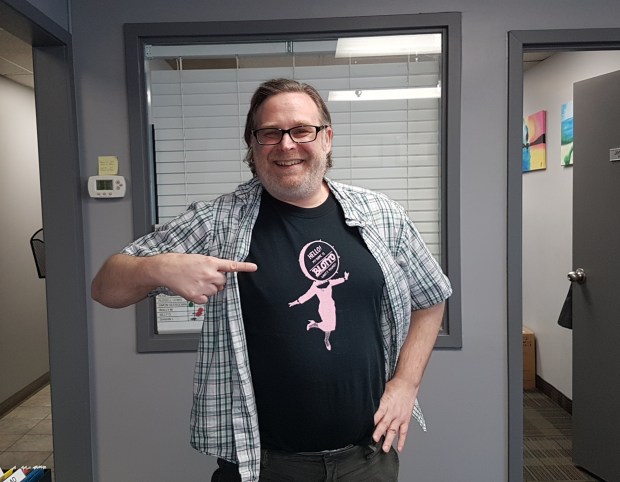
Fast forward again.  We lost Jen’s mom, and I started writing again.  My Blotto reviews were spotted by drummer F. Lee Harvey Blotto himself, who contacted me in gratitude.  He even sent me a shirt, while defending their cover of “Stop! In the Name of Love” which I wrote slightly negatively about.  “What a cool guy,” I thought to myself.

I wore that Blotto shirt with pride until it pretty much wore out.  I also emailed F. Lee in 2019 when Sarge passed away from cancer.  What shitty disease it is.

I continued to listen to and love my Blotto albums over the years.  I purchased the Collected Works CD which has most of their studio material.  The rest of their discography eluded me, at least at prices that Jen won’t smite for me.  And finding Blotto, in the wild, in Ontario?  Not frequent, or I would have had an album sooner than 2018!

I’ve lost a lot of weight since then!

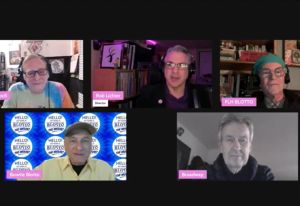
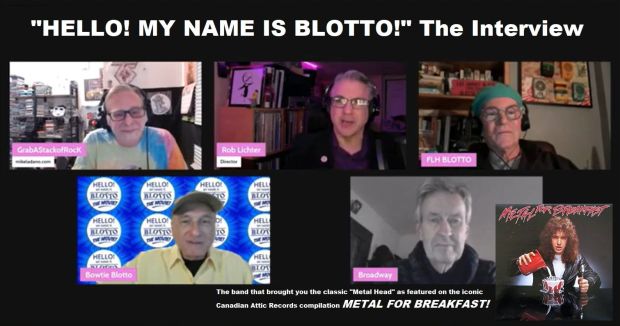
Fast forward again!  It is now 2025, and to my delight, I discovered that a Blotto documentary film was coming!  Hello! My Name Is BlottoThe Movie, directed by Rob “Bert Blotto” Lichter will premier April 12 at the Cohoes Music Hall.  I asked for any band member to come on my show Grab A Stack of Rock to talk about it.

A day or two later, F. Lee emailed.  “Why not!” he said, and offered the whole band and director Bert too.

And so we did the interview, and it was a lot of fun and hopefully gained the band a few new fans.  I know that among many of my regulars, particularly in Australia, it was their first time hearing and seeing Blotto.

What was really cool was the pre and post-show chat when we weren’t recording.  Bert was first to arrive in the virtual studio, and his passion for Blotto was only exceeded by his feelings of camaraderie with them.  We chatted a bit, and then Bowtie arrived.  He was curious about me, so I told him I was from about an hour west of Toronto in a place called Kitchener/Waterloo.

Without pause, Bowtie said “We played there as the Star Spangled Washboard Band in the early 1970s.  1975 or so.  We also played Guelph and Richmond Hill.”

My jaw must have dropped at that moment.  Guelph is pretty obscure even among Canadians.  And Bowtie pronounced it right, which most people don’t do on their first try.  He said that Broadway Blotto would remember.  I speculated that they might have played at the Coronet Club, not far down the street from me.  They were known for their regular-hours lunch menu, and strippers and rock bands at night.  That was the kind of place that Blotto would have played up here, as Bowtie and Broadway confirmed.

Also confirmed by F. Lee:  There are lots of Blotto live collections up on Spotify waiting to be streamed.  Lots more music for me to hear, right at my fingertips.

At the end of the show, the Blotto guys thanked me for my support over the years and said some very kind things about my writing.  I’ll tell you, there is nothing better than when someone whose art you admire, tells you that they also like what you do.

Broadway called us “kindred spirits” which I find very flattering, but this is where it gets really cool.

He asked me to choose my own “Blotto name”.

I thought about it, and I played with Hoser Blotto for a little bit.  I ultimately decided on “Kitchener Blotto”, because that really identifies me.  Maybe there are lots of fellow hosers who are Blotto fans, but I hope when Blotto hears the word Kitchener, they think of me.  And the strip club.

Thank you guys.

Don’t meet your heroes?  Pfft.  Choose your heroes wisely, I say.

Kitchener Blotto


Blotto Interview Outtake

As Blotto themselves know, from the making of their new documentary film Hello! My Name Is Blotto – The Movie, sometimes great stuff happens when the tape stops rolling!  That happened to me on Tuesday February 25, after finishing up my interview with the band.

During the pre-show chat, Bowtie Blotto told me that they had played my home town of Kitchener, as well as my dad’s city of Guelph.  And he asked Broadway Blotto what he remembered of those gigs.

Check out the funny story in the YouTube short below, and check out the full interview if you haven’t already!


GRAB A STACK OF ROCK With Mike and Blotto Episode 92:  Hello! My Name Is Blotto! The Interview

Blotto hit the sand on MTV with “I Wanna Be A Lifeguard”, being among the first 40 videos played on their first morning as a station.  Then came “Metal Head”, Metal For Breakfast, and a heck of a lot of gigs.  The core members were all named Blotto:  Sarge, Cheese, F Lee, Broadway and Bow Tie.  Sadly we lost Cheese and Sarge, but for this special interview, F Lee, Broadway and Bow Tie reunited with director Bert Blotto on Grab A Stack of Rock.  It’s a Blotto reunion, and a good time was had by all.

The subject is a new movie about to premier on April 12 at Cohoes Music Hall:  Hello!  My Name Is Blotto!  The Movie.  Director Rob “Bert Blotto” Lichter has carved this film from many hours of archives, like a sculptor cuts wood.  Join the Blotto guys and I, as we check out the movie trailer and hear firsthand stories from the band.  There are laughs a-plenty, some serious moments, and some fan geekery.  You’ll always hear about the one (hilarious) unreleased track that was never recorded.

It is clear that for Rob, this is a work of passion and pride, as well as hope.  Indeed, Blotto deserve a larger audience, for their music still rings true and makes us laugh.

Plus, Bow Tie does the “Dr. Bow” laugh from “Goodbye Mr. Bond” and if that isn’t worth the price of admission, I don’t know what is.

Video premieres at 7:00 PM Eastern.

Thursday February 27 at 7:00 P.M. E.S.T. / 8:00 P.M. Atlantic.   Enjoy on YouTube.

Hello! My Name Is Blotto! The Interview on Grab A Stack of Rock

GRAB A STACK OF ROCK With Mike and Blotto
Episode 92:  Hello! My Name Is Blotto! The Interview

Blotto hit the sand on MTV with “I Wanna Be A Lifeguard”, being among the first 40 videos played on their first morning as a station.  Then came “Metal Head”, Metal For Breakfast, and a heck of a lot of gigs.  The core members were all named Blotto:  Sarge, Cheese, F Lee, Broadway and Bow Tie.  Sadly we lost Cheese and Sarge, but for this special interview, F Lee, Broadway and Bow Tie reunited with director Bert Blotto on Grab A Stack of Rock.  It’s a Blotto reunion, and a good time was had by all.

The subject is a new movie about to premier on April 12 at Cohoes Music Hall:  Hello!  My Name Is Blotto!  The Movie.  Director Rob “Bert Blotto” Lichter has carved this film from many hours of archives, like a sculptor cuts wood.  Join the Blotto guys and I, as we check out the movie trailer and hear firsthand stories from the band.  There are laughs a-plenty, some serious moments, and some fan geekery.  You’ll always hear about the one (hilarious) unreleased track that was never recorded.

It is clear that for Rob, this is a work of passion and pride, as well as hope.  Indeed, Blotto deserve a larger audience, for their music still rings true and makes us laugh.

Plus, Bow Tie does the “Dr. Bow” laugh from “Goodbye Mr. Bond” and if that isn’t worth the price of admission, I don’t know what is.

Video premieres at 7:00 PM Eastern.

Thursday February 27 at 7:00 P.M. E.S.T. / 8:00 P.M. Atlantic.   Enjoy on YouTube.


Show notes

Rob Lichter’s Hello! My Name Is Blotto – The Movie! Is set to premiere at Cohoes Music Hall on Saturday, April 12.  The film spans the origins of the band members starting as The Star-Spangled Washboard Band in the 1970’s, their evolution to Blotto and heyday in the 1980’s, and their long afterlife up to the present.

This film is the brainchild of Rob Lichter, aka Bert Blotto, a multimedia expert and longtime friend of Blotto. 25 years of footage and interviews plus archives going back to 1972!  Why a documentary, and why now in 2025?  Whose idea was it to create a film?  How did this evolve?

Is the film done, edited, finished, ready to roll?

Obviously MTV was important to the success of the band, having been one of the first 40 videos played on the station.  MuchMusic in Canada also played a lot of Blotto and I’m wondering what your career was like in Canada.

What were you guys thinking, making music videos before there even was an MTV?

What was that feeling like, seeing your music video on national TV?

Did the Metal For Breakfast compilation album bring “Metal Head” to another level?

When prepping this interview, a friend asked me if Buck Dharma from BOC was on Metalhead and I confirmed.  How did you get that to happen?

“Video 45” on VHS from Sony with three videos of Blotto songs that also received wide exposure from airplay on MTV, including “Metalhead,” with Donald “Buck Dharma” Roeser from Blue Öyster Cult on lead guitar.”  How did this happen?

I was struck by the one quote in the trailer about how some people thought Blotto was making fun of the music they liked.  I felt the same way!  I didn’t know how to take this band.  There was a bald guy and a guy with a tie and glasses!  They did look like they were “taking the piss” as the English say.

Each guy in the band had a different look.  How did you approach Blotto as a visual band?

Were there any musical genres off limits to you guys?

What about musicianship?  Obviously you guys could play.  Were there any ideas you had that were beyond your abilities?

I’ve always wondered who is singing lead on HSH?  Bowtie?

Any plays for DVD or Blu?  Or even a soundtrack album?

MOVIE REVIEW: Mystique – Standing On the Firing Line (2022)

Note:  This review is of the new 96 minute cut of Mystique – Standing On the Firing Line. 

A collaboration with Jex!  For Jex Russell’s review, click here!

MYSTIQUE: STANDING ON THE FIRING LINE (2022, 2023 edition)

Directed by Marco D’Auria

“EPIC METAL” – Martin Popoff

They had the raw talent to make it.  They just needed a break.  They didn’t get it, but what they achieved instead was a legendary status with a handful of priceless releases left behind.  They were Mystique, a progressive heavy metal band from Hamilton Ontario.

Standing On the Firing Line is a 2022 documentary film by Marco D’Auria, finally shedding light on the history and music of this lesser-known band.  They always deserved more attention, and hopefully the film brings them that.  From the first shots of the band, the music of “No Return” assaults the senses with chopping riffs and unholy screams.  Why didn’t they make it?

The main driving force of Mystique from their beginnings to their demise were opera-trained singer Ray D’Auria (originally from Naples Italy), and perfectionist drummer John Davies, who had spent time in a few hard rock bands before Mystique.  Many other talented members joined and enhanced them along the way, but it was Ray and John who were there ’til the end.  The two met up when John auditioned for Ray’s band, Orion.  A friendship was formed, but the band wasn’t paying them the money they were owed.  They split as a pair and didn’t waste time starting their own thing.  15 year old Dave Dragos was a shredder – rated 2nd best in Canada at the time – and was first on board.  He introduced them to bassist Mark Arbour (a mixture of Geddy Lee and Chris Squire), and a solid band was formed.  A 1984 basement tape of “Black Rider” shows the nameless band had the goods.  It was Ray who blurted out “Mystique”, which felt right.

They found a rehearsal space, and added keyboardist Victor Barreiro.  The band practiced hard, and pushed each other to improve as musicians.  Davies tended to handle the business side, but they were attracting attention to themselves.  They found a manager (Ted Smirnios), money was borrowed, and songs were improved upon, until they were finally in shape to record.  Primitive but technically inventive tracks were recorded on 1/2″ tape, on a 16-track desk.  Not the best for sound quality, but good enough to get the songs down.  They went as far as to butcher a classic Leslie speaker to get a driving keyboard sound.

A stoned viewing of the animated Lord of the Rings movie captured John Davies, and inspired the song “Black Rider”.  The band had a sort of gothic bent in the mid-80s, but Ray D’Auria’s voice was appropriate for this progressive style of metal.  Journalist Martin Popoff remarks that the keyboards brought them into that progressive world.  Melodic guitar/keyboard solos took time to work out.  They were unafraid to play ballads, which Martin compares to a vintage Judas Priest dirge.  Mystique were a serious band!  The Black Rider EP impressed their peers for the playing if not the sound.  Popoff heard a strong Maiden influence, but compares more to Armored Saint and Odin with elements of power metal.  1000 copies were sold, an impressive amount.  Their manager got it as far away as Greece, and even accidentally set himself on fire as part of their stage show!

The band were doing well but dreams were not exceeded, and eventually members left for greener pastures, leaving Ray and John to rebuild.  Bizarrely, they met a talented French guitarist named Eric Nicolas in Jackson Square, and went to France to record their next demo:  1987’s I Am the King.  They struggled with the language barrier, and were recording digitally for the first time.  Ray blew everyone away with the “God note” that he held in “I Am the King”.  They were offered a record contract with Elektra in France, which didn’t pan out.  They brought the tapes home to Canada for release.

They added a new bassist, Les Wheeler, and evolved from metal to “hair”.  “The explosion in the costume factory look,” as described by Popoff, of their new extreme look that didn’t match their music.  “It looked good, from a distance,” jokes Ray.  Teenage girls loved their posters though!  Unfortunately having a guitar playing living in France was a barrier.  Wheeler broke his wrist in an accident.  A new lineup formed.  They felt forced to go more commercial, which resulted in the 1988 Poison-esque single “Rock and Roll Party Tonight”.  It was vastly different from “Black Rider”, but they went straight from that to recording a proper album, funded by EMI.  They taped 11 to 12 songs…but the album was never released and is partly lost today.  The masters tapes were sold and erased.  There were some good songs on that tape.  Ray, however, looks back at their change of direction as a mistake.  More shuffles in band members caused long breaks in activity, and the writing was on the wall.  Ray no longer identified with the music, and was the one to leave.  By 1989, their music was out of date anyway.

Manager Ted Smirnios is given a tremendous amount of credit for making Mystique happen.  It’s a touching part of the film.  The band members went their separate and sometimes surprising ways, but the story never really ends so long as people keep discovering the music.  Their releases are now valuable collectables today, worth a small fortune on the second-hand market.

Rare live clips and candid photos really bring an intimate look at Mystique.  You feel like you get to know the personalities.  This new edit of the film cut a substantial amount of footage, mostly interview footage with people who were there at the time.  The movie gains better pacing from this, as it just flies by in no time.  A new ending to the film brings us to the present day, and the movie’s theatrical premiere in front of a cheering audience.  The original cut might be considered for more hard-core viewers who want that “feels like being there” experience, but the current 96 minute edit is better for the enjoyment of Mystique.  It’s a much tighter and more direct story.  There is still plenty of unreleased music and vintage images.

Stay tuned for the mid-credit scene!

4.5/5 stars

MOVIE REVIEW: Jodorowsky’s Dune (2014)

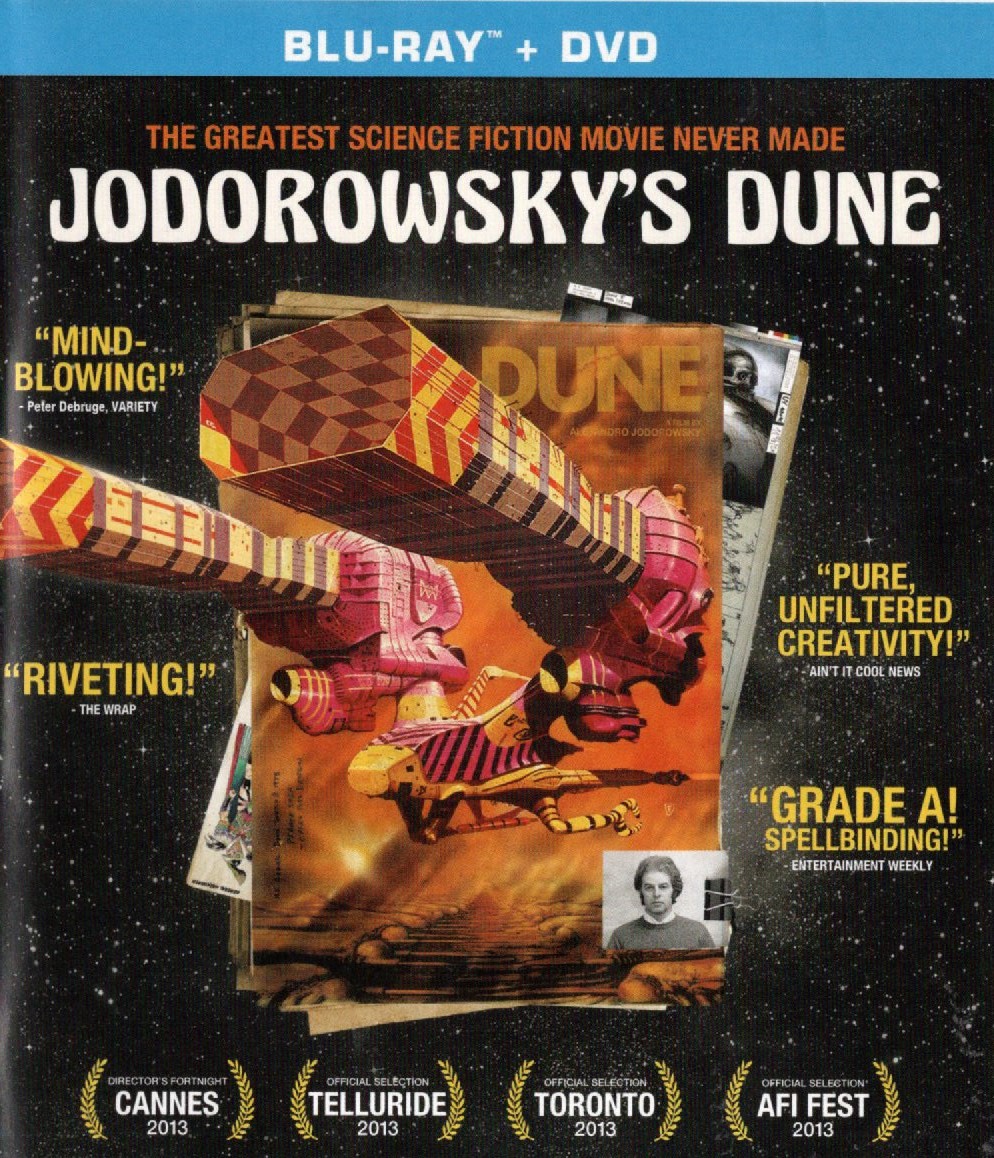
JODOROWSKY’S DUNE (2014 Sony Pictures)

Directed by Frank Pavich

What do Alien, Star Wars, Raiders of the Lost Ark, Flash Gordon, Masters of the Universe, The Terminator, and Blade Runner all have in common? They all bear the imprint of Alejandro Jodorowsky’s attempt to make a film version of Frank Herbert’s Dune in the mid-70s. 2001: A Space Odyssey was the definitive space movie, and Star Wars was just a gleam in Lucas’ eye.  Dune, considered by many to be unfilmable, was perfect for Jodorowsky.  The Chillean-French director was considered a madman, albeit one with a sky-high imagination.  Of Dune, he sought to give the audience a druggy trip without the drugs.  But he also sought to make so much more – “a prophet”, he described it.  Something that would change the consciousness of the audience, and the future of movies.  Free the imagination, the mind, the soul.  He saw it as something much bigger than making a film, and so he assembled a team of “spiritual warriors” to join him in making his vision real.

His warriors included the Swiss genius H.R. Giger, known for his biomechanical style. Comic artists Chris Foss and Jean “Mœbius” Giraud were on board.  (Ian Gillan fans will recognize Foss’ style from the cover of his Clear Air Turbulence album.) Special effects genius Dan O’Bannon sold all his possessions and moved to France to work with the team. Pink Floyd and Magma were assigned to do music for specific planetary settings. Mick Jagger, Orson Welles, Salvador Dali, David Carradine and Udo Kier signed on, with Welles to play the grotesque Baron Harkonnen. Jodorowsky convinced him by offering to hire his favourite French chef for his catering.  As the key character of Paul Atreides, the messiah of Dune, who could he cast but his own son Brontis?  The boy went through gruelling physical and mental training for  the role.

The team assembled what is now known as the Dune book, an incredibly detailed shot-by-shot storyboard, several inches thick, and filled with images that found full motion and sound later on in the aforementioned films.  Giger’s designs are especially recognizable, including one that foreshadows his famous Alien Xenomorph.

Jodorowsky used Herbert’s Dune as the basis for his own, but began to drastically change the storyline.  Some of his original ideas were brilliant, but his ending is completely baffling.  In an “I am Spartacus!” moment, Paul dies, which does not happen in the book.  Suddenly his consciousness transfers to the people of planet Arrakis, who all proclaim to be Paul.  The planet comes back to life, with green jungles and blue oceans appearing.  Arrakis then breaks orbit, and shoots through space to share its new joined consciousness with the universe.  Heady stuff perhaps, but a sharp change in direction to Herbert’s more serious science fiction style.  Jodorowsky believed in his story, with an unbelievable passion.  He is visibly angered at what comes next.

When movie executives told him that the film had to come in at 90 minutes, it was the beginning of the end.  No, he said.  Eight hours, or 20 hours, he would make the movie he needed to make!  Studio executives don’t like hearing such things, and fearing budget overruns, cancelled the Jodorowsky version of Dune.  His team scattered, with many such as Giger, O’Bannon and Foss meeting soon again on Ridley Scott’s Alien.  The Dune project was handed to David Lynch, who Jodorowsky believed was the only other person who could have realized the movie the right way.  It filled him with feelings of dread that soon turned to glee when he saw just how bad Lynch’s Dune turned out.  Yet he knew, it had to be the movie executives who ruined it.

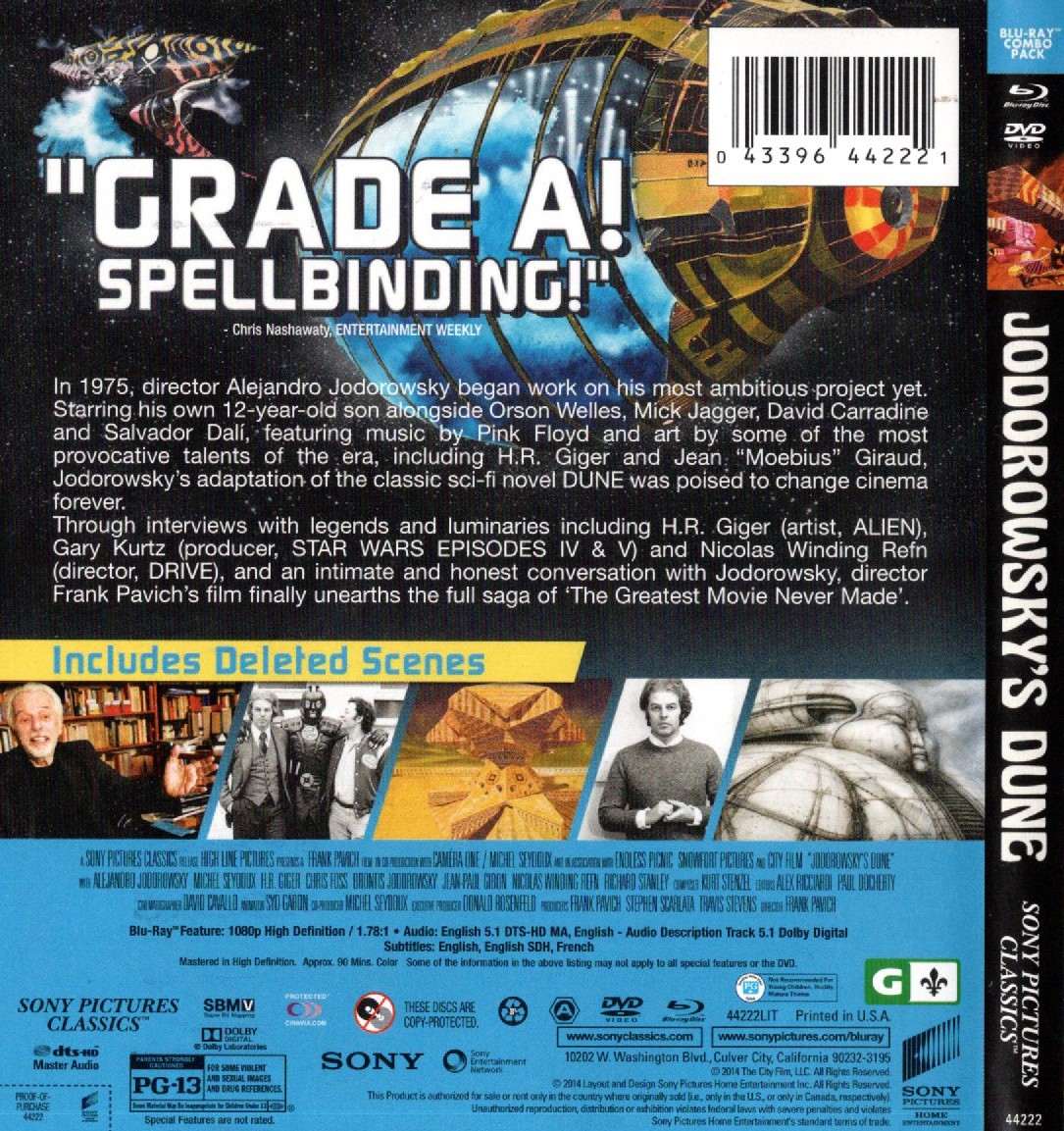
This is the story of Jodorowsky’s Dune, a documentary film by Frank Pavich.  You will be stunned by the images that this team created, and by Alejandro’s deep passion for making his art.  This is your own chance to see what might have been.  Blu-ray recommended.

4.5/5 stars

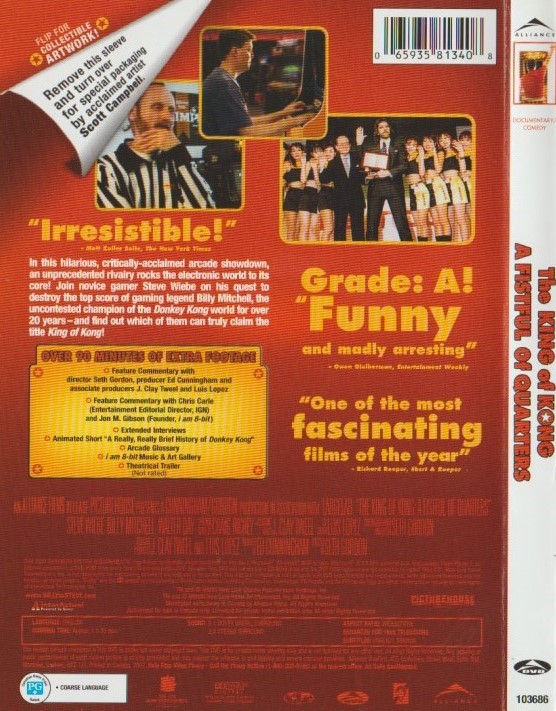
DVD REVIEW: The King of Kong – A Fistful of Quarters (2008 New Line)


THE KING OF KONG – A FISTFUL OF QUARTERS (2008 New Line)

Directed by Seth Gordon

This documentary is a story about a clash of the titans.  A clash of a different variety: Donkey Kong!  Newcomer Steve Wiebe vs. veteran champion Billy Mitchell. Choose your side and watch the battle begin.

If you grew up in the 1980s, then it’s very possible that you spent a good deal of your summer holidays popping quarters into arcade machines. Whether you were a Pac-Man freak, into Centipede, or the ultimate challenge of Donkey Kong (Mario’s first game, don’t forget), then you will love the memories associated with this film. Billy Mitchell was thought to be the greatest classic gamer of all time. He held all the big records, until 2018 when it turned out that Billy was a cheatie-cheaterton!  Many of his records, we now know, were performed on emulators, not original arcade machine.  Couldn’t happen to a nicer fella.  In The King of Kong, he doesn’t come across as a pleasant guy, and not at all humble. He was, however, respected in the classic game community. So what happens when a newcomer named Steve Wiebe shows up, who claims to have smashed Mitchell’s longstanding Donkey Kong record?

Wiebe is a tragic figure, a loving husband and father who always excelled at sports and music, but was never “the best” at anything. He obsessed over Donkey Kong, drawing patterns on screens for months until finally beating the record, on an arcade machine, on film. However it’s not that simple. Many were sceptical of his claims, especially since he came out of seemingly nowhere with a Donkey Kong board given to him by Billy Mitchell’s arch-foe, Roy Shildt. To prove himself, Wiebe travelled to The Funspot in New Hampshire to beat the record in person, on one of the most notoriously difficult Donkey Kong consoles known to mankind.

Partly a history of the golden age of video games, partly a David and Goliath story, and partly just a tale about a guy who wants to be the best at something, The King of Kong is a heartwarming documentary. It will have you cheering along, and remembering the good ol’ days. Surprisingly tense at times, but always interesting, The King of Kong is very re-watchable.

The most common critique of this film is that there is some dispute over its accuracy. It seems that some game records were ignored in favour of dramatic effect. However, it’s still a great film.

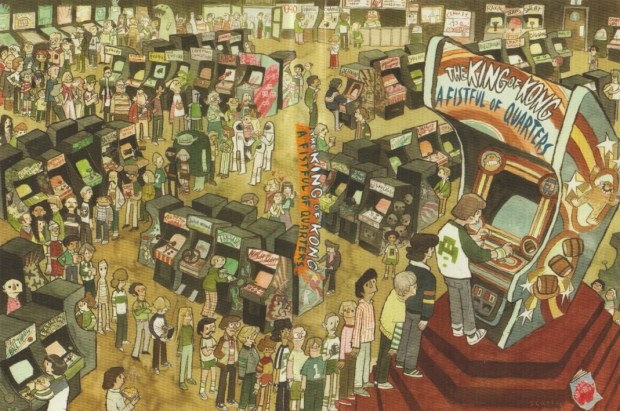
The DVD is loaded with special features including two commentary tracks, and check out the cool reversible cover art. Take your pick — Steve Wiebe on the cover, or a cool painting of a loaded video arcade.  You choose!

5/5 stars.  For geeks worldwide.

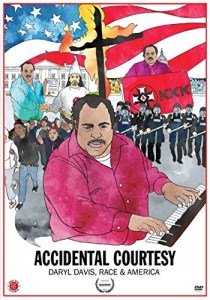
MOVIE REVIEW: Accidental Courtesy (2016)

ACCIDENTAL COURTESY (2016 PBS)

Directed by Matthew Ornstein

I’ve done it, and you have probably done it too:  Getting in an argument online with a total stranger over racially charged politics.  We live in new times.  It’s the era of Trump, Trayvon, and Mike Brown.  We live in the years of racial profiling and travel bans.  Just when we think we’ve made amazing strides including the first black US president, we seem to be heading backwards just as fast.

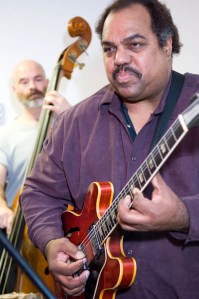
Daryl Davis is a musician.  Most notably, he was the keyboardist in Chuck Berry’s band.  He’s played with B.B. King, Muddy Waters, Jerry Lee Lewis, the Platters, and knows all the greats.  He’s a very talented but also intelligent and compassionate man.  Upon watching Accidental Courtesy, I wondered if music really is his first calling.  It seems that Davis’ true talents may just be sitting down and talking.  “When two enemies are talking, they’re not fighting,” says Daryl.

Although this movie is about a musician, it’s not about the music.  Music does play a small role.  The first time Davis experienced race-related hate, he was the only black child in an otherwise white marching band, and didn’t understand why things were thrown at him.  He thought, maybe they were playing the music poorly.  His parents had to explain to him, “They don’t like you because of the colour of your skin.”  Life was never the same after that.

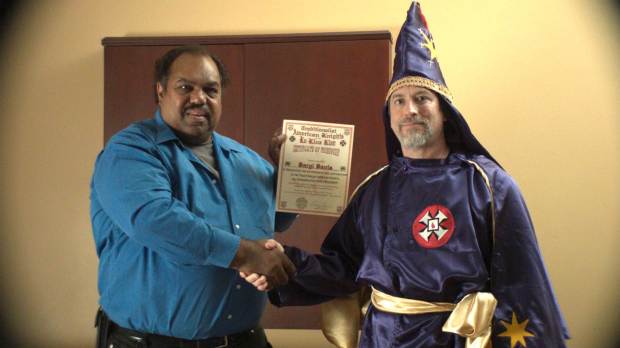
Accidental Courtesy isn’t about his music career, but about what Daryl Davis has done with the Ku Klux Klan and other white supremacists.  Since 1990, Davis has sat with various members of the KKK, both high ranking and rank-and-file.  Very few people can rival Davis for his knowledge of the Klan’s history and practices, so much so that Klan members have even approached him to learn.  Over long periods of time, after truly and sincerely befriending Davis regardless of his race, 26 Klansmen eventually turned in their robes to him and gave up the Klan.

It’s bizarre to see men who don’t believe in the mixing of races show up at Davis’ wedding to a white woman, to celebrate with him.  His friendship with them trumped their belief system.  It’s strange to see a black man invited into a KKK home, and vice versa.  It’s certainly unusual to see a fully robed KKK wizard sitting and shaking hands with a black man, simply enjoying conversation and company.

In the film, Davis also sits with the Southern Poverty Law Center, who seem less moved by his “person to person” method of combating hate.  They prefer to use a bigger stick.  What was surprising is how much flak he took from representatives from Black Lives Matter in Baltimore.  Here, he was mocked by two dropout activists for “only” converting 26 KKK members since 1990.  What was especially shocking was that the Black Lives Matter reps refused to continue to the conversation.   To them, he was worse than a white racist; to them he betrayed the cause.  All these white supremacists were willing to sit down and shake hands with Davis, but Black Lives Matter gave him the most difficult time.  They actually got up from the table and berated and belittled him before cutting the conversation off completely.  He was even treated with more respect by the KKK leader who refused to acknowledge the holocaust and said that blacks should be grateful to whites for freeing them.  It’s troublesome to think on what that means.

Certainly not everyone approves of the methods of Daryl Davis.  But in this day and age of social media, it’s more important than ever to talk.  Not online, not on Facebook, Daryl advises.  In person, where people can get to know each other, see each others faces and expressions, actually get to know one another.  Talk to each other, instead of talking at each other.  In this film, Davis asks questions, but rarely lectures.  Davis’ technique is simply to ask what makes people tick.  “How can you hate me when you don’t know me?” is a good opener.  He finds out what makes them think the way they do.  There is always more to the story than appears on the surface.  There is always a root cause.

Some felt Daryl did more harm that good with his methods.  Some feel he has betrayed his own people.  But, as Daryl says in the film, whites and blacks and people of all races must share America together.  That’s why we have to talk and figure out how to co-exist.  If he could convince an Imperial Wizard to hang up his robes, that is one small step to making the world a better place.  Black Lives Matter and the Southern Poverty Law Center have their own methods.  That does not negate the inroads that Davis made, just by talking.

There doesn’t seem to be much accidental about Daryl Davis’ courtesy.  It’s all very much on purpose.  Davis has a rich tapestry of friends behind him, some of whom have given up on hate.  If they can, why can’t everybody?

4/5 stars

MOVIE REVIEW: Mad Tiger (2016)

“When you create something, it doesn’t matter if it’s art or music…there is always suffering attached to the creative process.” — Peelander Purple (Akiteru Ito)

mad-tigerMAD TIGER (2015 Film Movement)

Directed by Jonathan Yi and Michael Haertlein

Peelander-Z is a Japanese-born punk band, via New York City, sort of a cross between Gwar and Japanese science fiction.  In their own words, they are a “Japanese Action Comic Punk band hailing from the Z area of Planet Peelander”.  They have been releasing music to a cult following since 1999.  Their hits include “Mad Tiger” and “Ninja High School”.  Music is only 10% of what they do, with elaborate stage shows, stories, monsters and characters to go with it.  Like many Japanese super-teams, they are all completely colour coordinated.  Their founding leader is Kengo Hioki, or Peelander Yellow.  His partly-shaved head is always dyed yellow, and his costumes match.  According to his wife Peelander Pink (keyboards), Kengo first had to learn how to play guitar standing up in order to form a real punk band.

Their music is meant to be fun, to bring happiness.  The music itself is not serious, but Yellow takes his band very seriously.  When original drummer Peelander Blue left the band in 2008, he was replaced by Peelander Green who helped bring the music to a more professional level.  Bassist Peelander Red (Kotaro Tsukada) was the lynchpin, being the member who was the most physical on stage and able to do the stunts that Yellow could not.  A new stunt involved him riding a unicycle in a squid suit and crashing into the stage.  He’d often be the member who was climbing on top of things, and hanging from the ceiling by his legs.  Other gags include human bowling a-la Jackass, and chair fights like WWE wrestling.  Red’s physicality was essential to this.

The atmosphere around Peelander-Z is bubbly and celebratory, but inside, there is tension.  Red has decided to leave the band and open a bar in New York.  A final show for Red is a big deal, an emotional event for the members — each one changed colours to red for this special show.  For Yellow, it means not only losing a close friend, but having to create a new character for a new member to play.  Another friend, Akiteru “Eatman” Ito, is flown in from Japan to play bass.  His musical style is different from Red’s, and different from what Yellow is used to.  He becomes Peelander Purple, a rhino-headed bass behemoth, and they prepare for their first show together.

While this movie is ostensibly about a unique punk band with a 15 year history, it is more so a look at Kengo Hioki, a born entertainer who was facing a crossroads in his life with the departure of Red.  We get to visit his family in Japan, his devoutly Christian father and his siblings.  We get a sense of what friendship and commitment means to Kengo, especially in regards to the tensions between his partners in Peelander Z.  Watching the band seemingly fall apart while he was working hard to build  it back up is poignant. Filmmakers Jonathan Yi and Michael Haertlein chose to leave in raw, emotional footage that Kengo wanted to sum up in animated form.

The songs are silly and fun, but the passion is genuine.  Check out Mad Tiger.

4.5/5 star-z

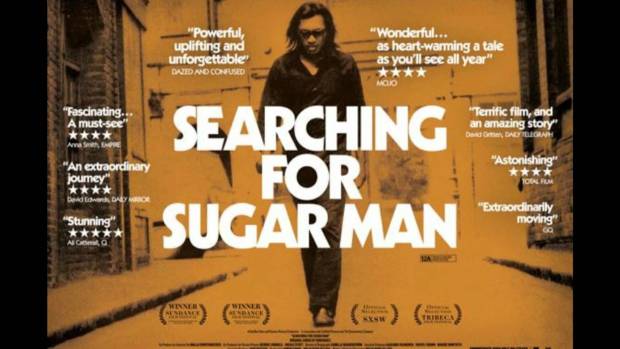
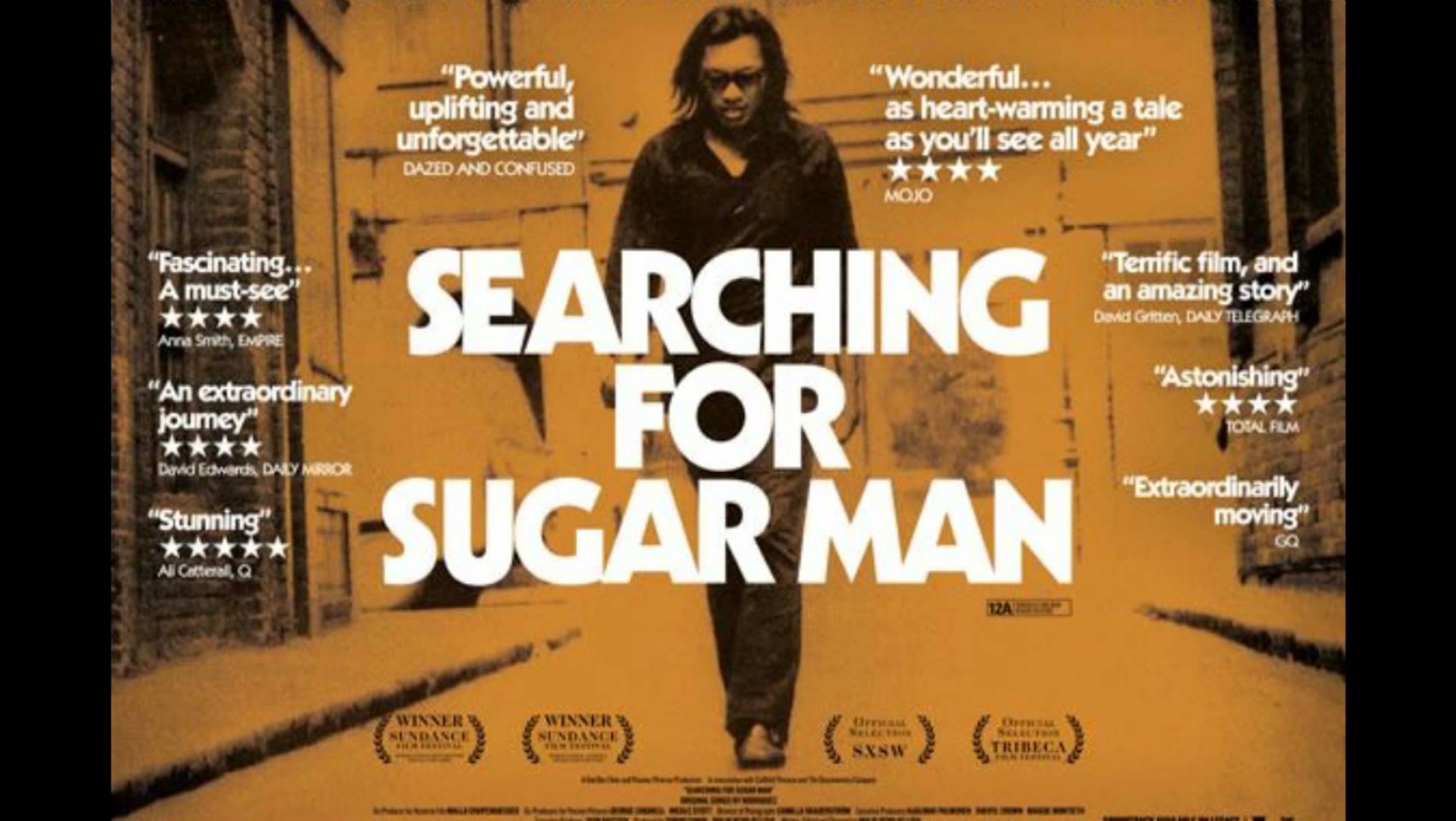
MOVIE REVIEW: Searching For Sugar Man (2012)

Looking for something to watch on Netflix this weekend? Look no further.

SIXTO

SEARCHING FOR SUGAR MAN (2012 Sony)

Directed by Malik Bendjelloul

Like the rest of the world outside of South Africa (and Australia), I had never heard of the American singer Sixto Rodriguez.

If I had, I could all but guarantee I would have been a fan.  With a rare songwriting ability often compared to Bob Dylan, the artist known only as Rodriguez released two albums in the early 70’s.  He sounded something like Dylan hanging out with Neil Diamond and Johnny Cash, with the sadness of Nick Drake.  His voice, like those of Dylan and Cash, communicated volumes of emotion.  After he was dropped by his label, he disappeared completely.  What he did not realise is that change was coming to South Africa that he would one day be a part of.

They think his music first arrived in Apartheid-era South Africa via a bootleg tape that made the rounds.  Cold Fact (1970) and its followup Coming From Reality (1971) were of a remarkable quality, but with socially conscious lyrics that struck a chord.  Rodriguez became immensely popular among the people, who were tired of racism and felt Rodriguez’ music was valid to their country.  Some songs were banned completely.  The government didn’t like it, and scratched the songs out of the records so they could not be played.  But no government lasts forever.

Nobody in South Africa even knew who Rodriguez was.  Even his full name wasn’t obvious.  His albums had credits with names such as “Jesus Rodriguez” and “Sixth Prince”, but nothing confirming the artist’s identity.  The story was he killed himself in a spectacular fashion, on stage.  The tale wasn’t consistent.  In one version, he doused himself with gasoline and set himself alight.  In another, he shot himself on stage.  These stories helped propel his popularity in South Africa to a level beyond even Elvis or the Beatles.  And he had no idea any of this was happening.

Hard core fans and musical detectives were determined to find out what happened to Rodriguez.  They followed the money, but nobody was paying the artist for South African CD reissues.  They poured through his lyrics for clues as to his whereabouts.  References to Amsterdam were misleading, and clues scarce.  “How did Rodriguez die?” was the only question on the searchers’ list.  Imagine their surprise when Rodriguez’ daughter in Detroit Michigan discovered the searchers online, and contacted them to tell that Rodriguez was alive and well and living modestly in the city!  Many South Africans thought this impossible, and fully expected it to be a hoax.  Only when he arrived and played a series of concerts in the country did they realise this was no impostor.  It was akin to Elvis returning for a comback today.

Searching For Sugar Man maintains the mystery.  That seems to be the way Rodriguez wants it.  Now that his fame in South Africa has finally caught up with him, he gives most of his newfound wealth away to family and friends.  The voice is intact, and so is the mystique.  The movie has given him a second chance in music, and he has returned to the stage for the first time since a brief tour in Australia in 1979, where he maintained a small pocket of fandom.  Rodriguez will be playing the Centre in the Square in Kitchener Ontario, on Sept 10.

5/5 stars
A rare of example of bass clarinet in popular music.