John Cuniberti

REVIEW: Joe Satriani – Surfing With the Alien (1987, 1999 remaster, 2017 RSD 2 LP reissue)

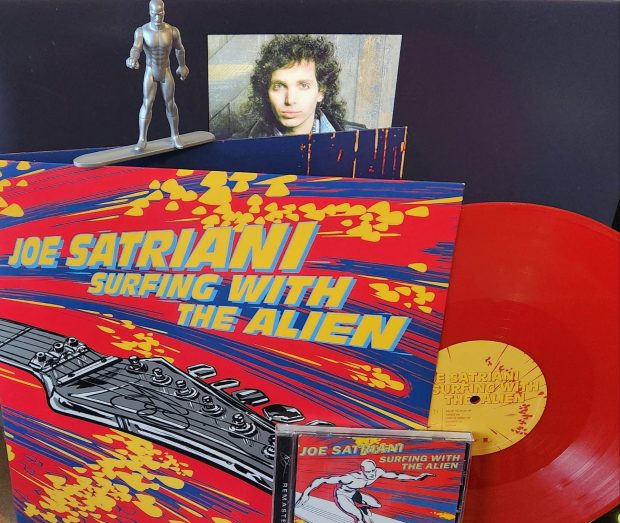
JOE SATRIANI  – Surfing With the Alien (1987, 1999 Sony remaster, 2017 RSD Epic 2 LP reissue)

On October 15 1987, the face of rock music was  shaken when a little instrumental album called Surfing With the Alien started making waves.  The record eventually went platinum, and its songs found itself used on radio and TV for decades to come.  Why?  Possibly because of Joe’s impeccable attention to songwriting.  Though his guitar playing put him on the map, it was his knack for writing catchy rock songs that made this album so special.  Satriani’s songs are written as if the lead guitar is the lead singer.  There are verses and choruses, and attention to structure and melody.  That must be why Surfing With the Alien was nominated for two Grammys in 1988.

Opening with the title track, a striking little chugging riff starts the show.  But then Joe’s melodic lead guitar kicks in, and you realize it’s exactly like if a singer was leading the show!  You can literally sing along to Joe’s guitar and a little wah-wah effect doesn’t hurt.  And then the shred begins, and you feel like, “OK, I get it now.  This guy is an actual genius.”

Yet it’s all accessible.  He may throw in licks as fast as greased lightning, but you can still follow.  Your brain still picks out notes and melodies that satisfy those musical needs.

The cool “Ice 9” is a funky groove (Joe on bass) with a slick melody on top.  Joe can work with mid-tempo grooves just as well as high-speed blazes.  Solos with different sounds and guitar tones add diversity.  A fun tune, but the third song “Crushing Day” has more tension and urgency as the tempo is turned up once again.  The variety of solos, melodies and riffs in one short song is quite remarkable.  Joe’s guitar tone is bright and shimmery, like the Silver Surfer himself.

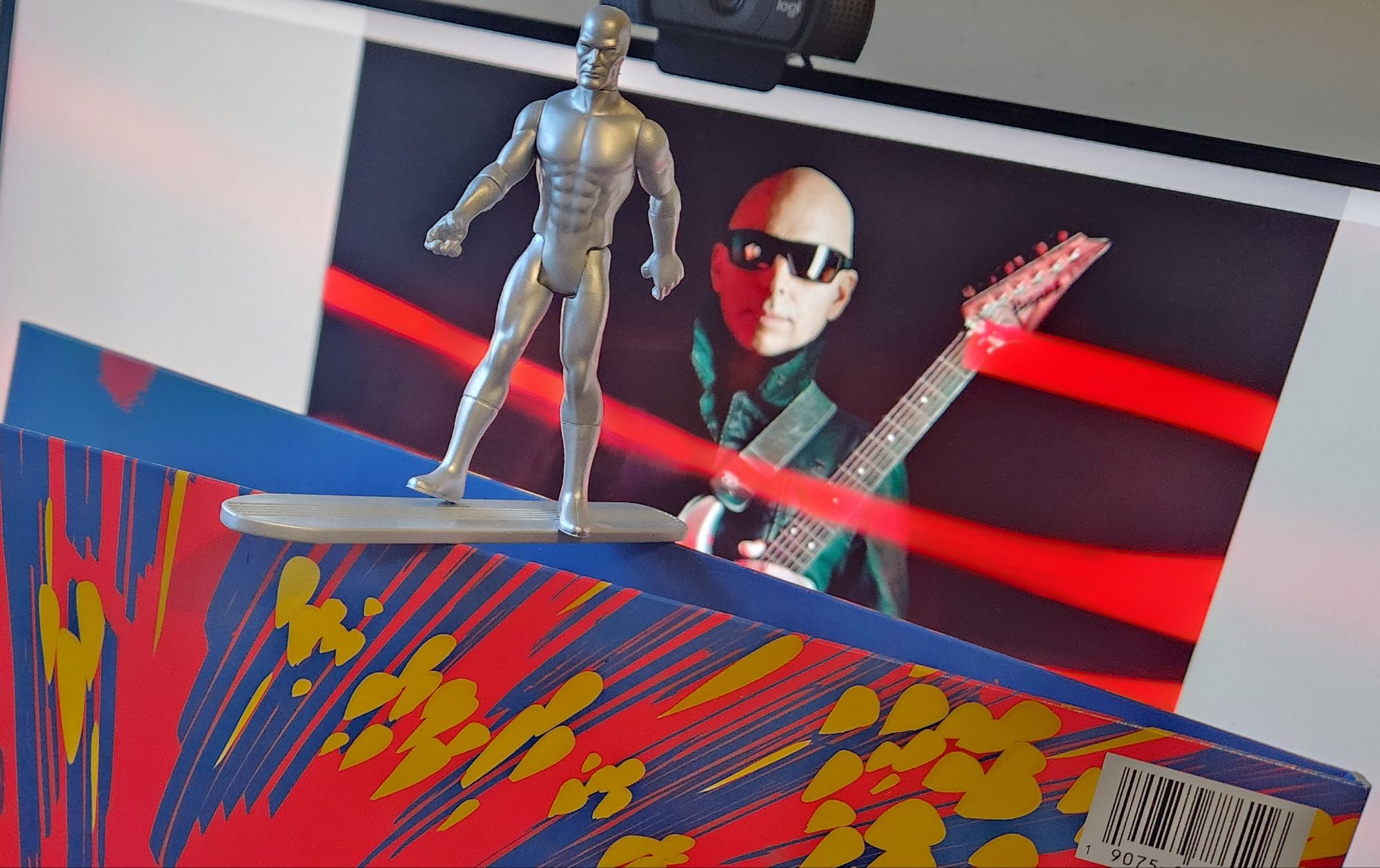
Incidentally, regarding the striking album cover featuring the titular Marvel character from Silver Surfer #1 (1982), Joe lost the licensing for him at some point in the 2000’s.  This is why the 2017 RSD reissue has different artwork, without him.  (Look carefully at the new art, and you will see that they replaced the yellow streaks with yellow guitar picks!)  Hopefully Joe doesn’t feel too badly about losing the Surfer art.  Marvel comics repaid him for the popularisation of the character outside the comic world by naming a planet after him.
The beautiful ballad “Always With Me, Always With You” might be considered the most famous song.  It received three Grammy nominations in three separate years (live versions, you see) and was prominently featured in an American Dad episode.  It is hard to describe exactly what makes it so special, without you listening for yourself.  The guitar is lyrical and memorable, and it worked so much better than it would have with a lead vocal.  This is an instrumental ballad, made magical.

“Satch Boogie” is arguably just as popular.  Deep Purple played it during the brief period when Joe Satriani was in the band post-Blackmore and pre-Morse.  It has been used on TV, radio and video games.  It is indeed a boogie!  It taps into the Van Halen vibe a-la “Hot For Teacher”, but burns straight through without stopping to talk.  Mid-song, there’s a jaw-dropping solo that is pure tapping nirvana.

An ominous and brief interlude (“Hill of the Skull”) paints an apocalyptic picture.  The programmed drums don’t detract, as it is all about the tale that the guitar is telling, with layered wails.  This serves to set up “Circles”, one of the most interesting tracks.  Echo is employed to great effect on this mellow but dark ballad.  Without pause, the striking chimes of “Lords of Karma” enter the picture, a pounding guitar rocker with drums by Jeff Campitelli.  (Drums on this album are a mix of live and programmed.)  Much like “Crushing Day”, “Lords of Karma” is a bit faster and more intense.

A lovely classical sounding interlude called “Midnight” sets up the final track.  “Midnight” features techniques that an expert will have to identify, except to say it sounds remarkable and innovative.  The spotlight is never really on Joe’s fingers though – just on the notes and sounds he magically produces with them (and an array of effects).  Then the thud of bass opens “Echo”, the last song on this important album.  It’s unlike the previous ones, with the bass so prominent.  The song sounds as if it’s always just bubbling under.  Perhaps it would come as a surprise that the final song on this album of guitar showcases is so much about feel and restraint.

That’s one thing about Surfing that does make it special.  Like any good album, it is sequenced as a full listen, not as a collection of shreds.  Even without the shreds, it’s still not bad.

That’s what the 2017 Record Store Day deluxe vinyl edition is all about.  A bonus LP is included, with all the lead guitar stripped off.  This allows you, the ambitious home player, to try to solo over the bed tracks.  For the rest of us, it just allows us to listen a little bit differently to an album that is very familiar.

The drums seem more prominent on the title track, allowing us to better hear Jeff Campitelli’s fills.  Mostly though, you can still bang your head, and maybe sing along to an imaginary vocal melody.  “Ice 9” is particularly fun in this guise, sounding a bit like an “80s dance remix” even though it’s not.  “Always With Me, Always With You” is still delicate and beautiful.  You get the picture.  These tracks, though needing the lead guitar to be whole, are perfectly listenable without.  Only “Circles” and “Midnight” seem completely barren.  You don’t have to be a guitar player to enjoy this bonus record.  You just have to be interested in music, and how it is constructed in the mix.  You can hear melodies and accents, even on “Always With Me”, that you might have missed on the album version all these years!

There are many ways to acquire copies of this impactful album, that opened the charts to Steve Vai and others a few years later.  There is a 1999 Sony remaster with liner notes and nice packaging.  There is a deluxe edition with a live DVD from the 1988 Montreux Jazz Festival.  The version with the most actual audio tracks, however, is the limited 2017 Record Store Day reissue.  You don’t get the lovely Silver Surfer artwork, but you do get the bonus record of stripped tracks, and red & yellow coloured vinyl.

No matter what choice you make, Surfing With the Alien in any form is an essential addition to a serious rock fan’s collection.  Some may argue it’s the best rock instrumental guitar album ever made.

5/5 stars


REVIEW: Joe Satriani – Shockwave Supernova (2015)

Purchased at BMV for $7.99 during Toronto Record Store Excursion 2016.

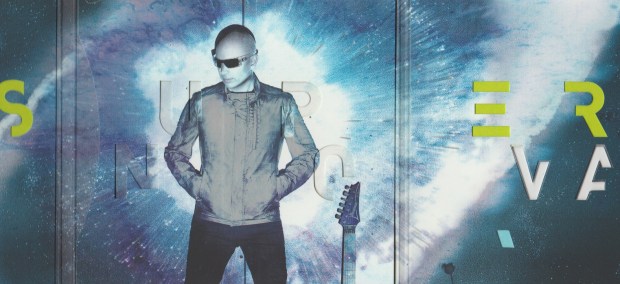
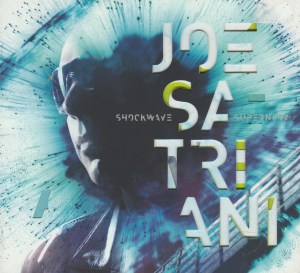
scan_20161217JOE SATRIANI – Shockwave Supernova (2015 Sony)

Like a manic version of “Puttin’ on the Ritz”, the title track from Joe Satriani’s latest Shockwave Supernova will render you mute as you pick your jaw up from the floor.  Syncopated guitars and drums unite before Joe focuses everything on the melody.  Joe’s brand of instrumental rock usually features the lead guitar in a melodic position where a lead singer would normally deliver the hooks.  That’s Joe’s job and he has done it consistently well.

New age-y guitar twinkles highlight the ballad “Lost in a Memory”, which pulses with understated rhythms.  It is only appropriate that this spacey music was recorded at Skywalker Sound.  What atmosphere and what power.  Things take a turn down Weird Street on “Crazy Joey”, a showcase for sounds you didn’t know a guitar could make, but still with a cool melody to remember.  Unbelievable accuracy and dexterity here.  “In My Pocket” brings back Joe’s bluesy harmonica work (often overlooked) with a stripped basic track.  Then we fly “On Peregrine Wings”, but the song itself is heavy as granite.  An unorthodox guitar hook reminds us that Joe isn’t a typical songwriter or player.  Thunder returns on “Cataclysmic” which moves along with the grace of a herd of rhinos.

Joe hops in his Tardis for a trip back in time to the early 60s on “San Francisco Blue”, but of course with his own space age sound.  He just has to “Keep On Movin'”, but it’s still a surprise when the piano shares the spotlight.  There is no shortage of string majesty, but the piano is a nice touch.  Things cool down on “All of My Life”, a gentle song with breezy congas and unexpected twists.  “A Phase I’m Going Through”, track 10, is the point at which the listener begins to get a little bit of ear fatigue.  15 songs might be normal for a Joe album, but 10 songs might be the ideal length for the average listener.

Take a break if you have to because there are still great moments ahead.  “Scarborough Stomp” is an apt title for the snare-heavy 11th track.  It’s all about that uncomplicated beat, but there is a cool baroque section in the middle that sounds as if lifted from Joe’s brief stint in Deep Purple (1994).  A tender ballad (“Butterfly and Zebra”) is a transitional song leading to the ominous backwards guitar intro to “If There is No Heaven”.  This song is reminiscent of past Joe blasters like “One Big Rush”. Then you will see the “Stars Race Across the Sky” on one of Joe’s more atmospheric tracks. A “Goodbye Supernova” sends us off in dramatic fashion with heavy keyboard accents by veteran Mike Keneally.

Very few Satriani albums will let you down.  Though some might argue “if you have one Joe, you have them all”, his fans will appreciate the differences.

3.5/5 stars

REVIEW: George Lynch – Sacred Groove (1993)

It’s a shame I lost my original 1993 review of this album.

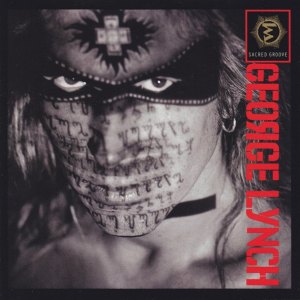
LYNCH_0001GEORGE LYNCH – Sacred Groove (1993 Elektra)

If you like Dokken but never followed George onto the Lynch Mob, then this album is for you.

George Lynch is a very talented shredder, capable of playing a wide variety of styles.  Sometimes he hits, sometimes he misses, but on Sacred Groove he makes the mark every time.  Sacred Groove was designed as a solo project shortly after the second Lynch Mob album.  The idea was to work and write with different singers and musicians, and George loaded up on some great singers.  Glenn Hughes, anyone?

John Cuniberti, who co-helmed many Joe Satriani albums, produced this opus and lent it some serious sonic excellence.  The opener “Memory Jack” is a collaboration between producer and guitarist, but this is little more than a sound collage to kick off a killer instrumental called “Love Power From the Mama Head”.  This isn’t to say that “Memory Jack” does not contain some shredding licks, because it does…but they are not the focus.  The sound collage itself is the focus.  Into “Love Power”, George lays down some serious riffy rhythm guitars.  This is topped with a very Satriani-esque guitar melody.  “Love Power” is constructed very much like a Satch rock instrumental track, with memorable guitar melodies and song structures.

There is a very cool moment in the guitar solo in “Love Power From the Mama Head”, at exactly 4:47.  While George was essentially assaulting his guitar with the whammy bar, he accidentally dropped the instrument on the studio floor.  “Shit!” said George, while producer Cuniberti ran over and stopped George from picking it up.  The producer then kicked the guitar for added effect!  Cuniberti assured George it would sound cool, and it kind of does!  The guitar just stops on this weird chord-like sound, before they punch out of that and into more shredding.  It’s different and spontaneous and I love shit like that.

“Flesh and Blood”, contender for best track on the album, is the first vocal, featuring Badlands’ Ray Gillen (R.I.P.).  It’s a Dokken stomper for sure, but with Ray Gillen’s bluesy Coverdale-isms all over it.  Killer.  The lyrics were co-written by George’s ex-Dokken bandmate Jeff Pilson, who also co-wrote and plays bass on the next track, “We Don’t Own This World”.

Now here’s the interesting thing about “We Don’t Own This World”.  Lyrics by: Don Dokken?  The fuck?

George, Don and Jeff had planned to reunite on this one song, that Don supplied the lyrics for.  Don however cancelled or chickened out (either/or) and didn’t make it to the session.  It just so happened that the Nelson twins, Matthew and Gunnar, were in town and eagerly sang on the track in Don’s absence.  With their harmonies, “We Don’t Own This World” sounds nothing like Dokken, except in basic ways.  It’s the most commercial track on the album; a pop rocker.  The vocals soar over one killer melody, and the solo is one of George’s best.  If this song had come out only two years sooner, it would have been a hit single.  The Nelsons have done some cool music over the years, and not gotten a lot of credit for it, so this song is pure delight.

I still think of CDs as “albums” with distinct sides, and on the cassette version “I Will Remember” closed Side One.  This instrumental ballad has a vaguely dark tropical feel, although it is an electric guitar song.  George’s solos are sublime and I love his unexpected timing on certain notes.  He has flawless chops mixed with feel…a rare combination.

LYNCH_0002

Side Two’s opener is an epic in two parts, but it’s as close to a skip as this album gets.  The problem is vocalist Mandy Lion, of WWIII.  You either like his glass-garling-elfin-metal voice or you do not.  I do not.  However, “The Beast” Parts I and II are such a slamming groove that I tend to block out the words and the voice singing them.  This is another track where the original vocalist slated could not do it.  Udo Dirkschneider wanted too much money and Rob Halford was too busy, but Mandy Lion would do it.  He showed up at the studio in the heat of summer wearing head to toe black leather.

“The Beast” could be a dirty sex anthem, I guess, but it’s far too heavy for the 50 Shades crowd.  I dig when halfway through, George breaks out his newly-bought sitar.  (I remember seeing pictures of George in Metal Edge magazine buying it!)  If only Mandy would have chosen to shut up at this moment.  Bassist Chris Solberg comes in and grooves through to a false ending, and then it’s “Part II (Addiction to the Friction)” — a 10 minute track in total.  Thankfully a huge chunk of it is instrumental.

The regal Glenn Hughes raises the bar any time he opens his mouth.  His two songs were the first new Hughes singing I had heard since Black Sabbath.  I detect some fragility in his voice here.  I think this may be from a period where Glenn was recovering from addictions.  Regardless, he sounds a lot better today, whatever the reasons are.  That’s not to say he’s bad here, because he’s still the best singer on the album.  You just feel he’s not giving it everything like he does today.

“Not Necessary Evil” is Glenn’s first song, a Dokken groove with Hughes’ soulful signature style.  This one too had hit single potential, but only in an alternate timeline in which Rock never fell to the Grunge Hordes in 1991.  “Cry of the Brave” is his second track, a slower and more soulful rock track.  This is a song about injustice to the American Indian (reading the lyrics, I’m assuming specifically Leonard Peltier), and it’s worth noting that Glenn wrote the lyrics by himself.

The album closes with a final instrumental called “Tierra Del Fuego”, and if you couldn’t guess, that means George breaks out the flamenco guitar.  There’s also a guest electric guitar soloist named Daryl Gable.  If I remember the story correctly, Daryl Gable was a lucky fan who was selected to have a guest shot on the album.  How cool is that?  And he’s pretty good, too!  I have to admit I like these dusky tropical flamenco things, so I consider “Tierra Del Fuego” to be a very successful album closer.  But fear not, there’s plenty of electric guitar too!

Sacred Groove is pretty damn near flawless.  If only they could have got Udo instead of Mandy, eh?

4.5/5 stars