DUST – Hard Attack(1972) / Dust(1971) (2013 Sony Legacy)
fans know the names of Richie Wise and Kenny Kerner. This production team laid down the first two Kiss records, and although their production was not the best, they were the first. But where did they come from? A little trio called Dust. Wise was the singer and guitar player. Kerner was the manager, co-producer and co-writer. They released two records as Dust, also featuring legendary Derringer bassist Kenny Aaronson and drummer Mark Bell. These two albums, Hard Attack and Dust, were remastered and compiled as one CD by Sony in 2013 (presented in reverse order).
The cool thing is the Dust albums actually sound better than the Kiss albums.
Dust were a hard rockin’ band, distinguished by having loads of slide and pedal steel guitars (handled by Aaronson). Dust were travelling the same roads as other bands such as Aerosmith, Cream, Free or Zeppelin, but with less of an identity. The songs were good. “Stone Woman” is slippery slick blues rock, while “Goin’ Easy” is a laid back southern acoustic blues. And they could get heavy. “Love Me Hard” is the kind of proto-metal that Budgie, Sabbath and Purple were doing on the other side of the Atlantic.
3.5/5 stars
This was a 200 word review in the tradition of the #200wordchallenge.
– Hotter Than Hell(1974 Casablanca, 1997 Mercury remastered edition)
Sunny California awaited Kiss, and producers Kenny Kerner and Richie Wise. Hotter Than Hell was an apt title for the album they were set to record, but nobody was happy. Maybe it was homesickness, but Hotter Than Hell is sonically perhaps the very worst Kiss album ever released. Brittle, thin and tinny are three appropriate words to describe its sonic flatness. What are supposed to be drums sound more like wooden planks. It sounds less like an human drummer and more like a clanking machine flailing away in a deep cave.
Production issues keep Hotter Than Hell off the tops of many lists, but the songs were all there. It remains a favourite for many, a reminder of times both good and bad, as nostalgia helps wipe clean the lingering audio disappointment. Kiss had little problem coming up with 10 great songs, mere months after their debut album Kiss(also 1974). Gene Simmons and Paul Stanley had the usual goods, and Ace Frehley provided co-writes on three songs. And what songs they were.
The slow riff for “Got to Choose” is a perfect opener, chunky yet melodic. Paul sings lead, Gene harmonizes, and a Kiss classic is born. “Ooh ooh ooh, got to choose who’s your baby!” they sing, and who doesn’t love “ooo ooo ooo’s” in their choruses? They contrast well with the heavy Kiss guitars, much edgier than the jangle of Kiss. Yet that’s nothing compared to the machine gun tactics of “Parasite”, a Frehley signature track as sung by Gene Simmons. When Ace does contribute his own material, it sounds like idiosyncratic Frehley. “Parasite” powers its way through the sonic haze, forcing its way above the sludgy sound. Ace’s solo remains a trademark, a stuttering classic you can hum in your sleep. Guitarists the world over got their start trying to play “Parasite”.
This makes way for the first Kiss “ballad” if you want to call it that: “Goin’ Blind”. It’s really too heavy to be a ballad, but it’s also too slow and mournful to be a rocker. This track goes back years, as Gene wrote it with his Wicked Lester bandmate Stephen Coronel as “Little Lady”. Though the lyrics may not appeal to all (“I’m 93, you’re 16”), “Goin’ Blind” is one of Gene’s finest songs. Ace’s solo just cries (loudly).
Paul Stanley’s title track is a favourite. The groove is what Kiss call their “monster plod”, and you know it when you hear it. It stomps, it rolls, and it takes its time. “Hotter Than Hell” has not one but two amazing riffs, and some of Ace Frehley’s coolest wailing. Frehley’s outro solo is multitracked, surely one of the earliest examples of this in Kiss. Then Frehley burns it all to the ground on “Let Me Go, Rock ‘n’ Roll”. Lightning licks and turbo charged rock n’ roll get the sweat pouring. Anyone who wants to know what the fuss about Kiss is all about just need to play “Let Me Go, Rock ‘n’ Roll”. Get past the sonics and focus on the adrenaline.
Dig that cowbell on “All the Way”, a Simmons rock and roll celebration. Though it wasn’t on Kiss Alive!, and hasn’t become a Kiss mainstay, that is not a reflection on its quality. Hotter Than Hell is often heavy and oppressive. “All the Way” is just fun, blowing off steam, and having a good time. “Watching You”, on the other hand, is one of those heavy Kiss grooves that Gene does so well. Listen to his bass playing, too. Cream were one of his big influences, and though Gene is no Jack Bruce, he composes melodic rolling bass lines. Because of his persona, and because it is more about the act than the musicianship, Gene’s skills on the four string are often overlooked. “Watchin’ You” places them front and center. And just listen to Paul Stanley coming in screamin’ at about 1:35! What a voice. There were no slouches in Kiss. Even hampered by the tinny drum sound, Peter Criss is ferocious, almost tribal. (And with tasteful use of cowbell.)
Paul Stanley has come up with some very cool, simple and classic rock and roll riffs over the years. Tracks like “Mr. Speed”, “C’mon and Love Me”, and more recently “All For the Love of Rock & Roll”. Add “Mainline” to that list of great Paul Stanley guitar parts. This song is given to Peter Criss to apply his rasp to. Compared to the more aggressive material elsewhere, “Mainline” almost slips between the cracks. It has become a favourite in fan circles. So has “Coming Home”, a rare Stanley/Frehley co-write. It is unfortunate that you cannot clearly hear the nuances of the rhythm guitars, because Paul and Ace blend their parts very well. “Coming Home” is so upbeat and energetic that you just keep trying to hear it a little better.
A Sabbathy closer called “Strange Ways” was written by Ace and given to Peter Criss to sing. This is an early example of Frehley’s loyalty to Criss. Ace knew that Peter could use another vocal on the album more than Paul and Gene did. Peter nailed it, and with Gene Simmons joining on the chorus, Kiss just flattened everything. Kiss rarely got as heavy as “Strange Ways”, and “Parasite” too…both Frehley songs.
Hotter Than Hell could easily score a 5/5 stars, but the sonics are impossible to simply ignore. Every time you listen to it, there are things that sound irritating. Instruments that don’t sound like themselves. Notes and beats you struggle to hear. It’s unfortunate that such a potentially lethal album was neutered by the lack of magic in the studio. But it was OK. Casablanca Records weren’t about to give up. A third album would be needed, pronto.
Today’s rating:
4/5 stars
Uncle Meat’s rating:
3 ¾/5 steaks
Meat’s slice: Some of the party/sex/sex/sex etc. songs Kiss filled the first album with were replaced by songs with darker lyrical themes. The sound on this album is, well…shit. This seems fitting considering all the bad experiences the band had while making this record (Ace’s face was mangled in a car accident). There are some great songs here, especially on side one. But side two is murked up a bit with a some clunkers.
Not only the first Kiss album I ever owned, but the very first rock record as well. I think my second record was The Bay City Rollers Greatest Hits.
Favorite Tracks: “Parasite”, “Got to Choose”, “Strange Ways”
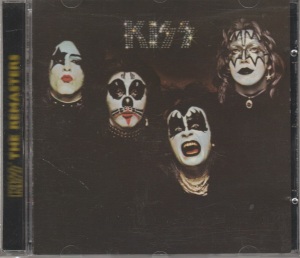
– Kiss (1974 Casablanca, 1997 Mercury remastered edition)
The recording contract was signed with Casablanca Records. Management was retained with Bill Aucoin. The live gigs were quickly becoming legendary. All Kiss needed was an album.
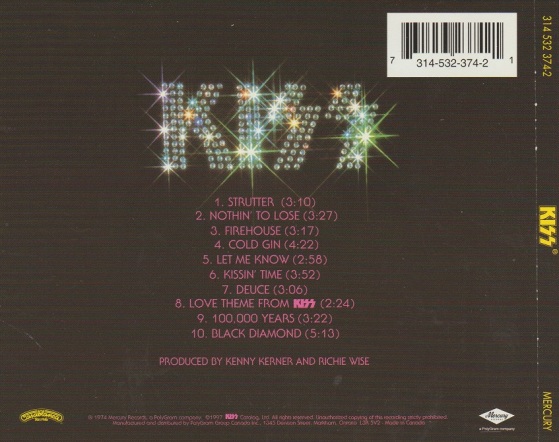
They band convened at Bell Sound studios in New York with Kenny Kerner and Richie Wise (ex-Dust) producing. They selected nine of their best originals and got down to the job of recording. Within a few weeks, they had a fully mixed album in their hands.
Kiss’ 1974 self-titled debut was simple and to the point. No ballads, no frills, no fluff, very little filler and all rock. It was a lean debut that lacked the thunder of their live performances. Guitar-based, yes, but restrained and underpowered. There was more Keith Richards rock and roll jangle than heavy metal distortion. Yet these songs have formed the backbone of Kiss’ live set for decades.
Peter Criss has the honour of having the first sounds on the first Kiss album – a drum roll to introduce Paul Stanley’s “Strutter”. The jangling Stones-y rhythm guitars of Paul and Ace Frehley are intertwined to create the “Strutter” riff, while Paul sings of a girl that he knows “a thing or two” about. She gets her way just like a child, but there is no bitterness in the song. It’s simply a rock and roll celebration, timeless and perfect as it is. When Ace Frehley arrives with his first guitar solo, it’s clear that he was always a talent to watch. His licks are fluid and precise.
One of Kiss’ biggest musical strengths was the fact that they had three (later on, four) capable lead singers. Gene, Peter and Paul take turns on “Nothin’ to Lose”, a simple rock and roller made perfect by Peter Criss’ raspy scat. The lyrics have nothing to say except that some lucky young lady has nothing to lose. Following this, Paul Stanley calls the “Firehouse”, a live favourite that loses a lot of its bite on album. The fire truck sirens are intact, but the recording is under powered — it needed more crunch and a little caffeine. Much tougher is Frehley’s “Cold Gin”, sung by Gene Simmons. The tempo is a little sluggish but it really came to life in the live arena. This classic was kept in the set long after Ace left the band, proving its mettle. Hard party rock doesn’t get much better than this. “My heater’s broke and I’m so tired, I need some fuel to build the fire.” It’s rare to hear Kiss singing about booze, which usually wasn’t their forte.
“Let Me Know” was one of the first songs Paul Stanley wrote, under the name “Sunday Driver”. It’s right there in the lyrics, “Let me be your Sunday driver, let me be your Monday man…” There are some songs that should get more recognition, and “Let Me Know” is absolutely one of them. Gene and Peter join Peter for an irresistible group effort. It gleefully continues the jangly rock of the first Kiss album, although there is also a heavy closing outro riff. This powerful riff has been recycled live over the years to end other songs. “Let Me Know” closed the first side with this memorable piece of Kiss guitar thunder.
Gene Simmons’ “Deuce” has become one of the most identifiable trademark Kiss songs. “You know your man’s been working hard, he’s worth a deuce.” Gene says the words are meaningless, but lines like “Get up and get your grandma out of here,” had the attitude he wanted. Still one of Kiss’ hardest rockers, and with a riff that kills (ripped off from the Stones, according to Gene), “Deuce” will likely be played live until the end of time itself. You can see Gene up there on stage, tonguing himself for all eternity.
A bit of filler called “Love Theme From Kiss” (formerly: “Acrobat”) is one of their few instrumental tracks. It doesn’t have much meat, and was dropped from the set before too long. Live, “Acrobat” used to feature a fast and heavy part called “You’re Much Too Young” that is far better than “Love Theme From Kiss”. The lollygagging guitars of “Love Theme” just don’t cut it.
“100,000 Years” is driven by a wicked Simmons bass lick, and Paul Stanley’s wailing vocals. Its groove has kept it in the live set on and off for decades, a fan favourite often extended for concerts with a long Paul rap and drum solo. Then finally there is “Black Diamond”, the biggest sounding and most dramatic of these early tracks. It utilizes a sweet Paul Stanley acoustic intro, before it goes full electric and Peter Criss takes the lead vocals. His sandpaper rasp kills it: “Black Diamond” is another Kiss classic that has stood the test of time (and even different singers) over the years. The original album version is hard to beat.
Casablanca weren’t happy with how the album was selling. Label head Neil Bogart rushed Kiss into the studio to record a “hit single”. They decided on covering “Kissin’ Time” and promoting it with a “kissing contest”. Attention achieved, although the single performed only moderately. The track was added to the reissued album, as the first song on side two. The band were never particularly happy with it, and even though it showcases lead vocals from Paul, Gene and Peter, it does not sound much like Kiss. It sounds more like compromise.
Promoting Kiss meant keeping a constant stream of product on the shelves. A few months later, they were off to Los Angeles with Kerner and Wise to record a followup. Kiss would have two studio albums in 1974, mere months apart. Fortunately they had plenty of old Wicked Lester material to dust off. The Kiss debut remains a quaint sounding beginning. While their songwriting was intact and has proven to stand the test of the ages, their knowledge of the recording studio was just beginning. Kiss could have used a heavier edge, but it is what it is: a start.
Today’s rating:
4/5 stars
Uncle Meat’s rating:
4 ¾/5 steaks
Meat’s Slice:One of the best debut albums in rock history; there is not a bad track on the album. You could potentially hear more than half this album at any Kiss concert. Easily a Top 3 Kiss album for Meat. Certainly the production could be better, but the songs are great and even the minimalistic sound makes it feel even more like a great Rock and Roll record. Which is what most of 70s Kiss really is. Classic Rock and Roll. Even “Love Theme From Kiss” has aged well.
Favorite Tracks: “Nothin’ to Lose”, “Black Diamond”, “Cold Gin”
Forgettable Tracks: “Kissin’ Time” (Nitpicking here. Wasn’t even really on the original album in the first place.)
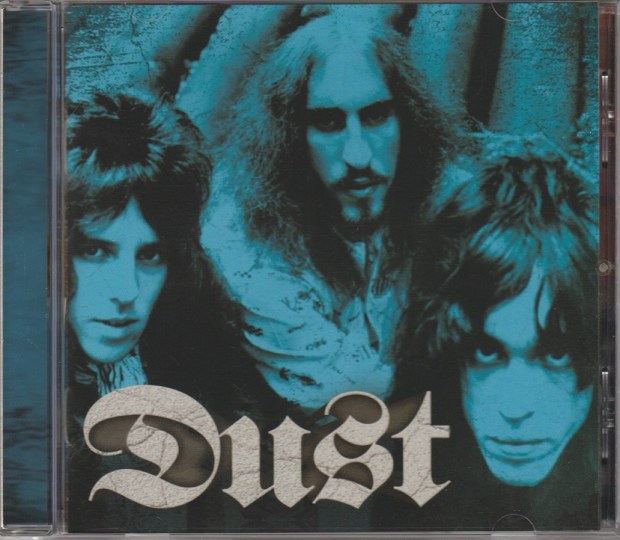


 fans know the names of Richie Wise and Kenny Kerner. This production team laid down the first two Kiss records, and although their production was not the best, they were the first. But where did they come from? A little trio called Dust. Wise was the singer and guitar player. Kerner was the manager, co-producer and co-writer. They released two records as Dust, also featuring legendary Derringer bassist Kenny Aaronson and drummer Mark Bell. These two albums, Hard Attack and Dust, were remastered and compiled as one CD by Sony in 2013 (presented in reverse order).








You must be logged in to post a comment.