London Symphony

REVIEW: Raiders of the Lost Ark – Original Motion Picture Soundtrack (2008 CD reissue)

scan_20170116RAIDERS OF THE LOST ARK – Original Motion Picture Soundtrack (Originally 1981, 2008 CD reissue)

When it comes to sci-fi nerds, movie geeks, and Speilberg buffs, there is one name that we all salute:  composer John Williams.

In 1981, Williams was given the task of composing yet another soundtrack for his buddy Steven:  Raiders of the Lost Ark.  Like Star Wars and The Empire Strikes Back before it, it needed identifiable themes to accompany our characters:  the heroic school teacher (!) Indiana Jones, his one true love Marion, and a whole slew of evil Nazis.  This time Williams needed to come up with appropriate music not for epic space battles, but to inspire awe in the wrath of God and the Ark of the Covenant.

To go with the 2008 theatrical release of (the atrocious) Kingdom of the Crystal Skull, Lucasfilm remixed and reissued the original Raiders soundtrack with 30 minutes of bonus tracks.  (Unfortunately, both the LP and box set have music not on this CD, but we don’t get this stuff for free, so a review of this CD is all you get.)  Virtually every note will be familiar to fans both casual and die-hard.

Indy begins his adventure “In the Jungle” and immediately you can picture the spiders and creepy-crawlies that Indy had to step through.  “The Idol Temple” has even more creepy-crawlies, and Williams expertly finds the musical effects to go with the eight-legged chills.  Just like the movie, be ready to jump startled at certain cues.  Serious action begins on “Escape from the Temple”, the kind of track that is a benchmark for such scenes.  The “Flight From Peru” is the very first appearance of the famous Indiana Jones theme, as he escapes death…barely!

scan_20170116-3

In America, Indy is paid a visit at the school by two “Washington Men” who want him to find something.  This is the eerie, understated debut of the Ark’s theme, though Indy’s own theme plays around with it, indicating the two will eventually collide.  “A Thought for Marion” introduces her theme, and then back to the Ark’s music once again.  The ominous overtones indicate that Indy’s mission to find the Ark will not be easy.  He is then off to Nepal with music that hints at the dangers ahead.  In Nepal he finds both Marion and the medallion, which has its own dark music.  The military drums foreshadow the involvement of the Nazi forces also searching for the Ark.

The score takes a slight middle eastern turn with “Flight to Cairo”, also augmented with Indy and Marion’s themes.  The two must find the Ark before the Nazis do with the help of Indy’s old Egyptian friend Sallah.  Marion finds herself in trouble almost immediately.  “The Basket Game” is one of the most memorable cues from the movie, though it ended badly for Marion and Indy.  Williams uses articulate melodies in a cartoon-like style to hint at the motion happening on screen.  With Marion gone, Indy must continue his quest with Sallah.  Together they visit a wise man, and discover that someone is trying to poison them with “Bad Dates”.

“The Map Room” is the setting for the next piece, building tension back with the Ark theme.  This incredible cue ends with Indy discovering the location of the Well of the Souls.   What I always assumed were sound effects in the scene is actually music (chimes).  Soon he finds Marion alive and well.  Her theme and that of the Ark return for another go-round as the heroes finally find the treasure.  The music when the Ark is found is similar to that in the Star Wars scene where the first Death Star explodes.   More creepy-crawlies (“Snakes…why’d it have to be snakes?”) infest “The Well of the Souls”, surely the creepiest scene in the movie.

Another great Indy action cue is “Indy Rides the Statue”, a piece of music that recurs when our hero is in great danger.  Escaping the Well of the Souls, Indy must battle a massive German henchman in “The Fist Fight”.  The tension is turned up again, and fans will recall this piece from one of the most punishing action scenes in the film.  “The Desert Chase” is the longest piece on the album, to suit a roller-coaster scene of thrills and chills.  The music delivers the same thrills, as you can picture Indy on that horse chasing down those Nazis.  It’s among Williams’ finest music.

scan_20170116-6

A tender moment (“Marion’s Theme”) is short lived as the Nazis return.  The action-packed music takes Indy to a secret Nazi island in the Mediterranean (“The German Sub” and “Ride to the Nazi Hideout”).  The horrifying finale reveals “The Miracle of the Ark”, and again some of Williams’ best music.  The end credits music “Raiders March” is some of most memorable music in film history.  It revisits the most exciting music from the score.  It is similar in style and equal in quality to what John Williams did with the Star Wars saga end credits.  This single track should be in any serious music lover’s collection.

For a more knowledgeable take on the Raiders soundtrack, we spoke to Rob Daniels from the Visions In Sound radio programme.  He had this to add:

When I first heard John Williams’ score to Raiders I immediately fell in love with the theme. In fact it has been my ring tone on my phone for several years over at least three phones. That being said the score to Raiders is much more than its theme. By the way, the theme is actually two separate pieces that Williams had written to be the title theme for the film.  Speilberg loved them both and asked them to be combined.

John Williams is the master of memorable themes and Raiders is no exception. There are several wonderful themes such as the aforementioned “Raiders March” but also to be commended is “Marion’s Theme” and the “Ark Theme”. Though I have to admit that my favourite comes in the cue “Desert Chase” as Indy is going after the Ark as it is on its way to Cairo. As the cues play you can see the Nazi soldiers being thrown from the truck and Indy’s fight in the cab with one of them as he eventually gets dragged behind the truck to his final victory and escape. It’s an amazing piece of audio gymnastics in an 8:18 cue.

Williams is known for his broad themes (See Star Wars & Superman) but he also plays the smaller moments just as well. (See “The Medallion” & “To Cairo” cue). In the hands of another composer this could have been just another score but Williams elevated the film to a fun and epic adventure that can be playful, sad and triumphant, sometimes all in the same cue.

The remixing renders an awesome sounding CD with the depth and clarity you expect.  A nice looking booklet has the images to go with it.  Remember listening to a soundtrack while leafing through the photos in the LP?  Relive that with the reissued Raiders of the Lost Ark.

5/5 stars


REVIEW: Deep Purple – In Concert with the London Symphony Orchestra (1999)

Thanks for joining me this week for Purple Week at mikeladano.com.  Today is Part 5 and the last album for now.    But don’t worry, I don’t think we’ve seen the last of Deep Purple around these parts…  

Part 1:  Shades of Deep Purple
Part 2:  The Book of Taliesyn
Part 3:  Perfect Strangers
Part 4: Whitesnake Live in ’84 – Back to the Bone
Part 5:  In Concert with the London Symphony Orchestra 

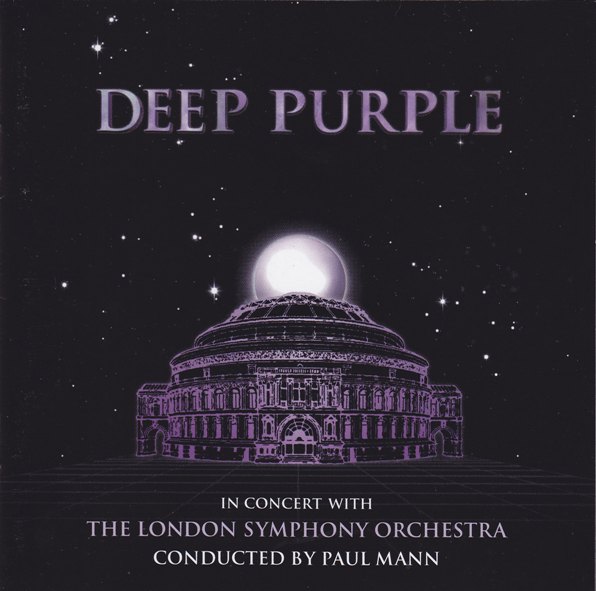
DEEP PURPLE – In Concert with the London Symphony Orchestra conducted by Paul Mann (1999 Eagle Records)

The original Concerto for Group and Orchestra (1969) was Jon Lord’s baby.  The rest of the band didn’t care too much for it, and it had only ever been performed twice.  The Albert Hall recording became a successful live album, and it was performed once more in Los Angeles.  Soon after, the original score was lost, permanently.  Even if Deep Purple wanted to (and let’s face it, if Blackmore were in the band he’d probably say no), it could never be performed again without the sheet music.

I’ll let Jon Lord take it from here.  From the liner notes to the CD:

“Marco de Goeij, a young Dutch composer…had decided to re-create it by listening to the recording and watching the video.  Over and over and over again.  A task of mind-bending complexity, dexterity and musicality, which then only left me the far simpler job of filling in what he had been unable to decipher, re-creating what I could remember of my original orchestration, and in part, as those who know the work will hear, re-composing where I felt it needed it.”

Conductor Paul Mann had independently been searching for the original lost manuscript.  When Jon informed him of the re-created one, Mann was on board with the London Symphony to do it once more.  Deep Purple now had a new guitar player, Steve Morse, who undoubtedly would have to bring his own slant to the guitar solos.  For Jon and the fans, it’s the stuff of wishes come true.

Since the Concerto was really Lord’s project, it seems like a fair compromise for each of the members of Deep Purple to also get a moment or two to showcase their solo work.  In fact many musicians from those solo works are welcomed to the stage, including the Steve Morse Band, Ronnie James Dio, Mickey Lee Soule (ex-Rainbow and ex-Gillan), Sam Brown, and more.  Deep Purple fans are generally open to different styles of music, and this album showcases those styles in a professional, classy format.

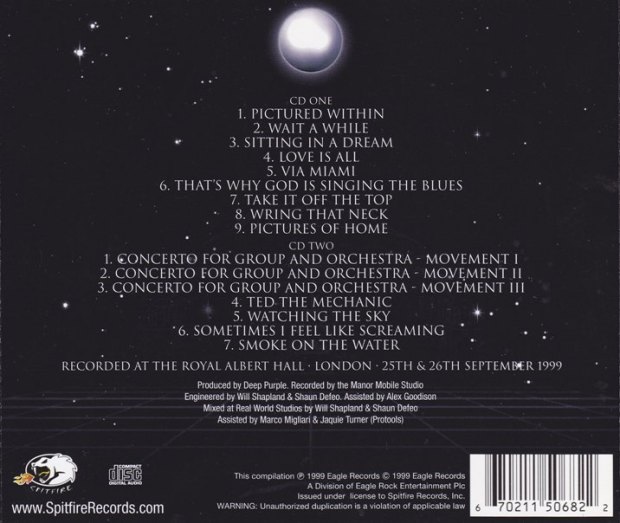
Once again at the Albert Hall, the set commences with a disc highlighting the solo careers. Lord’s “Pictured Within” (with Miller Anderson)  and “Wait a While” (with Sam Brown) begin the proceedings with a quiet, powerful pair of songs backed by Jon’s piano and dramatic strings. These versions are, dare-I-say-it, superior to the original studio versions.

From there, Roger Glover’s solo career gets a looksee, with “Sitting in a Dream” and the irresistibly bouncy “Love is All”, my favourite. Ronnie James Dio reprises his vocals from the original Butterfly Ball versions, sounding as great as he did nearly 30 years prior!  It really is impossible not to like “Love is All”, which of the two is especially fun.

DP LONDON SYMPHONY_0003

In 1988, Ian Gillan and Roger Glover did a project together called Accidentally on Purpose, a quirky tropical pop rock album.  “Via Miami” is one of the more upbeat tracks from that album.  Ian’s “That’s Why God is Singing the Blues” features his solo band’s guitarist Steve Morris (not Morse!)  Both it and “Via Miami” spark and roll along joyfully.

Steve Morse (not Morris!) is up next with the Dixie Dregs’ “Take it Off The Top”.  It’s the Steve Morse Band and the Kick Horns.  It’s always a pleasure to listen to Dave LaRue, Van Romaine, and Steve Morse playing together, but to hear them at the Albert Hall?  That’s a venue suitable to the genius they wrench from strings and wood.  Graham Preskett joins on violin to dual Morse with string acrobatics.

Ian Paice’s spotlight song is a horn-laden jazz version of Purple’s “Wring That Neck”. This is my kinda jazz, the kind with a rock beat you can swing to!  The violin solo lends it a bluegrass feel, too. The first CD ends with a powerfully heavy “Pictures From Home”, originally from the immortal Machine Head record, performed by Deep Purple with the London Symphony.  It’s a powerful, dramatic song on which for the full Deep Purple to enter.

Disc two features the entire Concerto from start to finish, all three movements, roughly 50 minutes in length. This truly was Lord’s baby, the piece that kept him up nights in 1968 and 1969 writing little black notes on white paper. It made Deep Purple a unique property when it was released on LP 1969, but had not been heard live in 30 years. Purple fans will be in seventh heaven with this de-extinction. Indeed, Morse’s guitar is different, but he hits the right notes at the right time while still playing within his style.  Otherwise, I’ll be damned but I can’t tell the difference.

What can I say of the Concerto itself?  I think it’s pretty cool, and I’ve always geeked out to stuff like this.  Jon envisioned it as “rock band meets orchestra” — at first they say hello, and play around, then they start shouting at each other, and before long it’s all-out war!  Speaking of shouting, my favourite is probably Movement II, which has Gillan’s all-too-brief but oh-so-perfect vocal.

DP LONDON SYMPHONY_0002

The disc concludes with three more (three Morse?) of recent vintage. “Ted The Mechanic” and “Sometimes I Feel Like Screaming” are two of the best songs from Purpendicular, and “Watching The Sky” is probably the heaviest song from Abandon. I personally feel that all the Abandon material was better live than on album, and “Watching The Sky” maintains that.  Unfortunately none of the Abandon songs were really that great.

Of course, “Smoke On The Water” ends the album with guests returning, including Ronnie James Dio who takes a verse. “What do you think Ronnie!”  Then the Elf himself is up at the microphone singing “Smoke on the Water” with Blackmore’s old band Deep Purple.  I shouldn’t need to tell you that this is one of my all-time favourite live versions of “Smoke”.

This album, which ended up being one of Lord’s last with Purple, was really a special gift to the fans. It is a beautifully crafted live performance containing some of the rarest of the rare gems in the extended Purple canon. An event like this will never happen again. There is a DVD of this show, but beware, it is only about 2/3 of the set.  What a disappointment that DVD version was.  You want every moment, but you won’t get it.

If you do hunger for more after this, then you can binge on The Soundboard Series 12 CD boxed set. It consists of 6 shows, two of which featured full live performances of the Concerto, with guests such as (yup!) Ronnie James Dio. There is also Live at the Rotterdam Ahoy which lacks the Concerto portion, but makes up for it with a more extensive set of classic rockers, including Dio’s own “Rainbow In The Dark” and “Fever Dreams”!…But that’s another review.

5/5 stars. For the true fan, and anybody who’s not afraid to expand their listening territory.

DP LONDON SYMPHONY_0005