Mike Varney

REVIEW: Tony MacAlpine – Edge of Insanity (1985 Shrapnel)

TONY MacALPINE – Edge of Insanity (1985 Shrapel)

Tony MacAlpine seemed to be in every guitar magazine when I was a kid, but I never got to hear his music. He looked cool, and he was highly praised as a shredder, but his music (on Shrapnel records) was impossible to find unless you ordered it from a specialty shop.  Like most of Shrapnel’s output, it was produced by Mike Varney.

His 1985 solo album Edge of Insanity features an impressive band:  Journey’s Steve Smith on drums, and of course it’s common knowledge that Billy Sheehan played bass.  The album is instrumental.

Opener “Wheel of Fortune” has a neoclassical vibe, with the rapid fire bassline enabling MacAlpine to focus on the melody rather than shred his way throughout.  There is certainly a commonality in terms of musical direction with Yngwie, but Tony’s approach is more easily digested.  Tony’s music has an actual bottom end thanks to Billy, and of course Steve Smith’s technique speaks for itself.  He’s more than capable of heavy metal hammering as he does on “Wheel”, but listen carefully and you will hear his signature cymbal work, so unique to me.

“The Stranger” discards some of the neoclassical robes, and rocks a more straight-ahead blitz.  Tony has a wicked keyboard solo mid-song, showing the breadth of his abilities.  The pulse of the song is all Sheehan, and Smith’s fills sound a lot like a certain band that started with a “J”.

A live solo called “Quarter to Midnight” is unaccompanied.  It reminds me of a Randy Rhoads solo.  There’s some nice whammy work near the end, which was so popular in the era.

A ballady song called “Angrionia” (mis-printed on the back cover, but correctly in the booklet) follows; quite a nice little tune with the occasional bursts of neoclassical guitar speed.  Billy has a couple nice rips as well.  MacAlpine multitracks his guitars for effect.

“Empire in the Sky” has a very cool keyboard intro, that leads into a gallopy metal number.  This has a mid-tempo vibe like Maiden circa Seventh Son when keyboards were happening.  You could imagine this coming from that era, though of course Tony was three years ahead.  His doubletracked leads set it apart from that, and there are some chunky riff chords happening beneath, though this is not a riff album.  There’s also some outro guitar twangin’ that is absolutely freakin’ rib-shattering.

An Yngwie vibe pervades “The Witch and the Priest”.  You hate to make comparisons, and it seems lazy, but when you hear a vibe there might be something to it.  Of course, Billy Sheehan and Steve Smith help make it sound less Yngwie.  Tony’s tone is warmer than the Swedish shredder’s as well.

“The Taker” is the only song with Tony playing bass and it’s less prominent for that reason.  This tune is a full-speed blaze, with Tony deftly weaving melody through all his playing, and then suddenly taking a left turn with harpsichord-like keys and then some organ for good measure!  “The Taker” keeps you on your toes.

Tony treats us to actual classical music next:  his spin on Chopin.  “Prelude 16, Opus 28” is performed on piano, and you’d never guess it wasn’t from a professional classical pianist.  This prelude leads into Tony’s “Edge of Insanity”, a deep cut title track and one that allows the chug-chug-chug of the metal to come through.  There’s still a soaring melody and flying bassline to absorb.  Smith’s drum parts are smashing – literally.  A great tune and a little easier to digest than the speedier stuff.

“The Raven” has classical keys opening a speedy metal rollercoaster ride.  Once again, Smith is classing up the place several notches with his signature fills.  Tony rarely lets up, constantly treating the listener to impressive shred.  He switches tones (and probably guitars) at some points, giving the lead work different voices.

The closing track, “No Place in Time” has some slinky Billy bass, and really allows him to have some of the spotlight.  His playing here is all about the groove he’s laying down, and how he complements Tony’s lead.  MacAlpine uses doubletracked guitars and plays a slow melody.  It’s not the most memorable track, and not the most effective closer.

Edge of Insanity is more accessible than a lot of instrumental guitar albums of the era.  If some of those other artists seem daunting but you’d still like a taste of neoclassic rock, then go for some Tony MacAlpine.

3.5/5 stars


REVIEW: Dudes – The Original Motion Picture Soundtrack (1987)

A collaboration with Jex Russell – check out his review of the vinyl by clicking here.

DUDES – The Original Motion Picture Soundtrack (1987 MCA)

Every collector is different.  My time is a valuable commodity, so when I buy movie soundtracks made up of mixed songs, I generally only play the songs by the bands I like, and I may never hear the rest of of the album.   So it came to be, I have never played the Dudes soundtrack, despite owning it almost 30 years.  I don’t know the premise of the movie either.  All I know is the old Keel music video for “Rock ‘N’ Roll Outlaw” featured some of the movie footage, starring Jon Cryer, Flea, and Mary Catherine Stewart.  It was clearly a comedy.  Back then, they didn’t tell you what movie or album a video was from, so I never knew the movie was called Dudes until I saw the CD physically.

I bought this disc at the Record Store in 1997 mostly for Keel, W.A.S.P. and Steve Vai.  One look at the cover and I said “This is that movie with the Keel song!  I recognize those two guys!”  And so it was.

The Keel video commences with a stern warning from a police officer: “You know, maybe this wouldn’t have happened if you looked like normal folks.”  He scolds a hilariously punky-looking Jon Cryer.  We know what kind of movie this is without seeing it.  (Lee Ving of Fear is also in the film.)

“Rock ‘N’ Roll Outlaw”, produced by Kevin Beamish, is the opening track.  It’s loaded with attitude and a cool riff, backed by electric slide guitar.  “All I need is a rock and roll band, and somewhere new to play!” howls Ron Keel, a distinct singer that never achieved the level of success he was due.  There’s a dual solo, with Marc Ferrari comedically using a pistol as a slide in the music video.  “Rock ‘N’ Roll Outlaw” is one of Keel’s top tunes, and it wasn’t on their album.  The drums are recorded a little clanky, but otherwise this tune is top-notch road rock.

I have never listened to the Vandals, as far as I know, in my life until this moment.  “Urban Struggle” begins with a mock Indian war beat, and a mutation of The Good, The Bad, And The Ugly theme.  It’s a joke song with cowboy-themed lyrics in a mock accent, and then going into a punk western style, and words about mechanical bulls.  Not a song I’ll be coming back to.

“Show No Mercy” by W.A.S.P. (produced by Mike Varney) is more my speed.  A non-album track, it hearkens back to early W.A.S.P.  The lineup pictured inside was the current W.A.S.P., including Johnny Rod and Steve Riley.  The actual track is from an earlier lineup with Tony Richards and Randy Piper.  As such, it sounds exactly like the first album, and having more tunes with that sound is never a bad thing.  It is a smoker, and Chris Holmes’ familiar guitar sound is welcome in my ears.  This song easily could have been on the album, if not used as a single.

Simon Steele & The Claw don’t seem to have released much music over the years.  Shame.  “Vengeance Is Mine” is a traditional metal gallop.  The vocals are decent, usually occupying a low John Bush-like growl, but occasionally releasing into a scream.  There’s an awkward key change midway through, but the pace remains relentless throughout.

Megadeth’s jokey cover of “These Boots Are Made For Walkin'” was on their first album as “These Boots”, but this version is slightly longer.  Produced by Paul Lani, it is a different recording from the album version by Dave Mustaine and Karat Faye.   It remains as entertaining as ever.  It may as well be an original if not for the lyrics.  You’d never think it was “These Boots” if it was purely instrumental.

A complete change of pace is the pop rocker “Time Forgot You” by Legal Weapon.  Apparently they were primarily a punk band, but this is a really cool mainstream 80s rock track that could have been a big hit on radio if circumstances allowed.  Singer Kat Arthurs is a breath of fresh air after the grit of Mustaine!  This is the hidden gem of the album, with a strong bassline and catchy, well-recorded stabs of shimmering rhythm guitar.

“Jesus Came Driving Along” by Swedish band The Leather Nun is like a gothic punk rock hybrid.  The vocals are recorded low in the mix and odd sounds are rampant, but it’s pretty cool.  It has a beat you can drive to, which might be the intent.

I was never a big Jane’s Addiction fan, but “Mountain Song” is a brilliant piece of swirly-whirly rock brilliance.  A big Jane’s fan told me at the time that he never heard this particular version of “Mountain Song” before, produced by the band themselves.  He considered it a rarity.  The riff to “Mountain Song” seems like it has been ripped off so many times over the years since.  There’s a Zeppelin-esque massiveness to it, but with a tribal beat, an 80s haze, and a howling Perry Farrell.  Utter musical magnificence.

Punk band The Little Kings have a very cool song here called “The Lost Highway”.  The exaggerated warbling mannerisms of the singer recall Elvis a bit, as the band chop out a greasy rockabilly sound behind him.  It’s hard hitting and unique.  It goes breakneck for a moment, and then back into a rockabilly groove.

A short instrumental from the movie score, “Dudes Showdown” has twangy guitar, and tense synth backing.  It certainly sets a scene.  It sounds like a setup for a climax.

The final song is almost a coda.  It’s Steve Vai’s rare rendition of “Amazing Grace”, which he has since released as part of his Secret Jewel Box collection.  At the time however, it was one of those scattered one-off rarities.  Vai goes surprisingly delicate here, with heavy, dreamy guitar effects and a very experimental arrangement of the traditional music.  Steve used to say, “Sorry, I can’t help myself!” and here’s an example.  He couldn’t help doing something completely different.

And that’s the album!  Not bad actually, with only the Vandals track being the one I’d skip today.

4/5 stars


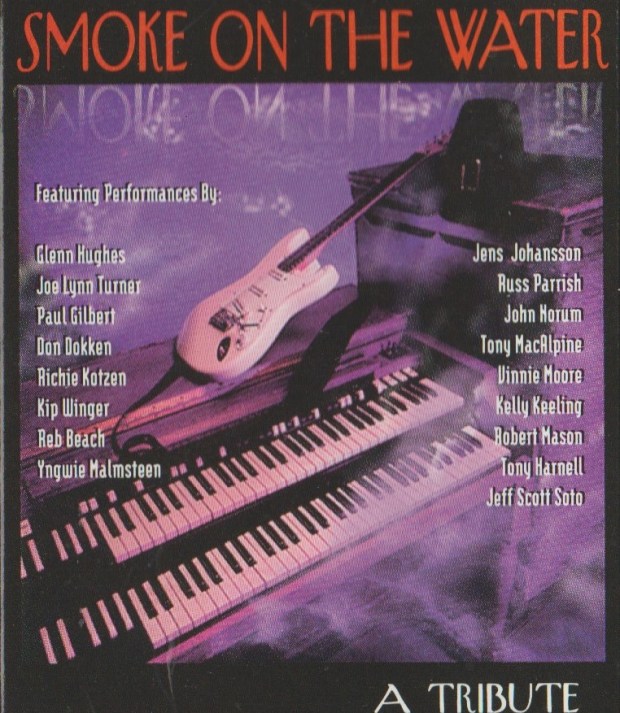
REVIEW: Smoke on the Water – A Tribute – Various Artists (1994 cassette)

SMOKE ON THE WATER – A Tribute (1994 Shrapnel cassette – tribute to Deep Purple)

This baby can be expensive to acquire on CD, so let’s give ye olde cassette tape a spin.  It’s not been played in over 20 years.  This review is with fresh ears.

The backing band on this tribute to Deep Purple consists of:  Deen Castronovo (Hardline/Journey – drums), Jens Johansson (Yngwie Malmsteen – keys), Todd Jenson (Hardline/David Lee Roth – bass) and Russ Parish (Fight/Steel Panther – rhythm guitar).  Each track has a featured singer and lead soloist.  Let’s dig in.

First up:  “Speed King” by Yngwie J. Malmsteen with Kelly Keeling on vocals.  Keeling is on the sandpapery side of Joe Lynn Turner here, while Yngwie gets to jizz fanboy style all over the fretboard.  The star might actually be Jens Johansson’s keyboards but this is an unfortunately very cheesy version of “Speed King”.  Woah, Keeling just nailed an Ian Gillan scream!  Nice.

Kip Winger and Tony MacAlpine team up for “Space Truckin'”.  Tony goes his own way with the solos, innovating as he goes.  This is…pleasant?  There’s some kind of spark that’s missing, and when you’re playing “Space Truckin'” you need to put accelerant in the tank or you’ll fall flat.  Studio sterility has replaced spontaneity.

You gotta hope Glenn Hughes and John Norum can shock some life into “Stormbringer”.  They can!  Of the guitarists so far, John Norum (Europe) is the one who has the right feel for Deep Purple.  Glenn’s great, but doesn’t get to play bass, and here’s part of the problem.  You can hear that the backing band recorded the songs and then the featured players recorded their parts over them.  In a perfect world you’d have Glenn plotting the way on bass too, gelling with the backing band in a united groove.  That can’t happen when you record this way.

One guy who manages to inject his song with personality is Richie Kotzen.  He’s got the funky “Rat Bat Blue” and is granted both the lead vocals and guitars.  Yngwie returns on “Lazy” and he’s teamed with former Deep Purple singer and his own former bandmate, Joe Lynn Turner!  Yngwie plays appropriately on this strong but fairly bland track.  And that’s the cue to flip the tape over.

Paul Gilbert (Mr. Big) gets the vocal and guitar honours on “Maybe I’m a Leo”, which frankly is too slow and lacks groove.  Paul’s vocals, however, absolutely nail Gillan’s on the original.  Things turn stale quickly when it’s time for “Smoke on the Water”.  Russ Parish takes the guitar slot while Robert Mason (Lynch Mob/Warrant) sings.  Far more interesting is “Fireball” with Don Dokken and his future Dokken bandmate Reb Beach.  Don sounds a bit overwhelmed by the demanding song, but hits all the requisite notes.  The brilliant Jeff Scott Soto takes the driver’s seat on Mk I’s “Hush”.  This veteran vocalist (Yngwie/Journey/man more) makes mincemeat of your ears, absolutely killing it.  Soto is absolutely the vocal star on this album (one that includes Glenn Hughes)!  The final song goes to Tony Harnell (TNT) and Vinnie Moore (UFO).  They busy-up “Woman From Tokyo” a bit too much with unnecessary fills, but Moore does some really cool picking during the quiet section.

Though interesting, Smoke on the Water is far from an essential addition to your Purple collection.  There are already so many tributes out there.  The most interesting was T.M. Stevens’ Black Night which re-interpreted Deep Purple according to his New York sensibilities.  He had Joe Lynn Turner, Vinnie Moore and Richie Kotzen on his album too!  Then there is the more recent Re-Machined, featuring Iron Maiden, Metallica, and more Glenn Hughes.  Considering the CD prices these days, place Smoke on the Water fairly low on your priority lists.

2.5/5 stars