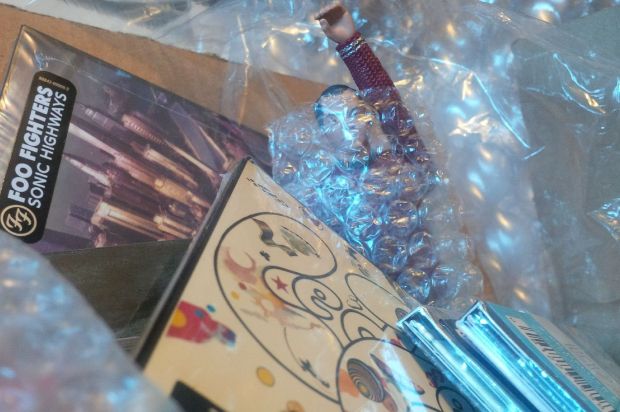
packaging

#1156: To What Lengths? (Shelf Wear)

RECORD STORE TALES #1156: To What Lengths? (Shelf Wear)

We, as collectors in this community, generally buy our music on a physical format to listen to it, but also value its condition and cosmetic perfection.  We don’t want creases in the inner sleeve, or banged-up covers if we can avoid it.  We especially don’t like being the ones responsible for damage.  It does happen.  Sometimes it’s as simple as pulling a favourite CD or LP out of its designated filing location too many times.  Scratches and scuffs appear on the jewel case or sleeve, if not protected.  Most people protect their vinyl LPs in plastic, and a small minority of CD aficionados do as well, which mitigates damage to just those moments you remove the packaging from that sleeve: the dirt and oils in your hands, the dust in the air, the light wear from handling.

If you’re new here, this is a judgement-free place!  If you go to tremendous degrees to protect your jewel cases (I had one customer who bought them 5 at a time and insisted each one be in its own separate little bag) then I applaud you.  I wish I had your discipline, honestly.  I’ve cracked and scuffed many-a-case over my years as a fan and collector.

Another fact known to CD collectors:  Many, especially in the 1990s, came in specialised jewel cases that could not easily replaced if damaged.  The best you could hope for was a Krazy Glue solution.  Example:  Pet Shop Boys’ Very CD in 1993, which came in a unique, opaque orange case with lego-like bumps on the front and a sticker with track listing on back.  It had a matching orange tray inside.  Fortunately, these were a bargain bin perennial and if you broke you case, you could buy a replacement for under $6 bucks.  If not, you could do a reasonable repair job with glue.

Coloured jewel cases were another variation.  With collector’s allure, Alice In Chains’ self-titled CD in 1995 came in two variations.  The common one was a yellow case with a purple inlay.  The very rare reverse was purple case with yellow inlay.  So rare in fact that in my 12 years in music retail, I never saw a copy come my way without one or both components damaged.  Less rarely, Kiss’ 1996 CD You Wanted The Best, You Got the Best came in a wine-red case with yellow tray.  I may or may not have swapped some at my store with plain cases, allowing me to keep the wine-red and yellow for myself, for other Kiss releases.  Perhaps I did.


Regardless of how you acquire such packages, the ideal collection has them relatively intact for the duration of their stay at your home.  How to do ensure this to the best of your ability?  As implied, I don’t want to put every CD I own in a sleeve.  However, I do make sleeves for discs like the above.  Simple ones out of clear comic bags (for example) cut down to size.  They even make sandwich bags in the exact right size if you feel lazy.  Remember:  no judgement!

Of course, this cannot prevent breakage all the time.  If you have ever moved house with boxes of CDs, you probably endured some damage.  When I moved, I did two important things:  1) I insisted only I handled the boxes marked “CDs”, and 2) I packaged all specially-cased CDs in a special padded box, also handled by myself.

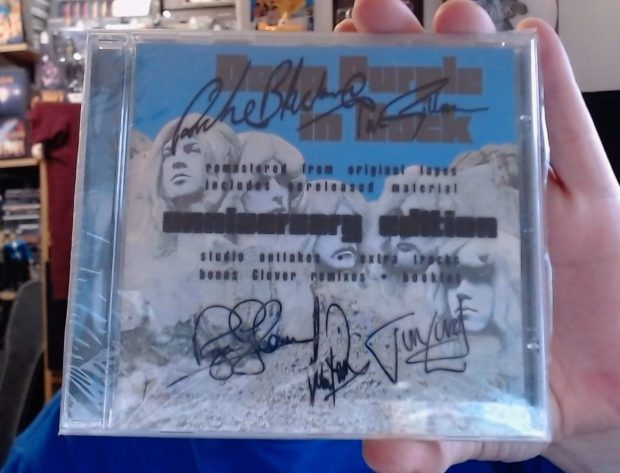
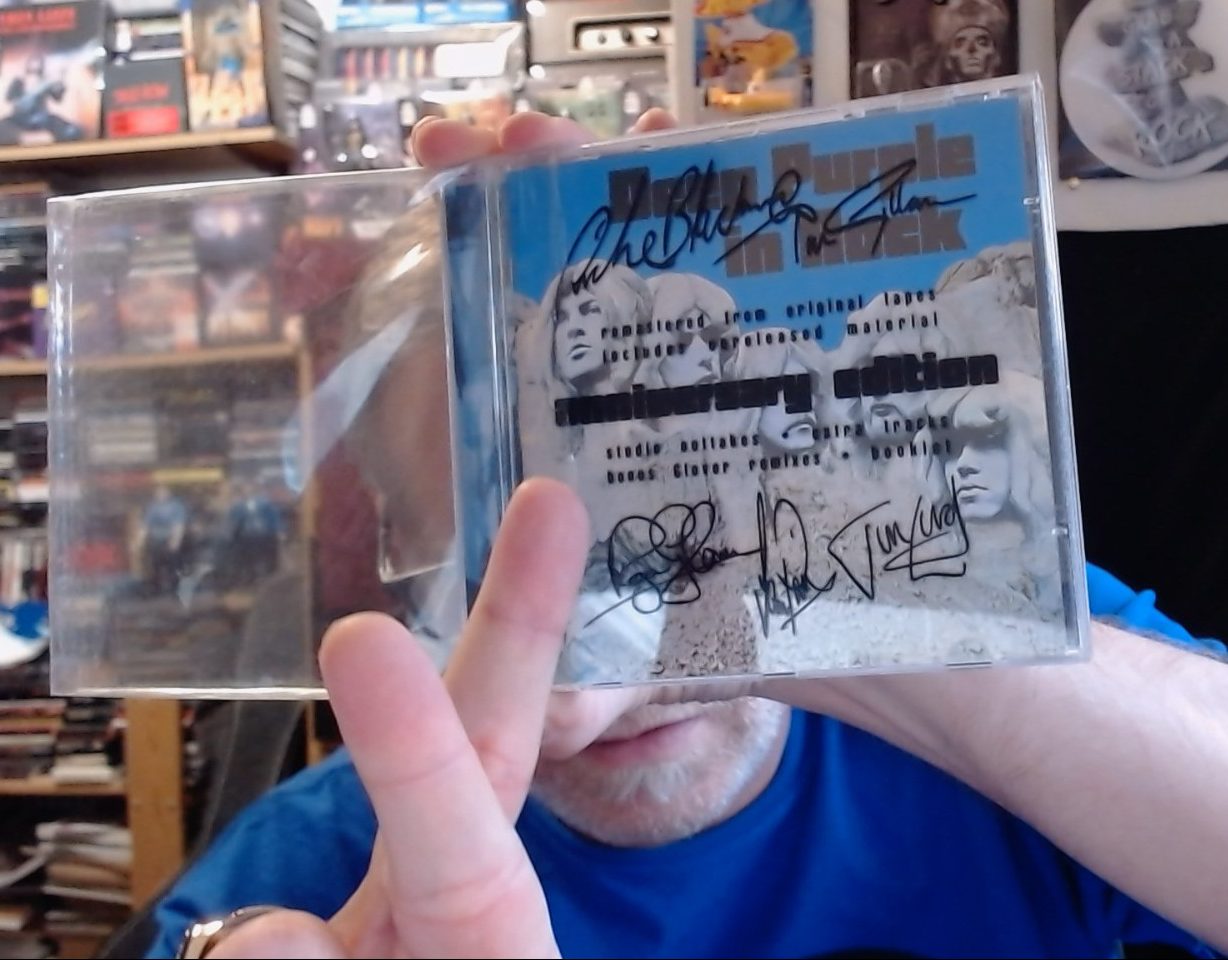
Another variation, and perhaps my favourite, is the engraved jewel case.  One of the most common is the Prince “Love Symbol” CD, fairly easy to find multiple intact copies.  My most treasured engraved case is Deep Purple’s 25th anniversary edition of In Rock.  (Now we’re over 50 years…)  I bought my copy in 1996, in Toronto, at (I think) Sunrise.  It was there or HMV, and I was present with the mighty T-Rev, who braved the streets of Toronto with no air conditioning on a hot summer day in my Plymouth Sundance.  He drove – I wouldn’t.  I cradled my precious Purple in my arms so carefully on my way home.  I could see easily that the signatures and text on the front were in the plastic of the case, and not printed on the booklet.

I made a plan, and carefully executed it.  My solution protects my CD to this day.

Using a Swiss Army knife, I carefully slit the right side of the plastic wrap, all around the entire CD, and removed this side flap.  I then carefully coaxed the CD out of its plastic home, and upon success, pushed it back in.  I had created a little sleeve that protected my new purchase upon my shelves.  It still functions today, and my copy of In Rock still looks pretty good despite hundreds of plays.

Fingers crossed!
 

REVIEW: Jethro Tull – Thick As A Brick (1972, 50th Anniversary remixed, cut 1/2 speed vinyl edition)

Thanks to Aaron of the KMA for sending this record for my 50th birthday!  50th anniversary edition for my 50th trip around the sun.


JETHRO TULL – Thick As A Brick (Originally 1972, 50th Anniversary Chrysalis Steven Wilson remix, cut 1/2 speed vinyl edition)

This review is focused on the remix and packaging of the 50th anniversary edition.  For a more music-focused analysis, read our 25th Anniversary CD review.  That CD came out in 1997.  How does that make you feel?  Here we are on the 50th anniversary of this great album already.

Even those who dislike remixes often approve of those done by Steven Wilson.  In 2012, for Thick As A Brick‘s 40th anniversary, Wilson created new stereo and 5.1 mixes for the album.  Such remixes work best when you play the album and can’t quite tell exactly what has changed.  Such is the case for Thick As A Brick.  The bass sounds deeper and the album sounds bigger.  You may notice musical elements you didn’t pick up on before, but the remix was clearly done with respect and never deviates too far from what you know.

The 5.1 remix is scheduled for a reissue in the fall, as even the 40th anniversary edition will get a reprint after nearly a decade out of print.

This vinyl LP was cut at 1/2 speed at AIR Studios.  According to the front sticker, this was performed on “a fully customized Neumann VMS80 lathe with fully recapped electronics”.  According to the same sticker, the 1/2 speed cutting allows better recreation of high frequencies.  I probably can’t hear them anyway, but in short:  the record sounds amazing!  The nuances of the flute, the organ, the acoustics…all here.  All thick as a brick!  Punchy.  More three-dimensional.  Because everything is so clear and in your face, this is my preferred way to listen to Thick As A Brick.  There is no struggling to hear any of the parts.  It’s all there, with good separation too.

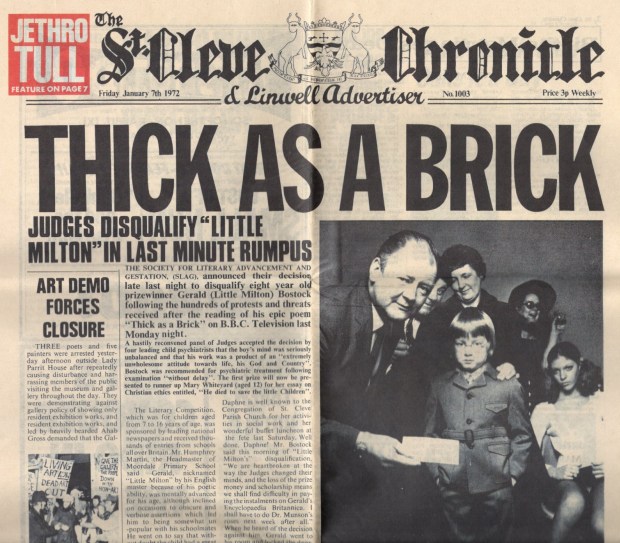
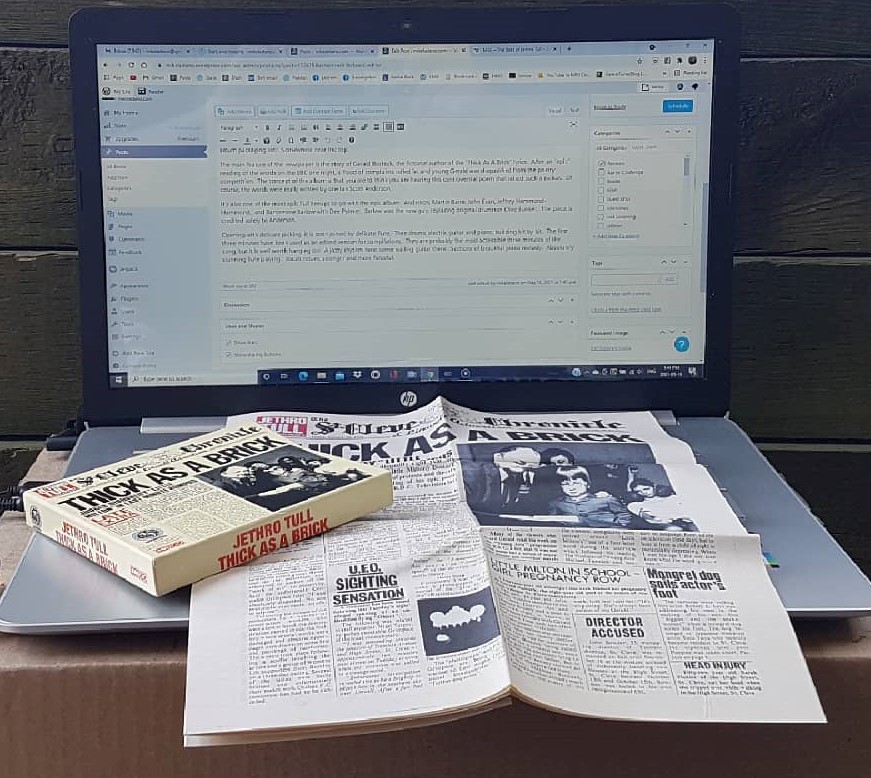
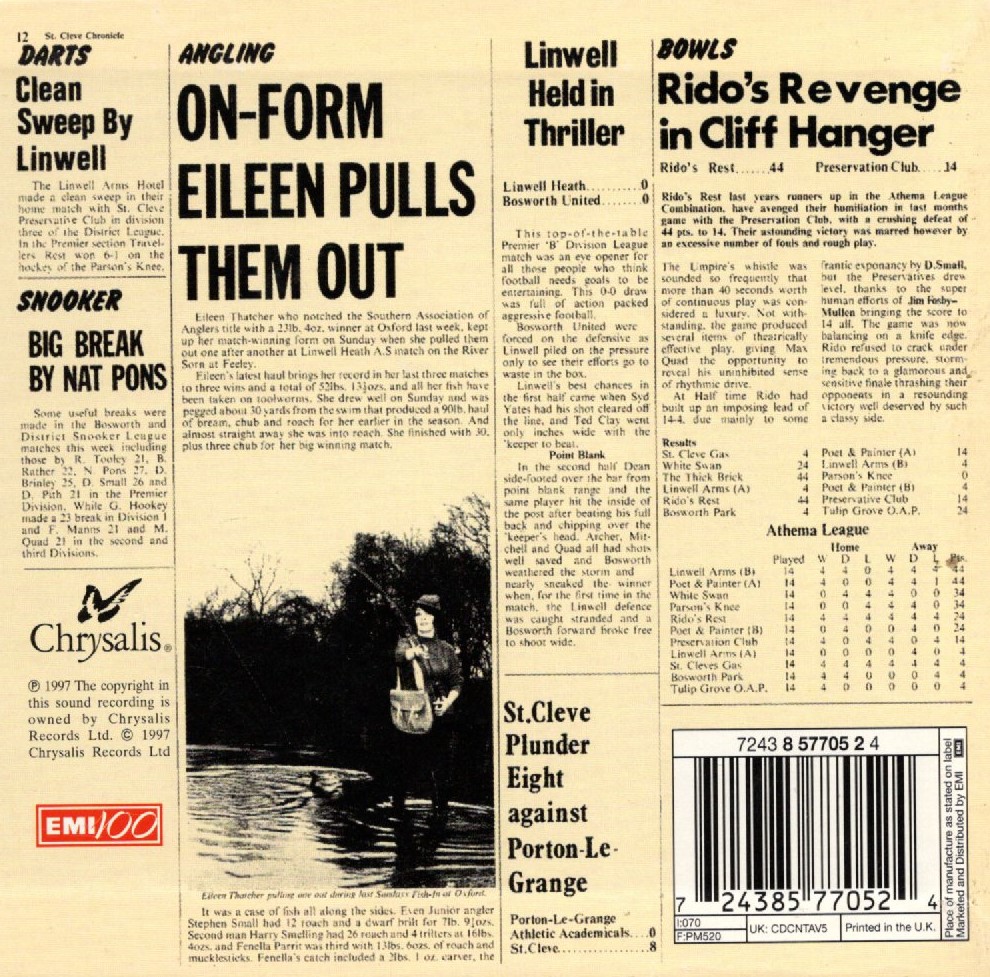
For this reissue, the newspaper packaging has been reproduced full size.  The actual sleeve of the album is a 12 page newspaper.  This was, of course, discontinued for most reissues over the past decades.  Like a real newspaper, this packaging include crosswords and advertisements, all fake and meticulously assembled to entertain and baffle those who stumbled upon it.  The outer page, which becomes the front cover, is of harder paper stock than the inner pages.  There have been complaints of bent and damaged pages inside the shrink wrap, but this copy was perfect upon opening.

In case you need to be told, Thick As A Brick is one song, split over two sides of vinyl.  “Thick As A Brick” sides one and two; there’s your complete tracklisting!  It must be said that though side two tends to get less appreciation, the last 10 minutes are pure progressive rock delight.  The album just gallops on side two.

Get your newspaper and a coffee, and sit down to enjoy the Steven Wilson remix of Thick As A Brick.  It’s a lovely way to spend your day.

5/5 stars


#941: Design Flaws – the CD Jewel Case

RECORD STORE TALES #941: Design Flaws – the CD Jewel Case

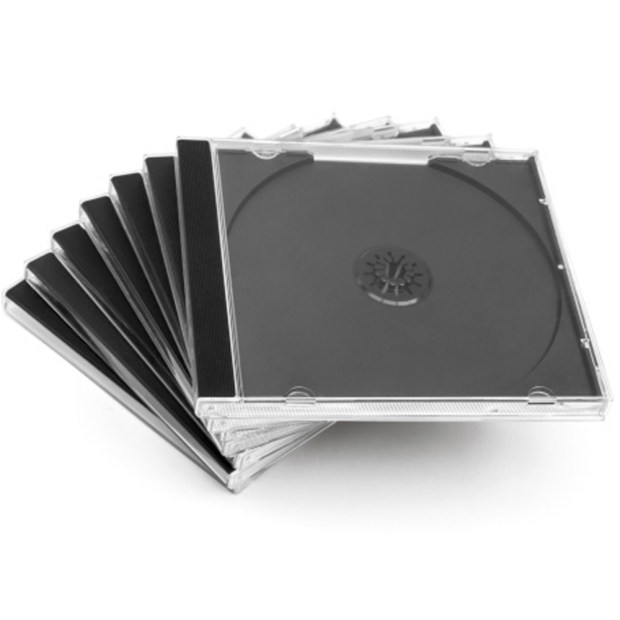
While CD has proven to be an enduring format (40 years old now!), its packaging has been, shall we say, less successful.  I’m not referring to the “long box” packaging that CDs originally came with, a disposable (but now collectible) piece of cardboard that served a couple different purposes.  It enabled stores to display their CDs in existing LP shelving, and it discouraged theft.  It also also created waste, and was phased out rather quickly.  However worse than that is the jewel case, the same damn jewel case we use today.

You are as familiar with the flaws of the traditional jewel case as much as I.  They have a number of common breakage points:

  1. The hinges snap off quite easily.  Hinges are commonly broken in shipping.  This is really a flaw inherited from its predecessor, the cassette jewel cases.
  2. A ring of plastic teeth holds in the CD in by the center hole.  Weak inner rings often came broken right out of the package.  This is a deadly flaw, because it leaves plastic shards underneath the CD itself, jiggling around and scratching the disc.  Plus the CD itself cannot be secured inside and moves around as well.  Ugly disc damage all but guaranteed.
  3. Also often broken during shipping are the little plastic tabs that hold in the CD booklet.  Not a fatal flaw, but an annoying one.
  4. All of this amounts to a tremendous amount of plastic waste when a broken CD case or component is discarded and replaced.

The music industry, driven by environmentally conscious artists such as Pearl Jam and Neil Young, thought to try the digipack as a solution to the packaging and waste problems of the jewel case.  This was only moderately successful.  While making CD packages such as Vitalogy out of paper did keep plastic out of the landfill, it did not help with longevity.  Unless extra care was taken every time, the CD would scratch itself coming in and out of its cardboard sleeve.  Many were eventually rendered unplayable.  And then you have plastic in the landfill again.  These paper sleeves were also prone to damage quite easily.  Shelfware, scuffs and rips are common.

Some decent packaging solutions worked well but never caught on, probably due to cost.  For example, look at the Super Audio CD (SACD) case.  Some regular CDs also came packaged in these “super jewel cases”, such as Queen remasters.  It features a much stronger hinge design and thicker plastic.  Not unbreakable, but certainly more difficult to break.  You can still crack them right across the front, but at least the jewel case will still function the way it was intended to:  holding the CD in securely without damaging the surface.

While there is nothing you can do about a CD case damaged in shipping, if you take a reasonable amount of care of your collection, you will end up with very few broken cases.  At least there’s that!

REVIEW: Jethro Tull – Thick As A Brick (1972, 25th Anniversary “newspaper” CD edition)

“Quite hard to play, and a lot to remember.” — Martin Barre

JETHRO TULL – Thick As A Brick (Originally 1972, 1997 EMI 25th Anniversary CD)

Some albums are more famous for factors other than the music.  Chinese Democracy, for example.  Anyone reading this can say “that’s the one that took Guns N’ Roses 17 years to make.”  Meanwhile, the same can be said for Jethro Tull’s Thick As A Brick.  Even if you have never heard the album, you probably know “that’s the one that came with the newspaper inside”.  You might even know that it’s only one, long 44 minute song.

All true.  You had to flip the song midway on the original LP, and that side break still exists on CD as the song is split into two tracks.  The 1997 Anniversary edition replicates most of the newspaper too, and though you will be wary of completely unfolding it and getting it back inside the case again, it is still a marvel.  With campy articles, crosswords, horoscopes, ads and news stories, you could read this paper for as long as it takes to listen to the album.  It is certainly among the most fabulous extras ever included with any release, LP or CD.  Top ten album packaging list?  Somewhere near the top.

The main feature of the newspaper is the “fake news” story of Gerald Bostock, the fictional author of the “Thick As A Brick” lyrics.  After an “epic” reading of the words on the BBC one night, a flood of complaints rolled in, and young Gerald was disqualified from the poetry competition.  The concept of the album is that you are to think you are hearing this controversial poem that raised such a ruckus.  Of course, the words were really written by one Ian Scott Anderson.

It’s also one of the most storied Tull lineups to go with the epic album:  Anderson, Martin Barre, John Evan, Jeffrey Hammond-Hammond, and Barriemore Barlow with Dee Palmer.  Barlow was the new guy, replacing original drummer Clive Bunker.  The piece is credited solely to Anderson.

Opening with delicate picking, it is soon joined by light flute.  Then drums, electric guitar and piano, building bit by bit.  The first three minutes have been used as an edited version for compilations.  They are probably the most accessible three minutes of the song, but it is well worth hanging on!  A jazzy rhythm here, some wailing guitar there.  Sections of beautiful piano melody.  Absolutely stunning flute playing.  Vocals return, stronger and more forceful.   This holds together for a long time as a pretty singular work, with lengthy instrumental sections between the vocals.  Then 12 minutes in comes the organ solo.

The song bounces back and Ian returns to the front, ranting about class.  It’s a surprise when the familiar opening guitar figure returns, but it is all one song after all.  This ushers in a folksy section, which eventually comes back to the power of progressive Tull.  A loud, rhythmic guitar outro takes us to the end of the first side with a hefty serving of organ.

The second side could not possibly open with as much panache as the first, nor should it, being the middle of a song.  After a brief respite, we are back into the heavy progressive Tull, and then a drum solo.  Exotic melodies dominate the first few minutes, when the drums do not.  The acoustic guitars return as they eventually must, and the song resumes a path like the one that it began with.

From moment to moment, Tull are not at all shy of showing you how smart-guy they are.  Those who adore challenging rock music will be right at home, drinking in every sudden time change and rippling solo.  The second side is thick with daunting rock.  Those who find this too pretentious to take seriously are already out of the room.  They’ll miss the thundering timpanis and cascading organ/flute duos.  Their loss.


What makes Thick As A Brick special is not the packaging.  From section to section, the song remains compelling.  Every part has some kind of hook or performance that draws you back.  By playing the 3:03 version, you are missing too much action.  You can’t pretend that such an album isn’t ostentatious.  You either like it (usually admiring and aspiring all the while) or you are repulsed by it.

The 25th anniversary CD comes complete with a 12 minute live rendition from much later, in 1978, from New York.  That means it’s John Glascock on bass, as Hammond had left in late 1975.  This abridged version has some of the majesty of the album, coupled with the excitement of the live stage.  Finally there is a 16 minute interview with Anderson, Hammond and Barre.  They explain the organic construction of the music, and the painstaking process of the packaging.   Though you can also get the 40th anniversary boxed set remixed by Steven Wilson, if you are just looking for the original album on CD, this edition is the obvious one.

5/5 stars


#354: Packaging & Cellophane

RECORD STORE TALES MkII: Getting More Tale
#354: Packaging & Cellophane

As I sit here finally ripping the cellophane off some of the discs I received for Christmas, a pile of discarded shrink wrap sits before me.  I find the plastic waste problematic, but I also recognize that in today’s consumer market, you have to present your product as “brand new” or “untouched by human hands” in some way.  So they seal up every CD and DVD, ensuring that nobody got their sticky hands on the playing surface of your disc.  As an added bonus the shrink wrap protects the CD or DVD case, meaning you and only you can scuff it up yourself.

IMG_20150102_094208Part of me hates waste.  The other part (the OCD part) really enjoys ripping the shrink wrap off a brand new CD and knowing that its appearance is perfect inside.  Only I can mark it up, now.  Same goes with toys, appliances, tools…we all want everything to be brand-spanking-new when we open them, when possible.  We want to be the ones to rip the protective plastic film off that new TV.  We want to be the ones who carefully remove our new laptops from the layers of packaging protecting them.

This seems to be especially important when giving gifts.  When you’re giving something to a loved one, you want everything about it to be perfect as possible, from the box to the product, right?  In cases like this, we tend to look at the layers of wasteful packaging as a necessary evil.  You probably recycle and re-use as much as possible, but we all throw a whole lot of packaging straight into the garbage bin whenever we open something new.

IMG_20150102_094112I’ll give you an example from the Record Store days, just how some people value packaging over waste when gift giving.  We used to offer a shrink wrap service.  I don’t remember what we charged.  If you wanted to buy a used CD and shrink wrap it in order to hide the fact that you were buying a used CD, we’d do it for 25 cents or 75 cents or something.  It might shock you how many times I heard variations of the question, “This is a gift.  Can you shrink wrap it for me?”

“Is there a way to put plastic on this so he doesn’t know it’s a used CD?”

“I don’t want her to know this is used.  Do you have a shrink wrapping machine or something like that?”

And so on and so forth.  There was a demand (clearly) so we offered it.

I found a better use for the shrink wrap machine.  When I happened upon a rare digipack version of a CD, or something with fragile packaging, I would reseal it, to protect it.  You’d be amazed how much you can wreck a CD case just from normal shelf wear.  If it’s something which has value in its packaging, then you want to prevent that.  I had (and later sold at a profit) a rare copy of The Black Crowes’ Amorica album.  This had the “x-rated” cover on a good condition digipack.  To prevent it from getting scuffed or damaged and losing value, I resealed it.   When I later got the Sho’ Nuff box set, I sold it for like $20.

IMG_20150102_093955You know those burgundy and yellow jewel cases that came with Kiss’ You Wanted the Best, You Got the Best CD?  Another prime candidate for resealing (though you will still have to be careful you don’t crack the plastic)!

Some of my co-workers were known to reseal their hands.  I do not know why.  I did not partake in that ritual.

My quandary can be summed up as this:  I like packaging to a certain degree.  I hate the waste aspect of it, and the environmental impact.  In my own life I try to reduce waste as much as possible.  But I can’t get around my preference to tear open the shrink wrap on a brand new virgin CD and be the first to touch it with bare hands.

What is the compromise?  I don’t know.

I don’t think there is a compromise.  I don’t think wasteful packaging is a sustainable practice.  I think, sooner or later, we all are going to have to get used to shedding layers of waste in our future.