The KISS RE-REVIEW SERIES Part 7:
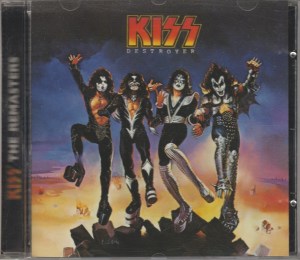
 – Destroyer (1976 Casablanca, 1997 Mercury remastered edition)
Kiss had “made it”. Alive! put them where they wanted to be: on the charts and headlining concert stages coast to coast. The financial pressure was off and they didn’t have to simply crank out new albums to keep the band afloat. They could now take their time and make something that was more thought out; a statement.
The first issue to deal with was Kiss’ past sonic inadequacy in the studio. Prior albums produced by Kenny Kerner & Richie Wise, and Neil Bogart did not capture the full-on Kiss thunder. They failed to shred the speakers. They needed somebody “big time”, to give them the punch they desperately needed. That somebody was Canadian producer extraordinaire Bob Ezrin. Ezrin had been an instrumental guiding force for Alice Cooper. Now it was Kiss’ turn to receive the platinum Ezrin magic touch.
Ezrin agreed to work with Kiss, reportedly influenced by a neighbor kid who liked to discuss music. “The kids from school love Kiss,” the boy told Ezrin. “The problem is, their records sound so shitty. But the band is so good we buy the records anyway.” Working with Kiss wasn’t much different from working with Cooper. These were not schooled musicians. Ezrin had to take them to boot camp. Keeping the drums in time was a challenge. Peter Criss had difficulty maintaining a steady tempo, so Ezrin would beat a briefcase to keep him in time. He wore a conductor’s coat and tails, and pushed the rest of the band like a drill sergeant. Even the mighty demon Gene Simmons was chastised, for finishing a take before the producer instructed him to stop. And when Ace Frehley didn’t show up because he had a card game? Shenanigans were not tolerated. When Ace wasn’t available when he should have been, Ezrin’s buddy Dick Wagner (Alice Cooper) was there. For the first time, a Kiss member was replaced on album by an outside uncredited musician.
One innovative technique that Ezrin brought in to thicken up Kiss’ sound was using a grand piano to back up the big guitars. The end result doesn’t sound like piano and guitars, but one solid wall of rock, like Phil Spector channelled through Bob Ezrin. Where Kiss used to rely on rag-tag recordings they now had a big glossy sound to play with. Ezrin was also fond of sound effects and orchestration, and he brought both to Kiss.
The opening track “Detroit Rock City” was a slam-dunk intro to the new Kiss sound. After an extended start with the sound of a fan driving to a Kiss concert, the band thundered into focus. That trademark riff chainsaws through, before Paul Stanley’s powerful pipes take command. What a song. The new Kiss had arrived, shiny and sleek, souped up and fueled, as if they were a brand new band.
 “Detroit” faded out into “King of the Night Time World”, an outside song brought in for completion by Ezrin and Paul Stanley. They turned it into something that worked for a Kiss album, albeit very different from their past. As for Paul, he contributed a fast hard rocker called “God of Thunder”. Though reports sometime differ in the details, ultimately the song fit Gene Simmons’ demon persona better and the song was given to him to sing. It was slowed to a monster plod, and a few lines were changed to suit. (“Make love ’til we bleed” was changed to “Hear my words and take heed”.) And those little demonic voices? Bob Ezrin’s kids, playing with walkie-talkies.
“Great Expectations” (based on Beethoven) has to be the most bizarre song on the album and one of the weirdest that Kiss have attempted. A lush ballad with strings and choirs and Gene Simmons in crooner mode, it is definitely different. Even one of the rockers, “Flaming Youth” written by Frehley/Stanley/Simmons/Ezrin, is different for Kiss. It’s a rock song…with calliope. (Picture circus music.) Gene’s “Sweet Pain” had female backing vocals like an old Motown single. These are all interesting experiments, but none of those three songs have become live concert classics.
Bob Ezrin tricked the band into writing “Shout it Out Loud”. He realized they needed one more song, so he told the band that they had lost the masters to “Great Expectations” and needed a replacement. Gene and Paul hurriedly wrote “Shout it Out Loud” with the producer and had another instant classic. Like “Rock and Roll all Nite” before it, “Shout” was an anthemic rallying cry that a concert audience could get behind.
The album closer was a track called “Do You Love Me”, another tune brought in by outsiders (Kim Fowley) to be finished by Kiss. Though on the surface “Do You Love Me” is a bit repetitive and dull, it was later covered by Nirvana. There must be something to it that struck a chord.
There was still one more song on the album, a throwaway. It was used as a B-side to “Detroit Rock City”, as the band didn’t have much faith in it. Peter Criss had brought forward a love song called “Beck”, named for a girl named Becky, written by Stan Penridge for their old band Chelsea. The song needed work, including a new title. Ezrin revamped it completely, and the result was one of Kiss’ all time biggest hits: “Beth”. Tender and accessible, the only Kiss member on “Beth” was Peter Criss himself. Dick Wagner played acoustic and Bob Ezrin played piano. The orchestra finished it off. Eventually, radio stations started flipping the “Detroit” single and playing “Beth”. This led to Casablanca reissuing “Beth” as a single A-side, Kiss’ highest charting ever.
With the help of “Beth”, Destroyer maintained Kiss’ stardom and opened up the doors for any future musical experiments they could fathom. Its cover showed Kiss in an apocalyptic landscape, in full super hero mode for the first time. Artist Ken Kelly created something that helped define Kiss as larger than life…and larger than life they did become.
That wasn’t the end of the story for Destroyer. For years it became the benchmark that Kiss albums were measured against. In 2012, Bob Ezrin revisited the backing tapes and produced an alternate mix called Destroyer: Resurrected. This featured some previously unheard music such as an alternate Ace Frehley guitar solo for “Sweet Pain” (Dick Wagner played the original solo).
Destroyer is far from the definitive Kiss album. In fact, it is more like a one-off, an experiment that was never fully revisited. Some of its songs are less than classic. Others are so classic that you can’t imagine the world without them. The bottom line for Kiss was that Destroyer propelled them further towards their goal of becoming the hottest band in the world.
Today’s rating:
3.5/5 stars
Uncle Meat’s rating:
4/5 steaks 
Meat’s Slice: The general consensus of casual Kiss fans is that this is their greatest studio album. Let’s examine this. I’ll start with the iconic.
“SHOUT IT OUT LOUD” – On May 22, 1976, this song went number one in Canada, the band’s first ever number one song. 40 years later and “Shout it Out Loud” might be the Kiss song with the longest shelf life. One of two perfect “live concert” songs on Destroyer. The other?
“DETROIT ROCK CITY” – Thin Lizzy-esque two-guitar rock fest. Sitting on the same shelf as “Shout it Out Loud”. Iconic indeed. Unperishable. Even has a movie named after it. I have never seen it. Maybe it’s finally time to do so.
“BETH” – If any other member sang “Beth” it wouldn’t have been the same song, or had the same success. Peter Criss has a special rasp in his voice that can both rock and schmaltz it up. Like Rod Stewart, or that goof that sings for Slaughter. I personally wish “Beth” would “fly to the angels” up in the sky, but this song did do one good thing for me. My grandmother refused to get me anything Kiss related until I pointed out to her that “Beth”, on the radio in the car at the time, was actually Kiss. So thanks for that at least.
“DO YOU LOVE ME” – Perhaps this song is more iconic in my own mind specifically, since it is in my Top Five Kiss songs. Classic Paul Stanley stuff here.
“GOD OF THUNDER” – Unique in every way for the time. A lot of Ezrin tricks in this track including backwards drumming. I still have not heard the great cover of this song I always thought I would from some Metal band. There’s still time….
No wonder the casual Kiss fan believes this is the best of all of the Kiss studio albums. It is a great collection of songs that are still loved today. But everything else on Destroyer not listed above is average at best, or much worse than that. Maybe it’s because Kiss was too busy getting music lessons from Bob Ezrin while in the studio. Maybe it’s simply that Kiss was tired of being looked at as a “joke” and wanted to get more serious, hence getting some more respect from the mainstream press. Now again, this is my opinion and I’m sure that some might vehemently disagree with me about some of the deeper Destroyer tracks. The best of which I think is “Flaming Youth”. “King of the Night Time World” is pretty good, but borrowed from another song. “Great Expectations” is blah stuff except for the melody stolen from Beethoven. “Sweet Pain” sucks. And “Rock and Roll Party” is just unnecessary filler, very much like “Inside”, the ending track on 5150. Might as well take the needle off the record as soon as the song starts and put on something else immediately.
Let’s use this analogy.
A couple raises 10 children. Three of their children become world leaders. Two others become successful doctors. But half of their kids are in jail, some for unspeakable crimes against humanity. Can you call them the best family overall because half of them are special? Destroyer is definitely not the greatest Kiss album.
Agreed? Discuss….
To be continued…


Original mikeladano.com review: 2012/07/06
























You must be logged in to post a comment.