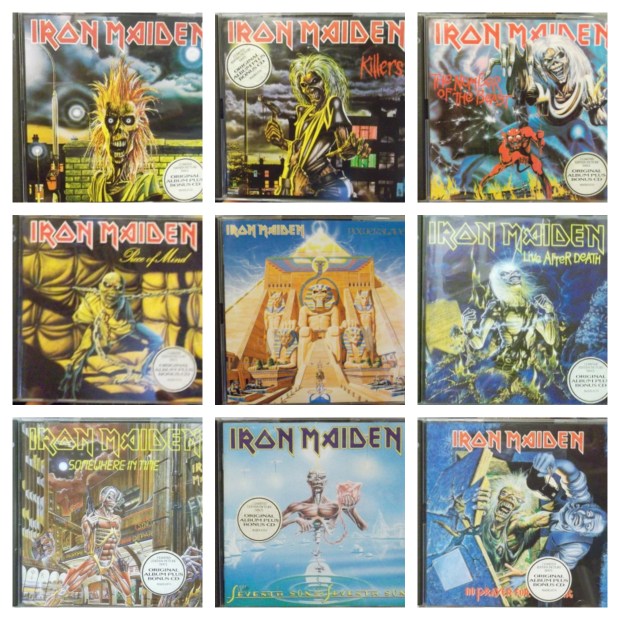
RECORD STORE TALES #1149: Eddie’s Story – The Narrative of Derek Riggs’ Iron Maiden Art
Edward T. Head, better known as “Eddie”, has been Iron Maiden’s mascot since the late 1970s. He was just a mask then, made by roadie Dave Lights, to hang on the band’s live backdrop. Why “Eddie”? Because the mask was essentially just a head, or “‘ead” in British slang. Therefore: Eddie the Head! When Iron Maiden were signed to Capitol Records, manager Rod Smallwood wisely surmised that the band would do well with an identifiable “stamp”…like a mascot. He contacted artist Derek Riggs, and before too long, Eddie made his painted debut on the cover of Iron Maiden’s 1980 single “Running Free”.
Eddie’s impact cannot be overstated. He is more recognizable than any single member of the band. He is seen on T-shirts worn by diehards, casual fans, and even those who have never heard an Iron Maiden song in their lives. He is ubiquitous. Needless to say, Rod Smallwood was very wise, and Derek Riggs very talented. Riggs did the cover art for every Maiden album from 1980 to 1990, and almost every single and EP in the same time frame.
As young impressionable kids growing up in suburban Ontario, we certainly knew who Eddie was. My friends and I collected not just the albums and singles, but also the buttons. We were intimately familiar with Eddie, his different outfits, settings, and crimes! We attempted to draw our own Eddies. I took a shot at a single cover for “The Duelists”, a favourite song. It featured Eddie and the Devil fencing at the edge of a cliff. The Devil was a foe of Eddie’s going back to the “Purgatory” single cover. Derek Riggs eventually built an extensive mythology for Eddie and associated characters. He focused on “Easter Eggs”, hiding characters and symbols within the artwork. Powerslave and Somewhere In Time were chock full of such goodies. References to the bars Maiden played, the Reaper, and even a TARDIS can be found on those albums. One of the great pleasures of being an Iron Maiden fan was opening up an album and looking for all the secret images and messages while you played the records.
By 1986, some of us had noticed that the album covers, not including the singles, seemed to a tell a continuing story. There was a continuity to the cover art, and Eddie in particular, that made us think there was an actual story unfolding with each album release. This story seemed to run through Derek Riggs’ entire tenure as Iron Maiden’s cover artist, from 1980 to 1990. While I am certain that this is entirely something made up in our heads, it does seem to hold water.
Let’s have a look at the album covers, and the story they may tell.
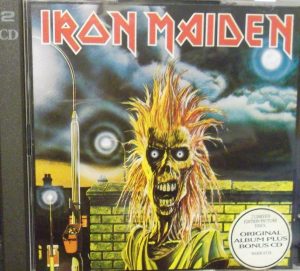 IRON MAIDEN -1980
Just an introduction to the character. Eddie is a street punk, in a loose T-shirt, standing on a London street at night. Behind him is a lit doorway, and a window with a red light – a reference to “Charlotte the Harlot”. You can also see two of the streetlamps behind Eddie form an arc, with the moon. Eddie’s eyes are just black sockets with light behind. Later artists would change Eddie’s eyes, but Riggs always painted them black with some kind of illumination. Eddie’s skin appears yellowed and stretched, like that of a mummy. His hair is pure punk rock.
The story has yet to begin, but Eddie is clearly someone you don’t want to mess with on a London street at night.
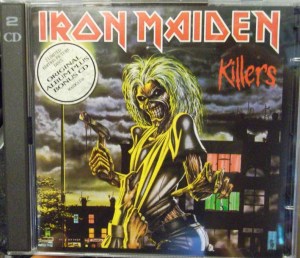 KILLERS – 1981
Eddie appears much more refined in this image. You get a better look at the character, including a belt and blue jeans. The punk rock hair is gone, though Eddie remains on the streets. It could be the same neighborhood as the first album. The black clouds in the sky are similar. This time, Eddie has a bloody hatchet in hand, while his victim grips his shirt in dying desperation. Eddie seems to have no mercy. He even seems to relish killing. Fitting, for an album called Killers. Our interpreted story begins here, with a murder.
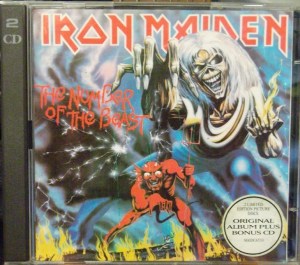 THE NUMBER OF THE BEAST – 1982
The plot thickens. In Riggs’ best album art to date, Eddie appears a giant over a scorched, hellish background. The rear cover had more of this scenery, indicating we were indeed in hell. Eddie’s eyes are now lit by flames, matching the ground below. He also has a fire in his hand, a reference perhaps to Montrose’s “I’ve Got the Fire” which was an earlier B-side. The most striking feature here though is the appearance of the red Devil himself! Eddie appears in control, manipulating the evil one with green puppet strings.
This was the first cover that really had us squinting at the details, on our little cassette J-cards. For if you look closer, you will see Eddie is not in control at all. Satan himself has his own puppet, and it is Eddie! Our minds were boggled. What could this mean? We began pulling together the threads that seemed to be telling a story. Derek Riggs had outdone himself, but he was only getting started.
 PIECE OF MIND – 1983
Imprisoned! Captured, chained in an asylum, and lobotomized to boot! Now bald, Eddie bore a scar across his head! He had been cut open like an egg, and this scar would remain for the next several album covers. Two more details were added: a stream of blood going down his nose (always his right side), and a metal bracket holding his head together. The screws in the bracket would always be in the same orientation.
Clearly, Eddie was in trouble. We saw this as the punishment for his crime of murder. The Devil came to take his due, and now Eddie is stuck in a cell. Would he escape? The next album told us no.
Of course, the real life inspiration for the artwork was the title Piece of Mind. On the inner sleeve, the band members are preparing to dine upon a brain! It doesn’t look tasty, and Adrian Smith in particular doesn’t look hungry. In our childhood fantasy world, the Devil had served up a particularly brutal punishment for our favourite Metal mascot.
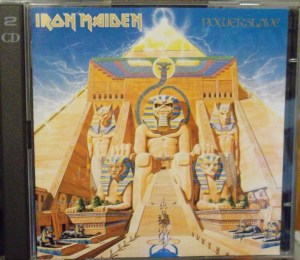 POWERSLAVE – 1984
It appears that Eddie did not survive his brain surgery and imprisonment, for here he was being laid to rest in an ancient Egyptian setting. In Riggs’ best artwork to date (again), a multitude of Easter eggs were hidden on the front, back and inner sleeves. The Great Pyramid appears as it once did in antiquity, smooth and topped by a golden capstone. Eddie’s sarcophagus can be seen, carried up the stairs, to his eternal resting place.
Or was it?
It seems pre-destined that Maiden’s next album would be called Live After Death. It was really at this point that we started to put together that there was a story unfolding here. Live After Death, and Eddie was buried on the previous album? It all made sense!
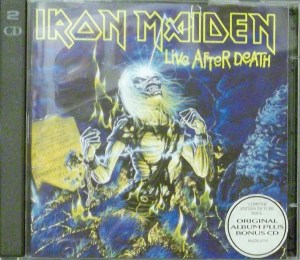 LIVE AFTER DEATH – 1985
Now this was an album that simply had to be owned on vinyl. There was text to be read on the tombstones (“Let It RIP”), and so many Easter eggs on the back cover, including a black cat, the Reaper, and a visible “Edward T. H…” on his tombstone. For many of us, this was the first indication that Eddie did have a last name!
With a bolt of lightning re-animating the already dead corpse, Eddie was back! Still wearing his chains from the Piece of Mind album cover, Eddie’s hair had grown back while his T-shirt has seen better days. Flames can be seen bursting from the ground, hinting at his hellish past. On the rear cover, a city can be seen, surrounding the pyramid from the last album. The continuity seemed clear. The only issue here was that on the prior album, Eddie was laid to rest inside the pyramid. Here, he is seen bursting out of a normal grave. It would seem that Eddie’s remains were re-located between albums. A minor issue easily explained away.
The city on the back cover calls to Eddie! He was back, and up to his old ways again…
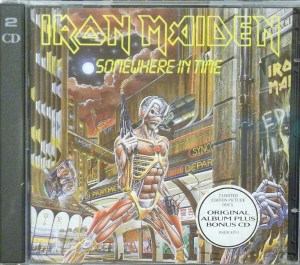 SOMEWHERE IN TIME – 1986
Riggs outdid himself again, with the Blade Runner inspired Somewhere In Time. Owning this album on vinyl is simply a must, for there is so much going on.
Still lobotomized, but bearing a new brain of circuitry, Eddie was technologically enhanced. The blood, scar and bolts holding his head together are still visible despite the modifications. On his chest, Derek Riggs’ signature emblem can be seen clearly. It was always hidden somewhere on his albums, but here it was plainly visible. A poster that reads “EDDIE LIVES” can be seen on the right, with the dying hand of a victim that he has just exterminated. Back to his old killing ways from the Killers album! Instead of a blade, Eddie now wields a pair of blasters. Eddie seems to have arrived in a “Spinner” vehicle, similar to Blade Runner.
The same familiar moon from previous albums blazes behind, but there is so much on the back cover to discover too. A reaper, red-lighted windows, and the names of things important to Iron Maiden’s lore are present. As far as our story went, we imagined that Eddie emerged from his tomb centuries in the future. This time, the Devil would not stop him! But despite the cybernetic enhancements he underwent, his body was not whole…and soon it would be time to be reborn.
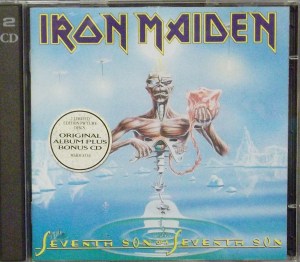 SEVENTH SON OF A SEVENTH SON – 1988
This is where things got weird. Really weird. Not content to keep drawing Eddies with axes through people’s heads, Riggs went abstract on Seventh Son of a Seventh Son. Eddie was now little more than a torso, with his skull ripped open and aflame! The scar, bolts and blood are still present (though the blood would be replaced by a mustard-like substance on the single cover for “Can I Play With Madness”). The remnants of his cybernetic enhancements are still present, with one eye replaced by a robotic one. He also still has a metal throat. An apple can be seen within his ribcage, but most striking is the Eddie-infant he’s holding in some kind of embryonic sac! This sac is attached to his ribcage with an umbilical cord. An arc of lamps recalls the first album. A “book of life” is present on the back cover, tying into the album’s concept. There are also ice statues of past Eddies on the back cover, for a total of seven Eddies.
Look closely and you can see that the surface below is both solid and liquid, and the icebergs do not touch the surface. In our story, this represented Eddie on another plane, as he gave birth to his successor – a new Eddie.
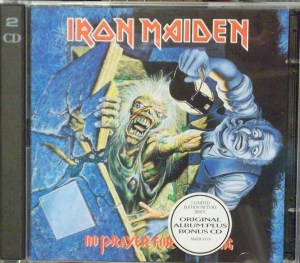 NO PRAYER FOR THE DYING – 1990
For the first time, we felt disappointed by an Iron Maiden cover. Gone were the layers of Easter eggs. The art felt unfinished, and indeed, Derek Riggs would remake it for a 90s reissue. The album was sonically a “back to basics” affair for Iron Maiden, with simpler lyrics and shorter, harder songs. The artwork reflected this, with a simple Eddie just back to killing again.
Reborn, and without scars, bolts or lobotomies, Eddie emerges from a stone coffin. Because why not? The undead should surely be reborn in a grave! Grasping the poor gravekeeper by the throat, Eddie is seconds away from his first killing in his new body! Looking at his coffin, the name plate is unfinished, with no clever names or puns. The fragments of the shattered coffin don’t even fit together properly. The blue and yellow colour scheme definitely links the album to Seventh Son, Live After Death, Powerslave and The Number of the Beast, but there is far less to keep you looking at the cover.
And this is the end of our Eddie story, for Derek Riggs would not do another Maiden cover for years, and by then there was no point in any continuity. The next time we see Eddie, he has red bug-eyes and is half-tree.
Iron Maiden would continue to produce fascinating album covers in the future, always featuring Eddie in some way. Notable artists included Mark Wilkinson, Melvyn Grant, and Hugh Syme. For most fans, the original run of Derek Riggs covers will remain the pinnacle of Maiden artwork, primarily the period of 1981 to 1988.
Did Riggs have a story that he was telling with his covers? Probably not; he probably just liked keeping Eddie consistent from cover to cover. He would probably appreciate the fact that a bunch of Canadian kids in the suburbs had interpreted this entire saga from his artwork. I think he’d like that a lot.


 mikeladano.com
Interesting descriptions for the album covers and I can see how they fit with Eddie’s transformation from album to album. Also, I can’t believe all this time, I never noticed the victim’s hand holding onto Eddie for dear life in the ‘Killers’ (1981) album cover. What the heck!
LikeLiked by 1 person
So awesome! Eddie as a slasher movie villain.
LikeLiked by 1 person
It fits him well.
LikeLiked by 1 person
Sounds like Harrison art!
LikeLiked by 1 person
I could inform him as a slasher aficionado.
LikeLike
Best album and best artwork goes to Killers for me.
LikeLiked by 1 person
It’s absolutely great and far better than the similar No Prayer.
LikeLiked by 1 person
I know you’re not a big Killers fan, but I really love that album!
LikeLike
Totally fantastic, Mike. I love this to bits. What a journey Eddie has taken, and taken fans on!
LikeLiked by 2 people
Thank you so much! I’m glad people enjoyed my dimestore analysis.
LikeLiked by 1 person
That was awesome. I can see that journey in those covers. I have never really gotten in to Maiden, but have always loved their covers and you are right, everyone knows Eddie!!
LikeLiked by 2 people
Maybe you will be familiar enough with Maiden to join us in 2025 for an album breakdown?
LikeLike
I always loved the little nods to the previous ones (the bolt of the forehead for example)
LikeLiked by 2 people
I think without those nods, we never would have put this story together the first place. It was impossible to ignore, especially with it being so prominent on Piece of Mind.
LikeLiked by 1 person
Yep. I love the idea that each Eddie has a remnant of the previous one. Such a cool idea.
LikeLiked by 1 person
At least up until No Prayer which was a permanent reset, it seems. And the Fear of the Dark Eddie was just off the rails.
LikeLiked by 1 person
So good!
LikeLiked by 1 person
THANK YOU! Oh wait – you meant the artwork. LOL
LikeLike
You’re good too.
LikeLike
Well, yeah, the artwork too. It works for both!
LikeLike
Great piece, Mike, very well done. As an added comment, while I can see the “Blade Runner” influence, I’ve always wondered if the art for “Somewhere in Time” ( 1986) was perhaps also influenced also by Marvel Comics character Deathlok, a cyber assassin. I first met Deathlok in the pages of Captain America # 286 (cover date October 1983) but I later learned from reprints that he was in fact introduced much earlier in “Astonishing Tales” # 25 (cover date August 1974). Henry.
Sent from Yahoo Mail for iPhone
LikeLiked by 1 person
While I cannot rule out any connection to Deathlok (didn’t know any of that before, thank you!) it is acknowledged that Blade Runner was a primary inspiration for the cover art. Still, I would wager that Derek Riggs was familiar with Marvel Comics. I am sure he was. Eddie himself wouldn’t be influenced by anything in Blade Runner, I think. All those androids were human looking. Nothing like Cyber-Eddie. So, you could be onto something!
LikeLike
Wow, nicely done. I need to pull out all my Iron Maiden albums and look at the covers in much more detail. Saying that, my all time favourite is for the single “The Trooper,” which depicts Eddie in a British uniform, running through a battle having just chopped off a Russian soldier’s head.
LikeLiked by 1 person
Oh such a good one. I had the McFarlane statue of that cover, and I also have the Super 7 action figure of Trooper Eddie. And my dad approved since it depicted the Charge of the Light Brigade. I was well aware of the Crimean war, thanks to my dad.
LikeLiked by 1 person
I’ve always said that Iron Maiden was the best way to teach history.
LikeLiked by 1 person
Can vouch for that! Between them and my dad, I had everyone at school in the dust. LOL
LikeLiked by 1 person
It makes so much sense that I think this “story” might be true.
Now if someone could just explain Saga’s multi album story ( songs marked Chapter 1 to Chapter 8) I can finally be pleased. Is someone willing to take on that challenge or has it already been done?
LikeLike
My own headcanon is slightly different and involves every EP cover, but not any live albums (ie neither Live in Japan, Live after Death, nor A Real Live/Dead One).
Firstly, there’s the Running Free EP cover : a street thug is fleeing a dark figure that seems to be Eddie… all that to fall into the claws of another dark creature. Eddie doesn’t seem to be as supernatural compared to the hand we see of the other mysterious creature.
To me, on this cover art, Eddie is a street punk that works with supernatural creatures, prone to violence but probably not a predatoral creature.
Then comes the Iron Maiden album cover : finnaly, we see Eddie’s head. And it seems that since Running Free, he has become much more of a supernatural creature. His nose is missing, his eyes became dark pits with glowing white iris, his skin seems grey and even rotting, his lips are missing, he doesn’t seem to have any flesh on the bones. He looks like a walking corpse. He probably became fully part of the dark creatures he was working with previously. But his eyes aren’t complete white circles yet, as the’ll become on every art after that, so he might be in the middle of his transformation.
On the Sanctuary EP cover, we see Eddie stabbing Margareth Thatcher. That could make him one of the good guys, but he nevertheless looks more unnatural than ever. From a menacing supernatural creature he became a murdurous one. He seems to be fully commited to making clear he owns the streets, and he’s ready to kill those that would try to remove his mark, the Iron Maiden posters on the wall that the Iron Lady was seemingly trying to removee when he stabbed her. In my interpretation, Eddie is on the rise among the creatures he was working with and then completely joined, and showing such ruthlessness is a sign of it. He is no longer the beater that lures small street thugs into the hands of the creatures : he’s now a full-blown hunter who kills his prey himself.
But somehow Thatcher survived the assault and decided to take revenge on Eddie. She’s ambushing him with an automated rifle on the Women in Uniform EP cover art. And we can see that now, Eddie’s kind of the boss of the streets. Althought his physical appearance is less human-like than ever, his demeanor is much more human than previously seen. He’s walking proudly, a woman in each hand, like he owns the place. He also seems to have gained a bit of muscle on his bones. Wil that be enough to get out alive from the desastre in coming ?
The Killers album cover seems to state so. Eddie seems more restless, his face returned to more animalistic features, his hair became much longer, and while he’s killing a victim with an axe, we can see the hands trying to rip his shirt are much larger than his own. My hypothesis is that he did survive the ambush by the Right Honourable Baroness Thatcher, but that wasn’t a easy fight, and he lost quite a bit of his strength and his confidence, hence why he came back to fighting his turf on the streets.
And on the Twilight Zone EP cover, he’s a phantom trying to contact Charlotte the Harlot throught her mirror, while she’s crying on a Death tarot card, while a framed signed photo of her now passed away lover Eddie is displayed on her cabinet. It seems Eddie didn’t make it. Althought he fought valiantly to take back the control of the streets after barely escaping a tough ambush, it wasn’t enough and he died on the street.
After an indeterminate time wandering as a ghost, it was time for Eddie to enter the Purgatory. The cover art of this EP shows us Eddie’s body being possessed by a devil-like figure. Maybe he’s the creature that enabled Eddie’s transformation in the first place ? And his goal was for Eddie to hit the bucket so that he could possess his body ?
Eddie isn’t the kind to simply accept such an outcome, however, and on the Run to the Hills EP cover, he’s fighting that devil-like creature (later known to be The Beast), having come all the way to its diabolical realm in the outer world. He does seem to have the advantage in this fight, but will he manage to pull it off ?
Yes. Yes he does. The Beast may have gain control of Eddie’s body, but Eddie himself, his soul, his essence, manipulates the Beast like a puppet, as is shown on The Number of the Beast album cover. He won this fight, he even managed to control the perpetual fire of this diabolical realm, and while legions of demons are cheering his possesed corpse, he himself controls his possessor.
But all good things come to an end, and on The Number of the Beast EP cover, Eddie in the end decided to behead The Beast, and the blood from the decapited head is flowing on a burning diabolical realm.
This act of boredom might however have been to much for the many inhabitants of this kingdom, and in a desperate attempt, they sent a champion to defy the new ruler of this wretched realm. A flying angel was ascending to the heights where Eddie was ruling with an iron fist, and althought he managed to escape the threat by burning its wings with a flamethrower, Eddie understood it was time to escape this realm and come back to good old Earth. He took The Beast’s bat wings and escaped. All of this is immmortalised on the Flight of Icarus EP cover.
He did come back to his body on Earth, only to find himself having been brutally lobotomized, and restrained with a straitjacket and even chains, in a padded cell, as shown in the Peace of Mind album cover. Maybe while The Beast did take control of his body, its wretched actions convinced higher authorities they needed to do anything to restrict him, and since killing him hadn’t worked the first time, restraining him in every way possible was the only solution ? Or maybe… maybe he never died. Maybe he never became a ghost haunting Charlotte. Maybe he never got the Purgatory while The Beast possesed his body. Maybe he never fought The Beast, beat it, and ruled over its demonic realm. Maybe his rule never was threatened by the revolt of his new subjects and he never had to flee back to Earth. Maybe when he was injured enough to believe he had die, his ennemies collected his body, performed a vicious and brutal lobotomy, and he had been imagining it all ? Who am I to know what is true and what isn’t ? What’s for sure is that Eddie knew if he was to escape, he needed to find the resources to do so in his own inner realm. Using his imagination to travel through times and places, until he managed to find to power to escape and go back at his ennemies.
His first stop on this long journey was 19th century Crimea, when he took the role of a British trooper. Having take part in the desperate charge of the light brigade, he is shown a bloody sabre in one hand and the broken handle of a torn British flag in the other, on The Trooper EP cover.
But maybe 19th century warfare wasn’t the solution. Maybe a more modern setting would allow him to find his way out. On the 2 Minutes to Midnight EP cover, Eddie is shown in the ruins of what seems to be the UN headquarters, displaying the flags of every country in the world. New York has been blown to pieces by a nuclear explosion, and Eddie prepares for an appocalyptic war.
Obvioulsy, a word reduced to hashes isn’t a very good place to acquire the power he needs. Maybe he had worked all of that the wrong way. Maybe he didn’t need to learn from the art of war, but the art of deception. Going all the way back in history, to ancient Egypt, he managed to snake his way up to the top, becoming the most powerful paraoh that ever was, and after a long and prosperous reign, he was buried in a fabulous pyramid figuring his face, encircled into a cobra snake that symbolized the cunning political manoeuvering he had displayed during his rule, shown on the Powerslave album cover.
Nevertheless, as successful a ruler of ancient Egypt he had proven to be, the knowledge acquired there wasn’t enough. Maybe he’d better have chose a more technologically advanced civilization ? Plus, having avoided violence during all this time to rule as a just and beloved god-king was very difficult for him, given his thirth for violence. Yes, going to a more modern era was a great idea, and while he’s at it, he might as well go back to being a warrior. He set his heart on 20th century WW2 and became a fighter pilot, as shown on Aces High EP’s cover.
Having been able to express his natural violent tendencies, Eddie was abble to ease off on the pressure and go back to being a bit more cool-headed. He then pondered. He had already lived four evenful lives, but all the experience accumulated from these didn’t allow him to acquire the power he needed to escape from his predicament. Maybe the answer wasn’t in the past, but rather… the future ? Having wasted his time was a shame, sure, but he needed not waste his time searching for those wasted years. His resolution was firm as steel, and the Wasted Years EP’s cover shows it, as he made it his motto, perpetually displayed on his spacecraft’s main screen, which reflected his resolved face.
His determination to finally find the precious knowledge he needed was such he had decided to turn himself into a cyborg, as shown on the cover art for the Somewhere in Time album, so that he may spend as much time as needed to find it. Having become a space wanderer, he spent decades, centuries, millenia, even, exploring countless words, slaying countless ennemies, exploring every inch of every world inhabited by any sentient creature in the infinity that is space.
In his endeavor, he one day managed to find a clue. That clue lead to another, and then to another. He followed the trail until a small saloon, on a distant planet, inhabited by strange humanoids with insectoid features. There he came, a Stranger in a Strange Land, and found somebody who he was sure could learn him how he could be freed from his mysterious captors.
The knowledge he acquired nearly rendered him mad. In order to become free again, he needed to dive deeper into his subconsciousness, and somehow manage to make the create a link between the real world and the worlds of imagination he had traveled into for eons already. He needed to go beyond his flesh, beyond his sanity, beyond his sens of reality itself. His first try was as painful as it was ridiculous, as shown on the Can I Play With Madness ? EP cover.
But soon, he managed to stabilize his fundamental essence and explore the frozen vastness that was his subconscious, shown on the Seventh Son of a Seventh Son cover.
Abandoning his sense of self was a difficult task, but he managed to do it, and having set foot in the most deep part of his inner world, he found something. Something that he didn’t know was there. Something that could, indeed, allow him to be free again, albeit in a most unexpected maneer. What he found there was the remnants of the contract of souls Eddie had signed so, so, so long ago, at the very beginning of everything. It was this very contract that had allowed him to transform into the supernatural being he had been living for all this time. And with this contract was, to his surprise, his very own devil. Not The Beast he had vanquished in the diabolical realm, but a real devil he could never overcome, but who would never fail him. The Evil that Men Do.
In order for his plan to work, he needed to get rid of any sense of his current self. Having conveyed his plan to his inner devil, who acquiessed, Eddie set about eliminate every last remain of his own self, becoming a quasi abstract being, displaying the various aspects of his very essence all at once and reducing them to ashes. By doing so, he became for a fraction of a second an all-seing Clairvoyant.
His plan worked. He had managed to come back in time, to before the moment when The Beast had possesed his body. Now an intangible spirit, he started the long and painful process of possesing his own dead body. At some point, The Beast tried to possess it, but it wasn’t a difficult task for him to fight it and banish him back to his firey realm. He was now alone, and could at last concentrate entirely on the task at hand. Finally, after several months, he had manage to entirely take the control of his body. It was a rugged body, which had started to rot months before, but it was his body nonetheless, devoid of any lobotomy, free from any constraints. Except from the grave in which in which it was burried. But that wouldn’t be a problem for a being as experienced as him. In a fell swoop, he smashed open the gravestone and grasped the gravekeeper by the throat, as shown on the No Prayer for the Dying cover, making him the very first of a new bloody streak. Eddie is back, baby !
A few hours later, as shown on the Bring Your Daughter… to the Slaughter cover, the reborn Eddie is ready to make his way back at the top. He found a new axe, launched his very own army of supernatural beings, every one more lucidrous than the other, and his dear Charlotte was back in his arms. It won’t be long until he regains his position.
And that’s how my headcanon of Derek Rigg’s Eddie ends.
LikeLiked by 1 person
THIS IS SO EPIC!!! Thank you for taking the time to write all this down. Including all the single art too, that was a challenge that I didn’t think could be done but you’ve managed to tie them all in! Pat on the back…that’s amazing stuff!
LikeLike
Thanks ! That wasn’t easy !
LikeLike