In the spring of 1996, we opened up the big store that I managed. It was our biggest store to date. There were a lot of good times at that location, and hundreds of incredible musical finds. Around the same time, I began replacing my cassette collection with CDs in earnest. Cassettes donβt have the longevity or the sound quality of a CD. Most of my tapes were starting to sound awful, especially the ones purchased from Columbia House, who manufactured their own at a lesser cost.
Upgrading my Kiss cassette collection to CD was an early priority. Some of the first Kiss tapes I bought, like Asylum, had degraded so much they were unlistenable. The early (Canadian) CD releases had issues too; they were not perfect. Both Hotter Than Hell and Alive II (disc one) had severe problems with digital noise in specific spots. On Alive II it was βLove Gunβ that was the issue. There was a terrible scratchy sound encoded onto the CD.
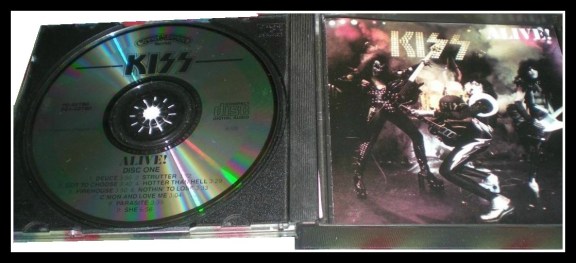
The differences between my boss and myself were obvious the day that Kiss Alive! came in stock, used. Β It came in one of those old “fat” CD cases. Β It was the first chance I had to buy the first Alive! at an affordable used price, in such great condition. The boss and IΒ had very different personalities, almost opposites. I was a music obsessive who collected things and wanted to know all the obscure facts. He liked music but just wanted to sell CDs. I grabbed that copy of Alive! and handed it to the boss to ring in with my staff discount.
He sighed and gave me a look. βDonβt you already have this?β
He sounded like my dad. When Iβd come home, heβd say, βMore Kiss? Donβt you already have Kiss?β My boss had a lotΒ in common with my dad.
I had the tape, but the cassette had the songs in a different order.Β This was a fairly common practice. Β Song order would be swappedΒ around on cassettes, to keep sides one and two about equal in length. That reducesΒ the amount of actual tape used to manufacture it, and therefore cuts costs. It would be cool to have a CD copy of Alive!Β to listen to the songs in the original order.
βI have it on cassette and LP,” I explained. Β “I listen to the tape, but this CD is different. Β The songs are in a different order,β I finished.
He looked at me again and responded in a mocking tone, βHey Mike, look at my shoes. The left one is different from the right one. Do you want to buy it?β
βNo because I donβt collect shoes,β I answered. βI collect Kiss.β
He shrugged with frustration. I really think he was more just pissed off that I had taken some good stock for myself.
Oh well.
Staff taking βgood stockβ was an ongoing issue, but because getting stock at a discount was one of the established perks of working at a used CD store, there wasnβt much that could be done. I’ll give him credit; the boss considered the staff discount to be part and parcel of the job for all of us. Β He eventually put a limit on how much we could buy at a time. Meanwhile, my dad would look at my collection and say βsell, sell, sell!β
He ended up getting that copy of Kiss Alive! back, when I upgraded to the 1997 remastered edition. And then he ended up getting that 1997 remastered edition back when I upgraded to the Kiss Alive! 1975-2000Β box set.
He might not have understood my wants and desires as a collector, and he may have complained about me taking all the good stock, but he ended up making money when I sold back my equally good stock. No harm, no foul. Hopefully, I have bought Kiss Alive! for the final time.
β Alive! (1975 Casablanca, 2006 remastered edition from Alive! 1975-2000)
Music fans consider it one of the greatest live albums of all time.Β Its name is spoken in the same breath as Frampton Comes Alive, Cheap Trick At Budokan, and Deep Purple Made in Japan.Β It spawned thousands of young new guitar players (particularly of the grunge era), eager to emulate the six string heroism of Ace Frehley.Β There is really only one miniscule issue:Β Kiss Alive! is not really live.
Oh sure, Kiss and producer Eddie Kramer did record live shows.Β When they listened back to the tapes, there were no performances that satisfied them.Β Kiss were too rambunctious live.Β They were busy jumping around, entertaining the crowd, not paying attention to each and every note. Β For the live album, they werenβt looking for perfection, just performances without glaring mistakes or noise.Β They realized they didnβt capture that with the shows they recorded.Β Β So they did what most bands do: Β went back into the studio and try to fix it. Β Lead singer and guitarist Paul Stanley explained it in his book: βYes, we enhanced it β not to hide anything, not to fool anyone. Β But who wanted to hear a mistake repeated endlessly? Who wanted to hear an out-of-tune guitar? For what? Authenticity?β
Authenticity is an important part of great rock music, but not the only important part.Β If you canβt tell the difference, then does it matter?Β Fans listened to Kiss Alive! for decades, blindly enjoying every detail, from Ace Frehleyβs extended βRock and Roll all Niteβ guitar solo, to Paul Stanleyβs unforgettable stage raps.Β Few suspected anything was out of the ordinary, unless they heard original bootleg recordings of the same Kiss gigs.Β Eddie Kramer and the band re-recorded approximately 70% of the album.Β The only thing they didnβt have to touch were Peter Crissβ drums, which were already pretty solid.Β Bass, vocals, and even lead guitar was touched up and fixed, all but seamlessly.
The reason Kiss Alive! was and is considered great is that you canβt tell the difference.Β Unlike a double live Poison album (or even Kiss Alive II), you cannot hear obvious fixes and overdubs.Β Kiss Alive! might not be authentic, but certainly sounds it.
With 16 scorching tracks all sourced from the first three Kiss albums, Alive! is all killer and no filler.Β Even the typical βslowβ moments, such as a long Paul Stanley rap backed by a Peter Criss drum solo (β100,000 Yearsβ) is an unforgettable highlight.Β Importantly, the new live version of βRock and Roll all Niteβ became the definitive one. Β Today, itβs not the studio original version that still gets ready airplay. Β It’s the Kiss Alive! version.Β Many of these tracks usurp the originals as the superior versions:Β βFirehouseβ, βCold Ginβ, βWatchinβ Youβ, βNothinβ to Loseβ, and just about everything from Hotter Than Hell. Β For the first time, all the warmth and energy are captured on Kiss vinyl. Β If any of their studio material sounded sleepy, then this was a shot of caffeine. Β Any sonic issues with the first Kiss studio albums are quickly forgotten by these volcanic recordings, finally capturing Kissβ full power…in a roundabout way.
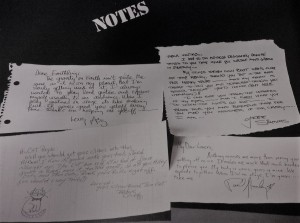
Kiss Alive! saved the band, and saved their record label Casablanca records.Β Casablanca were on the verge of bankruptcy, and manager Bill Aucoin had to put the band on the road using his American Express card for currency.Β Alive! put everybody back in the black.Β It also put Kiss on the map as a rock and roll band to be reckoned with.Β The two LP set was decked out with a gatefold sleeve, photos, a booklet, and even written notes from the band members.Β For the first time, it felt like Kiss had released an album that lived up not only to their show, but their larger than life image.
Whether you decide to pick up Kiss Alive! on CD or LP, you will be in for a βrock and roll partyβ as per Paul Stanley.Β Our recommended edition:Β The four disc 2006 box set Alive! 1975-2000.Β The set contains four volumes of Kiss Alive, deliciously remastered, with each album fit onto a single CD without losing any songs.Β Fire away.
Today’s rating:
5/5 stars
Uncle Meat’s rating:
4.5/5 steaksΒ
Meat’s slice: Β Β I would approximate that it was probably somewhere around 1978 when I first heard this record at a friendβs place. Β I sat there and stared at the inner booklet and the album artwork, and I just wanted to be there.Β I actually did get there many years later, but since I was like nine years old at this time and had not seen any sort of concert, it was all I knew of what a rock show was.Β The picture on the back of the album taken at Detroitβs Cobo Hall is an unforgettable one, and makes you almost feel like you are there.Β You get the scope of what itβs like to be on the floor for an arena show.Β Tracks like “She”, “100,000 Years” and “Cold Gin” shine on this record specifically because of the banter of Paul Stanley.Β I think itβs what truly makes the album special.Β It wouldnβt surprise me to hear that Bruce Dickinson may have learned a thing or two from the Starchild on how to connect with an audience.Β Alive! is the most important album of Kissβ career, and is especially significant for those who were lucky to be a Kiss fan at a young age, while their unstoppable takeover of the Earth was building and building.
Following the release of Kiss Alive! in September of 1975, the second half of the 70s became known as the “Live Album Era” of Rock and Roll. Not only were a lot of bands doing it, but they were having massive successes with them (At Budokanβ¦Frampton Comes Alive...Unleashed in the Eastβ¦If You Want Blood etc).Β This pioneering album was able to make the listener feel like they were actually at a rock concert, better than almost any live record has since.Β Kiss Alive! was truly the birth of what is now known as The Kiss Army.
However with all this good comes some bad.Β It was revealed years ago what everyone had already suspected: Most of the record is overdubbed and even most of the crowd noise is dubbed in.Β For this reason and this reason alone I didnβt give this album 5 steaks.Β But I refuse to go lower than 4 Β½ .
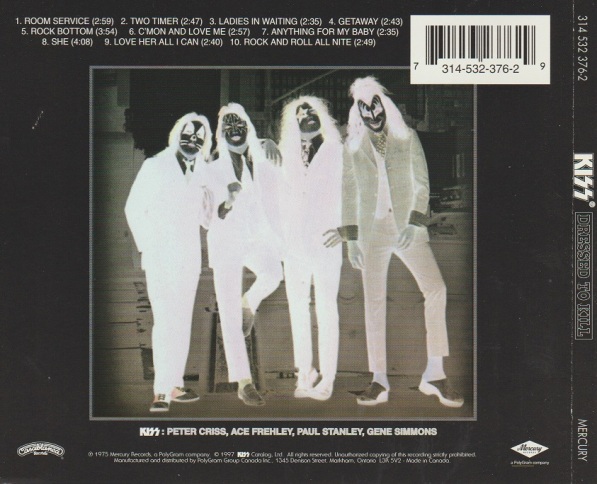
– Dressed to Kill (1975 Casablanca, 1997 Mercury remastered edition)
The band was expected to be huge, so what was going wrong? Β They had the look and they had the stage show. They had two albumsΒ and both underperformed.Β Casablanca label head Neil Bogart wasnβt about to give up, and took matters in his own hands. He brought the band back to Electric Lady in New York and economically produced the third album himself.
Kissβ Dressed to Kill was their third LP in 12 months.Β It was not a drastic change of direction. It offered the same basic rock and roll that Kiss presented on the first two.Β Bogart provided a clean production, a better sound but not too dissimilar from the first Kiss. Β It wasΒ miles away better than the sludge ofΒ Hotter Than Hell, and it was a shorty (just half an hour). Β Like the first two albums, it recycled some old Wicked Lester songs and Kiss-ified them.
Kiss wasΒ touring relentlessly so it was no surprise to hear songs like βRoom Serviceβ among the new tracks.
I’m feelin’ low, no place to go, And I’m a-thinking that I’m gonna scream, Because a hotel all alone is not a Rock and roll star’s dream.
But just when I’m about to shut the light and go to bed, A lady calls and asks if I’m too tired or if I’m just to dead forβ¦
Room service, baby I could use a meal, Room service, you do what you feel, Room service, I take the pleasure with the pain, I can’t say no.
An upbeat workmanlike Kiss song about sex on the road? Β Just what Dr. Rock ordered.Β The jangly rock and roll of early Kiss is omnipresent, and so are the cat-like pitter-patter drum rolls of Peter Criss. Β Ace Frehley’s solo is multitracked for extra harmonic punch. Β Then the album goes for a slow grooveΒ on “Two Timer”, a Gene stompΒ powered by his melodic basslines. Β Kiss’ voices blend consummately for a nice memorable monster chorus. Β The “Ladies in Waiting” arrive next, and according to the lyrics, “You’ve been to the market, and the meat looks good tonight.” Β He’s not singing about Porterhouse steaks (or Uncle Meat). Β The groove has kick, and plenty of Ace’s guitar fireworks.
Peter Criss had only one lead vocal on Dressed to Kill:Β “Getaway”, written by Ace. Β The guitarist hadn’t started singing lead himself, and he knew that Peter needed more material to sing. Β “Getaway” is a traditional rock n’ roll lick with Pete’s rasp and smooth style. Β There is nothing wrong with an enjoyably simple Kiss song, especially when it’s one of Ace’s. Β That goes double if Peter Criss is singing on it. Β “Getaway” might not be a classic but it’s a deeply enjoyable album cut.
Dressed to Kill‘s first side had a brilliant closer in “Rock Bottom”, a song in two parts. Β In the years since, Ace Frehley has quite competently come up with some beautiful acoustic songs. Β On his solo and Frehley’s Comet albums of more recent years, he usually has an acoustic instrumental in his “Fractured” series. Β The “Rock Bottom” intro might be considered a prequel to the “Fractured” series. Β A piece like this came out of left field on a Kiss album. Β He and Paul Stanley created a lovely blend of acoustics, and Neil Bogart captured it warm and clean. Β As long as the intro is “Rock Bottom” itself, another one in a series of classic Paul Stanley rockers. Β Paul has a knack for punchy and memorable rock and roll guitar songs, and “Rock Bottom” gets you right between the eyes.
It’s actually two Paul songs in a row that deserve the “classic” tag. Β Not just “Rock Bottom”, but the side two opener “C’Mon and Love Me” is as brilliant as a 100 watt bulb right in the face. Β Paul is probably not recognized enough for his riff writing. Β Iommi, Page and Young are icons of riff, but Paul has really written some corkers over the years. Β “C’Mon and Love Me” remains so awesome today because of that biting riff. Β Not quite so with the pop rocker “Anything For My Baby”. Β It’s too similar to the forthcoming (and superior) “Rock and Roll all Nite”. Β However side two is quickly redeemed by the heavy-as-fuck “She”. Β Yes, “She”, the same “She” that sounded like Jethro Tull on acid when recorded for Wicked Lester (1973). Β Kiss transformed a corny hippie experiment into Sabbathy metal shrapnel. Β Instead of a wanky falsetto, Gene employed his deep monster voice on “She”. Β Combined with Peter Criss’ tribal drums, “She” slams you to the wall so turn it right up.
“Love Her All I Can” is goofy filler, another old Wicked Lester remake. Β Not one of their finest moments, but important to the history of the band. Β It is notable as being another fine example of Gene and Paul blending their voices for a nice thick chorus. Β Frehley’s solo smokes so hot it’ll set off your fire alarm, but the song itself ranks low. Β This matters not, because “Rock and Roll all Nite” was held back as the final track. Β When Gene and Paul wrote together, they created magic. Β But it’s not just Simmons and Stanley that can take all the credit. Β Peter Criss’ cat-grooveΒ is unmistakablyΒ integral to the song. Β Neil Bogart did a better job of capturing the band than Kerner and Wise did. Β He also pushed the band into writing an anthem for themselves, and write it they did. Β Notably, for the first time outsiders were brought into the studio to appear on a Kiss album. Β In this case it was just friends and roadies, but it was also the first Kiss “gang vocal”.
There we go. Β Hit written. Β Or was it?
“Rock and Roll all Nite” failed to scorch the charts as it was designed to do. Β Bogart and Casablanca Records were in dire straits now. Β They had unwisely banked on a Johnny Carson comedy album to sell millions, and were sitting on all that unsold product. Β (It would not be the last time Casablanca got cocky and made that mistake.) Β If the record label were in trouble, by extension, so was Kiss.
Dressed to Kill will always be fondly remembered for rocking and rolling us all nite, for the very first time. Β It’s also a beautiful record jacket to look at. Β The black and white photo of Kiss in ill-fitting suits, surrounded by embossed Kiss logos, was quite striking. Β Simmons looks particularly demented, only deepening his Demon image. Β It’s a good Kiss album, but if they were to survive they had to make a serious statement. Β Most importantly, they had to capture that thunderous sound at its full potential, something every producer thus far had failed to do. It was time to come Alive!
Today’s rating:
4/5 stars
Uncle Meat’s rating:
5/5 steaksΒ
Meat’s slice: Β Almost exactly half an hour of perfect Rock and Roll. Β The shortest Kiss album is the best Kiss album in Uncle Meatβs opinion.Β Β After a sophomore slide, Kissβ third album somehow improved the sound by getting the president of their record company to produce?Β What shouldnβt have worked, worked perfectly with Kiss under the gun and writing, recording and releasing Dressed to Kill in a ridiculous five months after Hotter Than Hell.Β Why does it take Metallica 45 years to make a fucking album again?Β Donβt say egoβ¦because we are talking about the Donald Trump of egos in Gene Simmons by himself here. Β Fuck Metallicaβs bullshit!!! Β (* I apologize…this is for another time to be determined *) Β Β Anyway,Β Kiss became tighter as a band and better musicians through constant touring.Β This prepared them to brave these unlikely circumstances and produce not only some of my favorite all-time songs of theirs, but undoubtedly the song that would live on as the very flagpole the Kiss Army flag is attached to, “Rock and Roll all Nite”.
Short but sweet has never been so apropos to describe a record. The chorus of “Cβmon and Love Me”. The cowbell in “Room Service”.Β Then “She” takes off her clothes and Iβm sold.Β Best album of their career. Another interesting Kiss noteβ¦Only twice have Paul Stanley and Ace Frehley shared writing credits alone on a song together: Β “Comin’ Home” and “Rock Bottom”.Β The former being a song I have already mentioned I donβt really like much, and the latter being a Top 3 Kiss song for me.Β Ironically a song titled “Rock Bottom” is the exactly the antithesis of that.Β Top shelf Rock and Roll from the band that got me into Rock and Roll.Β Also in my Top 3 album covers of all time.Β Scared the shit out of me when I was a kid.
Favorite Tracks: Β “Rock Bottom”, “Love Her All I Can”, “She”, “Cβmon and Love Me”, “Room Service”
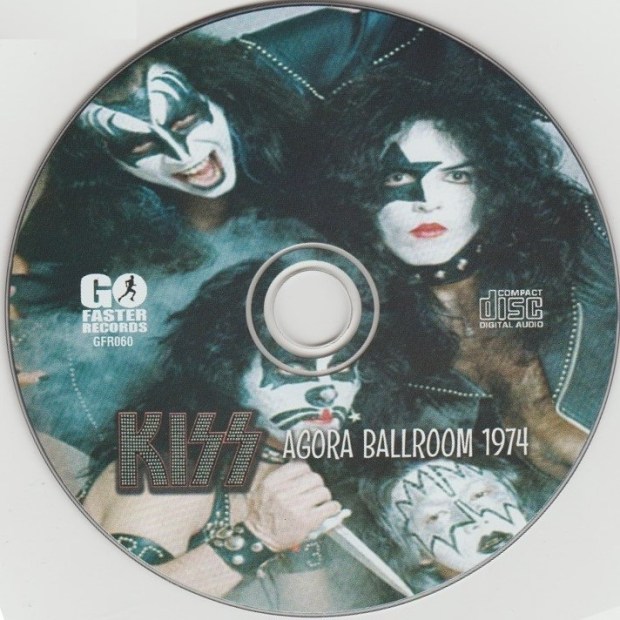
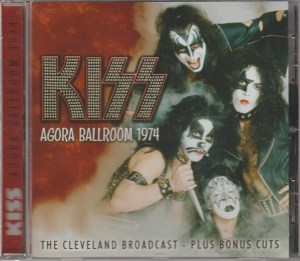
– Agora Ballroom 1974– The Cleveland Broadcast – Plus bonus cuts (2015 Go Faster)
Radio broadcast CDs are common and cheap today. Β They are a great way to get rare live recordings from bands you love, at a good price, with acceptable sound quality. Β When this set was recorded at the Agora Ballroom in Cleveland (April 1, 1974) Kiss only had one album out. Β It’s a rare early glimpse at the band when they were just beginning to stretch their road legs. Β Already, the performances on this CD were far more fiery than that on their studio albums — and that’s without Gene breathing fire.
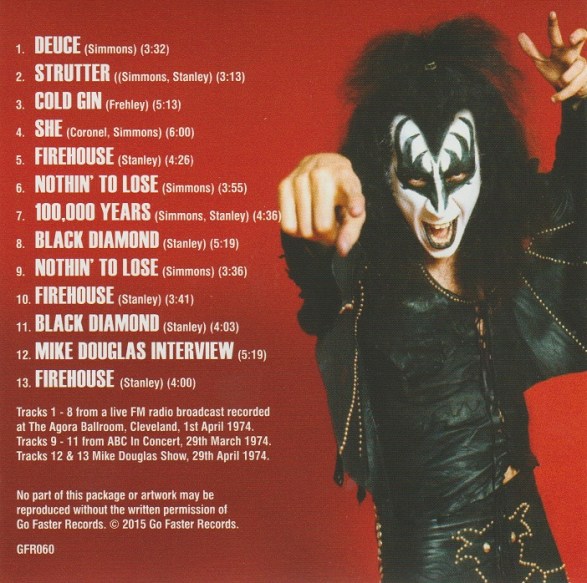
The Agora set was a mere eight songs, and a strong representation of Kiss’ best early material. Β Almost everything is from the first LP; nothing from the second that would be released a mere six months later. Β The oddity is “She”, an old Wicked Lester holdover that wouldn’t come out as a Kiss song until 1975. Β Also fascinating is that Gene Simmons even does some talking between songs, and you can see why he lets Paul do all the talking now. Β “How many are you, a hundred? Β Are you ready to rock? Β Rock?” Β Paul Stanley was clearly better at stage raps, and this CD offers a reason why Gene doesn’t do them anymore.
As with any radio broadcast CD, do not expect flawless audio. Β This isn’t the greatest recording. Β There’s hardlyΒ any bass. Β What it is though is a great performance captured at the very beginning. Β Tracks like “100,000 Years”, “Nothin’ to Lose” and “Cold Gin” have so much reckless energy that they make the originals sound sterile. Β Kiss were a very active band on stage, and all that jumping around means bad chords, missed notes and vocals that drop in and out as Paul moves to and fro. Β You wanted authenticity? Β You got authenticity. Β The most consistent member is Ace Frehley whose solos were often highlights of any Kiss song.
Best track: Β “Black Diamond”.
But wait, there’s more! Β From ABC In Concert (03/29/74) comes additional versions of “Nothin’ to Lose”, “Firehouse” and “Black Diamond”. Β These are not flawless either, but they have more beef and a lot more bass. Β The performances areΒ just as ragged. Β Then from their legendary appearance on the Mike Douglas Show (04/29/74) is the Gene Simmons interview and “Firehouse” once more. Β “Let me spread my wings”, says an awkward Gene, not quite the character he’d become later, but quite the ham. Β The audience (and guests) had no idea what to make of him. These are tapes that fans have had and loved for years, but to have them on a commercial CD is pretty cool. Β Besides, these really are bonus tracks. Β They’re not on other versions of Agora, such as the 4 CD Radio Waves 1974-1988 which only has the first eight songs.
Any Kiss fan needs the Agora show in some form. This CD may as well be your choice, since it’s affordably priced and has those lovely bonus cuts. Kiss is a band that evolved, year by year, from sheer touring experience. The early performances have a raw un-schooled edge, and that’s what makes them special.
Wanna win a brand-spankin’-new copy of this awesome book? Β “The Merciless Book of Metal ListsΒ (by Howie Abrams and Sacha Jenkins, retail price $21.95 Canadian) is a highly opinionated compendium of the most random, funny, and challenging information about Heavy Metal from the last forty years.”
Just answer the simple trivia question below. Β The answer can be found somewhere on mikeladano.com. Β You just have to find it.
Here are the rules:
Do not leave your answer in the comments. Β Donβt spoil the contest! Β Leave your answer by filling out the form below which will be directly emailed to my top-secret address.
You may enter as many times as you like.
But the first right answerΒ and only the first answerΒ gets the prize.
This shouldnβt be too hard, but the contest master might be cajoled into giving out a few clues if this goes sideways and takes forever.
The winner will be required to provide a mailing address for the prize to be sent.
Ready? Β Here is your question.
The answer, which you can find somewhere on mikeladano.com, may surprise you. Β Good luck! Β Let’s see some entries! Β GO!
– Hotter Than Hell(1974 Casablanca, 1997 Mercury remastered edition)
Sunny California awaited Kiss, and producers Kenny Kerner and Richie Wise. Β Hotter Than Hell was an apt title for the album they were set to record, but nobody was happy. Β Maybe it was homesickness, but Hotter Than Hell is sonically perhaps the very worst Kiss album ever released. Β Brittle, thin and tinny are three appropriate words to describe its sonic flatness. Β What are supposed to be drums sound more likeΒ wooden planks. Β It sounds less like an human drummer and more likeΒ a clanking machine flailing away in a deep cave.
Production issues keep Hotter Than Hell off the tops of many lists, but the songs were all there. Β It remains a favourite for many, a reminder of times both good and bad, as nostalgia helps wipe clean the lingering audio disappointment. Β Kiss had little problem coming up with 10 great songs, mere months after their debut album KissΒ (also 1974). Β Gene Simmons and Paul Stanley hadΒ the usual goods, and Ace Frehley provided co-writes on three songs. Β And what songs they were.
The slow riff for “Got to Choose” is a perfect opener, chunkyΒ yet melodic. Β Paul sings lead, Gene harmonizes, and a Kiss classic is born. Β “Ooh ooh ooh, got to choose who’s your baby!” they sing, and who doesn’t love “ooo ooo ooo’s” in their choruses? Β They contrast well with the heavy Kiss guitars, much edgier than the jangle of Kiss. Yet that’s nothing compared to the machine gun tactics of “Parasite”, a Frehley signature track as sung by Gene Simmons. Β When Ace does contribute his own material, it sounds like idiosyncratic Frehley. Β “Parasite” powers its way through the sonic haze, forcing its way above the sludgy sound. Β Ace’s solo remains a trademark, a stuttering classic you can hum in your sleep. Β Guitarists the world over got their start trying to play “Parasite”.
This makes way for the first Kiss “ballad” if you want to call it that: Β “Goin’ Blind”. Β It’s really too heavy to be a ballad, but it’s also too slow and mournful to be a rocker. Β This track goes back years, as Gene wrote it with his Wicked Lester bandmate Stephen CoronelΒ as “Little Lady”. Β Though the lyrics may not appeal to all (“I’m 93, you’re 16”), “Goin’ Blind” is one of Gene’s finest songs. Β Ace’s solo just cries (loudly).
Paul Stanley’s title track is a favourite. Β The groove is what Kiss call their “monster plod”, and you know it when you hear it. Β It stomps, it rolls, and it takes its time. Β “Hotter Than Hell” has not one but two amazing riffs, and some of Ace Frehley’s coolest wailing. Β Frehley’s outro solo is multitracked, surely one of the earliest examples of this in Kiss. Β Then Frehley burns it all to the ground on “Let Me Go, Rock ‘n’ Roll”. Β Lightning licks and turbo charged rock n’ roll get the sweat pouring. Β Anyone who wants to know what the fuss about Kiss is all about just need to play “Let Me Go, Rock ‘n’ Roll”. Β Get past the sonics and focus on the adrenaline.
Dig that cowbell on “All the Way”, a SimmonsΒ rock and roll celebration. Β Though it wasn’t on Kiss Alive!, and hasn’t become a Kiss mainstay, that is not a reflection on its quality. Β Hotter Than Hell is oftenΒ heavy and oppressive. Β “All the Way” is just fun, blowing off steam, and having a good time. Β “Watching You”, on the other hand, is one of those heavy Kiss grooves that Gene does so well. Β Listen to his bass playing, too. Β Cream were one of his big influences, and though Gene is no Jack Bruce, he composes melodic rolling bass lines. Β Because of his persona, and because it is more about the act than the musicianship, Gene’s skills on the four string are often overlooked. Β “Watchin’ You” places them front and center. Β And just listen to Paul Stanley coming in screamin’ at about 1:35! Β What a voice. Β There were no slouches in Kiss. Β Even hampered by the tinny drum sound, Peter Criss is ferocious, almost tribal. Β (And with tasteful use of cowbell.)
Paul Stanley has come up with some very cool, simple and classic rock and roll riffs over the years. Β Tracks like “Mr. Speed”, “C’mon and Love Me”, and more recently “All For the Love of Rock & Roll”. Β Add “Mainline” to that list of great Paul Stanley guitar parts. Β This song is given to Peter Criss to apply his rasp to. Β Compared to the more aggressive material elsewhere, “Mainline” almost slips between the cracks. Β It has become a favourite in fan circles. Β So has “Coming Home”, a rare Stanley/Frehley co-write. Β It is unfortunate that you cannot clearly hear the nuances of the rhythm guitars, because Paul and Ace blend their parts very well. Β “Coming Home” is so upbeat and energetic that you just keep trying to hear it a little better.
A Sabbathy closer called “Strange Ways” was written by Ace and given to Peter Criss to sing. Β This is an early example of Frehley’s loyalty to Criss. Β Ace knew that Peter could use another vocal on the album more than Paul and Gene did. Β Peter nailed it, and with Gene Simmons joining on the chorus, Kiss just flattened everything. Β Kiss rarely got as heavy as “Strange Ways”, and “Parasite” too…both Frehley songs.
Hotter Than Hell could easily score a 5/5 stars, but the sonics are impossible to simply ignore. Β Every time you listen to it, there are things that sound irritating. Β Instruments that don’t sound like themselves. Β Notes and beats you struggle to hear. Β It’s unfortunate that such a potentially lethal album was neutered by the lack of magic in the studio. Β But it was OK. Β Casablanca Records weren’t about to give up. Β A third album would be needed, pronto.
Today’s rating:
4/5 stars
Uncle Meat’s rating:
3Β ΒΎ/5Β steaksΒ
Meat’s slice:Β Some of the party/sex/sex/sex etc. songs KissΒ filled the first album with were replaced by songs with darker lyrical themes.Β The sound on this album is, wellβ¦shit.Β This seems fitting considering all the bad experiences the band had while making this record (Ace’s face was mangled in a car accident). There are some great songs here, especially on side one. But side two is murked up a bit with a some clunkers.Β
Not only the first Kiss album I ever owned, but the very first rock record as well.Β I think my second record was The Bay City Rollers Greatest Hits.
Favorite Tracks: Β “Parasite”, “Got to Choose”, “Strange Ways”
– Kiss (1974 Casablanca, 1997 Mercury remastered edition)
The recording contract was signed with Casablanca Records.Β Management was retained with Bill Aucoin.Β The live gigs were quickly becoming legendary.Β All Kiss needed was an album.
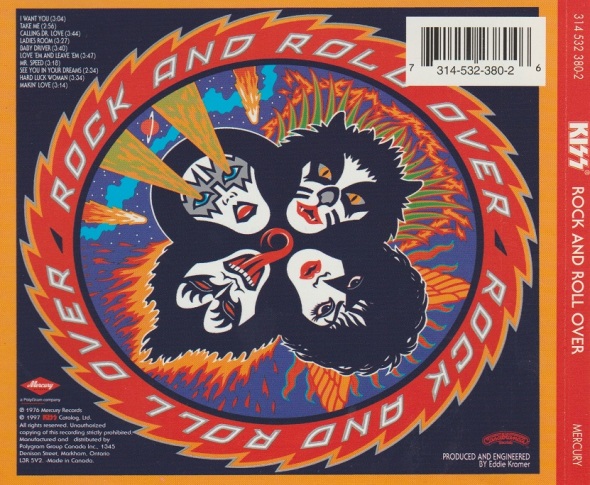
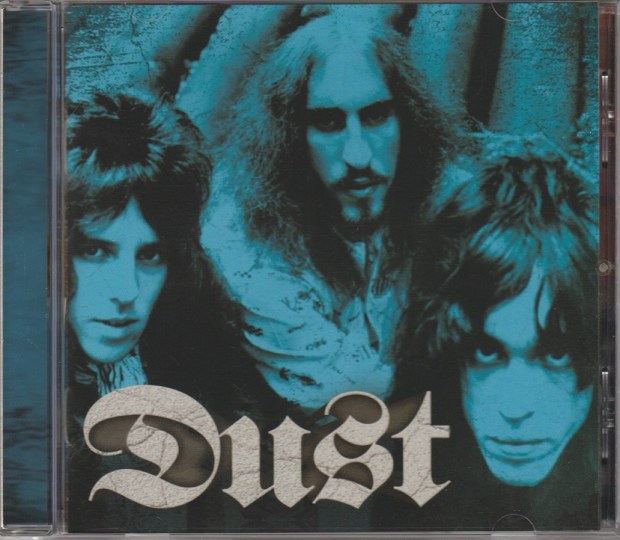
They band convened at Bell Sound studios in New York with Kenny Kerner and Richie Wise (ex-Dust) producing.Β They selected nine of their best originals and got down to the job of recording.Β Within a few weeks, they had a fully mixed album in their hands.
Kissβ 1974 self-titled debut was simple and to the point.Β No ballads, no frills, no fluff, very little filler and all rock.Β It was a lean debut that lacked the thunder of their live performances.Β Guitar-based, yes, but restrained and underpowered.Β There was more Keith RichardsΒ rock and roll jangle than heavy metal distortion. Β Yet these songs have formed the backbone of Kiss’ live set for decades.
Peter Criss has the honour of having the first sounds on the first Kiss album β a drum roll to introduce Paul Stanleyβs βStrutterβ.Β The jangling Stones-y rhythm guitars of Paul and Ace Frehley are intertwined to create the βStrutterβ riff, while Paul sings of a girl that he knows βa thing or twoβ about.Β She gets her way just like a child, but there is no bitternessΒ in the song.Β Itβs simply a rock and roll celebration, timeless and perfect as it is. Β When Ace Frehley arrives with his first guitar solo, it’s clear that he was always a talent to watch. Β His licks are fluid and precise.
One of Kissβ biggest musical strengths was the fact that they had three (later on, four) capable lead singers.Β Gene, Peter and Paul take turns on βNothinβ to Loseβ, a simple rock and roller made perfect by Peter Crissβ raspy scat.Β The lyrics have nothing to say except that some lucky young lady has nothing to lose.Β Following this, Paul Stanley calls the βFirehouseβ, a live favourite that loses a lot of its bite on album.Β The fire truck sirens are intact, but the recording is under powered — it needed more crunch and a little caffeine.Β Much tougher is Frehleyβs βCold Ginβ, sung by Gene Simmons.Β The tempo is a little sluggish but it really came to life in the live arena.Β This classic was kept in the set long after Ace left the band, proving its mettle.Β Hard party rock doesnβt get much better than this.Β βMy heaterβs broke and Iβm so tired, I need some fuel to build the fire.βΒ Itβs rare to hear Kiss singing about booze, which usually wasnβtΒ their forte.
βLet Me Knowβ was one of the first songs Paul Stanley wrote, under the name βSunday Driverβ.Β Itβs right there in the lyrics, βLet me be your Sunday driver, let me be your Monday manβ¦β Β There are some songs that should get more recognition, and “Let Me Know” is absolutely one of them. Β Gene and Peter join Peter for an irresistible group effort. Β It gleefully continues the jangly rock of the first Kiss album, although there is also a heavy closingΒ outro riff. Β This powerful riff has been recycled live over the years to end other songs. Β βLet Me Knowβ closed the first side with this memorableΒ piece of Kiss guitar thunder.
Gene Simmonsβ βDeuceβ has become one of the most identifiable trademark Kiss songs.Β βYou know your manβs been working hard, heβs worth a deuce.βΒ Gene says the words are meaningless, but lines like βGet up and get your grandma out of here,β had the attitude he wanted.Β Still one of Kissβ hardest rockers, and with a riff that kills (ripped off from the Stones, according to Gene), βDeuceβ will likely be played live until the end of time itself. Β You can see Gene up there on stage, tonguing himself for all eternity.
A bit of filler called βLove Theme From Kissβ (formerly: βAcrobatβ) is one of theirΒ few instrumental tracks.Β It doesnβt have much meat, and was dropped from the set before too long.Β Live, βAcrobatβ used to feature a fast and heavy part called βYouβre Much Too Youngβ that is far better than βLove Theme From Kiss”.Β The lollygagging guitars of βLove Themeβ just donβt cut it.
β100,000 Yearsβ is driven by a wickedΒ Simmons bass lick, and Paul Stanleyβs wailing vocals.Β Its groove has kept it in the live set on and off for decades, a fan favourite often extended for concerts with a long Paul rap and drum solo.Β Then finally there is βBlack Diamondβ, the biggest sounding and most dramatic of these early tracks. Β It utilizes a sweet Paul Stanley acoustic intro, before it goes full electric and Peter Criss takes the lead vocals. Β His sandpaper rasp kills it: βBlack Diamondβ is another Kiss classic that has stood the test of time (and even different singers) over the years.Β The original album version is hard to beat.
Casablanca werenβt happy with how the album was selling.Β Label head Neil Bogart rushed Kiss into the studio to record a βhit singleβ.Β They decided on covering βKissinβ Timeβ and promoting it with a βkissing contestβ. Β Attention achieved, although the single performed only moderately. Β The track was added to the reissued album, as the first song on side two.Β The band were never particularly happy with it, and even though it showcases lead vocals from Paul, Gene and Peter, it does not sound much like Kiss. Β It sounds more like compromise.
Promoting Kiss meant keeping a constant stream of product on the shelves.Β A few months later, they were off to Los Angeles with Kerner and Wise to record a followup.Β Kiss would have two studio albums in 1974, mere months apart.Β Fortunately they had plenty of old Wicked Lester material to dust off.Β The Kiss debut remains a quaint sounding beginning.Β While their songwriting was intact and has proven to stand the test ofΒ the ages, their knowledge of the recording studio was just beginning.Β Kiss could have used a heavier edge, but it is what it is:Β a start.
Today’s rating:
4/5 stars
Uncle Meat’s rating:
4 ΒΎ/5 steaks Β
Meat’s Slice: Β One of the best debut albums in rock history; there is not a bad track on the album.Β You could potentially hear more than half this album at any Kiss concert.Β Easily a Top 3 Kiss album for Meat.Β Certainly the production could be better, but the songs are great and even the minimalistic sound makes it feel even more like a great Rock and Roll record.Β Which is what most of 70s Kiss really is.Β Classic Rock and Roll.Β Even “Love Theme From Kiss” has aged well.
Favorite Tracks: Β “Nothin’ to Lose”, “Black Diamond”, “Cold Gin”
Forgettable Tracks: Β “Kissin’ Time” (Nitpicking here.Β Wasnβt even really on the original album in the first place.)
Has any band gone nearly 50 years with such integrity? Β The only original member left is drummer Ian Paice, but that matters not. Β Ian Gillan and Roger Glover are original members to laymen. Β Steve Morse has been in the band for over 20 years, and Don Airey is at about 15. Β There is no lack of authenticity to Deep Purple, no matter what preconceptions you may have. Β This most recent lineup with Airey is now on itsΒ fourth studio album. Β The new album InfiniteΒ (produced again by Bob Ezrin) will be out April 7.
“Time for Bedlam” is a great choice for a single. Β It rocks a “Pictures of Home” (1972) vibe. Β Gillan’s lyrics are as biting as ever. Β “Sucking my milk from the venomous tit of the state…” Β Meanwhile Deep Purple sound like Deep Purple, but always pushing outwards. Β There is newness in “Time for Bedlam”. Β The droning intro is nothing like Deep Purple past, with Ian in a low monotonous voice. Β But whatever makes Deep Purple sound like Deep Purple, it’s on “Time for Bedlam”. Β For most people, the organ is the most identifiable ingredient, and Don Airey continues to pay tribute to the original, Jon Lord, in every note. Β The solo sections from Airey and Morse are jawdropping.
This great CD single has three additional tracks. Β “Paradise Bar” is a new non-album track, a laid back summer time groove. Β It has progressive keys and a lazy easy going vibe. Β It remains to be seen how it ranks among Infinite‘s album tracks. Β It’s nice to buy a single and get an actual new unreleased track, and “Paradise Bar” isn’t mere filler. Β Fans will enjoy Steve and Don’s solo trade-offs. Β An unreleased instrumental version of “Uncommon Man” (from 2013’s Now What?!) will also be of interest to fans of the musicians in Deep Purple. Β For such a long track (6:59) it’s amazing how well it works as a simple instrumental. Β You have to hand that to this great band, and producer Bob Ezrin for capturing such great ambience.
The last track “Hip Boots” is an instrumental rehearsal of a track that will be on Infinite. Β It’s a funky jam, a lot like what Deep Purple have always done. Β It remains to be seen what the album track is like (will it have vocals, will it be a jam?) but this is an intriguing look at a song in a state that we don’t normally get to hear. Β It whets the appetite for what could be coming.
Kudos to Deep Purple for still utilizing the singles format (something they also did with Now What?!), and in doing so, giving the fan some added value. Β They’re creating a buzz for Infinite, so let’s hope that pays off in April!