Reviews

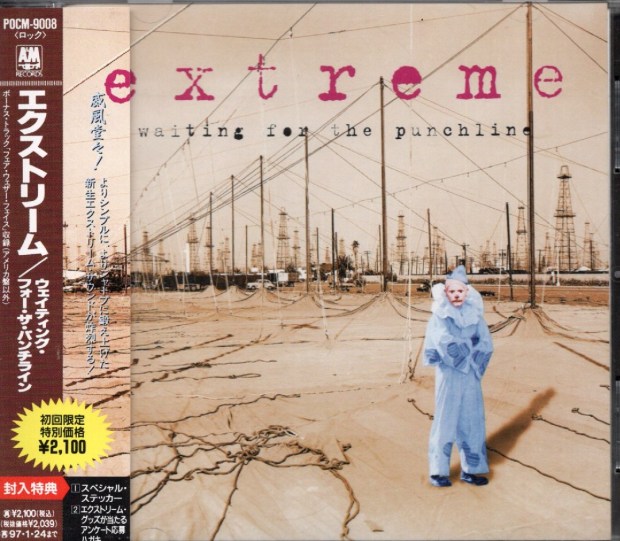
REVIEW: Extreme – Waiting for the Punchline (1995 Japanese/bonus track)

EXTREME – Waiting for the Punchline (1995 Polydor Japan)

Let’s start with the bonus track!  “Fair-Weather Faith” is only available here, on the Japanese pressing of Extreme’s fourth album.  And it is…well, it’s probably not controversial to say it’s the weakest of the 13 (12 plus one unlisted) tracks.  That’s why it’s a bonus track.  Is there anything wrong with it?  Hell no!  But do you absolutely need it in your life?  No.  You can live without it.  Be warned though that Gary sings his ass off, while Nuno plays it funky.  It sounds as if this is one of the tracks with Paul Geary on drums.  (Mike Mangini joined the band mid-album.)  Like many Extreme songs, religion is the topic.  Gary is critical of these who put on the act of believing for the benefit of those around them.  Decent bonus track, but not especially mind-blowing.


(The rest of this review was previously published in 2017)

Sometimes you just gotta laugh.  Extreme released two of their finest albums after grunge wiped the slate clean.  Extreme were the punchline, but that didn’t stop them from making a smokin’ fourth album.  In 1992 Nuno envisioned the next album as “really funky”, and there is some funk here.  However Waiting for the Punchline was much more straight ahead: stripped down, no orchestras, no rap, just guitar rock through and through.

“There Is No God” sounds like an odd title from a band as Christian as Extreme were, but Gary Cherone has always been a lyrical champion.  It’s not as simple as it appears, but the groove just lays waste.  The next track “Cynical Fuck” turns it up further.  It is pure smoke, and perfect for the decade it was written in.  “Tell Me Something I Don’t Know” takes the soft/hard approach with a loud droning Nuno riff.  It’s another brilliant song, and harder than what Extreme were doing before.  Much of Waiting for the Punchline is driven by the bass and drums.  The interesting thing about this is that drummer Paul Geary left during the making of this album, and was replaced by Mike Mangini who is now in Dream Theater.  You hear two very distinct drum styles through the CD.  Geary has a straight ahead approach, while Mangini is capable of just about anything.  His first track is the single “Hip Today” and you can hear how his beats are anything but basic.

“Hip Today” is a good tune and a good indicator of what the album sounds like: Bass, drums, guitar. Listen to how the rhythm guitar drops out when Nuno solos. Just like the first classic Van Halen. The lyrics sound bitter as Gary warns the next generation of bands that their time too will end.  Things slow down a little on “Naked”, before the side-ending instrumental “Midnight Express”.  This is a truly brilliant track, proof that Nuno’s stunning plectrum practice has paid off.   When it comes to acoustic guitar work in rock and roll band, Nuno is among the very best.  “Midnight Express” gives me callouses just thinking about it.

Dark moods commence the second side with “Leave Me Alone”, a sentiment many of us understand.  Don’t worry about me — I’m happy alone sometimes.  Nuno uses volume swells a-la Van Halen’s “Cathedral” to create a nifty riff.  Into “No Respect”, Nuno makes his guitar purr, while the rhythm section throws it into overdrive.  “Evilangelist” tackles the religion questions again, with a funky riff and cool digitized chorus.  The dark and heavy vibes give way to light shortly on “Shadow Boxing” and “Unconditionally”.   Both tracks are brilliant but different.  “Shadow Boxing” might be considered the “Hole Hearted” of this album, while “Unconditionally” leans towards “More Than Words”.  Neither are re-writes, but those are the easiest comparisons.

One final surprise is the unlisted bonus track.  It wasn’t on the cassette version, but you will find the title track “Waiting for the Punchline” after “Unconditionally” (or “Fair-Weather Faith” on the Japanese CD).  There are two cool things about this.  One: it’s an awesome track, much like the angrier stuff on side one.  Two: it closes the album even better than “Unconditionally”.  Great little surprise so don’t hit “stop”!

The thing about Waiting for the Punchline is that it’s a grower.   The first couple listens, I thought “It’s not as good as their old stuff, but what is these days?”  The new stripped down Extreme didn’t seem as interesting as the lavish one from Extreme III or the flashy one from Extreme II.  After a few listens, different textures began to emerge, add their own colours and depth.  Particular with the guitar work, but also the rhythms, there is much delight to be discovered here.

5/5 stars

REVIEW: Hollywood Monsters – Thriving On Chaos (2020 Japanese/bonus track)

HOLLYWOOD MONSTERS – Thriving On Chaos (2020 Voice Music, Japanese import)

Supergroup?  Or just a good time?  Singer/guitarist Steph Honde, drummer Vinny Appice, and bassist Ronnie Robson gathered a load of friends and recorded a fun heavy metal album of originals and covers.  There is also a healthy helping of Canadian content (such as Robson in the core trio)!

Opener “A Scream Looking For a Mouth” is a raging heavy metal track along the lines of vintage high-voltage Motorhead.  Hell of an opener.  Add Deep Purple’s Don Airey on guest Hammond organ solo, which just hits the right spot amidst all that raging.  “Speak of the Devil” continues the heavy, though not the speed, thankfully, or you’d be seeing a chiropractor from all the headbangin’.  A catchy chorus and solid riffing make it another instant winner.  Solid metal.  A chunky riff kicks off “Something Wicked”, a really fun uptempo rocker.

Things get slower and darker on the monumental “Running Up Hill”, which is instant hit material.  Ted McKenna on drums.  Instant classic, with a chorus that kills.  Regardless of the daily struggles we face, Honde reminds us, “Never surrender!”  It’s a message of positivity, and the best track on the album.

“Numb” is another good one, grinding out a riff slow an’ easy.  The added keyboards provide texture.  Even better is the beautiful acoustic ballad “In This House”.  Honde has an excellent acoustic album called Empire of Ashes, and this track easily could have fit on it.  Though he’s a rocker, he is exceptional at tender acoustic ballads.

The first cover is “I Don’t Need No Doctor” featuring Jim Crean on backing vocals.  It kicks all the expected asses, and Honde’s guitar soloing is tasty as hell.  Next up:  Canadian content with the Goddo cover “Drop Dead”, featuring Greg Godovitz on co-lead vocals and Tommy Denander on lead guitar.  It smokes, and that lead solo?  Set phasers to stun!

“Thriving On Chaos” is another impressive original.  It has a slow, dramatic riff that is somehow familiar.  Excellent songwriting, and hard to pigeonhole.  It’s followed by a very Maiden-esque song called “Fortune Teller”, which has a vibe very similar to some of the tracks on Fear of the Dark.  Fred Mika plays drums on this tempered-steel monster.

The final cover (and Canadian guest) is the Thin Lizzy cover “Cold Sweat”, as sung by Danko Jones.  Danko is the perfect guy for it!  He nails the Phil vibe, yet with his own snarl.  And the Steph Honde guitar solo?  Call the fire department!  This alchemy of Jones/Honde/Appice/Robson is pure combustion.  You can seldom go wrong with a Thin Lizzy cover, but here everything goes so, so right.

Always a surprise when the Japanese bonus track is one of the highlights.  The heavy, thumping “I Am the Best You Can Get” slays!  “Heavy” is an understatement!  Vocalist Steph Honde goes from scream on the verses, to growl on the chorus.  The droning chorus is the best part!  This one features (Canadian) Glen Drover on lead guitar and Alexis Von Kraven on the relentless drums.  The Japanese CD even comes with a printed interview with Steph Honde – though I cannot read Japanese!

Pick it up – shell out for the Japanese if it’s within your means.

4/5 stars

REVIEW: KISS – Off The Soundboard – Poughkeepsie NY 11.26.1984

 – Off the Soundboard – Poughkeepsie NY 11.26.1984 (2023 Universal)

Are you getting sick of reading all the same complaints about the new Kiss Off the Soundboard CD from Poughkeepsie NY 1984, the fifth in this series?

Me too!

If you can’t appreciate the historical value of a Mark St. John show with Kiss, then I can’t help you.

If you didn’t know Kiss played these songs at lightspeed in the 1980s, then you never saw Animalize Live Uncensored.

And if you don’t know what an official bootleg is, then this CD is not for you anyway.

Actually, the only thing I’m really sick of is typing “Poughkeepsie”!

There are Kiss bootlegs with Mark floating around out there.  I can’t vouch for the audio quality on those.  This, I can tell you, is soundboard quality, which in my opinion is the best way to hear a live album.  Unpolished, the way it was that night on the board.  I love hearing the band make mistakes.  I have no problem with the fact you can barely hear the bass on some tracks, and too much on others.  The vocals are clear and each member is distinct in their singing.  Whether you think Paul is too “erratic” or not, that’s personal taste.

The setlist is similar to Animalize Live.  You won’t hear any Animalize deep cuts that were not on that video.  Two songs are incomplete (“Young and Wasted” and “Rock and Roll all Nite”) due to tape issues but are included for their historical significance.  No issues here.  In fact, “Rock and Roll all Nite” might be better this way…it often drags on too long at the end of a show!

The jazz-influenced Mark definitely added his own style and twists to the solos, even simple ones like “Detroit Rock City”.  There, he inserted an extra note or two to make it his.  Mark was a shredder, and that was the direction Kiss wanted to go in at that time.  It was the 80s.  Bands had to have shredders if they wanted the kids to take them seriously.  Mark wasn’t even Kiss’ first shredder, but he was certainly unique.  There’s a lot of whammy bar, and some pretty wicked licks on songs like “Fits Like a Glove”.  Now, before you get too excited, the “Guitar Solo” listed on the back cover is Paul Stanley’s familiar solo that he was playing during that era.

Mark aside, Eric Carr is a star on this album.  He was a busier drummer than Peter Criss and he goes to town on songs like “Cold Gin” and “Under the Gun”.  Fox fans will not want to miss this CD in their collection.  Peak Eric.  His drum solo will be familiar, yet will also most likely sound better than any version you currently own.  Unfortunately he stops singing on part of “Young and Wasted”, which is one of the partial songs anyway, so no big deal.  We have him singing that on Animalize Live.

Paul Stanley’s performance is pure rock and roll, and especially expressive on “I Still Love You”, but many have complained about the F-bombs dropped during his intro to “Love Gun”.  Hey…check out the Animalize Live version for something naughtier than an F-bomb!

If you’re Kiss collector, this is ending up in your library regardless.  Choose your format and go wild like the animals.

3.5/5 stars for the quality

3.5/5 stars as a “Kiss show”

5/5 stars for historical value and significance to the Kiss army

REVIEW: Night Ranger – Big Life (1987)

NIGHT RANGER – Big Life (1987 MCA)

This CD was a gift from Tim Durling, and this review is simply a conversation with Tim Durling!

Tim:  Big Life might sound dated to you, it is very 1987 and possibly one of their mellowest albums. Of course I have a soft spot for it, but then I like the band.

Me:  That’s the one I’m popping in now actually.

Tim:  Your Big Life is a fancy 2009 remaster that I’d never seen before. The original was my very first CD back in 1990.

Me:  Oh jeez, it’s the album with “Secret Of My Success!”  Now I have two copies of that song…The booklet is nice, full lyrics.

Tim:  You can file that under guilty pleasure for me, I know it’s cheesy but “worlds collide, and hearts will be broken” damn it’s so catchy.

Me:  Wow, Blades’ name is on every single songwriting credit.

Tim:  Fun fact: there are two different covers, and I didn’t know that till I had Josh from Fans in Motion on my show.  Same band shot, but some copies have less stuff in the background. I love learning stuff like that.

Me:  Interesting. So somebody said “We need to add a spotlight and a wall” to some versions.

Me:  Wow this opening track is very…Umm…Faux-macho.  Sorry, not liking “Big Life” the track.  It’s like when Warrant tried to act tough on “We Will Rock You”.

Tim:  Doesn’t bode well, but I did say it will sound dated to you.  If you’re looking for a more typical catchy Night Ranger tune, I’d recommend “Carry On”, maybe my favourite on this album.

Me:  I’m gonna give it a fair shake.  This guitar solo is great. Gillis?

Tim:  Not always sure who does which solos, all I know is that if you hear crazy whammy bar, that’s Brad.

Me:  “Color of Your Smile” is better.  I like this one.  Very youthful lyric.

Tim:  Wow, I figured you’d hate it.

Me:  No,  there’s something here that reminds me of youthful summers.  Fuck, this is good. Didn’t see this dual solo coming.  OK, so we have a winner here on track 2, good tune.  If I had this as a kid, it would have been the song I played for girls to get them to like me.

Me:  “Love Is Standing Near” – starting well.

Tim:  That’s encouraging.

Me:  It’s the guitar that sets this band apart for me. Puts them a level up.

Tim:  Definitely one of their calling cards.

Me:  Now I’m on the David Foster produced song (“Secret Of My Success”) that we already know my opinion of.  I really hate it.

Tim:  I will accept that, frowning.  But I get it if you didn’t grow up with it.

Me:  It’s like they’re using the ZZ Top Afterburner book of samples

Tim:  With you there, way overboard on the bells and whistles.

Me:  “Carry On” is a little corny, but might grow on me.  Actually…love it…Very Bon Jovi to my ears, but better vocally.

Tim:  Probably why I like it, never made that connection.

Me:  “Better Let It Go” – I like the acoustic, don’t like the drum loops.

Tim:  “Better Let it Go” is a great faux-ballad, sabotaged by Fitz’s unfortunate decision to use the “French horn” patch similar to Don Henley’s “Sunset Grill”.

Me:  It was a thing. I never liked that kind of thing, but it was a thing.

Tim:  Get ready for the French horn patch.

Me:  Oh it’s like House of Lords French horn.  “Under Blue Skies”.   Yup, I hear it.

Tim:  Down at the sunset grill.

Me:  Marillion have some like this too.

Tim:  I have to say I was most apprehensive about your thoughts on this album, so not bad.

Me:  Well, I mean context is important, 1987 was peak synth.

Tim:  Yes.

Me:  Things got toned down in ’88, ’89, ’90 and then of course ’91 killed synth!  …This guitar solo is great.  Why are Gillis and Watson named more frequently on lists individually, rather than as a duo?  Just strikes me, these guys are absolutely up there with the great duos.

Me:  “I Know Tonight” is a little overwrought.

Tim:  Man, I can’t predict shit.

Me:  OK, now it’s kicking in.

Tim:  I thought you’d dig it.

Me:  Now it’s like “Turn On the Night” by Kiss.

Tim:  It is! Good comparison.

Me:  Yeah see this would have been kicking it in my stereo in 1987-88, IF ONLY MUCHMUSIC PLAYED THESE GUYS ON THE POWER HOUR. I never heard this music

Me:  Please tell me they’re not ending this album on a ballad.

Tim:  They’re ending this album on a ballad.

Me:  Ah damn.

3.5/5 stars

MOVIE REVIEW: Avatar: The Way of Water (2022)

AVATAR:  THE WAY OF WATER (2022)

Directed by James Cameron

For those who will tell me “Yeah, but you need to see it in 3D for the whole experience”:

I know.  But I didn’t.  A movie still has to hold my attention in 2D, and based on that, I’m writing this movie review.

I like James Cameron, and I liked the first Avatar well enough, even though it was a derivative story we’ve all seen before in multiple films.  I am happy to revisit Pandora in all its splendor, with new biomes and new lifeforms — including intelligent whale-like cetaceans.  The allegories are unsubtle.  Perhaps they have to be, in order to have an impact on a dumbed-down modern audience.  For the rest of us, these parallels are a little too on-the-nose.

Was Avatar: The Way of Water a good film?  Sure!  It wasn’t a bad one.  But it certainly was not great.

Too many characters, too hard to distinguish.  Zoe Saldana disappeared in this film.  Sam Worthington is almost second fiddle to Navi: The Next Generation.  The kids are the center stage this time:  Jake and Netiri’s kids, and a human named “Spider” that you will tire of watching run around barefoot in his Tarzan clothes.  Who is “Spider”?  He is the son of Stephen Lang’s character from the first film.  Yes, he had a son he didn’t know about.  But he will, because now dead humans can be sent back to Pandora in new avatar bodies.  Now Stephen Lang’s all blue, but still just as intense.  This time he wants revenge on Jake Sully.  Good thing that happens to line up with Earth’s plan to pretty much do to Pandora what they already did to Earth!

Jake and family must move, so they choose a water clan to join.  They are somewhat welcomed, but of course do not fit in, and the kids have to endure the kind of things that kids endure when they move to a new town in movies.

Because nobody on Pandora dies permanently, apparently, Sigourney Weaver returns as her own CG daughter, which actually works.  She’s the highlight of the film.  Others, like Kate Winslet and Edie Falco, just disappear into this very crowded movie.  Plenty more characters from the original make quick, token cameos.

The first two hours were fine enough.  A lot of world building, showing, and telling.  There’s a lot to see.  Every corner of the screen bleeds beauty.  Too much.  Eventually it becomes numbing.  So much colour, so much water, so much life.  Perhaps this is where the 3D aspect would come as a relief.  You can just…look.

The last hour’s worth of Titanic ripoffs and kid rescues was tiring and I barely finished.

Bring an extra large popcorn.

3/5 stars

MOVIE REVIEW: Jodorowsky’s Dune (2014)

JODOROWSKY’S DUNE (2014 Sony Pictures)

Directed by Frank Pavich

What do Alien, Star Wars, Raiders of the Lost Ark, Flash Gordon, Masters of the Universe, The Terminator, and Blade Runner all have in common? They all bear the imprint of Alejandro Jodorowsky’s attempt to make a film version of Frank Herbert’s Dune in the mid-70s. 2001: A Space Odyssey was the definitive space movie, and Star Wars was just a gleam in Lucas’ eye.  Dune, considered by many to be unfilmable, was perfect for Jodorowsky.  The Chillean-French director was considered a madman, albeit one with a sky-high imagination.  Of Dune, he sought to give the audience a druggy trip without the drugs.  But he also sought to make so much more – “a prophet”, he described it.  Something that would change the consciousness of the audience, and the future of movies.  Free the imagination, the mind, the soul.  He saw it as something much bigger than making a film, and so he assembled a team of “spiritual warriors” to join him in making his vision real.

His warriors included the Swiss genius H.R. Giger, known for his biomechanical style. Comic artists Chris Foss and Jean “Mœbius” Giraud were on board.  (Ian Gillan fans will recognize Foss’ style from the cover of his Clear Air Turbulence album.) Special effects genius Dan O’Bannon sold all his possessions and moved to France to work with the team. Pink Floyd and Magma were assigned to do music for specific planetary settings. Mick Jagger, Orson Welles, Salvador Dali, David Carradine and Udo Kier signed on, with Welles to play the grotesque Baron Harkonnen. Jodorowsky convinced him by offering to hire his favourite French chef for his catering.  As the key character of Paul Atreides, the messiah of Dune, who could he cast but his own son Brontis?  The boy went through gruelling physical and mental training for  the role.

The team assembled what is now known as the Dune book, an incredibly detailed shot-by-shot storyboard, several inches thick, and filled with images that found full motion and sound later on in the aforementioned films.  Giger’s designs are especially recognizable, including one that foreshadows his famous Alien Xenomorph.

Jodorowsky used Herbert’s Dune as the basis for his own, but began to drastically change the storyline.  Some of his original ideas were brilliant, but his ending is completely baffling.  In an “I am Spartacus!” moment, Paul dies, which does not happen in the book.  Suddenly his consciousness transfers to the people of planet Arrakis, who all proclaim to be Paul.  The planet comes back to life, with green jungles and blue oceans appearing.  Arrakis then breaks orbit, and shoots through space to share its new joined consciousness with the universe.  Heady stuff perhaps, but a sharp change in direction to Herbert’s more serious science fiction style.  Jodorowsky believed in his story, with an unbelievable passion.  He is visibly angered at what comes next.

When movie executives told him that the film had to come in at 90 minutes, it was the beginning of the end.  No, he said.  Eight hours, or 20 hours, he would make the movie he needed to make!  Studio executives don’t like hearing such things, and fearing budget overruns, cancelled the Jodorowsky version of Dune.  His team scattered, with many such as Giger, O’Bannon and Foss meeting soon again on Ridley Scott’s Alien.  The Dune project was handed to David Lynch, who Jodorowsky believed was the only other person who could have realized the movie the right way.  It filled him with feelings of dread that soon turned to glee when he saw just how bad Lynch’s Dune turned out.  Yet he knew, it had to be the movie executives who ruined it.

This is the story of Jodorowsky’s Dune, a documentary film by Frank Pavich.  You will be stunned by the images that this team created, and by Alejandro’s deep passion for making his art.  This is your own chance to see what might have been.  Blu-ray recommended.

4.5/5 stars

REVIEW: Foo Fighters – Sonic Highways – summary

The Meat Man was always pushing.  “Watch this, listen to this.”  To his credit, he introduced me to a lot of music this way.  He wasn’t so open to my suggestions, but Roky Erickson is a personal favourite now that I discovered through Meat, by watching the Foo Fighters’ Sonic Highways series.  Most of things he pushed me to watch or listen to never stuck.  A few, like the Moody Blues and Roky, did stick through multiple years.

Over the Christmas holidays of 2014, he pushed again and we spent an entire day watching the Sonic Highways series.  I took down his comments, and wrote eight reviews on the fly in a single day.  Eight hours of viewing, eight hours of writing.  I resented a lot of his pushing, but this time, the push was really worth it.

I wanted him to return in the new year to help me finish and get the series posted.  What he realized then, and I did not, was that the series was already finished.  It didn’t need any polishing.  Sure, it could have used some more connective tissue but the key words were all there.  I waited and waited for his return, but he was simply not interested in revisiting.  So the reviews sat there unpublished for nine years, until I finally decided to post them now.

I’ve never written a song by song review of an album before so this was something that only ever happened once.  I’m grateful that I did it and I hope you enjoy it.  I owe Meat a thanks for pushing me this time.  I haven’t played the album since.


Sonic Highways 1 – Chicago “Something From Nothing”


Sonic Highways 2 – Washington – “The Feast and the Famine”


Sonic Highways 3 – Nashville “Congregation”


Sonic Highways 4 – Austin – “What Did I Do?/God as my Witness”


Sonic Highways 5 – Los Angeles – “Outside”


Sonic Highways 6 – New Orleans – “In the Clear”


Sonic Highways – 7 Seattle – “Subterranean”


Sonic Highways 8 – New York – “I am a River”


4/5 stars (album)

5/5 stars (series)


REVIEW: Foo Fighters – Sonic Highways 8 – New York – “I am a River”

FOO FIGHTERS – Sonic Highways 8 – New York – “I am a River”

New York City.  The end of our journey, and the very last song on Sonic Highways.

We’ve had a hell of an education so far.  New York is the final stop, the “greatest city in America” according to Grohl.  If you make it there, you can make it anywhere, says LL Cool J.  Every style of music could be heard just by turning the dial.  Tin Pan Alley, Billy Holiday, Woodie Guthrie, Lou Reed, New York Dolls…the scene was eternal and endless.  The streets, and the recording studios, were tight and crammed with people.

CBGB’s, Max’s Kansas City, the folk singer-songwriter scenes all formed a potent mix of styles.  The Ramones and Dead Boys emerged, as did the hip hop scene.  Hip hop started in New York, in the Bronx, but soon spread to Brooklyn and Queens and Long Island.  Guys like the Beastie Boys made the jump from punk rock to hip hop, because the attitude was the same.  “Rap seemed like a party, and then Public Enemy came out,” says Grohl.  They introduced a militancy that hadn’t existed in rap before.  Chuck D was influenced by the things he saw around him in the aftermath of the Vietnam war.

Woodie Guthrie did something similar.  He “wrote what he saw” which is something Dave Grohl tried to do, for a change, on “I am a River”.  Dave noticed that things are all connected, the stories and the people.  “I am a River” also refers to an underground river that runs beneath Electric Lady studios.

Jimmy “Shoes” Iovine became one of the most powerful men in music, and he was right there recording John Lennon and Elton John in the late 70’s.  Electric Lady studios, built by Hendrix, was the place for artists like Kiss, Bowie and Zeppelin to record.  But Dave chose the Magic Shop, in Soho.  Owner Steve Rosenthal has a collection of vintage keyboards to use (and bands like Coldplay did use them).  So did Norah Jones, Arcade Fire, and David Bowie.  The Magic Shop isn’t in the nicest part of town, but it does have an incredible sounding drum room.  Butch Vig recorded Sonic Youth’s Dirty there.  The room even has a Neve board.

When MTV stopped playing rock and roll, the Magic Shop had to do something to survive.  Now, the main income in made in another room, restoring old classic recordings for permanent storage.  The future, says Steve Rosenthal, is “cloudy”.  He doesn’t know if recording studios are obsolete in the face of laptops and easy home recording.  The final interview presented is with President Obama, who thinks it’s more important to produce art than to consume it.  “It’s all about the garage band, the juke joint, the jazz club.  It’s about people rejecting what’s already there to create something entirely new.”  It’s the American dream he says.  Play some rock and roll, take a chance, and make it.  Obama refers to “musical rivers” that connect us, bringing us back full circle.

Finally, “I am a River” closes the Sonic Highways series and album.  It has a long, slow and meandering Floydian intro, and a pleasant easy melody.  Dave mentions the “water” beneath the “subway floor”.  It’s your typical Foo Fighters closer. It builds from quiet to more epic, with choruses of shimmering guitars.   It’s nothing new for Foo Fighters, but it is basically everything you expect for a closer.  A youth string section joins them to end the album in style.

As an album, we applaud the Foo Fighters for the concept and vision of what into making it.  Without the TV series, however, we would have no inclination about what makes each song different.  Sonic Highways would remain “just another Foo Fighters album,” all but interchangeable with the last two.  That’s unfortunate.

Episode 4.5/5 stars

Song 3.5/5 stars

Album 4/5 stars

Series 5/5 stars

REVIEW: Foo Fighters – Sonic Highways 7 – Seattle – “Subterranean”

A HUGE thank you to Uncle Meat, who found the original writeup for this episode of Sonic Highways in his email.  Now the series is posted complete.  Thank you!!


FOO FIGHTERS – Sonic Highways – 7 Seattle – “Subterranean”

Seattle. The home of Nirvana and the birthplace of the very first Foo Fighters demos. It’s a place Dave is intimately familiar with.

Low black clouds, rain and long isolated winters really informed a lot of the gloom Seattle was known for. Dave didn’t know anything about the city before he moved there. “It’s really cold,” a young Dave says on an old home movie. Today, it is a place for both bright and dark memories. It’s become more commercialized, too.

Robert Lang studio is a weird, stone building that a killer drum sound. No walls are parallel and all surfaces are uneven. Robert Lang would trade studio time to help pay excavating costs, and he’s still not done building it. It has rooms deep underground. He almost got buried alive a couple times. A neighbor’s wall collapsed. It was also the last place Nirvana recorded. Since Nirvana, Death Cab for Cutie, Dave Matthews Band, and the Presidents of the United States of America recorded there for the vibe. Foo Fighters returned a few times.

Seattle didn’t have much going for it in the 1970’s except for Heart. Even Heart weren’t really associated with Seattle, because they were always out touring. A new wave/punk scene started bubbling under, as it tends to. But rock bands didn’t tend to stop in Seattle; it was too far out of the way. The scene had to create itself, because that was the only way for live music to exist there. Sub-pop records put out records by the Melvins, Green River, Soundgarden, Mudhoney and more. There was no thought of commercial success.

The bands were sloppier than what was on MTV, and the scene was typified by small sweaty shows with loads of audience interaction. Nirvana were actually latecomers and didn’t even have a name with they started recording. They weren’t expected to go anywhere, but they quickly found their footing. Meanwhile, bassist Nate Mendel was playing with Sunny Day Real Estate, who later became 1/2 of the first Foo Fighters lineup. Dave Grohl recorded about 40 songs towards the end of Nirvana, by himself, which were not meant for public consumption. The songs range from hilarious crap to future Foo Fighters hits. They weren’t meant for Nirvana either, since Kurt already wrote songs so naturally.

Nirvana exploded. So did Pearl Jam, Alice in Chains, and Soundgarden. Seattle became the place to be, and grunge became the fashion. It became a commercial business. When Kurt died, Dave had to discover his love of music. As for Seattle, new people and new scenes soon took the place of the old, though the old still persists and inspires.

“Subterranean” was recorded in that studio deep underground. Hawkins played the drums, and Dave the cymbals, in order to get better separation. Dave makes a great “lead cymbalist”. Regardless of the setting, the band make recording look like a shitload of fun. Ben Gibbard from Death Cab joins them on guitar for this Beatles-vibed ballad. There’s also some Floyd in the grooves. It’s good to get a slow song at the stage of the album, and it fits the gloomy mood of Seattle. You might even read some Layne Stayley influences into the lyrics about being “deep in the dirt”.

Episode 4.5/5 stars

Song 4/5 stars


Sonic Highways 1 – Chicago “Something From Nothing”


Sonic Highways 2 – Washington – “The Feast and the Famine”


Sonic Highways 3 – Nashville “Congregation”


Sonic Highways 4 – Austin – “What Did I Do?/God as my Witness”


Sonic Highways 5 – Los Angeles – “Outside”


Sonic Highways 6 – New Orleans – “In the Clear”


Sonic Highways – 7 Seattle – “Subterranean”


Sonic Highways 8 – New York – “I am a River”