Reviews

REVIEW: Ritchie Blackmore’s Rainbow – Black Masquerade (2013)
RITCHIE BLACKMORE’S RAINBOW – Black Masquerade (2013 Eagle Rock from a 1995 TV broadcast)

It’s a damn shame it took so long for this recording to get a release. Recorded in 1995, this CD release was a German TV broadcast, and is the only live Rainbow album to feature singer Doogie White. The only difference from the recent Stranger In Us All album lineup is the drum seat. John O’Reilly was jettisoned in favour of Chuck Burgi who was with Rainbow from 1983 to 1984.

There are some clear mixing problems on some tracks, notably the opener “Spotlight Kid”.  The backing vocals sound as if they are from another song, or audio leakage from another broadcast.   There’s little else wrong, aside from those things that happen in a real live setting.

In some respects this lineup of Rainbow was rather faceless, but Doogie White was an entertaining and versatile frontman.  He’s comfortable in all eras of Rainbow, and he does them all, plus two eras of Deep Purple.  That means Doogie White not only sings his own material (seven tracks from Stranger In Us All) but also must sing the songs of Ian Gillan (“Black Night “, “Smoke on the Water” and “Perfect Strangers”), David Coverdale (“Burn”), Ronnie James Dio (“Man on the Silver Mountain”, “Long Live Rock ‘N’ Roll”, “Temple of the King”), Graham Bonnet (“Since You’ve Been Gone”) and Joe Lynn Turner (“Spotlight Kid”).  White even does a classic Ian Gillian singalong in “Black Night”, imitating Ian’s “Doo doo doo doo doop!”, before breaking into a traditional drinking song with improvised lyrics.

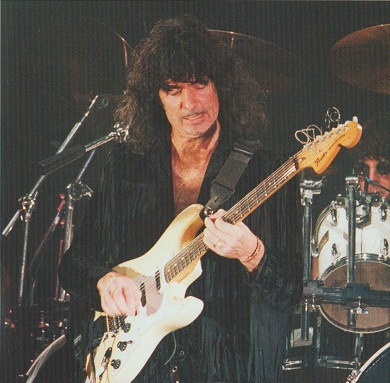
What about Ritchie?  Brilliant as ever, and even though he is notorious for…not enjoying…being filmed, it doesn’t seem to inhibit his performance here.  Extended solo sections sound like joy.  Perhaps having his true love on stage with him, Candice Night on backing vocals, soothed the savage Man in Black.  Regardless he sounds as flawlessly and quintessentially “Ritchie Blackmore” as ever.  There’s only one.

Live albums from obscure, buried periods like this often yield solid hardened gems.  “Hunting Humans” and “Ariel” are better live than they were on album.  Things are looser and livelier.  “Wolf to the Moon” has guitar and keyboard interplay that takes it further than it went on album.

The most intriguing track is the Dio-era classic “Temple of the King”.  As Doogie tells it, when the band were recording in America, they’d often pop out for a drink.  Sometimes they’d play music in bars and “Temple of the King” came from those times.

Given that there is so much bloody live Rainbow out there (with another brand new live album just announced!), Black Masquerade can understandably go fairly low on your want lists.  If you see it though, don’t hesitate.

4/5 stars

REVIEW: Star Wars: The Last Jedi soundtrack (2017) [spoilers]

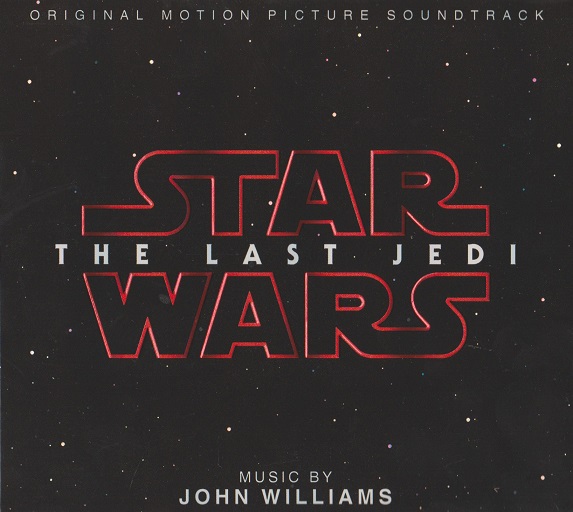
STAR WARS: The Last Jedi original motion picture soundtrack (2017 Lucasfilm/Disney)

Rejoice, dear soundtrack fans, for John Williams is slated to compose the music for the final Star Wars saga film, Episode IX.  It will be a fitting close for the saga, because Williams will have done all nine films.  Star Wars is about the saga.  The anthology films are extraneous to the core Skywalker story.  Episode VIII, The Last Jedi, is mostly about two Skywalkers:  Luke, and his nephew Ben Solo, inheritor of the mighty Skywalker blood.  The film score revisits many classic cues related to the main characters.  Even Darth Vader’s shadow still looms, musically and spiritually.

The Last Jedi spends much time revisiting classic musical cues, such as “The Asteroid Field” from The Empire Strikes Back.  One of the best revisits is of more recent vintage.  It’s also very different.  “Rey’s Theme”, from The Force Awakens, stands atop the mountain in company with the best of the best Star Wars music.  Hearing it again in The Last Jedi is a ready reminder that Williams has the magic.  Rey is the hero of this particular trilogy, and in The Last Jedi she proved herself.  It’s all up to her, now.

One of the biggest and most delightful surprises was the return of Yoda.  Yoda’s theme recurs within “The Sacred Jedi Texts”.  The beloved Jedi Master brought hope to the film, and his music lifts the soul.  The Last Jedi, however, is a dark film and much of the music matches.  It could be argued that The Last Jedi is the darkest film of the whole saga, even more so than Revenge of the Sith.  “Revisiting Snoke” reflects the dark, while tension-filled pieces like “A New Alliance” keep you riveted to your seat.  There are some fantastic percussion beats in the latter.

The military-style marching of “The Battle of Crait” recalls classic Star Wars action, and the music for the Luke scene is stunningly emotional.  In fact, the music for any of Luke’s screen appearances gives goosebumps.  John Williams’ score is, in many ways, more successful than the movie at hitting home.  I think this soundtrack release will receive more home play with the average buyer than the overlong movie.

There are two minor critiques to be addressed.  One is when Leia’s theme is dropped into the end credits for the touching Carrie Fisher tribute.  Yes, it’s heartbreakingly appropriate, but the music doesn’t fit well.  It comes across as a cut and paste job without enough transition.  A second is in regards to the Canto Bight casino music.  On many Star Wars soundtracks, Williams has a chance to go outside the box.  “Cantina Band”, “Lapti Nek”, “Yub Nub” and the music by Maz Kanata’s castle band are prime examples.  The steel drumming in “Canto Bight” sounds a bit too much like a retread of the original “Cantina Band”, but with more…samba.

John Williams did it again, but will we ever see a proper 2 CD edition with all the music?  That would be nice.

4.5/5 stars

REVIEW: Queen – On Air (6 CD box set)

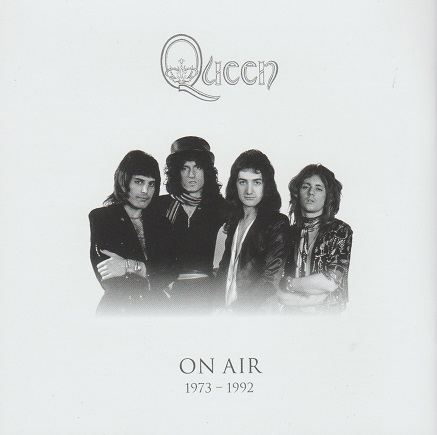
QUEEN – On Air – The Radio Collection (2016 BBC 6 CD box set)

Go big or go home.  Why buy the 2 CD version of Queen On Air when you can go for the 6 CD smorgasbord?  If you love Queen, it is the only way to do it.  Having said that, if you only “like” Queen and wouldn’t give your own blood to buy a box set, then the simple 2 disc standard edition will probably suffice.  The first two discs in this set are the same as the standard edition.  Everything else is a bonus.

The contents of the first two discs are The Complete BBC Sessions, 24 songs in total plus some disc jockey chit chat.  Because these tracks come from multiple BBC appearances, some songs are played more than once, such as “Keep Yourself Alive”, “Modern Times Rock ‘n’ Roll” and the epic “Liar”.  Most of the recordings are from the very early 70s — 1973 and 1974.  Queen were a rough and ready beast back then, but these versions are really not too far off from the original album tracks.  Because it’s the BBC, the recordings and fidelity are excellent.  This is a treasure trove of early Queen, all the best tracks, captured perfectly.  Any fan of the first three Queen albums will be more than satisfied with these discs.  Then, there’s a gap.  After the Sheer Heart Attack (1974) era, there is nothing until 1977’s News of the World.  That album is represented by four of the best tracks:  the fast and guitar-heavy version of “We Will Rock You”, plus “It’s Late”, “My Melancholy Blues”, and “Spread Your Wings”.

According to the liner notes, even though they were a new band, Queen were afforded unusual leeway at the BBC.  Everyone knew they were talented and capable, and so when Freddie Mercury demanded very high standards and everything just so, he was accommodated.  The pay off is that these recordings are stunningly good, and rival the official album versions for quality.  Apparently the BBC sessions were heavily bootlegged, and you will understand why.

Disc 3 contains portions of three concerts.  Shame it’s not the full shows.  I’m sure those will come one day.  In the meantime, enjoy this CD.  You will hear highlights from concerts in 1973, 1981 and 1986, again recorded by the BBC.  This makes for a diverse listen, including guitar solos and covers.  The 1981 recording from Sao Paulo, Brazil is the weakest in terms of sound, but still perfectly listenable.  The 1986 material from Germany is fabulous.  Freddie dropped an “F” bomb in “Under Pressure” as he was being recorded for radio!

This might be where most listeners have to check out.  The final three CDs are interviews with all four members of Queen — 210 minutes of interviews.  Did you know Freddie Mercury could speak Japanese?  Full concerts would be better than interviews, but here they are.  Also among the interviews is a chat with producer Roy Thomas Baker.  The interviews range from 1976 to 1992 and the tribute concert.  Queen never reveal too much, but the timeline of interviews provides a lot of detail surrounding Queen’s most celebrated albums.

The problem with the interviews isn’t so much the quality, but a matter of “when am I going to listen to all this” and “how often”.  The music is the meat of it.  This box set can be found affordably, so be aware of what’s inside and don’t pay too much.

3.5/5 stars


REVIEW: Big Wreck – In Loving Memory Of… (20th Anniversary edition)

BIG WRECK – In Loving Memory Of… (Originally 1997, 2017 Linus Entertainment anniversary edition)

“You need to get into some new bands, man,” said my buddy T-Rev.

Trevor had a point.  Most of my collection was rooted in the 70s and 80s.  New bands weren’t appealing to me, one or two excepted.  But I did hear this new band on the radio (Q107) called Big Wreck that I didn’t mind.  “Like a bluesy Soundgarden with a hint of Rush” said the DJ.  Their first single “The Oaf” was pretty awesome.

“I found a new band I liked,” I told Trevor.  “Big Wreck.”

“Hahaha, oh man.  You found a new band and they suck!” he retorted.  Trevor was really into Brit-pop and probably hoped I would have discovered the Bluetones or Supergrass.  Alas, it wasn’t to be this time.  I bought the Big Wreck album In Loving Memory Of…, and I liked it enough to get the 20th Anniversary Special Edition two decades later.

Big Wreck were a little bit of a throwback.  Their use of blues was different from the post-grunge bands they were competing with, and that’s what initially appealed to me.  And yes, Ian Thornley could be compared to Chris Cornell in terms of singing power.

The album boasted a number of immediate standouts.  “The Oaf” was the tough introduction, but “That Song” followed it with something immediately accessible.  “Look What I Found” takes a trip to the levee, emulating a Zeppelin stomp through the production of 1997.

There’s a balance of heavy/light here, that skews too much on the light side.  Fortunately the two CD bonus tracks put the scales back on the heavy side.  The only real weakness to In Loving Memory Of… is a reliance on slow songs within the bulk of the album.  Some of the quiet songs are incredible.  “Under the Lighthouse” (a single in Canada only) has atmosphere out the wazoo.  Echoes of heartbreak are smeared through “Blown Wide Open”, another single.

If I had to put my money on it, I’d say “Under the Lighthouse” is the best song on the disc, ballad or not.

In Loving Memory Of… is most enjoyable when jaunting through bluesy rock guitars.  The musicianship is always exceptional.  “How Would You Know”,  “Fall Through the Cracks”, “Overemphasising” and “Between You and I” are comfortably in rocky framework, with outstanding lead work.  The album does run a bit long, though.  In 1997, the full length value of a CD was being utilised more than today, now that bands realise less is often more.  The original 13 tracks ran an hour long, which is probably 15 minutes too long.

Yet the two additional bonus tracks are excellent.  Both speed along at a good clip.  The bright “Ill Advice” is more upbeat than most of the album, save “That Song”.  “Still Holding” has punch.  The album would have been stronger for their inclusion if they had been there all along, despite its length!

Fixin’ for a shot of 90s nostalgia?  The Big Wreck anniversary edition might be what you needed.  The band are playing the whole album in sequence on their current tour, so you may as well become re-acquainted.

3.5/5 stars


REVIEW: Mike Slayen – DUDE: A Guitar CD (2018)

MIKE SLAYEN – DUDE: A Guitar CD – 12 Notes & the Truth (2018 Mike Slayen)

San Diego’s Mike Slayen crowdfunded his latest album, titled DUDE: A Guitar CD.  I think Mike was born with the perfect name; after all, he’s just slayin’ it on this album.

The format is laid back acoustic instrumentals.  Upon first track “Chill”, you’ll be hooked immediately.  Slayen’s writing on DUDE is consistently memorable.   The arrangements have just enough meat — bass, drums/percussion and occasional keys back up the main guitar melodies.  The key element to each song is the lead melody.  Similar to fellows like Joe Satriani, Mike writes catchy guitar melodies to take the focus.  Each track is memorable for that reason.

The musicianship and recording is immaculate.  The warm atmosphere is inviting for return listens.  DUDE is a perfect CD for chilling and relaxing and it’ll work particularly well on the porch during summer.  Mike explores different tempos, and demonstrates an intimate knowledge of the acoustic guitar with his intricate picking.  Yes intricate at times, but never anything less than enjoyable.  DUDE is a guitar CD but not necessarily for guitarists.  DUDE is just a good CD to have for folks who enjoy relaxing and memorable music.

Check out songs such as “The Secret”, “Ice Cream” and “Chill” for a taste of what Mike Slayen does on DUDE.  There are exotic and latin influences along the way, and enough variety to make the CD an easy one to listen through.  There is even one fairly heavy piece — heavy for acoustic anyway — which is the title track “Dude”.

Go to MikeSlayen.com and check out DUDE.  Discerning fans of instrumental guitar music are unlikely to be disappointed.

4/5 stars

Full disclosure:  I first “met” Mike Slayen as a reader on this site.  I believe that this review is impartial and I would have given DUDE the same score even if I didn’t know Mike.

REVIEW: Queen – Flash Gordon (with 1991 and 2011 bonus tracks)

Flash Gordon – Original Soundtrack Music by QUEEN (Originally 1980, 1991 and 2011 Hollywood CDs)

When mom and dad rented the movie Flash Gordon, we sat and watched it as a family.  “It’s terrible,” a family friend told us.  There were only so many movies available to rent at the local store (Steve’s TV), just one small wall of VHS and Betamax.  Flash Gordon came home with us one weekend, and because we tried to make the most of our movie rentals (including the VCR, also a rental) we watched it twice.

I have not seen Flash Gordon since that childhood weekend.  It really was awful.  Maybe we hoped for more because Max Von Sydow was in it.  Neither Sydow, nor Brian Blessed, nor a young Timothy Dalton could save Flash Gordon.

Flash Gordon, New York Jets

Queen also could not save the movie, though their soundtrack is certainly one of the best things to come of it.  (Another is the movie Ted, basically a love letter to the original Flash Gordon).   All four Queen members wrote music for the film, and recorded it as a band.  Brian May wrote the lion’s share of material, though Freddie Mercury was responsible for “Vultan’s Theme”, later ripped off for an Atari video game called Vanguard.  I wonder if Freddie ever saw a dime from that?  I knew Freddie’s song from the video game by heart, long before I ever heard the album by Queen!

The soundtrack gave us one Queen hit single, “Flash’s Theme” written by May.  The 2011 double CD has a single version, and a live cut from Montreal in ’81 (also on Queen Rock Montreal), as bonuses to the album track.  “Flash’s Theme” is sparse but catchy, featuring movie dialogue that makes it seem like the film should be much better.  Queen’s bombast was ideal for this.  When Roger Taylor sings the highest notes in the chorus, it’s sheer musical delight.

The album plays like a soundtrack, with lots of atmospheric keyboard instrumentals and movie dialogue.  Because of its ambient nature, you might not at first recognise some tracks as Queen.  Some is similar to the ambient work that closed their last album, Made in Heaven.  The music is far more grand than its onscreen imagery.

One of the most memorable instrumentals is “Football Fight”, a Mercury synth workout.  Perhaps sometimes we forget what a great keyboardist Mercury was, simply because he was such an amazing vocalist.  “Football Fight” is super fun, and you can also get it in a piano-based demo version on the 2011 CD.  Check out a Queen-tastic version of Wagner’s famous “Wedding March” performed by May on guitar.  Finally there is the rock track “The Hero”, a riffy song with full vocals by Freddie.  It reprises some prior themes from the soundtrack, such as “Vultan’s”.  Queen is augmented by an orchestra on “The Hero”, which is as grand as you would expect.  Like “Flash”, you can also get “The Hero” on disc two in live form, in Montreal 1981.

A long forgotten bonus track for this album was released on the 1991 Hollywood Records CD.  A remix by somebody called “Mista Lawnge” starts off well enough, with a grinding beat synched to May’s guitar.  It goes downhill when somebody starts rapping, “Flash, one time!  Flash, two times!”  Note to all remixers:  Never, ever add random rappers to rock songs.  Don’t.

Rest assured, no matter which version of Flash Gordon you pick up, there are some definite musts on the album.  Much of it will only appeal to fans of soundtracks.  If that sounds like you, take a ride with Flash to planet Mongo and get down with some Queen.  Skip the movie!

4/5 stars

#629 / REVIEW: Oasis – The Red and The Blue

GETTING MORE TALE #629:  The Red and The Blue

It was the second of April, 1973. EMI released two Beatles compilations simultaneously, the “greatest hits” to end all greatest hits. They were double albums, split up by era. Hence the titles 1962-1966, and 1967-1970.  Nobody refers to them as such.  Due to their packaging, fans simply call them the Red and the Blue albums.

This story is not about those albums.

Of course, some cheeky bootlegger used a similar gimmick when compiling up all of Oasis’ B-sides and non-album tracks back in the late 1990s.  The earliest rarities were lumped together on The Red Album 93-94.  Everything beyond was on The Blue Album 94-96.  The CDs had matching artwork and back covers that boasted “A complete and global anthology of non-album tracks”.  And for the period, that seems to be generally true!

When I first got into Oasis, they already had plenty of singles and B-sides out there.  Collecting them all was an intimidating prospect.  Oasis singles were always chock loaded with quality unreleased songs.  Unlike most artists, Oasis’ Noel Gallagher insisted that their B-sides were as good as album tracks.  And they were — often better.   My Record Store cohort T-Rev had a complete collection of singles, but was still missing a few other rare songs.  While at a record show, we found the Oasis Red and Blue CDs.  At $30 a pop they were still cheaper than trying to collect all the Oasis singles, with the added bonus of the songs T-Rev was missing!  They were recorded for him immediately of course.

T-Rev preferred the Creation Records singles, which were the UK printings.  My bootlegs were interesting to him, but not something he would spend money on.  When I moved into his apartment for a few months in ’98, he could listen to my bootlegs whenever he wanted to anyway.  He knew I was fussy about the handling of my music, and he was as well, so we could easily trust each other with our collections.  It was a very easy situation because we both had total respect for each other’s music.

The two songs he didn’t have (yet) were only available in two official capacities.  “Sad Song” was exclusive to the vinyl and Japanese versions of Definitely Maybe.  Similarly, “Bonehead’s Bank Holiday” was exclusive to the same formats of (What’s the Story) Morning Glory.  Neither of us had heard these songs before.  What a joy to find that they were as extraordinary as the rest of Oasis’ B-sides.

Several other rarities couldn’t  have been found just by collecting the regular Oasis CD singles.  A demo of “Cigarettes and Alcohol” came from somewhere else, likely a compilation.  The second version of “Fade Away” on the Blue Album with Noel singing was from a Warchild charity CD.  A demo of “Some Might Say”, and the Beatles cover “You’ve Got to Hide Your Love Away” (lead vocals by Noel) were only on Japanese CD singles.  These songs have since been reissued on official Oasis releases, but at the time, the value they added to these bootlegs was immense.

Still, a bootleg is never as good as an original.  Sound is a problem on a couple tracks.  “Up in the Sky”, “Sad Song” and “Whatever” have volume issues.  There are also cute track-listing errors.  “Round Are Way” is amusingly “corrected” to “Round Our Way”.

Oasis have done a commendable job of deluxe edition album reissues.  Their first three albums have all been given triple disc deluxe CD upgrades.  That renders the Red and the Blue bootlegs largely obsolete.  There is only one song on the Blue Album that can’t be found on one of the deluxe Oasis reissues, and that is “Fade Away”, the Warchild version.  It can, however, be found on the B-side to Oasis’ 1998 single “Don’t Go Away”.

There is some truly remarkable music on these CDs that make their occasional listening a recurring pleasure.  Even some of the primitive early material like “Alive” and “I Will Believe” have true spark.  By the time you get to the more polished side of Oasis, like “Whatever”, you’ve already been treated to a number of early Oasis classics.  Live and alternate versions of “Columbia”, “Bring it On Down”, “Up in the Sky”, and “Supersonic” represent the best of Oasis’ early material.  There is also the love-it-or-hate-it extended live workout of “I Am the Walrus”, all 8:20 of it.

The Blue Album is a consistently brilliant listen.  So many incredible single-quality originals:  “Acquiesce”, “Round Are Way”, “Step Out”, and “The Masterplan”.  Any of these could have stormed the charts as an A-side.  “Bonehead’s Bank Holiday” is decent too, though it sounds a bit of drunken fun.  There are also the terrific covers of “Cum on Feel the Noize” and “You’ve Got to Hide Your Love Away”.

At the time, circa 1997, it was easy to justify paying a combined $60 for these two albums.  T-Rev’s friend Paul “Geeza” thought they were pretty neat.  Geeza was from England, and he visited Canada in the summers.  T-Rev befriended him via the store.  When he was back in Canada, he came over to the apartment and looked over our awesome CD collections.  He was all over my Red and Blue albums.  I made sure Geeza knew how I liked to take care of my stuff.  He was respectful but teasing.

I had to go out.  When I got back, Geeza and T-Rev were gone, but a note was left behind.

It was from Geeza.  He teased that he took my Oasis CDs!

We lived in such a small place, they weren’t hard to find.  I think the Red Album was under my pillow.  The other CD took longer.  It was just in good fun.  I was probably pissed off for a minute or five, but who cares now?  I get the joke now.  Living with me must have been a little like living with Sheldon Cooper.

If a guy like Geeza, who was an absolutely madman for Oasis, was interested in the Red and Blue albums, maybe you should keep an eye open for them too.  Don’t pay $30 each, but consider adding these eye-catchers to your collection.

OASIS – The Red Album 93-94
OASIS – The Blue Album 94-96

They’d have been 5/5 stars in 1997.  In 2017…

3/5 stars

REVIEW: Max Webster – A Million Vacations (1979)

MAX WEBSTER – A Million Vacations (originally 1979, 2017 Anthem remaster)

Why are Max Webster still held in such high esteem by their devoted fanbase?  Possibly because they concocted an ideal mixture of humour and incredible playing and composition.  Much like Frank Zappa, Max Webster felt that humour does indeed belong in music.  It’s “smart kid rock” but never taking itself too seriously.  From playful musical sections to the words of lyricist Pye Dubois, Max could also be counted on to poke you in the ribs.

A Million Vacations is certainly one of their best albums, if not their absolute magnum opus, but that’s all a matter of opinion.  At this stage of the game, Max was really cooking.  The 10 songs within represent some peak level songwriting, and several are still on the radio today.  Through the airwaves, “Paradise Skies”, “Let Go the Line”, “A Million Vacations” and “Night Flights” might be speeding over Canada somewhere as you read this.

“Paradise Skies” indeed!  One of Max’s most immediate tracks is the party opener.  Total mainstream Max: catchy hooks, insane playing, and a chorus that’s ready to blast off.  Terry Watkinson’s “Charmonium” is more complex but no less catchy.  The keyboardist wrote the song and does the lead vocals as well.  Dig into those flurries of notes making up some tasty solo sections.  Losing no momentum, “Night Flights” keeps a jaunty pace.  Pye Dubois’ poem about the love of touring reminds us how important Pye was to the band.  How many bands have a touring lyricist?

Breaking the fun-loving character for just a moment, a day-dreamy “Sun Voices” has connections to the next songs, “Moon Voices” and “A Million Vacations”.  “In my chair, chaise lounge…” and how many songs can you think of with a chaise lounge in the words??  “Sun Voices” is a meditative poolside view.  Perhaps then the side-closing instrumental “Moon Voices” is the loud party, after the sun goes down?

“A Million Vacations” (written by drummer Gary McCracken and Pye Dubois) on side two is a party-ready Canadian summer anthem.  Part of being Canadian is hibernating for our cold, dark winters.  Once we have endured the freeze, and life returns with the spring thaw, it is like a celebration.  “A Million Vacations” has that feeling.  “Throwin’ out all kinds of fishing line, Friday Friday is a good time to shine.”  Yes indeed, hitting the outdoors is a Canadian weekend tradition in the summer time.

“Look Out” is an often forgotten buried gem.  The chorus is written around a catchy keyboard riff, which suddenly gives way to a conga jam.  It’s Max as only Max can do, daring but never fearing.  But side two’s centerpiece is undoubtedly the magnificent ballad “Let Go the Line”, with Watkinson back on lead vocals.  Kim Mitchell orchestrates a guitar chorus for the main instrument hook and it’s instant love.  For sheer smart pop songwriting, “Let Go the Line” is Max’s finest.  The new 2017 remaster from the recommended box set The Party really reveals a lot of nuance in the back that were hard or impossible to hear on previous CD editions.

Kim gets a little goofy with “Rascal Houdi”, an undeniable party rocker.  “I’m switching out, I’m out to lunch,” and it’s a teenage blast.  But the party finale, “Research (At Beach Resorts)” takes it to the max (pun intended).  “Line up crowds at the pavilion, Max is playing ‘Vacations'”.  It’s a beach party, and Max is “in Newport for research, to get abreast of things…”  What about Wasaga Beach on Georgian Bay?  Already taken care of, friends.  “We’ve just researched Wasaga Beach, bonfire pits at midnight.”  But what the heck are they “researching”?

“What is it that we stare at?
Is it the passports and campsite stars?
Or the monogrammed bikinis and cars?
Or maybe we just need some perspiration ’cause we’re frostbitten Canadian boys!”

There are few bands better than Max Webster, folks, and Max’s A Million Vacation is an easy album to love, so flip it over and play it again like I’m about to.

5/5 stars


#624: Christmas in Bed

I started feeling sick on the 24th. By Christmas Day it was a fully blown flu.

I’ve been running on empty. Driving back and forth from London for cancer doctor appointments, fighting to get an MRI done, Jen’s biopsy, work…the tank has been empty for two weeks. It’s no wonder I got sick. I generally don’t get the flu shot, though it is free and widely available. Last time I got it was in 2006. I got so ill that I swore I’d never get the flu shot again.

On Christmas Day, a couple people in the family made a rude comment behind my back about how I’d better be in a “better mood” by dinner. They thought I couldn’t hear. That was that. Energy = tapped. Why even keep trying. I’ve been in bed ever since. I’m writing this from bed on my laptop. I haven’t been out of bed. I haven’t felt this exhausted in many years.

There will be no Christmas update and we’ll have to see about end-of-year lists. I’m too tired.

I hope your Christmas has been germ and drama-free!

REVIEW: Bad Axe Throwing, Kitchener Ontario

BAD AXE THROWING, 700 Strasburg, Kitchener Ontario

There are few things in life as basic and satisfying as the sound of an axe striking true.  Chopping wood was one of those fun chores at the cottage, but we never got to throw an axe.  Now, I have.

Axe throwing is, simply put:  fun!  It’s fun because it’s not something you get to do every day.  It’s a physical activity, but one that all types can participate in.  Thowing axes is a casual group activity that’s about as competitive as going out bowling.  At its core though, axe throwing gives you the thrill of hurling a sharp metal object at a target.

Here’s the thing.  I’ve watched enough seasons of The Walking Dead.  I know how handy this skill would be in case a zombie apocalypse.  Hell, they virtually did an entire episode about Rick Grimes’ axe.  Should the zombies come for us all, I will have an advantage over anyone who hasn’t gone axe throwing.  When the zombies rise, I’m heading over to Canadian Tire and stuffing as many axes as I can find into my belt.

Once waivers are signed and a few basic rules are gone over, you are free to start throwing.  There are throwing cages, set up for two throwers and two targets.  Our group had an instructor who showed us the basics.  I favoured a two-handed throw.  Others chose to throw single-handed, though with less accuracy.  It’s so easy!  Once you have your form, you can really get on a roll.

After everyone had warmed up, a game began.  We were to give insulting names to the other team, and it seems the best they could come up with were “Spice Girls” and “Charlie’s Angels”.  Needless to say, I was not involved in the name selection.

I was pleased to have thrown the winning axe in game #1.  We barely lost game #2, which involved a tricky target of a small blue dot.  To keep things fun, the instructor threw in a few twists.  Bonus points were given for the best “battle cry”.

Food and alcohol are welcome, but our pizza delivery guy got lost.  The Kitchener Bad Axe Throwing location is not easy to find.  Go to the Forest Glen plaza on Strasburg Road, but then you have to drive in behind the No Thrills.  Look for the wooden Bad Axe Throwing sign.  If you have your windows down, you’ll be able to hear it before you see it — that awesome sound of wood giving way to steel.

We had our group booked for three hours, and after we finished our second game we just took turns having fun.  Fun it was!  I would do this again.  At no time did I find it dangerous, and the instructors are always right there to help.  As my visit was organised as a work event, I did not see the final cost.  Give Bad Axe a call and check out their website.  They have locations in Canada and the Unites States.  Throw an axe and have a blast.

5/5 stars