RSTs Mk II: Getting More Tale

#492: The Golden Records

golden 2

GETTING MORE TALE #492: The Golden Records

In 1977, two unique records were pressed that are literally out of this world.
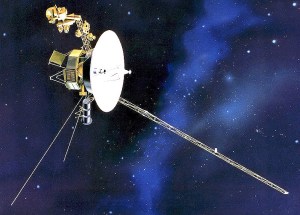
voyager 2The Voyager space probes (1 and 2) were designed for exploration of our outer solar system.  Never to return, the probes were built for the “Grand Planetary Tour”:  a rare alignment of the outer planets that allowed the probes to use gravity to slingshot around and visit them all.  The Voyager spacecraft transmitted to Earth some of the most breathtaking images ever taken.  For the first time, Saturn’s rings could be seen up close, and surprised us with more layers and complexity (including the ‘F’ ring that is kinked) than anyone anticipated.  Jupiter’s Great Red Spot was discovered to be a gargantuan storm, three Earths wide!

Although the probes were not really intended for long term scientific observations beyond their initial missions, their plutonium generators will continue to provide power for another decade.  Clever scientists have managed to use the probes’ limited sensors to observe what goes on at the edge of the solar system.  Both probes are now well on their way out of our home system, and into interstellar space.  Once their generators die, they will go silent forever.  They are now the furthest man-made objects from the Earth and will remain so forever, unless we find the money to invest further in deep space exploration.

Even when the Voyager probes finally go dark forever, their mission will still be ongoing.  Both Voyagers were equipped with special antiquated technology that can tell alien civilizations a little bit about the troubled species that launched these probes in the first place.  If an alien race ever finds our probes (the fictional Voyager 6 was found by a machine race in Star Trek I) then they will find the Golden Records.

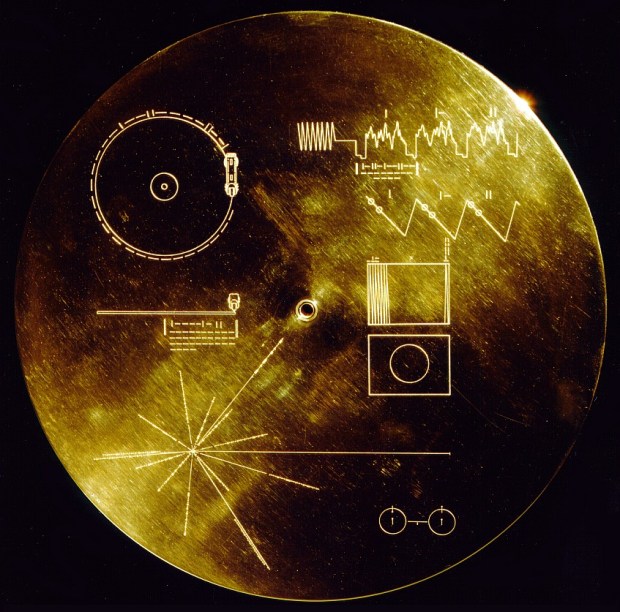
The Golden Records, surely the most priceless LPs in the universe, contain a wealth of information selected by a committee headed by the late Dr. Carl Sagan.  Each record is encased in a gold sleeve.  Included is a visual depiction of how to play the record, an easy task for an advanced race.  Extracting sound from the grooves should be a simple process given the instructions.  The needle and cartridge are already included.  The records are made copper, plated in gold, one of the most corrosion resistant materials known to man.

What is included on the records?  A variety of audio for one, designed to give a glimpse into human culture.  First is a greeting in 55 Earth languages.  Then, there are “Sounds of Earth”:  birds, dogs, frogs, cars and trains, and more.  Most interesting to music fans is the selection of compositions from around the world.  There are 90 minutes of different pieces, including Chuck Berry’s “Johnny B. Goode” (USA), Bach’s Brandenburg Concerto (Germany), jazz and blues, and many kinds of world music.   (The records are designed to be played at 16⅔ revolutions per minutes, enabling a longer play time.)  In a classic example of record company stupidity, the Beatles were excluded from the golden LPs, because EMI wouldn’t let NASA use “Here Comes the Sun”.  Perhaps they were afraid aliens would bootleg it without paying for it.  (This serves as a fine case of EMI standing for “Every Mistake Imaginable”, as some artists refer to them.)  After the music is an hour of brain wave recordings, of Carl Sagan’s wife Ann Druyan.

There are even 116 images encoded on the disc.  Some of these are intended to help with calibration and interpretation.  The rest are images of Earth:  DNA strings, children, families, landscapes, animals, houses, cities, spacecraft and more.  Tellingly, there are no images of one of human-kind’s most popular activities:  warfare.  Only good impressions were wanted, meaning the Voyager Records contain much false advertising.   The images are encoded in the form of 512 vertical lines, in colour and black and white.

What if one wanted to listen to the rarest records in the universe?  What to do then?  Last year, NASA uploaded the audio contents of the records to SoundCloud.   Now anyone on Earth with an internet connection and speakers can hear the greetings that we sent to the stars in 1977.  Hopefully one day, someone else from another world will be able to listen as well.

Click here for the NASA SoundCloud page, and scroll down for the Voyager recordings!

#491: My First Tragically Hip Experience, by Scotty G (Guest Shot)

HIP

GETTING MORE TALE #491: My First Tragically Hip Experience, by Scotty G

As fans know, Gordon Downie of the Tragically Hip was recently diagnosed with terminal brain cancer.  It is devastating news.  Downie, living his life as an artist, has decided to go out as an artist and do a farewell tour in support of the new album Man Machine Poem.  As writers, we have been trying to come up with a way to honour the man without dwelling on the negative.  With that in mind, in a multi-site event, we have several posts for you today to honour the man and the legend, Mr. Gord Downie.  Mikeladano.com’s contribution  is this guest shot by the King of Rock Knowledge, and fellow ‘Fester, Scott.  He is what I like to refer to as a “Jedi Master of rock”, the kind of man that can pass down stories and legends to the next generation.  Scotty had the chance to see The Hip back in the early, early days and…well see for yourself!  Please welcome Mr. Scotty G!


My first Hip experience was around 1988 or so, just prior to the release of Up To Here (1989). Somewhere after the Spoons and Rough Trade, and possibly prior to Sass Jordan, (I cant remember) at a Canada Day concert at Molson Park in Barrie, the Tragically Hip hit the stage.

Obviously young and lacking a whole lot of support, they carried their amps on stage themselves, placed them on chairs and started to play. I was kind of familiar with “Last American Exit” from the video, but that was it. They hit the stage and I was BLOWN AWAY. Mid-set, after really rocking one out, Gord called out to the crowd and asked if anyone had a dime? Literally, the crowd pelted the stage with change.  Gord grabbed the coin of choice and proceeded to tighten a screw in his mic stand. He thanked the crowd for the help, and they blasted into another tune.

Months later, with this show still in the forefront of my mind, Up To Here was released and with it came more opportunities to see the Hip in many small venues. One in particular, the Highlands in Cambridge*, always offered up good opportunities to meet bands and in this case a couple of us were welcomed into the dressing room where Gord very politely obliged our fan talk.  Joint after joint flew from Johnny Fay’s expert rolling fingers. Although it’s a long time ago, I have a good memory of it. I have to add that I am still amazed that he gave us the time of day, and seemed cool with having two 17 or 18-year-olds sitting in the dressing room asking silly questions while the band got stoned….

I got to see the Hip many times after that, and look back on those early performances with fondness. I never saw them live after the Road Apples tour, but will always recall the welcome that Gord and the band gave two young fans after a great show in Cambridge. He is a cool shit….

SCOTTY G

* I saw the London Quireboys at Highlands in Cambridge in December 1990 

#490: Sh*t LeBrain’s Mom Says

Thanks for joining me this week, for the week of Getting MORE Getting More Tale. I hope you enjoyed all five musical stories!

Monday – #486:  Dream Music
Tuesday – #487: All Apolologies
Wednesday – #488: Almost Cut My Hair
Thursday – #489: I Forgot To Remember To Forget
Friday – #490: Shit LeBrain’s Mom Says

CHEESE

I love my mom.  I have the best mom in the world!  That’s why I want to share these memorable mom quotes.  Let’s hear it for my mom!

1. One day we were at the cottage playing cards.  Someone cut a stinky fart.  My sister demanded to know who the cuplrit was.  “Who cut the cheese??” she asked.

“What cheese?” answered my mom.


2. Remember “More Than Words”? Extreme really broke into the mainstream with the standard-setting acoustic ballad. This is the one, more than any other acoustic ballad, that conjures the most images. My mom liked the song. She asked my sister and I who sang it.

“Extreme!” we answered simultaneously.

“Who’s Nick Streen?” she asked back.

3. My mom and dad just got back from a cruise. They excitedly told me about the different activities I would enjoy. Rock climbing, bumper cars, and lobster every night if I wanted it. “And they have special shows,” added my mom. “Like Rock of Ages.”

Doing my best to exaggerate the degree to which I was offended by this suggestion, I slowly turned my head to stare, and removed my glasses raising the eyebrows just so.

My mom caught my drift, but not why.

“Do you not know what Rock of Ages is?”

I answered matter-of-factly, “Yes I do, that’s not my point!”

“But it’s about rock!” clarified my mom.

My mother-in-law, who was also visiting at the time, knew what I was getting at.

“Your son is a music snob,” she said.  She turned towards me and quickly amended, “Or a music aficionado if you prefer.”  I smiled at her and laughed.   That was it exactly.


Thanks for being such a good sport mom!  Glad you enjoyed the trip.

#489: I Forgot To Remember To Forget

meme

GETTING MORE TALE #489: I Forgot To Remember To Forget

Here are five short stories about forgetfulness in the old Record Store Days!

1. The Boss Man lived his life via one of those day timer books. Everything was in there – all his contacts, all his notes, where he had to be, when he had to be there, everything. So it was quite difficult for him when he left the book on top of his car and drove off! Needless to say he had to buy a new day timer and start over.

2. In my last year, I totally forgot I was working a morning shift. It was during the Christmas rush, and we had two people opening:  me and one other guy. Since my reputation was that I showed up at least an hour early for an opening shift, my absence was noted before we actually opened. My co-worker Kam called me. “Did you forget you were opening today? You’re usually here by now.” Quickly covering for myself, I answered “Nah I was just doing some banking, I’ll be there really soon.” Saying this as I pulled on my pants trying to get out the door….

3. Ah, daylight savings time. Spring forward, and fall back! One day the Boss Man called me from our store in Waterloo.  Keep in mind, I always got to work early except for that one time!

“Mike, have you heard from [“Bully” – name redacted]?” She’s not here at the store yet.”

I answered him no, but that she’s not usually in that early in the morning anyway, and not to worry. She’d surely be in before opening.

“But she’s late!  I had to open the store!”

But she wasn’t late, and the store wasn’t supposed to be open. The clocks had turned back, but the boss forgot to change his. The boss got there early without realizing it and opened the store early anyway! We had a good laugh over this misunderstanding.

4. They had me running all over the place. I drove all the way to open a store in Oakville, Ontario one morning, only to discover I forgot the key to that store at home. Thankfully the boss man wasn’t far away and within 20 minutes he was there to open the door for me! Crisis averted again!

5. Once, and only once, somebody forgot to lock the door at closing time. I opened the next morning and was shocked to find the door unlocked. Obviously nobody had tried the door during the night or the alarms would have gone off. That was scary! My dad always taught me to lock up the doors when you leave a place. In fact there were times – many times – on my drive home when I couldn’t clearly remember locking the door, so routine had closing become. So I would drive back and check. I never left the door unlocked, but I also never would have been able to sleep at night if I didn’t go back to check!


#488: Almost Cut My Hair

GETTING MORE TALE #488: Almost Cut My Hair

Whatever musical subculture you come from, if it has a uniform, then no doubt hair style is a part of that uniform.

Nowhere has this been exemplified better than the classic mohawk made famous by 1970’s punk rockers.  Mr. T made it mainstream in the 80’s, rendering the punk shock value of it dead.  On to the next thing!  How about a a 1″ hole in your earlobe to keep it edgy?  Hair cuts and music have a much longer association than that, of course.  The Beatles were considered rough and shaggy for their hair that COVERED THEIR EARS!  Can you imagine?  On the other side of the pond, Elvis was popularizing the greaser look.  All over the world, kids tried to look like these rebellious rabble-rousers.

The late Eric Carr, who served as Kiss’ drummer from 1982 until his passing in 1991, told stories of how he desperately tried to straighten his hair to look like a Beatle.  He’d put pantyhose on his head overnight to try and get the curls out.  Meanwhile, there are photos of young Gene Simmons with bangs down to his eyebrows and Paul Stanley with hair covering his ears.  (Paul had a second motivation — one of his ears is deformed and he was eager to hide it.)

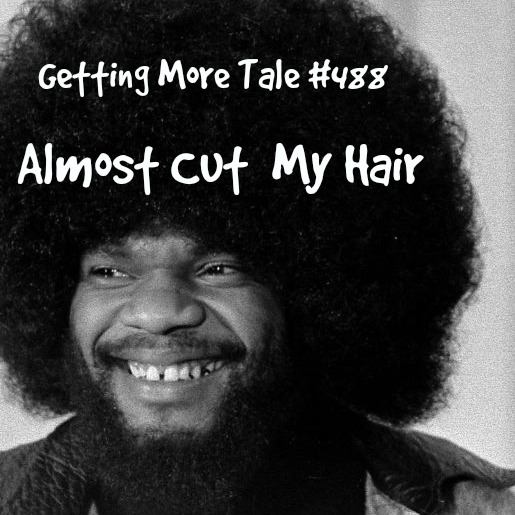
In America, another hairstyle was emerging, and it was strongly related to the funk, r&b and disco scenes:  the Afro.  It is the only hairstyle I am aware of that is probably measured in diameter, not length.  In the 1960’s, the Afro was associated with the ripple effect emanating from the civil rights movement.  Today it is a classic hairstyle, immediately adding strength and character to almost any face that it frames.  The Afro is a beautiful thing, truly.

Billy Preston "the Fifth Beatle"

Billy Preston “the Fifth Beatle”

Almost as beautiful are the dreadlocks.  In many cultures, dreadlocks are sacred.  The association of dreadlocks with modern music is due to the emergence of Reggae.  Rastafari (part of the Abrahamic family of religions) emerged in Jamaica in the 1930’s.  Who in the whole genre of Reggae was more famous than Bob Marley?  Marley was Rastafari, and as his musical fame grew, so did his locks.  As far as pop culture is concerned, Marley is an icon, and the silhouette of his dreadlocked head is known all over the world.

I think somebody must have just invented hairspray at the beginning of the 1980’s.  That’s the best explanation that I can provide for what happened next.  Everybody lost their mind, and instead of measuring their hair in length or even diameter, they began to measure it in height.  It also began to take on bizarre shapes.  Like the wings of Mike Score, from the obvious example A Flock of Seagulls.  Cultures clashed.  Culture Club, a New Wave band, featured a cross dressing lead singer with braided hair!  It was glam meets Rasta in all the wrong ways.  Boy George today is happily bald.  Meanwhile, across the pond in suburban New Jersey, Jon Bon Jovi was attempting to break the 12″ height record.

The hairstyle closest to my heart is the one most associated with rock music:  the classic long-hair.  It’s the perfect hair in almost every way.  You can tie it back for the “I mean business” look, or just to keep it out of the way.  When you need to unleash the rock fury, long hair is superior.  The best part is, after a good solid thrash around, long hair usually looks better than it did before!  Only dreadlocks can rival classic long hair for headbanging money-shot images.

I never liked getting haircuts in the first place, but when I started getting interested in music in the early 80’s, it seemed as good a reason as any to stop getting them.  Besides, one kid at school named Ian used to chide me that I “didn’t look like a rocker” with my lame short hair.  I wanted so bad to look cool like a rocker.  Sure, there were some cool short haired rockers, like Rick Neilson, Alex Van Halen and Alec John Such, but they were a vast, sometimes teased, minority.  My hair started to grow down past my neck.  This caused clashes with my dad like you would not believe.  You thought Darren McGavin made for some foul language in A Christmas Story?  My dad can eat Darren McGavin for breakfast and ask for seconds.  My dad invented many of his own swears.  He even started singing in swears!  One of his biggest hit songs with us kids was always “Shittily, Shittily, La La La”.  And that is exactly how the lyrics went.  Over and over!  One day, he was singing “Shittily, Shittily, La La La” in public again.  He must have been overheard, because the next thing that happened was a Jehovah’s Witness approached him.  She handed him a Watchtower magazine, and told him, “I think you really need this.”  But I digress.  You can imagine how the hair battles in our house ended.  Usually with us not speaking to each other for the next three days.

Eric Brittingham

Eric Brittingham

That’s not due to my dad, mind you.  It’s due to me being a stubborn little shit.  To be fair, I learned the “stop speaking to your parents” schtick from my best friend Bob who frequently stopped speaking to his mother.  Bob too was attempting to grow long hair.  His goal at that time was to be a redhead version of Eric Brittingham from Cinderella during the Long Cold Winter era.  He thought that would have looked awesome.  It probably would have, but eventually he had to get a job and cut it.  He went with a classic crew cut, and a little bit of a fringe on the back:  the mullet.  This is what I ended up with as well, because instead of growing over my ears, my hair simply began curling and going back up again!  My dad hated this but more importantly, wanted me to be employable.  One day he came home to tell me that the manager of the nearby grocery store wanted to speak with me about a job opportunity.  This I was not going to be stubborn about, so I went to the barber, cut it all off, and went in for a brief interview.  I started that week.

The teasing at school was inevitable.  Most of those kids had never seen me without some form of attempted mullet.  The drastic sudden change also made my ears look (in my eyes) freaking huge.  To me, I looked like another kid in our school named “Trophy”.  Trophy was called that because his ears stuck out so far they made his head look like a big trophy.  I was hideous!  I was Samson without his locks.  I had nothing.  I attempted to grow a moustache.  This was abandoned in less than a week when a girl at the grocery store that I liked named Kathleen recommended that I lose the ‘stache.  It was hopeless.  I felt…naked.

When grunge hit the ground running in the early 90’s, rockers one by one began to shed their locks.  Many ladies of the 80’s fainted when Jon Bon Jovi went short in 1993 for Keep the Faith.  Three years later, some thrash acolytes nearly had heart failure when not one, not two, not three, but all four members of Metallica included James Fucking Hetfield cut their hair short!  The game was over.  While many rockers such as Ozzy, Alice, and Nikki elected to keep their hair, they were overshadowed by the folks who let it go:  David Lee Roth, Edward Van Halen, Tommy Lee, Paul Stanley (notably for Phantom of the Opera), pretty much all of Aerosmith except for Tyler and Perry….There were no magazine headlines that said “Alice Cooper Keeps His Hair Long”.  But there were headlines to the effect of “The World is Ending — Jon Bon Has Cut His Curls!”

As rockers age, so do our styles.  I thought Jon Lord looked very distinguished, with his silvery hair in a ponytail when he got older.  Some of us have cut our hair, some of us have lost our hair.  Some of us dye it and some of us shave it.  In this day and age, it is very difficult to tell one’s musical affiliation by hairstyle alone.  You can have long hair and be a DJ spinning samples on a laptop.  A guy shredding lead electric guitar is just as likely to have short hair as long.  Over there, that metal band has a bunch of people with dreadlocks, and that rap group does too!  Mohawk with dreadlocks?  Hello Doug Pinnick from King’s X!  Sub-cultures continue to clash in ways both new and retro, and as with any style, music will always have a part in it.

1993, return of the long hair.


#487: All Apologies

GETTING MORE TALE #487: All Apologies

People screw up!  It’s in our nature as human beings.

The human brain has its own “autocorrect”.   Have you ever seen something like this?

The quick brown fox jumped over the
the lazy dog.

Or this?

I cdn’uolt blveiee taht I cluod aulaclty uesdnatnrd waht I was rdanieg.

See how you read both sentences easily regardless of the mistakes within?  The brain makes little corrections to our perceptions on a second by second basis.  Think about the human eye, how it darts around, but what you perceive is a clear static picture.

Given that the human brain makes its own “corrections” every second of every day, it’s bound to also make mistakes in doing so, either by missing a correction, or making one where it wasn’t necessary.  Either way – we fuck up!  Add in a fast-paced environment, and mistakes are not a question of if, but when and how many.

In customer service, a screw up can be a critical moment.  Mistakes can make or break the decision for a customer coming back or not.  Whether you ring in something wrong, give the customer the wrong item, mis-charge a credit card, or give the customer incorrect information, sometimes you owe them an apology.  So why not turn lemons into lemonade?

Since money speaks louder than words, the owner at the Record Store had a cool method of keeping the customer, even after a screw up that might have them fuming.  It was actually a genius idea.  We used something we called “apology letters”.

Let’s say we screwed something up, unambiguously.  The best example of this would be forgetting to put the CD in the case, or putting the wrong disc inside.  This was a lot easier to screw up than you might assume.  Maybe the CD was supposed to be in slot #132, but you grabbed the disc in #123.  Sometimes you don’t even notice it’s the wrong CD because after a while, they do all look the same.  I had myself convinced that I was actually dyslexic.  That’s how bad it got on some days.

Sometimes you’d catch the mistake before the customer left, and all would be well.  The rest of the time, there was a chance they’d be pissed off that they had to make a return trip to get the right CD.  Returning something that is defective doesn’t count towards an apology letter; that’s not necessarily down to staff mistakes.  An apology letter was only issued when it was clear that we screwed up and in doing so, inconvenienced the customer.  We didn’t use them to blame staff, or tally up numbers of them, but damn, I sure issued plenty over the years.

When a mistake such as this was discovered, we would prepare an apology letter.  Staff would sign the letter and give it to the customer with their apologies, and the correct CD!  The letter entitled the customer to $3 off their next purchase.  We discovered that this small token often defused situations quickly and easily.  Very few customers refused to return after receiving an apology letter worth $3.  Many in fact were impressed to the point that we started seeing them more often.

It was a smart idea:  one of many that I learned during my years in retail.
SORRY

#486: Dream Music

Welcome to another theme week at mikeladano.com. This week: Getting MORE Getting More Tale. Instead of reviews, we have lined up five days of music stories in the Getting More Tale series. Hope you enjoy.


dream music

Have you ever heard music in your dreams?

Steve Vai has.  When he was a young musician, he experimented with lucid dreaming.  When you’re in a lucid dream, you can control your own actions.  Vai’s lucid dreams were very sexual, and musical.  Eventually his album Passion & Warfare emerged from these experiences.  The opening track “Liberty” is directly inspired by one of his dreams where he was standing saluting a flag (“a different kind of flag,” said Steve).  His song “Liberty” was meant to approximate what he heard in the dream, but what he was able to write versus what he actually heard in his head were very different.  He was unable to capture the fullness and grandeur of his dream.

Terence Trent D’Arby too has heard music in his dreams.  In his case, Marvin Gaye approached him in a dream, and asked if he’d be interested in a song Gaye had written.  Perhaps as an expression of his own ego, D’Arby answered, “If I like it.”  He must have, because D’Arby recorded the song as “To Know Someone Deeply is to Know Someone Softly” on 1989’s Neither Fish Nor Flesh.  Much like Vai, D’Arby found it impossible to translate the beauty of his dream music accurately into the real world.

As for me?  I’m no musician; I wish I was.  Maybe if I was, I could do something with the music constantly cruising around in my unconscious LeBrain!*

I don’t know why it is, but music does exist in dreams, and vividly so.  Bringing that music into the auditory realm is so damn hard no matter how hard you try to remember.  I like to write songs – little riffs and melodies that fit together into ditties that I can hum, but not really perform on an instrument.  Some of the music I have heard in my dreams would have been the best songs in the world, had they been real!

It’s impossible to describe anything specifically, except to say the music I heard in my dreams was heavy, symphonic, grand and complex.  If I wanted to, I could focus in on any specific part.  I could dive into the strings and hear the individual parts.   I could even manipulate the music once immersed.  As if I was playing the guitar myself, I could make the guitar solo go any way I wanted it to.  I could control the music like I was a conductor.   The only thing I couldn’t do was remember it when I woke up.

I’d wake up, and even though I could remember dreaming of an amazing piece of music, I couldn’t get it out of my head and onto tape or paper.  I could hum a melody or two, but nothing more.  The grandness and power was all gone.  Who knows if the melody I was humming was even anything like what I heard.  Either way, the melodies I would hum after would be tiny snippets, special in no way at all.

It’s a rare, bizarre, beautiful, frustrating experience.  Has this ever happened to you?


*Thanks to Mr. Books for perfecting that sentence for me.

#485: Cry for the Indians

GETTING MORE TALE #485: Cry for the Indians

We rarely get political here at LeBrain’s Record Store Tales and Reviews.  We try to keep the discussions light.  The topics are mostly focused on music, tech, retail and work place stories.  With that in mind, here’s a good work place tale from 2006.

Without getting into the nitty gritty details, back in 2006, a group of Six Nations on a reserve near Caledonia held an armed standoff over Aboriginal land claims.  In question was a 40 hectare parcel of land that was being prepared for development into subdivisions.  They occupied a large patch of land and wouldn’t budge, stating that historically they never gave up this land.  There is a very complex history as to the ownership of land in Caledonia, going back to 1784.  The police arrested occupiers, and in return the Six Nations set up roadblocks.  This went on for weeks, highlighted by violence and anger on both sides.  Local radio covered all the news, which made national headlines.   It was an ugly scene all around, but also a very serious issue that remains unresolved today (the last blockade happened in 2014).

During the months this was going down in 2006, I was working in a small data entry office with two ladies a little older than myself.  The radio was tuned to the local news.  During an update on the situation, one of the two ladies blurted out, quite offensively, “Why don’t those Indians just pack up and go home and stop causing trouble?  I’m sick of them!  I don’t even understand what they want!”  She ranted for a bit and then things went quiet.  The other lady didn’t answer, so I chimed in.

“They’re arguing for their rights to use their traditional lands,” I explained.

“What land?!” she answered incredulously.

“In Caledonia, but really this was all their land,” I informed her.  “When the Europeans like us came to this country, we pushed them off their land and took it for ourselves.  Now all they have left are these little crummy reservations.  But they were here first.”

Her response was something I’ll never forget:

“What?!  I never heard of that!”


Come again?  Did you somehow miss grades 1 through 12?  Canada often prides itself in our great education system.  There’s proof right there that it certainly has its flaws.  Highschool is free, people!  I had to explain this to a lady who was old enough to know where all the white people in North America came from.  I had to convince her this was real history and not a “theory”.  She didn’t have to like these facts, but how can you go through life without even knowing them?

And that is the story of one of the most ignorant comments I’ve ever heard inside or outside the work place.  In the words of Anthrax:

We all see black and white,
When it comes to someone else’s fight,
No one ever gets involved,
Apathy can never solve.

Forced out – brave and mighty,
Stolen land – they can’t fight it,
Hold on – to pride and tradition,
Even though they know how much their lives are really missin’,
We’re dissin’ them.
On reservations,
A hopeless situation.

Cry for the Indians,
Die for the Indians,
Cry for the Indians,
Cry, cry, cry for the Indians.

Respect is something that you earn,
Our Indian brothers’ getting burned,
Original American,
Turned into second class citizen.

Love the land and fellow man,
Peace is what we strive to have,
Some folks have none of this,
Hatred and prejudice.

Territory –  It’s just the body of the nation,
The people that inhabit it make its configuration.
Prejudice – Something we all can do without,
Cause a flag of many colors is what this land’s all about.

#484: Top Five Road Trip Movie Singalongs

HAROLD AND KUMAR

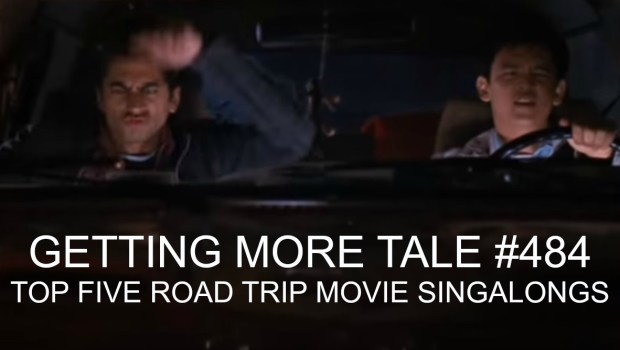
Sometimes-contributor Thussy and I came up with a list of our Top Five Favourite Road Trip Movie Singalongs!  The five songs below are forever associated with these films in my mind.  Like any other list, I’m sure you’ll have plenty that we forgot.  These are some of our favourites.  What are yours?


#5: Harold and Kumar Go to White Castle – “Hold On”

Once our heroes Harold and Kumar finally best the Extreme Sports Assholes, they not only steal their ride but also their “Extreme Mix Vol. 5” tape! Kumar and Roldie then enjoy a hearty singalong to Wilson Phillips’ “Hold On”.  So extreme!


#4: Dumb & Dumber – “Mockingbird”

“Radio?  Haha!  Who needs a radio!  Ready Harry?”


#3: Planes, Trains and Automobiles – “Three Coins in the Fountain”, “Meet the Flintstones”

Double whammy with this classic movie!  Steve Martin attempts to get a bus full of people to sing the 1954 theme song from the romance film Three Coins in the Fountain, with no success.  Much to his chagrin, John Candy’s irritating (though lovable) character Del Griffith got plenty of response to his “Meet the Flintstones”.


#2:
 The Hangover – “Three Best Friends Song”

The Hangover featured two great original songs:  “Doug” performed on piano by Ed Helms, and “Three Best Friends” sung by Zach Galifianakis. “Three Best Friends” gets the nod, because the other took place in a hotel room.  Come on, sing along folks…


#1:  Wayne’s World – “Bohemian Rhapsody”

Technically not a road movie, but they did make a trip from Aurora to Milwaukee in the film.  This iconic scene had to be #1.  There really were no other competitors.  We’re not worthy!


#483: The Wreck of the Edmund Fitzgerald

GETTING MORE TALE #483: The Wreck of the Edmund Fitzgerald

The legend lives on from the Chippewa on down,
Of the big lake they call gichi-gumi.
The lake, it is said, never gives up her dead,
When the skies of November turn gloomy.
With a load of iron ore twenty-six thousand tons more,
Than the Edmund Fitzgerald weighed empty,
That good ship and crew was a bone to be chewed.
When the gales of November came early.

Living in Southern Ontario, we have easy access to three of the five Great Lakes. Many children spent time holidaying on Huron, Erie or Ontario. In school we learned to memorize the names of the Great Lakes with the acronym “HOMES”: Huron, Ontario, Michigan, Erie and Superior. The Ojibwe called Superior “gichi-gami” meaning “big sea”. When I was a kid we spent our summers at the cottage in Kincardine. Kincardine is located on the eastern shore of Lake Huron, or as my dad used to call it when I was a toddler, “big water”. Some things are universal.

We are surrounded by nautical activity, from the great locks at Welland canal, to the legendary shipwrecks on the Great Lakes.   Just a few kilometers south of Kincardine is Boiler Beach, so named because a few meters from the shore sits the boiler from an old steamer that exploded in 1883.  The Erie Belle was a tug boat sent to rescue another ship that had blown aground after missing Kincardine harbour and attempting to turn around.  It could not budge the freighter, and the Erie Belle’s boiler exploded when the engine overheated and seized.   The piece of history is still sitting there partly due to the cold fresh waters of Huron.  You can see it clearly even from the road.  If that kind of sight doesn’t instil in a kid an interest in nautical Great Lakes history, nothing will.  And then there are glass-bottom boats that do tours, and in clear waters to view shipwrecks.

We also weathered quite a few storms that rolled in off the lake, taking down hydro poles and trees.  All you can do is sit tight and wait it out.  We always kept several oil lamps at the cottage, ready to go, and we had to use them annually.  It was easy to see how a even a huge ship could come to harm in such a storm.

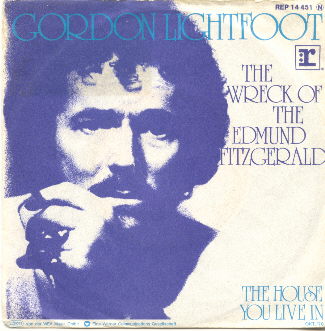
Today, thanks to Gordon Lightfoot’s musical immortalization, the wreck of the freighter SS Edmund Fitzgerald is the most famous Great Lakes shipwreck of all time.

EDMUND

The huge freighter was hauling iron from Duluth, Minnesota to steel mills in Detroit, Michigan.  Its final destination of the season was the port of Cleveland. It was late in the year 1975, and the big ship had to traverse the entire length of Superior, the deepest and most northerly lake.  From there, to the locks at Sault Ste. Marie, and then south down the entire length of Huron.  The Edmund Fitzgerald was a sturdy ship, launched in 1958 as the largest on the lakes.  She broke speed records, and then broke her own records.  She was a favourite to crowds because of the charismatic “DJ Captain”, Captain Peter Pulcer.  He enjoyed piping music in the loudspeakers, and entertaining crowds on the St. Clair and Detroit rivers with tales of the big ship.  But it was Captain Ernest M. McSorley who was command that fateful night in November.

There was a storm on the radar, but the weather service predicted it would proceed harmlessly south of Lake Superior.  The Edmund Fitzgerald departed on November 9, but by 7 pm that night, the weather reports suddenly changed.  The storm was crossing the lake, and they sounded the warning for gale-force winds.  Pounded by 60 mph winds and 10 foot waves, the Edmund Fitzgerald headed north for shelter.

When suppertime came, the old cook came on deck,
Saying, “Fellas, it’s too rough to feed ya.”
At seven PM it grew dark, it was then,
He said, “Fellas, it’s been good to know ya.”
The captain wired in he had water comin’ in,
And the good ship and crew was in peril.
And later that night when her lights went out of sight,
Came the wreck of the Edmund Fitzgerald.

Gordon Lightfoot was fascinated by the story and wrote the famous song around the disaster. His storytelling ability made it legendary, never to be forgotten.  It went to #1 on every relevant chart in Canada, and has been covered by artists as diverse as the Dandy Warhols and the Rhoestatics.  And in honour of the 29 men who died on that ship, he has revised his old lyrics. Formerly the words went, “At seven PM a main hatchway caved in.” However this implies the hatchway was not secured properly, and investigations showed that there was no crew error in the disaster. With respect to history, Lightfoot changed the line to “At seven PM it grew dark, it was then…”

Lake Huron rolls, Superior sings,
In the rooms of her ice-water mansion.
Old Michigan steams like a young man’s dreams,
The islands and bays are for sportsmen.
And farther below, Lake Ontario,
Takes in what Lake Erie can send her.
And the iron boats go as the mariners all know,
With the gales of November remembered.

The Edmund Fitzgerald lies at the bottom today, 15 miles from the aptly named  Deadman’s Cove, Ontario.  It is now a protected site, but there are no conclusive answers to what happened in her final moments.  The way Lightfoot worded it was appropriately vague: “And later that night when her lights went out of sight, Came the wreck of the Edmund Fitzgerald.”  What is more important today, rather than the cause of the wreck, is the fact that the 29 people lost at sea are now immortal.  Gordon Lightfoot ensured that.

In a rustic old hall in Detroit they prayed,
In the Maritime Sailors’ Cathedral,
The church bell chimed ’til it rang twenty-nine times,
For each man on the Edmund Fitzgerald.