“Recently, a young journalist asked me how many songs I had written in my life. I replied that the last time my assistant counted, twenty years ago, it was over 500. I felt quite accomplished until she pointed out Dolly Parton’s 5,000 songs, calling me a lazy sod.” – Ian Gillan
DEEP PURPLE – “Lazy Sod” (2024 Ear Music)
Since Deep Purple’s =1 album was my #1 album of 2024, it should be no surprise that I love the single “Lazy Sod”. It exemplifies what Simon McBride brings to Deep Purple on this new album. His smooth playing is loaded with feel and perhaps he adds just a tad more hooky riffiness into the band. “Lazy Sod” is a fantastic track, a shorty at 3:40, even loaded with solos by Simon and Don Airey. No fat, just like those old Deep Purple Machine Head firecrackers from the early 70s.
Back when we reviewed the =1 box set, we speculated why a live version of “Highway Star” with Simon McBride wasn’t included. Same with “Lazy”. Here they are. “Highway Star” (Milan, October 17 2022) is pretty damn energetic and features the Simon stuff that we were waiting for. His sound might be likened as somewhere between Steve Morse and Ritchie Blackmore, but what he brings to the table fits perfectly, without copying either.
“Lazy” (Sofia, May 23 2022) is the lengthy one, at 8:33. Don Airey opens it with some meandering organ soloing, before playing some more familiar notes. Then it’s Simon’s turn, sending out a delightfully original solo for “Lazy”. He throws it back to Don like a game of ball, and Don slays it some more. “Fun” doesn’t begin to sum it up. There are old Deep Purple versions of “Lazy” where it does not sound like they are having fun. This does, for Don and Simon in particular. The rest of the band have to be able to feed off that. Ian Gillan doesn’t enter the picture for over five minutes. He turns in a performance more like a lounge singer, but with some screams towards the end.
Another great single from the Purples. Thanks for keeping the format alive. It’s limited to 2000 copies but hopefully that’s enough for the collectors who want it.
Jen is still as beautiful as they day we met. As we both age, she has retained her youth better than I. I am grateful to have her. She had a wonderful birthday dinner at Golf’s Steakhouse in Kitchener.
She had the prime rib, medium rare. I had the salmon. The soup was vegetable puree. We both had salad bar, and I added some garlic shrimp to my order.
Kitchener Ontario’s Max the Axe has several studio albums and EPs, plus a “best of”, but never before have they released a live album. Until now!
Recorded in 2006, 2017, and 2018, the album features a spread of Max classics new and old, including favourites like “Scales of Justice” and “Gods On the Radio”. Each song features Eric “Uncle Meat” Litwiller on vocals.
“But Mike,” you ask. “I thought Meat joined the band later than 2006.”
True. While we won’t get into details, if you consider Kiss Alive to be a great album, then you should have no problem with Live In Ontario!
The first six tracks come from a 2006 recording called Heads or Tails, recorded in Etobicoke Ontario. The lineup includes Litwiller, Mike “Max the Axe” Koutis on guitar, Tom Cole on bass, and Jeff Slauenwhite on drums. These tracks are heavy on bottom end. The guitars are pure sludge. Opener “Blood Runs Red” sounds great with Meat singing; a fantastic vocal performance. The familiar “River Grand” follows, and once again the vocals stand out, with Eric adding twists that aren’t on the album versions.
“Labyrinth” has distortion and groove. Max wrings some cool sounds from his axe on this frantic, messy, punky classic. It’s very shambolic, definitely with a punk rock appeal. Back to a more metallic sound on “Immortal” (subtitled “I Feel the Sun”). The vocals are more tentative here, as the song was less familiar when recorded.
“Mexican Standoff” opens with the traditional Mexican sounding guitar lick, and then it’s off to the races with Meat in peak voice. This version lacks the shouted backing vocals, but is cool nonetheless. Max throws some wah-wah on during a noisy interlude. One more song from this gig is the Metallica-like “Space Marine”. It is great to finally have versions of these older songs with Meat singing, tentative as some are.
Onto the next batch of songs from 2016 at “The Farm” in Woodstock Ontario. This was the very first gig with the new (and definitive) lineup: Mike Mitchell on bass and Dr. Dave Haslam on drums. Having never played live before, and with a batch of brand new songs, the gig sounds much as you would expect. It’s energetic and engaged, but good as the songs would come to be, they are not there yet. The set features a number of compositions that would later appear on the Status Electric album, plus “I Don’t Advocate Drugs”, the first version available with Eric on vocals. He cranks it up a couple notches.
A very cool band intro leads into “The Other Side”, a very embryonic version. The parts are all there, but it’s not tight yet. “Loose” is a good word to describe this live album in general. There’s also an extended guitar solo. From there, Eric asks the audience if anyone out there owns a snake? Which means, of course, that “Scales of Justice” is up next. It’s not as crunchy as the album. If anything, maybe it’s a bit more Zeppy. Yet those vocal hooks are there, and Meat is in peak voice. This track needed some work before it was album worthy, but it is fun to hear these early versions, flaws and all.
“This is a song about gambling,” explains Eric. This means the “Next Plane to Vegas” is about to land. It barely hangs together, but it’s over in a flash. Finally, “Gods On the Radio” closes the set with Max’s best song. Again, it’s not quite what it would become on album yet, but the bones are there and the vocal hooks are 100% intact. It doesn’t have the drive of the album version and unfortunately the drums are hard to hear. The guitar solos also haven’t evolved yet.
Finally, “Randy” from 2018 was recorded on a cell phone by your’s truly. While a limited run of one (1) single picture disc was made, this is its first CD release, and in much better sound quality. In terms of performance, this is by far the best track. All the songs were by now well rehearsed by the band, as the album had been completed. The difference between this and the Farm tracks is clear.
It is a shame the whole 2018 Boathouse set was not recorded. That said, you do the best with what you got. In this case we have a 2006 recording of an early band lineup, with the older songs. Then you have the 2017 recording of the definitive lineup, but with songs that they were still honing. So it’s not a perfect situation, but it’s history recorded. Something to remind us that albums don’t come fully formed. They must be worked on diligently, and if anything, Live In Ontario! makes us appreciate Status Electric that much more.
“Randy” on the other hand could be the best version of that song, period.
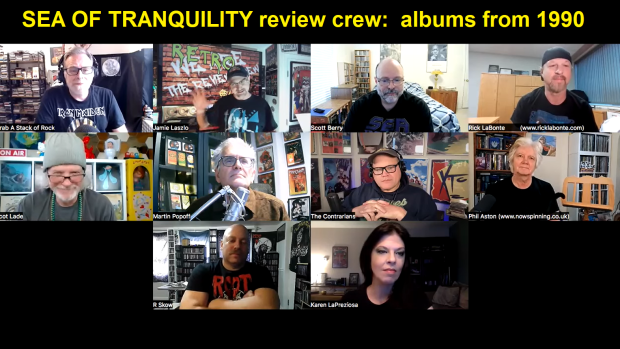
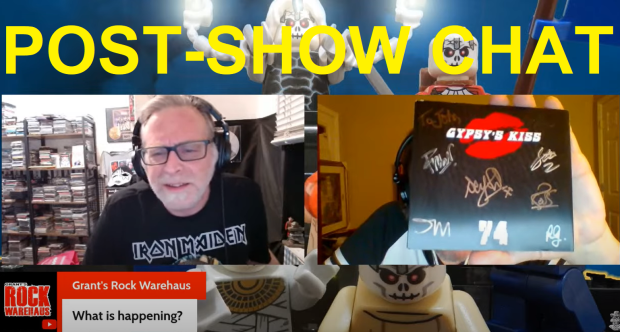
The best of 2024 in rock and pop was on showcase this week on Grab A Stack of Rock. Tim Durling, Harrison Kopp and special surprise guest Uncle Meat brought their Top Fives and runners-up in this fun and action packed show.
What did you miss? Well, shirtless Jex for one. That one even scared off Peter Kerr, but did result in some pretty hilarious comments.
The comments section was lively, and if you want to catch Johnny Metal’s Top Five of 2024, his were in the comments section which I put on screen. Meanwhile, there was some minimal repetition, and actually less than I expected. Mr. Big, Deep Purple, Jon Anderson and Bruce Dickinson were among the artists who scored two hits on tonight’s lists. There was plenty of love for other artists’ new albums such of Opeth, Paul Di’Anno, Blaze Bayley (of course) and Arkells.
We also took a look at three books that I enjoyed in 2024 – two of them by Mr. Durling!
A fun, passionate and laugh-filled 90 minutes of music appreciation awaits you below.
See you December 31 at 9:00 PM EST for a drop in New Years Eve party!
GRAB A STACK OF ROCK With Mike and the Mad Metal Man Episode 82: Ranked: Top Five Albums of 2024 with Harrison and Tim Durling
2024 was another fantastic year in music. From new music from legacy bands, to great reissues and live albums, to new music by newer bands, we saw it and heard it all in 2024.
What were your Top Five Albums of 2024? Leave them in the comments, or drop them in the live chat tonight, as Harrison, Tim and I talk Top Five Albums of 2024. I am always personally limited by what I was able to buy and what I had to miss in a given year. For example, last year I didn’t get Blame My Ex by the Beaches in time to make my list. This year, unfortunately Blaze Bayley didn’t make it into my inventory in time, nor did the new live Ghost. However, they may appear on other lists.
Join Tim, Harrison and myself tonight live at 7:00 PM EST to take part in the fun. Spirits will be high, and I may be drinking alcohol. We’ll just have to see what happens! Remember to let us know your own Top Five in the comments section.
Let the fun begin!
Friday December 20 at 7:00 P.M. E.S.T. / 8:00 P.M. Atlantic. Enjoy on YouTube or onFacebook!
In 1995, the writing was on the wall. After struggling for years as a new CD/tape store, the boss discovered a goldmine: selling used CDs. The story has been told a dozen times or more, but the short version is this. In early 1994, the boss brought a small tray of used CDs into the store, priced them, and they sold out immediately. I think the discs came from his own collection with a few from his brother. He realized that he could buy used CDs from the public for a few bucks, and then flip them for double or triple the price. The hunger days ended soon after.
Profit margins on new CDs and tapes was slim. After you factor in shipping, overhead, paying the part-timers, and an expensive magnetic security system, the boss was left with little for himself, if nothing at all. He could not survive like that forever. With used CDs, he could control his own costs. This was something rare in retail. Costs are usually determined by your supplier. You could negotiate for better rates, but it was nothing compared to used CDs. We could pay five or six bucks for a CD, and sell it for ten or twelve bucks.
You know what happened next. Expansion! Waterloo opened, followed by a second store in Kitchener. These stores had 90% used stock, with a small chart for new releases. They didn’t carry cassette tapes, at all. While this surprised me, it was a smart move. We were ahead of the curve by not carrying cassettes in those stores. We didn’t even carry used tapes. For one, it was harder to check them for quality compared to CDs. For second, it simplified things greatly by only focusing on discs. One product, one display system, one storage system. You could take the disc out of the case, hide it behind the counter, and put the empty case on the shelf. The security system was replaced in this simple way.
Eventually the original Stanley Park Mall store had to close. Rent in malls is higher than that in plazas. It was the only store that still carried a full selection of new CDs and tapes. It closed at the end of 1995, right after Christmas. And we weren’t allowed to tell people we were closing. Technically, it was a move. A new location had been procured in Cambridge. It too was to follow the 90% used model. Although we called it a move for the purpose of good optics, the reality was that one store closed and another very different store opened in another city. The manager was the same, and they took the unsold stock and sold it as used, but it was a new store.
Closing Stanley Park put us in an awkward position. In 1995, we lived in what was essentially a two format world: CDs first and foremost, with cassettes still strong, but dying off bit by bit every year. More and more releases were coming out on CD only. Vinyl? In 1994, only Pearl Jam had a mainstream vinyl release. We carried Vitalogy on vinyl. It was beautiful. The boss opened a copy to look at it. He ended up selling that one to his brother. But what about that awkward position? Here we were, going into the Christmas season and selling gift certificates to a small but significant number of people who still only had cassettes players. We were selling gift certificates to people who were not going to be able to redeem them for cassettes except for a small window: the six days following Christmas. Many of those people had been customers for five years, since we opened.
“If someone complains about it, tell them to talk to me, I’ll take care of it.” The boss was not the kind of person who relished giving people their money back, but I am sure he handled those cases as best he could. We did special order cassettes for customers for a short period of time in some of these cases; they were isolated cases. We had some cassettes returned in the new year as well, which had to be dealt with.
I do remember some angry customers. “Where am I gonna buy my tapes now?” asked one guy who was unhappy, to say the least, that we were closing up, moving to a new location, and ceasing cassettes completely. I suggested the HMV store at the other mall, but even they were noticeably cutting back.
For me, it was interesting to have lived through these changes in formats. As a fan, I watched vinyl decline in importance to the point where nobody in highschool bought records anymore. That was 1986. Then I lived through the advent of CD, and its eventual replacement of the cassette. I was working in the front lines at the Beat Goes On when Napster came along, and I saw shelf space once reserved for CDs now showcasing bobbleheads.
I wouldn’t trade it for the world. All apologies to the inconvenienced!
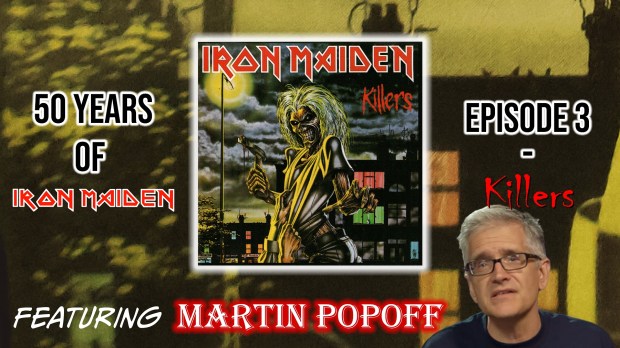
Today’s challenge comes again from the mind of Martin Popoff. Pick two bands – and swap their album covers! For example, Martin went with Uriah Heep and XTC. I chose two bands that are a little more similar. This was by far the most challenging list to date. We could do one way swaps, or two way swaps – I chose two ways, all the way. I like a challenge. It seemed do-able, so I went for it.
For those keeping track, this is my tenth week in a row on the Contrarians. The subjects thus far have been:
Tune in tonight and comment! Martin always tries to address the comment section.
THE CONTRARIANS – They Swapped Covers! – Wed. December 18 – 7:00 PM EST
Sad Wings of Destiny for Cross Purposes
Fairly obvious – the wings of the angel works for Sad Wings, and the angel on Sad Wings is holding the Judas Priest cross.
Black Sabbath for Angel of Retribution
The haunting woman on the Sabbath cover could be our “angel of retribution”. Meanwhile, if that Priest angel had been on an album called Black Sabbath, I sure would think my doom was at hand. His cross gesture with his arms works with the religious connotations of the word “Sabbath”.
Never Say Die for Hell Bent For Leather
The pilots outfits must have leather in them. Meanwhile, the mask/face/helmet concept on Leather evokes a Never Say Die attitude.
Jugulator for Dehumanizer
Two robotic characters, who cares which is which? The robotic reaper could be a Jugulator, and the Jugulator could be a Dehumanizer. Who knows!
Paranoid for Stained Class
The sword in the head sure works for Paranoid! Meanwhile, the sword guy is abstract enough that it could go with Stained Class just as well as a chrome head.
Technical Ecstasy for Turbo
Look at the turbo cover and tell me that’s not some technical ecstasy. Meanwhile, the robots on the Sabbath cover could be turbo charged in a very 1970s way.
Hero Hero for Tyr
The barbarian on Hero Hero can surely represent The Battle of Tyr, from the Tyr album. He’s not a Viking, but close enough for heavy metal, right? Meanwhile the Tyr cover is astract enough to be called Hero Hero, I guess.
Heaven and Hell for Point of Entry
Point of Entry – the sky is heaven, and that eternal strip of printer paper surely is hell! Meanwhile, the angels are smoking – their point of entry to bad behaviour!
Forbidden for Ram It Down
The reaper on the cover of Forbidden needs to ram all those ghosts back down that hole! Meanwhile, the fist pounding the Earth just screams the word FORBIDDEN to me!
Born Again for Redeemer of Souls
I’m really really stretching it here. That baby definitely needs its soul redeemed. And that redeemer of souls…if he’s redeeming souls, doesn’t that make them Born Again?
DENNIS DeYOUNG – Back to the World (1986 A&M, 2013 BGO reissue)
Though his solo debut Desert Moon was a moderate hit, Dennis DeYoung took no time off and was back with a second album two years later. Still using Tom Dziallo on guitar, Dennis also added C.J. Vanston on keyboards. With Dennis being an acclaimed keyboardist himself, was this too much of the instrument? Once again, DeYoung wrote everything himself, with no cover tunes this time.
Opening the album is the theme from The Karate Kid II, “This Is the Time”. Fortunately the song is a lot better than the film. With emphasis on saxophone and keyboards, this is a pleasant, anthemic light rock theme. With some exposure, it could have been a minor hit, but fortune was not with Dennis this time. The track only made it to #93, while the album peaked at #108.
“Warning Shot” has a bombastic Styx-like opening, though with less emphasis on guitar. Dennis’ singing here is top notch, employing a lovely falsetto when necessary. When the chorus hits, it feels like this is the Dennis we have been waiting for. A spectacular guitar solo brings it into a classic rock realm, but really “Warning Shot” is all chorus. A host of backing singers join in and the song launches into the stratosphere. It should have been a single.
The biggest hit, the ballad “Call Me”, was the single, which hit #5 on the Adult Contemporary charts, where no Styx fans were likely to hear it. It has some nice saxophone textures, but it’s unremarkable and will always live in the shadow of Dennis’ better known ballads. It’s just too light. “Unanswered Prayers” is better, with some lyrical guitar work in the intro and solo. This slow number feels like a nice one for a slow dance, but the album needs a jolt of energy and this isn’t it.
Opening side two, “Black Wall” is darker and harder edged. It’s a slow burner with focus returning to the guitar. It is not exactly the energy injection we need, but at least it is a change of direction. The “Black Wall” in the title refers to the Vietnam Veterans Memorial, in Washington D.C. The powerful music is suitably dramatic and deliberate, with the soulful backing vocalists dominating the chorus.
A bluesy harmonica solo introduces “Southbound Ryan”…but the electronic tom tom drums just jar you when they come in. Fortunately once that’s out of the way, we’re onto one of the best tracks on the album and the shot of energy we so desperately needed. A smoking horn section blasts forth, and the tempo is finally hot! That horn section is like the jelly in a PB&J! So sweet, so good, just the perfect punch for a song that deserved it.
Fortunately, the tempos and horns remain on the next song, “I’ll Get Lucky”. We’re definitely in the 80s now, with more keyboards and programming at the forefront. Notably, C.J. Vanston contributed a rocking instrumental section in the middle. The song is a bit jerky, going from dense sections to sparse ones, and it feels bumpy compared to the prior one. Would it have been better had Dennis just played it simple instead of trying to get so clever with the production? Once again, Dennis produced the album himself.
The final song, “Person to Person” has a Styx-like vocal and might have worked on one of the later albums. It’s a little too savvy for a pop record, which is a good thing. Had Styx done it, hopefully it would have less synth and corny toms, but it was 1986 and that was the sound to have. At least Dennis closed the album on an uptempo note, and a song with a memorable chorus.
Had Dennis employed an outside producer, perhaps his first two studio albums would be more even. Back to the World and Desert Moon share this problem. Both albums sag in spots, and despite some awesome songs throughout, there are not enough of them.
DENNIS DeYOUNG – Desert Moon (1984 A&M, 2013 BGO reissue)
Alas for me in ’83, Styx were coming very close to an end. Tommy Shaw didn’t want to sing songs about robots (or something) but what it really came down to was Dennis DeYoung’s vision vs. his. Dennis was the theatrical one, and Tommy was the rocker. That’s putting it in simplistic terms, but by the end of the tour, Tommy was out. The other three members of Styx wanted to replace him and carry on, but Dennis was not interested. In 1984, Styx issued their live album Caught in the Act, and said goodbye. Less than six months later, Dennis DeYoung was out of the gates with his debut solo album.
Desert Moon demonstrated that Dennis was full of new ideas. He wrote seven of the eight songs, with a Hendrix cover in the mix, and no co-writers. Not that Dennis needed co-writers before, but he did often share credits on early Styx tracks with his bandmates. Guitars on Desert Moon were handled by Tom Dziallo, who also programmed drums when necessary. Dennis takes care of all keyboard duties, augmented by saxophone on some tracks.
I can distinctly remember watching MuchMusic in 1984, when a new Dennis DeYoung video came on, called “Desert Moon”. It was a top 10 hit, and a ballad. I was quite clear in my youth that I did not like Styx for their ballads. I dismissed Dennis as a solo artist immediately. I am sure he was broken-hearted that a 12 year old Canadian kid didn’t like his new direction.
I should not have dismissed Dennis so easily. If I had bought his new album, I would have loved the opening rocker “Don’t Wait For Heroes”. It could have been a Styx song, the upbeat triumphant kind of single that they were known for pre-“Roboto”. Styx fans might have considered it a return to form for the singer. While not as guitar-heavy as the two-guitar band, it does rock, with the drums (by Tom Radtke) in particular driving the song. The melodies evoke “Don’t Let It End (Reprise)” on Kilroy Was Here, but with more edge. The end refrain of “get up, get up, get up!” should indeed make you get up.
Guitars come to the forefront on “Please”, with a riff and a chug. Then on the pre-chorus, Dennis lets the keyboards come out. “Please” is a duet with Rosemary Butler, a singer with dozens of albums on her resumé. A tasty guitar solo continues to keep things accessible to Styx fans, but the duet is really impressive. Butler goes head to head with DeYoung, and blows him away by the end with some incredible high notes.
New wave sounds inflect “Boys Will Be Boys”, which Dennis delivers with spoken-word verses. The fast beats and bouncing synth recall Devo and bands of a similar nature, not to mention that Alice Cooper ’80 sound. There is also a clear 1950s influence on the chorus, with that “dip dip dip dip dow!” The production recalls “Music Time” from the final Styx record Caught in the Act.
You don’t know that you’re listening to a Hendrix cover at first. It sounds more like a slowed down “Peter Gunn”, but then Dennis sings those lines. “You don’t care for me, I don’t care about that…” Only then do you realize you are grooving to “Fire”. Unlike every other cover of it, Dennis all but rewrites it as a slow rock groove. While “Fire” is not an album highlight (think about that a moment), it is one of the most interesting versions you’ll ever hear. It takes guts to reimagine a song like “Fire”, and it takes talent to pull it off so well.
The aforementioned title track “Desert Moon” opens side two. It was the top ten ballad, and it’s easy to hear why. It’s a slow, romantic sounding song with a resounding nostalgic chorus about summer nights, innocence and dreams. The formula worked. In the liner notes of the BGO edition CD release, Dennis credits the arrangement which emphasizes his voice, and therefore the lyrics. The guitar solo is also a thing of beauty, with one sustained note that just sings. A magnificent solo.
Dennis digs into his classic rock and broadway roots for “Suspicious”. It’s a DeYoung trademark, but in light of exceptional material preceding it, it tends to go unremembered. It might be a case of too much synth. “Gravity” uses such electronics as well, but in more upbeat setting. “I wanna climb Mt. Everest, and find my Shangri-La,” sings Dennis. The fast New Wave beats during the chorus are fun but the song struggles to find an identity, and the listener has trouble hanging on.
Desert Moon ends on “Dear Darling (I’ll Be There)”, a final ballad, and just not enough to recover the album from a dip in memorability at the end. It’s simply too much saccharine at the end of the day. Another upbeat track should have ended the album, though at least there is a fine sax solo to dig into.
Dennis suffered an injury while making a music video and never got to tour Desert Moon properly. Would it have made a difference? Unlikely. While Dennis was more than capable of delivering a good album on his own, left to his own devices, it didn’t have the consistency we were used to with Styx. Perhaps a co-producer would have made a difference, since Dennis produced this album by himself. The performances are all excellent, particularly lead vocals, but there needed to be more spark within some of the songs.