A&M Records

REVIEW: Dennis DeYoung – Back to the World (1986)

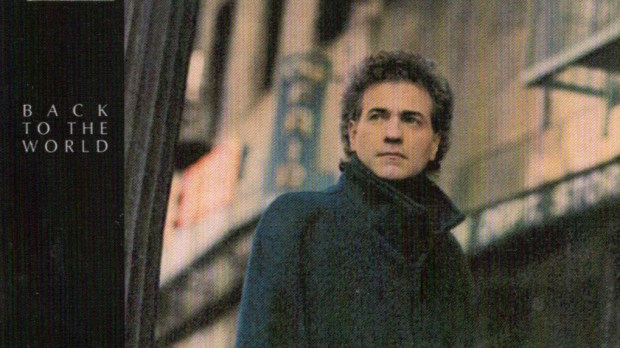
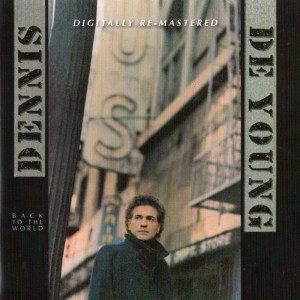
DENNIS DeYOUNG – Back to the World (1986 A&M, 2013 BGO reissue)

Though his solo debut Desert Moon was a moderate hit, Dennis DeYoung took no time off and was back with a second album two years later.  Still using Tom Dziallo on guitar, Dennis also added C.J. Vanston on keyboards.  With Dennis being an acclaimed keyboardist himself, was this too much of the instrument?  Once again, DeYoung wrote everything himself, with no cover tunes this time.

Opening the album is the theme from The Karate Kid II, “This Is the Time”.  Fortunately the song is a lot better than the film.  With emphasis on saxophone and keyboards, this is a pleasant, anthemic light rock theme.  With some exposure, it could have been a minor hit, but fortune was not with Dennis this time.  The track only made it to #93, while the album peaked at #108.

“Warning Shot” has a bombastic Styx-like opening, though with less emphasis on guitar.  Dennis’ singing here is top notch, employing a lovely falsetto when necessary.  When the chorus hits, it feels like this is the Dennis we have been waiting for.  A spectacular guitar solo brings it into a classic rock realm, but really “Warning Shot” is all chorus.  A host of backing singers join in and the song launches into the stratosphere.  It should have been a single.

The biggest hit, the ballad “Call Me”, was the single, which hit #5 on the Adult Contemporary charts, where no Styx fans were likely to hear it.  It has some nice saxophone textures, but it’s unremarkable and will always live in the shadow of Dennis’ better known ballads.  It’s just too light.  “Unanswered Prayers” is better, with some lyrical guitar work in the intro and solo.  This slow number feels like a nice one for a slow dance, but the album needs a jolt of energy and this isn’t it.

Opening side two, “Black Wall” is darker and harder edged.  It’s a slow burner with focus returning to the guitar.  It is not exactly the energy injection we need, but at least it is a change of direction.  The “Black Wall” in the title refers to the Vietnam Veterans Memorial, in Washington D.C.  The powerful music is suitably dramatic and deliberate, with the soulful backing vocalists dominating the chorus.

A bluesy harmonica solo introduces “Southbound Ryan”…but the electronic tom tom drums just jar you when they come in.  Fortunately once that’s out of the way, we’re onto one of the best tracks on the album and the shot of energy we so desperately needed.  A smoking horn section blasts forth, and the tempo is finally hot!  That horn section is like the jelly in a PB&J!  So sweet, so good, just the perfect punch for a song that deserved it.

Fortunately, the tempos and horns remain on the next song, “I’ll Get Lucky”.  We’re definitely in the 80s now, with more keyboards and programming at the forefront.  Notably, C.J. Vanston contributed a rocking instrumental section in the middle.  The song is a bit jerky, going from dense sections to sparse ones, and it feels bumpy compared to the prior one.  Would it have been better had Dennis just played it simple instead of trying to get so clever with the production?  Once again, Dennis produced the album himself.

The final song, “Person to Person” has a Styx-like vocal and might have worked on one of the later albums.  It’s a little too savvy for a pop record, which is a good thing.  Had Styx done it, hopefully it would have less synth and corny toms, but it was 1986 and that was the sound to have.  At least Dennis closed the album on an uptempo note, and a song with a memorable chorus.

Had Dennis employed an outside producer, perhaps his first two studio albums would be more even.  Back to the World and Desert Moon share this problem.  Both albums sag in spots, and despite some awesome songs throughout, there are not enough of them.

3/5 stars


REVIEW: Dennis DeYoung – Desert Moon (1984)

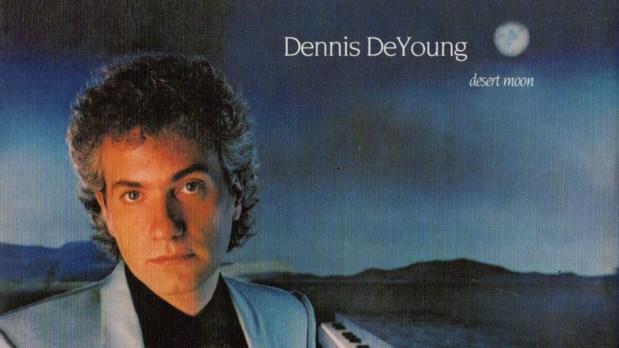
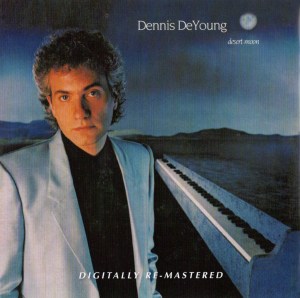
DENNIS DeYOUNG – Desert Moon (1984 A&M, 2013 BGO reissue)

Alas for me in ’83, Styx were coming very close to an end.  Tommy Shaw didn’t want to sing songs about robots (or something) but what it really came down to was Dennis DeYoung’s vision vs. his.  Dennis was the theatrical one, and Tommy was the rocker.  That’s putting it in simplistic terms, but by the end of the tour, Tommy was out.  The other three members of Styx wanted to replace him and carry on, but Dennis was not interested.  In 1984, Styx issued their live album Caught in the Act, and said goodbye.  Less than six months later, Dennis DeYoung was out of the gates with his debut solo album.

Desert Moon demonstrated that Dennis was full of new ideas.  He wrote seven of the eight songs, with a Hendrix cover in the mix, and no co-writers.  Not that Dennis needed co-writers before, but he did often share credits on early Styx tracks with his bandmates.  Guitars on Desert Moon were handled by Tom Dziallo, who also programmed drums when necessary.  Dennis takes care of all keyboard duties, augmented by saxophone on some tracks.

I can distinctly remember watching MuchMusic in 1984, when a new Dennis DeYoung video came on, called “Desert Moon”.   It was a top 10 hit, and a ballad.  I was quite clear in my youth that I did not like Styx for their ballads.  I dismissed Dennis as a solo artist immediately.  I am sure he was broken-hearted that a 12 year old Canadian kid didn’t like his new direction.

I should not have dismissed Dennis so easily.  If I had bought his new album, I would have loved the opening rocker “Don’t Wait For Heroes”.  It could have been a Styx song, the upbeat triumphant kind of single that they were known for pre-“Roboto”.  Styx fans might have considered it a return to form for the singer.  While not as guitar-heavy as the two-guitar band, it does rock, with the drums (by Tom Radtke) in particular driving the song.  The melodies evoke “Don’t Let It End (Reprise)” on Kilroy Was Here, but with more edge.  The end refrain of “get up, get up, get up!” should indeed make you get up.

Guitars come to the forefront on “Please”, with a riff and a chug.  Then on the pre-chorus, Dennis lets the keyboards come out.  “Please” is a duet with Rosemary Butler, a singer with dozens of albums on her resumé.  A tasty guitar solo continues to keep things accessible to Styx fans, but the duet is really impressive.  Butler goes head to head with DeYoung, and blows him away by the end with some incredible high notes.

New wave sounds inflect “Boys Will Be Boys”, which Dennis delivers with spoken-word verses.  The fast beats and bouncing synth recall Devo and bands of a similar nature, not to mention that Alice Cooper ’80 sound.  There is also a clear 1950s influence on the chorus, with that “dip dip dip dip dow!”  The production recalls “Music Time” from the final Styx record Caught in the Act.

You don’t know that you’re listening to a Hendrix cover at first.  It sounds more like a slowed down “Peter Gunn”, but then Dennis sings those lines.  “You don’t care for me, I don’t care about that…”  Only then do you realize you are grooving to “Fire”.  Unlike every other cover of it, Dennis all but rewrites it as a slow rock groove.  While “Fire” is not an album highlight (think about that a moment), it is one of the most interesting versions you’ll ever hear.  It takes guts to reimagine a song like “Fire”, and it takes talent to pull it off so well.

The aforementioned title track “Desert Moon” opens side two.  It was the top ten ballad, and it’s easy to hear why.  It’s a slow, romantic sounding song with a resounding nostalgic chorus about summer nights, innocence and dreams.  The formula worked.  In the liner notes of the BGO edition CD release, Dennis credits the arrangement which emphasizes his voice, and therefore the lyrics.  The guitar solo is also a thing of beauty, with one sustained note that just sings.  A magnificent solo.

Dennis digs into his classic rock and broadway roots for “Suspicious”.  It’s a DeYoung trademark, but in light of exceptional material preceding it, it tends to go unremembered.  It might be a case of too much synth.  “Gravity” uses such electronics as well, but in more upbeat setting.  “I wanna climb Mt. Everest, and find my Shangri-La,” sings Dennis.  The fast New Wave beats during the chorus are fun but the song struggles to find an identity, and the listener has trouble hanging on.

Desert Moon ends on “Dear Darling (I’ll Be There)”, a final ballad, and just not enough to recover the album from a dip in memorability at the end.  It’s simply too much saccharine at the end of the day.  Another upbeat track should have ended the album, though at least there is a fine sax solo to dig into.

Dennis suffered an injury while making a music video and never got to tour Desert Moon properly.  Would it have made a difference?  Unlikely.  While Dennis was more than capable of delivering a good album on his own, left to his own devices, it didn’t have the consistency we were used to with Styx.  Perhaps a co-producer would have made a difference, since Dennis produced this album by himself.  The performances are all excellent, particularly lead vocals, but there needed to be more spark within some of the songs.

3/5 stars

REVIEW: Keel – The Right to Rock (Remaster/bonus track)

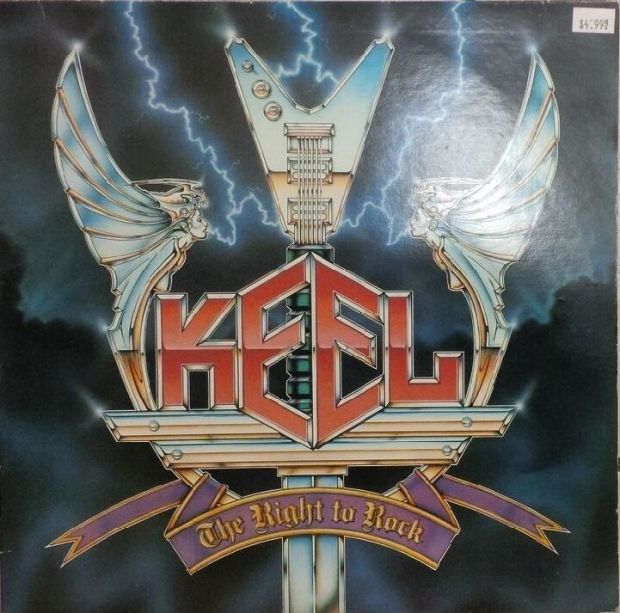
KEEL – The Right to Rock (1985, 2000 Metal Mayhem Music/bonus track)

From the Gene Simmons Song Factory, heeeeere’s Keel!

Let’s talk about the bonus track first.  Anybody could tell you that “Easier Said Than Done” was a Simmons song, just from one listen.  Surely enough, scan the liner notes, and it’s Gene and Mitch Weissman, whom fans know from 1984’s Animalize album.  Like many Gene Simmons productions, The Right to Rock bears his name on a few writing credits.  “Easier Said Than Done” is right down mid-80s Kiss alley.  What about the remix?  Structurally, it is unchanged.  The drums sound different, and on a whole the track sounds a little brighter.

That’s it for extras.  The booket is only a single fold-out, with no lyrics.  It has a note from Ron Keel, indicating that this is the first CD issue of the album outside Japan.


(The rest of this review was previously published in 2015)


The rest of the non-Simmons songs are basically reworkings of tracks from Keel’s first album Lay Down the Law. That album, like Ron Keel’s debut with Steeler (featuring one Yngwie J. Malmsteen) were on Shrapnel. For the A&M Records debut, they pulled out the big guns. They got Gene Simmons in all his wig-ness, and put out a very corny but tremendously fun music video.

It is “America 1989”, and rock and roll is outlawed. “Those who are apprehended suffer severe consequences.” Can our young teenage Keel lookalike get away from the rock police? Quiet Riot did something similar with their “The Wild and the Young” video a year later. It’s corny fun.

The song too is corny fun. I guess it’s a classic now. It has that stock heavy metal riff that you need: something Motley Crue or the Scorpions would be comfortable with. It has that rebellious rock theme that was so prominent in the 80’s. It has a shout-along chorus. “You got it! The Right to Rock!” Hey, I grew up in a Catholic school. I know what this is about. “Don’t let anyone tell you how to live your life!” I had a teacher call me out on the first day of school for wearing a Judas Priest T-shirt. I could relate to this song in a big way when I was 13.

It should be noted that Gene Simmons, as a producer, is not known for his sonics. The Right to Rock sounds pretty good for the period, but the drums ring shallow and weak. There’s not much presence for the bass guitar, and the backing vocals are the typical rock mush. That’s what you get with Gene behind the console.

“Back to the City” has a good Priest-like chug to it. I think Keel were going for something middle of the road with their music, like Priest-meets-Scorps-meets-Crue-meets-Kiss. If so, this hit the mark. Ron’s vocals are overwrought but that’s his style. If you don’t like that kind of vocal, you won’t like Keel.

Kinda stinky is “Let’s Spend the Night Together”. You know, I still gotta give the guys credit. They have made this into a pretty fine pop metal song. If you didn’t know the song, you’d assume it’s an original, in the pop metal genre. So from that perspective, I think it’s kinda cool. Stinky and cool — like good gorgonzola.

“Easier Said Than Done” was written by Simmons/Weissman, the same team responsible for much of the Animalize album. The lyrics even reference “Russian Roulette”, a song title Gene had been toying with for years. (A song called “Russian Roulette” was finally released on Sonic Boom.) So, guess who “Easier Said Than Done” sounds like? That’s right — it is a dead ringer for Simmons-style Kiss. And it’s actually a pretty good song. The problem is Ron’s Gene impression. I can’t help but chuckle at his dead-on Gene vocals. I dare you to refrain from a giggle yourself. Same deal with “So Many Girls, So Little Time”. Kiss fans will recognize that’s a line recycled from the Kiss song “Burn Bitch Burn”.

Onto side two, “Electric Love” is a Keel original, but you immediately notice that the song isn’t as immediate as the two previous Simmons tunes. “Speed Demon”, another original, sounds exactly as the title implies. Quality-wise, it’s only at “Priest outtake” level (Defenders of the Faith era). Then it’s back to Simmons outtakes, with “Get Down”, the weakest of the Simmons songs by a long shot. “You’re the Victim (I’m the Crime)” is a Gene-like title, but this too is a Keel tune. It’s in the same vein as “Speed Demon”, and the same level of quality.

It’s fun to revisit The Right To Rock periodically…but sparingly.

3/5 stars

REVIEW: Keel – The Right to Rock (1985)

IMG_20150613_084127KEEL – The Right to Rock (1985 A&M)

From the Gene Simmons Song Factory, heeeeere’s Keel!

Like many Gene Simmons productions, Keel’s The Right to Rock bears his name on a few writing credits.  The rest of the songs are basically reworkings of tracks from Keel’s first album Lay Down the Law.  That album, like Ron Keel’s debut with Steeler (featuring one Yngwie J. Malmsteen) were on Shrapnel.  For the A&M Records debut, they pulled out the big guns.  They got Gene Simmons in all his wig-ness, and put out a very corny but tremendously fun music video.

It is “America 1989”, and rock and roll is outlawed. “Those who are apprehended suffer severe consequences.”  Can our young teenage Keel lookalike get away from the rock police?  Quiet Riot did something similar with their “The Wild and the Young” video a year later. It’s corny fun.

The song too is corny fun. I guess it’s a classic now. It has that stock heavy metal riff that you need: something Motley Crue or the Scorpions would be comfortable with. It has that rebellious rock theme that was so prominent in the 80’s. It has a shoutalong chorus. “You got it! The Right to Rock!” Hey, I grew up in a Catholic school. I know what this is about. “Don’t let anyone tell you how to live your life!” I had a teacher call me out on the first day of school for wearing a Judas Priest T-shirt. I could relate to this song in a big way when I was 13.

It should be noted that Gene Simmons, as a producer, is not known for his sonics. The Right to Rock sounds pretty good for the period, but the drums ring shallow and weak. There’s not much presence for the bass guitar, and the backing vocals are the typical rock mush. That’s what you get with Gene behind the console.

“Back to the City” has a good Priest-like chug to it. I think Keel were going for something middle of the road with their music, like Priest-meets-Scorps-meets-Crue-meets-Kiss. If so, this hit the mark. Ron’s vocals are overwrought but that’s his style. If you don’t like that kind of vocal, you won’t like Keel.

Kinda stinky is “Let’s Spend the Night Together”. You know, I still gotta give the guys credit. They have made this into a pretty fine pop metal song. If you didn’t know the song, you’d assume it’s an original, in the pop metal genre. So from that perspective, I think it’s kinda cool. Stinky and cool — like good gorgonzola.

IMG_20150613_084211

“Easier Said Than Done” was written by Simmons/Weissman, the same team responsible for much of the Animalize album. The lyrics even reference “Russian Roulette”, a song title Gene had been toying with for years. (A song called “Russian Roulette” was finally release on Sonic Boom.) So, guess who “Easier Said Than Done” sounds like? That’s right — it is a dead ringer for Simmons-style Kiss. And it’s actually a pretty good song. The problem is Ron’s Gene impression. I can’t help but chuckle at his dead-on Gene vocals. I dare you to refrain from a giggle yourself. Same deal with “So Many Girls, So Little Time”. Kiss fans will recognize that’s a line recycled from the Kiss song “Burn Bitch Burn”.

Onto side two, “Electric Love” is a Keel original, but you immediately notice that the song isn’t as immediate as the two previous Simmons tunes. “Speed Demon”, another original, sounds exactly as the title implies. Quality-wise, it’s only at “Priest outtake” level (Defenders of the Faith era). Then it’s back to Simmons outtakes, with “Get Down”, the weakest of the Simmons songs by a long shot. “You’re the Victim (I’m the Crime)” is a Gene-like title, but this too is a Keel tune. It’s in the same vein as “Speed Demon”, and the same level of quality.

It’s fun to revisit The Right To Rock periodically…but sparingly.

3/5 stars