In collaboration with 1001albumsin10years…
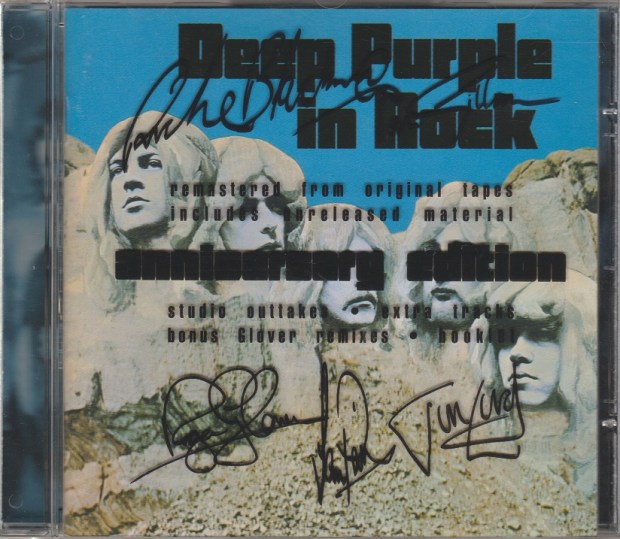
DEEP PURPLE – In Rock (1970, 1995 EMI anniversary edition)
 Deep Purple In Rock: The title speaks mountains about the music. They didn’t want there to be any question regarding what kind of band Deep Purple were. The first version of the band, Deep Purple Mk I, made three psychedelic but still clearly rock and roll albums. Wanting to rock harder, they ditched singer Rod Evans and bassist Nick Simper, and brought aboard Ian Gillan and Roger Glover. However the first album released by Deep Purple Mk II was…Concerto for Group and Orchestra? There was also a wishy-washy gospel rock single called “Hallelujah” that went nowhere. Indeed, there was some confusion in terms of public perception. In Rock was designed from the start to reaffirm.
With In Rock, producer Martin Birch commenced a long and fruitful relationship with Deep Purple. The single was a track called “Black Night” which, oddly enough, wasn’t on the album. It was a response to a record label request for a single, so the band nicked the bassline from Gershwin and wrote a simple rock track with nonsensical lyrics. It was an immediate hit. Appropriately, the original single version of “Black Night” is included on this 25th anniversary edition of In Rock.
The B-side to “Black Night” was an edited version of opening album track, “Speed King”. The full length version was even edited down for some releases of the In Rock album, except in the UK. Almost a minute of noisy instrumental freakout explosively starts the full enchilada. This leads to a calming, light Jon Lord organ, misleading you into thinking the onslaught is over. Think again.
“Speed King” is a quintessential Deep Purple track, cementing their instrumental prowess and lyrical credentials. The sheer velocity of the track alone packs a whallop, but the sonics are just as powerful. “Speed King” has a deep, gut-punching heaviness. There is also a long instrumental section, custom built for the jam-loving audiences of the era. The words are cut and pasted from classic rock and roll hits in one stream of consciousness. The best word for “Speed King” is “exhausting”. Listening through feels like you just finished a sprint. The band were trying to capture the same vibe as Jimi Hendrix’s “Fire”, but overdid it just a smidge!
And what of that new singer? Ian Gillan didn’t get to do much screaming in his previous band (with Glover), Episode Six. In Deep Purple, his unmistakable wail sets world records for pitch and volume. Without Ian Gillan, there would be no Bruce Dickinson, and therefore Iron Maiden could never have existed as we know it today. In Rock features Ian at his peak powers. Nobody can touch In Rock, not even Bruce in his prime.
“Bloodsucker” is a vintage, grinding organ-based groove. In Rock has a very bass-heavy mix, but clear and defined. This helps the low growling Hammond combine with Roger Glover’s pulsing bass to form a wave of sound. Ride that wave on “Bloodsucker”, with a cool double-tracked Gillan vocal that keeps the thing slightly off-balance. Drummer Ian Paice can never be underappreciated, and in 1970 he was one of the hardest hitters on the field. “Bloodsucker” leaves massive Yeti footprints because of that beat.
One of the most important songs in the Deep Purple canon is “Child in Time”, a 10 minute composition of light and shade that transforms as you listen. As it begins gently, Ian Gillan gets to utilize the soothing side of his voice. “Child in Time” is almost a lullaby…until it is not. Wait for the ricochet. This album is called Deep Purple In Rock after all. Not Deep Purple In Bed or Deep Purple At Church.
In 1970, this would have been the moment you get up and flip the record. To do that, you would have to peel yourself from the floor.
The second side of In Rock features lesser played tracks, but no less impressive. “Flight of the Rat” takes off amidst a Blackmore guitar rocket riff. Though fast, it is a step off the pedal from “Speed King” and with enough vocal melody to keep one hanging on. Lord and Blackmore both solo, fighting to be champion but with no clear winner. All the while, Glover and Paice keep the pulse going through the time changes. Then it is “Into the Fire”, a rarely played unsung classic that the band resurrected on tour in 2000 and 2014. Bopping heavily along, “Into the Fire” will burn if you let it. Then the drums of “Living Wreck” fade in, with a incredibly deep natural echo that you feel in the bones. The snare sound rings sharp. “Living Wreck” was actually one of the first tracks taped, and just listen to Ritchie Blackmore’s tone on the lead solo! This is truly a triumph of studio recordings.
Finally “Hard Loving Man” closes In Rock with one of the heaviest Purple riffs in their history. Deep Purple invented the heavy metal chug on “Hard Loving Man”. Meanwhile Jon Lord contributes to the sludge by hitting as many keys simultaneously as he seemingly can! What a track, and much like “Speed King” at the start, it leaves you beaten and out of breath.
No Deep Purple album has come close to In Rock for brute strength. The band and Martin Birch truly captured something special in the studio, back when that meant finding the right amp for the right instrument in the right room. It’s much like alchemy, only real. In Rock is an artifact of the way they used to do it, and evidence of why it can’t seem to be repeated. The monument on the album cover was an apt indicator of what the new Deep Purple sounded like.
The 25th anniversary edition contains a wealth of bonus material, interspersed with amusing studio chat, such as:
Jon Lord (singing): “I smashed the microphooooone.”
Martin Birch: “Are you going to hit it again?”
Jon Lord: “I don’t think so.”
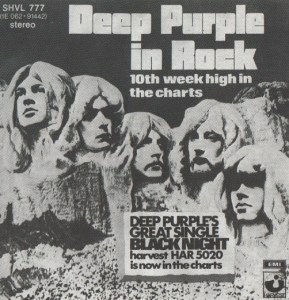 In addition to the original single “Black Night”, there is a fascinating alternate take of “Speed King”. The band were toying with a version featuring piano instead of organ, which completely changed its character. This version was recorded and accidentally released on a single instead of the proper one. Here it is as a bonus track, showing you a work in progress and what could have been.
Then we have a Roger Glover remix of “Cry Free”, one of the earliest songs recorded (30 takes total) but ultimately rejected. It was first released on the 1977 posthumous Deep Purple album Power House, one of many releases that EMI put out during the period the band were broken up. Glover oversaw remixes of many of Deep Purple’s reissues beginning here. The differences are subtle but not unnoticeable. Glover also remixed “Black Night” (more on that later), “Flight of the Rat” and “Speed King” (including intro) for these bonus tracks. They might be described as “fuller sounding”. “Black Night” was expanded to include a previously unheard outro. Then there is “Jam Stew”, an instrumental with a chicken-pickin’ lick that has been all but forgotten. It was played for the BBC once with improvised vocals; that version can be found on BBC Sessions 1968-1970. Ritchie used the riff later in 1970 for a side project album called Green Bullfrog.
With these bonus tracks, the In Rock anniversary edition is expanded from 43 to 78 minutes. For fans that needed every last morsel, there was still one more release to be found. To coincide with the anniversary edition in 1995, EMI released a limited and numbered CD single of “Black Night”. (How many made? I don’t know, but I have #2908.) This three track single has two versions not on the In Rock CD: a single edit of the “Black Night” Glover remix, and a “matching mix” by Glover of “Speed King”. This “matching mix” seems to be an edited remix without the noisy intro. They’re not essential except to the collector.
To date, this 1995 anniversary edition is still the only expanded edition of In Rock. With the rare photos and expansive Simon Robinson essay inside, it is the obvious definitive edition, 22 years reigning strong. They even tried to get Ritchie Blackmore involved with the reissue. He offered one quote for the booklet: “This is my favourite LP along with Machine Head.” Be very careful if seeking out a mint condition copy of this CD. The jewel case itself is very special. The autographs and notes on the front cover are not on the front cover. They are etched into the plastic of the jewel case. Mine is safely enclosed in a scratch proof plastic sleeve, but finding an original jewel case intact will not be an easy task on the second hand market.
6/5 stars
Yes, 6/5 stars


 : Lebrain



You must be logged in to post a comment.