YES! Now this is what I’m talking about. Metallica haterz can leave the room now, because there is nothing here they will enjoy.
“Hardwired” is the first single from the forthcoming album Hardwired…To Self Destruct due in November. There’s plenty here for the fans to sink their teeth into. A very punk-like metal track, “Hardwired” is promising. Even Lars sounds on top of it. The drums are one of the hooks of the song. Jaymz drops an F-bomb for that street cred, but what matters most is that this is pure rock. Call it metal, call it thrash, whatever — doesn’t matter. What does matter is that Metallica are rocking the fuck out with a great, heavy and blazingly fast track. I love how Jaymz just spits out the words. “We’re so fucked — shit out of luck.” Metallica’s worldview is just as rosy as it was in 1984!
I don’t think anybody reasonably expects Metallica to turn back the clock, or discover some crazy new direction with this album. Fans will dig it, haterz won’t listen with an open mind, but where the single could succeed is bringing in young metal fans who might never have bought a Metallica album before. It sounds just as energetic as a new band.
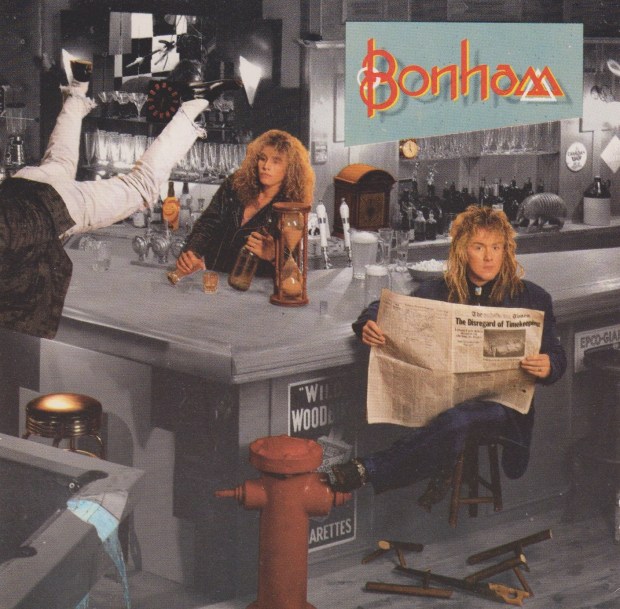
The rock press went nuts for Bonham in ’89. Finally, after long wait, the son of legendary Led Zeppelin drummer John Bonham finally made his move into the music world. Fans had seen him in The Song Remains the Same. Some knew that Jason Bonham jammed with Zeppelin in 1988 at Atlantic’s 40th anniversary bash. It was a much more successful reunion than 1985’s Live Aid.
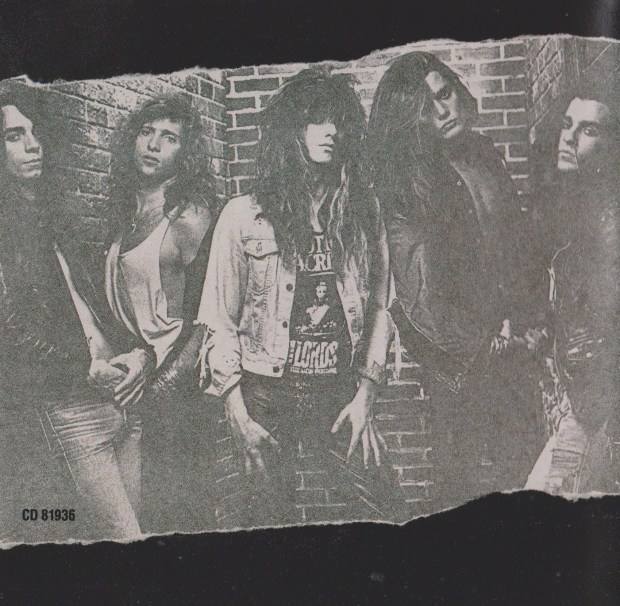
The music world in 1989 was far removed from the days of Zeppelin. Pretty boys with big hair and flashy videos were the norm. Bands who could get up there and jam for 20 minutes or more on a single track were few. With much naiveté, the magazines drooled over Jason Bonham’s new band, simply and obviously called Bonham. The singer, a young Canadian named Daniel MacMaster, had the youthful curls and range of a young Robert Plant. The bassist, John Smithson, was a talented multi-instrumentalist just like John Paul Jones. The band had to be a quartet; there could be no other way. They tapped Bob Ezrin to produce, a guy who has never done anything that sounded like Led Zeppelin, but someone who was able to take young bands and push them ahead a few levels.
The resultant album The Disregard of Timekeeping attained a lot of attention, making many magazines’ year end lists. Best new group, best new album, etc. etc. And while it is an ambitious record for a debut, it does fall very short of those lofty marks.
Going for the bombastic, the CD opens with a two minute instrumental of keyboards, guitars, violins and the odd burst of drums. It makes little impact besides setting up the first single “Wait For You”. Conceptually, it sounds as if they collectively said, “Right, so let’s write a song that sounds like something that could have been on the next Zeppelin album after In Through the Out Door.” So it’s big, echoey and loaded with keyboards and effects. It does recall Zeppelin, particular the remarkable pipes of MacMaster. It has the necessary big chorus that you needed to have in 1989, and the two sides of rock that Bonham inhabited were melded together in fine fashion. “Wait For You” is a success, but Ezrin’s production in the late 80’s seemed hollow.
Is the Bonham DNA present? Yes, of course. It comes out most naturally via the drum parts, but a lot of the material sounds intentionally contrived. Still, there were a number of really good tracks on the album, enough to make it worth buying. Young Jason, sounding exactly like his dad, counts in the quality track “Guilty” with a “One, two, ha ha ha!” It sounds less like Led Zeppelin, and more like late-80’s Deep Purple. Which is fine of course; we’re talking about quality comparisons. Especially great though is John Smithson’s violin solo. I’m especially fond of the violin in rock music. I like out of the box thinking, and it’s this kind of experimentation that made Bonham more like Zeppelin in the long run. Smithson nails it with the perfect tone.
Another pretty decent tune is “Holding on Forever” which has a Zep funk, with a modern 80’s chorus. “Dreams” though is nearly tanked by a long intro, featuring a guy coming home, brushing his teeth, setting his alarm and going to bed. Yes, that is correct. You have to listen to a guy coming home, brushing his teeth, and going to bed. You gotta blame Bob Ezrin for that mistake. Who wants to buy a rock album and sit through a guy brushing his teeth…only to get a ballad out of it? At least “Dreams” is a decent, progressive sounding ballad, but in the CD/mp3 age, how many people are gonna hit “skip” before the actual song, while the guy hasn’t finished brushing his teeth?
Having unloaded their best songs on side one, the second side is a bit of a chore to complete. Songwriting was not the band’s strongest suit. The two best songs (“Wait For You” and “Guilty”) were co-written by Bob Ezrin, and I don’t think that’s insignificant. Other songs on the album, such as “Playing To Win”, “Cross Me and See”, and “Just Another Day”, are competent. What they lack is the magical ingredient that makes a song stay with you forever. Bonham embraced the past and present, modern production and old-fashioned playing, but that alone was not enough to forge a truly great album.
Finally the album left one of the most impressive songs for the end, “Room For Us All”, an ambitious track over seven minutes long. Soft and anthemic, “Room For Us All” has subtlety that is missing elsewhere on the album. It’s an impressive end…but too little, too late.
Skid Row had the songs, but most importantly, they had the frontman. Only once in a blue moon does a congenital entertainer like Sebastian Back happen upon the scene. Born in the U.S. but raised in Canada, Bach had it all: the looks, the youth, the charisma, and most importantly the voice. He was a bull-headed bastard in those days too, but that is often a part of the frontman package. Bach was a dynamo, always “on”, and with that voice on his side, people paid attention.
Without Bach, would Skid Row ever have made the impact they did? Not to that degree, no. Sure they had Jon Bon Jovi in their corner (and to take them out on tour) but without Bach, Skid Row would have been just another hard rock band in 1989, the peak year for the genre. It can’t be understated how important the voice was. Bach had the power, range and unique style required, but he had it right out of the gate! The band was good too: Dave “Snake” Sabo, Rachel Bolan and Scotti Hill wrote some great, bone-shaking cock rocking tunes. Rob Affuso (today in Four by Fate with members of Frehley’s Comet) has long been an underrated drummer capable of some serious steppin’. With Michael Wagener in the producer’s chair, everything aligned and came up platinum.
Three major hit singles made the album a must-have. They were, of course, “Youth Gone Wild”, “18 and Life” and “I Remember You”. These have become their career-defining songs, particularly the ballad. “I Remember You” may have misled more than a few listeners when it first came out. This is not a ballad album, but a very hard rockin’ record. This wasn’t Bon Jovi. It was heavier than everybody else on the radio that summer: Motley, Warrant, Aerosmith, Van Halen, Def Leppard. Though it rocks hard, it’s still memorable.
With the benefit of hindsight, we know Skid Row were capable of so much more, and they delivered on the next album Slave to the Grind. Once they let the thrash metal and punk influences come out, the real Skid Row sound was conceived. Their debut is good, but the next two were even better.
Whether they know it or not, everybody has their first Wes Anderson movie. Mine was Rushmore, an easy entry point, and I had never seen anything like it before. It has a genuine quality, an old-fashioned look, and a killer soundtrack — all Wes Anderson trademarks.
The Criterion Collection (“a continuing series of important classics and contemporary films”) deliver some of the best colour transfers, and that is necessary for any Wes Anderson film. Soaked in dark but rich colours, Anderson fills his work with vibrancy. His visual trademarks are apparent right from the first scene, a hilarious fantasy sequence introducing our main protagonist Max Fischer (Jason Schwartzman). Max is more than a dreamer though. He is a doer. He dreams things and makes things happen. As such he is the founding (and sometimes sole) member of multiple clubs at Rushmore Academy. He writes, produces and directs lavish school plays with no thought given to compromise, or safety. Unfortunately, Max doesn’t dream much of his own schoolwork, and never seems to get it done. He is on notice. Fail one more class, and he’s expelled from the school he loves so much. Brian Cox (Super Troopers) is excellent as Dr. Guggenheim, the school principal.
Max soon meets steel magnate Herman Blume (Bill Murray), to the tune of “Making Time” by The Creation (1967). The retro music and formal dress at Rushmore Academy gives the movie a timeless feel. Could it be the 90’s? The 80’s? The 70’s? Sure, why not. Instead of working at getting his grades up, Max continues to dream. He dreams of saving the Latin program in school (for no real reason other than just to do it), and of new teacher Miss Cross (Olivia Williams). He’s a charmer, but often with ulterior motives. He and Blume manage to find a bond together. That is, before Blume himself falls for Miss Cross.
This leads to a strange rivalry between Max and Blume, with each jockeying for position in the Miss Cross stakes, with little thought given to how she feels about the whole thing. It also sets up some pretty amusing situations, such as Max trying to build a school aquarium for Miss Cross. He almost succeeds, too. Max is a hard character to read, as he often wants to make certain impressions. Blume, on the other hand, is clearly depressed, living in a sham of a marriage with two barbarian sons he doesn’t even seem to like. As their rivalry grows in intensity, so does the music, culminating in The Who’s epic live version of a “A Quick One While He’s Away” from the deluxe version of Live at Leeds. Wes Anderson has a knack for a musical montage too, and Cat Stevens’ “Here Comes My Baby” is host to one such montage. (Stevens also appears later on with “The Wind” in another song-appropriate scene.) The Stones’ “I Am Waiting” is more great music for marking the passage of time.
Max might not have been the best student, but genius does not always get good grades. His plays have an epic scope, and his aquarium does too: $35,000 cost, just for the initial plans. (Some of the aquatic movie footage that Max views may foreshadow a future Anderson film, The Life Aquatic with Steve Zissou, starring Bill Murray). He’s also a perfectionist. When it comes to his plays, every line matters. “Don’t fuck with my play!” he screams to the star of his version of Serpico, right before getting punched right in the nose. Finally young Max possesses a razor sharp wit, which he uses at will especially when it comes to those he considers love rivals, like Peter Flynn (Luke Wilson).
Rushmore is an ode to the creative mind. After some humbling experiences, Max learns to use his inventiveness to bring people together. His final triumph, to the strains of “Ooh La La” (The Small Faces), is to bring all the film’s characters (even the bully student Magnus) together in solidarity. It’s all done with plenty of laughs, smiles and a few tears.
Wes Anderson utilizes a cast of talents he would work with repeatedly, with Bill Murray being the most obvious. Kumar Pallana as Mr. Litteljeans, the groundskeeper, was an Anderson regular. Brian Cox, who also participated in The Fantastic Mr. Fox, brings a sour delight to Dr. Guggenheim. Secret weapon in this movie however is Mason Gamble as Max’s ally Dirk Calloway. Another Anderson trademark is that each frame possesses astonishing detail and visual information. Like beautifully painted and impossibly detailed storyboards, his scenes have a life and tell a million stories in the background. Much like one of Max’s plays, actually.
Without a doubt, one of the best special DVD features is a selection of play adaptations by the Max Fischer Players, from the 1999 MTV Movie Awards. The players do their own on-stage takes of: Armageddon, The Truman Show, and Out of Sight. MTV were producing some very funny bits for their movie award shows at the time, and these are some of the best. Utilizing the original cast and familiar music from the film, these feel like a fairly natural extension of Rushmore.
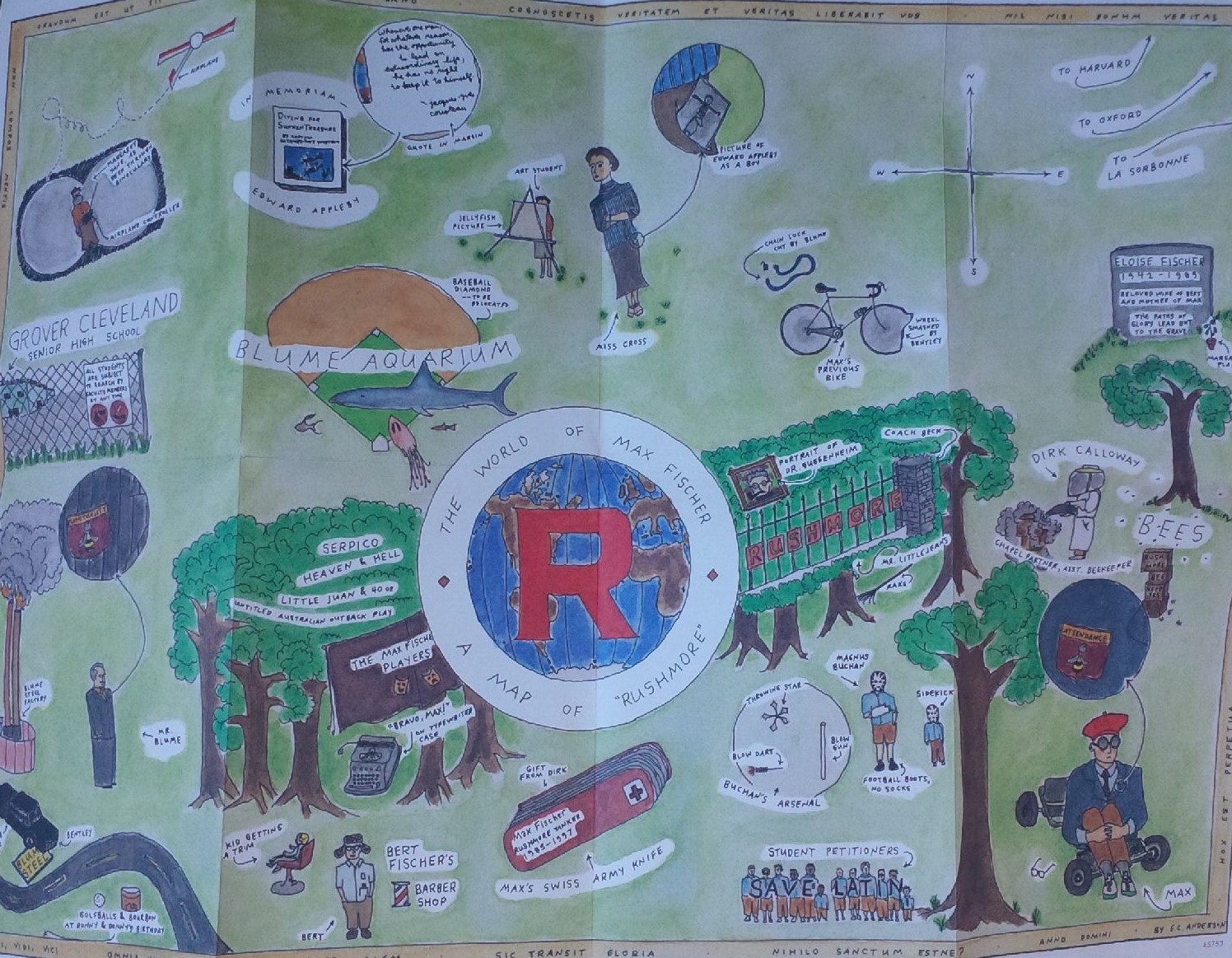
Other valuable trinkets include an on-screen program for Max’s Vietnam drama Heaven & Hell, and his adaptation of Serpico. Of course there must be an audio commentary and that is by Wes Anderson, co-writer Owen Wilson, and star Jason Schwartzman. There are also the requisite making-of featurettes and supplements. The biggest selling feature of this Criterion edition for those who value physical products is the giant fold-out map. From here you can follow the events of the movie on a delightful full colour sketch by movie artist (and director’s brother) E.C. Anderson. In fact all the packaging for this DVD was designed by Anderson.
25 million copies sold. Seven hit singles. A two year world tour. All done under the most difficult circumstances. Def Leppard’s Hysteria is one of rock’s greatest triumphs.
Although the album was released in 1987, the Hysteria story really begins on December 31, 1984. Drummer Rick Allen lost control of his speeding Corvette, and was thrown from the vehicle due to improper use of seatbelts. His left arm was severed. Doctors attempted to re-attach the arm, but infection set in and it could not be saved. It would be understandable if people thought Rick’s career in music was finished. While many artists from Django Reinhardt to Tony Iommi had dealt with physical disabilities, nobody had ever seen a one-armed rock drummer before.
Undaunted, Allen began working on a way around his disability. The band never considered a future without him, and were disappointed by “ambulance chasers” looking for a gig. Rick Allen wasn’t about to allow himself to go down or dwell in his misery. With an electronic kit triggered by his feet and right hand, Allen eventually regained his ability to not only play drums, but play live. This resulted in an inevitable stylistic change. Allen’s drumming style became more staggered, with emphasis on bigger, spaced out snare hits. His electronic kit was no crutch: singer Joe Elliott said he could play it “and make it really sound terrible”.
The next album was supposed to be a big deal. It was Phil Collen’s first Def Leppard LP as a writer, and Rick’s chance to prove he wasn’t out. Unfortunately, when the band started to record, producer Robert John “Mutt” Lange was not available. Instead the band began to work with Jim Steinman (Meat Loaf), but were underwhelmed by the results they were getting. Leppard’s ambition was not just to make another album, but to make something seriously good, memorable and special. Something with the potential to be as big as Pyromania was. Steinman was let go and the band started working with Nigel Green with no progress being made.
The band were taking so long, and suffered so many setbacks and delays, that eventually Mutt Lange was available again, and together they finally began work on the new Def Leppard LP. Co-writing every song with the band, Mutt provided the focus and intense discipline. The stated goal, following the template of Michael Jackson’s Thriller, was to make an album with 12 potential singles.
The long story of this difficult album (false starts, illnesses, studio problems) is only overshadowed by its success. But it took a while to get there.
The first single “Women” did well enough, but failed to kickstart the mega album sales needed to recoup the losses. “Women” was an odd choice for a first single: a slow robotic rock track, with a killer comic book-based music video. It was incredible just to see how Rick Allen played drums with his new setup. Apparently, video directors asked how they should shoot Rick? The band answered “Just the same as you would any other drummer.” It was simple as that.
“Women” introduced the new Def Leppard groove. A simple one or two note bass line, layers upon layers of vocals and chiming guitars, but none of the full-speed-ahead New Wave of British Heavy Metal that Leppard were founded on. The year was 1987 and Def Leppard were on the cutting edge. To get those chiming bell-like chords, Mutt had them recorded one note at a time! This is very apparent on “Animal”, the second single. It too was mildly successful, but not enough to push the album into orbit. Listen to the guitar chords and you will hear something that sounds more like chimes than strings. This is down to the incredibly detailed and overdubbed recordings. “Animal” was a stellar pop rock track, and a fine example of what Hysteria sounds like.
Refusing to give up, a third single was dropped: the ballad title track “Hysteria” and possibly the finest song on the album. The fact that these singles were not the hits the band hoped for at the time has not diminished them. Today they are all concert classics, radio staples, and beloved fan favourites. Leppard even re-recorded the song in 2013 for release on iTunes. (While the re-recorded version is impressive, it is impossible to exactly recreate the magic on this album.)
Finally, the success that the band and record label were waiting for happened. The track was “Pour Some Sugar On Me” and the North American version of its music video showcased the band’s stunning live show. Def Leppard were playing “in the round” to rave reviews. “Pour Some Sugar”, a retro glam rock tune with a contemporary sound, was a summer smash hit. It was cool, it was catchy, and Joe’s verses almost sounded like rap, although really they had more in common with Marc Bolan of T-Rex.
On a roll, nothing would stop Def Leppard now. Though the goal was an album with 12 potential singles, Hysteria eventually yielded seven. Most rock bands were lucky to squeeze three out of a hit album. Though the album was now becoming a bonafide hit, some critics and fans lamented the death of the original Def Leppard. Others embraced their pop success. The raw edgy guitars were gone and replaced by bright, precise parts working as a whole, in a gigantic pop rock juggernaut. Joe wasn’t screaming out every line, but actually singing now. It hardly matters. With the success of Hysteria, Def Leppard had embarked on a whole new journey and have rarely looked back to their origins.
The singles carried on, through the rest of 1988 and into 1989. “Love Bites” was fifth up, which originated as a country ballad that Mutt wrote and the band Leppardized into something different. It was a hit for the autumn of ’88, a slightly dark ballad for the fall. The victorious glam rock of “Armageddon It” was next, simple and pleasant enough for radio and video, and another huge hit. These were songs that had pep, but wouldn’t frighten mom and dad.
The seventh and final single was a surprise choice: “Rocket”. On album, “Rocket” was 6:37 long, and featured a long experimental middle section. The ambitious mid-section featured loads of NASA samples and sound effects, all backed by the African inspired drum loops of Rick Allen. The song was based a drum beat by Burundi Black, brought in by Joe Elliott, played by Rick Allen and looped. Eventually lyrics were added, inspired by the glitter groups of the 70’s that Leppard grew up with. Lange also used backwards vocals for some of the hooks. The line that opens the track and repeats through the song is the chorus from “Gods of War”, backwards: “Raw fo sdog eht rof gnithgif er’ew.” It was a sharp track to be used as a single, but that unforgettable beat was beyond question. It was remixed and brought down to 4:25 for the single release.
It is unfortunate that Mercury stopped at seven singles, because they could have released at least nine. Many fans had counted on a “Gods of War” release, certainly before “Rocket”. “Gods of War” had become a fan favourite for those who bought the album, and it could have been used as a “serious” themed single towards the end of the album’s life. Dark in tone but more epic in quality, it really could have been a valiant single. It has since become heavily associated with late guitarist Steven Maynard Clark, who was responsible for much of its guitar thunder.
The final track that shoulda woulda coulda been released as a single was the album closer, “Love and Affection”. As good as any of the actual singles, “Love and Affection” had its own charm and hit potential. It’s long been one of my album favourites, just under “Hysteria” and “Gods of War”.
Rounding out the LP are “Run Riot” and “Don’t Shoot Shotgun”, two rock tracks that help keep the album afloat. Neither are clearly as brilliant as the hits, but both solidly get the job done with guitar thrills. Finally there is “Excitable”, the only song I’ve never particularly dug. It strikes me as gimmicky and very 80’s, much like “Social Disease” by Bon Jovi. Too reliant on sound effects and gimmicks. So out of 12 tracks, only one was really a dud. That’s not bad by any measure.
So Hysteria rode the charts, recouped its costs, and then some. The tour in the round was legendary and resulted in a live video In the Round: In Your Face. Def Leppard were, for a short while anyway, the biggest rock band in the world.
Obviously, Def Leppard have continued to suffer ups and downs since Hysteria. Steve Clark died. Rick Savage has Bell’s Palsy. Vivian Campbell fought cancer. Yet they have continued to soldier on, never topping Hysteria of course, leaving it as the magnum opus that it is.
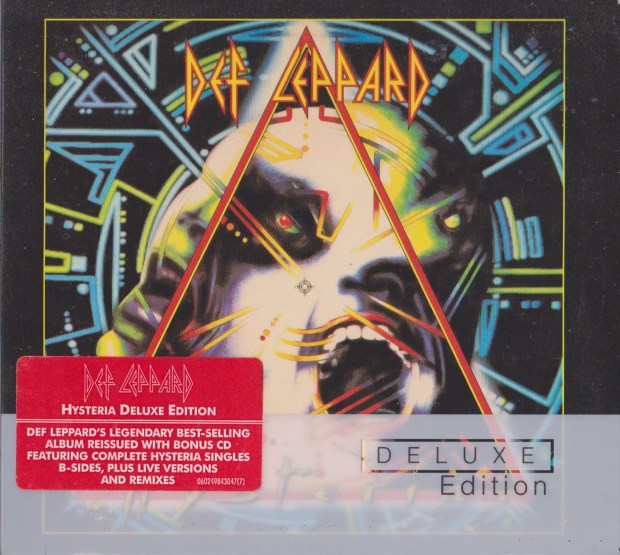
The album inspired a book and a movie. An album of Hysteria’s stature deserves a killer deluxe edition too. This one is nearly perfect.
As discussed in greater detail in Record Store Tales Part 4: A Word About B-Sides, this album and its singles really clicked with the collector in me. Def Leppard prepared a number of B-sides for Hysteria, and perhaps because these were not produced with Mutt, they all have a harder edge. “Tear It Down” was a speedy but basic rock track considered good enough to include on the next album, and so it was. The B-side version remains its superior, because it is tougher than the one on Adrenalize. “Ring of Fire” was even heavier, clearly too heavy for what Hysteria became. Along the same lines is “Ride into the Sun”, an old track from Leppard’s first EP, re-recorded here and in fine form. “Ride into the Sun” is a stellar track and perhaps should have received some acclaim. Even though the song has been remixed and reissued on other things, it remains a rarely heard gem. Yet the most impressive B-side was probably “I Wanna Be Your Hero”. This B-side from the “Animal” EP has the Hysteria vibe and sound. It easily could have replaced “Excitable” as an LP track, but if it had perhaps Hysteria wouldn’t have sounded as diverse. Dig that false ending!
This deluxe edition includes all the live B-sides and almost all the bonus tracks associated with singles for the album, and then some. “Women” is a live classic from the home video. Anyone who has seen it will remember this version and Joe’s intro. “We got everything we need! We got the band, the crowd, the lights, the cameras, the action! There’s only one thing that we ain’t got…” Women! (I doubt that, Joe!) “Elected”, the live Alice Cooper cover, was recorded during this period but released in 1993 on the “Heaven Is” single.
From the same gig as “Elected” came a lively cut of “Love and Affection”, which was also utilised as the album’s Japanese bonus track. It’s very rare to hear this song done live, and definitely rare to hear a great vintage version done live. Then there’s a so-so “Billy’s Got a Gun” (same gig again), and a fascinating “Rock of Ages” medley. This medley seamlessly captures some bits of classic rock tunes within itself: “Not Fade Away” (Buddy Holly), “My Generation” (The Who), “Radar Love” (Golden Earring), “Come Together” (The Beatles) and “Whole Lotta Love” (Zeppelin). This is all done to the tempo and style of “Rock of Ages”, and quite well, too. When this was originally released on the “Rocket” single, there was no mention of the medley part. It was a total surprise when Leppard broke into these other songs, some of which I’d never heard before.
Leppard released a few remixes during this period too. Extended versions of “Animal”, “Pour Some Sugar”, “Armageddon It”, “Rocket” and even “Excitable” all come from 12” singles. What’s missing is the single edit of the “Rocket”, the short version of the “lunar mix” . The single mix of “Pour Some Sugar” is also missing, but that track is on so many albums including the five-million-selling Vault, so we’re not going to worry about it. These extended remixes are, not surprisingly, pretty much for the fans and collectors.
Finally, and most importantly, is the last B-side “Release Me”. This track was initially released on the “Armageddon It” picture disc single, but not credited to Def Leppard. Much like their later acoustic B-sides credited to the Acoustic Hippies from Hell, “Release Me” is credited to Stumpus Maximus and the Good Ol’ Boys. Engelbert Humperdinck is responsible for the most famous version of “Release Me”, but Stumpus Maximus is definitely responsible for the most twisted. Featuring Def Leppard’s roadie Malvin Mortimer on lead vocals and the rest of the band goofing around, “Release Me” is a hoot. Mortimer breaks all known sound barriers with his screaming (and burping) of the lyrics. I was absolutely confused beyond belief upon hearing this for the first time, since I didn’t catch on to this actually being Def Leppard in disguise. They absolutely fooled me; I thought whoever they were, Stumpus Maximus and the Good Ol’ Boys absolutely sucked! For the time it was a novelty release, but it’s now a wonderful tongue in cheek finale to this great deluxe edition.
Some, including renowned rock journalist Martin Popoff, have dismissed Hysteria as lifeless and dismally underwhelming sell-out pop. Keeping in mind where they came from (High ‘n’ Dry, Pyromania) there is no question that Hysteria was a clear and intentional turn towards the mainstream. Where Def Leppard rose above a simple pop foray is in the detail and care given to the recordings. With Mutt Lange keeping his eye on the goalposts, he drove Leppard not to make an album without a soul, but one that offered flawlessly assembled guitar based songs. The passion and heart can still be heard; they are not buried. It’s a unique combination of studio sterility with Leppard’s brand of glam rock, and nobody (not even Leppard) have been able to duplicate the magic of Hysteria.
You might not “need” the full-on deluxe edition, but considering the quality of the B-sides and live material, you’d be positively missing out.
When speaking of Aerosmith “classics”, fans often skip over the 80’s or 90’s and talk singly about the 1970’s. This is unfair to 1989’s Pump, a bonafide classic indeed, a rebirth, an all-too-brief twinkling of Aerosmith turning back the clock and smoothly kicking your behind. Sure, Permanent Vacation brought them back from the dead and provided three surprise hit singles. But that album wasn’t as laser-focused as Pump.
Teaming up for a second time with the late great Canadian producer extraordinaire Bruce Fairbairn, Aerosmith (and co-writers) cooked a short and sweet batch up. 10 songs, all to the point and done “just right”. That’s how Aerosmith albums were in the 70’s, and Pump is as close as they have ever been able to touch that magical golden era.
Incidentally, if you’re curious about how this album was made, there was an excellent behind the scenes doc called The Making of Pump that was out on VHS. The band were clearly riding a wave of energy, it was palpable in the studio. There was some conflict but it all seemed productive. There was a surplus of songs. Titles such as “Looking Up Your Old Address” and “News For You Baby” were dropped in favour of stronger songs — the 10 on Pump.
“Young Lust” and “F.I.N.E.” have always seemed to work as a supercharged pair. The band sound young, therefore “Young Lust”! Joey Kramer on the skins propels the whole thing forward, aided and abetted by Tom Hamilton’s unmistakable bass slink. Whitford and Perry — locked on to target, supporting and boosting each other’s licks. And Steven Tyler, always the centrepiece, keeping the attention focused on the hooks. “I got a brand new record, and I gotta play,” he sings, and you have to believe it. When Aerosmith have all five members firing at peak performance, then you have one hell of a lethal weapon.
We don’t need to address “Love in an Elevator”; it’s all been said. All you really need to focus on when listening to this overplayed radio staple is the musicianship. All these years later, it’s still smoking hot. Hamilton’s bass rides that riff like a surfer.
Aerosmith weren’t a preachy band, but they were pretty open about their drug usage and recovery. “Monkey On My Back” was their first real statement about this subject.
“I made believe the devil made me do it, I was the evil leader of the pack, You best believe I had it all and then I blew it, Feedin’ that fuckin’ monkey on my back.”
The reborn Aerosmith infuse it with all the energy and greasy groove required to make their point. They’re a better band without the powders; deal with it!
“Janie’s Got a Gun” is another track we don’t need to delve into deeply. It was an innovative and daring track for the time; a real statement from Tyler. He fought hard for his lyrics. “Put a bullet in his brain” was changed to “Left him out in the rain” on some edits, which robs the song of its shocking impact. In my opinion, the real moment people started to pay attention was that line. And incidentally, this is one of the best songs to watch come to life on the Making of Pump video. From the initial work on the song with writer Jim Vallance to the punching in of final vocals, you can watch the creative process like a fly on the wall.
A brief but impressive acoustic bit called “Dulcimer Stomp” was used to open side two, right before another hit single, “The Other Side”. I always appreciated that they included “Dulcimer Stomp” in the music video, even though it’s not part of the single version. “The Other Side” is probably the safest track on the album, the only one without some kind of edginess. It does boast some popping horns, a Bruce Fairbairn production trademark. Bruce is one of the players in the horn section, dubbed the Margarita Horns. “My Girl” is similarly simple and to the point, although later plagiarized for not one but two songs on 2012’s Music From Another Dimension! Much more interesting is the heavy duty “Don’t Get Mad, Get Even”. Swampy, even including didgeridoo, this is one of those Aero-blasts through the blues that Perry and Co. do so well. Just as awesome is “Voodoo Medicine Man” which is probably the most…ominous…Aerosmith track ever recorded. It is different and groove-heavy. Deeply impressive heavy rocking happening here.
Closing out with the ballad “What It Takes” was a classy move. Unlike some other ballads this band has had hits with over the years, “What It Takes” has a sincerity and authenticity that has kept it from ageing badly. The country tinge of “What It Takes” foreshadows Steve Tyler’s current solo direction, but in 1989 this was just slightly different for the band. Listen for a callback to “F.I.N.E.” from side one, and a hidden bonus track. There’s an unlisted track of acoustic instrumental jamming, an outtake from the sessions, at the very end. Even incidental bits like “Going Down” and “Dulcimer Stomp” are given their own titles on the CD, but this last jam is left a surprise.
This rare limited edition version of Pump comes in a “leather case”. There is an outer slipcase, and an inner digipack. It was manufactured as a promo and then later sold as a limited release at retail. It’s cool and looks sharp, but there is nothing else exclusive about this release. It’s a cool find if you happen upon one in your travels, but sticking with the zillions-selling regular CD edition will do you just F.I.N.E. fine.
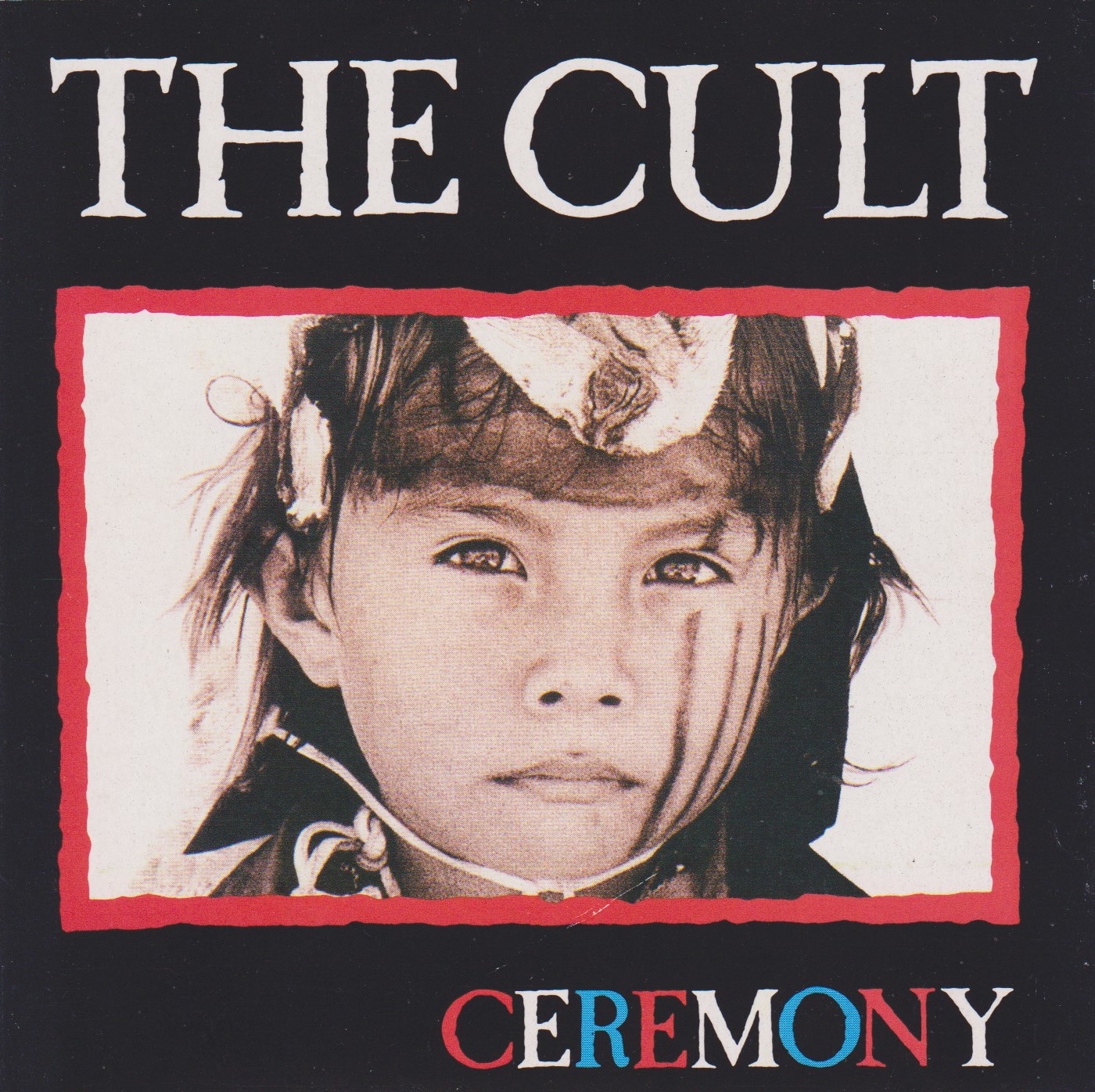
Only 25 years late, I have finally acquired the Cult’s Ceremony CD, thanks to my kind and generous reader Wardy. I somehow missed this album all those years, even though I own all the singles. There are some songs here that are completely new to me. Ceremony received mixed reviews when it was released, as it represented the band’s furthest move away from their roots, into commercial radio rock. Let’s see how accurate that is.
It starts sounding more like some lost Deep Purple album, with big organ and jammy sounds. Richie Zito co-produced this disc, and the band got a sharper sound out of the studio than they did with Bob Rock last time. Sonically, Ceremony has more impact, more heft, more oomph than the big and echoey Sonic Temple. The “Ceremony” in question on the title track is the rock arena, as the Cult had definitely become arena rock. They had also been reduced to a core duo. Jamie Stewart and Matt Sorum were gone, and the Cult used session musicians during this period. Charlie Drayton (bass) and Mickey Curry (drums) helped the band achieve what sounds like a very sincere crack at this kind of rock. Accessible it is, but the Cult didn’t really sell out. Check out the frantic “Wild Hearted Son”. Like the sound of a stampede of horses across the plains, “Wild Hearted Son” does not let up. I think I lot of fans were disappointed that the new Cult sound wasn’t more esoteric, but that doesn’t make it bad.
Just as relentless as “Wild Hearted Son” comes the “Earth Mofo”. One thing I had never really paid attention to before was the bass. Drayton’s get some great bass chops. The production of Ceremony leaves a lot of space between the instruments, so you can hear them. Those who find Sonic Temple overproduced may dig on this, so give “Earth Mofo” a spin. That’s nothing though compared to the powerful “White”. Epic in scope, “White” is a massive groove with layers of acoustic instruments a-la Zep.
I didn’t see the tender sound of “If” coming, just piano and Ian’s crooning. Not after all that heavy hitting rock. But then “If” also explodes into something bigger, anthemic and memorable. I’m starting to think that if Ceremony got a bad rap back in ’91, it’s because people weren’t paying proper attention.
“Full Tilt” is a great name for a rock song. Riffed out with generous helpings of rock sauce, “Full Tilt” was reported to have knocked a picture of at least one journalist’s wall.* Just wait until the afterburners ignite in the last minute of the song. Strangely, the very next track is the acoustic ballad “Heart of Soul”; a good song indeed but not as great as “Edie (Ciao Baby)” was. Back to the rock, “Bankok Rain” lacks the charisma that the rest of the tunes seem to have in common, though there is certainly nothing wrong with it’s staggering riff. By the end you won’t care, because the whole thing burns like fire and gasoline until all the fuel is spent.
A fascinating Cult song is “Indian”, a basic acoustic song with cello accompaniment. As Cult ballads go, this is definitely a peak moment. Ian infuses more passion into one line than most singers can do in a whole song. Unexpectedly, the album moves right on to another ballad, “Sweet Salvation”, which is actually less a ballad and more a soul song. It’s powerful, as are all these songs in their own ways. Ian Astbury breaks out the Morrison poetry jams to kick off the ending track, “Wonderland”, a riff driven slow broil.
That’s the album, and it’s hard to gauge where it sits among the whole Cult catalogue. Certainly, this and Sonic Temple are brother records. They are stylistically more similar than Cult albums tend to be. Ceremony possesses track after track of scorching rock music. Does it make as strong an impression as the bombastic Sonic Temple? Not quite. By stripping the production to a more sparse and live sound, perhaps the Cult sacrificed the nuances. Ceremony gleams shiny with amped up guitars and drums aplenty. It is hard to find fault. It is still a fine album.
3.5/5 stars
* That’s a true story, but I can’t remember what magazine I read it in. The reviewer said, quote “‘Full Tilt’ knocked a picture off my wall.”
Today’s movie soundtrack comes by no coincidence. Today’s my birthday! And I got this album on this day in 1987 from my partner in crime for many years, Bob!
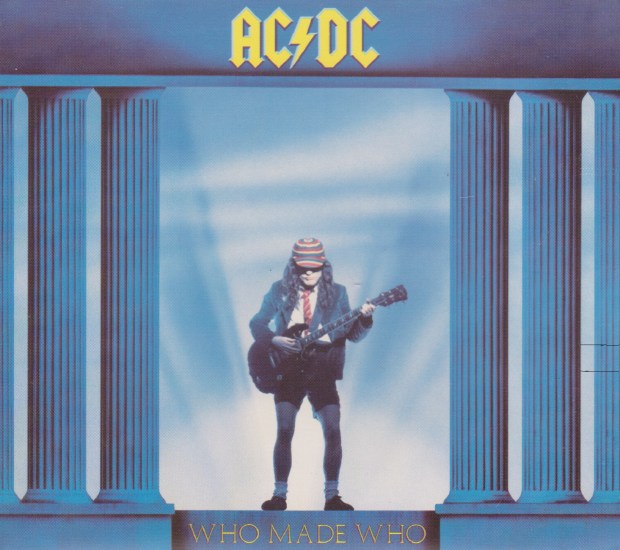
AC/DC – Who Made Who (1986 Epic soundtrack to Maximum Overdrive, 2003 remaster)
As a movie director, Stephen King is a great novelist.
30 years ago, Maximum Overdrive was King’s directorial debut. The movies based on his books had been box office gold so far, but King always complained about the adaptations of his original material. So why not hand the reins over to him?
King’s goal was to make “the loudest movie ever made”, and part of that was leaving the soundtrack to AC/DC. King issued the film with instructions that “this film is to be played as loud as possible.” The funny thing, according to him, was that most theaters did it.
AC/DC did the entire soundtrack, a mixture of old and new material. It was an unorthodox move and it left AC/DC with what some consider to be their first real “greatest hits” album; this coming from a band who in 2016 has yet to issue an actual greatest hits album!
The robotic pulse of “Who Made Who” commences the affair, a massive hit still a radio staple today. One of AC/DC’s most recognisable tunes, “Who Made Who” was a bigger smash than the movie that spawned it. That’s Simon Wright on drums, emulating the perfect beats of Phil Rudd before him, creating a fine facsimile. The keys to the song though are the simple and catchy guitars of Angus and Malcolm Young. Having nailed down the art of writing catchy bases for songs, the brothers Young really perfected it here.
They also perfected it on 1980’s “You Shook Me All Night Long”. Placing the biggest AC/DC hit of all time second in line is almost like nailing the coup de grâce prematurely, but there is plenty more firepower on the album. It works in the second position, cleaning up anyone left standing and getting them shakin’ on the dance floor.
AC/DC added two brand new instrumentals to this soundtrack (“Johnson was sick that day”, joked Angus). “D.T.” is the first of them, somewhat unremarkable and echoey on the drums. But this is designed as background music for movie scenes, so it really shouldn’t be measured by the same yardstick as, say, a Rush instrumental. The second on side two is the peppier “Chase the Ace”. Punctuated with some cool Angus licks, “Chase the Ace” is simple and effective like “D.T.”.
There were a few tunes from the recent Fly on the Wall album, all killers. “Sink the Pink” (oh, Brian!) is recorded so muddy that you can’t hear the words, but it does rock. Angus’ guitar break is pure fun, and the song gets your ass moving. That leads into the sole Bon Scott inclusion, “Ride On”, from a quieter moment in the film. What’s really cool is that even though these songs are from all over the place, Who Made Who sounds like a fairly cohesive trip.
Side two commences ominously with “Hells Bells”, a fine way to distribute classic tunes evenly across the sides. “Shake Your Foundations” is on its tail, hitting you with another blast of AC/DC right in the face. One of the better tunes from Fly on the Wall, “Shake Your Foundations” does its advertised job. Yet, I do believe there was only one way to properly end this album. That would have to be the cannon-fire of “For Those About to Rock”.
Who Made Who was actually my first Johnson-era AC/DC album, given to me by my buddy Bob on this day in 1987. If this review is slanted ever so slightly in the “pro” direction, so be it.
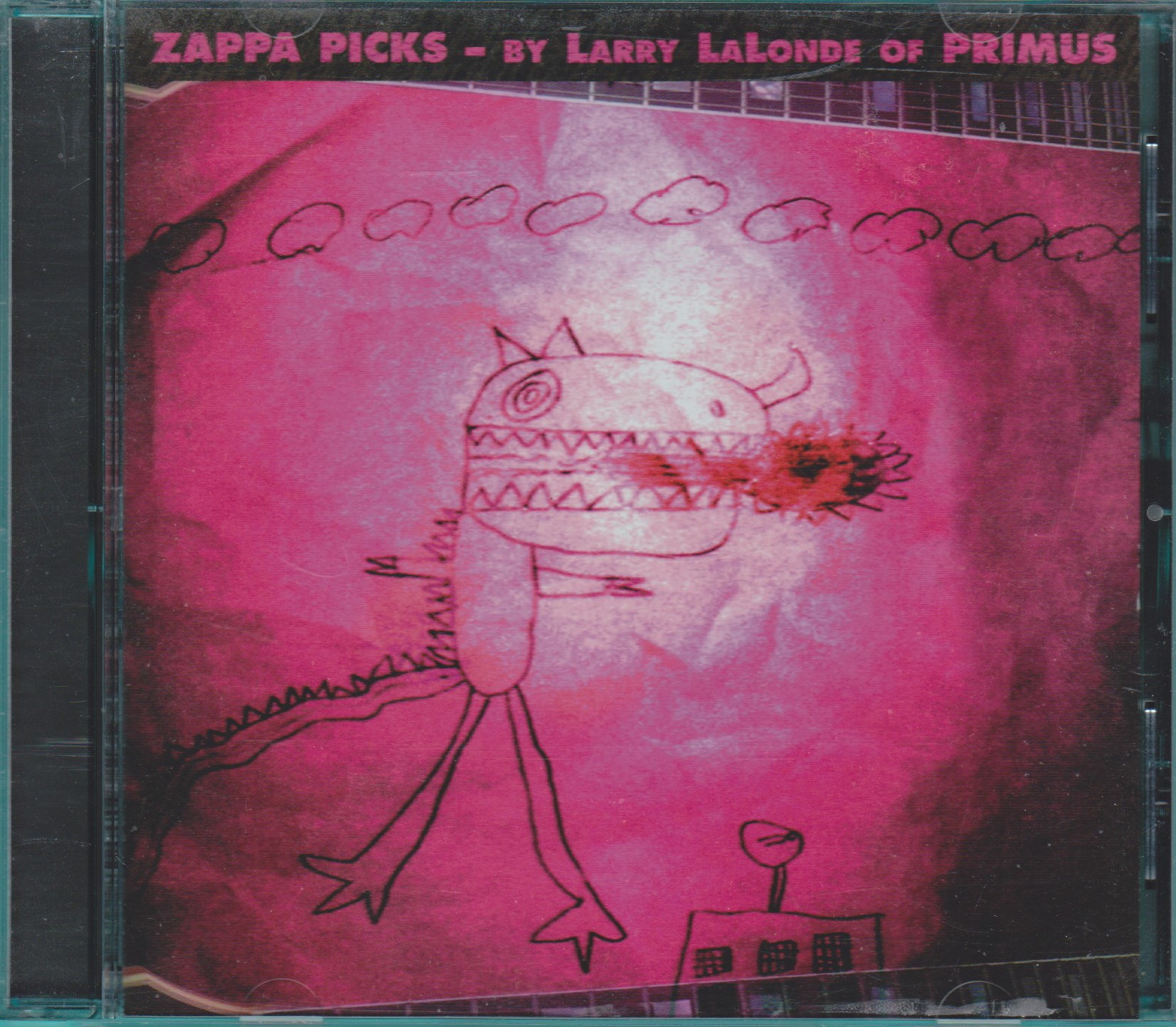
FRANK ZAPPA – Zappa Picks – by Larry LaLonde of Primus (2002 Rykodisc)
This was a cool idea for a series. I love the concept. Big name fans of Zappa compiling their own Zappa disc. I only know of one other disc — a Zappa Picks by Jon Fishman of Phish. I prefer Primus to Phish, so getting Larry LaLonde’s instalment of Zappa Picks seemed like a good idea. LaLonde assembled an eminently listenable, endlessly entertaining and humorous Zappa album. And of course the playing is still stunning, because it’s Zappa.
What I like about this album is that you get a lot of great and challenging tunes that aren’t on the Simply Commercial hits album. In fact I think there’s only one song that appears on both! The CD is sequenced in such a way that it sounds like an actual album in terms of flow. Songs merge into each other seamlessly and the pacing is perfect. I’m discovering a lot of music I missed, because I simply don’t have all the Zappa albums. Who does?
This is spacey fun. It’s guitar nirvana. It’s percussive. There is a wealth of material both instrumental and vocal. It’s weird all the way to the edges of comprehension. It stretches every genre you can think of. It’s anything but boring.
SAMMY HAGAR – Sammy Hagar / I Never Said Goodbye (1987 Geffen)
Remember when everybody in the Van Hagar camp just loved each other? Things were so happy in Van Hagar, that Sammy released a solo album in 1987 and nobody got mad. Hell, Eddie himself co-produced it and played bass! Hagar was obligated to do another solo album to get out of his contract with Geffen, and so the self-titled Sammy Hagar was recorded quickly. Sammy apparently forgot he released another album also called Sammy Hagar in 1977, so this one was re-titled I Never Said Goodbye. (I still call it Sammy Hagar.)
There was something particularly weird about this release on cassette. I had a version, purchased from Columbia House around 1989-1990, with a bizarre cover. The J-card was designed to fold around outside the cassette shell. I’m not sure why to this day, and I’ve never seen another copy like it. The artwork was obviously designed to fold on the outside rather than the inside, but I’ll never figure out why.
All the members of Van Halen even appeared in Sammy’s video for “Hands and Knees”. The plot was simple, and perhaps a foreshadowing of things to come. A bored Hagar calls his bandmates (including nextdoor neighbor Eddie) to jam, but nobody’s interested. Instead, Hagar jams with a group of robots! “Hands and Knees” was an odd choice for a first single, being a dark and slow mood tune. The video guaranteed attention, and still garners a chuckle today (albeit a sad one, knowing these guys aren’t pals anymore). I love Michael Anthony’s huge brick of a cell phone. The video was better than the song, though it does have a killer of a chorus. It’s clear if you listen that Eddie Van Halen is one damn fine bassist too. Are you surprised?
One thing about this album, though: it’s really commercial. Like way, way more pop even than 5150. It’s no surprise that some writers like the esteemed Martin Popoff have slagged this album. The production has an airy 80’s feel, not enough oomph. The opening track “When the Hammer Falls” is a hard rocker, but it could have been thicker with more meat. Not that it would have helped too much. The chorus on this one is pretty weak, which is too bad since the riff is good enough for rock and roll.
The second single, which Van Halen used to let Sammy play live acoustically, is “Give to Live”. Van Halen’s version can be found on 1993’s Live: Right here, right now. Hagar’s studio original is unabashedly pop, bombastic…and good. I admit I still enjoy this very cheesy ballad. Hagar is rarely profound, and neither is “Give to Live”, but it’s a nice song indeed.
A shitty synth (?) horn section urinates all over “Boy’s Night Out”. Speaking of synth, “Returning Home” is all but unpalatable. This is one of Sammy’s UFO yarns, a story of a guy returning back to Earth to find it wrecked. “I saw the ruins, once the smoke cleared, once upon returning home.” It’s just sunk by all this terrible synthesizer junk and programming. The UFO has crashed into the damn mountain!
The second side surprisingly opened with some blues jamming: “Standin’ at the Same Old Crossroads”. And that would be Sammy on the slide guitar. “Crossroads” leads directly into “Privacy”, a “Radar Love” re-write that is better than “Radar Love”. Maybe I’m just sick of “Radar Love”, but “Privacy” has some smoking playing on it, proving again that Hagar is actually a pretty badass soloist. Side two on a whole is actually much better than the first. “Back Into You” is a vintage-style Hagar radio rocker. Journey must have wished they wrote “Back Into You”. The keyboard overdubs aren’t necessary but hey, it was the 80’s and this is a great little AOR rocker.
Another tune that Hagar played live with Van Halen was “Eagles Fly”. He actually presented the song to the band for 5150, but it was turned down. A live Van Halen version can be found on the 1993 single for “Jump (Live)”. He did it acoustically on stage, but the studio version is bombastic and big like “Give to Live” is. It’s a pretty impressive tune, for pop rock. David Lauser’s drumming makes the song, I’m a sucker for that rat-a-tat-tat!
The album ends on a ho-hum note, the soul-funk of “What They Gonna Say Now”, sort of this album’s “Inside” to close it out. Just not good enough. If you want to hear Eddie Van Halen playing bass up close and personal, he’s very audible here, but he’s not a flash bassist. He plays with the groove for the song.
It’s tempting to think of this album as a collection of tracks that were not right for Van Halen, and that’s mostly true. A lot of it, however, just wasn’t good enough for Van Halen. “What They Gonna Say Now” could have been a Van Halen track, but it would have been the weakest tune on 5150 if so.















 mikeladano.com