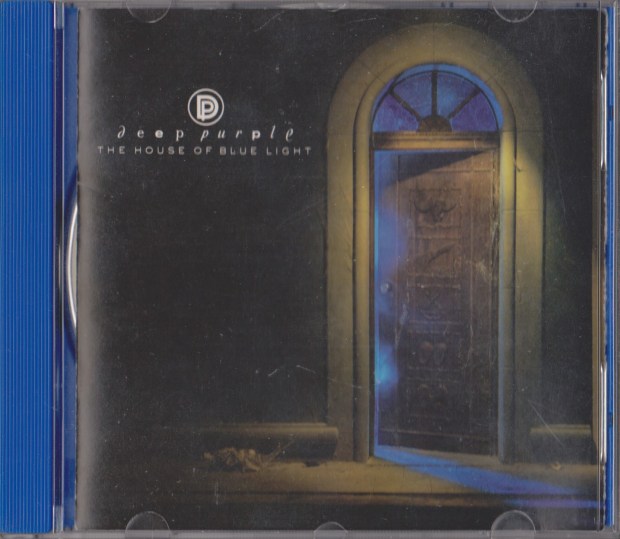
The Deep Purple Project continues! Join me for the next week (plus?) and see more rock majesty than you can shake a purple stick at!
 DEEP PURPLE – The House of Blue Light (1987 Polygram)
The Deep Purple reunion was the success beyond what anybody hoped for. The band had revitalized after many acrimonious years apart. They were fresh and rejuvenated, and the resultant album Perfect Strangers was the proof. If the live recordings are anything to go by, then the tour was also dynamite. Obviously the next thing to do would have to be a second reunion album.
According to Ian Gillan’s autobiography Child in Time, things went south very fast. He found Ritchie Blackmore increasingly difficult to work with, refusing even to record guitar for one song. Gillan admits he was no treat either, so it was the band that suffered. Ian compared Deep Purple to a beautiful meal, a plate full of gourmet perfection — that’s Roger Glover, Ian Paice and Jon Lord. Ian and Ritchie were the fork and knife on either side.
The House of Blue Light (title taken from Little Richard via Purple’s own “Speed King”) was not a fun album for anyone to make. Some hold it in high esteem today, such as renowned writer Martin Popoff, who rated it 10/10 in Riff Kills Man (as he did Perfect Strangers). While I believe Perfect Strangers is easily a 10, I don’t find The House of Blue Light to be its equal. The band may agree; none of its songs have been performed live since this tour. That also just could be residual hard feelings.
There is no mistaking the organ of Jon Lord on “Bad Attitude”. What an opening statement this is. Just as strong as the best songs on Strangers, “Bad Attitude” rules. It’s all about the spaces between, but Ritchie ensures there is a catchy trademark Deep Purple riff involved. His solos are exotic delight. Even in 1987, Purple weren’t afraid to load their single down with solos! Jon Lord’s synths are perhaps more prominent than they were in ’84. This is not a bad thing, because Jon Lord makes synth sound good. Synth and electronics take center stage on “The Unwritten Law”, powerful both because of and in spite of it. The pulse and beats give it a dramatic chase-like feel. Its drum outro is very reminiscent of “Chasing Shadows” from album #3 in 1969! It’s also the only Ian Paice co-write. In the 80’s, instead of splitting the writing credits five ways as they always had, Purple changed to awarding individual credits (and royalties). This led to petty squabbles and infighting.
“Call of the Wild” was a single and (pretty terrible) music video, and didn’t really make much of an impact. Too bad. It’s one of Purple’s more pop songs, but that’s just fine by me. Purple have occasionally forayed into commercial songwriting, but have always done so with class. This one sounds like a Rainbow song circa the Joe Lynn Turner years. “Mad Dog” blows away all three of the previous songs. With a killer, choppy Blackmore riff right up front, it sounds vintage. Gillan gets to play some bluesy harmonica on “Black & White”, a good mid-paced groove but not an outstanding one. Something like this needs a timeless Blackmore solo to drive it home, but the fire fails to light.
There’s a natural split between side one and side two, which still comes across on CD. “Hard Lovin’ Woman” (supposedly a sequel to “Hard Lovin’ Man” from In Rock) is one of the few songs that was played live, probably because of its energy. It has the pace of an old-school Purple rocker, but not the timelessness. It’s largely forgettable and really only notable because it’s on the live album Nobody’s Perfect. Back to regal sounding Deep Purple, “The Spanish Archer” could really have been something had they bothered to play it in concert. It has a drama to it that is one of Purple’s strengths, but a lot of its strength is sapped by 80’s production values. Glover’s bass doesn’t have enough meat to it, and there is a hint of electronic effects on the drums.
Onto “Strangeways”, the only long song (7:35). Its vibe is very much in tune with “Hungry Daze” from the previous album. The lyrics are unusually topical for Gillan and Glover. “Have you seen the headlines? Princess engaged. Three million out of work, but that’s on the second page.” Its length is taken up by some of Ritchie’s most subtle playing, but if you listen carefully, you can hear Ian Gillan on the congas. Just like old times. “Mitzi Dupri” is the one that Blackmore refused to record. The guitar you hear on the album track is taken from the original demo. Once Ian came up with the lyrics, Blackmore proclaimed he did not like it and would not participate in recording it for the record. I think he found the words a bit dirty. Closing the record is “Dead or Alive”, speedy Purple in the classic fashion. If only the production of this album were a bit tougher, that song would be mercilessly heavy.
The House of Blue Light is not the equal of its predecessor. Given some better production and perhaps one or two different songs, it could have been. Someone in Purple (I think it was Glover) said that every other Purple album was “difficult”. Perhaps there’s a smidgen to truth to that, because The House of Blue Light does not sound like the same confident band that recorded Perfect Strangers.
3.5/5 stars























You must be logged in to post a comment.