Here we have a simple and straightforward one hour bonus DVD. No bonus features other than subtitles, so let’s dive in and watch Deep Purple hit the road! This documentary, unlike past ones, is not about the making of the =1 album. This is about Deep Purple on tour, and is more like a fly on the wall look at the band in their environment. We seem them relax, practice, drink and work.
We begin with Steve Morse, and his sad necessity to step down from Deep Purple after 28 years in the band. Roger Glover explains that Steve came in at a time (1995) when Deep Purple needed to reinvent themselves, which is what they did. Then, we transition to Deep Purple live on stage with Simon McBride, and “No Need to Shout” from the bonus live 10″ records included in this box set. Don Airey calls it a “fresh start”, and Ian Paice contemplates on how a new member creates new energy in the Purples. Roger praises Simon’s “cool” personality. The important thing, with any new Deep Purple member, is to musically just be themselves. Don jokes that Simon “brought the average age of the band down to 74.”
Time to hit the road. Ian Gillan talks about the routine, and the tour begins (to the tune of “Hush”). Hotels, breakfasts, limousines…and security tips from Gillan! It takes about three hours to set up the stage and start checking the PA. Drums are tuned and cymbals are attached to the kit. The guitar tech talks about the adjustment from Steve Morse to Simon McBride, and a different brand of guitars. We also get a good look at Don Airey’s keyboard rig. In a cute touch, Don keeps a bobblehead of his old boss, Ozzy Osbourne, on his keys. Finally the band turns up and sound checks. Don Airey tells Ian Paice a funny story about Gary Moore messing with his keys. The band have a quiet, very English sense of humour, but they are often seen laughing and kidding around.
During soundcheck, we get to hear Purple working on a new song: “Old-Fangled Thing”, which ended up on =1. Airey says he really enjoys soundchecks because it gives them a chance to play things like bossa novas, and entertain the crew. We move on to the 02 arena with Blue Oyster Cult opening, and other gigs with Jefferson Starship, who Purple seem to get along with famously.
There is a hilarious bit in Don Airey’s keyboard solo. He takes a wooden shim, and sticks it in the keys to hold them down. As a single note plays. A waiter with a glass and bottle emerges. Don pours himself a glass of wine as he takes a brief break. It’s all so very quaint and gentlemanly funny. Don’s son is actually the band’s stage manager, and it has allowed him to see more of his dad than he ever would at home.
The documentary then jumps to another day, and the 10 minute wait before showtime. Backstage, Roger Glover takes a crack at Ritchie Blackmore’s violent aversion to cameras. Ian Paice jokes about the palpable tension in the air, as the band continue to joke around and laugh, whiling away the last minutes before stage time. Paicey picks up a pair of bananas, plays a drum roll, complains the bananas are not properly balanced, and tosses them aside. That’s the wildest party moment in the Deep Purple dressing room.
Finally the waiting is over. The whole day revolves around the 90 minutes on stage, remarks Gillan. The band take the stage while Holst’s “Mars: Bringer of War” assaults the crowd in preparation. “Highway Star” (which, incidentally, is not included on the live records in the box) rolls out the thunder, and Simon McBride brings his own style to it. The documentary runs through a few live clips to give you a taste of the set, including the beautiful ballad “Nothing At All”.
When Deep Purple hits Berlin, Ian Paice has the idea to play a bit of “Let the Good Times Roll”. A young horn section is brought in, and it sounds great to everyone. We are treated to a clip of a soundcheck of “Hush” with the horns.
Show over, it’s off to the hotel, get a tea, and into bed with a book for Ian Gillan. Paicey prefers a glass of wine after a show, “because I’m allowed”.
Though it’s never overtly stated, one can’t help but notice the contrast in this documentary to the war stories of old. We remember the tales of on-stage and backstage blowups, food trays thrown about…but not any more. Now Deep Purple is five older gents who love playing together and don’t seem to mind each other’s company too much. That’s nice to see. And it’s still entertaining enough for an hour.
As a bonus DVD in a box set, this one’s easily a 5/5.
The box also came with art prints, a lanyard, guitar picks, a nice T-shirt and more, all seen in this unboxing video below.
DEEP PURPLE – =1 Live Album – 10″ Vinyl (2024 Edel)
When you buy a Deep Purple super deluxe, you get a new live album on three 10″ records every time. These records are each 45 RPM. This wonderful Deep Purple tradition carries on with this important release, the first live album with Simon McBride to be released. Let’s have a listen to all six sides.
Record 1 was recorded in Milan 2022, the same gig that yielded the B-sides for the “Pictures of You” single (“When A Blind Man Cries” and “Uncommon Man”), though they are not included here. This record opens with Machine Head‘s “Pictures of Home”, and Ian Paice beginning the proceedings with his usual drum intro. Don Airey’s organ dominates the mix, but Simon can be heard doing justice to the original arrangement. His tasty solo is his own unique composition, combining bluesy playing with shred in a way unheard before in Deep Purple. Blackmore fans who found Steve Morse to be just too different may prefer Simon McBride.
From 2020’s Whoosh! album comes “No Need to Shout”, one of the more straightforward tracks. It has a solid “Stormbringer”-like groove, but consider that Deep Purple remain unafraid to play new songs on tour every time. Simon and Don sneak in these quick licks that add season to the sauce. The chemistry with McBride is immediately undeniable.
A set highlight is the powerful ballad “Nothing At All”, probably the best song from Whoosh! Originally this song had a trademark Steve Morse guitar lick, but Simon acquits himself very well in this tricky part. It’s not identical, but the right notes are played, if in a very slightly different style. This beautiful song is harder live, with Ian Paice really smoking those drums, and Don Airey hitting his keys with more vigor.
The first record closes with another Machine Head classic, the undeniable “Lazy”, which we have so many live versions of. I have at least 34 live versions of “Lazy”, with more residing on live albums I have yet to rip to my PC. This version is the first available with Simon, and the word to use is “refreshing”. After 52 years, it is nice to have a version with another lead soloist, bringing his own powerful, melodic twist. Ian Gillan’s vocal is a little laid-back, but this version is a delight! When Ian starts playing the harmonica, it changes into something more akin to a country jam.
Record 2 was recorded in Sofia, Bulgaria in 2022. “Strange Kind of Woman” keeps us in classic territory. Somehow I get the feeling that Airey’s organ isn’t growly enough. Of course Gillan struggles with the high notes, but that’s old news and nobody should really care anymore. Simon’s solo is, once again, a fresh twist. Then they dig back even further with “Hush” from Shades of Deep Purple. Nothing different here, just the same classic groove and a killer organ solo, followed by a playful tradeoff between Simon and Don.
Side two only has newer material, beginning with “7 and 7 Is” (by Love) from the covers album Turning To Crime. Including “Hush”, that’s two covers in a row. It is cool that they were playing Turning To Crime material live, but this is skippable for most people (except Ian Paice fans who will dig the busy drum parts). More enjoyable is “Throw My Bones” from Whoosh! Don’s synth on this track is especially fun, and Simon makes it a bit heavier in the guitars. “Time For Bedlam” from InFinite closes this side. Ian Gillan struggles with the difficult vocals, which makes it harder to enjoy, though the guitar melodies are just sublime. This is a very technical track. Roger Glover holds everything together on bass while the feature players stretch out.
We are back to Milan on the third disc. Record 3 opens with the biggest surprise: “Anya” from 1993’s The Cattle Grazes Battle Rages On. It is no secret that making the album was an unpleasant experience for the band, especially Ian Gillan, but it is really cool to see them reaching back to the early 90s. This is the first version available with Don or Simon. Just as “Anya” is the only representation of the 1990s (a decade with four Deep Purple studio albums), “Perfect Strangers” is the only track from the 80s, as it often is. This is a solid workmanlike version.
The final side closes, of course, with “Smoke on the Water” and “Black Night”, leaving us without a version of “Highway Star” with Simon. This is a real shame; we hope one will come on future inevitable live albums. Ian Paice sounds great on these, and Simon’s solo on “Black Night” is bonkers, the same way that Blackers used to be bonkers.
This is a great little late-period live album. With a band and a back catalogue this extensive, it is natural that they can’t always fit in songs from Purpendicular, Now What, or In Rock. Newer material is more valuable in a live release such as this. Still…would have been nice to get “Highway Star”.
“It all adds up to one…” Would that have made a better title? Deep Purple don’t always come out with the greatest album titles or covers, but they have produced consistently good music during the Morse era, and now beyond. In their first lineup change since Don Airey joined the band in 2003, Steve Morse has stepped down for important personal reasons, and new kid Simon McBride has picked up the plectrum.
When Mr. McBride was born in Belfast in 1979, Deep Purple weren’t even a band anymore. They were in the middle of an eight-year hiatus. The last Deep Purple compilation released was 1979’s Mk II Purple Singles when he was an infant. Deepest Purple wasn’t even out yet. Rainbow was about to release Down to Earth with Graham Bonnet. Gillan were working on the second album as a band, Mr. Universe. Into that world sprang Simon McBride. He would grow to become a solo artist who would work with Purple members Don Airey and Ian Gillan, before being asked to join temporarily and then permanently.
Retaining Bob Ezrin the producer’s chair, Deep Purple wound up with something familiar, yet slightly different. There is less double tracking on Ian’s voice, which gives it a fresher sound. The songs are slightly harder edged, and there are more of them. =1 is the first first Deep Purple without bonus tracks since InFinite, and like Whoosh, feels conceptual on some tracks. According to the band, the world is “growing ever more complex, everything eventually simplifies down to a single, unified essence. Everything equals one.” I don’t know about that, but that’s what =1 means to them.
At 13 songs, the album could be trimmed down to a tidy ten. Let’s break them down.
Simon gets to show off some new sounds at the start of “Show me”, a relentless groove, unlike anything from the Morse era. Ian’s speak-sing storytelling vocal is familiar and fun, a perfect way to adapt to singing in your 70s. The groove is different from past works. Wonderful solo work from Don and Simon here, with Don on synth. The back and forth is very tasteful. It’s more playing for the song, and less trying to outplay each other like Jon Lord and Ritchie Blackmore in the 1970s.
Track two continues that hard grooves. “A Bit on the Side” boasts a great chugging guitar part, very different for Deep Purple of any era. The chugging is almost Slash-like, circa “Locomotive”. The chug-riff is the main feature, but once again Simon’s solo is stratospheric with loads of technique. Don’s is equally cool, with a spacey vibe.
“Sharp Shooter” is one song on which Ian doesn’t sing the name in the chorus. Instead there is a memorable refrain of “Shot in the dark”. The vocals are pushing the upper limit a bit, and the song has a vibe very much like the Morse era of Deep Purple. Nice soulful female backing vocals here, which is rare in Deep Purple. Once again, Don is focusing on the synth for solos. Not a highlight, but a decent tune with a modern Purple groove.
The first video/single was “Portable Door”. Ian Gillan weaves his traditional “English as a second language” lyrical whimsy. Some favourite lines:
When it came to me one day in Jerksville Man, I was right on the edge And that jacket’s too small for a man of your size And those socks are too big for your head
I love that. Socks are too big for your head? Why not. The lyrics seem to be about tedious conversations that go in one ear and out the other.
I was trapped in a dire situation Between reason and someone-in-law
“Between reason and someone-in-law” is just brilliance. Only Ian Gillan could write that. Meanwhile, Simon hits you with a cool chord that swooshes through. “Portable Door” has a stamp like the last few albums, but the one Simon chord really sets it apart. One chord: huge impact.
“Old-Fangled Thing” has a nice lyrical reference back to “Living Wreck” from In Rock, but is not the most memorable of songs. Is “old-fangled” another Gillan-ism? This song is a little tricky, like much of the Morse era was. In the end, it’s possible that this song could have been axed, but its speed is impressive.
There are two “ballads” (or slow blues) on this album. The dramatic one is “If I Were You”. There is a memorable chorus and a mournful guitar melody that might recall things like “When A Blind Man Cries”. Either way, Purple have done some impressive ballads and slow songs during the Morse era, and now the Simon era too. His solo is a little Bonamassa at times. Also take note: there’s an orchestra on this track!
The second single “Pictures of You” is immensely memorable. A fantastic song, with a focus on vocal melody. Purple play it simpler here and the dividends pay off. There’s a bit of multi-tracked vocals on the chorus, which is essentially what this song is about: the chorus! Until we get to the outro that is, which is more Marillion than Purple.
On the single for “Pictures of You”, the song went right into “Portable Door” without a break. The effect was an exciting transition. It’s less exciting on album, leading into “I’m Saying Nothin'”. This has that herky-jerky feel of the Morse era, but is otherwise not particularly memorable. Another one that could have been cut.
What’s the story with “Lazy Sod”? Ian Gillan was asked how many songs he’d written in his life. He estimated about 500. He was then informed that Dolly Parton wrote over 5000…”you lazy sod”. Can’t argue with that, so Ian turned it into a lyric. “That’s alright because I’m a lazy sod, and I’m hot.” It’s the third single and the most “rock” of them. Very old-school Deep Purple. Could have been on Who Do We Think We Are!
“Now You’re Talkin'” is the second song with an abbreviated “in'” title instead of “ing”. (David Coverdale, were you in the room?) Very similar to “Bananas” from 21 years ago. Almost a re-write of that prior song, but with a really fun screamed part in one of the verses. Really great riff, and always a pleasure to hear Ian do a scream, whether he sounds like a 70+ year old or not! Wait til you get to the solos!
Back in the Rapture of the Deep era, Ian told us that “Money Talks” to him. Now, he has “No Money to Burn”! There is an organ-based riff, which is a nice change of pace for this album, but the song is otherwise unremarkable. The third of three songs we could cut to get down to ten.
Deep Purple are not overkilling it on ballads. “I’ll Catch You” (maybe a slow blues) is a lovely ballad, soft and bluesy like a smokey club. It is placed perfectly near the end as an ear-cleanse, before we get into one of the best Deep Purple closers in years with the very English title, “Bleeding Obvious”.
If “Bleeding Obvious” isn’t the best closer since “Bludsucker” on Abandon, then let’s hear your picks! It could also be the most progressive tune? Could that opening figure work for Dream Theater or Marillion? Or even Rush? This is an absolutely brilliant tune, mostly down to that tricky riff and melody.
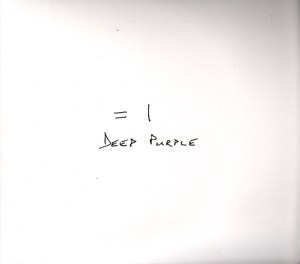
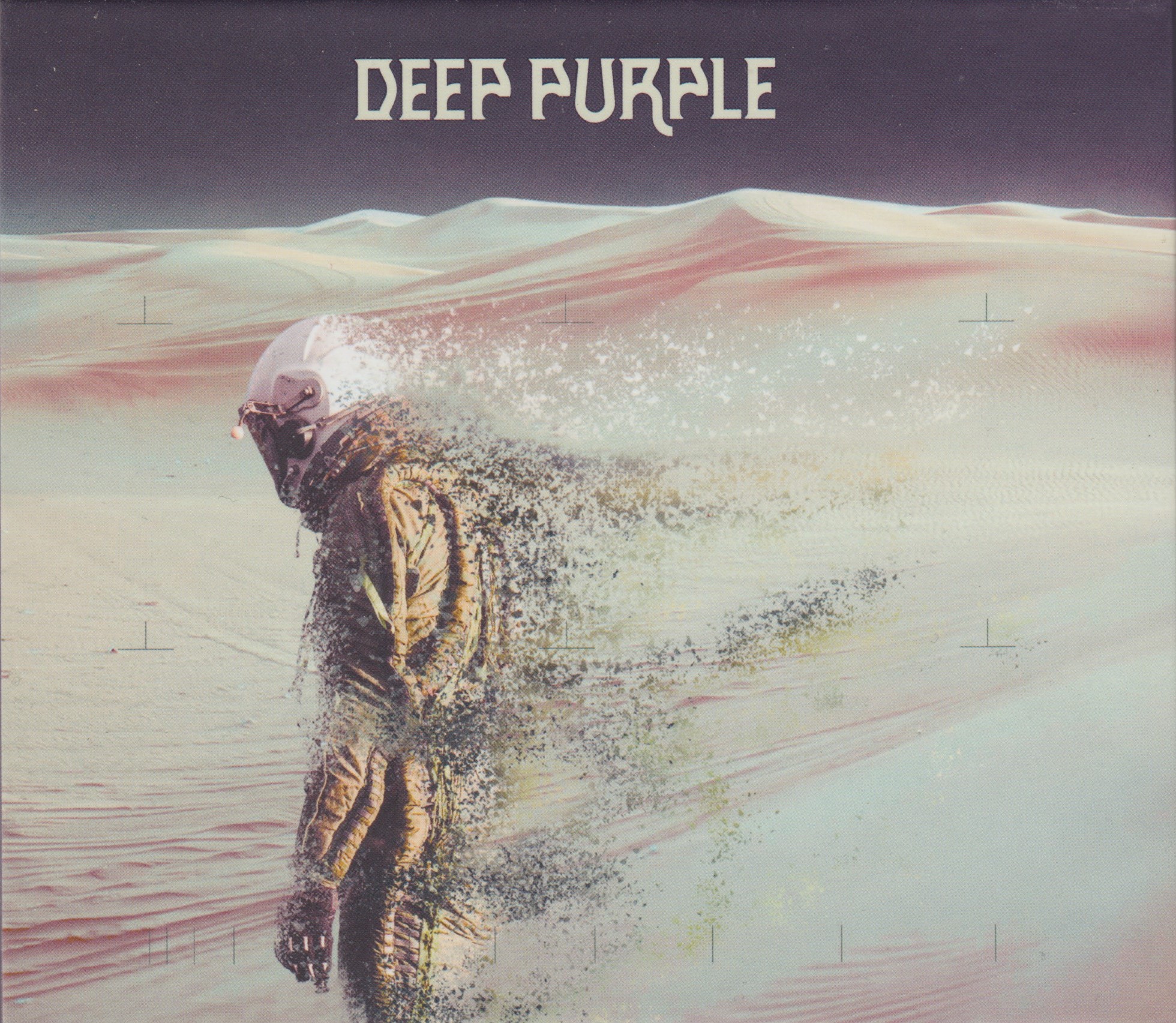
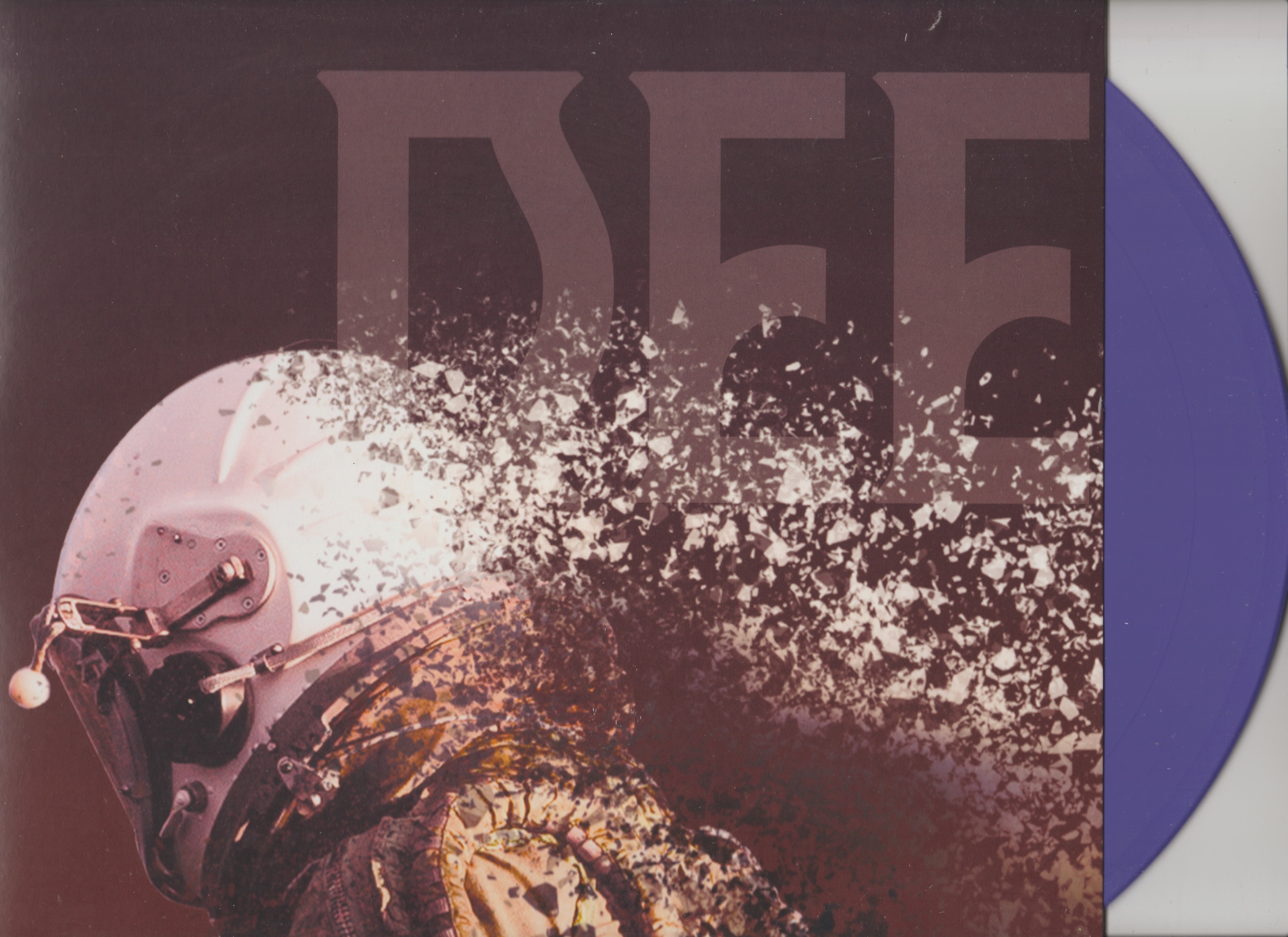
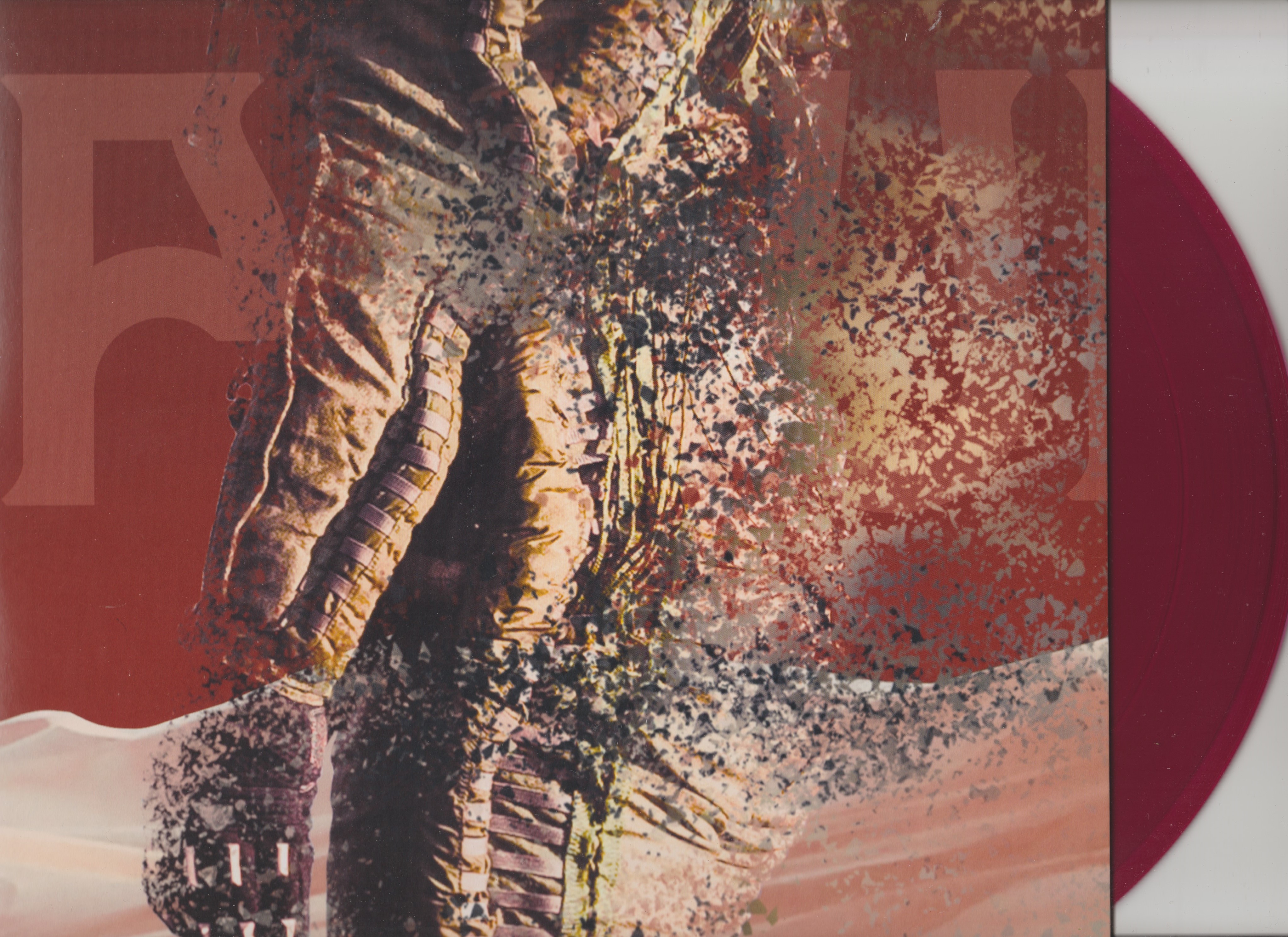
And so that’s it with =1; no bonus tracks this time. There is a deluxe box set with the first official release of a concert with Simon McBride, which we’ll get into on a separate review. Aside from the length, the only real complaint here is the minimalist artwork. The inner sleeve art is far more engaging.
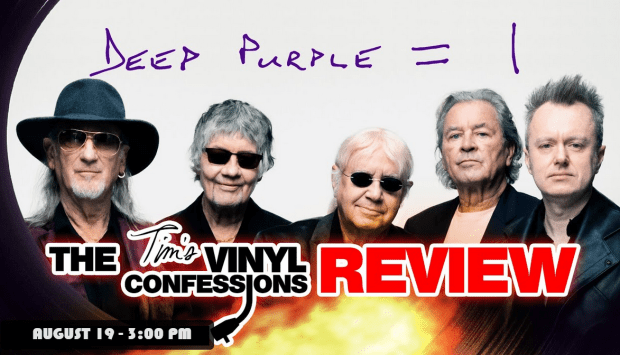
Deep Purple albums take time to absorb, especially in the current “Ezrin era”. The records are not lazy with simple songs (puns intended)! Tim and I attempted to break down the new album =1, track by track. We tended to agree on a lot of the songs.
What’s with the artwork? Is Simon a new Blackmore? What the heck is Ian Gillan singing about? Find out in this excellent episode of Tim’s Vinyl Confessions, out today.
My written review of the album will follow tomorrow morning, with the deluxe edition live discs getting the written review treatment in the coming weeks.
I’ve never hid my disappointment that Skid Row have been unable to hang into a lead singer for long since Sebastian Bach’s 1996 ouster. Johnny Solinger was their best shot at a permanent lead singer, since replaced by a dizzying array of vocalists. Erik Grönwall, from Swedish Idol and H.E.A.T., was probably the biggest hope. Sadly, as a cancer survivor, Erik was forced to resign and focus on his health. The one album he made with Skid Row, The Gang’s All Here, received critical acclaim in 2022 and was called Album of the Year by several outlets.
Erik Grönwall brings the necessary range and power, more so than Solinger. Unfortunately, both Solinger and Bach had a lot of character in their voices. Grönwall has a more generic sound, and this robs Skid Row of some of what made them special. He almost sounds too good, too professional.
A lot of people will disagree and that’s fine. We’re all entitled to our opinions.
Only two songs here, “Time Bomb” (sort of a punky rewrite of “Piece of Me”) and “The Gang’s All Here”, made it onto the tour setlist. 80% of the album was not played live. There are shout-along choruses, Kiss-like guitar licks, and Bolan’s bass bounce…but do the songs stick to the brain like albums of yore? Some do. The best moments are the ones that recall the past, such as “Resurrected” which has a “Monkey Business” familiarity. Unfortunately, the trite lyrics are another one of those “we’re back where we belong” kind of songs.
The strongest song is the ballad “October’s Song”, which comes closest to nailing the timeless Skid Row level of quality. Grönwall’s schooled approach to singing is opposed to Bach’s desperate passion to blow down the biggest of buildings, but that was a long time ago, and Bach is never coming back. “October’s Song” has some great riffage and should have been made a permanent part of the setlist. You’ll not find a better song among the new ones. We’ll say it right here: this song stands up against the back catalogue, even the intense Slave to the Grind ballads.
Credit due: Skid Row almost go activist on the environmental message song “World On Fire”.
Much of the album was written with previous singer Z.P. Theart, of Dragonforce. Core Skid Row members “Snake” Sabo, Scotty Hill, and Rachel Bolan handle the majority of songwriting, retaining Rob Hammersmith on drums.
If you want a new Skid Row album that you can pump your fist to, stomp your feet, or bang your head, then The Gang’s All Here is a must-buy. If you were hoping for a Skid Row album that you’ll remember for years like Slave to the Grind, Subhuman Race, or even Thickskin, then the jury is still out. Thickskin had way better songs – there, I said it!
DEEP PURPLE – Bombay Calling – Live in ’95 (2022 – Edel CD/DVD reissue)
Years ago, I begged for a CD issue of Deep Purple’s live DVD Bombay Calling. You could download the audio on iTunes and burn your own double live, which I did, but that just doesn’t do it for a physical product collector. I’ve made my case for physical product here over the years many, many times. Unfortunately, this physical release was pooched by Edel by excluding one song. Like similar CD bootlegs of this 1995 concert, the new Edel CD is missing the opening track “Fireball”! It’s still there on DVD, and it was always there on the iTunes edition, but it’s missing from CD 1. That’s a real shame since it’s a good version of “Fireball” and it’s the damn opener! (The original DVD of Bombay Calling was issued in 2000. iTunes got it in 2003.)
When originally released on iTunes, this was promoted as an “official bootleg”. Now it seems to be marketed as some kind of deluxe live album, limited and numbered to 10,000 CD/DVD sets. The hype sticker calls it “the best rock show ever staged in India.”
This concert was recorded on April 18 1995, which eagle-eyed fans will realize is well before thePurpendicular album. Bombay Calling was recorded not long after “the banjo player took a hike” and Purple ultimately carried on with Steve Morse for the next few decades. Joe Satriani stepped in for a short while, but it was Dixie Dregs guitar maestro Morse that took the Man in Black’s place permanently. This concert was recorded at the very start of Morse’s tenure, and features a few songs they would drop from the set a year or two later. It also features a brand new tune they were working on called “Perpendicular Waltz”, later spelled “The Purpendicular Waltz” on the album. The lineup was fresh, feeling each other out, but full of energy and the excitement of a band creatively reborn, both in the studio and on stage.
There is one earlier concert available from this period, which is Purple Sunshine in Ft. Lauderdale Florida, exactly two weeks prior. That one is truly is an official bootleg, taken from audience sources and released on the 12 CD box set Collector’s Edition: The Bootleg Series 1984-2000. The setlists are slightly different. When they hit India for this concert, a new song called “Ken the Mechanic” (retitled “Ted the Mechanic”) was dropped, as was “Anyone’s Daughter”. They were replaced by long time favourites “Maybe I’m a Leo” and “Space Truckin’” from Machine Head.
Special treats for the ears on Bombay Calling include Steve Morse’s incendiary soloing on “Anya” (which would be dropped from the set in 1996). His feature solo leading into “Lazy” is also excellent, and of course very different from what Ritchie used to do. Jon Lord’s keyboard solo is among the best I’ve heard, and even features a segue into “Soldier of Fortune” from Stormbringer. The solo segments that Deep Purple did often allowed them to play snippets from songs from the David Coverdale period of the band, and this one was unexpected and brilliant.
Highlights: “Fireball” (boo for excluding from the CD), “The Battle Rages On”, and “Anya”.
I love a good, raw live performance captured on tape, and Deep Purple don’t muck around. This is special, coming from that transitional period when Steve Morse was just getting his feet wet. Considering how different he is from Ritchie Blackmore, this smooth switcheroo is quite remarkable.
3/5 stars (subtracting half a star from iTunes edition, for losing a song)
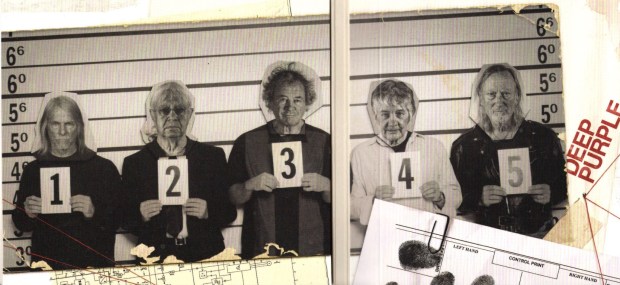
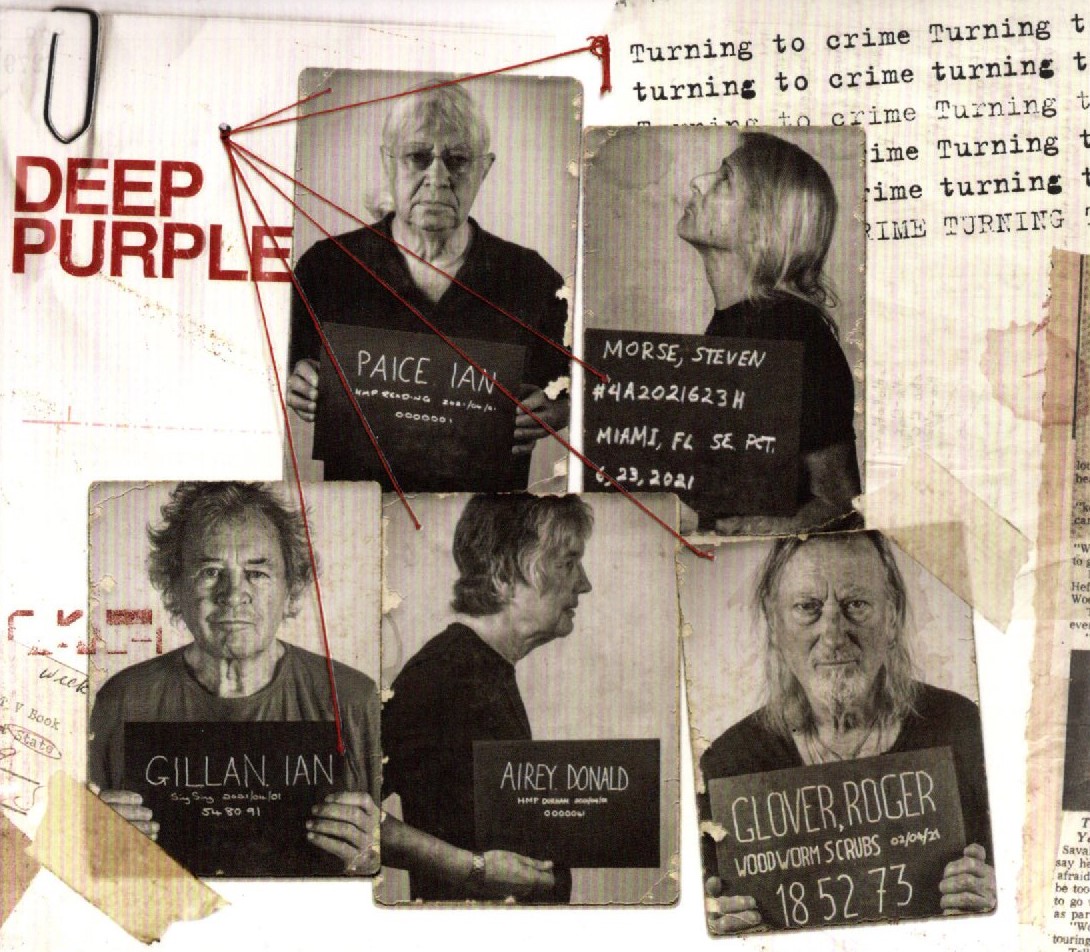
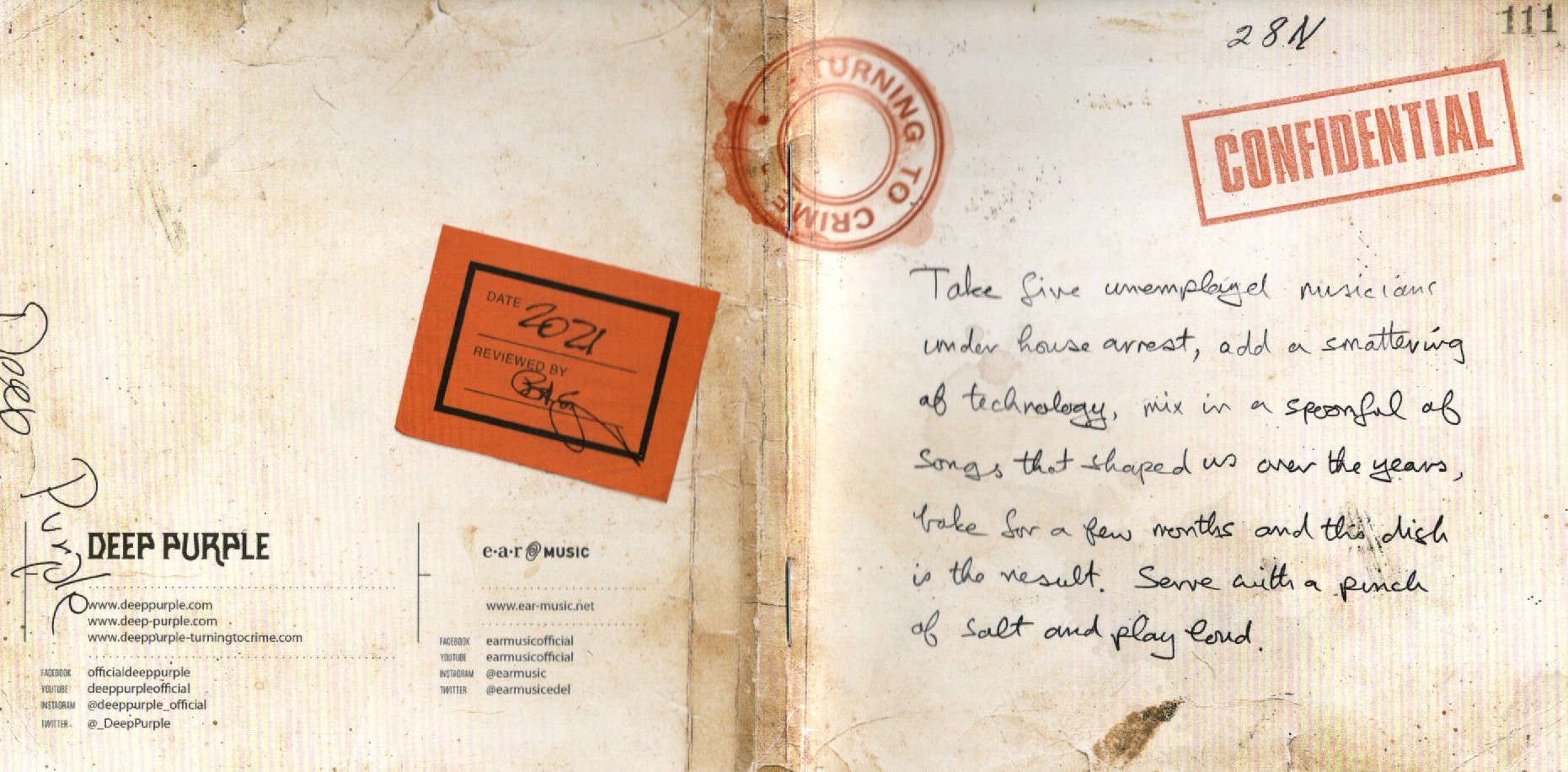
DEEP PURPLE – Turning to Crime (2021 Edel / mailing list bonus track)
Deep Purple are more known as the kind of band that people cover, rather than a band known for doing covers. Sure, “Hush” (Billy Joe Royal) was a hit. “Kentucky Woman” (Neil Diamond) was almost a hit. Their first three records are cover-heavy, but that was the 1960s. Live covers, like “Lucille” (Little Richard) or “Green Onions” (Booker T. & the M.G.’s) were more of an in-concert thing. Until the surprising inclusion of “Roadhouse Blues” (The Doors) on 2017’s InFinite.
Stir in another surprise: a worldwide pandemic! You get one of the world’s greatest bands doing a covers album to keep from going stir-crazy! Re-teaming with producer Bob Ezrin, the boys in Deep Purple decided to turn to crime and steal songs from other artists. With twelve tracks plus one bonus, it’s 53 minutes of Deep Purple doing their thang all over the oldies. How salacious!
The excellent packaging even tells you who did the original tunes if you didn’t already know. Love’s “7 & 7 Is” has been covered numerous times by our beloved rock artists, including Alice Cooper (twice) and Rush. Without comparing, the charm of Purple’s version is threefold: 1) Ian Gillan’s mannerisms on lead vocals, 2) Ian Paice’s pace, and 3) Don Airey’s quaint 80s backing keyboards. Not to be outdone, Steve Morse turns in a solo that can only be described as brief but epic.
Sax and horns join the for “Rockin’ Pneumonia and the Boogie Woogie Flu”, once covered by Aerosmith. You so rarely get to hear Deep Purple gettin’ down with a horn section (although they once did a whole tour based on that concept). It’s brilliant, and listen for a nod to “Smoke on the Water” in a musical Easter egg. “Rockin’ Pneumonia” is reminiscent of “Purple People Eater” from Gillan/Glover.
Like a polar opposite, Fleetwood Mac’s “Oh Well” is built tough and heavy. Morse plays the main blues riff on an acoustic, while Don Airey’s big Hammond roars behind. This smoker will sound great if Purple play it live. Meanwhile, 73 year old Ian Paice plays those drums like a berzerker.
Mitch Ryder & the Detroit Wheels were an influence on early Purple. Ritchie Blackmore confessed to appropriating their kind of beat for “Kentucky Woman”. You can absolutely hear that here on “Jenny Take A Ride!”. The two songs are connected via Purple’s playing. There’s also a mid-track segue into one of Gillan’s big influences, Little Richard’s “Jenny Jenny”.
Bob Dylan isn’t an artist you think of in conjunction with Deep Purple. “Watching the River Flow” has a beat you can get behind. Ian Gillan’s actually the perfect singer to do Dylan, isn’t he?
The horns return on Ray Charles’ “Let the Good Times Roll”. It sounds like “Deep Purple go Big Band”! Which is not a bad thing. Especially if you want a varied covers album. Airey and Paicey really go for that jazz band vibe. You can picture this one in a big smokey club somewhere in Chicago.
It’s Little Feat next with “Dixie Chicken”, a track we can assume came in via Steve Morse. Airey and Morse are the stars here, but as a cover it’s a little nondescript. The Yardbirds’ “Shapes of Things” is similarly like sonic colourlessness, though Roger Glover gets to shine a little. They can’t all be highlights on this album.
Speaking of album highlights, this one will doubtless be divisive. Some will think it’s too corny for Deep Purple, others will love the fact that it’s so different and Purple’s take is so original. Lonnie Donegan’s version of “The Battle of New Orleans” is the main inspiration rather than Johnny Horton’s. You can hear that in the beat. But what might really surprise people about “The Battle of New Orleans” may be the singers. For the first time, that’s Roger Glover up front. Ian Gillan, Steve Morse and Bob Ezrin are also credited singers. As for Purple’s arrangement, it’s jaunty and slightly progressive where the guitar is concerned. It’s certainly not pure country though it does have plenty of twang and fiddle. Crossover hit material?
The album has not necessarily peaked as there are still great tracks ahead. “Lucifer” by the Bob Seger System is right up Purple’s alley. Purple could easily put it in a concert setlist. It’s jam-heavy and sounds right at home. Another track in the same category is Cream’s “White Room”. Keen-eared Purple aficionados will recall Purple opened for Cream on their first US tour. Of course, only Ian Paice is still around from that tour, but he got to witness the original band play it every night. It’s certainly odd hearing a band that is clearly Deep Purple playing such a recognizable Cream song, but damn they do it so well! What’s amazing is these jams were recorded separately in home studios by family members.
The final track on CD and LP is “Caught in the Act”, a medley of famous songs that they Purple-ized. Many of these, Purple have played live such as “Going Down” and “Green Onions”. We’ll save some of the others as surprises. They finish the medley with “Gimme Some Lovin'” by the Spencer Davis Group, and it’s a totally smashing way to finish an album that was some massively fun listening.
But it’s not really the last track if you signed up for Deep Purple’s Turning to Crime mailing list. A specially numbered 13th track was emailed to those who subscribed. “(I’m A) Roadrunner” by Junior Walker & the Allstars is another horn-laden Deep Purple soul jam. Just drop it in the folder and it’s already pre-numbered as the last track on Turning to Crime. Great sax solo!
What you won’t hear on Turning to Crime are any of Purple’s earlier classical influences, for those members are gone. Nor will you get any Beatles whom Purple covered twice in the early days.
How many times will you end up reaching for a Deep Purple covers album to fill your speakers? Hard to say, but know this — you will enjoy it every time you do.
The Infinite Live Recordings, Vol 2. (3 x 10″ EPs)
DVD – Live at Hellfest, Roger Glover and Bob Ezrin in Conversation
Whoosh!
Every Deep Purple album seems like the final album. Maybe this one is; maybe it isn’t. It feels like the band treat every album as seriously as if it was their last. The cover art and music of Whoosh! takes us back to 1968 and Shades of Deep Purple. The logo is similar, and there is a new version of the 52 year old first Deep Purple song ever, “And The Address”.
Opening with the lead single “Throw My Bones“, the album sets a mid-tempo pace from the start. This is a lush, catchy groove with hints of classical and funk. It began life during the Infinite sessions but was not finished until Whoosh! Purple pick it up a bit on “Drop the Weapon”, a non-preachy appeal for cooler heads to prevail. It has a similar vibe to the 1988 album Accidentally On Purpose by Ian Gillan and Roger Glover. The immediate riffs and hooky vocals are bound to make this a favourite.
“We’re All the Same in the Dark” has a cool groove and a jaw dropping funky Morse solo. Purple haven’t sounded this funky since Glenn Hughes was in the band. Airey and Glover give it some heaviness. “Nothing At All” sounds like a Morse composition, but his intricate classical-inspired interplay with Airey is sheer delight. This could be the best track on Whoosh!, and contender for one of the best songs of the entire Morse era. A massive chorus could help this one cross over on radio. Though it’s a far different song, “Nothing at All” has elements that recall “Never A Word” from Bananas. A regal-sounding crowning achievement.
“No Need to Shout” opens with the growl of a Hammond. “Just a bunch a crap, you’re talkin’ out your hat!” sings Ian on a song featuring rare female backing vocals. This is one of a few new Deep Purple songs that display a pissed-off attitude. “I got your message loud and clear, the meaningless ringing in my ear.” Add in a couple naughty words and you can tell Ian isn’t having any of it. Cooler though is “Step By Step”, a very different kind of song with perhaps some lineage with “Vincent Price” from Now What?! The haunting, ghostly quality of “Step By Step” sets it aside with a cascade of keyboard accents.
Purple start to boogie on “What the What” (a friendlier way of saying “What the Fuck”). While Don’s hammering the keys, Steve stabs out with some tasty guitar twang. If any song recalls “old” Deep Purple, it’s “What the What”, which could have been on 1973’s Who Do We Think We Are! But that album completely lacks the joie de vivre of “What the What”. Then Purple get heavy on “The Long Way Round” which just drives. The keyboard solo is out of left field but is a spacey masterwork to itself. There’s even a sly Black Sabbath callback — “I promised myself I would not get Trashed again.” Then the song dissolves into a beautiful, quiet stream of notes. This serves as a great lead-in to “Power of the Moon”, an excellent track previously heard on the “Throw My Bones” single. It stalks prey in the cover of night.
Another heavy growl unexpectedly opens “Remission Possible”, an absolutely smokeshow of fretwork. It’s a brief instrumental interlude just before the excellent “Man Alive”. This track, enhanced by orchestra, sounds absolutely massive. It has serious heft, but it’s not weighed down. Ian is writing about some heavy themes and it will take deeper analysis of the album as a whole to decipher them all. Roger Glover was very happy with Ian’s writing on the album, which takes a more contemplative tone without going heavy-handed.
The final side of vinyl begins with another instrumental, the aforementioned “And the Address” from Shades Of. Deep Purple have occasionally re-recorded old material with new lineups, such as “Hush ’88” and “Bludsucker”. This cut of “And the Address” has more momentum. The only guy present who played on the original is Ian Paice, but Don Airey is a dead ringer for Jon Lord. “And the Address” is one of the most enjoyable songs on Whoosh!, probably surpassing the original recording.
There’s still one track to go: the “bonus track” called “Dancing In My Sleep”. Safe to say it’s called a “bonus track” because it’s the most different of all the songs. It’s an Airey conception based on a cool little techno beat. Though it’s certainly not dance music, it does have one foot in that world and it’s a sheer delight to hear Purple stretch out into new territory 52 years into their game.
A seriously fine album this late in the career. An album so fresh that it is hard to rate so soon. But clearly a high point, with a band still exploring new ideas completely unafraid of what people might say. In fact, a band who still has something to say. Something worth listening to.
4.25/5 stars
But that’s not all of course. Go big or go home. Check out the rest of the box set’s contents in detail below.
The Infinite Live Recordings, Vol. 2
The previously released Infinite Live Recordings, Vol. 1 came out in 2017. The concept behind the series is simple: pure live releases with no overdubs. Vol. 2 comes from a show in 2017 on the Infinite Tour in Rio. It is the big bonus in this box set, and present on a set of three beautiful 10″ coloured records. 72 minutes of live Purple — essentially, a double live album.
The opening thunder of “Highway Star” is robust on purple 10″ vinyl. How these guys can still blast through it full speed is unknown, but they do it. Mr. Gillan still gives it his all, which is not the same in 2017 dollars as it was in 1970 dollars, but still more than the average mortal his age. Mr. Morse and Mr. Airey give each version of “Highway Star” a different feel, while Mr. Paice in the back is the only original member left from the 1968 lineage. Sticking to Machine Head, Purple seamlessly go into “Pictures of Home”. The old familiar groove of Mr. Glover is comforting warmth from the emptiness, eagles and snow. Morse’s solo is a composition to itself, and then Airey gets to put his spin on Jon Lord’s classic organ solo. Then it’s an unfortunate side flip as the band goes back to In Rock with “Bloodsucker”. Gillian is more a verbal timekeeper than the screamer he once was, but the track is otherwise flawless and heavier than lead. A more mainstream hit, “Strange Kind of Woman” flows from that, and relaxes the groove a bit. Don Airey gets his first of two solos (this one organ) as the last track on this disc.
The action continues on transparent burgundy vinyl, and “Lazy”. Morse’s signature string bending is the star of this show. There are a couple different twists in this fresh version including a nifty Gillan harmonica solo. Then it’s the only new song of the set, “Birds of Prey” from Infinite. It’s weighty and worthy of its place. Steve Morse is the Captain on this flight. Gillan ends the track on a joke and then, after a side flip, introduces Don Airey’s keyboard solo including Ozzy Osbourne’s “Mr. Crowley”. This diverse and fun solo goes into “Perfect Stranger” (no “s”?) which has steadfastly remained in the setlist ever since its 1984 conception. Gillan is shaky but the Purple is solid.
The final vinyl, clear 10″ power, commences with “Space Truckin'” signalling the beginning of the end. “Smoke on the Water” is the penultimate moment, slow and groovy after all this blazing rock. Ian Paice has a couple nice moments on this one and Steve Morse’s stuttery solo is completely compelling. One more side flip, and Purple end the set with their first hit “Hush” and the “Peter Gunn” theme. Glover goes funky on this one with a bassline a little like “Another One Bites the Dust” in parts.
An entertaining and good live album, but one you won’t play often simply because Deep Purple have 846 live albums (exaggeration).
There is still more live material from the same tour in DVD form included in this box set.
Live at Hellfest
Next we have a double feature DVD: A live show from Hellfest in 2017, and an interview session with Roger Glover and Bob Ezrin. The Hellfest show has a much longer runtime with more new material. They open the show with “Time For Bedlam” from Infinite. Ian doesn’t even attempt to sing it in tune, but we’ll always cut the guy some slack for still getting up there and givin’ ‘er. The track has a “Pictures From Home” vibe, and the band look cool playing midday in shades. Into “Fireball”, Ian Paice leads the charge as if it was 1971. Don Airey has an Ozzy bobblehead on his keyboard! Then it’s “Bloodsucker”, powered by Paicey. “Strange Kind of Woman” is a nice melodic respite after a pair of piledrivers like that. Ian ends this one with a bizarre freeform spoken word beat poetry bit, but with Morse shredding next to him.
The Jon Lord tribute from Now What?!, “Uncommon Man”, is heartfelt, and a solid track from their current era. It sounds massive. As good in quality is “The Surprising” from Infinite, something of an epic, and performed with full gusto. Intricate symbol work by Paice.
After a brief pause, it’s on to Don Airey and “Lazy”. A high speed workout like that merits something slower to follow, so it’s “Birds of Prey” from Infinite, a steady groove with dynamics. Steve Morse’s solo takes center stage and it’s a melter. “Hell To Pay” picks up the pace. Not Purple’s most remarkable single, nor the best version, but nice to have in live form. Airey’s jammy keyboard solo on this track is stellar, just as the sun starts going down. Then he gets his own full-blown solo, with the Ozzy bobblehead there next to him during “Mr. Crowley”. Roger Glover just watches from the side as Don goes to town through familiar melodies and themes. The crowd eats it up smiling.
Don takes it into “Perfect Strangers” without missing a beat, and soon the rest of the band joins him. This version has some stellar Morse guitar trickery. The set is almost finished, with only “Space Truckin'”, “Smoke on the Water”, “Hush” and “Black Night” left to satisfy cravings for the classics. Even at the end Paicey still brings that thunder. “Hush” has the “Peter Gunn” theme attached, and “Black Night” brings the show to a massive finish.
It’s absolutely delightful watching Ian Paice play the drums, as he mouths along to every beat as if playing beatbox along to himself. It’s fantastic and an expression of pure joy.
It’s not over yet. The DVD has even more content.
Roger Glover and Bob Ezrin in Conversation
The DVD also includes the conversation with Roger Glover and Whoosh! producer Bob Ezrin. This is another full 70 minutes of content. Ezrin was involved with Purple from the jamming stage in Nashville and speaks in terms of “we”. One of the biggest takeaways from this interview is a piece of wisdom from the late Jon Lord as told by Roger Glover. Lord didn’t want to do more than two takes of a solo. More than that, and he starting thinking too much.
The pair discuss the lyrics, the songs, the title (nicked from Faulty Towers), the playing, and more. It’s lovely watching the pair just enjoy Steve Morse’s harmonics. “Like capturing lightning,” says Roger. Watching this portion of the DVD will enhance your enjoyment of the album. It’s fun knowing what parts of the songs turned on the musicians and producer. “Stretch out,” advised Bob. And so Purple interpreted that as stretching it out every way. “I wanna put the Deep back in Purple,” said Bob. The boys also praise Ian Gillan’s focus, from eating right to meditating. They even go back in time and talk about Glover’s joining of Deep Purple in 1969.
Ezrin particularly loved seeing magic unfold live before his eyes and ears, captured on tape. He is obviously a fan of Deep Purple as musicians and as people. Whether you can get into Ezrin-era Purple or not, there is real chemistry between band and producer.
You’ll probably only watch this conversation once, but you’ll be glad you did that at least. There is so much knowledge and history to absorb here that all fans are advised to give the whole thing a spin.
Summing up
The box set itself comes with a cool black T-shirt with the “strolling dissolving astronaut” graphic. This is the second album in a row with simple excellent art design for Deep Purple. The astronaut recalls the music video for “Knocking At Your Back Door” from 1984. He appears in numerous places in this set in different forms. There are three art prints (two 12×12 and one 12×6), and of course all this music! The vinyl copy of Whoosh! comes in a gatefold sleeve with credits and photos. It sounds phenomenal with plenty of bottom end. For lyrics, you’ll have to dig into the included CD copy.
Of course, if you don’t need all the extra live stuff and added goodies, you could just buy Whoosh! on CD, vinyl or download. It’s frequently said that the benchmark for Purple is Purpendicular. “Best album since Purpendicular,” fans often enthuse. Whoosh! could be the best album of the Ezrin era, and is a contender for best of the Steve Morse epoch. A serious fan will want the whole box with the three live 10″ discs. They are beautiful to look at and sound good on the turntable. Though the set is expensive, this is the kind of thing I’m willing to pay for.
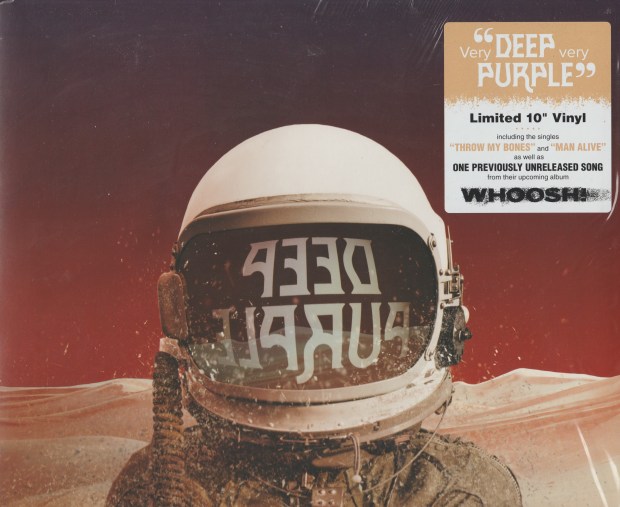
DEEP PURPLE – “Throw My Bones”/”Man Alive” (2020 10″ Edel single)
As a general rule, I won’t listen to new Deep Purple until I have a physical product in my hands. These days that usually happens in the form of a new single. Deep Purple will be back with a new album Whoosh! produced by Bob Ezrin in August 2020. Until then, they’ve issued a three track single with one exclusive new song. How nice of them!
A huge thanks to John of 2 Loud 2 Old Music for gifting this vinyl. Certain new releases are difficult to find today (for obvious reasons), at least without spending money on huge markups by secondary sellers. Music friends are the best kind of friends — make one today!
A word about the cover art: love it! Though not identical, the new Deep Purple logo is strongly reminiscent of the original Shades Of Deep Purple logo from 1968. The astronaut is similarly retro. He even recalls the similarly-garbed “archaeologists” in the music video for “Knocking At Your Back Door”. And now, for the first time, the needle drops on the vinyl and we find out what the new Deep Purple sounds like.
“Throw My Bones” has one of those quirky Steve Morse guitar riffs but then it’s backed up by those lush Don Airey keyboards. This is one of the catchier songs that Deep Purple have written in the last few years. Morse’s solo is as breathtaking as usual, but the sparkling keyboards are what makes this song shine.
The second track is the non-album “Power of the Moon” which prompts the question: if this didn’t make the album, just how good is the album? Because this track is excellent. It’s different. Its quiet passages are mesmerising. Once again it’s Morse and Airey who really take it to another level.
Finally we have “Man Alive”, a song adorned with an orchestra. Under the deft guidance of Bob Ezrin, something powerful and dramatic hits the ears even though Deep Purple don’t really do “heavy” anymore. “Man Alive” is the song that detractors call the “environmental agenda song”. Hey, if Deep Purple can say something relevant to today and get you to think, that’s great. We don’t always have to hear about strange kinds of women from Tokyo. The lyrics are assembled intelligently and thoughtfully.
A lot of people bitch and moan about Ian Gillan. For the most part, it’s not the singer delivering the hooks in these new songs. Just as Steve Morse has had to adapt to his damaged right wrist to keep playing, Deep Purple have adapted to Ian Gillan’s age. The songs don’t blast like they used to; they breathe. Ian’s voice is multitracked to give it some thickness. Incidentally the vocals were recorded in Toronto, a city that Gillan has history with.
Longtime Purple fans who enjoyed Now What?! and InFinitewill enjoy these new songs just as much. The cool thing about Purple is that they have distinct eras. We might be in the tail-end of a Bob Ezrin era (and the whole saga in general) and with time, the Purple/Ezrin collaborations will be looked back on fondly. The Ezrin albums don’t sound like the Bradford discs, the Glover productions, or any of the others. They’re more subtle and show a band growing even in their later years. Whoosh! could be a nice capstone to a career. We shall see.
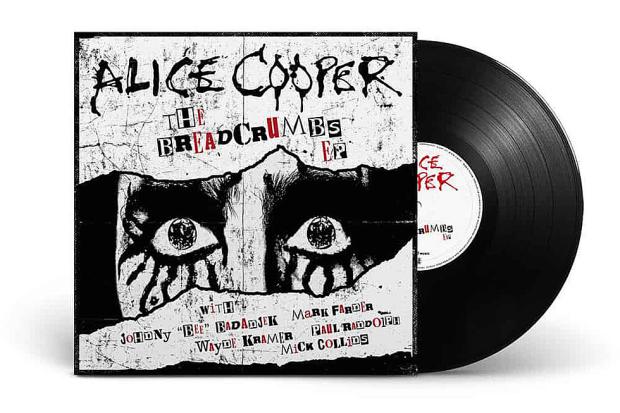
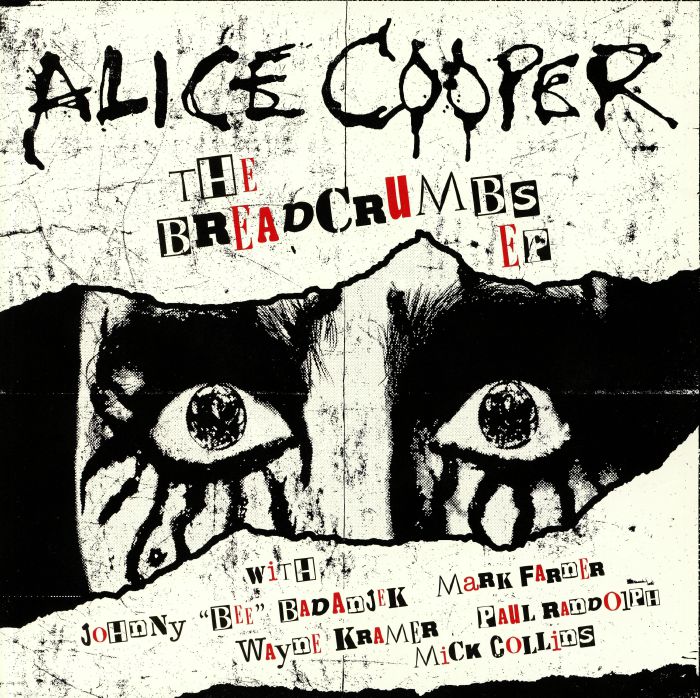
Alice Cooper wanted to do a Detroit garage rock record and pay homage to his roots. And so we have The Breadcrumbs EP, six tracks of stripped down goodness, ironically produced by Bob Ezrin. The 10″ vinyl is limited to 20,000 copies. Somehow, by the grace of the black widow, we scored #48!
For these special songs, Alice is backed by the MC5’s Wayne Kramer, bassist Paul Randolph, Grand Funk’s Railroad Mark Farner, and Detroit Wheel Johnny “Bee” Badanjek. A remake of Alice Cooper’s “Detroit City” (from The Eyes of Alice Cooper) is an appropriate starting point:
Me and Iggy were giggin’ with Ziggy and kickin’ with the MC5, Ted and Seger were burnin’ with fever, and let the Silver Bullets fly, The Kid was in his crib, Shady wore a bib, and the posse wasn’t even alive.
That’s some rock and roll poetry right there. Not one of Alice’s finest songs but worthy of a second chance. Then “Go Man Go” is a new original composition co-written by Wayne Kramer. It’s punk rock Alice, as authentic as the bands he’s paying tribute to. Bob Seger’s “East Side Story” closes the side on a steady groove, right out of Hendrix’s version of “Gloria”.
A really funky “Your Mama Won’t Like Me” (Suzi Quatro) is the centrepiece of the EP. Horns blastin’, Alice hasn’t been this funky since his dance-oriented Alice Cooper Goes to Hell in 1976. “Devil With a Blue Dress On” (Mitch Ryder and the Detroit Wheels) is the soulful side that Alice occasionally shows. It’s merged with “Chains of Love” (J.J. Barnes) which pulls everything back to rock. Finally “Sister Anne” by the MC5 puts the snot on the nose and the grime in the rock. Kramer’s simply awesome riff is perfectly complemented by Cooper.
If copies are still available, get one. Cooper fans will love the change of pace, while rock and rollers will adore the authenticity.

 DEEP PURPLE – =1 Access All Areas (2024 Edel DVD)


















 mikeladano.com