
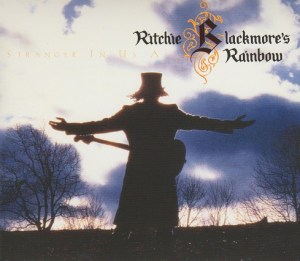
 RITCHIE BLACKMORE’S RAINBOW – Stranger In Us All (originally 1995, 2017 Sony expanded edition)
Blackmore said “adios” to Deep Purple for the second and final time in 1993. He beat them to the punch with new music, in the form of a resurrected Rainbow…sort of. As he is prone to do, Blackmore assembled an all-new Rainbow of unknowns. The only familiar face was bassist Greg Smith who happened to be in Alice Cooper’s band when Wayne’s World was filmed. The new singer was the smooth-voiced Scot, Mr. Doogie White. White’s career almost broke in a completely different direction earlier, when he was one of two finalists in the running to replace Bruce Dickinson in Iron Maiden. It went to Blaze Bayley. Signifying new beginnings, Blackmore reverted the band’s name to Ritchie Blackmore’s Rainbow once again.
Back in 1995, my impressions of Stranger In Us All, the new album by Blackmore’s Rainbow, were significantly underwhelming. It has taken its time, but over the years the album slowly penetrated my stubborn refusal to accept it as legitimate. By now I think we know all Rainbow needs is the Man in Black. And there he stands on the front cover, pilgrim-hatted again, gloriously silhouetted against a cloudy sky.
The only serious weakness in Stranger In Us All has nothing to do with the lineup. The production (by Pat Regan and Blackmore) sounds low budget and the drums sound muddy. Blackmore’s guitar tone is thankfully impeccable and his neo-classical leanings on the first track “Wolf to the Moon” were refreshing. “Wolf to the Moon” is one song that has stood the test of time. It is thoroughly still enjoyable today, and Blackmore is unleashed. And the singer? It is true that Doogie White stands in the shadows of some great lead vocalists. I’ll resist ranking and comparing. White has a very smooth voice with impressive power and range, and he doesn’t sound like any of his predecessors. Where White really impresses is in live renditions. He is an entertaining and amicable frontman.
Track two brings a slower grind to Rainbow, and White slinks along with him, adapting perfectly to every vibe. Going slower still, “Hunting Humans (Insatiable)” really prowls. It is spare, dark and sweaty. Moving on to inspirational hard rock, Rainbow brings the harmonica-inflected “Stand and Fight”. What is not to like?

Rainbow ended the first side in typically epic fashion. “Ariel” was quite a track, featuring backing vocals from the lady who is now Ritchie’s wife, Mrs. Candice Night. She co-wrote a number of the album’s tracks including “Ariel”. This kind of thing is Ritchie’s bread and butter, he’s been writing epics like this since “Child in Time” back in 1970. As an added bonus, the extended edition of Stranger In Us All has the single edit of “Ariel”, trimming it to a tidy format-friendly 4:00. This is more like a re-edit, moving parts around and making it more compact.
They step on the gas again for “Too Late for Tears”. Side two has a couple “stock” rockers — “Too Late for Tears” and “Silence”. Good blood-pumping tracks, nothing to save for your greatest hits album, but decent enough. “Black Masquerade” is better, as it has a dark neo-classical edge. Thing go kind of goofy when they cover Grieg’s “Hall of the Mountain King” and add lyrics. They also have another go at the Yardbirds’ “Still I’m Sad”, this being the second time. The first Rainbow version was an instrumental. This one has vocals, and it’s pretty good. Just like with lead singers, I don’t think it’s worth comparing this version to the 1975 one. It’s unique enough that it’s almost two different things.
Back in 2013 I found the Japanese edition of Stranger In Us All at the 2013 Toronto Musical Collectibles Record & CD Sale for $15. Instant no-brain purchase right? Now that this expanded edition is out, I no longer need it in my ever-expanding collection. I am passing it on to massive Rainbow fan Brian over at Boppinsblog. Now that CDs are worth nothing, I like to pay it forward with my retired music. The expanded edition contains the Japanese bonus track, “Emotional Crime”. It has a cool, “smoove” groove and a bluesy feel. Think Purple’s 1988 remake of “Hush” in terms of vibe. The other extra tracks are the aforementioned “Ariel” edit, and a live take of the old Rainbow classic “Temple of the King”. This is and the “Ariel” edit are taken from the old out of print CD single. “Temple of the King” was recorded in Stockholm October 2 1995, meaning it is not the same as the one on the double live CD Black Masquerade. That was recorded exactly a week later in Germany. (Thanks to Scott the Heavy Metal Overlord for pointing this out.) It’s a brilliant arrangement giving Candice Night and Doogie White a chance to harmonize over a very quiet backdrop. The Man in Black whips out a solo that surely must be considered one of his most passionate.
That’s how this version of Rainbow succeeds — by a putting a fresh spin on it. You avoid trying to compare to other versions of the band and just enjoy. Ritchie reveals in the extensive liner notes that he wanted to call the band Rainbow Moon. And speaking of the liner notes, there are also recollections from Doogie White. In short this expanded edition is worth every penny, even if you’ve bought it before.
3.75/5 stars




 mikeladano.com