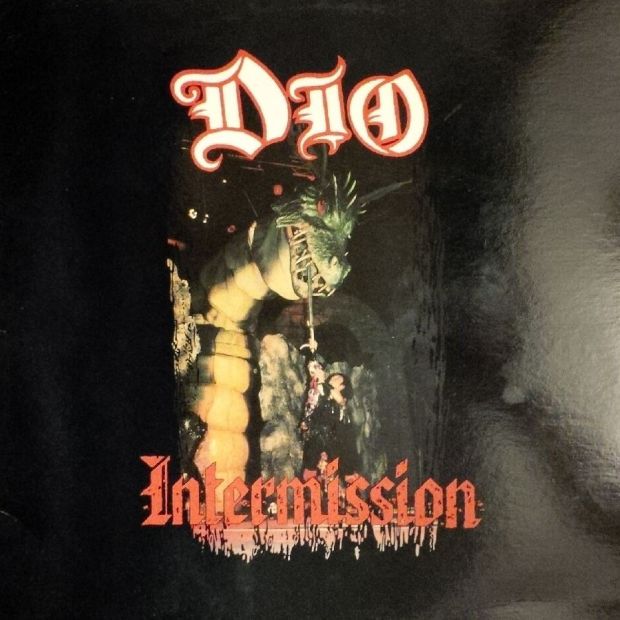
Intermission was Dio’s live EP, bridging the gap between Sacred Heart and Dream Evil. At the time it came out, Dio was very busy with the Hear N’ Aid project as well as replacing Vivian Campbell on guitar. Maybe that’s why he opted for just a Dio EP to tide fans over. For a long time this unavailable on CD; it has recently been reissued in its completion as bonus tracks on the deluxe edition of Sacred Heart. Good news, I’m sure, for those fans without the equipment to play vinyl.
The band was in a transitional period. They had recorded the five live tracks with Vivian, but replaced him with Craig Goldy in the middle of the tour. For years, fans were wondering who played on Intermission. Goldy’s picture is on the back, but the solos are clearly Vivian. There were no credits either, but today we know that Vivian is indeed the guitar player on the live tracks. And so is Craig! They overdubbed Goldy over Campbell on the live rhythm guitar parts! Why he decided to do this, aside from spite, I have no idea, but I strongly dislike tampering with live recordings. (Yes, that makes me a hypocrite since I rated Kiss Alive! a 6/5!)
Goldy plays all guitars on the soul newbie, “Time To Burn”. This new studio cut was a really excellent one; a mid-tempo burner (no pun intended). He co-wrote it, probably contributing that cool riff. The song has melody to spare and is definitely a diamond among Dio’s early solo material. It sounds similar to the Sacred Heart era, but with a higher level of songwriting quality.
As far as I’m concerned, they may call it an EP, but this is essentially an album, clocking in at 32 minutes. That makes it slightly longer than Van Halen’s Diver Down. It may only have six tracks, but one is a 10 minute medley of Dio and Rainbow classics. “Man on the Silver Mountain” sounds incredible; Ronnie was singing powerfully on this tour, and despite the tampering the band does sound great.
The Dio songs sampled here include obvious choices like “We Rock” and “Rainbow in the Dark”, but the two biggest hits (“Holy Diver” and “Last in Line”) are absent. Diligent fans already had live versions of those two on the last Dio single B-sides. The more puzzling inclusion is “King of Rock and Roll” which was already released live on the last album! Ultimately though I’m satisfied with the songs selected on this EP. The vinyl used to be frequently played around these parts, though it has no been collecting dust since the reissue of the songs on the deluxe Sacred Heart. It remains a great sounding mini-album, if you will!
Thanks for joining me this week for Purple Week at mikeladano.com. Today is Part 5 and the last album for now. But don’t worry, I don’t think we’ve seen the last of Deep Purple around these parts…
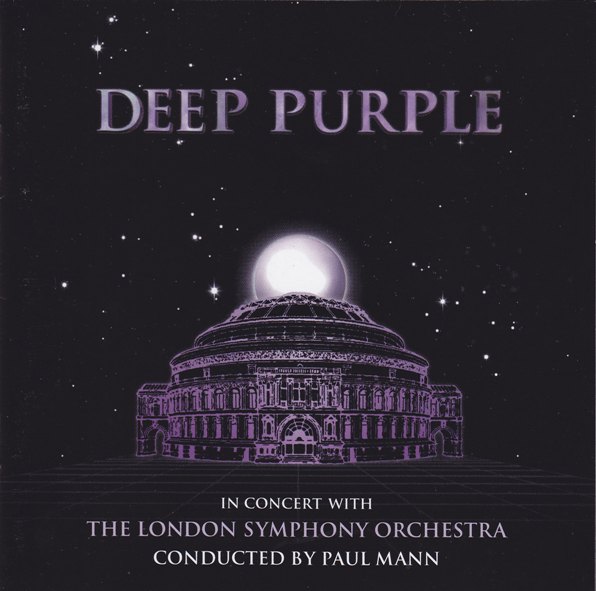
DEEP PURPLE – In Concert with the London Symphony Orchestra conducted by Paul Mann (1999 Eagle Records)
The original Concerto for Group and Orchestra (1969) was Jon Lord’s baby. The rest of the band didn’t care too much for it, and it had only ever been performed twice. The Albert Hall recording became a successful live album, and it was performed once more in Los Angeles. Soon after, the original score was lost, permanently. Even if Deep Purple wanted to (and let’s face it, if Blackmore were in the band he’d probably say no), it could never be performed again without the sheet music.
I’ll let Jon Lord take it from here. From the liner notes to the CD:
“Marco de Goeij, a young Dutch composer…had decided to re-create it by listening to the recording and watching the video. Over and over and over again. A task of mind-bending complexity, dexterity and musicality, which then only left me the far simpler job of filling in what he had been unable to decipher, re-creating what I could remember of my original orchestration, and in part, as those who know the work will hear, re-composing where I felt it needed it.”
Conductor Paul Mann had independently been searching for the original lost manuscript. When Jon informed him of the re-created one, Mann was on board with the London Symphony to do it once more. Deep Purple now had a new guitar player, Steve Morse, who undoubtedly would have to bring his own slant to the guitar solos. For Jon and the fans, it’s the stuff of wishes come true.
Since the Concerto was really Lord’s project, it seems like a fair compromise for each of the members of Deep Purple to also get a moment or two to showcase their solo work. In fact many musicians from those solo works are welcomed to the stage, including the Steve Morse Band, Ronnie James Dio, Mickey Lee Soule (ex-Rainbow and ex-Gillan), Sam Brown, and more. Deep Purple fans are generally open to different styles of music, and this album showcases those styles in a professional, classy format.
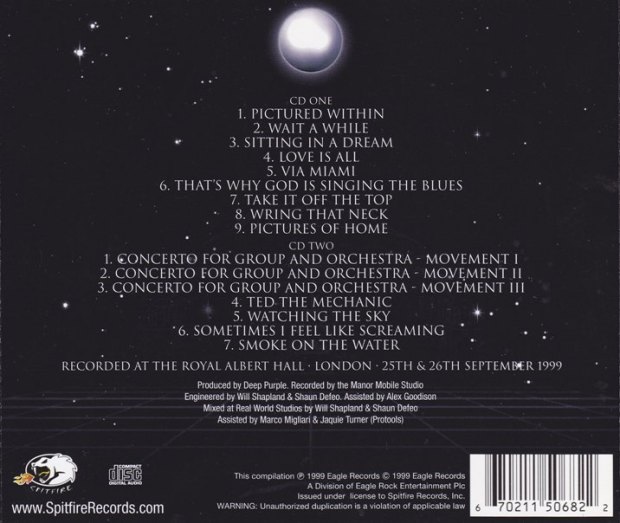
Once again at the Albert Hall, the set commences with a disc highlighting the solo careers. Lord’s “Pictured Within” (with Miller Anderson) and “Wait a While” (with Sam Brown) begin the proceedings with a quiet, powerful pair of songs backed by Jon’s piano and dramatic strings. These versions are, dare-I-say-it, superior to the original studio versions.
From there, Roger Glover’s solo career gets a looksee, with “Sitting in a Dream” and the irresistibly bouncy “Love is All”, my favourite. Ronnie James Dio reprises his vocals from the original Butterfly Ball versions, sounding as great as he did nearly 30 years prior! It really is impossible not to like “Love is All”, which of the two is especially fun.
In 1988, Ian Gillan and Roger Glover did a project together called Accidentally on Purpose, a quirky tropical pop rock album. “Via Miami” is one of the more upbeat tracks from that album. Ian’s “That’s Why God is Singing the Blues” features his solo band’s guitarist Steve Morris (not Morse!) Both it and “Via Miami” spark and roll along joyfully.
Steve Morse (not Morris!) is up next with the Dixie Dregs’ “Take it Off The Top”. It’s the Steve Morse Band and the Kick Horns. It’s always a pleasure to listen to Dave LaRue, Van Romaine, and Steve Morse playing together, but to hear them at the Albert Hall? That’s a venue suitable to the genius they wrench from strings and wood. Graham Preskett joins on violin to dual Morse with string acrobatics.
Ian Paice’s spotlight song is a horn-laden jazz version of Purple’s “Wring That Neck”. This is my kinda jazz, the kind with a rock beat you can swing to! The violin solo lends it a bluegrass feel, too. The first CD ends with a powerfully heavy “Pictures From Home”, originally from the immortal Machine Head record, performed by Deep Purple with the London Symphony. It’s a powerful, dramatic song on which for the full Deep Purple to enter.
Disc two features the entire Concerto from start to finish, all three movements, roughly 50 minutes in length. This truly was Lord’s baby, the piece that kept him up nights in 1968 and 1969 writing little black notes on white paper. It made Deep Purple a unique property when it was released on LP 1969, but had not been heard live in 30 years. Purple fans will be in seventh heaven with this de-extinction. Indeed, Morse’s guitar is different, but he hits the right notes at the right time while still playing within his style. Otherwise, I’ll be damned but I can’t tell the difference.
What can I say of the Concerto itself? I think it’s pretty cool, and I’ve always geeked out to stuff like this. Jon envisioned it as “rock band meets orchestra” — at first they say hello, and play around, then they start shouting at each other, and before long it’s all-out war! Speaking of shouting, my favourite is probably Movement II, which has Gillan’s all-too-brief but oh-so-perfect vocal.
The disc concludes with three more (three Morse?) of recent vintage. “Ted The Mechanic” and “Sometimes I Feel Like Screaming” are two of the best songs from Purpendicular, and “Watching The Sky” is probably the heaviest song from Abandon. I personally feel that all the Abandon material was better live than on album, and “Watching The Sky” maintains that. Unfortunately none of the Abandon songs were really that great.
Of course, “Smoke On The Water” ends the album with guests returning, including Ronnie James Dio who takes a verse. “What do you think Ronnie!” Then the Elf himself is up at the microphone singing “Smoke on the Water” with Blackmore’s old band Deep Purple. I shouldn’t need to tell you that this is one of my all-time favourite live versions of “Smoke”.
This album, which ended up being one of Lord’s last with Purple, was really a special gift to the fans. It is a beautifully crafted live performance containing some of the rarest of the rare gems in the extended Purple canon. An event like this will never happen again. There is a DVD of this show, but beware, it is only about 2/3 of the set. What a disappointment that DVD version was. You want every moment, but you won’t get it.
If you do hunger for more after this, then you can binge on The Soundboard Series 12 CD boxed set. It consists of 6 shows, two of which featured full live performances of the Concerto, with guests such as (yup!) Ronnie James Dio. There is also Live at the Rotterdam Ahoy which lacks the Concerto portion, but makes up for it with a more extensive set of classic rockers, including Dio’s own “Rainbow In The Dark” and “Fever Dreams”!…But that’s another review.
5/5 stars. For the true fan, and anybody who’s not afraid to expand their listening territory.
It’s Purple Week at mikeladano.com! It’s all Deep Purple and Deep Purple alumni, all week. This is Part 4…and once again we’re going Epic Review Time. It’s Deep Purple Mk III’s lead throat, David Coverdale & Whitesnake! This is almost a new release; it’s about four months old.
WHITESNAKE – Live in ’84 – Back to the Bone (2014 Frontiers Deluxe edition DVD/CD)
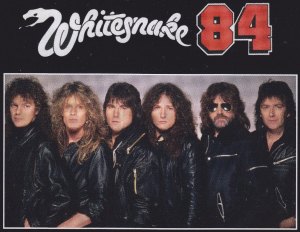
David Coverdale has been pretty good to the fans, in terms of giving them live archival releases from the periods they care about. In addition to cranking out studio and live releases with the current Whitesnake lineup, David has issued deluxe editions of certain albums along with the long awaited 3 disc set Live at Donnington 1990. Now it’s the 30th anniversary of the Slide It In album, so David has issued a live retrospective set from that period too. A CD and DVD set documenting the John Sykes years is almost a guaranteed slam dunk in itself, but how does it stack up when we break it down? Let us take a look at the DVD and CD portions in detail.
Super-Rock Japan ’84
The main program of the release is on the DVD, and the main focus of the DVD is Super-Rock Japan ’84. It is an 11 song set taken from Japanese television. This is the legendary four-piece lineup: David Coverdale, John Sykes, Cozy Powell, and Neil Murray. There is no doubt that even though the band had been trimmed down, they sounded powerful. I just really hate when an interview is inserted right between the first and second song. There’s no reason to ever interrupt a song on a live video, but editors do it all the time! It’s interesting seeing Whitesnake in a single-guitar lineup, but there is obviously a backstage keyboard player (Richard Bailey). The chops of John Sykes are such a welcome addition to the Whitesnake sound. He has a “chug” that few other guitar players have. Cozy Powell is as on-point as ever, but David Coverdale’s young lungs are remarkable. At peak power, David prowls the stage and humps the microphone in complete control.
The highlight of this portion of the set is “Crying in the Rain”, almost but not quite like it would be performed on Whitesnake 1987. I also enjoyed Sykes’ guitar solo. Sykes makes some of the best guitar faces in rock, and he resembles a young David St. Hubbins with his shaggy mane. “Soldier of Fortune” (an abridged version) was a pleasant surprise. On the other hand, Cozy’s looong overblown drum solo would be more appropriate to his time in E.L.P. (Emerson Lake & Powell). David must have been taking care of business backstage.
The video quality here is very good for an 80’s television broadcast. Sound quality, also good. David states in the liner notes that they weren’t able to find the master audio tapes, so this hasn’t been touched up too much. I’m satisfied; in 1984 we didn’t have 1080p TVs in widescreen.
Only three songs from this were included on the CD: “Love Ain’t No Stranger”, “Ready An’ Willing”, and “Slow An’ Easy”. That’s too bad. I would have paid a little more to get a 3 disc version with a full CD of this show. Just sayin’.
Jon Lord’s Final Whitesnake Performance
The passing of Jon Lord has been the biggest loss in rock, in recent memory. This truly is a treasure. From Swedish television and shot with multiple cameras, this looks even better than the Japan footage. Shame it’s only four songs. To have Jon there raises the bar several notches. It’s a five-piece lineup, although the cameras spend so little time on Jon that you’d wonder if the keyboardist is offstage again! (Jon’s wearing a white shirt in a black-topped band; he should be easy to spot but he’s not.) “Gambler” goes directly into “Guilty of Love”, and it’s so strange to hear it with only one guitar. With guys like Sykes and Powell in the band, they are very active on stage and the energy is plentiful. “Love Ain’t No Stranger” is so much better with Jon than without. You cannot understate how much difference that big bad Hammon organ makes. Then David tells the audience that they are “Ready An’ Willing” for some sweet satisfaction! From this brief four song set, I can at least conclude that Swedish television in the 80’s was better than Canadian television. Strangely, on the CD, it is included as one solid 16 minute track with no breaks.
Slide It In Slide Show
This is actually a cooler feature than you might think. These contain some snippets of writing demos for Slide It In. In some, David’s talking to someone, and there’s a single guitar. In others there is a full band, but the lyrics are not there yet. You can hear some of the classic riffs taking shape. The rest of the audio has vintage interviews with David and live music. Unfortunately at times the “slideshow” portion of this turns into little more than a lyric video, defeating the purpose of having a photo slideshow. The real treasure here is a live version of the B-side, “Need Your Love So Bad”, with just David and Jon. I am disappointed that it is not on the CD. Something that rare really should be.
Snakeskin Boots: The Best of the Bootlegs
The main feature on the CD consists of bootleg and soundboard tapes. I love bootleg recordings, and who can fault a band for beating the bootleggers and releasing the tapes officially? Tapes were cleaned up as much as possible to make them listenable (David suggests the car as a good setting). These songs were sort of arranged in the order of a live concert, so it still begins with “Gambler” and “Guilty of Love” like all the other sections. “Gambler” sounds pretty good, only slightly muffled but with a hard pulse. Sykes’ solo on “Guilty of Love” sends electric chills up the spine. It’s great to hear the band so young and ferocious!
Cheeky David tells the crowd that the Slide It In album title does not refer to a banana! “Love Ain’t No Stranger” is always a pleasure to hear, especially sung by a young David, and Sykes is shreddin’. Then another cheeky intro: “I’d like to give you a toast. If it’s in deep, and if it’s in long, and if it’s in hard…it’s indecent!” That has to mean “Slow An’ Easy” is up next. I will never tire of this excellent song. “Walking in the Shadow of the Blues” is a nice surprise, but “Ready An’ Willing” is overplayed.
Sykes is given a couple minutes on his own to introduce “Crying in the Rain” with some bluesy soloing. As great as this song is, this long version makes it clear why Whitesnake is a two guitar band. They sound very bare when John again takes a long solo in the middle, and Neil Murray is left to fill the space. David always wanted two guitar players, while John would have preferred not to share the spotlight. “Soldier of Fortune” closes this portion of the CD, a nice version of the old Deep Purple classic.
The rest of the CD is dedicated to the three tunes from Super-Rock Japan that they chose to include, and the four songs from Jon Lord’s final Whitesnake show. If you have a look at the tracklist you’ll notice that this means there’s a lot of repeat.
In closing
None of Coverdale’s archival releases or deluxe editions have been perfect. Live in ’84 – Back to the Bone is probably the best of them yet.
Deep Purple were the proverbial candle that was burned at both ends. Their first four studio albums (plus a friggin’ concerto!) were cranked out in a mere two years. Management and record labels pushed the band to stay on the road, only taking precious breaks to write and record new music. Sometimes the pressure worked (Machine Head) and sometimes it didn’t (Who Do We Think We Are). Ian Gillan’s resignation signaled the end of the celebrated Deep Purple Mk II lineup. Though the band successfully carried on with David Coverdale & Glenn Hughes, even those lineups imploded and by 1976, Deep Purple officially ceased to exist.
The absence of Purple created a void that was filled by greatest hits records, live albums, and well-known side projects such as Ritchie Blackmore’s Rainbow, Gillan, and Whitesnake. Still, there was such a demand for Deep Purple itself that original singer Rod Evans put together his own bogus “Deep Purple” and played several shows in 1980! In his band were a couple guys from Iron Butterfly, but no other former Purple alumni. Just Rod. The guy who didn’t sing “Highway Star”, “Smoke on the Water”, or “Lazy”. Needless to say, Rod Evans’ bogus “Deep Purple” did not last as soon as word got out. The lawyers for the other former Deep Purple members ensured that by running ads in the local papers. “The following members will not be appearing with the band called Deep Purple at [such and such a date and venue] : Ritchie Blackmore, Ian Gillan, Ian Paice, Jon Lord, Roger Glover, Glenn Hughes, David Coverdale.” A show in Montreal was particularly horrid, and reportedly the band’s stage act involved one of the members bringing out a chain saw to cut stuff up. They were hit with lawsuits galore and quickly packed it in, but not before recording two new songs for a projected new “Deep Purple” studio album. The two songs, “Blood Blister” and “Brum Doogie”, are thankfully lost. A video of “Smoke on the Water” live in Mexico remains, to remind us why this was not a good idea. [For more on the bogus “Deep Purple”, click here.]
Clearly, lots of profits were to made if the real Deep Purple were ever to reunite. They tried earlier on, but were hung up when Ian Gillan joined Black Sabbath. When Ian’s Sabbath commitments were finished a year later, it finally happened. Jon Lord had freed himself of Whitesnake, and Ritchie, Roger Glover and Ian Paice were all ready willing and able. The reunion was on, for real this time.
The band quickly agreed on creating new music (otherwise, what’s the point of it?), and decided that there had to be a level of quality that served the name Deep Purple. They retreated to the gorgeous Stowe, Vermont and found themselves to be in great spirits and full of ideas. Another wise decision was the use of bassist Glover to produce. After his first stint in Purple, he became quite successful as a producer. He recorded some of the best Nazareth albums, a Judas Priest record (Sin After Sin) , Rainbow, David Coverdale, and countless more. It only made sense to keep production of the new album within the band when you have a guy like Roger in the band!
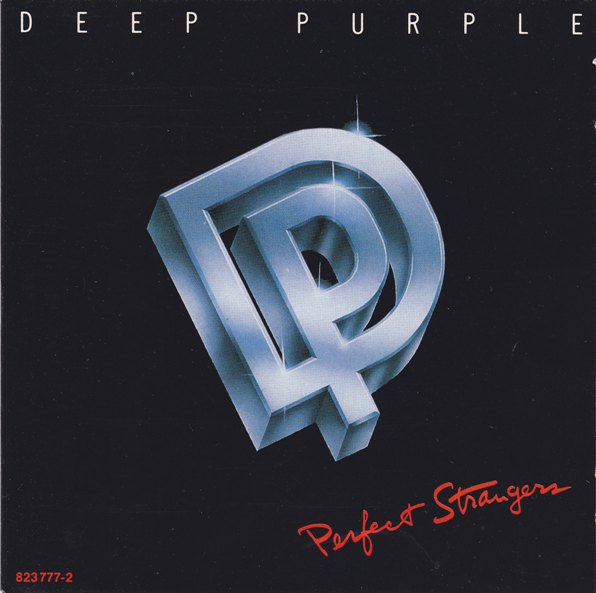
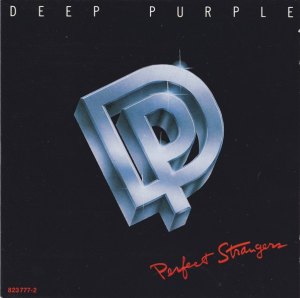
The album that resulted, Perfect Strangers, was more modern but unmistakably Deep Purple. Taking advantage of modern recording studios resulted in an album with rich instrumental tones. As great as classic Deep Purple albums were sonically, Perfect Strangers has a new richness and clarity. Jon’s organ is deep and gorgeous, but Ian Paice’s drum sound is monstrous.
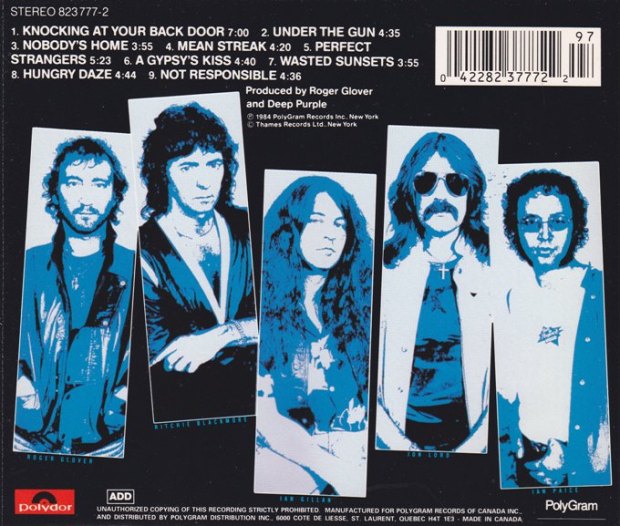
The opening track “Knocking at Your Back Door” (hah hah hah) commences with ominous keys from Jon, sounding at first like the pipes of doom. Then Roger begins a quick pulse, and Paice crashes that cymbal, and my God, Deep Purple is back! Ritchie and Ian join them for the first Deep Purple epic of the album — and on the first track, no less! “Knocking at Your Back Door” may be a joke lyrically, but it’s dead serious musically. It’s Deep Purple, but streamlined. Extraneous things have been discarded; others are sleeker. The only disappointment about the song is actually the guitar solo, which just slightly does not fit. Glover once said about this album that Ritchie struggles with solos in the studio more so than live. Something about when the red light goes on, he gets cold feet. There’s some incredible playing in this guitar solo, but parts of it feel out of place and overdone.
That one minor complaint is probably the only quibble you’ll read here about Perfect Strangers. The album continues to impress as it plays. “Under the Gun” is a song that would sound so great live today; shame that it hasn’t been played live in 30 years. I can’t imagine why. “Under the Gun” demonstrates the streamlined groove that Purple were going for in the 80’s. Listen to Paicey’s drums. They are relentless and powerful, but he’s also playing it simpler than he used to. This is intentional. When I say “streamlined”, that doesn’t mean there aren’t long solos, because Ritchie’s here is over a minute long (in a 4:34 song)!
“Nobody’s Home” gives Jon Lord a change to stretch out a bit on the synths, but it’s just a feint. This track re-writes “Black Night” for 1984, and ties it all up with a little bow in under four minutes. “Your lights are burnin’ bright, but nobody’s home!” sings Ian, for once not speaking of Blackmore! Jon takes the spotlight with a nice quick solo on the Hammond, a sound not often heard in ’84.
Side one was closed by the nasty little “Mean Streak”. It has one of those quirky Gillan lyrics that I like so much. “She came home last night, rockin’ rollin’ drunk. She talk no sense but she sound good so she thunk.” It’s a cool rock track with a chugging riff; always a deadly combination when wielded by Deep Purple. It boasts one of Ritchie’s coolest solos on the album.
I will never forget seeing this video on MuchMusic, introduced by Bruce Dickinson. Of Deep Purple he said, “Well, they’re very good. But not as good at football as they appear. No. They’re not.” The VJ (Erica Ehm) asked, “Why not?” Dickinson simply responded, “Because they’re not! What a silly question.”
Of all the songs on Perfect Strangers, only one has been consistently played live every tour: the title track. This epic, like its side one counterpart “Knocking at Your Back Door”, opens with Jon’s ominous keys. This time it’s the old trusty Hammond, and then the band crash in with the riff to kill all riffs. I think in some respects, this song has become Deep Purple’s “Kashmir”, especially when played in concert. It has evolved to become more exotic since it was first recorded, though it does contain those flavors here. The lyrics are ambiguously beautiful. Back in the Record Store days, I talked to a guy once who thought the lyrics were about God. I’ll leave it up to you. Blackmore called it his favourite Deep Purple song. It’s a tough call, but Top Five for sure. I cannot survive without this song in my life, period.
Then WHAM! “A Gypsy’s Kiss,” right in the kisser. If any doubters had thoughts that Purple had lost anything in the past decade, this song proved them dead wrong. Blazing pace, blazing Paice, the whole place is ablaze! Again, Ian’s lyrics are awesome, and I love the self-referencing. “Space truckers free and high, Teamsters get ya by and by.” I also really like this verse, because, hey. John Wayne, man.
John Wayne, the Alamo, Crazy Horse, Geronimo, I’ll smoke a piece with you. Mind, Body, Heart and Soul, We got Rock and Roll, And there’s nothing they can do.
A good Deep Purple album rarely has a slow blues buried deep within. “Wasted Sunsets” is the album’s heavy blues track, like “When a Blind Man Cries” was to Machine Head (though it was relegated to a mere B-side). Jon’s organ sets the mood stunningly, and Ritchie absolutely nails it. I get the feeling that Ian is baring his soul in the lyrics, although he doesn’t seem too regretful of all those one night stands.
For self referencing, no lyric on the album beats out “Hungry Daze”:
The mountain’s getting cold and lonely, The trees are bare, We all came out to Montreux, But that’s another song, you’ve heard it all before!
Regrets? Hell no. “Different girls, laughing girls, forever girls and it was loud!” Gillan has a talent for making cheeky lyrics like this work with serious music. “Hungry Daze” has that modern Purple groove with the same kind of chugging exotic riff that powers “Perfect Strangers” — but faster! There’s even backwards tapes (Jon’s organ), a sound unheard on a Deep Purple album since 1969, but back in style in 1984.
Lucky cassette and compact disc buyers got a bonus track: “Not Responsible”. When I first got the album (on cassette) I wondered, “Why is this song a bonus track? It’s one of the best songs!” Good question! (Perhaps because it’s the only song on which Gillan dropped an f-bomb.) I think it closes the album even better than “Hungry Daze” does. Lyrically it’s more drinking and debauchery. “So I’ll raise a glass to you, the foot is on the other shoe.” I consider “Not Responsible” to be of equal value to any of the better tracks on the album proper, so if you only own this on LP, consider getting this song (legally) to complete the picture.
Want more? There’s one more, but you’ll have to do a little research to get it in full. “Son of Aleric” is a killer slow groove 10 minute instrumental, with all the flavor of the album. It was released on the B-side of “Perfect Strangers”. If you bought the 7″ single, you got the 5:28 edit version. If you bought the 12″ single, you got the full Monty at 10:03. The full version was rarely issued on CD. I have it on a compilation CD with the cumbersome title of Knocking at Your Back Door: The Best of Deep Purple in the 80’s. But “Son of Aleric” is only on the UK version! (Other territories just got a live version of “Child in Time” from the live album Nobody’s Perfect. Bummer.) This is the kind of open Deep Purple jam that you just want to melt into. It’s magic.
If you like Deep Purple, but do not own Perfect Strangers, then I advise that you remedy that situation at your earliest convenience. I am no stranger to this album; I have played it hundreds of times, often more than once in the same day. I have never grown tired of it. For that reason, and many more, Perfect Strangers earns the coveted:
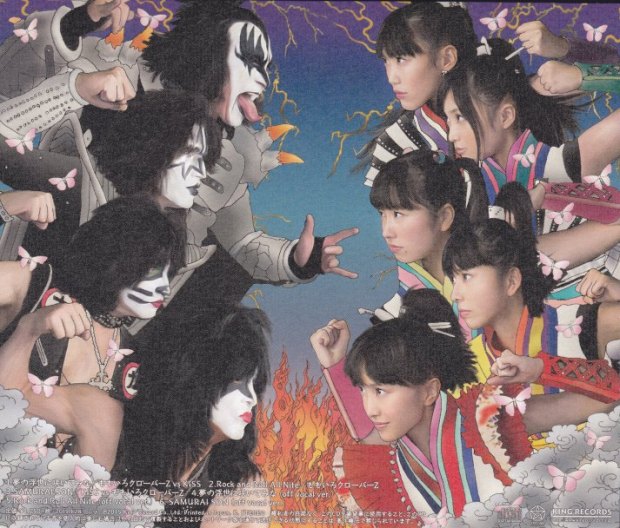
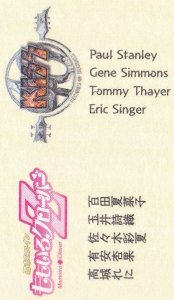
MOMOIRO CLOVER Z vs KISS – “Yume no Ukiyo ni Saitemina” / “Samurai Son” (2015 King Records Japan CD singles, sold separately)
Here they are, the new singles featuring the Kiss vs Momoiro Clover Z collaboration. “Samurai Son” appeared on the current Best of Kiss 40 CD, billed there as the “U.S. Mix”. That meant there are other versions out there, so I ordered the singles (two separate releases) from Japan. Even if I did not like the other versions of the song, the single covers were cool enough to keep as collectibles. As it turns out they are printed on high quality textured parchment style paper, and have stunning inner and outer art. They also come with transparent outer shells with shiny embossed symbols and writing. For packaging, it’s 5/5 stars for these singles.
Between the two singles, there are four different mixes from the “U.S. Mix” of “Samurai Son”. All feature Kiss, to a certain degree. Here’s how the versions break down, from “Least Kiss” to “Most Kiss”:
5. “Yume no Ukiyo ni Saitemina”. This is the full-on Japanese version with the spotlight primarily on Momoiro Clover Z. They take the lead vocals and their elements of the song and style and brought up in the mix. It’s funny to hear Kiss singing background vocals in English, underneath the Japanese lead vocals! Who know if the words actually go together in any way.
4. “Yume no Ukiyo ni Saitemina” (instrumental version). Kiss are the backing band on this track and you can clearly hear Tommy soloing, but the Kiss and J-pop elements are mixed fairly equally here. These first two renditions of the song are on both versions of the single.
3. “Samurai Son” (instrumental version). From the CD with the artwork emphasizing Kiss. This instrumental is based on the Kiss rather than the Momoclo version of the song. Tommy is in the spotlight a bit more on this version, as the instrumental mix leaves more room for his guitar licks to take the spotlight.
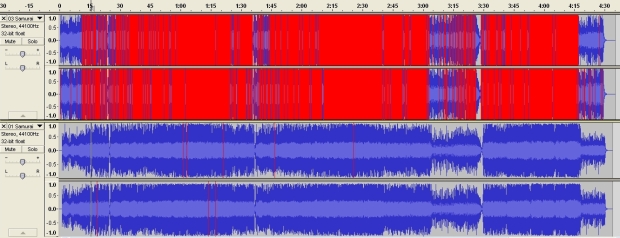
2. “Samurai Son”. From the same CD as the above track, this is a Kiss-heavy version similar to the “U.S. Mix” on Best of Kiss 40…but not quite the same. It follows the same blueprint of Kiss being up front and the Momoclo girls audible in the background and on the chorus. It has vocal, guitar and J-pop parts that are not as apparent in the “U.S. Mix”. Gene’s vocals also sound higher in the mix. It’s audibly mastered way, way louder than Kiss 40, as you can see from the Audacity waveform below. Track 3 from the CD is on top, the “U.S. Mix” from Kiss 40 is beneath.
1. “Samurai Son” (U.S. Mix). The Kiss 40 version; the mix that is geared to appeal mostly to Kiss fans. Logically, it sounds the most like Kiss. It’s only on Kiss 40; neither of these two singles have this mix which makes it a little more special for Kiss fans.
There are more tracks, but I’ll be frank — I didn’t even rip them to the computer. These tracks are vocals and instrumental covers by Momoiro Clover Z of “Rock and Roll all Nite”. I listened to it; it’s cute. If you want to try and get your little niece into rock music, this might be the way to do it. It has some guitars but it’s very cutesy. (Probably still better than Poison’s version though, Mr. Rockett.)
Finally there is the Blu-ray containing the music video, that I cannot play due to region restrictions. That’s why they invented Youtube, I think….
I give Kiss credit for doing something different like this and making it accessible to different audiences. My favourite version is the one on Kiss 40, but that one was custom built for people like me. These two singles are fun additions to the collection. It’s one of those conversation pieces you can show that one guy you know who says he has “all” the Kiss CDs.
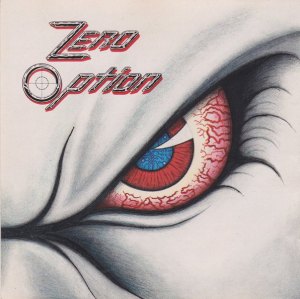
Here’s a blast from the past for your Throwback Thursday! Most readers will never have heard of Zero Option. Too bad! Zero Option blasted out Kitchener Ontario in the early 90’s with a fresh power metal sound. They released a debut album on indi label Fringe, a label best known for its punk rock roster including bands like Dayglo Abortions. Singer Phil Maddox was well known about town for his powerful pipes. Lead guitarist Rick VanDyk is probably best recognized for his later stint in another (more famous) Kitchener band — Helix. The Helix connection must go way back to this album, because Greg “Fritz” Hinz is thanked in the liner notes, as is legendary vocal coach Ed Johnston from Fergus Ontario, who also coached Brian Vollmer in the technique of Bel canto. (Johnston passed away in 2008.)
Zero Option sound nothing at all like Helix. They present their metal with a bass-heavy Megadeth groove. Maddox’s voice is nothing like Mustaine’s, but it too is a matter of taste. He has a smooth singing voice, and the ability to belt it out, but lacks the range to hit some of the notes he’s going for. Gates of Utopia is only a first album, and the guy probably would have grown as a singer had they made a second CD. He already had a pretty unique voice, as I struggle to compare him to someone else.
Opener “State of Panic” occupies that Mega-groove (think “Symphony of Destruction”) and boasts some pretty wailing solos and a decent chorus. “Face to Face” is a standout track, a thrash metal mash with a variety of cool elements: time changes, busy drums, guitar harmonies, and smoking riffage. In 1991, Zero Option were going for a sound that was based equally in classic metal and thrash, and they were considered to be on the cutting edge with Gates of Utopia. Listening back today I still get a feeling of “they were onto something cool”. You can understand why people were raving about the CD back then. The guitar work on “Face to Face” is top notch and the band were capable of tricky arrangements.
Other tracks good enough to put the CD on your want list include “Lords of the New Church”, which has a memorable chorus and tasty guitar harmonies. “Think Tank” thrashes pretty hard and has dualing guitar solos, a gimmick I always enjoy. “Right Off the Face” is one of the slow, grindy catchy ones. Gates of Utopia is less about the individual songs and more about the overall impact: there are lots of guitar and vocal hooks over the course of this solidly made album. It’s hard to judge it fairly by 2015 standards. In 1991, these guys were right on the cusp of something new. Something that bands such as Megadeth and Metallica would master and exploit to sell multi-platinum albums in just a short while: a cross pollination of thrash metal heaviness with more mainstream metal sounds. Gates of Utopia couldn’t have done what those mega-sellers did, but another record or two and who knows what Zero Option could have sounded like fully sharpened?
The serious weak link here is the lyrical department. For example, from “Rise and Fall”:
When the universe was created, Man was not around. Centuries later, Evidence was found.
Subject matter discussed on Gates of Utopia are standard fare: censorship, TV preachers, the dangers of drugs, insanity, pollution, and girls. They are adequate, but pretty highschool. Of course, these guys were barely out of highschool.
Rick VanDyk still plays music today, in a Metallica tribute act called Sandman with former Helix members Brent “Ned” Neimi and Paul Fonseca. So there ya go!
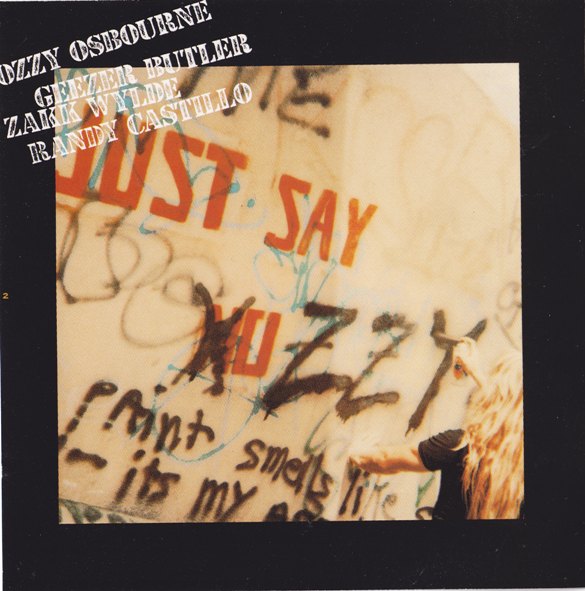
Nobody was shocked when Ozzy Osbourne, the man who said he hated live albums, put out his fourth (!) solo live release in 1990. (His other three live releases were the Mr. Crowley EP, Speak of the Devil, and Randy Rhoads Tribute. This does not include the Ultimate Live Ozzy EP which was…not live.) The liner note by Ozzy attempts to justify its release. “Firstly, ‘Shot in the Dark’,” begins Ozzy. “I am happier with this version than the original.” (Oooh, sick burn on Jake.) Ozzy continues, “Secondly, the Sabbath songs – To have recorded them one last time with Geezer Butler, Zakk and Randy says it all for me. It’s a chapter of my musical career I can now close.”
What the fuck did that mean?
Was Ozzy going to stop playing Sabbath songs? Did anyone actually believe that? The bitter liner notes accompany a front cover emblazoned with all four band members’ names, in the same sized font as Ozzy’s. And on the front cover is not Ozzy Osbourne, but guitarist Zakk Wylde! (Albeit from behind so you can’t see his face, and he’s just in one corner of the cover.) It all seems to deliver a message of “I am focused on the present, not my past.” This quartet was fully expected to record the next Ozzy studio album together, athough ultimately that did not happen. Geezer left in 1991 for a reunited Dio-era Black Sabbath. So much for not looking back!
Just Say Ozzy functioned as a stopgap. Ozzy would take his time with the next LP (which at that time was tentatively titled No Dogs Allowed, then Don’t Blame Me), but No Rest for the Wicked was already two years past. They had to release something, so here it is. One careful listen will reveal a lot of studio trickery was employed afterwards. Indeed, if one focuses on the crowd noise you can hear edits everywhere. Billboard magazine revealed that the music for this album was re-recorded in the studio with audience noise overdubbed.
Having said that, if this kind of trickery doesn’t bother you (and if you own Kiss Alive! or Frampton Comes Alive then it shouldn’t too much) then this is a great EP. Just Say Ozzy‘s meager six songs feature the only recordings of the brief Osbourne/Wylde/Butler/Castillo lineup. I was always a fan of those particular guys and there’s something to be said when you have two original Black Sabbath members in the band, while Black Sabbath only had one.
Since this EP was from the No Rest tour, three of its heaviest songs were showcased: the single “Miracle Man”, “Tattooed Dancer”, and “Bloodbath in Paradise”. No ballads. These three songs are nice to have, but are not even close to competing with the better known hits.
From The Ultimate Sin comes “Shot In The Dark”…yes, Ozzy’s so-called “preferred version”. And it is indeed very good. Zakk Wylde was a talented kid even then, and I love the youthful “go for it” attitude in his playing. “Shot in the Dark” features an extended solo that established Zakk’s place with his axe predecessors. Then, a deuce of Sabbath: a smokin’ “Sweet Leaf” and probably the best live version of “War Pigs” that I have ever heard.
Yeah, that’s what I said.
This Zakk-infused version of “War Pigs” is, in this humble writer’s opinion, the best live version ever released. Zakk’s guitar digs deep into the strings with those nice wide vibratos. It’s just monstrous, plus with Geez on bass, it has that slink it needs. Randy Castillo (RIP) was certainly no slouch, and his relentless fills here are solidly entertaining.
3/5 stars. Shame about that crappy cover art though.
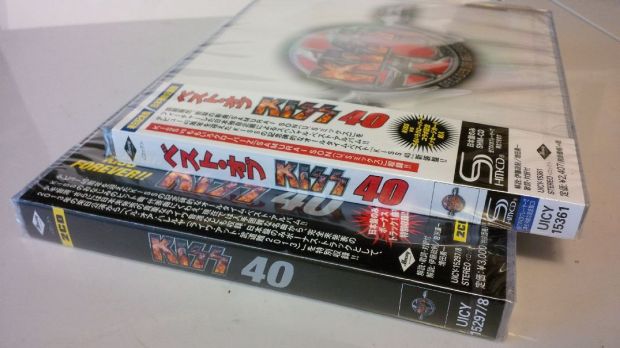
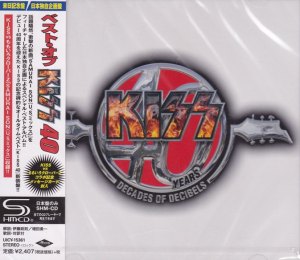
KISS – 40(2015 Universal Japan single CD Commemorative edition)
Wait a minute, I’m confused — did I just buy Kiss 40, again?
Wait a minute, it’s 2015 now — shouldn’t this be Kiss 41, or something??
Wait a minute, what the hell is “Kiss vs. Momoiro Clover Z”???
Eager to buy anything new from Gene and Co., I got this new single CD version of Kiss 40 without really knowing what it was about.
Now that the CD has arrived at the door, I discovered that Momoiro Clover Z is a Japanese all-girl pop group with similar intentions as Kiss themselves. They dreamed big dreams for themselves and aimed to entertain and bring a spectacle to the people. They have colour coordinated members and characters, so perhaps a Kiss collaboration seemed like the next step for them. I don’t know how the collaboration came to be, but the result was a brand new Kiss song written by Paul Stanley and producer Greg Collins.
This edition of Kiss 40 commences with a Kiss-heavy mix of the new collaboration, “Samurai Son”. There are other versions available on two singles and on iTunes, but reviews for those will wait until they arrive at LeBrain HQ. The good news is that the “U.S.” mix of “Samurai Son” has no problem hanging out on a Kiss greatest hits CD. Musically, it’s not too much of a departure of the direction from Kiss’ last album, Monster. It’s just more produced, polished and embellished. The girls from Momoiro Clover Z come in during the chorus, but it’s not the first time Kiss have had female backing vocals on their albums. It’s the first time since 1989, but remember old classic tunes like “Tomorrow and Tonight” from Love Gun, and “Sweet Pain” from Destroyer? Female backing vocals. The new twists this time are the lines in Japanese, and the very slight J-pop slant. It’s not too far of a departure.
Collector’s card included inside Kiss 40
It may not be to your taste, but I love “Samurai Son”. The lyrics address Kiss’ experience of hitting Japan for the first time back in 1976:
“I took a flight into Tokyo, Into the Land of the Rising Son, I heard my song on the radio, Blowin’ my mind like a shot from a gun.”
Paul then proceeds to tear it up all over town, “Livin’ life with no regrets.” The words suit one of those fast paced Kiss rockers that they’ve been doing of late — think “Hell or Hallelujah”. There are some cool Thayer licks and you can tell that Gene Simmons showed up for the sessions, because you can hear him singing on the choruses. The overall impression is that “Samurai Son” is one of those solid Kiss catalogue rockers. It’s like the new material on side four of Kiss Alive II: pretty good but living in the shadow of the Kiss greats.
From this point on, Kiss 40 (the 2015 abridged version) continues with the “best” hits from the full length 2 CD version…but not quite. There have been some major tweaks to the tracklist, perhaps to maximize the listening pleasure of consumers who just need one CD of Kiss in their lives. The classic live version of “Rock and Roll all Nite” has been replaced with the studio version from Dressed to Kill. Same for “Shout it Out Loud” and “Detroit Rock City”, here in their original full Destroyer guises instead of live. I like the way the car crash ending of “Detroit” merges into “Calling Dr. Love”. “Dr. Love” and “Love Gun” were thrown into the pile here, even though they weren’t on the original Kiss 40 in any form. A little further down, a different song was plucked from Kiss Killers: The superior “I’m a Legend Tonight” replaces “Down on Your Knees”.
Moving on from the makeup years to the non-makeup 1980’s, the original version of “Crazy Crazy Nights” replaces that unreleased live version from the double Kiss 40. That sums up the song substitutions; the album still continues chronologically to the current era. I’m pleased that even though early songs from the first two Kiss albums were axed, songs from the last two Kiss albums were not. I think Sonic Boom and Monster are Kiss albums the band should be proud of, so you get “Modern Day Delilah” and “Hell or Hallelujah”, as it should be. Other albums excluded from this compilation are The Elder, (surprisingly) Creatures of the Night, Hot in the Shade, the live records and the solo albums.
With all these tweaks and alterations, the overall listening experience is enhanced albeit at the cost of some deeper tracks. It’s a give and take, so the overall score for the new Kiss 40 remains:
RECORD STORE TALES MkII: Getting More Tale #361: LeBrain Goes to Toronto
Went to Toronto yesterday to visit Mrs. LeBrain at the hospital, and also visited Sonic Boom music at 215 Spadina while I was in town. I’m tired, so all I had the energy for was this quick & dirty 4 minute video. Hope you like it. You know I found music to buy…
“25 years in a rock n’ roll band, 10,000 women on a one-night-stand, all I got to show is the hole in my hand, where the money burned through.” – Wino
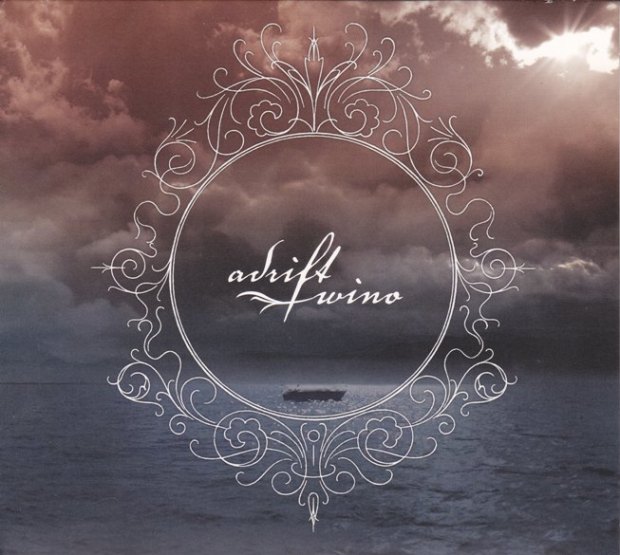
WINO – Adrift (2010 Exile on Mainstream)
I don’t know a hell of a lot about Scott “Wino” Weinrich (for shame), only that he was the guy from Saint Vitus, and they are doomy deliciousness. I’d heard him before on a couple records — a Sabbath tribute, and Dave Grohl’s Probot. I do love acoustic records by metal artists. I don’t mean unplugged albums, or acoustic versions…I mean when a heavy rock artist picks up an acoustic guitar and records what is (essentially) an acoustic heavy metal album. Take Zakk Wylde’s Book of Shadows as an example.
Adrift is a fucking great album. Even if you don’t like singer-songwriter type recordings, you’ll dig this. According to the cool liner notes, a lot of these songs are old compositions from his past. Wino made a ball crushing acoustic album out of them, and it’s brilliant. It’s not entirely acoustic; there are stunning electric solos and the odd flourish here and there, but it’s mostly just wood, strings, and Wino’s hands. Did I mention it’s fucking brilliant? You can even hear the guy breathing on some songs. It doesn’t get much more real.
But how does it sound? Take some simple rock chords and acoustic licks, and combine together for maximum impact. Wail out a long and atmospheric guitar solo when needed. Sing deeply personal lyrics with a haunting, gritty double tracked voice. Except on the instrumentals of course (of which there are two).
For shits n’ giggles, there is also a killer acoustic cover of Motorhead’s “Iron Horse/Born to Lose”. Its placement is a little weird (right smack in the middle of the album) but my God does it smoke.
Check out: “Green Speed”, “Old and Alone”, “Whatever”, “Shot in the Head”.
 DIO – Intermission (1986 Warner EP)






























 mikeladano.com