Even though Alice hadn’t produced anything as timeless as “School’s Out” during his 1980’s comeback, his profile rose greatly. Clean, sober and focused, Alice Cooper was very active in the last part of the decade. The same year as his final MCA album Raise Your Fist and Yell, he had memorable appearance at Wrestlemania III. In the corner of “good guy” Jake the Snake Roberts, Cooper had the honour of draping Roberts’ snake named Damien all over the Honky Tonk Man. After that, even my dad knew who Alice Cooper was.
Cooper only had a two record deal with MCA: Constrictor was the first in ’86; also the first album in the comeback period. Having re-established himself with MCA, Alice then signed with Epic and had a genuine smash success with 1989’s Trash. With a dream team of writers and collaborators (including hitsmiths Desmond Child, Jon Bon Jovi, Richie Sambora, Steven Tyler, Joe Perry and many more), Alice scored a platinum album.
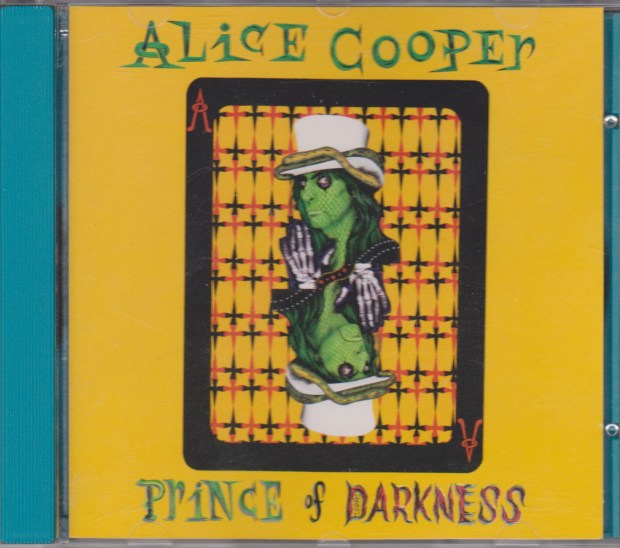
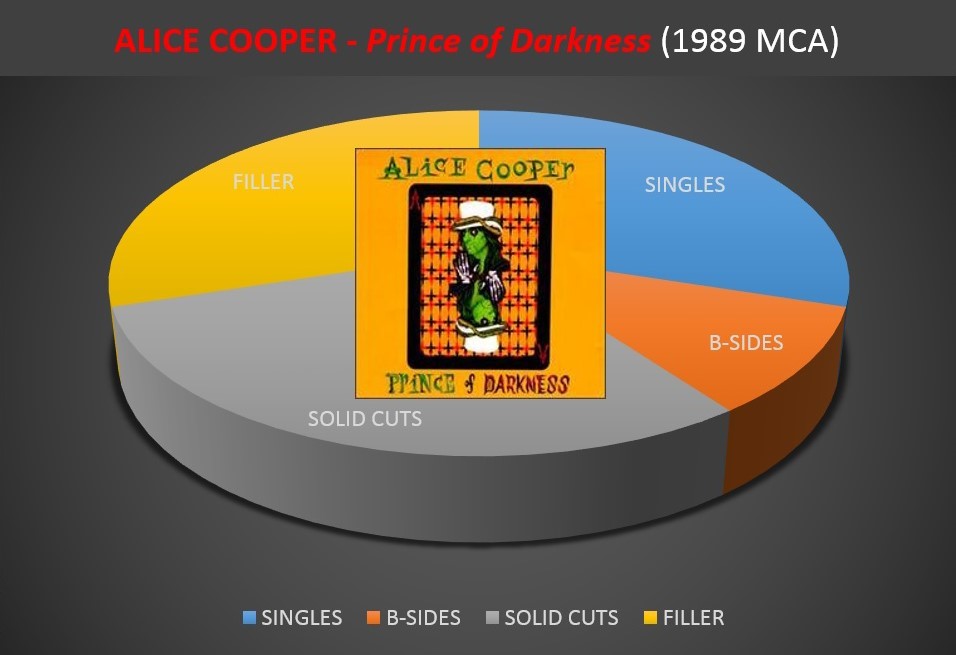
While Trash was still charting and producing singles, MCA put out a competing record: Prince of Darkness, a 10 track compilation of Cooper’s material for that label. Normally these kinds of releases are throw-aways, but Prince of Darkness is not and this review will tell you all about it.
It is not unfair to state that Constrictor and Raise Your First were mixed affairs. You had to wade through a significant amount of filler to reach a disproportionate amount of modern classics. Prince of Darkness does a great service by collecting some of the best material together on one CD. It is well sequenced and even includes one rare track, an exclusive on compact disc.
A grand opening is the dark and metallic “Prince of Darkness”, a theme song from a movie of the same name. This ominous and menacing track is one of the more memorable from this era, a heavy monument. It works amazingly well as an opening track, and “Roses on White Lace” follows by going faster and heavier. It was surprising to hear Alice creep this close to thrash metal, but what a track! A distorted vocal adds to the creep factor, making this one of the better samples of Cooper’s music during his “splatter horror” period. The 1986 single “Teenage Frankenstein” would be a must-own for any fan, and there it is in the #3 position. The big single from this era was “He’s Back (The Man Behind the Mask)”, a synthpop classic quite unlike the prior metal material. Right here is an easy and simple way to get this classic track, without having to buy Constrictor. Same with “Teenage Frankenstein”.
A nice little track here is a 1976 live recording of “Billion Dollar Babies”! This was a B-side from the “He’s Back (The Man Behind the Mask)” single, but Prince of Darkness is the only CD with it. The track itself sounds heavily remixed (remixing is credited to Garth Richardson) but it is indeed a B-side that is easy to acquire by getting this disc. Ignore the annoying, screaming overdubbed crowd and just dig the vintage performance of one of Alice Cooper’s most timeless numbers.
There are a few filler tracks on side two. “Lock Me Up” was fun, but not particularly memorable. Feel free to skip “Simple Disobedience” and “Thrill My Gorilla”, and go straight to “Life and Death of the Party”. Alice steps back into the shadows for a chilling horror number, mid-tempo and overcast. We are over and out with “Freedom”, another great single and dangerously close to thrash metal again. Prince of Darkness serves as the most effective way to get this one.
That’s why I recommend Prince of Darkness to any fan who wants to get a slice of Alice in the late 80’s — but just a slice. The whole cake is for diehards.
And lo! The beast named Alice reincarnated with a slab of wax, and they called it Constrictor. Slithering into the spotlight again was a triumph of will: Alice battled his demons (including the bottle), found some new young band members and started fresh on a new label. Though the music was merely OK, at least the man himself was doing just fine. As fans, I believe we genuinely wish our rock star heroes to be healthy and happy, so even if the music wasn’t the greatest, we could be glad that Alice was back.
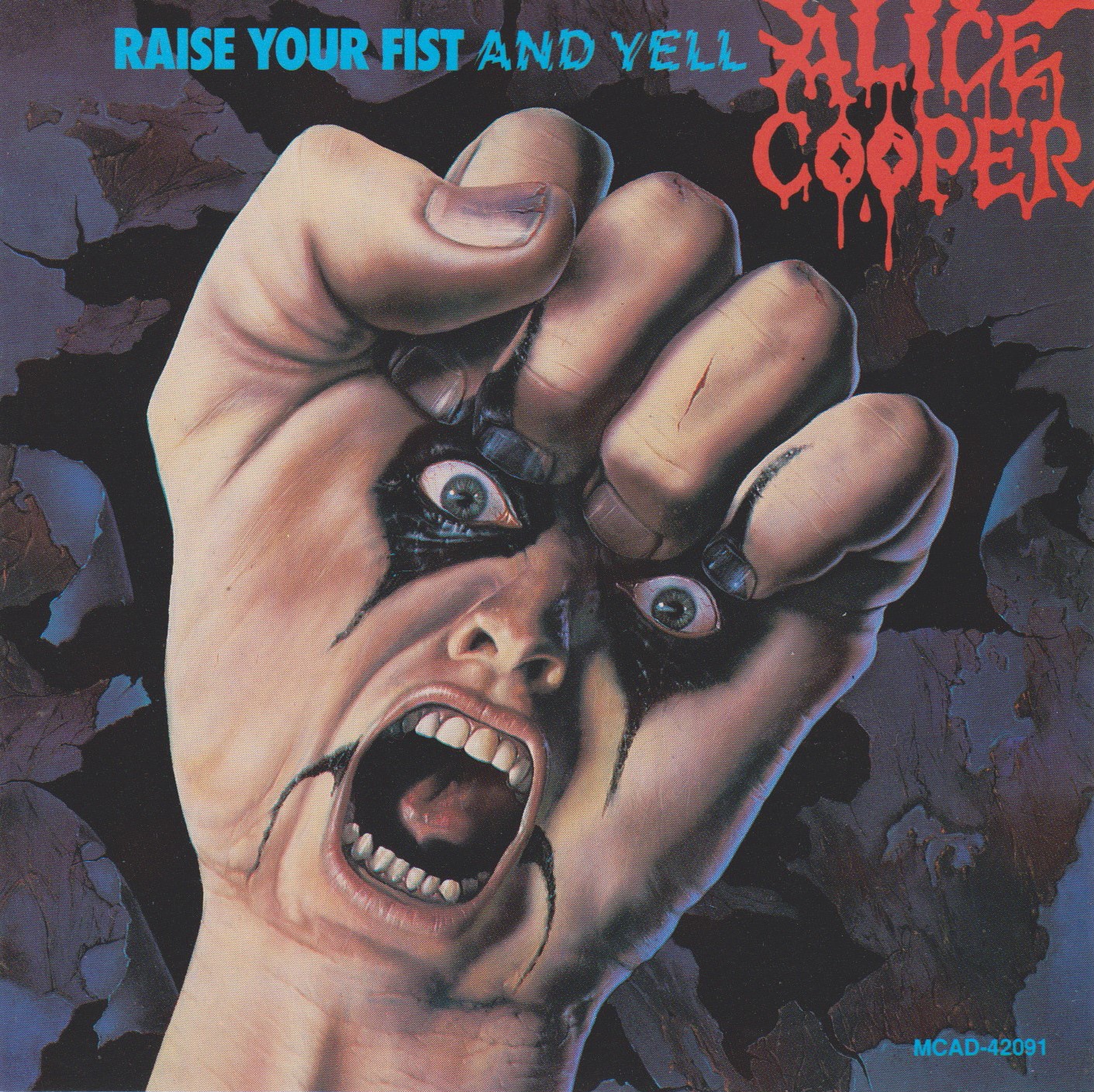
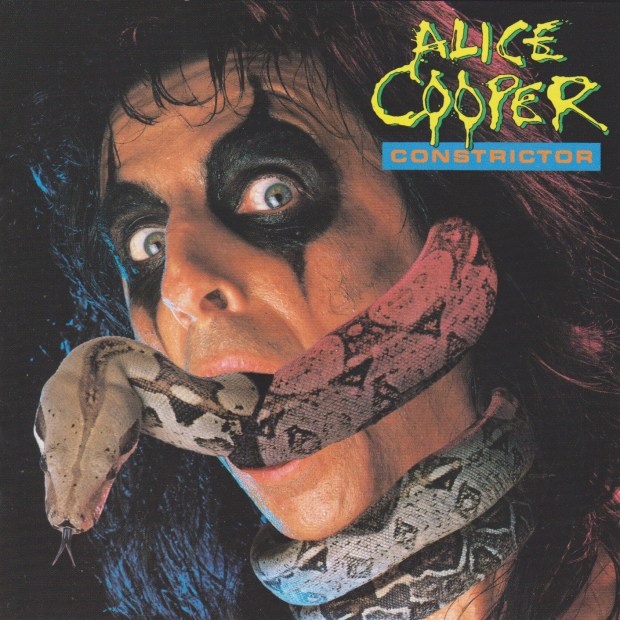
In the 70’s and early 80’s, Alice Cooper maintained a breakneck release schedule. This slowed down a bit in the second phase of Cooper’s career, but he still managed to follow Constrictor a mere 12 months later with Raise Your Fist and Yell. I probably don’t need to tell you this, but look at the cover: certainly one of the worst to ever envelope a major label release. The guilty party is a fella named Jim Warren who must hate this cover as much as I do, because just look at it.
It continued with the same shock-rock horror-splatter-movie theme, but turned up louder. Indeed, the lead single “Freedom” was the fastest most thrash-like track that Alice had yet performed. Censorship was a big target in Alice’s sights. “Freedom” was his ode to the PMRC: “You want to rule us with an iron hand, you change the lyrics and become big brother. This ain’t Russia! You ain’t my dad or mother.” Lemme tell you, when “Freedom” came out, the PMRC seemed a genuine threat. Dee Snider and Frank Zappa were testifying in front of the senate and stores were refusing to stock records. “Freedom” was an anthem we could all get behind. I don’t think anybody expected him to go so heavy!
The video was interesting. Kane Roberts looks like he’s not sure if he’s at a bodybuilding competition or a music video shoot. There were some new guys in the band; that’s not Kip Winger on bass. On drums is Ken Mary, later of House of Lords. Most interesting is the guy dressed as a priest. You can see him up close during the lyric “Back off preacher I don’t care if it’s Sunday.” They looked like the biggest bunch of misfits assembled. Perhaps this is what Alice was going for?
During this period, Alice was writing a few goofy rock songs. “Lock Me Up” is silly, but fun. It has a beat and you can headbang to it. “Take the Radio Back” sounds like a predecessor to “Hey Stoopid”, but not quite. “Give the radio back to the maniac!” sings Alice. Is he begging for airplay? It’s OK, but “Step on You” isn’t really. There are moments here and there, but these are mediocre songs. “Step on You” has an interesting atonal instrumental section but it doesn’t fit the song at all. “Not That Kind of Love” continues the heavy rock, but without hooks.
Back to quality, “Prince of Darkness” is a heavy metal horror movie theme, from the film of the same name in which Alice had a cameo. Menacing and intense, this tune scores high marks on both the Cooper Scale of Rock Thrills and Chills, and the Cooper Scale of Heavy. Kane Roberts’ lead solo is pure pointless 80’s excess, but the song is what counts and it’s a good’un. The acoustic outro is perfection.
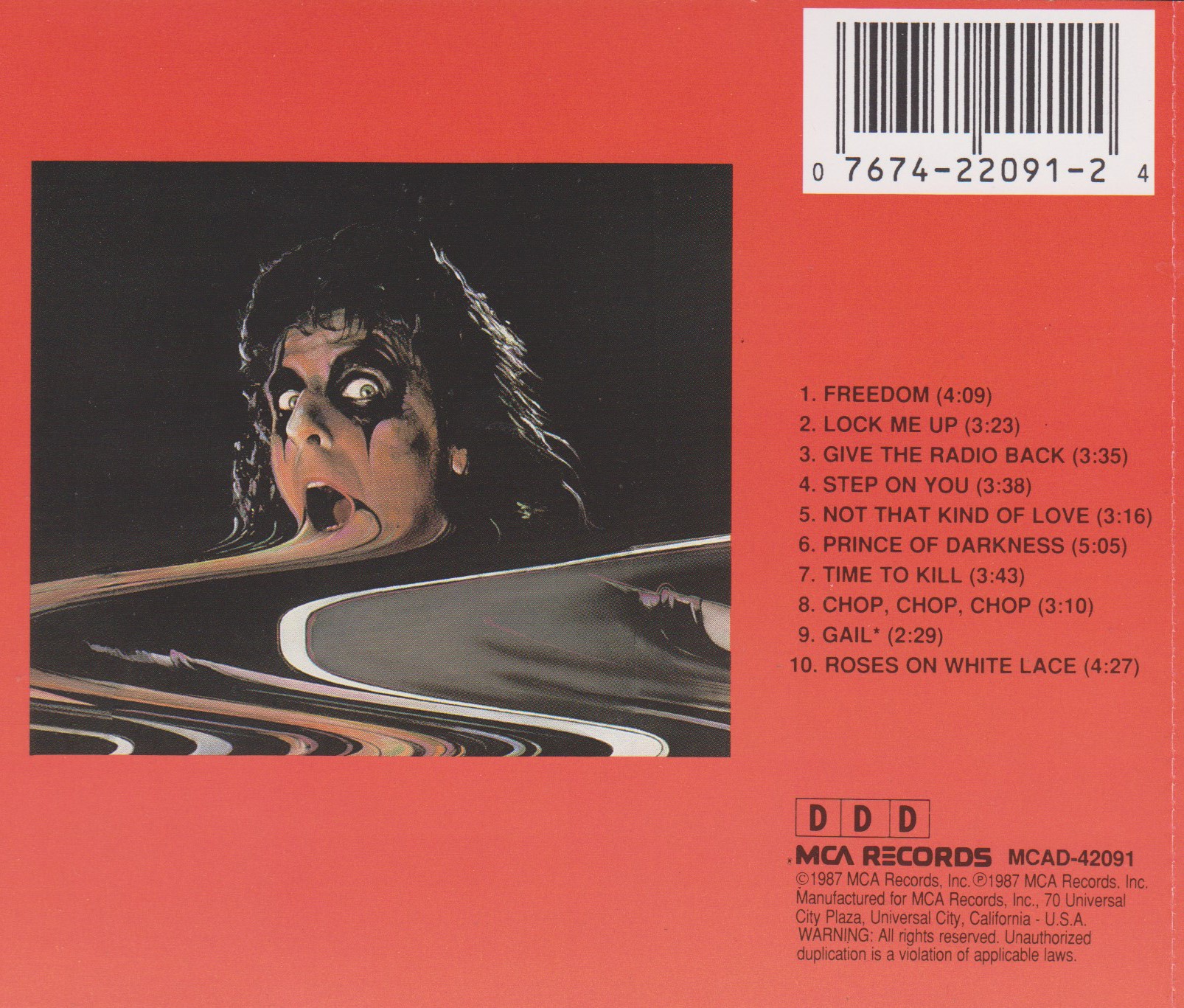
“Time to Kill” keeps things above the bar. “Chop, Chop, Chop” does not. I know — you’re surprised, right? A song called “Chop, Chop, Chop” isn’t a diamond of the highest carat weight? Nor is it a turd, but certainly well below the watermark. It does serve as a lead-in to “Gail”, a high quality also-ran that recalls Alice in the year 1975. It is the only Kip Winger co-write on the album, and he’s responsible for its eerie keyboard vibe. Finally it’s “Roses on White Lace”, another borderline thrash metal track that absolutely rips every head in the room off. This track, firmly in the splatter film world, is an excellent example of Alice at his heaviest. For its entire duration, it’s breakneck speed. Bold song to end an album with.
Post album, Kip Winger and keyboardist Paul Taylor bailed, and formed another band you might have heard of. Michael Wagener produced this record, and while heavy, the album is definitely lacking sonically in comparison to its contemporaries. All told there are four songs worth buying the album for: “Freedom”, “Prince of Darkness”, “Roses on White Lace”, and Gail. Three of those four songs can be found on the MCA compilation Prince of Darkness. So…your move.
Alice Cooper’s bizarre DaDa album was the end of an era. It marked the last album Alice recorded for his Warner Brothers contract, now complete. It was also the end of his experimental period that ran from 1980’s Flush the Fashion through to DaDa. It was the the last album Alice would make that he couldn’t remember making.
Alice mostly disappeared for the next three years. His activities were so low key that most people didn’t even notice them. He was hospitalized for cirrhosis of the liver caused by his blackout drinking. He got sober, for good. He also dealt with a divorce. Musically there was very little going on. In 1984, Alice starred in a very low budget horror movie called Monster Dog. He recorded two songs for the soundtrack: “Identity Crisises” and “See Me in the Mirror”. These two tracks are very much the conclusion to Alice’s early 80’s art-rock persona. “Identity Crisises” has a lo-fi, garage-y Iggy Pop sound. “See Me in the Mirror” is in the synthpop direction of DaDa: creepy, atmospheric and mostly electronic. These two songs were finally released for purchase on the legendary Life and Crimes of Alice Cooper boxed set in 1999.
Alice next emerged with one of the bands he inspired: Twisted Sister. Along with Brian Setzer, Clarence Clemens and Billy Joey, Cooper accompanied Twisted Sister on their single “Be Chrool to Your Scuel”. A very clever zombie-filled big budget horror-inspired music video was made for the song, which Alice co-starred in, as did Bobcat Golthwait (who was also in Sister’s “Leader of the Pack” clip). It should have been a big deal, with Alice getting equal screen time with Dee Snider. Unfortunately hardly anyone saw the video. MTV barely touched it. As a result it did nothing to aid Alice in terms of a comeback. It was good to note that Alice looked healthier than he had in years.
Alice regrouped and re-invented himself in a new persona. Taking inspiration from his Welcome to My Nightmare period, Alice went into “slasher film” mode. He recruited a massive muscle-bound heavy metal guitarist and songwriter, Kane Roberts, to be his co-pilot for this adventure. Also along for the ride was a hot new bassist and singer named Kip Winger, whose large mane hid the fact that the man was a classically trained musician. With producer Beau Hill, they made an album in tune with what was happening in 1986, and that meant heavy metal. Alice had always been a diverse, experimental artist, but this time the mission was pretty simple and the lines were clear.
Another horror film served to launch the next official Alice Cooper music: Friday the 13th Part VI: Jason Lives. Alice appeared in a brief cameo, but more importantly contributed two new songs to the movie soundtrack. They were the anthem “Hard Rock Summer”, and “He’s Back (The Man Behind the Mask)”, which served as the movie’s theme song. “Hard Rock Summer” was a bit of a throwaway, and was not used on the next Alice album. You can really hear the backing vocals of Kip Winger and Kane Roberts on it, but a classic it is not. “He’s Back”, and its very cool music video became synonymous with this new period of Alice Cooper’s life.
The new album, Constrictor, was finally released in September of ’86. With a snake in his mouth on the cover (not really; you can see it’s cheaply cut and pasted) it was pretty clear that Cooper was going for the scares. Opening track “Teenage Frankenstein” continues the horror theme, but combines it with Alice’s teen anthem style from the early 1970’s. “Teenage Frankenstein” is essentially an “I’m 18” for 1986. It’s not as memorable, inventive, or as good, but it gets the job done. It’s an Alice Cooper heavy metal anthem for pounding your fist to in concert. In lieu of a proper music video, a clip from his live show The Nightmare Returns was used, featuring Alice building a living robot monster on stage, which then turns against him! Alice was still one of the best live acts in the world.
It’s funny that DaDa is remembered as Alice’s “drum machine” album when it’s clear on “Give it Up” that a lot of the beats are programs and samples. “Give it Up” is a radio friendly hard rocker, nondescript but at its core not that different from the music Alice made in the 70’s. It’s even has some rock and roll piano. It’s just dressed up for the 80’s. There’s not much going on with “Thrill My Gorilla”, just a forgettable song with the shrill production that was so popular in the 80’s. Much better is the somewhat epic “Life and Death of the Party”. Slower, creepier and much more effective, “Life and Death of the Party” is the kind of song I like to point to as proof there was some mighty good material during this period. Unfortunately “Simple Disobedience” isn’t among that material. Like “Thrill My Gorilla”, there is little here to attract listeners today. The electronics and samples really are a drag. It is like there is a layer of distraction over the song that you have to penetrate through.
Flipping the record over (or pretending to since I own this on CD), “The World Needs Guts” isn’t a bad start to the second side. It could have been much heavier. It verges on the speedy power metal tendencies of bands like Accept, but the production keeps it from going all the way. As such it kind of sounds like a thin Judas Priest Turbo outtake with the synths stripped off. “Trick Bag” may sound familiar. It actually started life as “He’s Back (The Man Behind the Mask)”. There’s a demo version of “He’s Back” on the aforementioned Alice Cooper box set musically identical to “Trick Bag”. “He’s Back” was re-written, but the original music ended up as “Trick Bag”. It’s a decent album track but like much of Constrictor not particularly classic. “Crawlin'” is pretty close. With all the melody and hooks of an old 70’s Alice Cooper track circa Goes to Hell, “Crawlin'” is pretty good stuff.
“The Great American Success Story” is fantastic for two reasons. One is that it was originally written for the Rodney Dangerfield classic Back to School. Second, it’s like an updated “School’s Out” for the 80’s. Instead of celebrating the end of school, this time we are celebrating going to school. “He’s gonna take that plunge, gonna jump back in there.” Which, if you’ve seen the movie, you know is also a reference to Dangerfield’s character joining the diving team. “He thinks about the teacher in his literary class,” and I don’t blame him; it was Sally Kellerman! “Always been a brat, don’t get no respect” is another obvious reference to Dangerfield. But it’s a good song! It really should have been a single, and it probably would have been if it were in the movie.
Closing the album, we go full circle back to Friday the 13th and “He’s Back”. There’s little question that “He’s Back” is the best song on Constrictor. It actually bears more similarity to the synth-pop of DaDa than it does to the rest of the album. It’s brilliant because they stripped the song down to a very basic frame, which is a creepy digital pulse. There’s a little guitar but it’s mostly just horror pop of the finest quality. Ch-ch-ch-ha-ha-ha…don’t turn out the lights.
Part of the problem with Constrictor is that Alice had a faceless, fairly bland group backing him. Kane Roberts can play guitar, and Kip Winger can play the bass, but did they have their own identities? No. Dennis Dunaway played bass on those early Alice Cooper albums like no other bassist in the world. Michael Bruce, Steve Hunter, Dick Wagner, and the other great players Alice worked with all had their own sound. There is none of that on Constrictor.
I want to give Alice and company an A for effort: for finally getting sober, for finally getting back there on tour, and also for going heavy this time. Unfortunately Constrictor was a comeback album that needed a bit more comeback in it. The good news is that Alice did eventually get back to full quality, but Constrictor is only about half an album. Therefore:
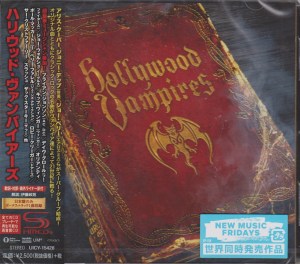
ALICE COOPER / HOLLYWOOD VAMPIRES – Hollywood Vampires(2015 Universal Japan)
Ignore the hype. The press has been going ga-ga over this new supergroup featuring movie star Johnny Depp (rhythm guitar), Joe Perry (lead guitar), and Alice Cooper (lead vocals). Just ignore the hype completely. Cooper fans know what this is. This is the covers album that Alice has been talking about doing ever since Welcome 2 My Nightmare in 2011. Alice has even been playing a number of these tunes, in these arrangements, live. Check out his Raise the Dead double live album/video for a few.
According to an interview with Ultimate Classic Rock earlier this year, “I can’t tell you who’s on what right now, ’cause it’s not gonna be released yet, but it’s the ‘who’s who’ of everything. It was one of those things where, at one point, I’m looking around in the studio and I’m going, ‘Holy crap! Look who’s in the studio.” Bob Ezrin, Alice’s long-time producer and musical collaborator came up with the concept. Alice continues: “Bob came up with the idea, ‘Let’s concentrate it on all the guys that you drank with in L.A., the Hollywood Vampires, the ones that are all dead.’ I like the title All My Dead Drunk Friends. It’s just offensive enough to work, but all those guys would have totally got it. They had the same sense of humor. If you told them you were going to do an album after they were gone called All My Dead Drunk Friends, they would have died laughing.” Ultimately the album was simply called Hollywood Vampires. That’s also the name of this “supergroup” which is essentially just Alice with Depp and guests.
I have this album filed in my Alice Cooper section, and that’s how I’m treating this review.
Hollywood Vampires consists of 14 tracks, except in Japan who have 15. Two of these are brand-new songs, and one is an intro called “The Last Vampire”. Fittingly, this features the narration of Sir Christopher Lee, who passed away earlier this year. Lee’s old friend from the Hammer horror days, Vincent Price, appeared on Cooper’s original Welcome to my Nightmare in 1975. Today, Alice Cooper truly is the last vampire left from those old days. Lee’s rich voice is backed by spooky keys and theremin by Ezrin, Depp and engineer Justin Cortelyou. “Listen to them, children of the night…what music they make.”
Alice then kicks it with “Raise the Dead”. Depp appears on every track, and Alice’s drummer Glen Sobol plays on this one and several others. It’s an upbeat stomper of a track, and a perfect introduction to this covers album that is also a concept album. The first of Alice’s dead drunk friends to be covered is Keith Moon on “My Generation”, an authentic and pounding version. Alice Cooper is one of the few that does justice to it. Bassist Bruce Witkin perfectly tackles John Entwistle’s signature bass solo. One thing that is immediately obvious is how massive this album sounds. Ezrin wrought a monster-sounding disc, so full and heavy, but textured when required.
John Bonham is up next. “Whole Lotta Love” was handled in a completely different way than you’d expect. Starting as a low, prowling Cooper blues it soon blasts into gear. Alice isn’t known for hitting those high Plant notes, so who joins him? None other than Brian Johnson of AC/DC, who kicks my ass completely. Joe Walsh and Cooper’s former lead guitarist Orianthi play some jaw droppingly greasy guitars, but Alice’s harmonica work is also worthy of praise! Even though very few can cover Led Zeppelin, “Whole Lotta Love” turned out to be my favourite track. It’s also the heaviest sounding, like a skid of concrete blocks assaulting your face! That’s Zak Starkey (son of Ringo) on drums.
Cooper has covered “I Got a Line on You” (Spirit) before, on the soundtrack to Iron Eagle 3, of all things. That 1988 take is my preferred version, but Alice remade it on Hollywood Vampires. Abe Laboriel Jr., Joe Walsh, and Alice’s old bassist Kip Winger join as guests. Perry Farrell of Jane’s Addiction helps Alice out on the lead vocals, but his part isn’t prominent. Then it’s time for the Doors, and a medley of “Five to One” and “Break on Through”. Alice had been playing “Break on Through” live, but this version has Robby Krieger! Alice heavies both of them up, but he is also one of the few singers who can do Morrison.
Farrell and Krieger return for a Harry Nilsson medley, joined by David E. Grohl on drums. “One” is rendered as a haunting, creepy piece as if Alice himself wrote it. This merges into “Jump Into the Fire”, a strangely upbeat companion which rocks in a vintage 70’s fashion. It’s like guitar nirvana. There’s also a cute outro of “Coconut”, also by Nilsson.
Sir Paul himself, rock royalty if there ever was one, shows up for Badfinger’s “Come and Get It”, which Paul wrote. Joe Perry has spoken about how incredible it was when McCartney showed up in the studio with his Hofner bass, and actually allowed them to hold it! “Come and Get It” is simple rock/pop, not the kind of timeless thing that happened when Paul wrote with John, but certainly a notch above what mere mortals can write. I love hearing Paul’s “screaming” voice, and I’m sure everybody in the studio had a great time. Sure sounds that way.
Marc Bolan’s “Jeepster” is one I could pass on. Alice makes it sound like an original from 1972’s School’s Out, but if you’re only going to skip one song, it’s probably going to be “Jeepster”. Lennon’s “Cold Turkey” featuring Joe Perry has more kick and grind to it, and it’s always a pleasure to hear Joe Perry do some Aero-jammin’ on lead guitar. (I think it would have been amazing to get McCartney to play bass on this Lennon classic — shame nobody thought of it. That could have been history made.)
The Japanese bonus track is “I’m A Boy”, the second Who cover. Once again, Alice nails it. This is such a difficult song to attempt. Alice makes it work, and if anybody can do it, it’s Alice. “My name is Alice I’m a head-case…” Just that one change makes the song work. “I’m a boy, I’m a boy, but my mom won’t admit it…I’m a boy, but if I say I am, I get it.” And he’s got the girl’s name. It’s perfect! This bonus track is worth tracking down if you’re a Cooper fan. You’ll definitely need it in your collection.
Jimi Hendrix was a Hollywood Vampire, and “Manic Depression” is the song Alice chose to cover. (He’d already done “Fire” back in the Hey Stoopid days.) Like “Jeepster”, this is one that could be skipped. Joe Walsh fans will enjoy his lead guitar work, but otherwise, it’s a stock cover. Way, way better is “Itchycoo Park”. Alice’s treatment of the Small Faces is far more entertaining, and its melodic base continue to deliver the hooks.
Brian Johnson returns to belt it out on the “School’s Out”/”Another Brick in the Wall Part 2” medley. This arrangement is similar to the way Alice did it live, and it’s cool how the two songs work together perfectly. It’s a genius mashup. Guests include Slash, and original Cooper band members Dennis Dunaway and Neal Smith. “School’s Out”, of course, is here for Glen Buxton, of the original Alice Cooper band. Buxton had suffered the consequences of alcohol abuse, and dropped out of music completely when the original band split in ’74. Buxton died in 1997.
The final song is an original, “My Dead Drunk Friends,” the song that Alice wanted to use as a title track. If you don’t mind some black comedy, you will love this tribute to all the lost Hollywood Vampires. It’s irresistible, and also sounds vintage Alice. So chants the crowd: “We drink and we fight and we fight and we puke and we puke and we fight and we drink!” Doesn’t sound particularly glamorous, but Alice isn’t about to have a mournful wake. Alice is about entertainment, and even though a brilliant artist who drinks themselves to death is sad, Alice has thrown a party for them instead. “My Dead Drunk Friends” ends the party on a darkly celebrating note, as only he can. Job well done.
Hollywood Vampires is pleasantly surprising. 9/10 covers albums are not worth the money you paid for them. Alice’s is. They call it a supergroup for marketing purposes but it only takes one listen to know what this is. This is a project that Alice, Bob Ezrin and friends have been passionate about for years, and has finally been finished. It is an apt follow-up to Welcome 2 My Nightmare, and another killer concept album from the kings of concept albums.
I sure hope I don’t get “trashed” for this review! Incidentally, this is the first CD I ever bought, in December of 1989. I still have it.
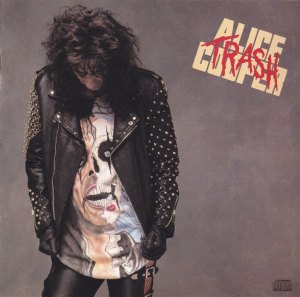
ALICE COOPER – Trash (1989 Epic)
After the strictly heavy metal n’ horror sounds of the previous two albums, Constrictor and Raise Your Fist And Yell, Alice decided it was time to get back to more diverse hard rock sounds. This time, he immersed himself in everything that was cool in the late 80’s, and created a “theme album” about sex. Cooper albums usually have themes — Alice Cooper in school (School’s Out), Alice Cooper in hell (Goes To Hell), or Alice Cooper insane (From The Inside). Sex was a new theme for this character.
Alice teamed up with Desmond Child, champion of many Bon Jovi and Aerosmith discs, as well as Mr. Jovi and Mr. Tyler themselves, among others. The result is unfortunately what I consider to be a weak disc, dated to the times, and with only a few strong songs that have held up over the years. It is certainly a creative low, though it did sell oodles of copies and was a sort of “comeback” album for Alice.
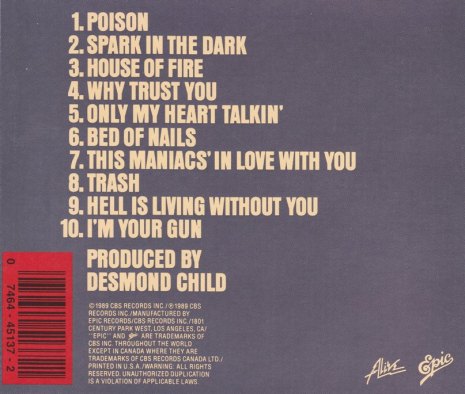
The first track and first single, “Poison”, is by far the best song. It is strong because it is based on the riff, and though it is commercial it is not blatantly so. It has a unique vibe to it, something authentic that other bands couldn’t touch. Sadly it’s mostly downhill from there. “Spark In The Dark” is unremarkable (though it does boast a killer riff), and so is the second single “House of Fire”. “House of Fire” at least has a catchy chorus, but it is simply too cookie-cutter. You could exchange it with virtually any single from any band’s albums in 1989. Just look at the writing credits: Desmond Child, Joan Jett, and Alice. Who was this song written for?
“It’s Only Heart Talking”, which was not written by Alice, is a decent ballad made more special with Steven Tyler’s duet. Otherwise, it is forgettable and inferior to later Alice ballads such as “Might As Well Be On Mars” and “Stolen Prayer”. Smash hit, though, so there’s that.
The lyrics to “Trash”, a duet with JBJ himself, are so bad it’s not even funny. “If my love was a lollypop, would you lick it?” Did Jon Bon just say that? “I’m Your Gun” is hardly better. I just can’t bear to listen to those songs. If you’re in the mood for some absolute dreck, check out “This Maniacs’ In Love With You”.
One of the more interesting songs that didn’t make the album was “The Ballad Of Alice Cooper”, written by Jon Bon Jovi. There is a poor quality demo of Bon Jovi doing it in his best Alice voice out there. I think it might have been better than most of the tracks on the CD. The Japanese version, however, does have great live versions of “Cold Ethyl” and “Dwight Fry” recorded during this era. (They can be found on the Alice Cooper Extended Versions CD today.)
This album like its sequel Hey Stoopid was loaded chock full of cameos. Just scanning the credits, besides Bon Jovi and Steven Tyler, I see: Kip Winger, Hugh McDonald, Joe Perry, Richie Sambora, Steve Lukather, Joey Kramer and Tom Hamilton. I think these cameos are very little more than hype.
Cooper’s albums tend to go in similar pairs (Nightmare/Goes To Hell, Constrictor/Raise Your Fist, Brutal Planet/Dragontown). Trash is no exception. Although Cooper realized that Trash was too soft and weak, Hey Stoopid is essentially a brother record to this one. I find it to be much much stronger by comparison.
I would tell casual fans instead of picking up this CD, to pick up something like Cooper’s Classicks. You’ll get the major tracks from this as well as some rare live ones.
TWISTED SISTER – Love Is For Suckers (1987 Atlantic, Spitfire reissue)
If the year was 1987, I would have given this CD 5/5 stars easily. When it came out in the summer of ’87 I was really into it. My best friend Bob and I used to play it all the time during that long hot summer, we had all the lyrics memorized. Unfortunately this album has not aged well, certainly not compared to their classic early albums.
One problem with the record is that it’s not actually by the band Twisted Sister! Even as a kid I wondered why people with names like “Reb Beach” or “Kip Winger” were listed in the credits. That’s because Love is For Suckers was written and recorded as the first Dee Snider solo album. Record company pressure forced Dee to release this as the next Twisted Sister album, even though no Twisted members appear on it (aside from new drummer Joey Franco). This only hastened the breakup of Twisted Sister in October of that year.
The album is produced by Beau Hill, a guy also known for Warrant and Winger albums (that’s why Reb and Kip are on here). Beau Hill is one of my least favourite metal producers of all time. He over-produces, uses too many samples, and glosses everything up. As such I find most of his albums pretty hard to listen to today. On Love is For Suckers, all the drums are samples and you sure can tell by that awkward gated sound, and identical snare hits.
Like when we used to climb the rope in gym class
As an 80’s glam metal album, the songs are not that bad. “Wake Up (The Sleeping Giant)” could have been a Twisted Sister song with its themes of rebellion and youth angst. “Hot Love”, the first single, was the song that got me to buy this album. A catchy pop-rocker with irrestible guitars courtesy of maestro Reb Beach, “Hot Love” was as commercial as it gets. Other standout songs included “Me And the Boys”, which was our theme song that summer. “I Want This Night (To Last Forever)” was a Van Hagar sounding pop-rocker with another great chorus. I think, if anything, Love is For Suckers sounds mostly like 5150-era Van Hagar, but with gang vocals and way more glossed up.
Love is For Suckers was reissued a while ago with 4 bonus tracks, demos from these sessions that fit right into the sound of the album. They’re just not as good. “Statuatory Date” for example suffers from extremely bad lyrics. One of them, “If That’s What You Want” is an early version of an album song, in this case “Me And the Boys”. Consider looking into these 4 bonus tracks when you’re choosing to purchase Love is For Suckers.
As an added little “insult to injury” following this album’s failure, producer Beau Hill took Dee Snider’s scream from one song, “I Want This Night (To Last Forever)”, and used it as the opening scream on Warrant’s smash hit album Cherry Pie. Uncredited! I’m sure 99.9% of Warrant fans assume it’s Jani Lane.
If this album description sounds good to you, check it out. You may enjoy it as much as I did all those years ago. For me, the years have not been kind.












 mikeladano.com