Journaling is a gift that keeps on giving. I’m so glad that I decided to document my years at the Record Store. Even when I think the well is dry, I keep finding little tiny flakes of gold. I’ve collected four retail rants from back in the day for your edification.
Date: 2004/05/03
Manners? This guy was just standing in front of me, burped three times, and smelled of pepperoni when he did. It was so gross I felt like I had to puke.
Date: 2004/05/18
I have decided that I want to work at the Money Mart next door. All they ever seem to do is take breaks! The one girl, she’s on her second smoke break in one hour!**
Date: 2004/06/02
You know you’re stupid when…
You pay for a neon sign to be made that is grammatically incorrect!
I was just walking past Angel’s Diner, who advertize that they have “The best rib’s in town!” Yikes!
Date: 2004/06/21
The last thing I needed to see today was an older couple purchasing a CD about tantric sex.
* Title inspired by XM radio DJ Grant Random
** I noticed this because I had a bit of a crush on her, as noted inRecord Store Tales Part 170. Not a creepy crush though I swear.
One of my (many, many) jobs at the Record Store was running our “buying classes”.
The problem was this: teaching new employees how to buy used CDs was a very intensive process. It made sense for us to train multiple people at once in one session. We wouldn’t even try to teach an employee how to buy until they’d been with us for two months. Once they had a little bit of experience under their belts, we’d start training them on being a buyer. One of the best features of the stores was that everybody was a buyer. You didn’t have to wait for a specific person. Anyone behind the counter could buy. We had to make sure that every single person was 1) fair, 2) competent, and 3) ready for the responsibility.
The first two buying classes were done with two instructors – myself and one of the bosses. (The first one was memorable — one guy came in with a cocaine hangover after spending the night partying too hard with the Dandy Warhols.) Subsequently, I handled the classes solo. We would generally have three to four new employees in each class, all from different stores.
We had a dedicated computer just for these classes, and of course it was an old outdated one. We couldn’t afford to buy a computer just for these training classes, obviously. Do you remember how huge an old computer was? I’d check in early and begin setting up the monstrous hardware which consisted of a PC, a titanic heavy monitor, keyboard, mouse and receipt printer. Or, if the class was being held in another city, I’d pick up the equipment at our home office and drive it (and sometimes employees too) to the class. If I was lucky, about two months later I’d see a mileage cheque.
We also had several large boxes of “training CDs” to help with learning scenarios.
For example:
CDs that were scratched, but repairable.
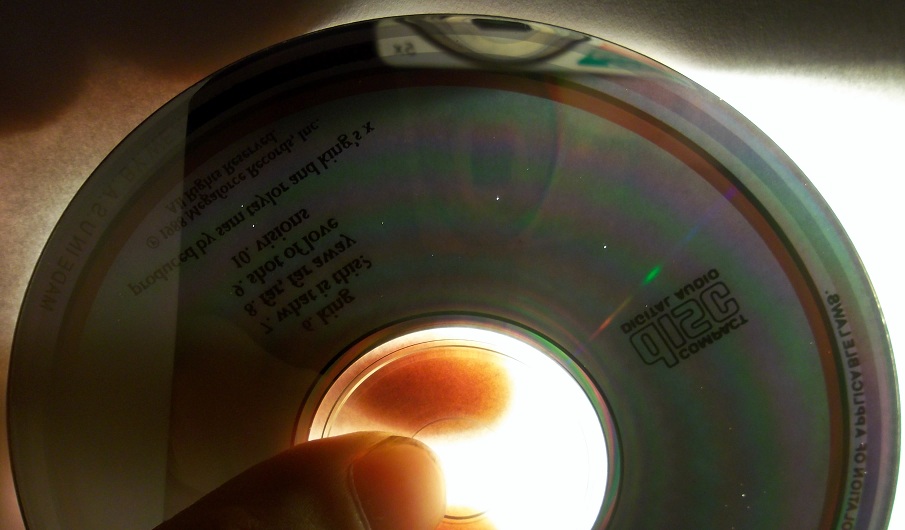
Discs that were top-scratched or pinholed, and not repairable.
CDs that were in mint condition.
CDs that were missing a component, such as a back cover, or one of multiple discs.
CDs that were so common that we always had them in stock.
Box sets.
Promo discs.
Classical music (we used a different buying structure for classical albums, based more on record label and series than artist and title).
Discs from every section of the store.
DVDs and video games too.
example of pinholes
There was a lot to teach, and I tried to make it fun, even though much of it was very tedious. A lot of repeat, a lot of doing the same thing over again, and a lot of waiting around as people took their turns going through buying scenarios. The classes were a chance for me to unbutton a bit and step out of the box. I had fun with the scenarios. I would play different characters. The white trash dude who watches everything you do and won’t shut up and let you think. The crackhead looking for a their next rock. The down-on-my-luck guy with a sob story that may or may not be true, who just needs enough money for the bus. And of course regular, every day, normal polite people. Because those are the exact situations they were going to experience in the front lines of the Record Store.
Not to mention (and we’ve been through this in more detail before, in Part 92: Staffing) there are many different versions of CDs. They can be similar, but have different tracks. It was crucially important to buy and enter these things accurately. If you didn’t, a customer would say, “I was looking on the internet and I saw you had the 1995 remastered version of Diary of a Madman,” and find that you just entered it wrong. It’s not the 1995; it’s the remixed 2002 one that nobody wants! Somebody made a trip in to get that CD, and you fucked it up. We tried to avoid that! But there’s only so much you can teach.
Then, to finish the buying procedures, I had to teach them about the bi-laws regarding buying used goods in the province, and how to take ID from customers. They had to know what ID’s were accepted, how to properly enter the info into the computer, and also how to deal with difficult customers who didn’t want to show their ID at all.
It was actually a pretty good system. Whoever came up with it (probably the same higher-up that sat in the first two classes) did a good job setting it up. Giving credit where credit is due, it worked. But also giving credit where credit is due, I worked my ass off in these classes, and made them my thing, while it lasted.
Training can be made fun. I think playing out scenarios is a great way to learn. Let’s face it, there is a lot of pressure on new employees during training. Doing my best to make it fresh and enjoyable was my strategy, and I think the results speak for themselves. A few people I trained ended up lasting over a decade, and that’s something to be proud of.
This summer is just burning by. This week, we’re burning through five more chapters of Record Store Tales MkII: Getting More Tale!
GETTING MORE TALE #506: I’m Eighteen
The old Record Store was 95% used CDs, bought from the general public. Like any store selling second hand goods bought pawn-style from walk-ins, we were regulated. As discussed in Record Store Tales Part 254: You Don’t Need to See My Identification, if you wanted to sell your shit to me, you had to present to me a government issued photo ID. That’s the law, and I was the sheriff, so show me your damned ID or you don’t get to sell your stolen CDs for weed money, got it!? It’s not like we were taking IDs just for fun. The cops really did go over our records (Record Store Tales Part 309: Penmanship), and every once in a while this would result in them catching a thief (Record Store Tales Part 307: Court). It was tedious but necessary work.
Part of the law regulating how we went about our business stated that you had to be 18 years or older in order to pawn stuff. People would complain. “But they’re just CDs, it’s not like I’m selling you a stolen television.” Yeah, but the laws don’t differentiate between you selling a TV, a Garth Brooks CD with a cracked case, or an X-Box. Some customers had a hard time grasping this concept.
To save yourself work, it was always advisable to ask a young-looking customer if they were 18 or older before you started going over their CDs. If they weren’t 18, you’d ask them to come back with a parent.
Here are some responses from customers who were asked if they were 18:
1. “But I’ll be 18 next week!” OK, then come back next week. You can’t vote if you turn 18 “next week”.
2. “Can you call my mom? She’ll tell you I can sell these.” No, you call your mom, and get her in here with her ID.
3. “Did you know it’s illegal to ask someone their age?” Uhh.
4. Several kids just went outside and asked strangers to sell their stuff for them, just like kids trying to get an adult to buy them liquor. Sometimes people would do it. Not exactly the wisest choice. If those CDs were stolen, guess who’s name is attached to them now?
5. You’d get the inevitable people who are flattered that you thought they were that young. “Thanks for the compliment!” Well, you’re very welcome!
The kid that really pissed me off (and this only happened once) was the kid who lied to me about his age before I went ahead and priced all his CDs. He had a lot of stuff, DVDs too, and it took a lot of time and work to go through and price them all. I checked each and every one for quality, I looked them all up in inventory, and I organised them according to value. I made the offer, the kid accepted it, and then I asked him for a piece of his ID.
And then I saw he was only 17.
I was pissed and I didn’t try to hide that. I had wasted all that time going through his shit that he couldn’t even sell, because he lied about his age.
That kid would be in his early 30’s today. I hope he learned to stop being a lying ass!
Note: This tale is from 1996 and does not reflect current tech.
GETTING MORE TALE #504: Waiting
The store that I managed for the longest period of time was opened in April of 1996. The format was 95% used stock, about 5% new. It was fun being a part of the cutting edge in retail.
When we opened that store, we were inundated by customers who had never heard of us before. Every day for months, somebody would wander in who had never been in one of our stores before. It was cool. We were different, and we wanted people to know it. We were eager to promote our special features and strengths, such as our listening stations and reservation lists.
The reservation list caused a lot of confusion among new customers.
Here’s how it worked. Let’s say you’re looking for a CD that is hard to find used – Pink Floyd’s The Wall. That one was expensive brand new. Usually it ran for about $33.99. Customers would much rather pay less, so they put themselves on our waiting list. At the time we opened, the waiting lists were for that store only. We didn’t have the ability to share our waiting lists with other branches yet. This was still a massive improvement over the old system: a notebook with phone numbers and titles written in it. (There were lots of names and numbers with the title “any Beatles”.)
The list operated on a first-come, first-served basis. If you were the very first customer to put their name in for The Wall back in April ’96, then you would get dibs on the very first used copy that came in. If you were second, you’d get the next shot at it, and so on and so forth. What seemed to confuse my early customers the most was “Where do these used CDs actually come from?”
There was no magical land of used CDs. There was no massive warehouse from which to pick and choose copies of The Wall in various conditions. There was no place from which to order used CD stock like you could with new. If there was a Used CD Magic Wonderland, then it was in your basement, because the only way we received our stock in those days was via the customer. If a customer came in and traded a great condition copy of The Wall, then congratulations – the first person on the waiting list received the first call.
On down the list we went. If the first person no longer wanted The Wall (a frequent occurrence) then we’d go down the list to the second person. We would phone each customer and give them a week to pick up their CD. Unfortunately most customers who no longer wanted the CD never bothered to tell us, so it would sit there for a whole week before we could put it back in the hopper. We wiped out our entire waiting list for Last of the Mohicans (Soundtrack) with just one copy, because none of the reserved customers wanted it anymore. There were five names on that list, and then suddenly none!
So: reserve a CD, and we would let you know when one was traded in. This doesn’t seem like it should be hard to understand, but apparently for some it was.
One upset customer came in about two weeks after reserving a rare CD. “Is it in yet?”
I checked. “No, it’s not in stock, but since you have a reserve for it, we’ll call you when it does show up.”
“When’s that going to be?” he asked.
“Hard to say,” I responded, trying to answer his question. “Whenever someone trades one in, which could be tomorrow or it could be next year.”
Then he bellowed, “What do I have to do to get this thing to come in?!”
Sometimes, I just didn’t know what else to say.
“You don’t have to do anything,” I said, not sure how to explain this further. “Somebody will get tired of their copy, or just need the money. If they sell it to me, you’ll get a phone call right away.” Then, feeling a little snarky, I added, “Unless you know somebody with a copy that you can talk into trading it in to us.”
There was actually one nearly-surefire way to guarantee a used CD would come into stock. T-Rev discovered this, inadvertently. Somehow, any time either of us bought a new CD that we’d been hunting for, suddenly a used copy would show up in store. Sometimes on the same day. This happened more than once! I was there when it happened with a Primus CD he was looking for. (Wish I could remember which one.) It was eerie.
Everything has changed today, obviously, and now you have access to the world’s inventory from your PC. It’s hard to imagine there was once a time when you (gasp!) had to actually wait to find a used copy of The Wall!
There are very few experiences in the world quite as trying as being forced to listen to a captive audience religious lecture at work. Now why would that happen? Well shit; in retail it happens all the time!
At the Record Store, I worked alone most of the time. Most of us did; we only staffed one person on duty for most of the day, from 10-5, for many years. This led to a number of inconveniences such as trying to find a moment to eat a lunch or take a wizz. Everybody dealt with it in their own ways; my way usually involved eating less lunch and more junk food, and getting really good at “holding it” for hours at a time.
But we weren’t busy all of the time. There were long stretches of…not boredom, but different kinds of work, when the store was slow and empty. Cleaning, balancing books, organising, doing inventory, taking annoying phone calls from higher-ups asking if the store was busy yet (and then somehow implying it’s your fault because “Cambridge is really busy right now”)…there was always lots to do! Unfortunately when you were alone at the store, you could sometimes get cornered by a talky customer for long periods of time.
The worst of these “conversations” (not really because they were usually one-sided) were the religious lectures. These were rare. I don’t want to mis-represent the situation. These religious lectures didn’t happen every day. But every once in a while, you would get cornered by somebody who just wants to tell you all about Jesus.
Yes, Jesus. I was never bothered by atheists, Muslims, Hindus or Wiccans. It was only the Christians, and only certain varieties of them, that wanted to tell you about their faith. I have nothing against any religions; I am a Christian myself but I consider this a somewhat personal journey. I really hate when people get my back up lecturing me about their faith. I like talking, not being lectured, and not at work! I’m trapped there; I don’t have an escape route. I don’t think this is an unreasonable pet peeve. But it happened. I’ve been handed Watchtower pamphlets, been invited to church services, and been told the music that was playing was satanic.
My strategy was “nod and smile”: Trying not to say too much, trying to get it overwith, and praying to my own Lord and saviour for the phone to ring so I could exit. You may think to yourself, “Well why not just tell the person you’re not interested?” Because they are used to hearing that and have answers to everything.
The religious solicitation at work continues today but with new methods. And there is only one church soliciting me today.
It started with the faxes in 2013: “Come to lunch at the Church of Scientology”. They were arriving weekly, the faxes, shortly after the new church opened in town. We joked about going; apparently they had a cafeteria that served lunch. We were getting sick of all the Wendy’s, McDonalds, and Burger Kings in town, but it never progressed further than joking. “Wouldn’t it be funny if…?” Even though they are open seven days a week during the day, the place always looked ominously deserted. It is mere walking distance from where I work today.
This week, I got my first Scientology invitation at home. It came in the guise of an offer for a “Free Personality Test” in my mailbox. It’s a “limited time” offer only (I’m pretty sure that’s false) and takes just one hour. It’ll help me improve my happiness and success in life. On the front it says “Oxford Capacity Analysis” (a nonsense phrase unrelated to Oxford university, designed to sound smart), and has graphs inside showing…something? The numbers on the axes aren’t explained. Only when you turn to the very back do you see who is offering this “Free Personality Test”, and yes, it’s the local Church of Travolta.
I find all of these tactics very cunning and shifty. In all these situations, they are coming at the target (me/us) with an advantage. I was cornered at work at the Record Store, putting me in a situation where it’s hard to escape the lecture. Today they send out these enticing booklets and invitations without being truthful about who they are until the last page. There’s something un-trustworthy about that.
Welcome back to the week of Getting More Getting More Tale!
GETTING MORE TALE #498: Hang-Up Wars
When the employee Joe “Big Nose” began working at one our stores in the late 90’s, he quickly became known for his surly phone demeanor. Not towards customers mind you; just towards co-workers! Joe was not much for pleasantries: “How ya doin’,” or “Have a great day.” We have said it many times in these pages before: Joe Big Nose was a very unique person. And hilarious.
The first time I ever spoke to Joe on the phone, I was calling his store from mine, looking for a stock check. Somebody wanted to see if a particular CD was in stock at his location. Joe pleasantly got it for us, took down the customer’s info, and put it aside. “Hey thanks a lot eh!” I said to the new guy. He didn’t answer.
I stared at the phone. “Did that guy just hang up on me?” He had! Joe doesn’t wait on the phone long enough for thanks and goodbyes. In fact there were uncountable times I thought I was speaking to him, and he had already hung up!
“Don’t worry, that’s Joe,” said his boss. “He doesn’t mean anything by it. That’s just his way.” OK, then, fine and dandy!
As I befriended Joe over the years, we would get into some friendly competitions over who could hang up the phone fastest on the other person. This started as part of the normal course of a day. We’d call each other looking for stock, but when business was done, it was only a question of who could hang up on the other fastest. My strategy was delaying him by asking something like, “I just have one more thing for you to check,” and THEN hanging up.
This grew into a competition with a life its own. We began calling each other with no purpose other than just to hang up.
For example, “Hey, do you have a used copy of the new Metallica?” CLICK!
Or, “Mike, I have a customer who wants to know if the new Bon Jovi is any good?” CLICK!
Or my favourite, just at the start of the call: “Hey Mike.” CLICK!
We took this to its natural extreme, which was me phoning Joe and hanging up just as he answers. A hang up can’t get much faster than that! I won the hang-up wars! (The bosses didn’t approve, but since the owner started the store pranks in the first place by stealing my Mars bar, I think they had it coming!)
As anybody who has ever manned a cash register for a living knows, you gotta keep that sucker stocked with change!
During the transactions of the day, you inevitably run low on certain coin denominations. With the Harmonized Sales Tax added in (our HST was a whopping 15%!) a used CD purchase always came to one of these four totals: $6.89, $10.34, $12.64, or $13.79. (Incredible, how I still have those totals memorised hey?) Most customers paid with a $20 bill. You can see how, through the course of a business day, you would build up a large stack of $20’s, while slowly running out of pennies, dimes, quarters, loonies ($1 coins), twonies ($2 coins) and $5 bills. (We rarely had to replenish the nickles. Since that time, pennies have been discontinued in Canada.)
One other critical factor to consider: We bought and sold used CDs. We paid between $2 and $7 cash per disc. You can see how would we run out of $5 bills, twonies and loonies quite easily on a busy day.
There were fewer worse feelings than running out of change midday, with no backup to make a bank run. Customers don’t like receiving a mitful of dimes for change because you don’t have anything larger left. Unfortunately, most of them didn’t help the situation. Some would try to give you exact change, or at least helpful change, but most would just lazily hand you a $20 bill even though they had a hand full of change, enough to make exact change. Granted, a large portion of customers actually wanted to keep their quarters and loonies for bus and laundry money. But I’ve also seen the odd guy here and there who would be paying, start counting out change to pay with, then lose count and just hand me a $20. Anyway: long story short, we were always handing out tons of coins and in need of change and small bills.
Managers like myself were responsible for keeping the register stocked with enough change. If we failed that, or miscalculated how much coin we’d need to get through the day, there’d be hell to pay in the morning! We had one nasty boss who was really good at yelling. Once she had unloaded the artillery on you, you didn’t want to disturb the beast ever again or you’d get it even worse. You didn’t ever want to have repeat offenses with this person. She could peel your skin just with a glare. So, I created a practical yet unpopular solution to this problem.
One day, after being yelled at for the umpteenth time for this, I said, “Fine. From now on, I’m stocking enough change to last us an entire week. We’re not running out again.” And we didn’t.
I’d have to call the bank in advance so they could prepare my large change order. (One bank wanted 24 hours’ notice — ridiculous!) I’d go to the bank with a small wad of $20 bills and return with a heavy bag of coinage. Fortunately we could use the “business line”, bypassing the large queue of regular customers, who sometimes would glare or make comments about the guy “jumping the line” (me). Unfortunately for my staff, whoever was closing at night had to count a whole bunch of coin and small bills. They complained, but I explained simply: “I’m not getting yelled at again for running out of change, so we have to live with it.”
Like I said, it wasn’t a popular solution, but it was an effective solution. Other store managers who might have been on the “good side” of that evil perfectionist boss didn’t have to worry about getting yelled as frequently as I did. She picked on me and a few select others harder than her favoured crew of close friends. Counting a shit-ton of change at night was a very small price to pay for this minor slice of peace of mind!
GETTING MORE TALE #489: I Forgot To Remember To Forget
Here are five short stories about forgetfulness in the old Record Store Days!
1. The Boss Man lived his life via one of those day timer books. Everything was in there – all his contacts, all his notes, where he had to be, when he had to be there, everything. So it was quite difficult for him when he left the book on top of his car and drove off! Needless to say he had to buy a new day timer and start over.
2. In my last year, I totally forgot I was working a morning shift. It was during the Christmas rush, and we had two people opening: me and one other guy. Since my reputation was that I showed up at least an hour early for an opening shift, my absence was noted before we actually opened. My co-worker Kam called me. “Did you forget you were opening today? You’re usually here by now.” Quickly covering for myself, I answered “Nah I was just doing some banking, I’ll be there really soon.” Saying this as I pulled on my pants trying to get out the door….
3. Ah, daylight savings time. Spring forward, and fall back! One day the Boss Man called me from our store in Waterloo. Keep in mind, I always got to work early except for that one time!
“Mike, have you heard from [“Bully” – name redacted]?” She’s not here at the store yet.”
I answered him no, but that she’s not usually in that early in the morning anyway, and not to worry. She’d surely be in before opening.
“But she’s late! I had to open the store!”
But she wasn’t late, and the store wasn’t supposed to be open. The clocks had turned back, but the boss forgot to change his. The boss got there early without realizing it and opened the store early anyway! We had a good laugh over this misunderstanding.
4. They had me running all over the place. I drove all the way to open a store in Oakville, Ontario one morning, only to discover I forgot the key to that store at home. Thankfully the boss man wasn’t far away and within 20 minutes he was there to open the door for me! Crisis averted again!
5.Once, and only once, somebody forgot to lock the door at closing time. I opened the next morning and was shocked to find the door unlocked. Obviously nobody had tried the door during the night or the alarms would have gone off. That was scary! My dad always taught me to lock up the doors when you leave a place. In fact there were times – many times – on my drive home when I couldn’t clearly remember locking the door, so routine had closing become. So I would drive back and check. I never left the door unlocked, but I also never would have been able to sleep at night if I didn’t go back to check!
People screw up! It’s in our nature as human beings.
The human brain has its own “autocorrect”. Have you ever seen something like this?
The quick brown fox jumped over the
the lazy dog.
Or this?
I cdn’uolt blveiee taht I cluod aulaclty uesdnatnrd waht I was rdanieg.
See how you read both sentences easily regardless of the mistakes within? The brain makes little corrections to our perceptions on a second by second basis. Think about the human eye, how it darts around, but what you perceive is a clear static picture.
Given that the human brain makes its own “corrections” every second of every day, it’s bound to also make mistakes in doing so, either by missing a correction, or making one where it wasn’t necessary. Either way – we fuck up! Add in a fast-paced environment, and mistakes are not a question of if, but when and how many.
In customer service, a screw up can be a critical moment. Mistakes can make or break the decision for a customer coming back or not. Whether you ring in something wrong, give the customer the wrong item, mis-charge a credit card, or give the customer incorrect information, sometimes you owe them an apology. So why not turn lemons into lemonade?
Since money speaks louder than words, the owner at the Record Store had a cool method of keeping the customer, even after a screw up that might have them fuming. It was actually a genius idea. We used something we called “apology letters”.
Let’s say we screwed something up, unambiguously. The best example of this would be forgetting to put the CD in the case, or putting the wrong disc inside. This was a lot easier to screw up than you might assume. Maybe the CD was supposed to be in slot #132, but you grabbed the disc in #123. Sometimes you don’t even notice it’s the wrong CD because after a while, they do all look the same. I had myself convinced that I was actually dyslexic. That’s how bad it got on some days.
Sometimes you’d catch the mistake before the customer left, and all would be well. The rest of the time, there was a chance they’d be pissed off that they had to make a return trip to get the right CD. Returning something that is defective doesn’t count towards an apology letter; that’s not necessarily down to staff mistakes. An apology letter was only issued when it was clear that we screwed up and in doing so, inconvenienced the customer. We didn’t use them to blame staff, or tally up numbers of them, but damn, I sure issued plenty over the years.
When a mistake such as this was discovered, we would prepare an apology letter. Staff would sign the letter and give it to the customer with their apologies, and the correct CD! The letter entitled the customer to $3 off their next purchase. We discovered that this small token often defused situations quickly and easily. Very few customers refused to return after receiving an apology letter worth $3. Many in fact were impressed to the point that we started seeing them more often.
It was a smart idea: one of many that I learned during my years in retail.
GETTING MORE TALE #476: Won’t Get Fooled Again (the long-awaited sequel to Record Store Tales Part 225: Bait & Switch)
“I knew immediately there was a problem. In his hands was a used copy ofPuff Daddy’s brand new smash hit album, No Way Out. It had one of ourBargain Binstickers on it, priced at $5.99. However the album was a fairly new release, and any used copies we had were always priced at $11.99. I’d never put one of them in my Bargain Bin, ever at this point. You just didn’t throw a new release into a sale bin. As Puffy said, ‘It’s all about the Benjamins.'” — from Record Store Tales Part 225: Bait & Switch
We had a deceptively simple inventory system at the Record Store. Each used CD case was empty. Every one of them was tagged with the price, and a number that would tell me the location of the actual compact disc behind the counter. This system benefited both our point of sale computer, which updated our inventory live in real time, and it was also a security bonus. With compact discs safely stored behind the counter, thieves knew they would get nothing by stealing a case. We made it obvious, by posting large ALL CASES ARE EMPTY signs. The bastards had to get creative when ripping us off.
In the Record Store Tale above, a scam artist got away with it. I wasn’t going to let him, but the owner didn’t stand up to the guy, called it a misunderstanding and let the guy have a discount. The scammer switched price tags, without realizing that the number code on the tags lead to a specific disc. When boss gave the guy a discount, it made me feel about two feet tall. I never let that happen again.
My new strategy was quite simple and it worked every time. When the first guy ripped us off, my big mistake was explaining to him that somebody switched price tags. That got him on the defensive and he had already prepared his argument regarding bait and switch laws. I got smart after that, by playing dumb.
The most memorable occasion involved a douchebag in his mid-20’s, and a rap title. I cannot remember today what the rap title was, but the CD itself was very brightly coloured and easy to spot. Buddy came up to the counter with a CD case, and the price tag looked tampered with. They never quite looked the same once peeled off and re-applied, and years behind the counter taught me that. Sure enough, the number on the price tag led to me the wrong compact disc. I checked out the locations of the discs in the computer and confirmed the guy had switched a tag. He wanted an $11.99 CD for $7.99, but it wasn’t going to happen on my watch. I pretended to look for the disc, but I had actually already grabbed it and put it aside. The price tag that he swapped it with, the $7.99 CD, was alphabetically right next to the other one. It was obvious he just grabbed two nearby and switched prices. I was taking time figuring this out though, so I had to tell him why.
“I’m sorry man but I’m having a really hard time finding this CD,” I explained. “Each price tag has a number on it that tells me where the disc should be, but it’s not in this spot. I’ll keep looking.”
As earlier explained, the compact disc I was supposedly looking for was a bright one, easy to spot. What I didn’t count on was this dude has already seen it behind the counter in its location. But what he didn’t count on was that I had since yanked it and hidden it out of sight! From the right vantage point, you could have spotted it, but it was gone now.
“Are you sure?” the scammer asked. “I think it’s right over there,” and he pointed me in the general direction. I put on a good act of looking, flipping through every disc but his. “I’m sure I saw it right there.”
“Can you show me?” I asked, knowing it wasn’t there. I don’t know if he figured out my game or not. He probably had. But there was nothing he could do about it. “Is this it?” I pulled out a disc with random artwork on it. “No, but I saw it right there, in that spot that is empty now.” Yeah, he caught me.
“I’m really sorry but it’s not there. I’ll keep looking. Why don’t you give me your name and phone number? I’ll call when I find it. I’m sure it’ll turn up.”