Stu Hamm

REVIEW: Joe Satriani – Dreaming #11 (1988 EP)

JOE SATRIANI – Dreaming #11 (1988 Relativity EP)

Don’t we all just miss the days when a major artist would just casually toss out a new EP between albums like this?  Following the Surfing With the Alien tour, Joe released a brand new song called “The Crush of Love” with three recent live tracks.  It went gold and hit the top 50 on Billboard.  You didn’t have to worry about pre-ordering it, and there was no “late tax” if you missed buying it right away.  That’s the way an EP by a major artist should be.

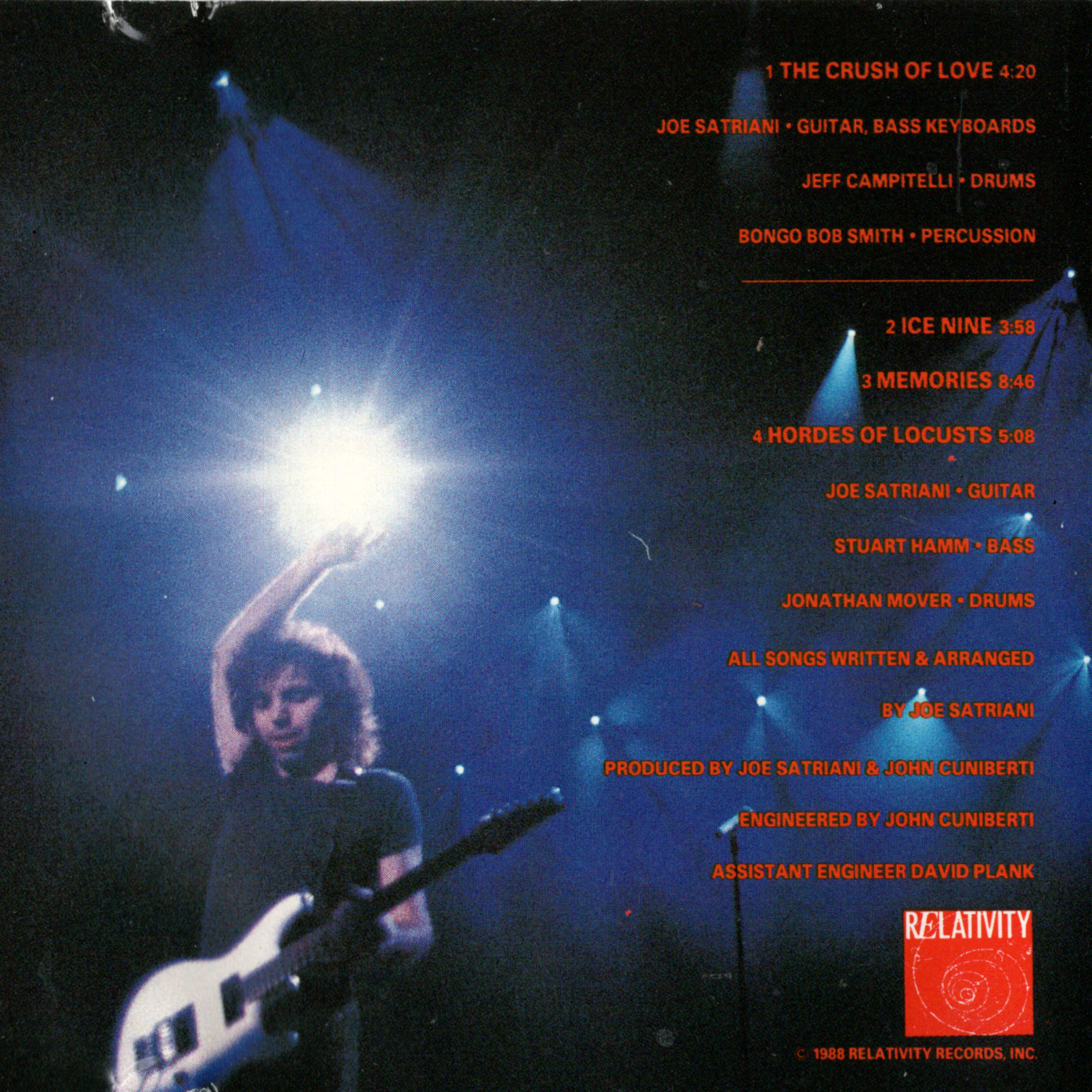
“The Crush of Love” is a magnificent track, with a overarching wah-wah hook that makes up the body of the song.  The rhythm section is Stu Hamm and Jonathan Mover on all tracks.  Hamm’s chunky bass is like that moment when you hit a big chunk of fudge in the middle of your ice cream.  Mover is the punctuation, while Joe indulges his melodic side with some wonderful lead.  In a Satriani composition, the lead guitar often takes the place of where the singer would normally deliver the hooks.  That’s “The Crush of Love” in a nutshell.  It’s more like Surfing material, rather than the Flying In A Blue Dream sound that Joe would explore 18 months later.

Onto the live tracks, all recorded by the King Biscuit Flower Hour in San Diego, June 11 1988.

“Ice Nine” from Surfing begins with Joe introducing his band, a symbol of their importance.  Then humbly he adds, “Thank you all for coming.  My name’s Joe.”  Onto the thumping “Ice Nine”, which Stu Hamm turns into a bass showcase for impressive fingerwork without overplaying.  Mover perfectly complements him, nailing the moments the drums need to add some explosions, without being too showy.  Meanwhile, Satriani’s causing explosions of his own, but it always comes back to song’s main melody.  Yes, Joe plays the crap out of this song, but it is indeed a song.

Joe takes us back to his debut album Not Of This Earth (which was reissued in 1988 with similar cover art to Dreaming #11) for the last two tracks.  The lengthy “Memories” opens with a guitar exploration, but quickly turns into a catchy little running guitar melody.  It’s an aggressive number and one of Joe’s more challenging to the uninitiated.  As always, Hamm’s playing his mindblowing and catchy.

Finally, “Hordes of Locusts” has a slower grinding groove that ends the EP on an ominous musical note.  Mover and Hamm largely stick to the groove while Joe shreds and strafes.

At over 23 minutes of exclusive music, this EP was well worth the value.  No wonder it went gold.

4/5 stars
REVIEW: Joe Satriani – Flying in a Blue Dream (1989)

JOE SATRIANI – Flying in a Blue Dream (1989 Relativity)

I used to read all the rock magazines and charts as a kid, and I was surprised when Joe Satriani’s latest album cracked the top 30 in Canada.  “Isn’t he an instrumental guitar guy?  Do enough people buy that stuff for it to chart?”  Apparently they did, and even if instrumentals aren’t your thing, you have to love Joe’s big vocal single debut, “Big Bad Moon”.

Joe nailed a cool, creative music video with lots of shreddery, which immediately caught my eye.  Joe looked like Razor Ramon before there was such a character, but cool as ice in that suit.  Meanwhile, another Joe in a leather jacket shreds the fuck out of a beautiful silvery Ibanez.  Putting on a gritty, Waits-ish voice, Joe slammed out a blues rocker like no blues I’d ever heard before.  I had to get this!

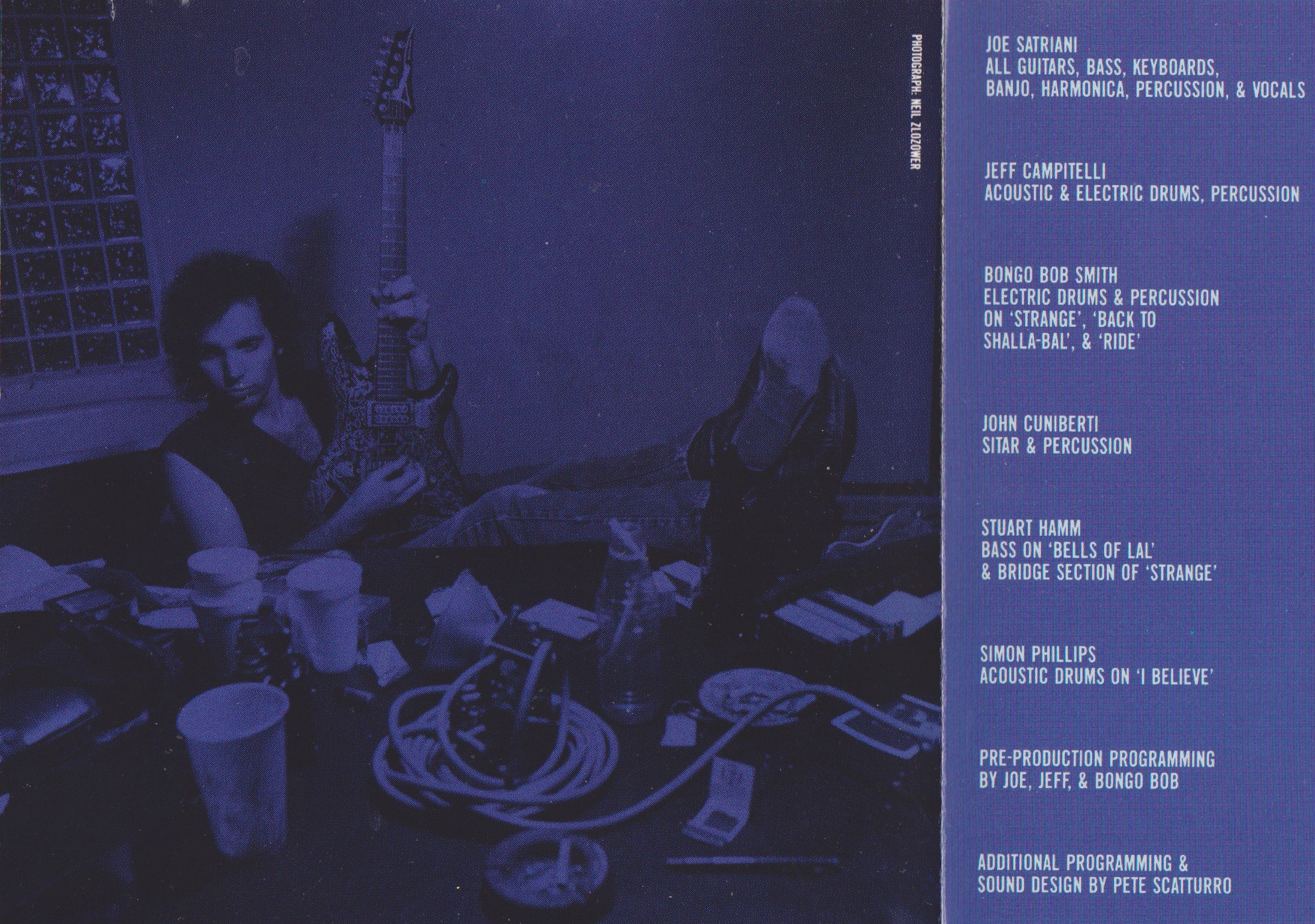
Flying in a Blue Dream contains only six vocal songs, but it didn’t need any more than that to become a hit.  The instrumentals are all killer (as Joe’s usually are).  For an album that is well over an hour, it is rare to find one so full of killer, with zero filler!  The best way to think about Satriani songs is that they are not really instrumentals, just good songs where the lead vocal melody is performed by a guitar.  Most of the songs on Flying share this quality.  The title track is one such song, where the musical backbone is a good song on its own, but the lead guitar front and center is where the lead singer would normally be delivering the hooks.  Instead, Joe delivers all the hooks with his guitar alone, and does so ably.  This is no easy accomplishment.  Lots of songs are in the five minute range, but don’t drag or bore.

Variety is another key quality to this album.  “Flying” isn’t a ballad, but falls somewhere in between.  “Can’t Slow Down” on the other hand will rip your head clean off.  For a real ballad, check out the beautiful “I Believe”, still a favourite of mine today.  While the diversity of the album is one of its strengths, another is the production, particularly on the guitars.  Melty, etherial and slippery as greased mercury, Joe’s tone defies imitation.  He gets crunchy on the rhythms though, and it’s a really sweet crunch — like a Skor bar.

When instrumentalists like Joe added vocals to their arsenals, jaded music snobs would often accuse the artist of “selling out” or “going soft”.  Nothing could be further from the truth.  Boom, right there on track #2 (“The Mystical Potato Head Groove Thing”) is bright instrumental showcasing virtually every trick in the Book of Satch!  Harmonics out the wazoo, sounds I can’t describe or articulate, but all done with an eye to the melody and groove of the song.  That’s how to do it, folks.  You want groove?  Check out “Can’t Slow Down”, one of the blazing vocal tracks, or the headlong “One Big Rush” and “Back to Shalla-Bal”.  You want bizarre and experimental?  Then “Headless” and “Strange” appropriately fit the bill.  You want mystical, exotic and avante garde…but with funk bass?  Parts I and II of “The Bells of Lal” should do you.

Adding vocals was the coup de grâce. Those songs really elevate Flying in a Blue Dream to a timeless level.  Of them, “I Believe” is particularly special.  It is quiet and spare, in contrast to some of the heavier moments on the album.  Tasteful and reserved guitar melodies set the tone, and Joe sings softly of making a better tomorrow.  His singing is remarkable actually, because though Joe is not known for his voice, he sings with the correct passion and feeling.  In short, it all works as a package.  Remember, it is usually Joe’s guitar that delivers the the hooks.

Flying in a Blue  Dream always seems to live in the looming shadow of its predecessor, the million selling Surfing With the Alien.  If I had to pick a favourite, it would be Flying in a Blue Dream, every time.

5/5 stars

Scan_20160331 (3)

R.I.P. Randy Coven – guest shot by Warren Murchie

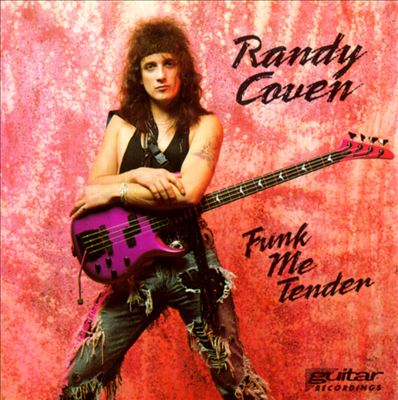
I read the news today that bassist Randy Coven had passed away at age 54 of undisclosed causes.  My friend and former customer as well as a bassist himself, Warren Murchie, shared a few words regarding the passing of Mr. Coven.

COVEN

By Warren Murchie

I met Randy Coven first off at a gig he had doubling up with Stu Hamm. Now, Stu’s albums are really good, not only as a bassist but also as a songwriter, and his works with Joe Satriani were incredible to say the least. I do have to say though that at this double bill, with both Randy and Stu and their respective bands and solo CDs, it was Randy that really stepped forward and was nothing short of incredible.

I HAD to talk to the guy afterwards, knowing he was someone that really had something to say to bass players in my mag. He proved to be forthcoming, informative and knowledable, and a hell of a decent character. (Many years later I met Stu Hamm in Switzerland at a bass clinic and he was a great dude too!).

As to Randy,both then and now I regret the fact that he did not have the opportunity or perhaps the wish to really create a portfolio of works. The guy was a brilliant bassist, equal to Billy Sheehan or Gary Strater of Starcastle, but of a different bent musically. It seem to be a good fit that Randy worked both with Steve Vai and Yngwie Malmsteen over the years. He was, as Chris Squire was and is, a Lead Bassist. Like Chris however, Randy knew when to back off and work in a band environment. He could be a Team Player while still being so dazzlingly good he stood out regardless — perhaps because he could play at an Yngwie or Steve Vai level if he needed to, but also knew when to just shut up and hold the groove down.

We are all beholden to Randy, for all he added to the instrument over his all too short life. I know the world of bassists is head over heels in love with what Jaco Pastorius gave to us as a lighthouse in the dark for inspiration, but Randy, never receiving his just dues, added so much as well and demanded little. We are all lesser for the loss of him! If reincarnatinon is true, he will be screaming back here to bring us the next chapter of where bass is going to….