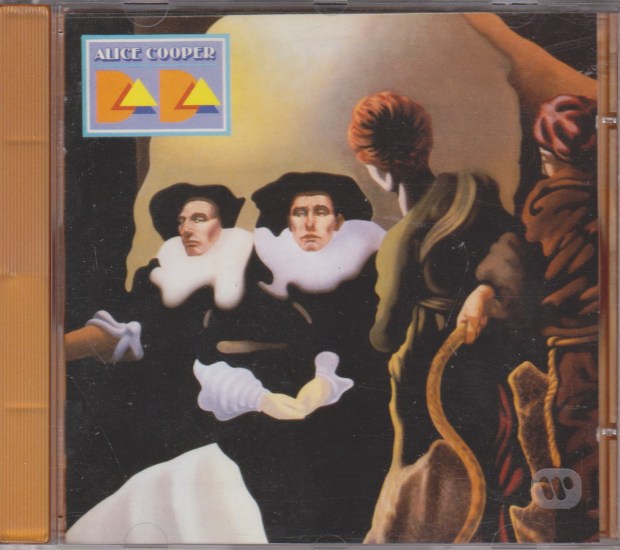


ALICE COOPER – DaDa (1983 Warner)
DaDa is one of the most fascinating albums in the Alice Cooper catalogue. So interesting in fact that this is the second time I’ve tackled a review of it. The first, posted on Amazon years ago shortly after buying the album, was not flattering. The entire thing is below:
This is what happens when you drink too much and can’t remember years of your life anymore.
This is what happens when your producer is nursing his own drug problems.
This is what happened to Alice Cooper in the early 80’s. Guitars, drums and bass have been jettisoned in favour of samples, keyboards, and programs. Songs? Non-existant. This album is worthless, filled with dreck that Cooper wouldn’t have even considered a decade earlier, or later. I defy anyone to explain the concept of the story to me. No songs ever played live, no tour.
One novelty track: “I Love America”, which is actually hilarious. It is also available on the Cooper boxed set. Pick that up, not this.
0/5 stars. The absolute nadir of the man’s storied career.
That’s what I said then, and I have to own it now. I could delete it and pretend I never said it, but that would be dishonest.
Rich at Kamertunesblog did a fantastic Alice Cooper series a few years back. When he got to DaDa, I said that “I still have not really penetrated [it]. I don’t know if I so much as appreciate it, rather than like it.” When Rich said he found that surprising, I realized I must be missing something with DaDa. So how does DaDa sit now, after a few years to let it absorb?
It’s different. It’s creepy. It’s funny. It’s worth the time spent with it.
The story of DaDa itself is almost as interesting as the story of how one man can go from hating it to loving it.
Alice re-teamed with Bob Ezrin on this album, for the first time in years. Dick Wagner came back for guitar, bass and songwriting duties. Wagner claimed in his autobiography that Alice wasn’t that enthused about making this album, and confessed that contracts stipulated he had to. Backing up Wagner’s claim is the fact that this was Alice’s last album for Warner, followed by a three year hiatus to finally get clean and sober for good. There was no tour, in fact no band.
In lieu of a drummer, all beats are programmed. This lends a stark early 80’s synthpop sound to DaDa. It works exceptionally well on the title track, an Ezrin instrumental creation. The echoey electronics sound as if from a frightening science fiction horror movie from the period. Punctuating this is the mechanical repeating sample of a child saying “da da”…and heavenly new age keyboard melodies. Talk about chills! If that doesn’t get you, perhaps the spoken word conversation between a therapist and a patient will give you the shivers. “I have a daughter too,” says the elderly patient. “You don’t have a daughter,” responds the doctor. “Yeah, I have a daughter,” insists the sick man. “Sir, you have a son,” insists the doctor as the conversation gets creepier. Alice Cooper is not even on this piece. Perhaps that is one reason it failed to make an impression on me all those years ago.
Alice emerges on “Enough’s Enough”, changing to the perspective of the son. “I just want to tell you, you’re a lousy dad, to hell with you!” Dark but strangely upbeat, “Enough’s Enough” has some of those Bob Ezrin touches that you love, such as the perfectly arranged backing vocals. The Dick Wagner guitars are the only real touch of rock and roll; the song otherwise lives in a punky new wave land. The best song is much creepier: “Former Lee Warmer”. Alice alludes to the character of “Former Lee” on the previous song: “Why’d you hide your brother?” “Former Lee Warmer” reveals that the body of the brother was locked in a chest in the attic. “All the mops and brooms keep him company, misconceived of the family.” Musically and thematically, this is just as good as Welcome to My Nightmare! This is all done in Alice’s brilliant speak-sing style.
The concept becomes harder to follow on “No Man’s Land”, a good rock and roll song only weakened by the clanky electronic percussion. Wagner is outstanding. Similarly disconnected is “Dyslexia”, which sounds like Devo snuck into the studio. Harmless fun; I wonder how many songs have been written about dyslexia in popular music? It’s not clear who is on bass (probably Prakash John rather than Wagner), but the bass pulse is brilliantly subtle and perfect. “Scarlet and Sheba” is an album highlight, electronically exotic and heavy too. It’s perfectly dressed a with killer chorus and kinky lyrics, topped with a brilliant Ezrin arrangement.
“I Love America” is admittedly a novelty track, but I still like it today. Taking on the persona of a redneck, Alice lampoons every cliche about his homeland. “I love Velveeta slapped on Wonder Bread! I love a Commie…if’un he’s good ‘n dead!” The reason it works is because it’s Alice Cooper. I don’t think anyone else could have pulled it off. Ezrin provides suitably pompous backing music, turning it into a rock national anthem. (My favourite lyric is the last one: “I love my bar, and I love my truck. I’d do most anything to make a buck! I love a waitress who loves to ffff…flirt. They’re the best kind!”)
Going into “Fresh Blood” you’ll notice the synth horns, not really a substitute for the real thing. It’s actually a pretty good funky rock tune. Alice sings melodically with layered vocals, and once again the bass sounds awesome if you pay attention to it. The final track is another drama-laden burner called “Pass the Gun Around”. The character (referred to as “Sonny”; perhaps the son from earlier in the album) wakes up in a hotel room after another blackout night. It’s not a pretty scene but it ends the album on a suitably serious and musically complex note. It’s actually one of the better Cooper tracks from any era, thanks in no small part to Bob Ezrin and Dick Wagner.
Interesting trivia: Probably because Ezrin recorded the album in his native land (Canada), Lisa DalBello is credited on backing vocals. Queensryche would later cover one of her singles, “Gonna Get Close to You”. She was also a part of Alex Lifeson’s Victor project.
Today’s rating: 4/5 stars, but only after a long journey. And the concept still seems to derail halfway through the album.


 mikeladano.com