Reviews

REVIEW: Mollo / Martin – The Cage 2 (2002)

Scan_20160208DARIO MOLLO / TONY MARTINThe Cage 2 (2002 Frontiers)

Three years out from their debut album The Cage, Tony Martin and Dario Mollo re-teamed up for a sequel, creatively titled The Cage 2!  On their second effort, Mollo and Martin broke out of a cage of sorts and made heavy metal music with a little more identity.  Keyboardist Don Airey did not return for this album, but in his stead is the legendary Tony Franklin on bass.

Heavy modern nu-metal touches highlight “Terra Toria”, a detuned beast with a bit of grunting on the choruses.  Thankfully the verses are piled high with Tony’s melodies, the same kind that he used to contribute to his Black Sabbath albums.  Mollo meanwhile lays down the shred with a Neal Schon vibe and plenty of power chords.  The heavy stuff takes a bit of a back seat on “Overload” which could have worked well as a Dio power ballad.  Underrated as a vocalist, Tony Martin has no issues delivering the hooks and high notes.  One thing I have loved about Tony Martin is that he also plays violin, and sometimes throws that into his songs, as he did on his solo album Scream.  “Overload” has a fast flying violin solo, and it’s a killer.

Distorted lead vocals on “Life Love and Everything” lend it a modern touch on the verses, but the layered vocals of the chorus make it clear that this is not nu-metal.  The guitar riff is a tricky shuffle, but with a groove.  It’s soul metal with the emphasis on the metal rather than the soul!  “Balance of Power” is just speed metal, along the lines of some of the things Sabbath had done on Tyr such as “The Lawmaker” and “Heaven in Black”.  If you miss that era of Sabbath, or the kind of fast metal that Dio was apt to do, then check out “Balance of Power”.  If you’re in  tune with 80’s Sabbath, check out “Amore Silenzioso”.  It is the closest thing to Black Sabbath’s “The Seventh Star” that I have heard, though not quite on that level.  A short keyboard based instrumental (“II”) closes that, and goes into “Wind of Change”, not the Scorpions song, but a ballad nonetheless.  If the songs on Cage 2 have a common weakness, it is that many are on the long side.  “Wind of Change” is too much ballad, though it does house an absolutely stunning guitar solo.

“Theater of Dreams” carries over with the 80’s Sabbath sound, and more intricate and cool guitars.  The slow groove combined with the might of Martin and the metal of Mollo make it a winner in these books.   Then they take a drive down Van Halen alley, with “What a Strange Thing Love Is”, not a bad tune at all, but definitely in the summer song style of Sammy Hagar.  It’s pop metal with soulful backing vocals, and it’s cool.

Scan_20160208 (2)

The only serious mis-step is an ill-advised cover of “Dazed and Confused”.  It’s nearly impossible to do this song without sounding like a jackass.  As great as Martin sings most of it, he ruins it by adding in his own adlibs that just remind you, oh yeah,  it’s a cover of a better version by Led Zeppelin. Thankfully Mollo makes the guitar solo the centerpiece and it does the job without copying Jimmy Page.  Without this cover clogging up the works, the CD is actually more enjoyable.

Moving into the last lap, “Guardian Angel” pounds the ground with double bass and heavy riffing.  It has Iron Maiden elements but kicks ass all around.  Still they saved the best track for last, which is “Poison Roses”.  This melancholy closer is the most memorable in a batch of pretty strong heavy metal songs.

You have to give Tony Martin credit.  He’s a great singer, a good songwriter, but no matter what kind of albums he makes, he remains in the shadows.  Too bad.  Fans would do well to seek his his collaborations with Dario Mollo.  They compete in quality with the albums Tony made in his better known band.

3.5/5 stars

REVIEW: Mollo / Martin – The Cage (1999)

Part one of a two-parter!

Scan_20160109DARIO MOLLO / TONY MARTIN – The Cage (1999 Dreamcatcher)

When Ozzy Osbourne returned to Black Sabbath in 1997, that was undeniably a very exciting moment in heavy metal, and rock in general.  By ’98, original drummer Bill Ward even returned to the band, completing the original lineup.  We were rewarded for our patience with two new Black Sabbath songs called “Psycho Man” and “Selling My Soul” by the original lineup, but otherwise it was the beginning of a long drought.  Though Sabbath toured and played festivals, it was the sparsity of new material that pissed off a few fans, this one included.

Thankfully during this Sabbath ice age, some former members kept the flame alive with new heavy metal music.  Former vocalist Tony Martin, who was ousted for Ozzy’s return, recorded three albums with Italian guitarist Dario Mollo.  1999’s The Cage, featuring Don Airey (Deep Purple) on keyboards, is their first collaboration.  This helped scratch the Sabbath itch during the drought.

A jagged Dio-ish guitar riff commences “Cry Myself to Death”.  The doomy edge is present.  Martin sounds as if in peak voice.  The thirst is quenched.  It’s easy to imagine a song like this could have been on a followup to 1995’s Forbidden.  Dario Mollo is nothing like Iommi, being capable of heavy modern shreddery at maximum velocity.  This is proven on “Time to Kill”.  This time the vibe is like “Lawmaker” from 1990’s Tyr album.  The pace is breakneck, but Don Airey is more than capable of keeping up on the keys.  This is a stunning metal track mixing the spirit of old with the talent of new.  It verges on regal Priest-isms by the solo break, blazing on to the end in a frenzy.

Don Airey plagiarizes his own keyboard part from Judas Priest’s “A Touch of Evil”, for an instrumental intro called “The Cage”.  This serves as the start for a moody Dokken-esque ballad called “If You Believe”.  Don Dokken only wishes he could still write a song this good, a quality dark ballad, perhaps akin to Sabbath’s “Feels Good to Me”.  Then “Relax” also operates on a dark Dokken / Whitesnake vibe.  Mollo’s shredding on this would would make Eddie Van Halen nod in approval.  And speaking of Whitesnake and Cov the Gov, guess what they cover later on in the album?  “Stormbringer”!  Don makes the keyboards a bit too spacey on that one, but it is an otherwise pretty authentic cover, and the guitar solo is virtually note for note.

Scan_20160109 (3)

“Smoke and Mirrors” is pretty lame.  “Some girls, they look really pretty but they tell you lies,” sings Martin.  Well maybe, but some singers sing real good but struggle on the lyrics.  The weakest track so far, “Smoke and Mirrors” has a sleezy rock vibe, like a latter-day Europe track.  Mollo’s playing is the highlight but the song is pretty skippable.  “Infinity” is more Sabbathy, reminding me of “Headless Cross”.  Onto “Dead Man Dancing”, I think of Gary Cherone and Extreme.  The song boasts a soaring Martin chorus and plenty string mangling by Mollo.  Then it’s onto “This Kind of Love”, a dead ringer for Van Hagar.

The album closes on “Soul Searching”, (kind of similar to Sabbath’s “Nightwing”) which is something I wish Dario and Martin had done more of during the writing of this album.  It would be nice to hear more of the sounds of their own personalities rather than songs that remind us of other bands.  That’s rock and roll; the great struggle.  It is not easy to carve out your identity among the thousands of bands who already have.  The Cage is loaded with great music, and the playing is above reproach.  What it lacks is originality.  Even in the guitar playing, I would say that Dario Mollo owes John Sykes a debt of gratitude, though he is certainly no slouch.  I just crave more originality in the tunes.  Yes, part of the appeal of following ex-Sabbath members like Tony Martin into a solo career is to hear a bit more of that sound you loved.  There are just too many moments on The Cage that sound like songs you already know.

3.25/5 stars

REVIEW: Sons of Freedom – Sons of Freedom (1988)


SONS OF FREEDOM – Sons of Freedom (1988 Slash records)


“Never retract, never retreat, never apologise…get the thing done and let them howl.”Nellie McClung 1873-1951


Once considered the saviours of Canadian rock, Vancouver’s Sons of Freedom powered their way onto the national scene in 1988 with “The Criminal”, one of the straight-up rockingest tracks to ever emerge from the tundra.  They maintained momentum long enough to beat Nirvana in the college radio charts in 1991 (#1 debut vs a #2 for Nirvana), but Sons of Freedom didn’t fit into a nice “grunge” pigeonhole.  They were too different, too weird, too Canadian.  By 1995 and a mere three albums, they called it a day, but were not forgotten.

What a track “The Criminal” was, certainly sounding very little like 1988.  The bleak music video didn’t look much like the competition.  Crammed into a tiny rehearsal space, the three clean-shaven, short-haired musicians (all named Don for real!) and one long-hair with a British accent (named Jim Newton at first, but he changed his name on every single album!) didn’t look like other bands on the rock scene.  They hooked up with Slash Records, and Faith No More’s producer Matt Wallace, and made a starkly heavy record.  They may have appealed to the same audience as The Cult, a superficial comparison, but Ian Astbury was considered an “honorary Canadian” by many rock fans (he lived in the Great White North for six years in the 1970’s and Cult bassist Jamie Stewart later made his home on the Toronto scene).  But in 1988, the Cult had never recorded anything as relentless as “The Criminal”.

We got love, we got love, we got justice from above.

If any band in Canadian rock history defined the phrase “ahead of their time”, it had to be Sons of Freedom.  “The Criminal”, with its emphasis on that singular groove and strangely hypnotic vocals, could have lead the charge in the 1990’s.  There are solos, but they are clang-and-bang, not shred.  They even had a quote by a Canadian female rights activist on the cover!  Why didn’t they catch?  Maybe it was the fact that they didn’t stand still and repeat themselves.  Maybe it was the singer changing his name to James Jerome Kingston.  Whatever it was, Sons of Freedom didn’t make the impact they rightfully could have.  They even had a song called “Fuck the System”!

The three Dons (Binns, Short and Harrison) lay down massive and strange bass-heavy grooves all over this debut album.  They sound more like industrial machinery than musicians on some tracks.   “Super Cool Wagon” has the concrete foundation needed to flatten all comers, but also boasted a weird “Ah-ooh-ah-ooh-ah-ay” vocal with no words!  That’s the album opener — nearly four solid minutes of heavy rock with nothing but ah’s and ooh’s for lyrics!  Amazing tracks like “Mona Lisa”, “This is Tao” and “Shoot Shoot” are based on the same template.  Smashing monolithic grooves, expertly recorded by Wallace, are topped by the unusual and melodic vocals of James Newton.  The vocals allow you to grasp onto the song, while the undercurrent of the groove carries you away.  I blame Don Binns for the sheer inertia of the grooves, since his bass work sounds to be the driving force of them.

Other tracks explore different directions.  “Dead Dog on the Highway” slows it down but adds a strangely funky Don Harrison guitar lick on top.  “The Holy Rollers” drones on slower than slow, the Smiths on Quaaludes, but again you are dragged along with it.  Pay attention to what is going on beneath the groove, as dischord rules with a balanced fist.  “Judy Come Home” is almost radio-friendly, but “Is It Love” has a stuttery groove that could have been hit material in the right climate.  “Fuck the System” is hard-hitting good-time punk and one of the only songs to have a rocky riff.  The final track “Alice Henderson” is the Sons’ version of an epic as it chugs without rest, leaving nothing but wreckage and waste behind.

Ultimately, I suppose nothing bonds bandmates like a good first name.  The three Dons emerged a few years after Sons of Freedom split, backing Lee Aaron (then simply “Karen”) in a new band called 2preciious and a later industrial project called Jakalope!

3.5/5 stars

Scan_20160120 (3)

REVIEW: Alice Cooper – DaDa (1983)

ALICE COOPER – DaDa (1983 Warner)

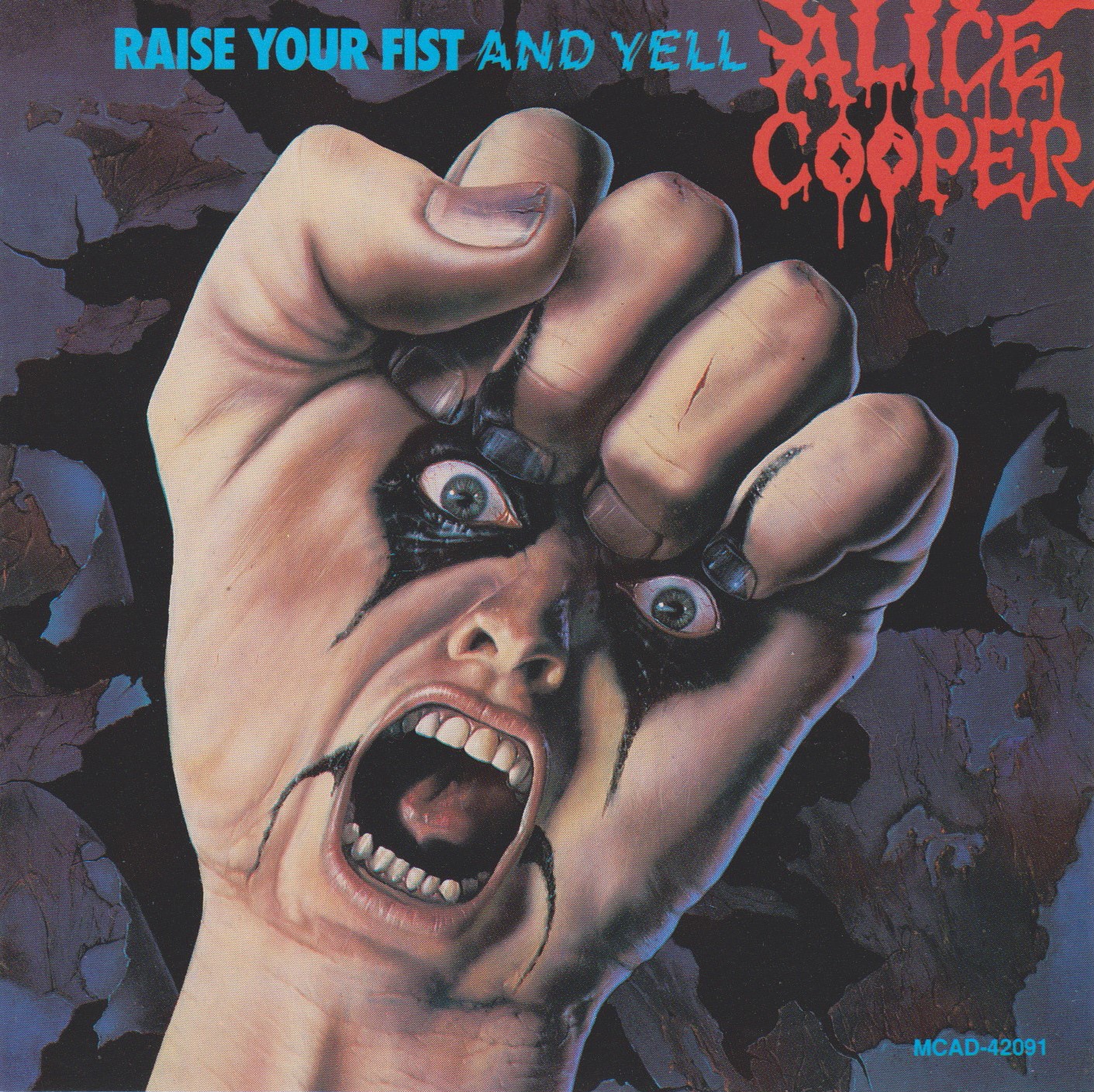
DaDa is one of the most fascinating albums in the Alice Cooper catalogue.  So interesting in fact that this is the second time I’ve tackled a review of it.  The first, posted on Amazon years ago shortly after buying the album, was not flattering.  The entire thing is below:


This is what happens when you drink too much and can’t remember years of your life anymore.

This is what happens when your producer is nursing his own drug problems.

This is what happened to Alice Cooper in the early 80’s. Guitars, drums and bass have been jettisoned in favour of samples, keyboards, and programs. Songs? Non-existant. This album is worthless, filled with dreck that Cooper wouldn’t have even considered a decade earlier, or later. I defy anyone to explain the concept of the story to me. No songs ever played live, no tour.

One novelty track: “I Love America”, which is actually hilarious. It is also available on the Cooper boxed set. Pick that up, not this.

0/5 stars. The absolute nadir of the man’s storied career.


That’s what I said then, and I have to own it now.  I could delete it and pretend I never said it, but that would be dishonest.

Rich at Kamertunesblog did a fantastic Alice Cooper series a few years back.  When he got to DaDa, I said that “I still have not really penetrated [it]. I don’t know if I so much as appreciate it, rather than like it.”  When Rich said he found that surprising, I realized I must be missing something with DaDa.  So how does DaDa sit now, after a few years to let it absorb?

It’s different.  It’s creepy.  It’s funny.  It’s worth the time spent with it.

The story of DaDa itself is almost as interesting as the story of how one man can go from hating it to loving it.

Alice re-teamed with Bob Ezrin on this album, for the first time in years.  Dick Wagner came back for guitar, bass and songwriting duties.  Wagner claimed in his autobiography that Alice wasn’t that enthused about making this album, and confessed that contracts stipulated he had to.  Backing up Wagner’s claim is the fact that this was Alice’s last album for Warner, followed by a three year hiatus to finally get clean and sober for good.  There was no tour, in fact no band.

In lieu of a drummer, all beats are programmed.  This lends a stark early 80’s synthpop sound to DaDa.  It works exceptionally well on the title track, an Ezrin instrumental creation.  The echoey electronics sound as if from a frightening science fiction horror movie from the period.  Punctuating this is the mechanical repeating sample of a child saying “da da”…and heavenly new age keyboard melodies.  Talk about chills!  If that doesn’t get you, perhaps the spoken word conversation between a therapist and a patient will give you the shivers.  “I have a daughter too,” says the elderly patient.  “You don’t have a daughter,” responds the doctor.  “Yeah, I have a daughter,” insists the sick man.  “Sir, you have a son,” insists the doctor as the conversation gets creepier.  Alice Cooper is not even on this piece.  Perhaps that is one reason it failed to make an impression on me all those years ago.

Alice emerges on “Enough’s Enough”, changing to the perspective of the son.  “I just want to tell you, you’re a lousy dad, to hell with you!”  Dark but strangely upbeat, “Enough’s Enough” has some of those Bob Ezrin touches that you love, such as the perfectly arranged backing vocals.  The Dick Wagner guitars are the only real touch of rock and roll; the song otherwise lives in a punky new wave land.  The best song is much creepier:  “Former Lee Warmer”.  Alice alludes to the character of “Former Lee” on the previous song: “Why’d you hide your brother?”  “Former Lee Warmer” reveals that the body of the brother was locked in a chest in the attic.  “All the mops and brooms keep him company, misconceived of the family.”  Musically and thematically, this is just as good as Welcome to My Nightmare!  This is all done in Alice’s brilliant speak-sing style.

The concept becomes harder to follow on “No Man’s Land”, a good rock and roll song only weakened by the clanky electronic percussion.  Wagner is outstanding.  Similarly disconnected is “Dyslexia”, which sounds like Devo snuck into the studio.  Harmless fun; I wonder how many songs have been written about dyslexia in popular music?  It’s not clear who is on bass (probably Prakash John rather than Wagner), but the bass pulse is brilliantly subtle and perfect.  “Scarlet and Sheba” is an album highlight, electronically exotic and heavy too.  It’s perfectly dressed a with killer chorus and kinky lyrics, topped with a brilliant Ezrin arrangement.

“I Love America” is admittedly a novelty track, but I still like it today.  Taking on the persona of a redneck, Alice lampoons every cliche about his homeland.  “I love Velveeta slapped on Wonder Bread!  I love a Commie…if’un he’s good ‘n dead!”  The reason it works is because it’s Alice Cooper.  I don’t think anyone else could have pulled it off.  Ezrin provides suitably pompous backing music, turning it into a rock national anthem.  (My favourite lyric is the last one:  “I love my bar, and I love my truck.  I’d do most anything to make a buck!  I love a waitress who loves to ffff…flirt.  They’re the best kind!”)

Going into “Fresh Blood” you’ll notice the synth horns, not really a substitute for the real thing.  It’s actually a pretty good funky rock tune.  Alice sings melodically with layered vocals, and once again the bass sounds awesome if you pay attention to it.  The final track is another drama-laden burner called “Pass the Gun Around”.  The character (referred to as “Sonny”; perhaps the son from earlier in the album) wakes up in a hotel room after another blackout night.  It’s not a pretty scene but it ends the album on a suitably serious and musically complex note.  It’s actually one of the better Cooper tracks from any era, thanks in no small part to Bob Ezrin and Dick Wagner.

Interesting trivia:  Probably because Ezrin recorded the album in his native land (Canada), Lisa DalBello is credited on backing vocals.  Queensryche would later cover one of her singles, “Gonna Get Close to You”.  She was also a part of Alex Lifeson’s Victor project.

Today’s rating:  4/5 stars, but only after a long journey.  And the concept still seems to derail halfway through the album.

TV REVIEW: American Dad (featuring James Hetfield of Metallica) – “The Life Aquatic with Steve Smith”

AMERICAN DAD! – “The Life Aquatic with Steve Smith” (Episode 2, season 12)

American Dad is back!  The 12th (or 13th) season (depending on how you count) commenced last week.  While last week’s instalment was ho-hum, this week’s was a brilliant return to form, thanks in no small part to the mighty metal music of Metallica.

It is spring time.  14 year old Steve Smith has vowed that this year, he will finally get to touch his first real boobs.  His latest scheme is simple.  Varsity athletes seem to touch boobs all the time.  Therefore, Steve needs a varsity jacket.  The water polo team is looking for members, and hardly anyone has signed up.  At tryouts, we meet the coach:  “I’m the new coach, James Hetfield.  I know what you’re thinking.  ‘Woah! The James Hetfield from Metallica?’  The answer is no way.  Even though I look and sound like him, and have all his guitars.  The point is, if I had to deal with the kind of pressure that guy is under, I’d probably crack and end up as a high school water polo coach.  So it’s a good thing that I’m just this very different James Hetfield.”

Unfortunately Steve cannot swim and is cut from the team.  Only when he colludes with the family goldfish Klaus (an East German ski jumper whose brain was transferred into the body of a fish) does he have a chance.   They realize that Steve can become the greatest water polo player in the world, with a little extra help from Klaus.  Klaus operates Steve’s legs by using his short n’ curlies as puppet strings, and Steve is unstoppable!  With his legs being controlled by Klaus, Steve can concentrate on the ball.  Cue:  “Master of Puppets”.  Steve is back on the team!  In fact, he’s the star.

The next musical number is the more recent “All Nightmare Long” (one of the best tunes from Death Magnetic), accompanying a montage scene.  Steve and Klaus’ plan seems to be working, as Steve attracts the attention of Amy (Ashley Tisdale), the school sports editor.  She wants to know what makes Steve so skilled at water polo, and the pressure is on.  James Hetfield orders the team to take the rival highschool “off to neva-neva-land-ah!”

The side plot involves Stan Smith and Roger the alien buying a sailboat at a CIA auction.  Roger’s antics are always hilarious, but the side plot can’t help but remain in the shadow of the main Metallica feature.  Still, Roger’s voice is always hilarious to me, and I crack up when I get to hear Roger calling people “assholes”.  I am easily amused.  The show does benefit from the ability to use mild swearing now.  Roger and Stan realize that owning a boat is kind of useless since they have nowhere to go and no idea how to sail.  They must get rid of it…somehow!

If American Dad can maintain this level of quality, it is bound to be a great season.  It’s also good to know that American Dad is maintaining its strong musical connections, even though showrunner Mike Barker left in 2013.  Barker was responsible for many of the show’s best such moments, such as the My Morning Jacket episode.  Although last season was a little bumpy, this episode might be the best one since Barker left.

5/5 stars

REVIEW: Royal Blood – Royal Blood (2014 Japanese version)

ROYAL BLOOD – Royal Blood (2014 Warner Music Japan, three bonus tracks)

Bass and drum duos are all the rage, but it’s all about the songs.  You can do a lot with just those two instruments as it turns out.  Royal Blood’s palette of sound is also of the bass and drum duo persuasion, and they have the songs too.  Their 32 minute (43 minute on the Japanese with bonus tracks) debut album has enough good tunes that you won’t notice there are only two guys playing.  The tunes are all short, tight and to the point.

Mike Kerr (bass, vocals) and Ben Thacker (drums) have been praised by luminaries such as Jimmy Page for this fine debut album.  When someone like Jimmy Page excitedly declares he’s a fan, I don’t care who you are — you gotta check them out.  Royal Blood composed a series of tightly arranged riffy songs, with some serious heft.    Riffs such as the one on “Come on Over” sound nothing at all like bass.  Kerr squeals high notes out of his bass like it’s nothing, all while pouring it all into his singing simultaneously. The dude possesses the pipes necessary to infect his songs full of angst.

Check out the tense “Figure it Out”, their best single so far. Thacker keeps himself busy on the drums, working with the song not against it. Everything these guy do serves the song. “Figure it Out” had to be one of the best rock singles of 2014, expertly crafted for maximum rigidity and plutonium hooks. Every song delivers sturdy riffs, understated vocal melodies, and plenty of taut rock action.

The songs are on such a level that only a few stand out above the others. “Figure it Out” is the obvious one, but a few others impress as highlights. “Little Monster” (also a single) isn’t forgettable, and “Ten Tonne Skeleton” immediately reminded me of Them Crooked Vultures. “Loose Change” shakes things up by going slightly funky with some electronic drum effects. These guys don’t waste their time farting around. They slam you with the riffage, bang bang bang, and they’re done. Of course with a band of this configuration, the songs are composed with plenty of space between the instruments, and that adds to the heft of it all.

When the CD ends after “Better Strangers” we are treated to three Japanese bonus tracks. “Hole” is from the first Royal Blood EP Out of the Black. Its slow Soundgarden-Nirvana grunge is notably less crisp sounding than the album at large, but holy cow — this is heavy shit! Right out of 1992. “You Want Me” was lifted from the single for “Come on Over”. This is upbeat hard rocking fun. The final track “Love and Leave it Alone” is from the “Figure it Out” single, and it may be one of the best songs here. It’s interesting that the bonus tracks offer more variety than the album itself, which is a good enough reason to own them. Each of these tracks is different and deliciously good.

Get some Royal Blood in ya.

4/5 stars

REVIEW: Jim Dead & the Doubters – Pray for Rain (2015)

Scan_20160125JIM DEAD & THE DOUBTERS – Pray for Rain (2015 Jim Dead)

I like Jim Dead’s authentic dark slant on country and blues.  I don’t know how you get such a true slab of blues out of Scotland, but there is no lack of truth in Dead’s music.  With the Doubters he gives a full-on band experience, blues-rock with drums and electric twang, but nothing has changed.  Jim Dead still sounds wracked with all the pain and agony from past records, perhaps even more so.

A “Wooden Kimono” doesn’t sound like comfortable garb, but this song is anything but wooden.  It’s played on wooden instruments plugged in with electricity, and accompanied by Dead, telling it like it is.  “Wooden Kimono” is a swampy stomp; this gives way to “May the Road Rise”, a powerful moaner of riffs and wounds.  Jim Dead has never sounded better, truthfully, than he does baring his soul on “May the Road Rise”.  “Pray for Rain”, the title track, is a storm of rock power so just get swept up with it.


This is a rough mix — the album version sounds better.

The blues vibe comes across on “Holding the Line”, with some very nice guitar work up front.  A soaring chorus and some bluesy guitars are just what the doctor prescribed.  “Lovesick Blues” is heavy shit, grunged up and ready to take it to the next level.  “I’m sick of TV, I’m sick of me,” sings Dead with the anguish you expect, but with a Glenn Danzig howl.

As if to emphasize an LP side change, “Trains” fades in slowly and feels like a new start.  Jim Dead likes writing about trains.  I like that.  “Trains” is the opposite of “Lovesick Blues”; it’s a brief percussive tune that introduces the country twang of “Crows on the Wire”.  Sounding like an upbeat road tune, “Crows” reminds me of Blue Rodeo.  It defies you to stand still.  “Let it rain, let it snow,” sings Jim and this time we’ll agree to disagree.  “Home” then is ominous, with those big fat guitar tones you love, again sounding a bit like Greg Keelor’s work in Blue Rodeo.  “You Coulda Said” has one of the sweetest sounds in the whole wide world, that being a dirty slide guitar.  The final track is the quieter “I’m Not Lost”, also the name of a prior Jim Dead EP.  Call it the album epic, but at almost seven minutes it really does feel like a journey.  It starts somewhere and goes somewhere else.  That’s the key.

If you want something authentic and real to listen to, with the darkness and brightness of the real world, than look no further.  You must simply Pray for Rain, and get this CD.  This is the real thing; the genuine article.  You can buy Pray for Rain by clicking here.

4.5/5 stars

DVD REVIEW: Black Sabbath – Never Say Die (live 1978)


BLACK SABBATH – Never Say Die (Live in 1978, 2003 Sanctuary DVD)

Recorded in 1978 at the Hammersmith, the DVD Never Say Die was recorded for TV, and not badly either.  The video part, anyway!  Great live angles and decent editing lead to a very watchable concert, albeit chopped down for length.  The audio leaves something to be desired.

The muffled riff of “Symptom of the Universe” commences the set, Iommi sounding as if powered through a crappy battery powered transistor amp, such is the horrible sound captured.  A blazed Ozzy growls through it, and Bearded Bill is in the back wearing braids and looking like a complete dirt bag.  As for Geezer?  He’s mixed too low to have any significant impact.  Tony Iommi stands guard at center stage, while Ozzy claps along next to him.

The close-up shots are nice and vivid, Ozzy waving the peace sign during the start of “War Pigs”.  He then commands the crowd to put their hands together, and they soon oblige singing along with him.  There is something about a live version of this song with the full original lineup including Bill Ward.  Bill was always a jazzy drummer, and that’s the vibe he loaned Black Sabbath.  It’s especially necessary on tracks like “War Pigs” which require a certain swing on the traps.  With Bill here still in vintage mode, the song has all the right heft and movement.

It’s hard to tell that this was a group of guys who couldn’t bear each other anymore.  While they mostly keep to themselves on the large stage (as they always have), Ozzy acts as Tony’s cheering section during the guitar solos, and you can even see a hint of a smile in Tony’s eyes.  Then Ozzy claps and screeches his way through the monolithic “Snow Blind”.

IMG_20160123_163908

The only track from the new album, Never Say Die, is the title track.  Its upbeat attitude and fast tempo allude to where Ozzy was going to go as a solo artist.  For Sabbath, it’s one of their most unappreciated tracks.  This live version is pretty sloppy but very rock and roll (including an old-tymey rock and roll riff that wasn’t in the original).  Then, Ozzy introduces the all-time classic, “Black Sabbath”, with an interesting statement.  “Thanks for the last 10 years, and we hope we’re around for another 10 years, and another 10 years.”  It’s interesting because at this point, Ozzy had already left the band once, been replaced by Dave Walker (Savoy Brown) for one TV performance (“Junior’s Eyes”), and then returned to the band to do the Never Say Die album, refusing to sing anything they wrote for Walker.  Not exactly the kind of environment to encourage longevity!  Of course the amazing thing is that three of these guys are still together, winding up the band that they formed.

It’s worth noting that nobody can (or will) capture the vibe of “Black Sabbath” like the original four.

Detouring to Technical Ecstasy, Sabbath pour into the underrated prowl, “Dirty Women”.  After this, uncredited, is a brief Bill Ward drum solo.  That melds into “Rock and Roll Doctor”, another obscurity.  Ward’s cowbell and Tony’s rock and roll riff give it a retro vibe.  Bill plays it busy compared to the album version; that’s fine by me.  Tony takes a guitar solo before the scary oldie-goldie, “Electric Funeral”.   Always a treat to hear this rarely played Paranoid classic, but unfortunately this one is noticeably edited down.

Closing out the disc, “Children of the Grave” is an obvious highlight.  Once again there is no drummer on Earth who can play it properly, except for Bill Ward.   Some come close, but none capture the reckless engine that drives it.  For the encore, Ozzy asks the audience “What do you wanna hear?” to which they are supposed to respond “Paranoid!”  I don’t know if they do; the audio here is really not good.  They trot out “Paranoid”, the flaw of which is that it always sounds by rote.  Ozzy couldn’t sound less interested in singing it again for the millionth time.

You have to consider the sound quality on a DVD like this and if you’re the kind of person who will care or even be able to tell the difference.  I don’t care.  This is a great though imperfect glimpse at a rare period in Black Sabbath’s history.  A short while later Ozzy would be solo, and Sabbath would go to Heaven and Hell with Ronnie James Dio.

3.5/5 stars


REVIEW: Alice Cooper – From the Inside (1978)

ALICE COOPER – From the Inside (1978 Warner)

In 1978, Alice Cooper’s health had hit a low point.  His excessive drinking was causing bleeding ulcers.  Alcohol always seemed to help before, but now it was time for Alice himself to get help.  He found himself in one of the strangest places he’d ever been in his life:  a sanitarium.

Alice got sober, for a short while anyway, and hooked up with some new players.  He wrote the lyrics for his next album with Bernie Taupin (Elton John) and got David Foster to produce him for the first and only time.  The inspiration for his next concept album was the sanitarium.  The people he encountered there inspired the characters on his album:  Millie, Billie, Nurse Rozetta, Jackknife Johnny, and more.  He amalgamated their stories and and personalities into the characters on the record, and with Bernie Taupin wrote some of his most interesting lyrics.  The horror themes of the past have been replaced by the real life madness of being locked in that place.

Musically, From the Inside is a hard pill to swallow.  Like a dose of Thorazine, it’s a sedated and subdued form of rock and roll, mixing Disco production and David Foster’s soft rock tendencies.  The sound of the album is clean and clear, but it is a dated a product of its time, the compression being the dead giveaway.  From the Inside is far more interesting lyrically than it is musically.  Bob Ezrin used to add strings, orchestras and choirs to the Alice Cooper mix, but David Foster’s version of the same is much more saccharine; much more easy listening without the weirdness.  Few of these songs are still in the live set.  Last time I saw Alice in 2006, he played “Wish I Were Born in Beverly Hills” with his daughter Calico playing a Paris Hilton type character on stage.  The Disco-stompin’ title track, and one of the only hard rockers (“Serious”) have also been performed in recent years.  For the most part, From the Inside is too much of a departure for these songs to having any staying power in Alice’s incendiary live show.

The title track is Alice’s story, and there are subtle references to Alice’s drinking club the Hollywood Vampires.  “Proposed a toast, to Jimi’s ghost.”  There also seems to be just a touch of bitterness about his situation:

Y’all got your kicks from what you saw up there,
Eight bucks even buys a folding chair,
I was downing Seagram’s on another flight,
And I worked that stage all night long.
You were screaming for the villain up there,
And I was much obliged,
The old road sure screwed me good this time,
It’s hard to see where the vicious circle ends.

It’s actually a fun Disco-rock tune, but now it’s time to meet Alice’s friends from the sanitarium.   The aforementioned “Wish I Were Born in Beverly Hills” boasts a catchy chorus (“I wish I could drink as much as she spills!”) and some nice Dick Wagner guitar harmonies.  For haunting music, “The Quiet Room” fits the bill.  It’s clear that the sanitarium was a serious place, and Alice and Bernie paint it clearly.  “They’ve got this place, where they been keepin’ me, where I can’t hurt myself, I can’t get my wrists to bleed.”  The character in this song questions why he wants to kill himself, but laments that he can’t even try in this place, “my Twilight Zone”.  He has spent so long there, alone with his thoughts and memories that “the quiet room knows more about me than my wife.”  It’s a strangely affecting tune.  Alice’s character driven lead vocal is the highlight; musically it’s pretty safe stuff.

The funniest track has to be “Nurse Rozetta”.  The lead character, clearly a priest, seems to really have a thing for Nurse Rozetta.  “I’m suddenly twice my size, my pants are all wet inside.”  Or my favourite line, “She popped the buckle off my Bible belt.”  The perverted priest fantasizes about the nurse on a string-laden but unremarkable tune, once again overshadowed by the words.  Alice and Marcella Detroit duet on “Millie and Billie”, a standard ballad, about a killer “criminally insane” couple to close Side One.

The only really killer hard rock track on the album is “Serious”, commencing the second side.  Foster’s production adds carefully arranged backing vocals, which matches the sound of the album, but dates the music to the time it was recorded.  Ezrin had a way of pulling off similar tricks and making them sound weighty.  Foster turns it around and produces a celebratory, gleeful sound.  I prefer the Ezrin approach, but one time the David Foster style works was the single “How You Gonna See Me Now”.  Something about this schlocky ballad works. The character in the song is writing a letter home to his wife, accompanied by this cheesey 70’s AM radio ballad. That’s the perfect way to do it.

“For Veronica’s Sake” and “Jackknife Johnny” are both good but unremarkable, although it seems Alice and crew really tried! They get an “A” for effort, but this brand of late 70’s adult contemporary rock has not aged well. The playing is the highlight, organ and guitar both. What the album was really missing up to this point is a suitably psychotic Alice Cooper song, but the final track “Inmates (We’re All Crazy)” scratches that itch. With all the pomp and circumstance necessary, this song delivers the dose of drama and strangeness that you need on an Alice Cooper album. It’s a disturbing lyric, too. “It’s not like we did something wrong. We just burned down the church, while the choir within sang religious songs.” Another inmate derailed a train. Then, the child-like sing-song chorus of “We’re all crazy, we’re all crazy, we’re all crazy…(Lizzy Borden took an axe and gave her mother forty whacks)…” Such a contrast, the child-like innocence and the horrendous deeds, but this is nothing new for Alice. The picture is now complete, and the album is over.

The cover art really pops on LP. Alice’s face is painted on hospital doors, which fold out to reveal the characters inside. Too bad all I have here at LeBrain HQ is a little CD booklet.

Alice, Bernie Tauper, David Foster, Dick Wagner, and the rest of them made an accomplished album with From the Inside. It’s a left-of-center artwork that isn’t immediately appealing, but does have the knack of drawing you back for another listen. I recommend doing just that.

3/5 stars

DVD REVIEW: Taylor Swift & Def Leppard – CMT Crossroads (2009)

TAYLOR SWIFT & DEF LEPPARD – CMT Crossroads (2009 Walmart exclusive DVD)


“There’s always a first day when you discover a band, be it the Beatles or Taylor Swift, when you hear the name for the first time and then you go and check it out. So we just Googled her, iTuned her, listened to it all and said, ‘Wow’!” — Joe Elliott

“I like to write songs about what’s going on in my life.” — Taylor Swift, stating the obvious

IMG_20160116_192039

Before the Swifties come and tear us apart for what you’re about to read, let’s be perfectly clear. Taylor Swift is very talented and has a genuine love for Def Leppard’s music. She is also an incredibly bright individual, and she has written more hits than Def Leppard in a fraction of the time. Both of them started in their teens, and are guilty of using outside writers. In the included interview footage, she and Def Lep seem like a mutual admiration society. We have nothing against Taylor Swift here, though her brand of pop music is never heard around LeBrain HQ…save this Walmart exclusive DVD release.

How did they hook up? Taylor was on tour with “Tim and Faith” (McGraw and Hill) who’s tour manager was Rick Allen’s brother. She expressed interest in doing an episode of CMT Crossroads with them, and then the phone rang.

Leppard and the Swift’s band share the stage, dual drummers, umpteen guitar players, and fiddle…but on a heavier track like “Photograph” you can’t really hear her group. Taylor gets the first line (she says she felt like a kid in a candy store to do so); then she and Joe swap. It’s clear that she doesn’t have the power nor the control that Joe Elliot has. Her voice is whispy by comparison. It’s also weird to see a girl in a gold mini-dress and cowboy boots fronting Def Leppard, but talk about dreams come true! I’m sure Def Leppard didn’t mind the national exposure either.

“Picture to Burn” is the kind of candy-coated pop country that irritates so many fans of the old fashioned stuff. Taylor is more at home on her own songs, but Joe has never sounded more awkward. Taylor’s band dominates on this song, with only a few Phil Collen guitar squeals to remind you he’s there. Tellingly, Joe Elliot says of her music, “You take the banjos and fiddles off, and you’ve got pop.” The next Taylor number, “Love Story” is one I’ve heard on pop radio many times, but it’s hard to suffer through. It brings back bad memories of Leppard’s pop disaster, X.

Taylor butchers my favourite Def Leppard ballad, “Hysteria”. The song successfully absorbs the twang, but again, Swift just lacks the vocal power to blast it the way Joe can. Her own ballad “Teardrops on my Guitar” is so laid back that most of the Leppard guys are sitting down for it. The bands mesh well and the song is pretty good, although she has a guitar player who kind of looks like a goth country emo Russell Brand. She’s at home on Leppard’s “When Love and Hate Collide”. Once again the meshing of the two bands works well here. There’s a full string section, plus backing vocalists crowding the already overloaded stage, but that’s what the song calls for and it’s genuinely great version of the well-worn hit. “Should’ve Said No” is a Swift song I don’t know, but it’s one of those pop tracks that just feels like it was written by a computer. It transforms directly into the show closer “Pour Some Sugar on Me”, but…damn. Taylor’s out of breath. She is audibly gasping (a big no-no) between lines and unable to deliver the goods. With the fiddle and extra accouterments added, this one’s a write-off.
IMG_20160116_194451

There are three bonus tracks that weren’t broadcast as part of the show: One Swift, two Leppard. Taylor says she wrote “Our Song” in ninth grade (“three years ago, actually”). That’s exactly what it sounds like, ninth grade pop, but obviously there is a need in the world for that kind of kid-friendly music. Leppard fans won’t find any appeal here. They will however appreciate “Love”, the only new Leppard song in the set. Interestingly it starts with only Taylor and two of her guitarists on stage, then Leppard emerge from the shadows. As a duet, it’s enjoyable, and it’s overall probably the heaviest thing all night. The much-overplayed “Two Steps Behind” is the final bonus track. The fun thing here is trying to count the number of people playing guitar on stage. (Eight plus fiddle and Rick Savage on acoustic five-string.)

Phil Collen gets bonus points for wearing a jacket on stage, dressing up a bit for the television, but he sticks to tradition by having no shirt on underneath.

2.5/5 stars