Reviews

REVIEW: Aerosmith – Draw the Line (1977)

DRAW THE LINE_0001AEROSMITH – Draw The Line (1977 Columbia, 1993 Sony)

The intial batch of Aerosmith platters (particularly Get Your Wings, Toys In The Attic, and Rocks) are all but undisputably great records. Most agree that, for a couple years anyway, Aerosmith created some of the great most important rock music in America. Draw The Line, Aerosmith’s fifth, was considered at the time to be a drop in quality although it has certainly aged well and fared better in hindsight. Compared to Rocks, perhaps it stumbles behind like a drunk tumbling out of the bar, but it is still a magnificent piece of rock and roll damnation.  And you gotta love the cover art caricature, by Al Hirschfeld.

The drug problems had sunk in, a monkey it would take them another decade to shake, but you wouldn’t be able to tell by the title track. Even though they were basically only recording music in order to keep paying for drugs, they still managed to create some legendary music on the title track.  This is desert island material, one of those songs that I don’t want to live my life without. To this day nobody has written anything as perfectly manic as “Draw The Line” from start to finish. They may have been falling apart, but musically they were capable of cranking out breakneck rock and roll of the highest quality.   It was Van Halen’s frontman David Lee Roth himself who proved the mettle of “Draw the Line” in a scientific way.  When all else failed, he used it to drive a yak heard away in the Himalayas!

And I still have no idea what Steven Tyler is singing after the lead solo break.  This is what it sounds like to me:  “OOOH check mate don’t be late take another pull, that’s right, impossible, when you gotta be yourself you’re the boss of the toss so dice the price baby baby and Draw the Line…”  I’m certain that’s not entirely right, and who knows what the fuck it means, but I’m not going to go and look up the lyrics.  Do you know why?  Because Draw the Line didn’t come with lyrics. If Steven Tyler wanted me to know what the hell he’s singing there, he’d have written it down.

Much like they did with “Nobody’s Fault” from Rocks, thrash metal pioneers Testament covered “Draw the Line”, which was released on their Signs of Chaos compilation.  Once again, it’s a perfect fit for the thrashers.

It doesn’t end there with “I Wanna Know Why” being one of the catchiest of the early ‘Smith rockers.  Those Tyler piano touches and Aerosmith horns make it the most “rock and roll” of the tracks.  It’s brassy, sassy and shows no indication of the decay setting in at all.  “Critical Mass” was also great, a song that grooves along smoothly.

Although Aerosmith fared well in the past marrying funk and rock, “Get it Up” doesn’t work as well.  While the band were playing beyond what you’d expect them to be able to, their songwriting was starting to fizzle.  Joe Perry’s “Bright Light Fright” kicks the decibels, but sounds unfocused and haggard.  The saxophone solo is a highlight, but listening to “Bright Light Fright” is like watching a drunk partying in top gear.  You know the crash is inevitable, and soon.

Turning sharply back towards jaw-dropping quality, “Kings and Queens” is regal and mighty.  Listen for the banjo lying underneath.  Oh if Aerosmith could only achieve lofty heights like “Kings and Queens” today!

“The Hand that Feeds” is a crap song, but “Sight for Sore Eyes” is better.  Aerosmith seemed to be leaning on the funkier side on the latter half of Draw the Line.  They close it with a chugging blues, a cover of “Milk Cow Blues” perhaps showing that Aerosmith didn’t have enough ideas of their own, perhaps not — they have always done covers.  Regardless, “Milk Cow Blues” is well executed, sounding very live and reckless in the studio, just like it should be.

This is impaired Aerosmith, but not entirely off the rails yet!

Yet…

4/5 stars

AEROSMITH BOX OF FIRE review series:
BOX OF FIRE THUMBDisc 1: Aerosmith (1973)
Disc 2: Get Your Wings (1974)
Disc 3: Toys in the Attic (1975)
Disc 4: Rocks (1976)
Disc 5: Draw the Line (1977)

REVIEW: Aerosmith – Rocks (1976)
AEROSMITH – Rocks (1975 Columbia, 1993 Sony)

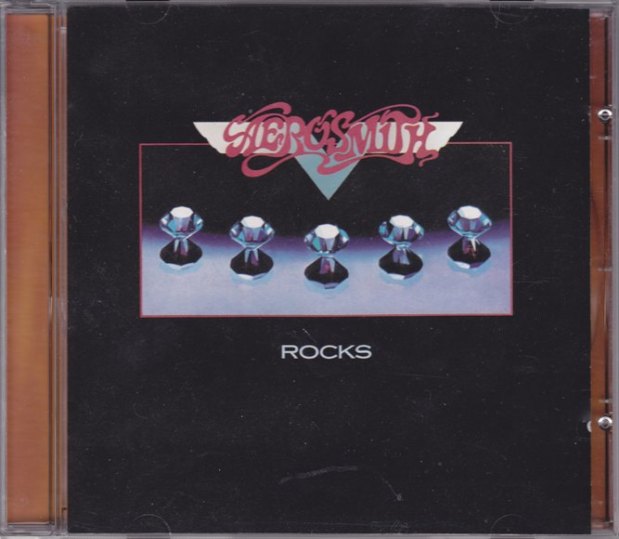
Packaged clean and sharp, Aerosmith made their intentions clear on the cover art for Rocks.  The album launched a million guitar players and a hundred careers in rock and roll.  It is also notable as being the last album before a major turning point; the point at which Aerosmith let the drugs work against them in a major way.

“Back in the Saddle” is an impressive opener.  The main riff in the song is not a guitar, but Joe Perry playing a six string bass.  Steven Tyler has mastered his own voice by this time, squealing and shrieking in conjunction with the hooks.  In some ways “Back in the Saddle” sounds like the birth of the true Aerosmith.  “Last Child” meanwhile nails the oft-overlooked funky side of Aerosmith.

“Take me back to-a south Tallahassee,
Down cross the bridge to my sweet sassafrassy,
Can’t stand up on my feet in the city,
Gotta get back to the real nitty gritty.”

With the help of an understated horn section, Aerosmith turn “Last Child” into something special.  This unexpectedly fades into the metallic aggression of “Rats in the Cellar”.  A spiritual sequel to the song “Toys in the Attic”, this one’s even meaner and faster.  Somebody said that the goal here was take what the Yardbirds were doing and turn it up.  Harmonica hooks and slide guitar goodness — I’d say they nailed it.

I need something groovy and right in the pocket after that, and “Combination” sung together by Tyler and Perry is one such groove. “Combination” is an album highlight boasting hooks and cool bass licks galore, and listen to Joey Kramer tearing it up on the drums! “Sick as a Dog” is another semi-forgotten classic. I’ve loved this melodic rocker (similar to past tracks such as “No More No More”) since day one. I can’t help but get it in my head every time I actually am sick as a dog. (Knock wood, no major illnesses yet in 2015!)

Perhaps the most important song on Rocks is the Whitford/Tyler composition “Nobody’s Fault”.  Along with “Round and Round”, Whitford has a knack for coming up with some of the heaviest Aerosmith riffs.  Testament covered it in 1988 for The New Order, taking it to an extreme that Whitford couldn’t have predicted.  The post-apocalyptic lyrics fit the concept of the Testament album.

Aerosmith’s original recording of Nobody’s Fault features some of Tyler’s most impassioned howls.  Drummer Joey Kramer considers it to be his best drumming, and I’m sure Whitford feels the same about his guitar work.  Although you can still hear that Aerosmith beat, “Nobody’s Fault” proves the band are versatile and more than just another American blues rockin’ band.

Bringing back the funk, “Get the Lead Out” isn’t particularly a standout except in terms in performance (which, with Aerosmith, is always above reproach).   “Lick and a Promise” returns us to quality, with a stock rocker about Tyler’s favourite subject.  We’re now at the end of the record, and “Home Tonight” continues Aerosmith’s knack for ending an album effectively with a slow number.  A piano ballad with plenty of guitars, “Home Tonight” adds that bit of class that Rocks needed in order to compete with an album like Toys in the Attic.

So how does Rocks compare with Toys in the Attic, anyway?

Too close to call.  Rocks is definitely a heavier record, and Toys in the Attic is closer to the dead-center of Aerosmith’s sound with the horns and strings.  Otherwise, it’s splitting hairs.

5/5 stars

AEROSMITH BOX OF FIRE review series:

BOX OF FIRE THUMBDisc 1: Aerosmith (1973)
Disc 2: Get Your Wings (1974)
Disc 3: Toys in the Attic (1975)
Disc 4: Rocks (1976)

REVIEW: Aerosmith – Toys in the Attic (1975)

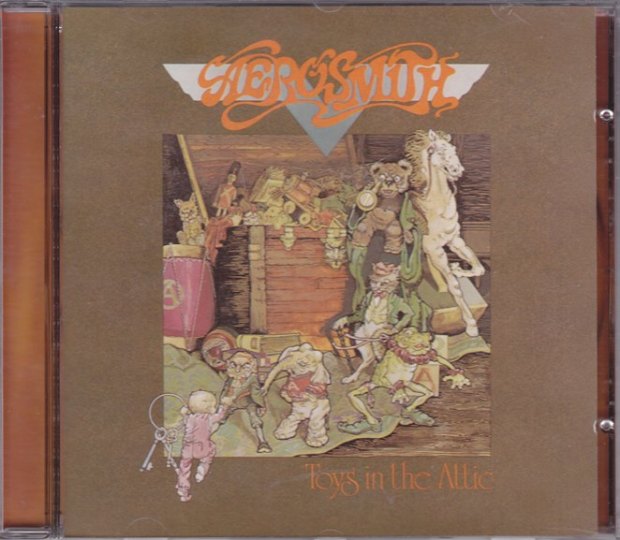
TOYS IN THE ATTIC_0001AEROSMITH – Toys in the Attic (1975 Columbia, 1993 Sony)

What’s your lucky number?  For Aerosmith, maybe it’s 3.  Third album in as many years, Toys in the Attic is considered by some to be the album: “If you’re only going to get one,” the desert island record.  Considering that Rocks was yet to come, let’s withhold judgement until we get there.  For now just be aware there is a lot of Aero-love in the world for Toys in the Attic, and you can hear why.

As if to prove that Aerosmith could keep up with some of their heavier competitors out there, “Toys in the Attic” is a blazing guitarfest careening through the speaker into your skull.  What a way to open an album: it’s a statement.  The band were honed to a razor-sharp edge by producer Jack Douglas.  Joe Perry in particular had grown to be a ferociously good blues-rock player, and “Toys in the Attic” is the evidence.

One of the great joys of listening to Aerosmith is finding the little known album gems that weren’t repeatedly re-released on hits packages.  “Uncle Salty”, a slow crawl through the blues via the neck of a bottle, is one such track.  Also underexposed is “Adam’s Apple”, which shows off Joe Perry’s greasy slide guitar sleaze.  The horn section makes an appearance here too, adding extra sauce.  Then they bring the funk on “Walk the Way”.  Run DMC recognized that funk and knew how to update it in 1986.  In 1975, Tom Hamilton’s rolling bass was the stuff that groove is made of.  This is the kind of song that proves the musical ability of these five gents from beantown beyond the shadow of a doubt.  Then the sassy horns return on “Big Ten Inch Record”, an old R&B classic from 1952.  Remarkably the band pull it off with class and sassafras.

“Sweet Emotion” is one of the band’s best known today, something that Tom Hamilton must be happy about, since it’s one of only a few Tyler/Hamilton co-writes.  It’s no surprise that Hamilton had a hand in its composition since it’s based on another one of his rolling bass lines.  But listen to the way Joey Kramer and Brad Whitford lock into him.  That groove is the foundation on which Aerosmith was built.  On top of that, Steven Tyler has always had a way with melody.  “No More No More” is one of his most irresistible singalongs.

The Sabbathy thunder of “Round and Round” was an unexpected twist.  Tracks like this and the later “Nobody’s Fault” show the metallic side of Aerosmith that usually remains shrouded.  “Round and Round”, though menacing and heavy as a brick, is the least memorable song on Toys in the Attic (only because the competition was so good).  Brad Whitford takes care of the solos on this one, a song he co-wrote (just like “Nobody’s Fault”).

“You See Me Crying” ends the album on a melancholy note but lovely note.  A piano based tune with strings and McCartney-ish melodies, it is truly the kind of classic that Aerosmith will be remembered for.  If it were not for songs like “Dream On”, “Seasons of Wither”, and “You See Me Crying”, then Aerosmith would be just another American rock and roll band playing their version of the blues that the Stones and Zeppelins of the world had already plundered.  “You See Me Crying” was proof that Aerosmith were more than that, and had their own thing going on.  (That’s Whitford playing the solos again, by the way.)

So what’s better?  Toys in the Attic, or Rocks?  Let’s find out next time.

5/5 stars

AEROSMITH BOX OF FIRE review series:

BOX OF FIRE THUMBDisc 1: Aerosmith (1973)
Disc 2: Get Your Wings (1974)
Disc 3: Toys in the Attic (1975)

REVIEW: Aerosmith – Get Your Wings (1974)

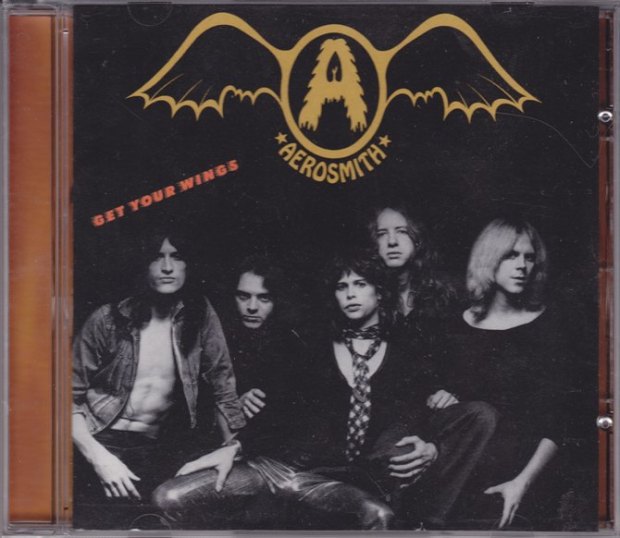
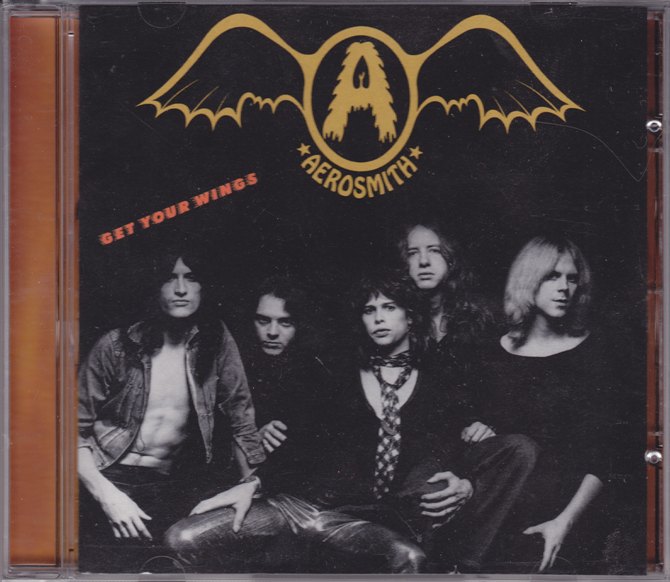
GET YOUR WINGS_0001AEROSMITH – Get Your Wings (1974 Columbia, 1993 Sony remaster)

Only the year after dropping their debut, Aerosmith cranked out another collection of solid bluesy rock tunes, but this time with better production! With Bob Ezrin overseeing the project, Aerosmith made the fateful hookup with Jack Douglas. Although the band had bigger hits under Bruce Fairbairn in the 80’s, Aerosmith made their best albums with Jack Douglas in the 70’s.

Get Your Wings really sounds like the Aerosmith we now know and love. The first album wasn’t all the way there yet. Get Your Wings sounds like my kinda Aerosmith. Surely, the opener “Same Old Song and Dance” is familiar to millions. Horn laden and funky, “Same Old Song and Dance” hits all the Aero-bases.

As a piano player, Steven Tyler usually keeps in simple and rhythmic, and “Lord of the Thighs” is the perfect example of that kind of Tyler piano part. It’s a menacing song, right in the pocket, also boasting some of Joe Perry’s more memorable solos.

One of my favourite songs, and one of the least-known is the sci-fi tale “Spaced”. This is a story about the “last man to survive”. It’s an ambitious tune for Aerosmith, and boasts a number of catchy parts. Another seldom heard track is “Woman of the World” which is also pretty cool. I like the acoustic intro and the smoking Joe Perry licks. “S.O.S. (Too Bad)” is a full-speed-ahead Aerosmith blast of adrenaline, a definite classic. These tracks boast a high level of musical depth and satisfying chops.

Aerosmith covered the legendary Yardbirds song “Train Kept a Rollin'” and managed to make it their own. When it picks up steam at the end, better hold on tight. This song may enduce whiplash. You get to cool down as it fades into the acoustic classic “Seasons of Wither”. As far as I’m concerned, “Seasons of Wither” is almost as brilliant as “Dream On”. It’s that good. It also takes advantage of the fuller production that Jack Douglas brought to the table.*

Although “Seasons of Wither” would have been a fine side closer, a coda is tacked on in the funky “Pandora’s Box”. Double and triple entendres, a rock solid rhythm section, and those soon-to-be-trademark Aerosmith horns n’ piano — what more do you need? While it does feel oddly sequenced, “Pandora’s Box” is every bit as classic as anything else on the album.

Get Your Wings showed significant growth from the band’s debut. Their trajectory had yet to peak…even better things were ahead.

4/5 stars

* I noticed in the photos in the CD booklet, this album was once available in Quad!  Oh, to have a quad version of “Seasons of Wither”!

AEROSMITH BOX OF FIRE review series:

BOX OF FIRE THUMBDisc 1: Aerosmith (1973)
Disc 2: Get Your Wings (1974)

REVIEW: Aerosmith – Aerosmith (1973)

It’s time for another series here at mikeladano.com! It’s been a while since I’ve tackled something this big, but for the last two weeks I’ve been writing and listening to a band that I hadn’t been spending a lot of time with in recent years. That band is AEROSMITH and it’s time to look at every original classic Aerosmith album on Columbia Records. The scope of the series is really simple: I’m reviewing all 13 discs in 1994’s massive Box of Fire collection — the entire box set from start to finish!

BOX OF FIRE THUMB

If you’re not into Aerosmith, I apologize, but that’s what I’ve got for the next couple weeks. To use the words of my friend Aaron, I just had to give’r.

You ready? As Steven Tyler might say, “Oooh-wha-ga-ga-ga-GOW!” Let’s go!

AEROSMITH_0001AEROSMITH – Aerosmith (1973 Columbia, 1993 Sony remaster)

Who woulda thunk that the band of young kids on this shitty album cover would become one of the biggest rock bands in history?  Nobody, that’s who!

I love this album.  I love its simplicity, its raw sound, basic production and youthful glee.  I love the built-in musical maturity that seemed to bloom fully formed.  I love the interplay of the whole band, their chemistry already intact.  Everything you love about the way that Perry and Whitford make their guitars mesh with bassist Tom Hamilton, and how Hamilton syncs in with Joey Kramer on drums — it’s already here.  Meanwhile, Steven Tyler had yet to discover all of his sass, but he was well on his way.   All Aerosmith (1973) is missing is great production, something the band would develop with Jack Douglas on the next album Get Your Wings.

It’s easy to draw comparisons between Aerosmith’s and Kiss’ first records.  Both records exhibited a more “rock n’ roll” vibe, and tame production values, with a band straining at the leash to really play like they do live.  Ultimately it took both bands a few years to capture that.

The two massive hits on Aerosmith are two of their best known and beloved:  “Dream On” and “Mama Kin”.  Think about that for a second.  One album with both “Dream On” and “Mama Kin”!  What more do you want?

You’ll also get six other great early Aero-gems.  “Walkin’ the Dog”, a Rufus Thomas cover, is one that Aerosmith still drags out in concert occasionally.  A decade later Ratt covered Aerosmith’s version, well before Guns N’ Roses made covering Aerosmith the cool thing to do, as they did with “Mama Kin”!

Hidden gem: “Movin’ Out”, based on a couple really cool Joe Perry riffs. There’s also a killer, even more raw alternate version on the Pandora’s Box set. Aerosmith recently dusted this one off again, and it sounded amazing.

I don’t think there is a weak song on the album.  There aren’t a lot that are “greatest hits”, but each one is great in its own way.  “Write Me”, “Somebody”, “Make It” and “One Way Street” are all catchy little blues rock tunes, nothing to write home about but plenty to shake your ass to.

Incidentally, with the benefit of 20/20 hindsight, Aerosmith also contains the greatest opening line of any debut album ever:  “Good evening people welcome to the show…”

Long story short: Aerosmith is a tasty blend of all the great Aerosmith ingredients that I love.  Electric rock and blues form a perfect blend, and Steven Tyler was the perfect singer to front this band.  Throw in some of his harmonica, piano and mellotron and you have a potent mix.  But keep in mind, greater things came in very short order.  Aerosmith, solid as it is, was only a precursor to true greatness.

4/5 stars

REVIEW: The Cult – Sonic Temple (1989)

By special request of reader Wardy!

THE CULT – Sonic Temple (1989 Polygram limited edition hologram cover)

The Cult went into 1989’s Sonic Temple with nothing but promise.  New hotshot producer Bob Rock had struck it rich with Kingdom Come the year before.  Critics raved about his drum sound and other Zeppish tendencies on that album.  The Cult themselves were following up the incendiary Electric album, a stripped back record produced by Rick Rubin.  Anticipation ran high.  Considering that Robert Plant was quoted as saying that “Led Zeppelin is being continued by The Mission and The Cult”, I think a few people expected Sonic Temple to be the second coming.

Some fans hoping for another Electric or even another Love were disappointed by the mainstream rock direction of Sonic Temple.  Mainstream though it may be, Sonic Temple burns with the same middle finger up attitude of old Cult, just with the edges sanded off and sound enhanced by Bob Rock.  Rock’s production is similar to that of Dr. Feelgood released the same year.

You couldn’t ask for a better double-whammy than the opening salvo of “Sun King” and “Fire Woman”.  Even though The Cult were able to score a major hit with “Fire Woman” it’s still a tough little song based on a killer Billy Duffy guitar hook.  Both songs have aged well, as has “American Horse”, a slow Cult stomper.  I love the interplay on the verse riff between Duffy and bassist Jamie Stewart.  Stewart, a member since the band became The Cult, departed after this tour and moved to Canada.  Here he produced a few up and coming bands such as Gut-Sonic.  I think Jamie Stewart was the underappreciated Cult member.  His grooves (with session drummer Mickey Curry*) are a part of Sonic Temple‘s drive.

The big hit ballad was the dramatic “Edie (Ciao Baby)”.  Here they really benefit from Bob Rock’s lush rock production values.  Strings and acoustics ring crisp.  Add in a howlin’ Ian Astbury chorus and you have one hell of a song.

“Sweet Soul Sister” was the third single (after “Fire Woman” and “Edie”) and another killer Cult song it is. You can really hear Bob Rock’s touch on the layered vocals for better or worse. It’s a touch that I find dated today, but the bare organ intro is magical! Unfortunately it gets dicey after “Sweet Soul Sister”.

I wouldn’t call any of the songs that follow “Sweet Soul Sister” poor or filler. None of them lack hooks or massive Billy Duffy guitars. Yet compared to the first side of the album, everything from “Soul Asylum” onwards fails to ignite like that. There are certainly lots of memorable moments, such as the breakneck “New York City” featuring an Iggy Pop cameo. It’s a good song, and so is “Soldier Blue” and the rest of the tunes…just not as good as side one. (By the way, if any song on Sonic Temple recalls Led Zeppelin, it the massive “Soul Asylum”, which is basically The Cult’s “Kashmir”.)

SONIC TEMPLE_0002

My copy of Sonic Temple is a limited edition with mirrored hologram cover. I bought it from this guy Todd, who worked at the HMV store at the mall. A buddy of mine had a crush on his sister, or something, and that’s how I knew him. He treated me right when I shopped at his store, and I returned the favour when he sold his stuff to us. That’s how I got this, and also how I got the Sonic Temple Collection 3 CD set complete with mail-away box.

I still like Sonic Temple today, but I only love side one.

3.75/5 stars

*Eric Singer played on the demos, released as part of the Rare Cult Demos box set.  Ex-Tori Amos drummer Matt Sorum appeared in the music videos and played on the tour, where he fatefully met Guns N’ Roses, and the rest was history.

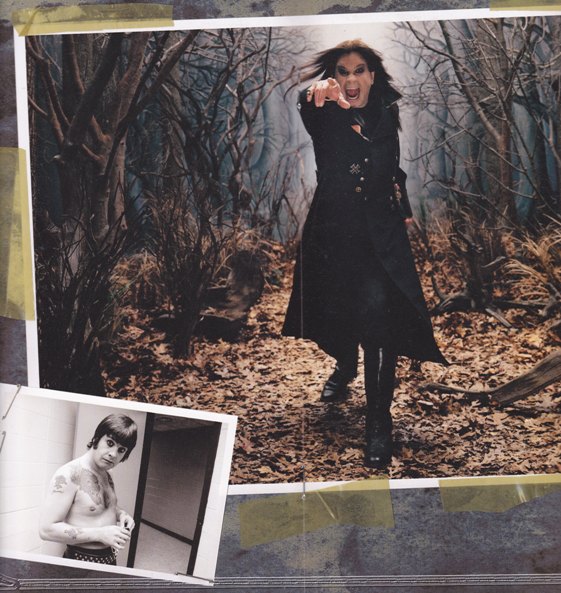
REVIEW: Ozzy Osbourne – Prince of Darkness (2005 Sony box set)

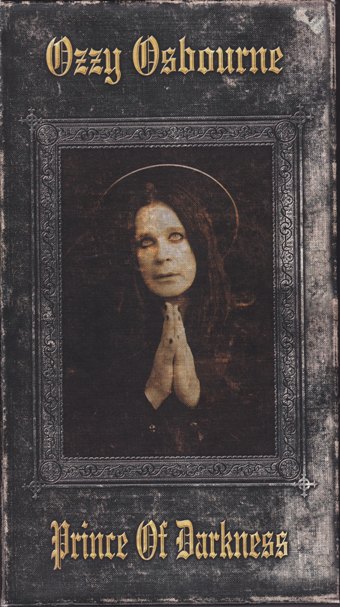
PRINCE OF DARKNESS_0001OZZY OSBOURNE – Prince of Darkness (2005 Sony)

Let’s pretend that you’re involved with Ozzy Osbourne’s management or record label.  When it comes time to release that first “definitive” box set, I’m sure you’d have your own ideas for making it the best box that Ozzy could release.  Ozzy Osbourne in 2005 had eight mostly great studio albums, numerous live records, and more rarities than you could shake a stick at.  They certainly had a lot of music to choose from.  I greeted the eventual release of Prince of Darkness with great excitement at these rarities…but tremendous disappointment at the overall listening experience.

A 4-CD box set is a lot of listening and in order to keep it riveting from end to end, you have to pick the right tracks and sequence them for maximum firepower.  Somebody at Sony’s box set department didn’t get my memos on that, obviously, because Prince of Darkness is one of the most annoying box sets to listen to in its entirety.   They decided to do two discs “anthology” style, with live and rare tracks mixed in.  The third disc is a questionable collection of Ozzy collaborations.  The final CD is the worst of all:  covers that Ozzy recorded and later released on their own album, Under Cover!  A CD that was released only months after Prince of Darkness itself — with additional bonus tracks to milk it further, forcing the completist to buy it again!

PRINCE OF DARKNESS_0004I have so many complaints about this set that I felt it best to list them all off in point form.

1. Never, ever start your box set off with a live track.  Even if that live track is “I Don’t Know” from Randy Rhoads Tribute.

2. Because this set was released in 2005, you are hearing the re-recorded bass and drums on all the songs from Blizzard and Diary…not the classic original versions.

3. Same with the tunes from Bark at the Moon.  These are the remixed versions found on the 2002 reissue of that album.  There are only two songs from that album anyway.  “Bark” itself is an unreleased live version.

4. Two CDs is not enough space to represent Ozzy’s album output in a box set, especially when you include the studio albums, live albums and rare tracks too.  The early Randy Rhoads material makes up the bulk of disc one, leaving the Jake E. Lee years under represented.  There are no songs from The Ultimate Sin at all, only the three live tracks originally for the Ultimate Live Ozzy EP.

5.  There are a few baffling exclusions, such as “Miracle Man” (first single with Zakk) and “I Just Want You”, in favour of also-rans such as “Spiders”.

6. The collaborations disc is a total mess.  “Purple Haze” is just a Hendrix cover from the No Rest For the Wicked era, by Ozzy’s band.  It’s not a collaboration, just a cover they did for the Make A Difference Foundation CD called Stairway To Heaven/Highway To Hell.  It’s a real challenge to listen to this whole CD in one sitting.  One moment you’re rocking out to a killer version of “N.I.B.” with Primus, the next you’re barfing through a piece of crap with Tony Iommi and Wu-Tang Clan.  From Was Not Was to Miss Piggy, at least the CD is diverse, and it does collect a lot of Ozzy’s singing from albums I don’t have.  I already had the Miss Piggy track but not the cover of “Stayin’ Alive” by Dweezil Zappa! Nor did I have “I Ain’t No Nice Guy” by Motörhead, from the mediocre March ör Die.  This disc is too jokey and not at all consistent.

PRINCE OF DARKNESS_0005

7. Even though the third disc collects a variety of tracks from a number of CDs, I am certain that Ozzy fans who buy this kind of box set already had some of them.  Including “Psycho Man” by Black Sabbath (not even a single remix version) from the Reunion CD (2008) is odd.  Many Ozzy and Sabbath collectors already have the Nativity in Black CDs, where the Primus and Therapy? tracks come from.

8. “Nowhere to Run (Vapor Trail)” by DMX, Ozzy Osbourne, Ol’ Dirty Bastard, The Crystal Method and Fuzzbubble is edited!  This track was from the South Park album and still features Isaac Hayes’ introduction, as “Chef”.  For reasons I cannot explain at all, the swearing and “n” words are blanked, and there were a lot of them.   It’s also missing ODB’s rant at the end, which itself was edited off later versions of the South Park CD.  (I have an earlier version with the rant intact.)

9. The packaging leaves a hell of a lot to be desired.  Inside the box which is just book-style, you will find a nice big booklet that just sits loose inside.  There is no way to secure it in, so it’ll fall out any time you pick it up!

10. Speaking of that booklet, the liner notes suck.  Ozzy has a brief note about each song, but not necessarily any useful information.  For example, regarding that South Park track, all we’re told is that Ozzy bit the head off Kenny.  Nothing about how that random assortment of artists was assembled.  The book is padded out with lyrics and shoddy credits that aren’t very accurate.  “Bark at the Moon” live for example was recorded in 1982-1983 according to the notes.  Come on, guys!  Not good enough for a box set.

11.  The entire fouth CD sucks.  You can read my review of the expanded Under Cover version of it here.  (Long story short: 1/5 stars.)  The only difference is that the box set includes Kelly Osbourne’s duet with daddy, on “Changes”.  This song was only included on the Japanese version of Under Cover but not the regular domestic.

Fortunately, Prince of Darkness is not a total bust.  Some of the unreleased tracks are real treasures, such as the demo of “S.I.N.” called “Won’t Be Coming Home”.  I prefer this to the album version from No More Tears by a long shot, as I do the twangier “I Don’t Want to Change the World”.  I also love the demo for the emotional ballad “See You On the Other Side”, which features previously unheard saxophone accompaniment.  I appreciated that they included the live version of “Perry Mason” from the Ozzfest 1 CD, which enabled me to sell off that pretty crappy album.

It’s easy to bitch and complain (don’t I know it?) but if I were to make a 4 CD Ozzy box from the same period, I would have done it very differently.  The covers CD would be axed completely and the rarities set aside to a disc all their own.  The first two “anthology” discs would be strictly studio versions, and original studio versions at that, with only a sprinkle of tracks from Randy Rhoads Tribute.  I would try to squeeze in more rare tracks from B-sides and EPs, and I would definitely try to mix them in with the collaborations so that you’re not left listening to so many of those novelty tunes in a row.

Buyer beware — Prince of Darkness is not the feast you were hoping for. This is a poorly executed package. When you have an artist like Ozzy Osbourne, you really gotta screw up bad to put out a set that is this hard to listen to. Prince of Darkness is going back on the shelf, for a good long while.

2/5 stars

REVIEW: Kim Mitchell – Rockland (1989)

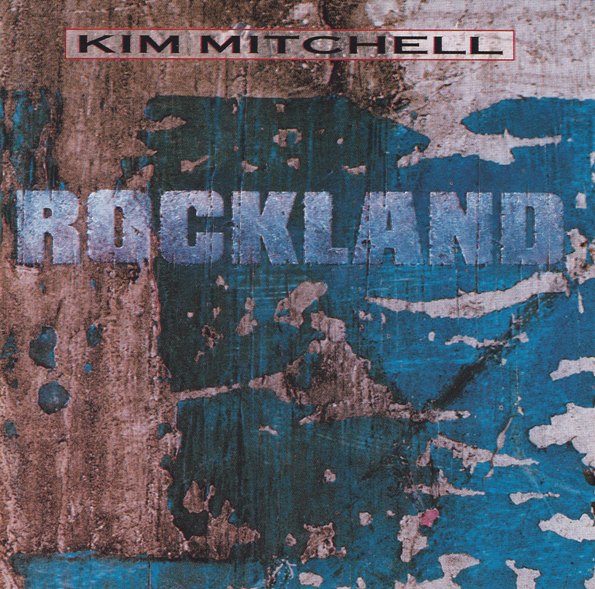
KIM MITCHELL – Rockland (1989 Alert)

This album was huuuuge in 1989. In Canada, summer time is Mitchell time. Cottages, brewskies, BBQ and Mitchell. That’s what it was all about! Shakin’ Like a Human Being was also a huge success for Kim, but he expressed a desire to use less keyboards and programming. Kim recorded in the US this time, and for budget reasons, did not bring along lyricist Pye Dubois with him. Pye had been in the studio with Kim for every album prior, and this caused a rift between the two that took years to heal. This was the last time they collaborated until 1994’s Itch.

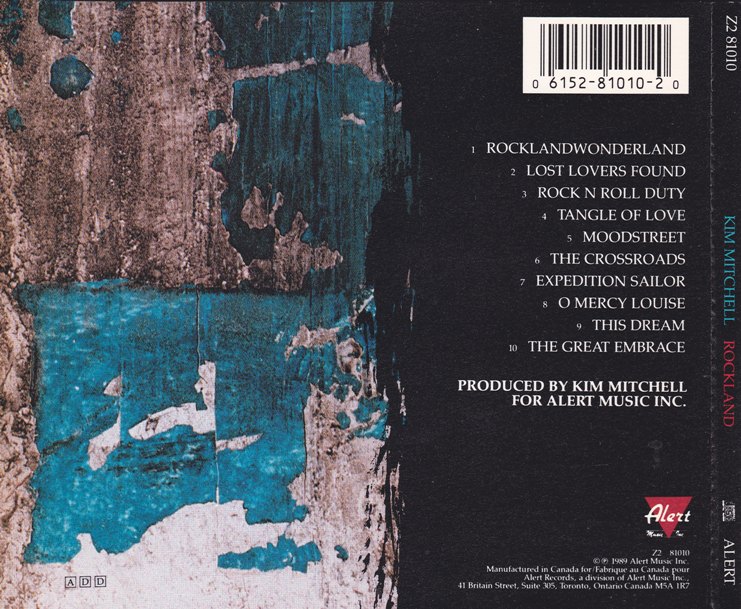
The pseudo-title track, “Rocklandwonderland” refers to the “concert bowl” at Canada’s Wonderland.  “Listen to the music, listen to the voices, listen to my guitar,” sings Kim, although the song is a little light on guitar. “Rocklandwonderland” was a big hit for Kim, and although it’s not a heavy rock, his guitar playing on it is stellar. Perhaps he shouldn’t have followed a slow rock tune with a ballad, although “Lost Lovers Found” is a hell of a ballad, with just a hint of twang. Some felt that Rockland was too soft compared to Kim’s progressive rock past, but a Kim ballad has more integrity than most. Kim’s backup singer extraordinaire, Peter Fredette, is present here and he also serves to class up any song by several notches.

Other ballads on the record include “Tangle of Love”, which is quirky and experimental but not great. “O Mercy Louise”, which has a rocking chorus, is a fine song with cool lyrics. The “big one” however was the single “Expedition Sailor”. This introspective acoustic song is sparse and effective. Kim’s buddy Rik Emmett from Triumph drops by to play an excellent solo on classical guitar. “Expedition Sailor” is top drawer stuff.  (The music video received a remix, which you can get on Kim’s Greatest Hits album.)

The “big” song on the album, still getting airplay today, is the anthem “Rock N’ Roll Duty”.  The tougher direction of the song is exemplified by a “live” style music video in a seedy bar.  As a fan I really wanted Kim to come out with a tough rocking tune, with a killer chorus, and he did.

“I’m just doing my rock n’ roll duty,
Creating a buzz buzz buzz,
Some say I’m in it for the money,
Man, I’m in it for love love love!”

The phrase “I’m just doing my rock n’ roll duty,” is now commonly heard among music fans in Canada. The song just hits the spot, and the riff is now synonymous for summer in my mind.

Other highlights on Rockland include the joyful “The Crossroads” which opens side two. The guitar-heavy “This Dream” is another favourite. I could always identify with the lyrics. It’s just a stellar song, an also-ran that could have been a fourth single. The record is rounded out by “Moodstreet” and “The Great Escape”, two decent but unremarkable tunes.

MVP:  Drummer Lou Molino, a near legend in these parts.  Curiously, when you Google images of Lou Molino, you will also get hits for Lou Ferigno.

Overall I was pleased with the direction of Rockland, going a bit more raw and rocking. Unfortunately with the exception of a few tracks like “Rock N’ Roll Duty”, it feels very tame. Except for quirky moments within guitar solos, it doesn’t possess enough of Kim’s humour and idiosyncrasies. It feels as if it’s on a leash, but it’s also not straining to get off it. It feels like Rockland hits the mark in many respects, but plays it too safe.

3/5 stars

ROCKLAND_0004

REVIEW: Scorpions – Face the Heat (Japanese and Canadian versions)

Part 2 of 2 — for yesterday’s instalment, click here.  For Aaron’s review of the domestic CD, click here!

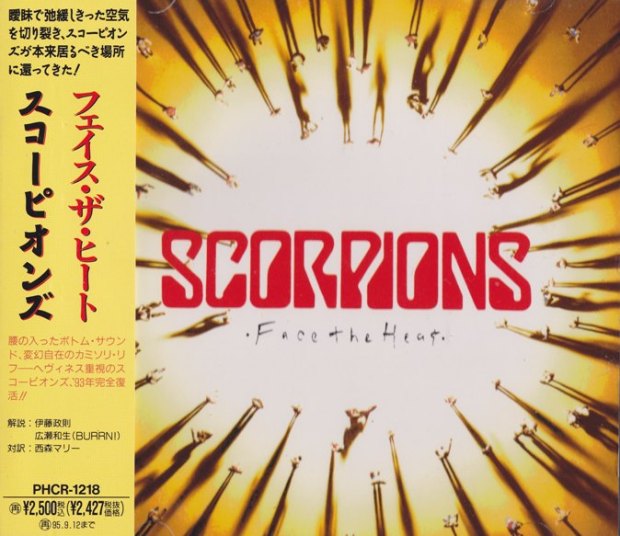
FACE THE HEAT_0002SCORPIONS – Face the Heat (1993 Polygram, Japanese and Canadian versions)

1990’s Crazy World was a huge hit, but before Keith Olsen produced it, Scorpions had approached Canada’s Bruce Fairbairn.  Pleased with his work on their Who cover “I Can’t Explain”, Scorpions prepared to convene in Vancouver with the producer.  They were disappointed when Bruce changed his mind at the last minute when forced to choose between the new Scorpions and AC/DC projects.  Fairbairn chose AC/DC, and the result was the five times platinum (US) Razors Edge album.

Since Crazy World ended up selling two million in the US and another five million worldwide, I’m sure there were no hard feelings between the two parties when they finally did hook up together on the followup album, Face the Heat.  Personally speaking I felt Crazy World wasn’t heavy enough.  I was hoping for more in Face the Heat.  Additionally, this album was the Scorpions’ first since 1972 without bassist Francis Buchholz.  Replacing him was five-stringer Ralph Rieckermann who ended up spending almost a decade with the Scorpions.  Rieckermann was a very different player and added new elements such as slapped bass.

The first single “Alien Nation” showed promise.  A menacing, metallic riff ushered in a tune with some slamming drums (thank you Herman Rarebell), and that ultra-low fifth string on the bass guitar. I preferred “Alien Nation” to just about any song on Crazy World. The year was 1993 and a heavy groove was exactly what the doctor ordered.

“No Pain No Gain” exhibits the Scorpions’ knack for naff song titles. Thankfully it too is a grinding metal groove, showing off Matthias Jabs’ talkbox skills on the guitar. With the Scorpions post-Schenker and post-Roth, you have to expect a certain amount of boneheaded metal. I think these guys genuinely love givin’ er on that trademark, simple sound. I believe they like playing this kind of thing with earnest, so good on them.

Three songs in and “Someone to Touch” is another great little Scorpions rocker. This speedy one won’t tax your brain cells in the lyrical department, but you will find yourself singing along to the chorus without realizing it. The chorus bears the stamp of Fairbairn with its answering lines. After this much firepower, I don’t mind a ballad and “Under the Same Sun” (perhaps a sequel to the worldwide hit “Wind of Change”) is a good one. Besides, Scorpions follow it by firing off another rocker called “Unholy Alliance”, another knockout with a great chorus. This helps lessen the impact of the next ballad, “Woman”. “Woman” is very different from “Under the Same Sun”, being dark and mournful. Another success.

Unfortunately, Face the Heat stalls in a major way on side two. A number of boring songs in a row (“Hate To Be Nice”, “Taxman Woman”, “Ship of Fools”, “Nightmare Avenue” boast only a few surprises and memorable moments. Jabs sports a nice fatbody jazz guitar solo on “Hate To Be Nice”, a trick that Fairbairn later encouraged Eddie Van Halen to use on his band’s next album, Balance. Unfortunately, a cool unique solo like this is within the same song as these lyrics:

“Hey baby, listen up,
I’m not in love with you,
You keep runnin’ off at the mouth,
And someone else can scratch my back,
And I could care less about your legs,
I just wanna see ’em walk all over me!”

The last listed track on the domestic CD is the ballad “Lonely Nights”, another really good ballad. Who cares that they just copied the way they ended Crazy World, with a slow dark ballad like “Send Me An Angel”?  All well and good says I, but as I mentioned in yesterday’s instalment of Getting More Tale, the US and Canadian versions of the album have a hidden bonus track!  Way back in ’89, the Scorps and Fairbairn discussed recording an Elvis cover.  Tucked away unlisted after “Lonely Nights” is Elvis Presley’s “His Latest Flame”.  It is a pleasant surprise!  The trombone and trumpets are the perfect added touch.  I’m sure Scorpions grew up listening to a lot of Elvis Presley records, and this version is faultless.  It’s gleeful and authentic sounding despite the fact that it’s the Scorpions!

FACE THE HEAT_0003Neither of the two bonus tracks on the Japanese version of the CD are as good as “His Latest Flame”.  Both are ballads:  “Kami O Shin Jiru”, and “Daddy’s Girl”.  They are inconsequential to casual Scorpions fans who don’t obsessively collect all their songs.  Additionally, they are disappointing to Scorpions collectors who buy these things hoping the extra tracks will be better.  I dig Rieckermann’s fretless bass on “Kami O Shin Jiru”, but these songs only serve to end Face the Heat on an excessively mellow note.  “Daddy’s Girl” is particularly depressing; I don’t want to listen to songs about child abuse — I already know it’s bad!  Scorpions tackle the subject in their usual subtle-as-a-brick fashion.

If only the second half of Face the Heat was as strong as the first.

3/5 stars