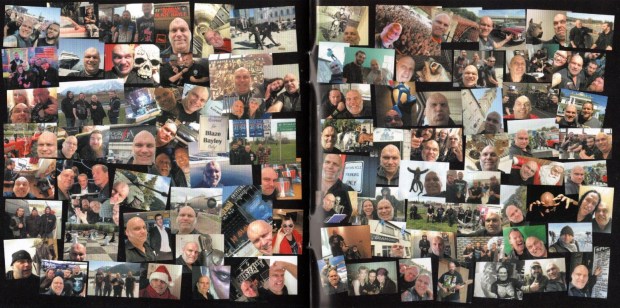
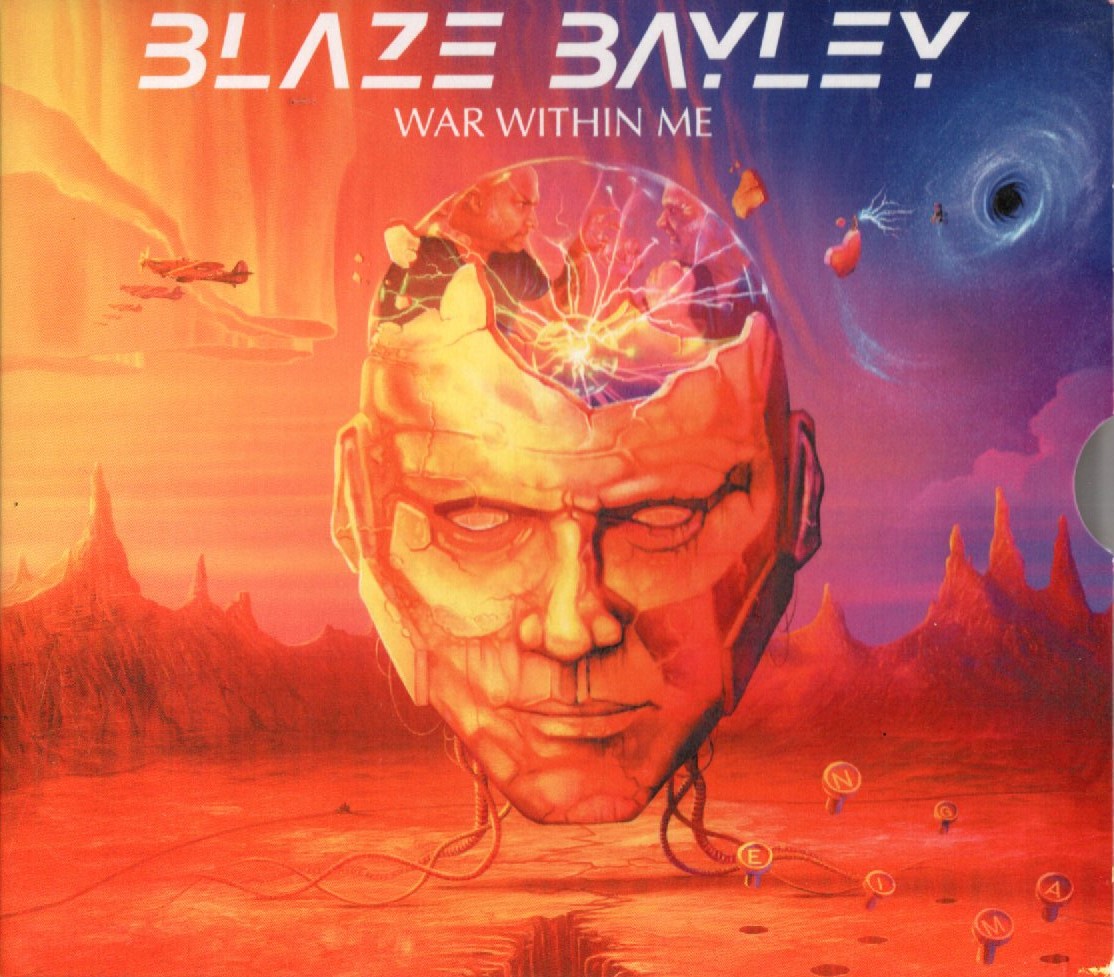
In 2021, Blaze Bayley released one of his finest solo albums, War Within Me. It was his 10th studio album and somehow it was also his best, rivaling his work with the inimitable Iron Maiden. It is also his most Maiden-esque, though heavier. Blaze fails to fall into lyrical cliches and presents a series of cutting riffs, elevating this album to apex predator status.
Opening with a blitzkrieg of battering drums and lightning fast riffing, the title track “War Within Me” is exactly what it sounds like. It is a battle for the mind! “Never give up, I won’t back down!” howls Blaze, singing as strongly as he did 30 years ago. “War within me, every day I fight!” What an opening! A mission statement from Blaze, with ribbons of guitars ensnared with cannon-blasts of beats.
Blaze takes us from the battle of the mind to the Battle of Britain of World War II. The RAF No. 303 squadron is the subject of “303”. Of course, this is a subject Blaze is familiar with, since Iron Maiden targeted the Battle of Britain with their own “Aces High”, one of Blaze’s top ten Maiden songs that he didn’t sing on. Like the opening track, this one too blasts forth with the throttle locked on full. Importantly, Blaze maintains a firm lock on vocal melodies and guitar harmonies. It’s very Maiden-esque, but cranked.
Blaze wisely slows things down on the third track, “Warrior”, one of the man’s very best songs of his whole career, before he speeds up once again. The guitar breaks are very Maiden-esque, perhaps even more like Bruce Dickinson’s latter-day solo work with Roy Z. This is tasty metal, sprinkled with explosive guitar spark. “I can be a warrior, with courage to rise up again!” growls Blaze like he means it. Along similar inspirational lines is “Pull Yourself Up”, a grinder that takes the tempo back a notch or two. The chorus on this one will eventually work its way into your skull like a drill. One of the riffs is very much like present day Maiden. The lyrics are obviously very personal to Blaze, with lines like “They said I could not sing.” This is something you see from those who don’t know.
Stop doubting yourself, Questioning yourself, Stop hating yourself, To believe in yourself. Control my own thoughts, Control my own mind, They said I could not sing, Come and sing with me!
“Witches Night” is one that takes a few listens to sink in. Once it does, the chorus sticks. The acoustic guitar segments add texture to the album, and again there’s a late Maiden quality to it. Then, “18 Nights” also takes a listen or three to hit properly. This is a simple tale of a South American tour – flights and earthquakes, oh my! “Evacuate to higher ground!” warns Blaze. “Stop the show!” A blazing winner – pardon the pun.
War Within Me has a semi-conceptual segment that I call the “scientist trilogy”. There are three parts: “The Dream of Alan Turing” about AI, “The Power of Nikola Tesla” about free energy, and “The Unstoppable Stephen Hawking” regarding his survival against the odds. “They only gave him three years to live, but Hawking defied them!” This track is all about not listening to those who say there is no hope. “They don’t know everything!” bellows Blaze. All three songs are excellent, each one different, but all three possessing a mighty Maiden-esque strength, heavier than that band but with similar flavours. Brilliant choruses on all three.
Appropriately, the album concludes with a ballad called “Every Storm Ends”. It’s about overcoming, which Blaze has certainly done. With War Within Me, Blaze has topped everything he released before under his own name. Not bad after 35 years making music.
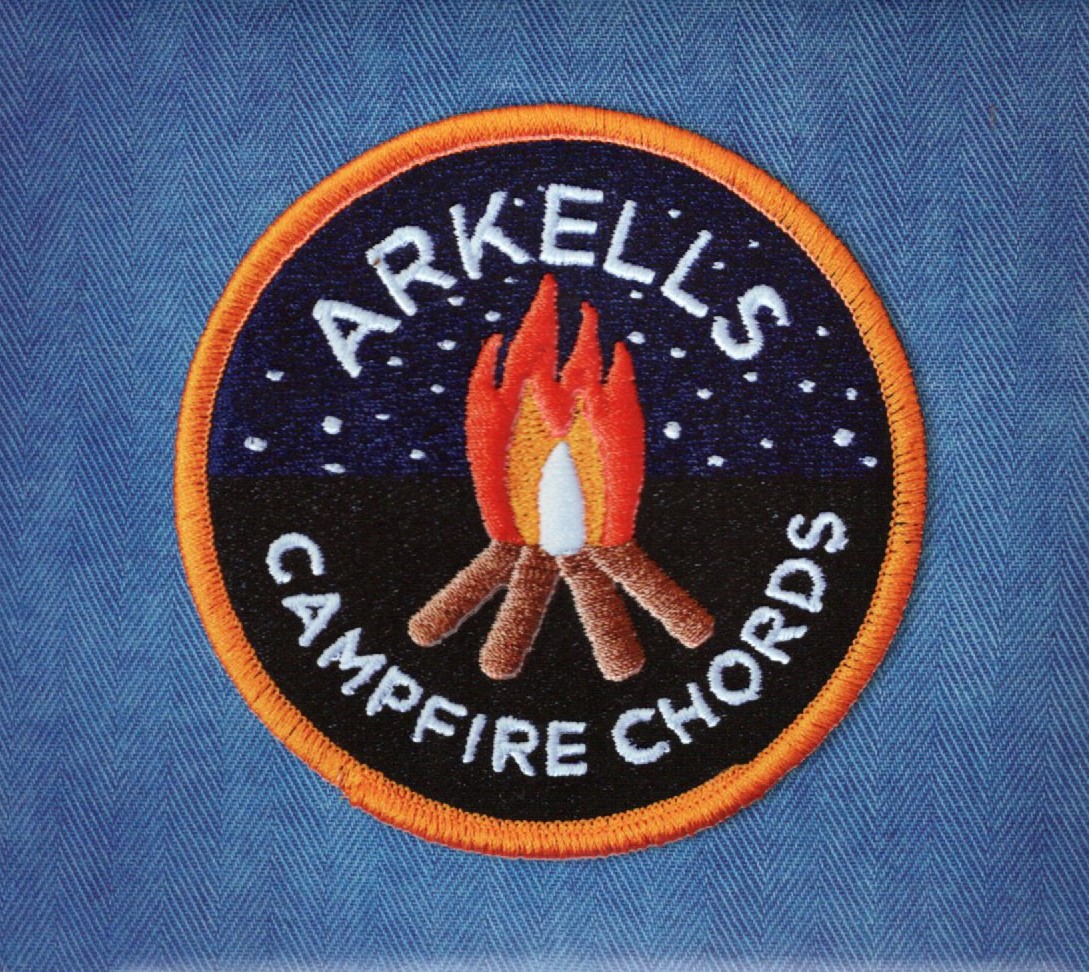
March, 2020: the world came to a sudden halt as the Covid-19 pandemic spread from city to city, nation to nation. We isolated in our homes and offices to keep our loved ones safe, and we waited it out. For bands, everything stopped. Gigs were cancelled, and recordings had to be done remotely from home. On the bright side, this resulted in some brilliant music from legacy bands. For the Arkells, it meant stopping all work on the next studio album (Blink Once) and separating for four months. At the encouragement of bassist Nick Dika, the band got down to their singer-songwriter basics with a series of stripped-down versions of the “greatest hits” (so to speak). Keyboardist Anthony Carone assembled the individual pieces into something cohesive, and Campfire Chords was born! The title refers to the “campfire test”: if a song sounds good done acoustically around a campfire, then it’s a good song. Bon Jovi have a similar philosophy.
Campfire Chords opens with a surprisingly somber “Knockin’ At Your Door”, which was more of an anthem in its single release. Souful backing vocals and pedal steel guitar gives it an entirely new feel. Although everything about the melody is the same, it feels like a new song.
Following this is a brand new song: “Quitting You”. This lovely acoustic country ballad is just a beautiful love song. Fiddles and acoustic guitars ring clean, while tambourines jangle in the background. “I thought of maybe quittin’…but there’s no quittin’ you.” Because it’s the Arkells, there are some cool “woah-oh-oh” singalongs too, because what’s a campfire without a singalong? An Arkells classic.
A second new song, “Years in the Making” opens with harmonica and a strong Max Kerman melody. This track later appeared on Blink Once in a vastly different arrangement. A true Arkells anthem, you can hear it on this stripped down version. It’s all about the melody, and then the hit of the chorus. The piano break in the middle is really nice.
One of their earliest hits, “Whistleblower”, is slowed down and intensified with soulful backing vocals and steel guitars. This one simmers, compared to the manic original. It has a different kind of intensity, but the tension is there. Another early hit, “Michigan Left” from the same album comes across really well acoustically. The “woah-oh!” chorus is intact, and though it’s slower, it’s just as uplifting. An even earlier song, from their debut album Jackson Square, called “I’m Not the Sun” comes next. It’s gentle and floaty, though the lyrics are dark. “So don’t let me be your guiding light, ’cause I’ll get you lost in the dark, I’m not the sun, there’s no guarantee, ’cause I burn out hard like a spark.” Returning to the present day, “Don’t Be A Stranger” from the Rally Cry album is a song that might be an improvement. Taking off the layers of polish, but leaving the string section in, it just breathes really smoothly now. It’s the same song, but it hits differently.
An absolute highlight of this album is the new version of “Comes to Light” from their best album High Noon. There’s a Bruce Cockburn feel to the guitars; quintessentially Canadian. This one just cuts clean through. The steel guitar is featured again, and the melodies shine. “And with my headphones on, as I fall asleep, you’re my barricade from intruding dreams.” While the original is hard to top, this one has magic to it that can’t be defined. A masterclass in re-imagining.
Another Arkells classic, “A Little Rain (A Song For Pete)” takes us to church! The Arkells go gospel, and do it like it’s second nature! The rich choir-like backing vocals lend it an undeniable authenticity, but Max Kerman absolutely nails it too. Not bad for a guy who, by the lyrics, “never tried religion”. A little rain ain’t bringing him down goes the chorus, and that feeling is washed upon the listener like a baptism. Pay attention to Nick Dika’s expressive and lyrical bass work.
Back to Rally Cry, the anthem “Eyes on the Prize” is stripped down to just acoustic and voice. Though it was written pre-pandemic, one lyric rings way more true from the perspective of 2020: “I think I’m done with the motherfuckin’ hiatus”! The choir returns with Max on the chorus, and a harmony chimes in, but the music remains mostly simple acoustic guitars and soulful singing.
Revisiting the early years again, the light and airy “Book Club” is a delight. The backing vocalists enhance its soulful feel, which was always there on the album version. Following this is the slow and moving “And Then Some” from Morning Report. One of the Arkells most beautiful love songs, it falls in the category of “personal favourite”. The original has a real pulse to it, and this one is quite different in that way, but there’s also a newly acquired softness to it. “Kiss Cam” from Michigan Left works well, given the lyrics. “This campfire won’t last forever, the Hip have only wrote so many songs.” Sadly true. “We can’t stay up north for the summer, head back to the city, find a job.” Can relate! Speaking of personal favourites, Jen loves “My Heart’s Always Yours” in particular. This acoustic version is transformed into much softer fare, like a dreamy morning anthem.
A steel guitar-laden version of the anthem “Hand Me Downs” is a back-end highlight. Then “11:11”, already a brilliant single in its own right, is enhanced by the acoustic treatment. This is another one that may in fact surpass the original. At the end of the day, it all comes down to personal taste. If you have more attachment to one version of another, that’ll colour what you prefer.
Finishing out the CD are the anthem “Relentless”, which always had a soul/R&B flavour. Here it simmers intensely like hot pavement. The closing track is the immortal “Leather Jacket” from High Noon, known to laymen as the “pay phone song”. Steel guitars take us out to the country and that’s where the album goes as it rides off in the sunset like some kind of Canadian cowboy driving a dusty pickup truck through the gravel. This is tagged by a lovely singalong (with horns) of the main hook, “You call me up from a pay phone, and I said who the fuck uses a pay phone! There’s a crazy New Orleans outro like you’ve never heard, and that’s it!
These kind of “re-imagining” albums (if you will) can be so hit and miss. I mentioned Bon Jovi earlier. Remember that atrocity they did, This Left Feels Right? It was so, so wrong. The Arkells made no such mis-step here. They key is…they didn’t have to take a left turn. They just needed to turn to a different side of their sound, and focus in like that for a whole album. The result is an acoustic album that has depth, variety, and in some cases, some versions that could top the originals.
You can’t get “Quitting You” anywhere else; to date this is its only release.
WHITESNAKE – Here I Go Again: The Whitesnake Collection (2002 Universal)
Back in the days before David Coverdale began lovingly curating his 80s catalogue with expansive box sets and assorted compilations, the record labels were doing it for him. And, all things considered, they were milking it pretty hard with very little in terms of added value to the fans who already had a decent collection. 2002’s Here I Go Again: The Whitesnake Collection might have been the first one really worth buying.
At its moment of conception, it was probable and perhaps likely that a large number of Whitesnake fans didn’t already own all three of the Geffen albums on CD. Perhaps they just owned Greatest Hits, or 1987. Rather than force fans to buy (or re-buy) a three disc set for all that material, Universal gathered 24-bit remasters of the three albums with some associated bonus tracks and released it all as more affordable two disc set. It offered good value for fans looking to get those albums digitally, or those just trying to acquire the bonus tracks.
Starting off with the rare “Radio Remix” of “Here I Go Again”, a familiar song leads the charge. This unusual version has Dan Huff on guitar, Denny Carmassi on drums, and Bill Cuomo on keyboards. It’s shorter without that long “keyboard heaven” opening. As a radio remix, it has choppier guitars, more keyboards, and prominent female backing vocals. Huff’s solo is refreshing after being used to Adrian Vandenberg’s for so long.
From there, the compilation delves into the albums, in their US mixes and running orders. Therefore, Slide It In kicks off with “Slide It In” just as I remember it. It will always be debated which version of Slide It In was superior, the original UK or the partially re-recorded US mix. I have long maintained that the US had more punch, and I still prefer it. John Sykes was a powerful force, and his modern guitar squeals helped push Whitesnake into the 80s (for better or for worse). From there the album runs through the big singles “Slow An’ Easy” and anthemic “Love Ain’t No Stranger”. These two songs alone are worth buying the album for, but the deep cuts are strong. “All or Nothing” and “Gambler” are darker, while “Guilty of Love has an upbeat rock singalong power. “Hungry For Love”, “Give Me More Time” and the cheeky “Spit It Out” are all memorable, but the dramatic “Standing In the Shadow Of Love” remains one of the most impressive Whitesnake closers to date.
There are no Slide It In-era bonus tracks included, but the next album 1987 is augmented with plenty. We already had the radio remix, so the disc dives in with opener “Crying In the Rain”, actually a re-recording of a track from Saints & Sinners, just like “Here I Go Again” itself. The CD runs through all of Side One of 1987 and partly into Side Two, with “Children of the Night” being the last song on the disc. This is the one and major flaw with The Whitesnake Collection: the oddly timed split between Discs One and Two. “Here I Go Again” (the album version) was meant to close Side One of 1987, but these things can’t be helped.
After you blast through that remarkable album and all the John Sykes guitar fireworks it contains, you are treated to a number of extras. UK-only songs “You’re Gonna Break My Heart Again” and “Looking For Love” should have been on the US album. One rocker and one ballad, they aren’t really like any of the other songs and could easily have strengthened an already mighty album. Then, for the fans that have always wanted to hear the one and only solo that Vivian Campbell recorded with Whitesnake, you are given the single mix of “Give Me All Your Love” (1988). An odd choice for a single originally when better songs were available, but significant due to Vivian’s tenure with the band. His solo is more whammy-inflected and shreddy, but it is still memorable and fitting. Weirdly, Campbell is not credited in the booklet though Sykes and Vandenberg are. The final bonus track of this era is the lovely keyboard ballad B-side “Need Your Love So Bad”, a re-recording of a Slide It In-era B-side. A song that could have even been a single! This showcase for David’s vocals features only keyboards and the man himself; no other instruments.
Some fans would stop the disc here and hit eject, for the controversial Steve Vai era is next with Slip of the Tongue. An acquired taste, or perhaps not acquirable at all, Slip of the Tongue was a left turn. Going even slicker and more modern, Coverdale eschewed the blues for the most part and took his band of pirates space truckin’. For Steve Vai fans, this album features his most commercial playing, for he didn’t write any of the songs. Adrian did, but was sidelined by injury. Now with Rudy Sarzo and Tommy Aldridge on bass and drums, the band was completely different from the 1987 version! David was pushing his voice into a higher register and it never quite sounded the same ever since. Though Slip of the Tongue was a powerful statement in the world of inventive guitar fireworks, it ultimately proved unpopular with those who preferred when David was singing the blues. Results may vary, but the perennial Vai-era bonus track “Sweet Lady Luck” closes the disc as it should. It does not have the Chris Lord-Alge remix of “Now You’re Gone”, but hey.
There are minimal liner notes and photos, and it’s amusing to read the notes from the perspective of a time when Whitesnake was no longer a band. (They reunited in 2003.) However the value here is getting all this music and relevant bonuses all in one place for a good price. It just made sense.
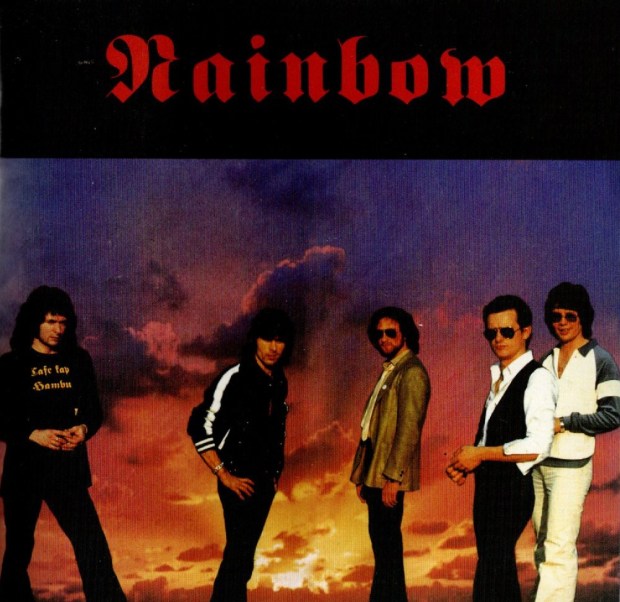
RAINBOW –Down To Earth Tour 1979 (2015 Purple Pyramid box set)
On the surface, this is quite a deluxe box set. It’s larger than than a typical CD case by an inch on either side, and it’s almost an inch deep. It has a beautiful hologram-style finish, shining and shimmery. There are three discs inside, one from each of three shows on the 1979 Rainbow tour: Denver, Long Island, and Chicago. Each CD comes in its own full colour sleeve, and there are other goodies packed inside, such as the obligatory booklet. It’s a loaded booklet, with loads of photos and text.
You might look at the track listing on the back and ask why there are only seven tracks per show (five for Chicago). Rainbow were only an opening act (for Blue Oyster Cult) on this tour, a source of frustration for the band. Also, the track listing is deceiving because “Lost In Hollywood” is a long bomber, over 20 minutes long on each disc, and contains lengthy solos and detours.
There are issues. First and foremost: the audio. It’s not great. None of the discs are particularly outstanding. They’re all different sounding; just a different variety of bad! People who buy bootlegs won’t mind so much, but when you look at a set this deluxe on the store shelves, you might be expecting more sonically. A lot more. That’s just the nature of these kinds of releases. They’re fine to play, but some people will dismiss them.
The other issue with the music would be that the tracks are repeated from show to show. The variety comes from the playing, not the setlist.
Speaking of playing, even though the band were tired of the opening slot, they don’t show it. The lineup was one of Rainbow’s best: Graham Bonnet on lead vocals, Don Airey on keyboards, Deep Purple alumnus Roger Glover on bass, the legendary Cozy Powell on drums, and of course the man in black Ritchie Blackmore on guitar. Everyone knows what to expect from a Blackmore guitar solo, but a Don Airey keyboard solo is less familiar territory. It’s part Doctor Who and part rock and roll. And Cozy, of course, slams. You only wish he were better recorded.
Rainbow were playing loads of new material on this tour, with only a handful of Dio-era classics. “Eyes of the World” is an interesting choice for opener, not an obvious selection. It causes the show to open with an electronic pulse, all atmospheric and sci-fi. It’s a change from the usual hit-em-hard kind of opener. Of course, the song does rock, but the intro is over a minute long. A second new song, the slower blues “Love’s No Friend” follows, another interesting choice. It’s rife with brilliant guitar work from Blackmore, and Airey compliments him perfectly. Continuing with new material, “Since You Been Gone” was the familiar single written by Russ Ballard, which closes with a load of solos from Blackmore and Airey, and the “Over the Rainbow” segment as well. “All Night Long” (which opened the Down to Earth album) works well to regain focus after all that meandering. I like how Graham changes the lyrics. He clearly sings “I need a girl who can give me head, all night long,” instead of “keep her head”! Unsubtle. The fifth and last of the new songs is the aforementioned scorcher “Lost In Hollywood”, bloated to 22 to 26 minutes from show to show. This is the track for the musicians in the audience, and for everyone else to take a pee. Fortunately for those who love great drum solos, Cozy has a spotlight moment. Unfortunately, not everyone loves drum solos.
The set closes with two Dio classics: “Man on the Silver Mountain” (long solo opening, and a bit of “Lazy”), and “Long Live Rock and Roll”. It’s hard for any singer to do Dio and here they sound like a Graham songs. I prefer Graham’s version of “Silver Mountain” to Joe Lynn Turner’s. Really, these are pretty good interpretations, as long as you can forget the mighty elf’s versions for a few moments. Graham had no issue with the range or power, just that he’s a completely different vocalist from Ronnie James Dio.
The Chicago set is missing “Since You’ve Been Gone” and “Silver Mountain”, which were not played that night.
The liner notes are excellent, except when printed in black ink over a blue background, rendering them extremely hard to read. It’s 28 pages with rare photos and ads. The set also includes a heavy metal bottle opener that you’ll never use, a Richie Blackmore guitar pick that you’ll never use, and a Rainbow button & patch that you won’t put on any jacket that you own.
This set is for diehards only; those that need as many Rainbow shows from as many lineups as they can get. For everyone else, it’s pure overkill.
Review written Nov 9 2009, rediscovered 2023, and posted unaltered.
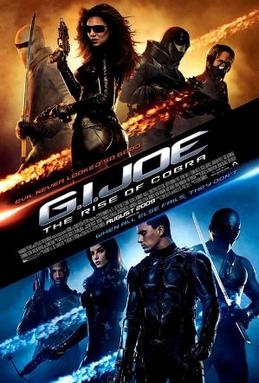
G.I. JOE: The Rise of Cobra (2009)
Directed by Stephen Sommers
I am a hardcore GI Joe fan, but only Real American Hero and its continuations. As such I am very critical of some of the liberties taken with the characters in this movie, but in the end I was pretty satisfied with the movie. Read on!
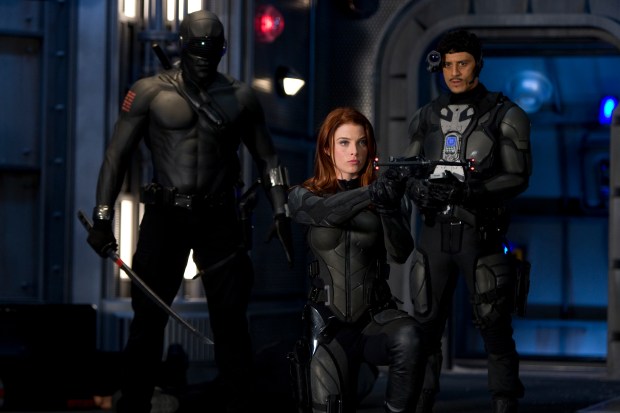
Rise Of Cobra is interesting in that Cobra and its commander don’t really exist for most of the movie. Instead, Destro and his M.A.R.S. organization are the heavies, with some support from the beautiful Baroness Anastasia DeCobray, the ninja Storm Shadow, and Zartan the master of disguise. Thus, this movie chronicles the rise of Cobra Commander and his terrorist organization determined to rule the world.
It is the “near future”. The original Marvel comic as written by Larry Hama was based on actual military tactics, history, and machines, while enhanced with lots of futuristic touches such as laser cannons and Jump-jet packs. This movie updates the franchise for the new millenium. New technology here include nanomites, accelorator suits, and other gadgets. Yet even so, updated versions of classic vehicles such as the Night Raven jet and V.A.M.P. jeeps appear. Basically, just as GI Joe was futuristic for the 80’s, this is futuristic for the now.
The acting here is bad bordering on terrible. This Channing Tatum guy can’t act at all. Dennis Quaid pours the cheeze-wiz on every line of dialogue that General Hawk delivers. Marlon Wayons (Rip Cord), Rachel Nichols (Scarlet), and Sienna Miller (Baroness) are passable. The heavies tend to get the best roles and the best actors: Arnold Vosloo (Zartan) steals every scene he is in, and Joseph Gordon-Levitt is surprisingly serpentine as Cobra Commander. Christopher Eccleston is good as the Scottish arms dealer Destro, just menacing enough while also dignified and cool. Also, it’s nice to see Jonathan Pryce in anything.
The direction, by that hack Stephen Sommers (The Mummy) is gawd-awful. He throws awkward flashback scenes in frequently with no real sense of flow. Check out The Watchmen for how to effectively do a flashback. His action scenes are pretty damn exciting, but you get a sense that a better director could have provided some more fluidity.
I’ll give you an example. The climactic sword fight between Snake Eyes and Storm Shadow is decent, and Ray Park of course is the best at what he does. However, when you compare what he does here as Snake Eyes to what he did as Darth Maul, it’s underwhelming. That’s because the director doesn’t know how to shoot a scene like this, that should be an epic monumental battle.
And speaking of Darth Maul, what’s with the blatant Star Wars ripoffs? “Stay on target! Eject!” Double-bladed sword fights, taking place in a room that looked a hell of a lot like like the one in Phantom Menace?
And what’s with Brendan Fraser’s cameo? Did he ever speak more than 4 words in a row, or was he basically just grunting?
Anyway, if you can ignore these quibbles what you have here is a sci-fi action film with some cool gimmicks and is very enjoyable. The die hard Marvel fas get a Larry Hama cameo, as well as nice touches like Breaker chewing some bubble gum and General Hawk in a wheelchair. Even Storm Shadow’s fate echoes back to what happened in the Marvel series, and I can’t wait to see it play out in the next movie. Even though I think Snake Eyes taking a vow of silence is beyond stupid.
DVD special features are pretty scarce even on this 2-disc edition. There are no deleted scenes so, unfortunately, I am certain that some sort of deluxe edition is coming. That scene from the trailer when Destro asks, “What did you say your unit was called again?” and Hawk responds, “I didn’t,” isn’t in the movie. There are definitely scenes out there that didn’t make the cut. You get the audio commentary track with the entertaining Sommers (I may not like his work but that doesn’t mean I don’t like him as a person) and two featurettes. I think this lack of extras is a bit of a ripoff and I could care less about the digital copy.
This movie is obviously the first of a franchise (Dennis Quaid is signed to three films) and it really whets the appetite for the next film. There’s even a cliffhanger/teaser ending. You only really get to know five or six Joes so I’m anxious to see who will depicted in the next film. My personal wishlist includes Stalker, and I hope Major Bludd shows up too.
If you’re a fan of action films and you don’t care about acting or realism, you’ll dig GI Joe. If you’re a diehard like me, you’ll love seeing some of the toys you owned flying around on screen. I would say that GI Joe was a more successful adaptation than the dreadful Transformers films.
3/5 stars. Very flawed, but acceptably entertaining.
“Oh-oh-oh!” sings Max Kerman in his most anthemic of choruses. “When your head gets dizzy and you can’t get right. Oh-oh-oh! But you push on through, don’t be denied.” This single from Rally Cry is an obvious highlight.
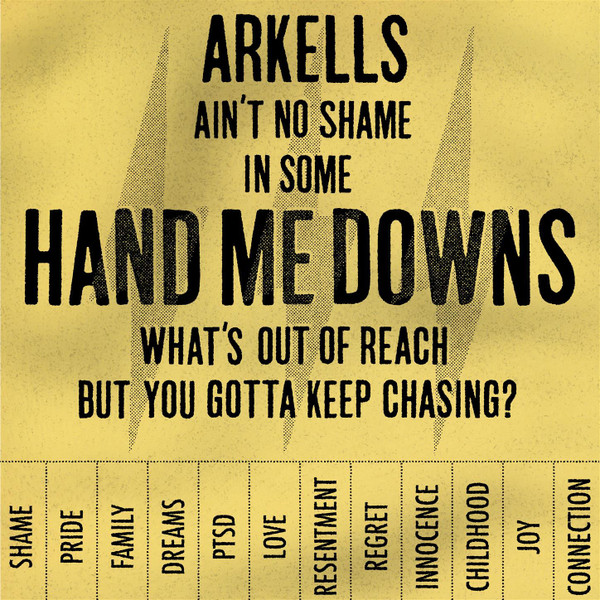
Kerman has always stood up for the little guy, in the face of banks and landlords. “First of the month gets you stressed out, and moving trucks bring you right back.” That’s what “Hand Me Downs” is. You get the impression that these characters in these songs are amalgams of people that Max knew. Most importantly, even more than the lyrics, is the power of the music. “Hand Me Downs” is one of the Arkells most immediate, most catchy, most powerful songs to date. And that’s saying a lot. If there was a quintessential “trademark” Arkells song, “Hand Me Downs” would be among them.
This 2019 digital single came with three versions. The album version, a live version, and a duet with English punk-folk rocker Frank Turner. The Turner version is an entirely new recording, not just a remix. A little more acoustic, a little less ornate, a little more live. Very much up Frank’s alley. It’s a little jarring to hear his accent on an Arkells song, but it’s a quick adjustment. Turner grabs the verses by the balls and makes them his. He mixes well with Max on the chorus. A brilliant version, and perhaps should have been released as a single in its own right.
The third and final version is an acoustic take from Clubhouse Austin (you can see a photo of Max on their website), and it’s perfectly recorded. Very little noise, very clean. Small rooms often make for the best live recordings. Their vocals are absolutely perfect. Arkells have proven time and again how talented they are in the studio, but it is live that counts the most. “Hand Me Downs” live is flawless, yet not: those vocal quirks that only come from a live performance, and only serve to sweeten the song, are everpresent.
“Hand Me Downs” makes for a brilliant three-song single. It is still available for purchase.
THE DARKNESS – Permission To Land… Again (2023 Box Set)
Once (and perhaps still) considered one of the biggest jokes in rock*, The Darkness have proven ’em wrong, for it was 20 years ago they dropped this bomb on the world called Permission to Land. Regardless of the ups and downs, the band continues on today with a documentary film in the works. Of course, the obligatory box set was also necessary. Permission to Land… Again collects nearly everything from the era and packs it up for you in a 5 disc set perfect for home consumption. And it’s affordable, too.
CD 1 commences with the original 2003 album, a monolith of Queen and AC/DC’s bastard children, brought to life in spandex and bandanas. The album itself spawned four singles:
“Get Your Hands Off My Woman”, the expletive-laden favourite that still delights today as a fast head banger.
“Growing On Me”, perfectly in the pocket, a melodic hard right classic with just enough bite.
“I Believe In A Thing Called Love”, iridescent and unforgettable as ever, a classic in every sense.
“Love In Only A Feeling”, bombastic and beautiful guitar chords crashing on this prototype for the trademark Darkness ballad. Steve Tyler wishes he could write ’em like this today.
That leaves six killer album tracks, none of which are filler. Opener “Black Shuck” is a monster (literally), rocking heavy and beating the doors down despite your best efforts. “Givin’ Up” should have been a single, but the language, tisk tisk! Foreshadowing Justin Hawkin’s drug issues, this song is literally about “stickin’ that fuckin’ shit” up his nose. Yes it’s surprisingly delightful, and perhaps the most immediately catchy one on the album. “Stuck In A Rut” is different, blasting fast and loud, with Justin singing at max voice. Back to lighter, catchy territory, “Friday Night” is a certain fan-favourite. It easily could have been another single, as Justin literally reads off his weekly schedule. “Monday, cycling, Tuesday, gymnastics, dancing on a Friday night.” Bopping piano accents will keep feet moving. Moving on to “Love On the Rocks With No Ice” (great title), the slow heavy grind smacks you in the head and reminds you this is a rock and roll band. Despite that, the album closes on a lovely ballad “Holding My Own” which also really could have been a single.
CD 1 is beefed out with six extra songs, all demos, of tracks that didn’t make the album and tracks that did. Speaking of which, they are rough but so similar to the final versions. Some have bits that were later trimmed out or de-emphasized, like keyboard overdubs and intros. “Black Shuck”, though without the hard-hitting production, might be better in some ways than the album version, with more twists and vocals. There is also a demo of “Out of My Hands”, a fine album B-side.
The best inclusions on this disc, however, are the surprises: demos that didn’t make Permission to Land! “Live ‘Til I Die” went unreleased until 2019’s Easter Is Cancelled, but this version has Eddie Graham on drums. This version is very, very different. Much more AC/DC and dare I say, much catchier and better. There’a also an early demo of “Nothing’s Gonna Stop Us”, which was finally released on 2012’s reunion album Hot Cakes. This one is much more similar to the glossier final product.
CD 2 is a treasure trove of goodies! Every studio B-side from the album, some non-album singles, some “clean” versions that we wouldn’t purposely seek out to buy; they are all here. (The live B-sides are included with their respective shows, but we’ll get to those.) This is comprehensive as heck.
The three tracks from the very rare 2002 EP I Believe In A Thing Called Love are included: the title track, “Love on the Rocks With No Ice” and “Love Is Only A Feeling”. The recordings themselves are the same as the final album versions, but the mixes are not. These earlier mixes have slight, but audible differences and can be characterised as a bit less finished. The bass may be more pronounced on some places, and backing vocals in another.
Like some British bands before them, such as Oasis, The Darkness seemed to put just as much effort into their B-sides, often making them album (or single) worthy on their own. The complete studio B-sides here are:
“The Best Of Me”, a crankin’ rocker with a southern vibe.
The aforementioned “Out of My Hands”, a lighter song with a Def Leppard vibe on the guitars. Could have been a hit in its own right. Brilliant chorus.
Concert favourite “Makin’ Out”, which has more of that AC/DC vibe that the Darkness really mined in their early days. A fan favourite for a reason.
“Physical Sex”, another riffy number with an outrageously high chorus.
The ballad “How Dare You Call This Love?” which also could have been on the album, had it been longer. The actual album had two already. A fun song though, with some lovely Lizzy-ish guitar harmonies.
“The best instrumental that AC/DC never recorded”, according to Tim Durling, is “Bareback”, one of the Darkness’ best B-sides ever…if not their best. Thankfully, this song was not just relegated to the dusky corners of the “Growing On Me” single, but received some live workouts too. More on that later.
A song about building a house, “Planning Permission”, is a bit goofy lyrically (mixing cement!), but it gets goofier still as you’ll see. Fortunately it’s a catchy, upbeat Darkness number that has all their trademark guitar and vocal accoutrements.
“Curse of the Tolland Man” is the goofiest of them all, a ghost story, and a song that gets trashed in the liner notes as awful muck, but is defended by Justin and Dan Hawkins as a favourite. The jury remains out, but they are all correct about it.
“I Love You 5 Times” is another ballad, but by this time we’re technically heading outside album territory. Forgettable, but for the strings and Justin’s silly “m-m-m-meees” stuttery vocals. It was actually the B-side to a standalone Christmas single, “Christmas Time (Don’t Let the Bells End)”, an excellent song in its own right.
This box set is so comprehensive that it even includes the two singles that were not from it.
“Christmas Time (Don’t Let the Bells End)“…don’t Google what “bell end” means in British slang. Let’s just say Justin had his tongue in cheek! Great rocker, very Lizzy, and an absolutely Darkness classic. Produced by Bob Ezrin! This track was included on some European editions of the album as a bonus.
Then we have the rarest of them all, and finally available physically for us to buy: 2004’s “Get Your Hands Off My Woman…Again“. Though it does have Frankie Poullain on bass, this song is more a part of the story for the second album, One Way Ticket. The band were experimenting with producer Roy Thomas Baker and this remake was sold digitally. It is here in both “clean” and “explicit” versions. A cleaner, sharper incarnation of the song, for better or worse! The liner notes finally explain the mystery of the added piano part: It was inspired by Ben Folds’ cover of the song, which they thought was an improvement!
CDs 3 and 4 contain three live gigs, and the balance of the B-sides from this era. “Gimme a D! Gimme an Arkness!”
The 2003 set at Knebworth is brilliant. Opening with “Growing On Me”, the band has a bizarre and comedic stage presence, but the song kicks! They are a tight band, and a beat is not missed. They play two B-sides, a manic “The Best of Me” (for dancing, says Justin) and the classic “Makin’ Out”. “I Believe In A Thing Called Love” from the Knebworth concert was previously issued on a German version of the Christmas single. I like when Justin asks the audience which version of “Get Your Hands Off My Woman” they’d like to hear, clean or dirty?
On the same disc is a set from the Astoria in 2003. Opening with a raging “Bareback”, this set is even better than the Knebworth one. What a start! Instrumentals can make a pretty killer opener! From there it’s “Black Shuck”, and a live version of “Get Your Hands Off My Woman” that was previously issued as a B-side to a rare DVD single for “Love Is Only A Feeling”. It’s notable for the strange “me-me-me” singalong thing Justin does at the end. Another thing they do in this set is something called “Buffet”, a pretty cool riff, from a part in the show that is explained in the booklet.
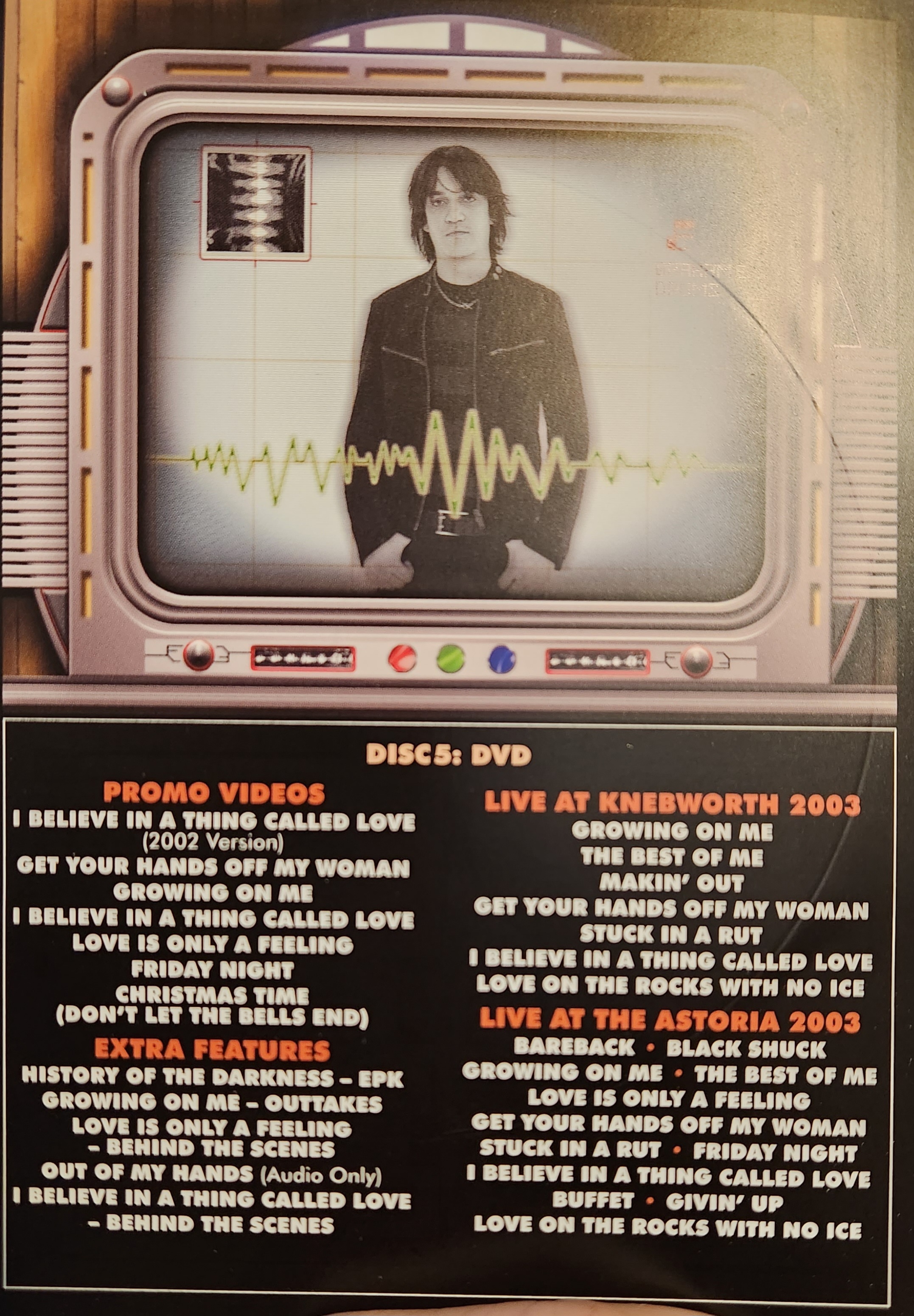
Best of all: The action-packed Astoria and Knebworth shows are both included on DVD inside. Watch Dan play all the guitars so Justin can do the splits! The DVD also includes all the music videos, outtakes and behind-the-scenes footage from their music videos. There’s a cute bit in the EPK (electronic press kit) explaining why Justin always asked the audience to see their thumbs. The editing on the Astoria show is absurdly fast!
CD 4 is a full-length show from 2004 at Wembley recorded on Dan’s birthday, and the last show on the tour. It’s especially cool, because the band were already road-testing new songs from One Way Ticket. Opener “Grief Hammer” was a new song that would become a B-side in 2005. It has a stuttery riff with elements of that AC/DC vibe, but the band were clearly moving beyond that pigeonhole. It takes balls to open a set at Wembley with a new song that nobody had heard before. From there they visit more familiar territory with the favourite “Givin’ Up”. A manic “Stuck In A Rut” blasts out immediately afterwards.
Other B-sides played at Wembley include the fan favourite “Makin’ Out”, “Physical Set” and that “Buffet” again! Future classics “Dinner Lady Arms” and “Seemed Like A Good Idea at the Time” are rolled out alongside the hits. “Dinner Lady Arms” is a tad harder than the soft-Leppard style of the later version, though the chorus still soars into the stratosphere. “Seemed Like Such A Good Idea at the Time” is presented without introduction, and Justin on piano with a more spare arrangement than the elaborate album version to come. This is more power ballad, and less experiment in extravagance.
As the 17 song set rolls through classics and hits, it’s clear this disc could be a standalone live album if the band choose to release it as such. Great banter, and the band were obviously having a blast on stage. At the end, there are two more surprises. One is an abbreviated cover of “Do They Know It’s Christmas?” by Band Aid, performed solo by Justin on piano. Finally, they close the show with a bombastic “Christmas Time (Don’t Let the Bells End)”, which works brilliantly in the end slot. There is no feigning joy and surprise here. All the delight is pure and genuine.
The final ingredient you need in a box set such as this is a kickass booklet with loads of reading. Look no further, as Dan and Justin exhaustively tell the story from session to session and song to song. The stories will keep you in stitches as the band shed light on things you never knew before. Eddie Graham was the most “normal” one of the bunch, but they have survived it all, and the Darkness keep going!
We live in the age of box sets. The Darkness have risen to the occasion with, dare I say it, the perfect version of Permission To Land. Will they pull this trick again in the future with One Way Ticket? They should, because they have demonstrated an understanding of what makes a great box set. In short:
Complete collection of B-sides, even from formats as obscure as DVD single.
The rare demos and EP versions we’ve been wanting.
Non-album singles.
Even those clean versions that we normally wouldn’t try too hard to collect.
Live concerts.
Extensive liner notes.
DVD with added value and live shows.
Reasonable pricing and packaging.
5/5 stars
* One evening in 2003, I was listening to the Darkness with my girlfriend in my living room, late at night, heavily intoxicated. I suddenly jumped and said “I get it! These guys are not a joke at all! They are dead serious about what they are doing! Listen! Just listen!” It was an epiphany and I was right.
BONUS! Check out Tim and I discussing this box set and more!
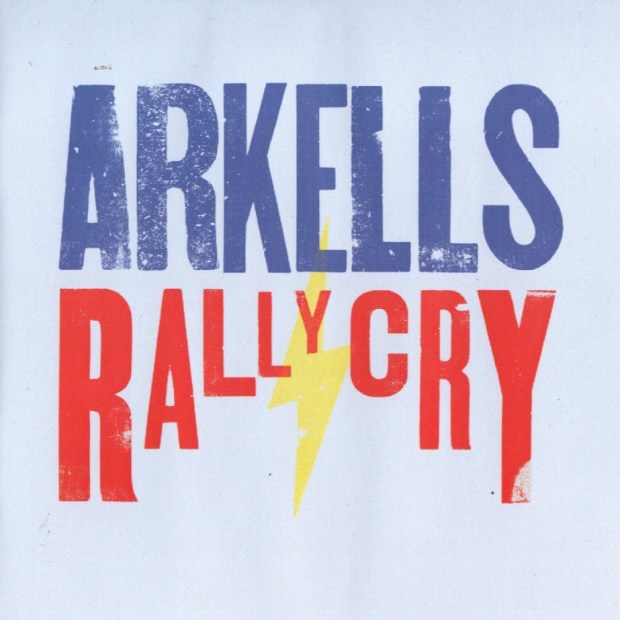
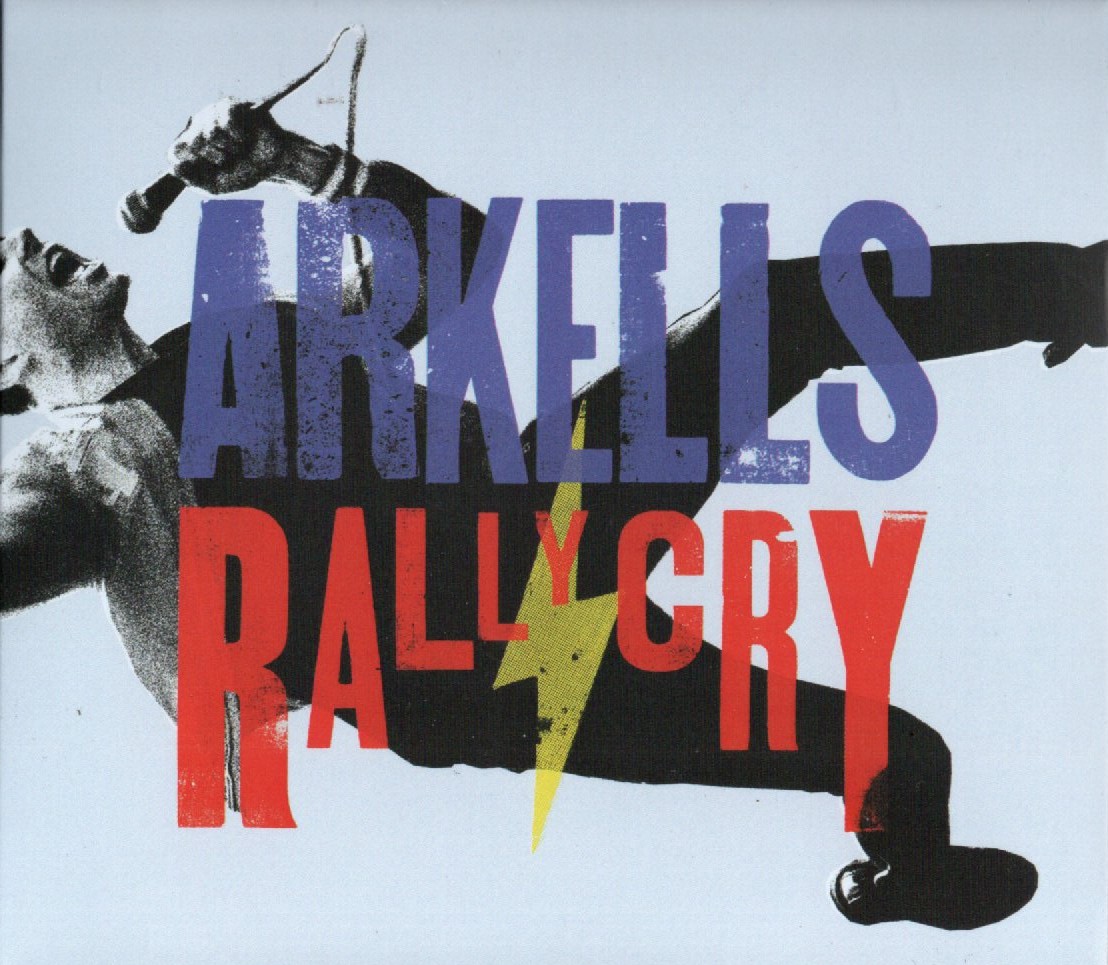
In a sense, Rally Cry is the last Arkells album that was made conventionally. Campfire Chords, Blink Once, and Blink Twice were all recorded during the pandemic. Laundry Pile was unplanned. Rally Cry is the last one recorded during quote-unquote “normal times”. It is 10 songs, 36 minutes, and clearly focused on pop rock with a soul/R&B influence.
This album is loaded with Arkells-style anthems, and leads off with one: “Hand Me Downs”. Their working-class social consciousness creeps into the lyrics, but most people won’t be paying attention when the chorus hits: “Woah-oh-oh!” shouts singer Max Kerman in a fashion he almost could have patented. “Ain’t no shame in some hand-me-downs!” Yet the words are some that any can relate to. “First of the month gets you stressed out, and moving trucks bring you right back.” Musically, this is not that different from the prior album Morning Report, though perhaps more direct.
“American Screams” juxtaposes irresistible dance music with a shot at organized religion. “You got your good book all wrong. You wanna do God’s work, it’s gonna be hard work.” The big thick dance beat though! The thing about Arkells music is that the it is so strong, the lyrics can be ignored if you so choose. It’s way more rewarding to look into what they’re saying. Unfortunately, this single is just three minutes long!
“Relentless” hearkens back to the bands’ youths. Ambitiously, it contains a sample “Sixolele Babe” by South African artist Chicco. The sample is not obvious at all, and somehow fits right in with this pop rock anthem. How do they find these records? Musically illiterate, the Arkells are not.
Moving on momentarily to a more straightforward Arkells sound, “Only For A Moment” is softer, and driven by beats and piano. A good time party tune, but with interesting things going on rhythmically. The lyrics are not too heavy, though the theme is letting your stresses and anxieties go, if only for a moment. Then a U2-like guitar lick chimes forth, while Max sings a melody that Bono could have written (but didn’t). It’s hard not to compare to the Irish quartet; even certain inflections in the voice.
Flip the side of the record, and you are back in the disco with the big single “People’s Champ”. It’s political, but not specifically so. It’s just about a candidate who’s no good: “You’ve got no vision for the long run, you’ve got no sense of history.” And then the chorus, “I’m looking for the people’s champ, and it ain’t you!” And then in the same song: “All my girls say woah-oh! All my dudes go, woah-oh!” So, it’s a rally cry, but it’s also a hell of a good time. And why not? Do you have to be dead serious musically when your lyrics are cutting slices out of the elite? Why not let that bass drum hit! Why not let that bass thump! Tim Oxford and Nick Dika oblige on both counts, while a horn section blasts in your ears.
“Eyes on the Prize” could have been a single too. This is more R&B than rock and roll, with loads of soulful backing vocals. This one sounds autobiographical. “I was repeating conversations with a chip on my shoulder, replaying the scene over and over.” But there’s those upbeat horns and lush backing vocals! Halfway through the song, Max takes us to church. Just like a preacher, he goes off on his tangent. “And the man behind the counter turned up the radio, one of those old AM/FM boomboxes, the kind with the cassettes.” Yes, he really sings that, with the soul backing vocals making it seem like the most important scene you’ve ever heard. Though at its heart, “Eyes on the Prize” is a hit-worth Arkells anthem, it’s chock full of diverse musical ideas, expertly executed. Genius songwriting and performance.
If you’re looking for a perfect summer soundtrack, check out the bass-driven “Saturday Night”. Again, Max’s lyrics are interesting and fun. “You and me talking about conspiracy theories, you said ‘I don’t give a fuck about a man on the moon.'” Again the punchy horns deliver the 80s, like a song right out of the summer of ’85. It sure feels the way I remember. The party comes to a stop on the darker “Company Man”, as the messages return to the forefront. Yet the music goes full 1970s, with rolling drums, bangin’ piano and horns blasting.
Album closer “Don’t Be A Stranger” is catchy, with a big drum beat like an old Beatles song. It ends the album on something of a somber note, but also a hopeful one. There’s a quaint keyboard part that gives it that throwback vibe.
Rally Cry, though musically and lyrically ambitious, does lack the emotional impact of Morning Report and some of the other preceding albums. It is a trade-off. The Arkells are somehow both streamlined, and expanded. The melodic construction of the songs are more emphasized than ever before, but beneath that lie layers of musical experimentation, mostly in the direction of Motown. As such, we don’t get heart-rending slow-burners like “Passenger Seat” from the prior album. The guitar riffs aren’t on the forefront. A good album it is, though perhaps by being so accessible, it loses that challenge that sometimes keeps an album in your deck for decades.
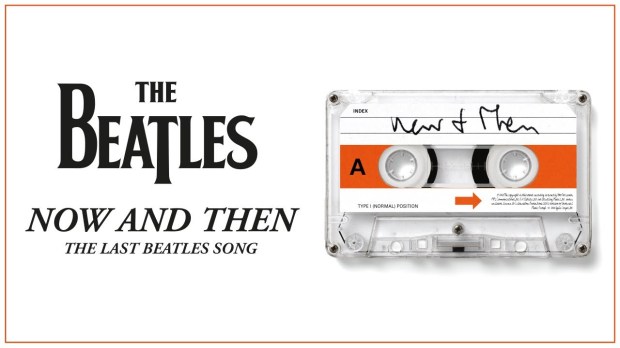
I get chills listening to this song. Knowing now the story, about how John’s voice on this old tape was just too buried behind piano to work with, and how technology made it usable again…it is incredible. John Lennon sounds fresh, front and center, as if the vocals were recorded yesterday, even though they were taped in 1977.
It’s also incredible that Yoko Ono handed these tapes off to the surviving Beatles for them to finish. She didn’t have to do that. She could have kept them, and put them out as unfinished solo songs.
George’s slide guitar parts were written in 1995 when the Beatles last tried to tackle this song. Paul and Ringo finished it with drums, bass, acoustic guitars, and strings. Paul felt the strings were very “Beatles”.
The string players had no idea what they were working on. Secrecy was a priority. They were just told they were playing on something for Paul McCartney, but not the Beatles. Can you imagine how the players would have reacted to that?
To me, this sounds like an old Beatles song from the Abbey Road or Let It Be era, that I had somehow forgotten about. It sounds somber – sad, and mournful. It also reminds us of “Free As A Bird” and “Real Love” from the Anthology albums, which underwent similar reworking all those years ago. It is the last Beatles song, and so it should be.
To me it is just incredible that we have one more Beatles song to enjoy.
“Now and Then” will be out on an expanded edition of the Blue album. A necessary purchase for fans who want to relive the days when we was fab. I just wish the artwork for the single wasn’t so drab!
 BLAZE BAYLEY – War Within Me (2021


















You must be logged in to post a comment.